A Cinematic Journey Through the History of Aviation
Description:
A wide cinematic collection celebrating the evolution of aviation, from fragile early biplanes and daring pioneer pilots to flying boats, wartime fighters, classic airliners, supersonic icons, stealth aircraft, and futuristic aerospace designs. The series combines golden hour light, dramatic skies, ocean crossings, misty runways, military silhouettes, retro travel atmosphere, and science fiction concepts to create a visual timeline of flight as both engineering achievement and human dream.
These images have been generated by Artificial Intelligence.
Vintage British postcard, 1910s. Hepworth Picture Player. P.C. 2. NB IMDb does not list a Alma Taylor film with the title The Girl Who Believed, so it may just be a tagline accentuating what we see.
Alma Taylor (1895-1974) was a British actress, who peeked in the British silent cinema of the 1910s and 1920s. In 1915 readers of Pictures and Picturegoers voted her most popular British performer, beating even Charlie Chaplin. Taylor acted in over 150 films, among which some prestigious examples like Shadow of Egypt (1924) by Sidney Morgan.
Alma Taylor was born in London, on 3 January 1895. According to Anthony Slide, brunette, blue-eyed Alma Taylor was the Hepworth actress 'par excellence'. Beginning in 1907, she already acted with producer Cecil Hepworth, playing tragic young girls. She then co-starred with Chrissie White in Hepworth's 'Tilly Girl' comic series (1910-1915) about two naughty schoolgirls, as well as in 75 or more short and long subjects by Hepworth, such as the Dickens adaptations Oliver Twist (1912), David Copperfield (Thomas Bentley) and The Old Curiosity Shop (Bentley 1913). In those days , everyone helped out at the studios, so both Alma and Chrissie helped in the processing rooms when the weather was too poor to shoot. During the First World War and soon after Taylor contributed to the war effort by acting in such propaganda films like The Nature of the Beast (Hepworth 1919). Taylor clearly was the producer's favorite, and remained devoted to him for decades, starring opposite Ralph Forbes in the rather old-fashioned British countryside drama Comin' Thro the Rye (1923), a remake of an earlier version by Hepworth. After a temporal absence from the screen, Hepworth relaunched Taylor in his last film, The House of Marney (1926), with John Longden. In 1924, the Daily News named her, along with Betty Balfour, Britain's top star. Alma Taylor only starred in four non-Hepworth films: The Shadow of Egypt (Sidney Morgan, 1924) with Joan Morgan, Quinneys (Maurice Elvey, 1927), A South Sea Bubble (T. Hays Hunter 1928) with Ivor Novello, and Two Little Drummer Boys (G.B.Samuelson, 1928). In the late silent era she did some German films, including her part of Mrs. Barrymore in Der Hund von Baskerville/ The Hound of the Baskervilles (Richard Oswald 1929), a film longtime considered lost but rediscovered in 2009. With the coming of sound, however, Taylor's career dwindled and she had to satisfy with minor, matronly roles, in small number of films, such as Bachelor's Baby (Harry Hughes, 1932), Things Are Looking Up (Albert de Courville, 1935), Lilacs in the Spring (Herbert Wilcox, 1954), and Blue Murder at St. Trinian's (Frank Launder, 1957). Uncredited, she played a box office woman in Hitchcock's second vserion of The Man Who Knew Too Much (1956). Probably her last part was the uncredited role of an old lady in the Titanic-drama by Rank, A Night to Remember (Roy Ward Baker 1958). Alma Taylor died in London, 23 January 1974. She was the wife of film producer and director Walter West (1885-1958), who in the late 1910s and early 1920s was the regular director of Violet Hopson, first with his company Broadwest (1914-1921) and then for Hopson's own company.
A Cinematic Journey Through the History of Aviation
Description:
A wide cinematic collection celebrating the evolution of aviation, from fragile early biplanes and daring pioneer pilots to flying boats, wartime fighters, classic airliners, supersonic icons, stealth aircraft, and futuristic aerospace designs. The series combines golden hour light, dramatic skies, ocean crossings, misty runways, military silhouettes, retro travel atmosphere, and science fiction concepts to create a visual timeline of flight as both engineering achievement and human dream.
These images have been generated by Artificial Intelligence.
The adorable bottle is only part of what makes this a fun and convenient way to protect yourself from UV rays.
The calendar says we’re still in spring, but the thermometer shows that summer is almost here. With temperatures in Tokyo hitting 30 degrees Celsius (86 degrees Fahrenheit) last weekend, we’re closing in on the time of year when some form of sun protection is a must for many when going outside, which in turn means the time of year when many find themselves thinking “I really should put on some sunblock…but it’s a hassle, so maybe I’ll just skip it…”
Thankfully, Japan’s Biore brand of sunblock is here to give us a little extra nudge towards taking the time to apply protection with its Kids Stamp UV.
Yes, the name does reveal that this was created first and foremost with kids in mind, but the appeal of cats knows no age limits, and unlike, say, children’s medicine, Kids Stamp UV is just as effective for adults as it is for children, with an SPF50 PA+++ rating.
Right away, the cute feline-eared design for the bottle catches the cat-loving eye, and things get even better when you flip open the cap.
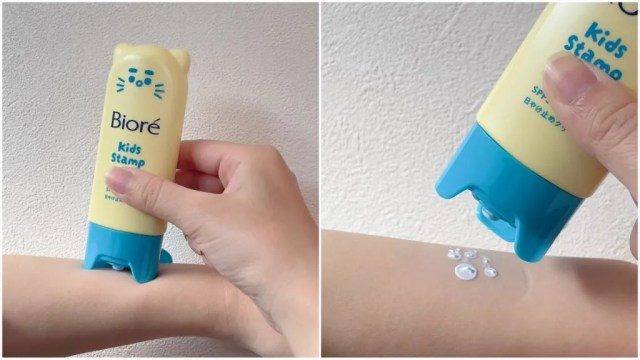
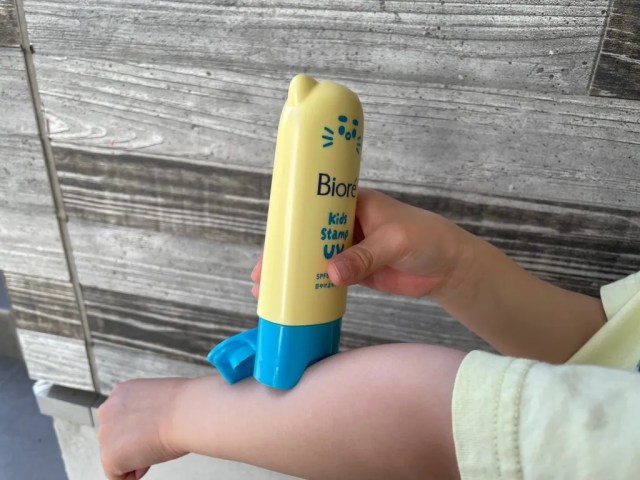
Instead of a single opening, Kids Stamp UV has five, arranged in the pattern of a cat’s paw pads. The bottle is also designed so that instead of squeezing out a stream of liquid, you use it like a stamp, tapping it against your skin to apply the sunblock directly…
…and when you do, you get a series of paw prints, like a little kitty has been walking across your arm, leg, or cheek.
You do still need to rub the lotion in, but while there’s some initial stickiness, it quickly fades away and the Kids Stamp UV sunblock dries nicely, leaving no significant greasiness behind.
If you have kids, a big advantage of Kids Stamp UV is how it makes the process of applying sunblock fun. Our Japanese-language reporter Ninoude Punico tried it out with her 6-year-old, and it immediately turned the regular session of “Sit still! You need this!” into a much more relaxed and happy “OK, let’s get our cat prints on before we go out.”
As a matter of fact, with how easy the sunblock is to apply because of the stamp-style top, Punico’s kid has even started using it without Mom’s help.
▼ The instructions, complete with adorable illustrations, say to apply one “stamp” every 10 centimeters (3.9 inches) or so.
Of course, Biore’s cute and clever design is just as fun and convenient for adult cat fans as it is for kids, and with Japan being the land of kawaii culture, you’re not going to get side-eyed by other adults for using it yourself either.
Being jointly developed by Biore parent company Kao and Aeon Retail, Kids Stamp UV is available at Aeon, Welcia, and Tsuruha supermarkets/drugstores, and we’ll be keeping some handy for mountain- hiking, Gundam-viewing, and other outdoor summer excursions.
For the first time in more than 25 years, the FDA has approved a new active ingredient for over-the-counter sunscreens. It clears the way for manufacturers to begin using bemotrizinol, or BEMT, an ingredient that's been used in Europe and Asia since the 1990s. Amna Nawaz discussed why this change took so long and what people should know about it with dermatologist Dr. Rachel Nazarian.
PolitiFact asked board-certified dermatologists to answer people's burning questions about SPF. When it comes to sunscreen, they advised buying broad-spectrum sunscreen that's SPF 30 or higher and reapplying regularly.
Vintage British postcard. Lubin, 1910s, No. 45. Photo by Gilbert & Bacon, Philadelphia, 1916.
Eleanor Caines (1870 or 1880-1913) was an American silent film actress. She spent most of her film career at the Lubin Film Company. According to IMDb, Eleanor Caines was born in 1870 in Philadelphia, Pennsylvania, USA. In 1909, she began her film career at Lubin in the short comedy Blissville the Beautiful (1909) with George Reehm and Harry Myers. In the following years, she appeared in some 30 Lubin productions. Eleanor Caines died in 1913 in her hometown Philadelphia at the age of 43. The cause of her death was surgery after an accident. She was married to William Robson with whom she had a child, and till her death to Jack Le Faint.
A Cinematic Journey Through the History of Aviation
Description:
A wide cinematic collection celebrating the evolution of aviation, from fragile early biplanes and daring pioneer pilots to flying boats, wartime fighters, classic airliners, supersonic icons, stealth aircraft, and futuristic aerospace designs. The series combines golden hour light, dramatic skies, ocean crossings, misty runways, military silhouettes, retro travel atmosphere, and science fiction concepts to create a visual timeline of flight as both engineering achievement and human dream.
These images have been generated by Artificial Intelligence.
Vintage postcard. Filmex NV. Ed. Takken, Utrecht. Magda Schneider in Robinson soll nicht sterben/ The Girl and the Legend (Josef von Baky, 1957), released in The Netherlands as Droom-eiland (Dream Island).
German singer and actress Magda Schneider (1909-1996) is best known as the mother of film star Romy Schneider, but in the 1930s, 1940s and 1950s s she herself starred in some 40 films. First she appeared on the screen as a charming Wiener mädel (Viennese girl) and after the war she often played the understanding mother or aunt.

 Login
Login