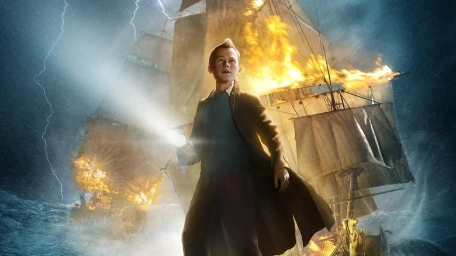
Fifteen years since Steven Spielberg‘s “The Adventures of Tintin,” Peter Jackson has confirmed that we may finally get his promised sequel. During a Q&A at Cannes, he told the audience he’s “currently writing the script and plans to direct the movie himself.”From the Q&A session: “The deal was that Steven directs one and I direct […]
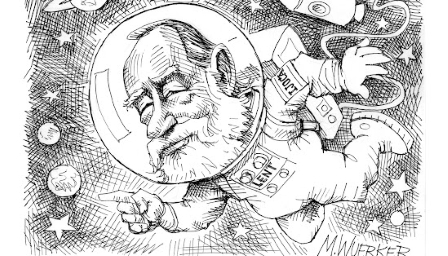
Comics scholar and researcher John Lent has passed away.John Anthony Lent September 8, 1936 – May 16, 2026 From The International Comics Art Forum: Dr. John A. Lent is one of the leading proponents of the international study of comics, and of comics research within academia. Having lectured and taught on comics and mass communications […]
This post is the “flip-side” of an article I posted here a few weeks ago (The Last Five Screen Gems Cartoons 4/14/26) where I looked at transition of the outgoing Columbia’s Screen Gems releases and the incoming UPA cartoons. A real changing of the guard.
Roughly ten years later, the guard changed again. Things weren’t going well for UPA in the second half of the decade. Their satellite studios in New York and London closed; the Magoo feature was a troubled project; The Boing Boing Show was bombing; the Columbia contract for theatrical shorts had an expiration date: 1959.
The last of the 1958-59 season, released in July 1959, was Terror Faces Magoo. Produced in New York during the production crunch in Burbank on 1001 Arabian Nights, the Magoo feature.
By the end of the year UPA founder/producer Stephen Bousustow found a new financial “partner” to bail the studio out – Henry G. Saperstein – who essentially bought the studio and ultimately inched Bosustow out the door. Beginning in November, Columbia began releasing Hanna Barbera’s TV-styled Loopy DeLoop shorts as theatrical subjects (an arrangement that lasted through June 1965)!
Mr. Magoo was still extremely popular, if only as a short subjects star – and Bosustow knew that. Bosustow decided to keep making “UPA shorts” for theatrical release, and from this point on UPA itself would release them. Four new shorts were put into production.
The first one, Magoo Meets Boing Boing (The Noise Making Boy), directed by Abe Levitow, was given an Oscar qualifying release in late 1959. This cartoon was certainly a perfect idea to start with a ‘Bang-Bang’. I love how in the ‘UPA-niverse’, Magoo is on a short list of babysitters in the McCloy household. Magoo mistakes Gerald for his dog (and vice-versa) and “rescues” Gerald from a fire (actually just Gerald’s sound effects voice). The animation is no worse than the last few Columbia Magoo films – but far from the heights of greatness both characters had previously attained just a few short years earlier. Note that the theatrical title for this film was Magoo Meets Boing Boing (The Noise-Making Boy), the TV version is retitled Magoo Meets McBoing Boing.
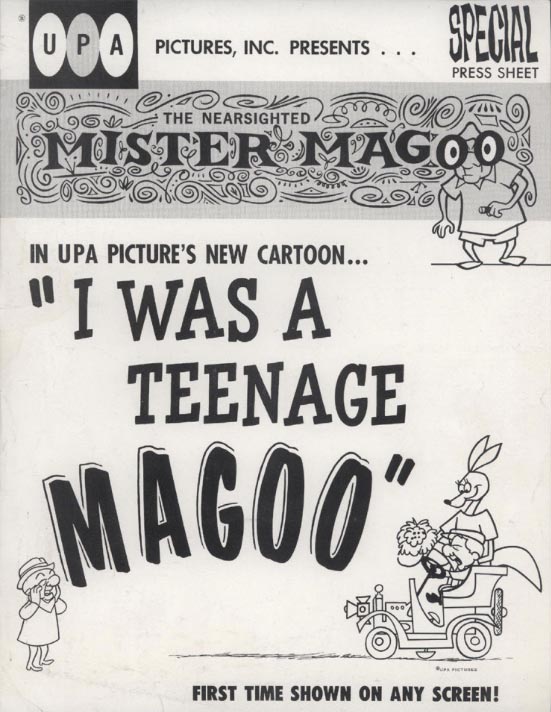
The second Magoo cartoon, released in 1960, was likewise submitted for Academy Award consideration – I Was A Teenage Magoo – this time directed by Clyde Geronimi. It’s an odd one. The most UPA aspect of it is the background designs by Tom Yakutis, which are very cool. The animation is up the theatrical standards of the last Columbia Magoo’s – but that’s not saying too much. Told in flashback, the plot has teenage (but still nearsighted) red-headed Magoo picks up his date “Melba” (a kangaroo) from her home (in a circus) and go on a picnic. Sort of a prequel of sorts to Magoo’s Young Manhood (1958). Bosustow’s attempt to self-distribute was a huge failure. This cartoon was ultimately released as part of the TV package – albeit cut by two minutes and shown under the title Teenage Magoo.
The third short produced by Bosustow for theatrical release was Bric’s Stew – directed by Harvey Toombs – which featured a pair of new characters “Bric n’ Brac”. The negative was discovered a few years ago among film elements acquired by the Academy of Motion Picture Arts and Sciences – within unclaimed inventory from the defunct DuArt Laboratory in New York City. Why it was abandoned and forgotten no one knows. Why there is a UA-TV logo at the end – no one knows. Asifa-Hollywood funded a preservation and I wrote about it in a post about this find in January 2019. I’m happy to present the entire cartoon, for the first time, below.
A fourth Magoo short intended for theaters – Magoo Meets Frankenstein – joined the other two in the Mr. Magoo TV package (130 new cartoons made-for-TV). Below is the first half of the rare theatrical version:
Bosustow finally sold his interest in UPA in June 1960. This wasn’t the end of Magoo – he would live on in his Christmas Carol TV special (a classic), a 26 episode series of Famous Adventures, as Uncle Sam, a GE light bulb salesman, in a Saturday morning DePatie Freleng series – and a live action movie (released by Disney)!
Despite a bittersweet fade-out, UPA was a historic game changer for animation during the 1950s. It was a studio – like Walt Disney’s – that is worth exploring with deeper dives.
SPECIAL THANKS to Al Warner and Denis-Carl Robidoux for permission to share their transfers of the first two UPA Magoo theatricals – and to ASIFA-Hollywood for letting us debut the complete “Bric’s Stew”.
VH-HET 1945 Supermarine Spitfire HF.VIII RAF as MV239 RAAF A58-758 Marked up as A58-602 RG-V Grey Nurse
Photo Taken at Warbirds over Scone NSW Australia March 2026
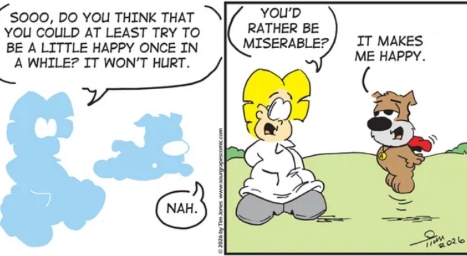
Sour Grapes is new at GoComics, sour grapes is an old story with newspapers, The Singh Brotherhood vexes the olde and the new Phantom, Henry Barajas presents good trouble, bad trouble for Scott Adams and revolutionary trouble with Sam Adams, MAD memories with John Ficarra and Gerry Gersten, and Keith Knight about That One Black […]
One of the many reasons artists like Lee Krasner, Jackson Pollock, Franz Kline, Cy Twombly, and other mid-20th-century pioneers of painterly abstraction were so innovative for their time is the use of the deliberate yet loose brushstroke. Pollock intuitively dribbled and splattered paint on surfaces spread across the floor of his studio, and Kline created bold, monochromatic paintings with just a few deceptively simple, gestural strokes of a large brush. It’s this visceral approach to visual rhythms and color that continues to awe us today. (A major retrospective highlighting both Krasner and Pollock’s work is slated for The Met later this year.)
For artist Liza Lou, the calculation of brushstrokes, color, and gesture opens the door to another media type altogether—beads. The artist is known for using the material, including a large-scale installation titled “Kitchen,” which took five years to create. In her recent work, she adds thousands of the diminutive baubles in myriad colors, shapes, and sizes to sweeps of oil paint on canvas. Tapping into the legacy of Abstract Expressionism, Lou parses the relationship between gesture, intention, organic forms, and the brushstroke as a subject unto itself.
Detail of “Enjambment”
Lou’s works appear this month in FAQ, a solo exhibition at Thaddaeus Ropac. The title references questions that the artist returns to again and again in her practice. When does a painting become not a painting? Can a brushstroke be more than a brushstroke? “These works are about amplification—about making things more ideal,” Lou says. “There’s a poem by Fernando Pessoa where he writes about wanting flowers to be more flowers than flowers, and in this body of work I’m using my material as a way to make paint more paint than paint.”
Unlike a quick swipe of a brush, each bead is meticulously placed amid a field of others, creating a chromatic topography. Lou likens them to painting “straight-out-of-the-tube,” except that they can’t be mixed on the canvas. She relies on color relationships, textures, and precise placement to give the impression that, from a distance, the loose strokes and splatters have blended or merged. When viewed up close, we see distinct, saturated topographies that, in a rather macro sense, are delightfully sculptural with the soft ground of painted details underneath. “My process involves this improv where every stroke requires everything I have, my full attention,” Lou says. “Every mark becomes this kind of violin-crescendo-holy shit-experience.”
FAQ opens on April 10 and continues through May 23 in London. See more on Lou’s Instagram.
“Onomatopoeia” (2026), oil paint and glass beads on stretched canvas, 52 x 51 x 1.75 inchesDetail of “Onomatopoeia”“Analepsis” (2025), oil paint and glass beads on stretched canvas, 42.75 x 41.75 x 1.75 inchesDetail of “Analepsis”“Stanza” (2025), oil paint and glass beads on. stretched canvas, 52 x 51 x 1.75 inchesDetail of “Stanza”“Ecphonesis” (2026), oil paint and glass beads on stretched canvas, 42.75 x 41.75 x 1.75 inches
Throughout her illustrious 32-year career, Pacita Abad (1946-2004) traveled to more than 60 countries. Myriad experiences ultimately introduced her to a wide range of techniques, materials, and relationships, shaping the artist’s practice over time. Movement provided an enduring source of new ideas and inspiration, and as she put it, “For me, traveling is my art school.”
In the spring of 1998, Abad visited Yemen. At the time, the country was still in recovery following the Yemeni Civil War, which took place four years prior. Grounded in her rigorous political engagement and the instabilities experienced in her native Philippines, Abad reflected on the immutable significance of cultural practices and their value despite periods of upheaval.
“Door made of straw III” (1998), oil, acrylic, painted and dyed canvas, painted cloth stitched on canvas, 85 x 56 1/4 inches
“Rather than positioning herself within a nameable lineage of artistic influences who moved in conventional gallery spaces,” Tina Kim Gallery notes, “Abad instead favored the inheritance of historically anonymous workers in craft, textiles, and the decorative arts, from locations outside of established Western institutional and market infrastructure.” This quote appears in a statement for the New York gallery’s third solo exhibition of Abad’s works, titled Door to Life.
The presentation highlights a body of work Abad completed in subsequent years, which takes inspiration from Yemen’s vibrant, ornate displays of architecture and decoration. One particular focus was doors, which the gallery refers to as “portals.” Through countless photographs and numerous sketches of doorways she encountered on excursions, Abad created a prolific visual archive to take home and use as reference, adding “Everyday a new idea, everyday a new door.”
Installation view of “Pacita Abad: Door to Life”
Crafted in her signature trapunto style, Abad’s vertical, rectangular compositions layer meaning, memories, and material. Painted and appliquéd geometric patterns on canvas call to decorative elements found in traditional Yemeni architecture, like tessellations and botanical motifs.
The artist’s series of never-before-seen qamariya paintings are evocative of the semicircular glass windows common in Sanaa, the nation’s capital—another key element of Yemen’s time-honored artisan practices. The Arabic term qamariya translates to “moon-like” or “of the moon,” echoing the glass structures’ half-moon shape and dynamic ability to transmit light.
Door to Life continues through June 20 at Tina Kim Gallery in New York. You can also flip through more works, which were previously compiled into a small publication that supplemented Abad’s initial Door to Life exhibition in 1999.
“Door made of straw I” (1998), oil, acrylic, printed cloth, dyed canvas stitched on straw mat, 89 x 53 1/8 inchesDetail of “White Heightens the Awareness of the Senses” (1998)“I Am By The Door in a Second” (1999), oil, painted cotton collaged and stitched on canvas, 61 1/2 x 38 1/8 inches“White Heightens the Awareness of the Senses” (1998), oil, acrylic, oil pastel, dyed cotton, painted canvas, painted cloth stitched on canvas, 84 x 63 inchesInstallation view of “Pacita Abad: Door to Life”“Beside You” (2001), oil and painted canvas stitched on canvas, 18 1/2 x 18 1/2 x 2 inches framed“Stained glass door in Sanaa” (1998), oil, printed cloth, painted canvas stitched on canvas 83 x 61 3/4 x 1 1/4 inches“Rainbow door” (1998), oil, painted printed cloth stitched on canvas, 82 1/4 x 58 1/2 x 1 1/4 inches“Gray Border” (2001), oil and painted canvas stitched on canvas, 18 1/2 x 18 1/2 x 2 inches framed“Door Connects Me to the Greatest Happiness I Have” (1999), oil, painted cloth, buttons stitched on padded canvas, 59 3/4 x 38 5/8 inchesQamariya Window (series) (2000), oil on paper, dimensions variableDetail of “Door made of straw III” (1998)Pacita Abad with “Door to Life” paintings in Jakarta (1999). Courtesy of the Pacita Abad Art EstatePacita Abad with “Door to Life” paintings in Jakarta (1999). Courtesy of the Pacita Abad Art Estate

 Login
Login