Login
Login
1969 Pontiac GTO
ShutterNut... posted a photo:

Please be aware... ALL Photos are purely for entertainment. I am no expert. Titles are from recognition - what I was told - or a quick search. Polite comments or corrections are welcome.


ShutterNut... posted a photo:
Please be aware... ALL Photos are purely for entertainment. I am no expert. Titles are from recognition - what I was told - or a quick search. Polite comments or corrections are welcome.
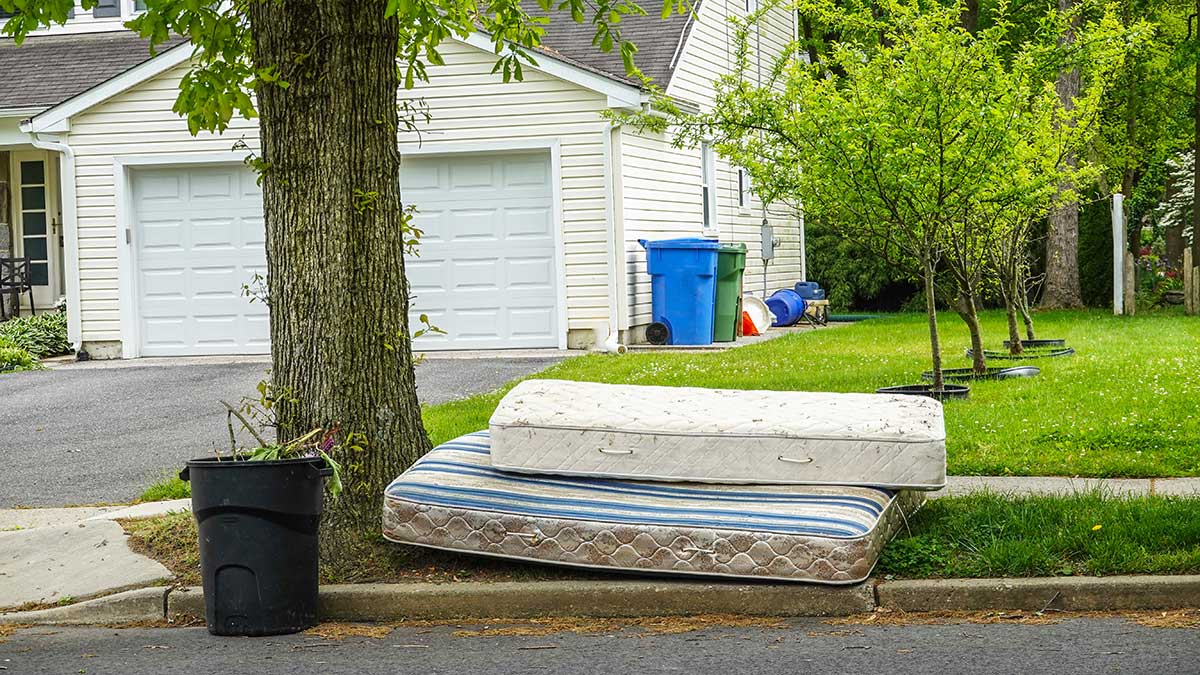
Pull the sheets back from the numbers and the American mattress starts to look less like a product and more like a disposal problem. The United States throws out an estimated 18.2 million mattresses a year — roughly 50,000 every day — and only about 19% of them are recycled. The rest, more than four out of five beds, are landfilled or incinerated.
A mattress is one of the largest, bulkiest, and most expensive things you own, and almost none of it has to be wasted. Recyclers can recover 80 to 95% of a mattress — steel, foam, fiber, and wood that become new products. Yet the default path for most beds is a hole in the ground, and that default costs the typical household twice: once to buy the bed, and again to get rid of it. Most mattresses are built to last seven to ten years, so a single household will buy and discard several over a lifetime. The bed itself is the obvious expense: a new queen mattress averages around $1,500, and even budget models start near $400.
The hidden cost shows up at the curb. Getting rid of an old mattress averages about $100 and runs from $40 to $200 or more depending on how you do it. Junk-hauling services typically charge $80 to $250. Municipal bulk pickup is often free but can mean a two- to eight-week wait, and many landfills tack on a $20 to $40 bulky-item fee. For a household replacing a bed every several years, disposal alone quietly adds up.
Mattresses are built to resist compression, which makes them miserable landfill tenants. Each one can take up as much as 23 cubic feet of space even after compacting, and their steel springs tangle and damage the heavy equipment that operators use to manage the waste. Multiply that by tens of thousands a day and mattresses become a stubborn drain on landfill capacity.
The waste is also material that holds real value. A typical mattress contains roughly 25 pounds of steel and 9 pounds of cotton, plus foam and wood. Across its programs, the Mattress Recycling Council reports keeping more than 555 million pounds of steel, foam, fiber, and wood out of landfills by recycling over 14 million mattresses. Buried beds throw all of that away.
Where you live largely decides whether recycling is even an option. Four states — California, Connecticut, Rhode Island, and Oregon, whose program began January 1, 2025 — run extended producer responsibility (EPR) programs. A small fee on every new mattress funds free drop-off through the industry’s Bye Bye Mattress program. The access is meaningful: in 2024, 98.4% of California residents lived within 15 miles of a collection site.
Once a mattress is dismantled, up to 75% of its materials become new products. The foam and fiber go into carpet padding, springs are melted down as scrap steel, and box-spring wood is chipped into mulch or biomass fuel. Outside the four EPR states, though, recycling depends on a patchwork of private facilities, and most households still pay to haul a bed away.
The post 18.2 Million Mattresses Disposed a Year, and Most of Them Get Buried appeared first on Earth911.

Pest management is most effective when the man-made cycles of the pests are observed in relation to their annual changes. Through such seasonal patterns, homeowners will be able to combine preemptive seasonal pest control tips with residential pest control services to avoid infestation before it becomes a great issue.
Early intervention lowers the population of pests in the area, and they curb the environment as well as the necessity of more potent chemicals in the future. Here is a year-round guide to minimizing insect, rodent, and other pests around the home.
The growth of infestations is best stopped in early spring. People living at home are supposed to inspect their homes in order to find possible entry points and breeding sites. Stagnant water, cracks in the foundations, and standing water are all attractive to pests.
This is done by common pest control activities such as:
Termite inspections are also important, as part of spring pest prevention, since termite galleries increase when it is warmer. Early identification of activity will prevent severe damage to buildings.
The most active season of pests is summer, as the heeat and the greater amounts of moisture encourage rapid reproduction of insects. Helpful strategies include:
It is also imperative to control the mosquitoes since stagnant water may develop into a breeding habitat very quickly.
In the lowering of the fall, the pests begin to seek warm places. Rodents and insects usually attempt to get into houses and structures.
Common fall pests include:
The fall is a vital season for preventive control of pests. When pests are in a house, they may stay there throughout the winter.
Control activities of critical falls involve:
Rodent control is of particular concern during this season, when mice have the ability of squeezing into a very small hole.
Even though enterable insects hibernate during winter, the control of pests is essential in the cold seasons. Some pests remain active in the house because temperatures are usually higher, and rodents usually head to houses.
It is the responsibility of the homeowners to ensure that they maintain their houses clean during winter. Keep food in closed containers, vacuum regularly, and examine exotic corners used infrequently, like attics and crawl spaces.
The choice of the seasonal pest control tips relies on the type of pests, the degree of their infestation, and the place of their treatment. Here are some of the popular strategies:
Some companies like CitiTurf are known to come up with tailor-made pest management structures that are made to deal with the domestic pest action all through the year.
46% of homeowners have experienced structural damage due to pests. The risk of infestations may be reduced significantly by simple maintenance measures and by following pest control tips.
The following are some tips to be considered in year-long pest prevention:
The care of the outside is taken with the same consideration as the house. Uncontrolled vegetation, dirty storage, and unnecessary moisture accumulation are some of the attractions of pests.
Your home is safe and comfortable courtesy of adequate seasonal pest management. Spring pest prevention is possible by addressing repairs, and rodents are better kept out in the fall and winter through routine maintenance and cleaning.
Being aware of the active period of pests makes homeowners respond in time before an infestation takes place.
About the Author
This sponsored article was written by Laura Phoenix, a British freelance writer with specialisations in countryside living, health, travel, and wellbeing. She writes content for blogs and social media and has been doing so for over 10 years, with a collective online following of over 40,000 viewers.
The post Guest Idea: When to Act and What to Use for Seasonal Pest Control appeared first on Earth911.


More than 25,000 square miles of the U.S. Great Basin, an area nearly twelve times the size of Yellowstone, has flipped from native sagebrush to invasive annual grassland over the past three decades, much of it without ever burning. The change is amplifying the Western fire season. Researchers using satellite data found that fire is no longer required to convert these landscapes; once the grasses arrive, the fire follows.
Grasses occupy a unique position in our climate. They are everywhere — pastures, lawns, prairies, savannas, roadsides — and they are easy to overlook precisely because they are so familiar. However, the world’s grasses are responding to warmer temperatures, shifting precipitation, and rising atmospheric carbon dioxide in ways that are reshaping ecosystems and fire regimes from the Mojave Desert to the slopes above the fire-scorched community of Lahaina in Hawaii.
The story of climate change and grass is, increasingly, a story about what burns, when, and how often.
Wildfire science has long focused on forests, but the dominant fuel type driving change in the American West today is not timber. It is grass, particularly fine, dry, non-native annual grass that cures by early summer and carries flame between shrubs that would otherwise be too widely spaced to burn together.
Cheatgrass greens up earlier than native bunchgrasses, drawing down soil moisture and nutrients before native species start to grow. It then dies in early summer, leaving a continuous, dry, highly ignitable mat across landscapes that historically had patchy fuels and infrequent fires. The Bureau of Land Management found that areas invaded by cheatgrass (Bromus tectorum) are roughly twice as likely to burn as uninvaded land, and that cheatgrass now dominates or is a meaningful component of vegetation on roughly 52 million acres of the Intermountain West, up from roughly 31.5 million acres mapped in 2000 using satellite imagery.
A 2013 study, later supported by broader analyses, found that fire return intervals are now two to four times more frequent in cheatgrass-dominated landscapes than in intact sagebrush steppe. In 2019, ecologist Emily Fusco and her colleagues published the first national-scale analysis of the problem in Proceedings of the National Academy of Sciences. They looked 12 invasive grass species across 29 U.S. ecoregions, and found that eight significantly increased fire occurrence by up to 230 percent, and six increased fire frequency by up to 150 percent.
“This work shows that invasive species are one of the ‘big three’ ways that people are changing fire regimes,” senior author Bethany Bradley told reporters when the study was published. “Climate change more than doubles the likelihood of fire, human ignitions triple the fire season, and now we can add invasive species fueling fires.”
Grasses are unusually responsive to climate change. Three variables — temperature, the timing and form of precipitation, and atmospheric CO₂ — interact in ways that often favor invasive annuals over the perennial natives they displace.
A decade-long warming experiment published in Frontiers in Plant Science by the U.S. Geological Survey tracked cheatgrass through three climate manipulations on the Colorado Plateau. Plots warmed by 4°C above ambient temperatures saw the vegetative growing season shorten by about 12 days; at 2°C, by about 7 days. Cheatgrass compressed its life cycle, finishing seed production and dying earlier in the summer. That sounds like bad news for cheatgrass, until you remember that an earlier, drier death means earlier, drier fuel, set down before the peak of the fire season.
Cheatgrass has another advantage native species lack: phenotypic plasticity. The Frontiers researchers concluded that the plant’s “phenotypic plasticity … may make the plant particularly adept at dealing with extreme interannual climate variation,” allowing it to respond to shifting climate cues that native bunchgrasses cannot. When native grasses fail to keep up with earlier springs and longer dry seasons, cheatgrass moves into the gap, adding fuel for fires.
Precipitation patterns matter as much as temperature. A long-term study in Global Change Biology of more than 10,000 wildfires across the Great Basin between 1980 and 2014 found that area burned in any given year was strongly predicted by precipitation in the previous one to three years. Wet years build fuel; the next dry year burns it. As the climate delivers more whiplash between wet winters and intense summer drought, the cycle accelerates.
Rising atmospheric CO₂ adds another wrinkle. Grasses use one of two photosynthetic pathways — C₃ (most cool-season grasses, including cheatgrass) or C₄ (most warm-season prairie grasses) — and both grow more efficiently as CO₂ climbs. A study in Nature examined a Wyoming CO₂ enrichment site, finding that elevated CO₂ improved water-use efficiency enough to partly offset the drying effect of warming;later research showed similar benefits for C₄ grasses. In short, more CO₂ means more grass, and more grass means more fuel.
Grasslands will not simply grow more biomass and burn more. Nature’s rules governing which grasses dominate where, and when each one cures, are being rewritten in real time. The species best equipped to exploit the new rules are, very often, the ones accelerating the grass-fire cycle.
On August 8, 2023, downed power lines sparked dry vegetation on a fallow hillside above Lahaina, Maui. By nightfall the fire had killed at least 102 people and become the deadliest U.S. wildfire in more than a century. A Washington Post investigation later confirmed the inferno began on land covered in non-native grasses, relics of sugar plantations that closed in the 1990s.
Hawaiʻi has experienced a roughly 400 percent increase in the typical area burned annually over the past century, and roughly a quarter of the state’s land area is now covered in flammable invasive grasses, according to the Hawaiʻi Invasive Species Council. Guinea grass (Megathyrsus maximus), buffelgrass (Cenchrus ciliaris), molasses grass, and fountain grass are the dominant culprits — all introduced for pasture or ornament, all now spreading on lands no one is actively managing.
“The main factor driving the fires involved the invasive grasses that cover huge parts of Hawaii, which are extremely flammable,” Clark University climatologist Abby Frazier told ABC News in the days after the fire. University of Hawaiʻi fire scientist Clay Trauernicht had been warning about exactly this scenario for years; in a 2018 letter referenced in Smithsonian Magazine, he wrote: “Just like with climate change, we know what steps will reduce the risk of wildfire. But actually taking these steps will require reinvesting in and, frankly, reimagining our individual and collective responsibility for the larger landscape.”
The Lahaina disaster is now considered a defining example of what ecologist Emily Fusco and her co-authors call the “human–grass–fire cycle,” the recognition that invasive grasses, human ignition sources, and a warming, drying climate are not separate problems but a single coupled system. People plant or spread the grasses (often inadvertently). The grasses build continuous fuel beds. Climate change extends the burn season. Human infrastructure provides the spark. The fire returns the landscape to grass-favored conditions, and the cycle tightens.
All the factors are rising, increasing the chance that a region will see a grass-fed fire.
It would be reassuring if this were a regional problem. It is not. The U.S. Geological Survey has documented invasive grasses altering fire cycles in the Midwest, Northeast, and Southeast as well. Cogongrass (Imperata cylindrica) is reshaping fire behavior in Southern pine forests; silk reed (Neyraudia reynaudiana) more than tripled fire frequency in the South Florida areas Fusco’s team studied. Mediterranean grass (Schismus barbatus) tripled fire occurrence in the Sonoran Desert.
Native grasslands face their own pressures. C₄ tallgrass prairie species like big bluestem (Andropogon gerardii) differ markedly in drought tolerance from co-occurring species like little bluestem (Schizachyrium scoparium); during the Dust Bowl of the 1930s, little bluestem replaced big bluestem across much of the tallgrass prairie, driving the kind of species reshuffling that more frequent drought is likely to drive again.
A 2025 study used species distribution models for 37 grasses and projected that C₄ species will retain higher habitat suitability in a warmer future while many C₃ species will decline. Because the C₄ species projected to take over tend to be less flammable than the C₃ species they replace, the same study found elevated CO₂ raised water-use efficiency enough to lower leaf-level flammability for some species, a rare piece of cautious good news in a literature dominated by bad.
There is no clean fix for a feedback loop, but there are well-tested intervention points in grasslands management. Federal agencies are scaling up restoration. The BLM launched the Restoration for Resilience program, funded through the Bipartisan Infrastructure Law and Inflation Reduction Act (both laws’ funding is under attack), is targeting 21 priority landscapes across the West for invasive species removal and native reseeding. Researchers at the University of Wyoming are leading the IMAGINE partnership to translate management science into guidance for land managers facing annual grass invasion.
On private land and at the wildland-urban interface, the highest-leverage actions are simpler than they sound: maintain native or low-fuel vegetation, remove invasive grass thatch before fire season, and create and maintain fuel breaks. Pre-emergent herbicides applied promptly after fires can give native perennials a fighting chance; without that intervention, burned landscapes in cheatgrass country tend to convert permanently to annual grassland.
The post When the Lawn Becomes the Fuse: How Climate Change Is Rewiring Grass and Wildfire appeared first on Earth911.


Americans throw away nearly 5 million tons of film and flexible plastic packaging every year, and less than 1% of it gets recycled, according to The Recycling Partnership. The salad bag, the potato bag, the pallet wrap behind every grocery store — all of it is technically recyclable, almost none of it actually is, and food contact applications make the math even harder, because the FDA requires rigorous migration testing before a single recycled pellet can touch what we eat. Kevin Kelly, CEO of Emerald Packaging, the largest supplier of retail flexible packaging to the U.S. produce industry, has spent decades on that problem from inside the industry. In December 2025, his Union City, California–based, third-generation family business announced that it had eliminated more than 1 million pounds of virgin polyethylene over the previous year by replacing it with post-consumer recycled (PCR) material, including, in partnership with Walmart, Idaho Package, and Wada Farms, the first 30% PCR potato bag approved for direct food contact. On this episode of Sustainability In Your Ear, Kevin walks through what it actually took to get that bag on a Walmart shelf, why most flexible packaging companies still won’t try, and why the most ambitious recycling law in the country may push the industry in the wrong direction.
Food-grade PCR is a different animal from the recycled plastic in a milk crate or a contractor bag. To pass FDA scrutiny, the feedstock has to be traceable from a known, food-adjacent source. For Emerald, that mostly means pallet wrap collected from Walmart distribution centers, washed, dried, and repelletized by suppliers like Dow Chemical’s Circulus mechanical recycling business and Canada’s Nova Chemicals. Variation in any given load of recyclable plastic causes carbon buildup on Emerald’s extrusion lines, forcing a shutdown every eight hours for cleaning, and waste rates are higher than with virgin resin. The company has had to audit its own suppliers in person, push back on competitors who hide non-food-grade PCR in the middle layer of multilayer films and call it sustainable, and walk produce buyers through what “food-grade” actually means before they sign on. Kevin describes Emerald as “the canary in the coal mine” for food-grade PCR — he can’t find another bag in the store that’s labeled the same way.
The harder argument Kevin makes is about policy. California’s SB 54, the most ambitious extended producer responsibility (EPR) law in the country, with a 65% recycling rate target and a 25% source reduction mandate by 2032, was supposed to drive exactly the kind of work Emerald is doing. But Kevin says the rulemaking went the other way. The pound-for-pound PCR credit that would have rewarded companies for replacing virgin resin with recycled content was stripped out, and the fees are low enough that producers can hit early reduction targets through agricultural film and other low-hanging fruit without ever switching to food-grade PCR. The deeper structural problem Kevin lays out is the capital story. Family-owned manufacturers freed from quarterly returns pressure, Kevin argues, are doing more to push food-grade PCR forward today than the capital pools that are theoretically supposed to fund the energy and sustainability transition.
To find out more about Emerald Packaging, visit empack.com.
Mitch Ratcliffe (0:09)
Hello, good morning, good afternoon, or good evening, wherever you are on this beautiful planet of ours. Welcome to Sustainability In Your Ear. This is the podcast conversation about accelerating the transition to a sustainable, carbon-neutral society, and I’m your host, Mitch Ratcliffe. Thanks for joining the conversation today.
Every year, Americans buy roughly 5 billion pounds of fresh produce that’s packaged in flexible plastic — that’s salads, carrots, potatoes, lots of produce. That packaging extends shelf life, reducing food waste, but most of it is made from virgin polyethylene refined from fossil fuels, and almost none of it gets recycled.
My guest today is Kevin Kelly, CEO of Emerald Packaging, the largest supplier of retail flexible packaging for the U.S. produce industry. And on December 11 of 2025, Emerald announced a significant milestone: that over the previous year, the company had replaced more than 1 million pounds of virgin polyethylene with post-consumer recycled material, or PCR, as you’ll probably hear it in this discussion.
That shift — granted that it’s only a million fewer pounds of plastic packaging in a vast sea of it — is a suggestion of what’s possible in food packaging. However, getting recycled plastic approved for direct food contact isn’t simple. Produce packaging is especially demanding, because shelf life and food safety are not negotiable. The FDA requires rigorous testing to ensure that no contaminants from that PCR migrate into food, and for years, the industry defaulted to virgin plastic because recycled content couldn’t meet those standards reliably at scale.
Emerald is working to change that equation. In collaboration with Walmart, Idaho Package, and Wada Farms, amongst others, they’ve introduced the first 30% post-consumer recycled materials potato bag approved for food contact, and Emerald’s initiative supports Walmart’s Project Gigaton, which aims to eliminate 1 billion metric tons of greenhouse gas emissions from the retailer’s supply chain by 2030. Emerald has also partnered with D’Arrigo, the company behind Andy Boy produce, to introduce another 30% PCR bag for romaine lettuce hearts — and that’s a shift that has removed over 600,000 pounds of virgin plastic from the supply chain between June 2023 and 2025.
Emerald is a third-generation, family-owned company based in Union City, California. Kevin brings the perspective of an organization that has operated through six decades of rapid, often revolutionary changes in how Americans buy and consume food. He’s led the company through its evolution from a regional bag manufacturer to becoming an industry leader, pushing the boundaries of sustainable, flexible packaging.
So we’re going to talk with Kevin about what it took to get recycled content into food contact packaging at scale, whether grocery customers are willing to pay more for sustainable options, how California’s recent SB 54 packaging law is reshaping the industry, and whether flexible packaging can ever become truly circular when most curbside programs still don’t accept it. You can learn more about Emerald Packaging at empack.com — that’s all one word, no space, no dash. Empack.com.
Can recycled content packaging go from future milestone to mainstream reality? Let’s find out, right after this. Welcome to the show, Kevin. How you doing today?
Kevin Kelly (3:33)
I’m doing great. How are you?
Mitch Ratcliffe (3:35)
I’m well, I’m well. Thanks for asking, and thanks for joining us. We’ve been working to get together for a few months now, and I’m glad that we actually now have the opportunity to complete the conversation. I’ve shared a summary of Emerald Packaging’s recent activity in my introduction, but could you share the backstory? When did your grandfather start the company?
Kevin Kelly (3:52)
It was actually my father. He started it in 1963 with three partners. They were based in Berkeley, California, and they mainly made — not produce packaging, which is what we specialize in now — they were making bread bags, because they were in the bread district. They were unionized by the bread workers’ union. It was a very different company when they started out. It also had one printing press and two bag machines.
Today, we have 32 bag-making machines, seven printing presses, and I don’t know how many other machines, and about 250 employees. It became a family business in ’93, and then gradually the other siblings retired, and I’m the last one here. So we’ve got a wonderful staff behind us — very creative, very technical, and best of all, they’re very detailed, which I’m not, which is why we’ve been having problems getting together for a couple of months.
Mitch Ratcliffe (4:52)
Tell me, how has the company changed since you’ve been involved with it? Obviously you just described a massive transition. But why the sustainability focus? When did that take hold?
Kevin Kelly (5:05)
Well, I started worrying about sustainability and packaging back in 2000, believe it or not, when the California Integrated Waste Management Board did a study of what was in landfills, and it turned out that plastic was a lot of what was in landfills, especially the ground covering that the agricultural industry uses in their growing operations. And so we started, with a bunch of California companies back then, having a conversation with the American Chemistry Council, which I can’t stand — I’m just going to be upfront about it — about creating a recycling system in California, because you could tell in the early 2000s this moment was coming. I mean, maybe it was a distant moment, but it was coming.
And the ACC told us absolutely not. The resin companies wanted nothing to do with fees. So really, back then, a bunch of small plastics companies in California couldn’t do anything if the ACC wouldn’t let us do anything. They had that much influence amongst both parties, the Democrats and the Republicans.
And so from there, I was sort of an orphan for a long time, you know — trying this, trying that. Worked with potato-based films, worked with PLA, polylactic acid. Tried different approaches. And then finally, a few years ago, post-consumer recycled resin became, I think, more affordable. It’s still about three times, four times the cost of virgin resin, but blended with virgin resin, I thought it was an affordable option now.
Trying to get people to buy anything that they can’t pass on — what a lot of people don’t know is that CPGs have year-long contracts with retailers, and there’s no causes for price increases, including acts of war, acts of God, supply disruption. So a lot of these companies are getting killed right now, but that’s another story for another day. They have no way to really pass on increases. And Walmart’s always said, we want sustainable packaging — we want it for free. They don’t say free; they say we want it for the same price as what we’re paying right now, which I take to mean free. They’ve gotten a little bit better in that stance, by the way, but there was really no way to pass things on.
So finally, in 2023, I just said, damn it. I’ve been working on this issue in one form or another for most of my career in packaging. I’m just going to do it. And so we convinced a customer to take their entire line and put 30% PCR in it, and we ate the cost of it. That was about 400,000 pounds of PCR right there. And from there, we attracted the interest of other companies. Some companies have taken surcharges, but PCR has really become our thrust at this point.
We’re still working with a lot of compostable options — in other words, experimenting — because at 5x, 6x, 7x, 10x, it’s still a very difficult proposition for most companies to take on. Companies with big margins, or specialty companies that don’t have year-long contracts, they have a little bit more leeway in this area, I think. But compostables remain — I’m not going to call it a pipe dream, because I’m feeling like the extended producer responsibility programs are making it more feasible — but they’re just not there yet.
Mitch Ratcliffe (8:39)
You’ve removed more than a million pounds of virgin plastic from your supply chain so far with recycled material, and that’s just within the last couple of years. How did you have to change the company to embrace the PCR process and address customer concerns about food safety?
Kevin Kelly (8:57)
Well, those are two great questions. I’ll break it down on a couple of different levels. Internally, when you’re the CEO of a family-run business and you say, hey, let’s go do this, people tend to start going and doing it. And there was a great deal of enthusiasm amongst the troops anyway about taking on a real project and commercializing it. So within the company, there wasn’t much opposition.
Now, Kevin walking into a room and saying, hey, there’s this really great technology — there’s a company, Circulus, that’s got an operation out in the Central Valley of California, about two hours away — let’s start working with them. Well, then my poor Director of Operations, Michael Rincon, has to make it happen. And PCR is an animal all its own. In terms of production runs, there’s a lot of variation within loads, for instance — not just between loads, but within. It causes a lot of carbon buildup on the extrusion lines, and so you have to shut down and clean them every eight hours. There’s much greater waste because of the variation within the loads, and so on and so forth. So we had a lot of learning on the production side in order to make this happen. We’re still learning.
But the other piece there has been the inconsistency amongst suppliers. Everybody talks about recycling and packaging, and yet you go to recycling conferences, and all you hear and all you really read about are the financial problems of recycling companies. The end markets really still aren’t there for them. In the case of PET, they’re competing with overseas supply that’s much cheaper. And so getting a consistent source as one company after the other goes out of business has been tough. So that’s been a challenge.
Our customers — they took us at our word that it was safe. They wanted to see what the process for ensuring that it was food-grade PCR was, you know — what were our certifications, what were the certifications of our suppliers, and then how did we trace within loads? Because the last thing you want is food-grade mixing with non-food-grade.
Mitch Ratcliffe (11:18)
You make this point already, and it was a question I wanted to dig into a bit, which is: with PCR, the sources are very mixed. Where does the feedstock come from? Is it from previously used film, or are we talking about other sources as well?
Kevin Kelly (11:33)
No, you’re talking, in the case of food-grade — you’re talking previously sourced film for, you know, plastic wrap around pallets. It’s not the salad bag that’s being brought back to the store and the store drop-off thing.
Mitch Ratcliffe (11:51)
And so this is largely a procurement management issue for you. And do you do a lot of testing of the material you get, or is this something that you take as certified? And is there a certification that you can rely on?
Kevin Kelly (12:04)
Well, I think that’s been one of the problems. You have this sort of nebulous process where a company that is making food-grade PCR — it’s nebulous. It just sounds strange. It’s not what I’m used to. When I’m used to certifications, they go to the FDA, they submit samples, they submit their process, and the FDA will come back and say — give you what’s called a letter of no objection, which hardly sounds like an endorsement, a stamp of approval. It’s like, we got no objection. So I think that process really actually has to be cleaned up.
There has to be some way — the Biodegradable Products Institute, there has to be some way of certifying companies and periodic testing that goes beyond us testing our incoming material. We’re a $90 million company. We have the ability to do some testing, and we do, but really we’re relying on Dow Chemical and Nova Chemicals to do what they say they’re doing, which is sourcing pallet wrap, washing it, washing it again, drying it, repelletizing it, drying it again, to drive out any impurities. So it is a difficult process. We have to have possession from them of the chain going all the way back to the source, but that’s a lot of documentation, and I think that’s where companies have come to rely on mass balance. But mass balance doesn’t tell you anything about food-grade, non-food-grade, and it’s also, of course, been manipulated by companies in ways that have undermined a process that could otherwise be helpful.
Mitch Ratcliffe (13:58)
Thinking about what you just said — is a transparency movement needed in order for PCR materials to be truly understood, both by the manufacturer who’s going to use the material and the consumer in the long run? Do we need that kind of full life cycle accounting to be available to say this plastic has gone through these steps, so people have confidence about the food safety issues?
Kevin Kelly (14:22)
I think so. I’m trying to imagine in my head how we would do that. That’s why there’s people smarter and greater than I involved in these things. But I think some way of tracing back, or some way of testing, or more periodic testing. Or, for instance, you could say, Emerald Packaging, you have to test your material 10, 15 times a year, submit, and it has to be done. You know, actually, that doesn’t work. I’m trying to think of a way you could possibly do it, you know, so that it’s absolutely ironclad. I’m going to say, I don’t quite know how you would do it, but I would frankly prefer that, because I know I’m making all efforts to use food-grade PCR, right? We’re documenting, we’re maintaining all of our documentation, and we’re working only with suppliers that we’ve gone and visited and certified ourselves.
There are other companies, especially at the beginning when we came out, who were saying — you can make a plastic that has three to five layers in it, right? You’re using one plastic on the surface, something in the middle, and another plastic on the surface. And they would say, well, we’re using PCR; it doesn’t have to be food-grade, because we’re putting it in the middle. You know, that protects it. And the company buying — particularly, say, in the produce industry — who aren’t educated in these things might think that that sounds reasonable. It’s not, of course, because whatever you put in the middle migrates to the surface. So if you’ve got contaminants in the damn thing, you know they’re going to get out of the middle eventually and end up on the surface, and then end up on the food.
And so we had to do a lot of customer education about what they had to get from their supplier in order for them to be reasonably certain that they were using food-grade PCR versus just any old derelict PCR that came from materials that are fine in a garbage bag, but not fine touching food. That education process largely then fell on us. I think we’re so early in this — I, you know, frankly, haven’t been able to find another bag or package in the store that says it uses food-grade PCR. We’re sort of like the canary in the coal mine. A lot of what one might hope would be coming from an industry organization, or the FDA, or a California certifying government body, or a government body that would be checking, you know, whether things were food-grade or not — randomly off the store shelf — all that’s fallen on us.
Mitch Ratcliffe (17:18)
That’s a huge undertaking, and I can understand now why it’s three or four times more expensive to use this material. How did you make the case to Wada Farms or D’Arrigo that this was a good choice? Was it a sustainable, moral suasion argument, or was it a consumers-are-going-to-love-you-for-this? How did you bring them on board?
Kevin Kelly (17:39)
For me, it starts with: this is a great way to make your packaging more sustainable. It starts with the moral argument that I always begin with — that, because that’s where I come from. I know one should be thinking about these things as huge marketing opportunities, and they are, I suppose. But for me, it’s really about: what can packaging do to move the needle on becoming more environmentally friendly? You know, I guess that just comes out of familial commitment, having to look your kids in the eye and tell them you’re actually doing something versus not. And so I always begin the conversation there.
And then I go to the marketing question — consumers will love it. And, oh, by the way, you know, Walmart has a program — that they’ve revised somewhat — but they have a program really emphasizing post-consumer resin in Walmart brand. And so this is something that will please Walmart, especially if the upcharge is very small or there’s no upcharge at all. And in the case of Wada Farms, that’s the sale they really took to Walmart. And whoever the purchasing person at Walmart on the other end was knew about the Walmart program, was committed to the Walmart program, and so jumped on the opportunity. That doesn’t always happen, but they did, and they saw it both, I think, as an internal possibility to fulfill an internal commitment to the environment, but also a way to market potatoes to consumers using packaging that was more environmentally friendly.
Mitch Ratcliffe (19:27)
If we don’t make this transition, what’s the outcome for the economy in the long term? Do we essentially choke ourselves on our waste? How do you envision the benefits of the sustainable packaging movement alleviating the crisis that we’re entering?
Kevin Kelly (19:45)
I think that the crisis operates on many different levels, right? So let’s sort of back up a little bit. You have the greenhouse gas crisis, you have the waste crisis, and they intersect, obviously, but they’re two distinct things.
And so in the case of some packaging, I believe there’s an argument to be made that it actually does reduce food waste and therefore greenhouse gas. The State of Oregon looked at that question in 2017 in a little-known study that came back and said, in the balance, produce packaging, for instance, reduces greenhouse gas through reduction of food waste, food preservation, shelf life extension, more than it actually contributes to greenhouse gas in the production thereof. So there’s this single study floating out there that says that. It’s not true in the case of every kind of packaging.
You can certainly ask yourself — and I’m not going to get into this debate — whether we need Ho Hos and Twinkies or not, and whether we need them wrapped, therefore, to get them. So, you know, there is this question on the store shelves of where is packaging beneficial and where it isn’t.
I think PCR moves the needle a little. I think it tells you where we are in this process. When one turn of this is close to being circular, right? Maybe we’ve, like, rounded the bend — one of the hundreds of bends to go to actually form a complete circle. But it’s a start. I mean, which is the way, I guess, we sort of have to look at it.
If you’re over in my world, the thing about sustainable packaging, and I think this has been true for the last 20 years, is that the technologies exist today to take the entire packaging world into compostable packaging. We’d then be choking on compostable packaging. But, you know, we’d need a lot of home compost, obviously, to deal with billions of pounds of compostable packaging. I mean, the infrastructure doesn’t exist, so on and so forth. The point I’m making here is the technology has been there. The question throughout has been, who’s going to pay for it?
Mitch Ratcliffe (22:22)
I think this is an absolutely critical question, and one we hear about with the green premium. I want to dig into this, but we’re going to take a quick commercial break, folks. We’ll be right back. Stay tuned.
Mitch Ratcliffe (22:37)
Welcome back to Sustainability In Your Ear. Let’s continue talking with Kevin Kelly. He is the CEO of Emerald Packaging in Union City, California, and we’re talking about the company’s investments in developing more sustainable food packaging options. Kevin, you mentioned that the flexible packaging recycling infrastructure in the United States is, let’s just say, still very limited. Most curbside programs don’t accept it. As you look at the material flow in your industry, are there new business opportunities in collection and processing that you see people missing, that they should be stepping into?
Kevin Kelly (23:12)
Well, I think you’re being generous when you say it’s limited. It’s virtually nonexistent, right? I mean, let’s be — the store drop-back, drop-off program is a nice — I don’t know, it’s nice, but imagine if everybody took their bags back to the store and Safeway became a solid waste dump. You know, it’d be a wake-up call to everybody.
But at any rate, I think there’s a big business opportunity in recycling, period. The issue has been on that end of things — the end markets. Okay? So you have recycled material. Where does it go? In a free market economy, you’re dealing with virgin material that’s cheaper than its recycled cousin. How do you create markets — not just create markets so that you attract capital into the recycling business, especially now where so many recyclers are going belly up because the end markets don’t exist and there’s too much competition for materials that can actually be used and resold? Which is true in the food-grade PCR business as well. I mean, how many loads of pallet wrap can you get out of a Walmart distribution center? There’s a lot of competition for what are called clean bales. They’re super expensive, and then you have to be able to turn around and sell that at a profit.
The perfect example is Circulus, which was a company that was created to make PCR, including food-grade PCR. They put a gorgeous facility in the Central Valley — some of the most sophisticated machinery I’ve ever seen in my life. And I love manufacturing lines. They put another one in Ardmore, Oklahoma, and they were going to put one in Georgia that I think they’re finally going ahead with. Was backed by venture capital — backed by a group out of Texas. And I think they looked at it as, wow, look at these EPR programs. There’s going to be a real opportunity here. And I’d say three years ago, I would have thought the same. They lasted about 18 months. And venture capital, private equity — which would be one source of capital in order to build out, you know, a private recycling system — recognized that they weren’t going to make any money soon. I always said I wanted to be the second or third owner of Circulus, because I was convinced, you know, within a few months of getting to know the market, that they were going to not make it, and that the private equity, which wants to see instantaneous returns, wasn’t going to be able to put up with the ups and downs of the current recycling system.
So they ended up selling out to Dow Chemical. You know, Dow Chemical has kept the operation going. They’ve put some money into it. They closed — I should say they closed the facility in central California. They kept the Ardmore facility going. They’re building the facility in Georgia. How much money will Dow put in to expand it? You know, they haven’t shown a great appetite to do so. The resin company that has probably put the most money in is Nova Chemicals, up in Canada, which sort of makes sense, because you have well-developed EPR programs in Canada, right? You have mandates around recycled material use in some provinces, and so Nova’s got a pretty good market just there in order to be able to sell the material.
Again, I think — you know, businesses sometimes don’t like to hear this, but the word “mandate” is going to be probably the savior of recycling in the United States, because governments mandating post-consumer resin use will drive a market and a viable one, because companies will have to actually use the material in order to hit the mandate.
Mitch Ratcliffe (27:35)
So with EPR laws taking off across the country — but particularly California’s SB 54, that requires a 65% reduction in single-use plastic waste by 2032 (so six years from now), and it has minimum recycled content thresholds in law as well. How has that changed the game? Are we moving in the right direction? Do you see that policy starting to come into place to put the weight behind the spear?
Kevin Kelly (28:02)
Good question. I think that SB 54 might actually do the opposite. Why? Because, in the original regulations, if a company used PCR, they were given a pound-for-pound credit against their fees. That got wiped out. And now, the overall program — if you get the mandate — is to reduce plastic use by 10%, the use of virgin plastic, by a certain date. I think it’s 2028. The low-hanging fruit there is, say, agricultural film, or something that is using a lot of plastic where you can use non-food-grade material all day long, and it doesn’t have to be widely used across the supply chain. 8% or 10% is an easy number to hit.
The fees themselves are small enough — believe it or not, even at, say, 60 cents a pound or 80 cents a pound for the worst sort of materials, mixed materials — that it doesn’t make sense to switch to food-grade PCR, which is still, you know — the differential before we went into the war was around $1.30 a pound between it and virgin material.
And so I think the regulation writers have to be more cognizant about the economics and the financial incentives that are being set, both within the fees and within the regulations themselves, in terms of using PCR or compostables as an offset. And one of the problems there — I think you get to the crux of this — is that there’s not a lot of conversation between all parties. The regulators aren’t talking — we’re just now starting, and, you know, it’s shame on both parties. We’re just now starting to talk to CAA, and we’re just now starting to talk to CalRecycle, and we’re really just now beginning to explain the economics of PCR within the structure of an EPR system. And I wish we had had these conversations a year, a year or two ago. It’s hard for CalRecycle to find us. It’s hard for us to find them in the mix. We’re small. I think we’ve come to more prominence because of the food-grade PCR use, and the fact that we’re one of the few doing it, and so folks have begun approaching us.
But in general, you know, having conversation with the packaging industry has been not that fruitful for regulators for decades, and so it isn’t a conversation that most have sought out. You know, even if there’s one or two of us out there who would like to genuinely have it and like to genuinely engage, it’s hard to find us in the mix of “nos” that the American Chemistry Council throws out there for every proposal for reform. So that’s a — I don’t know if the answer is discombobulated or not, but I’m finding that there’s not an easy answer to any of these questions. There has to be a thoughtful answer. To be thoughtful, you have to understand the packaging and the market and the prices within the market, and folks are very often unwilling to talk about prices and where they are today, and where they might be if we actually scale a proper recycling system, with proper PCR manufacturing, and then a proper end market. Those are the kind of conversations I think that need to be had in every state across the country that’s developing an EPR program.
Mitch Ratcliffe (32:07)
Absolutely. I couldn’t agree more. I’m surprised to hear that those conversations didn’t happen as we were preparing for SB 54 to go through the legislative process. But let me ask this: if, in fact, all the pieces fall into place — regulatory, there’s demand, and so forth — can you get past 30% PCR in this packaging? Is this a technical limit or a supply limit at this point?
Kevin Kelly (32:34)
It’s a technical limit.
Mitch Ratcliffe (32:36)
It’s a technical limit. So where can we go?
Kevin Kelly (32:39)
Right now, we’ve pushed to 50%. So we’re not at 100, and that’ll take, you know, some time. I think that would take several years, just given variations inside loads. But I think 50% is possible. It’s not the best-looking plastic on Earth, you know, but it’s certainly a reduction in virgin resin, and it is technically possible with the right company producing low-variation, high-grade PCR. And there are some out there who do that. So we found you can push it along.
I wouldn’t want to stake a claim and say all my packaging is going to be 50% PCR today, because I don’t think we could find enough consistent material, you know, to come up with 20 million pounds of PCR capable of creating 50% PCR packaging. I just wouldn’t want to do it. I think 30% is comfortable, and frankly, above what most companies are willing to attempt, which is around 20.
Mitch Ratcliffe (33:52)
Why is that?
Kevin Kelly (33:54)
It’s — I think this is where we get into, as a smaller, family-owned business, we can de-emphasize profit a little bit and say, okay, we’re going to push this to the technical limit that we’re comfortable with, and we’re going to accept more downtime for cleaning and dealing with loads that might require a lot more babysitting through the production process. We’re willing to do that. I think a lot of companies — once you, you know, if you’re owned by private equity, if you’re publicly owned, it’s a different calculus than the calculus we make. And I think that’s one of the benefits of smaller family-owned businesses. You know, if the family has a sense of social responsibility.
Mitch Ratcliffe (34:44)
Do you think that, in the private equity-dominated world that we’re in right now, we lack the sufficient patient capital to achieve a circular economy in the long term? Or are enough sources of capital starting to migrate toward this in response to things like the war and onshoring our supply chains and so forth, to get us there sometime within our lifetimes —
Kevin Kelly (35:08)
Yours and mine?
Mitch Ratcliffe (35:09)
Yeah, recognizing we’re both of a certain age.
Kevin Kelly (35:12)
My children’s, sure. You know, I’m 65. I don’t see it, unfortunately, happening in my lifetime. Now, I didn’t think I’d see an American Pope in my lifetime either, so there are surprises in the world.
Mitch Ratcliffe (35:30)
Miracles do happen.
Kevin Kelly (35:31)
They do. So I think, all things being possible, I would feel very comfortable saying my 25-year-old kids will live in a very, very different economy than the one I do today. And, you know, I think we do have to get past the private equity mindset. In fact, you know, the problem with where the social goals of society have gone, and where private equity has gone, has really shifted things far more, as you allude to, you know — getting returns within five years and flipping the company and, you know, doing this and doing this and doing this. It’s not worried, really at all, about social responsibility. So that’s where state mandates, I think, come into play, because you impose those upon companies that might not otherwise wish to engage them.
Mitch Ratcliffe (36:27)
When you imagine a grocery shopper picking up a bag of potatoes or romaine hearts, and they see that it’s made with PCR — what do you want them to understand about what that actually means to them and their health and the environment?
Kevin Kelly (36:42)
Well, I want them to know that it doesn’t affect their health in any particularly bad way. So we want them to feel comfortable that the recycled material is, in fact, food-grade, and what’s touching the food isn’t going to somehow, you know, introduce cadmium into their bodies, something like that. So you’d certainly want that — the bare minimum.
Then, I think, you next want them to know that this is a nice step along the road to a better, environmentally friendly packaging world, and that by buying this packaging and not that packaging, they’re choosing to support it. You see that most clearly in the experiment that Taylor Farms is doing at certain grocery stores with the fiber tray, fiber clamshell. You can choose the all-plastic one, or you can pay 10 cents more and actually get a little bit less spinach. Which one are you going to choose? And the consumer actually has been going for that fiber tray.
Mitch Ratcliffe (37:50)
All the data says that the consumers want those kinds of things.
Kevin Kelly (37:54)
They’re willing to pay a little bit more, or they’re willing to take a little bit less for themselves to participate, right? I mean, they feel like, okay, I’m shopping, but I’m actually making a statement in buying this and not that. So I think that allowing consumers to participate in building the world that they would like to build is important messaging that companies should be creating and making, in terms of marketing, what they’re trying to sell. Because you do want consumers to feel good about what they’re buying, but you want them also to be supporting the world they want, and the world we’d all like to see — which is a far more environmentally friendly one than the one we’re in today.
Mitch Ratcliffe (38:42)
Well, we can hope and we can work. As Jane Goodall said, hope is an active verb. It’s not something you sit back and wait for the results of.
Kevin Kelly (38:49)
That’s good.
Mitch Ratcliffe (38:51)
How can our listeners follow Emerald Packaging’s progress? Where should they tune in?
Kevin Kelly (38:56)
Well, I think we keep updates going on our website. I do a lot of interviews, and as we make progress, I tend to write about it or talk about it. Most of the articles about us, or information about us, eventually turns up in our news, the news part of our website. Or I started to use LinkedIn — we’re not a big company, so we’re not, you know, doing advertising on social media, or advertising on television, or anything like that. But we do try to get the word out there about what we’re doing and what we see as possible, both when it comes to PCR, when it comes to EPR laws, and when it comes to compostable materials.
Mitch Ratcliffe (39:43)
Well, Kevin, I hope that talking today helped spread the story, and I really appreciate it. It’s been a fascinating conversation. Thanks very much.
Kevin Kelly (39:50)
Oh, I thank you, and thanks for putting up with the complexities of the conversation. I think we captured that pretty well.
Mitch Ratcliffe (40:02)
Welcome back to Sustainability In Your Ear. You’ve been listening to my conversation with Kevin Kelly, CEO of Emerald Packaging, the largest supplier of flexible packaging to the U.S. produce industry, and the company that has now replaced more than 1 million pounds of virgin polyethylene with post-consumer recycled material, or PCR, in food contact bags that you can buy at Walmart through Wada Farms, and Andy Boy romaine hearts packages. You can learn more about Emerald and Kevin’s work at empack.com — that’s all one word, no space, no dash. Emeraldpackaging.com.
The headline here isn’t that million pounds, even though that’s an encouraging piece of news. The headline is that Kevin started having this conversation in 2000, when the California Integrated Waste Management Board first measured plastic in landfills and asked the American Chemistry Council whether the industry might participate in a recycling system. And of course, the answer from the industry was no. Now, 26 years later, Kevin’s family-owned bag maker has become, in his own words, the canary in the coal mine for food-grade PCR — because no industry body, no FDA process beyond that letter of no objection we heard about, and no California regulator has built the certification, testing, or chain-of-custody infrastructure this circular economy needs to scale.
Emerald is doing the customer education itself, walking produce companies through the difference between food-grade PCR and what Kevin colorfully called “any old derelict PCR,” which can be kind of gray. You’ve seen this in some Coke bottles, for instance. That gap between what is technically possible and corporate aspirations is the real story behind the million pounds of diverted plastic waste.
Emerald Packaging’s home state, California, can teach the rest of the country. You may remember my recent conversation with Zena Harris of Green Spark Group, in which California’s climate disclosure law is forcing a digital nervous system into being across Hollywood’s supply chain — and that regulation is doing what regulation is supposed to do. But, as Kevin said, SB 54 may do the opposite. The law mandates a 65% reduction in single-use plastic waste by 2032 and sets a minimum PCR threshold. But Kevin pointed out that a pound-for-pound PCR credit, which would have encouraged people to replace virgin polyethylene with PCR, was wiped out of the rulemaking, so the fees are low enough that companies can hit early reduction targets through agricultural film collection and other low-hanging fruit, without actually addressing food-grade PCR. And yet, several years after the law was passed, conversations are just starting between CalRecycle, the California Air Resources Board, and packaging makers.
A mandate without the right price levers doesn’t drive the necessary transition. It delivers the cheapest path to compliance. And that’s a useful warning for every other state currently writing extended producer responsibility laws — including California, Colorado, Maine, and Minnesota — where the design choices are being made right now that will determine whether or not food-grade PCR ever becomes economical at scale, or stays stuck in the boutique end of the market.
And a third point is the one that I’m going to be pondering after this conversation, and that is about Circulus. It’s a PCR plant in California’s Central Valley that was backed by Texas private equity and was supposed to be the supply-side answer to food-grade PCR, and it lasted only 18 months before Dow Chemical bought what remained, closed the California facility, while keeping an Oklahoma one running and moving slowly on a third site in Georgia. Kevin’s argument is that family-owned manufacturers, who can de-emphasize quarterly profit, are doing more to push PCR forward today than the capital pools that are theoretically supposed to fund our energy and sustainability transition.
That maps closely to the lessons from my recent conversation with Disney Petit at LiquiDonate — circular infrastructure works when there is an immediate economic pull, as her platform creates by saving retailers money the day they sign up, and it stalls when investors are asked to wait for a market that requires a mandate, a law, to exist. So the case for patient capital is also a case for mandates designed well enough to create the demand that patience requires.
The billions of pounds of produce packaging that are shipped each year is not a problem one bag maker, one retailer, or one state can solve. And the 25-year arc of Kevin’s career argues that we’ve been waiting for the wrong thing. The technology has existed. It does exist now. The willing operators have existed — a few of them. But what’s been missing is the policy architecture, the certification backbone, and the capital structure that would let these operators do at scale what one family-owned company has now proven is possible at 30% PCR levels in produce packaging. The next legislative cycle in every EPR state is where that may be decided, and we’ll be tracking it on the show.
So stay tuned, folks. And if this conversation moved you, could you do one thing for the show this week? Pick a single episode from the archive of more than 550 interviews and send it to just one person who hasn’t heard us yet. A short review on your favorite podcast platform is the other way to help, because folks, you’re the amplifiers that can spread more ideas to create less waste. So please tell your friends, your family, your co-workers, the people you meet on the street, that they can find Sustainability In Your Ear on Apple Podcasts, Spotify, iHeartRadio, Audible, or whatever purveyor of podcast goodness they prefer.
Thank you for your support. I’m Mitch Ratcliffe. This is Sustainability In Your Ear, and we’ll be back with another innovator interview soon. In the meantime, folks, take care of yourself, take care of one another, and let’s all take care of this beautiful planet of ours. Have a Green Day.
The post Sustainability In Your Ear: Emerald Packaging CEO Kevin Kelly Delivers Recycled Produce Packaging appeared first on Earth911.



NEW YORK, June 11 — Pop diva Taylor Swift was courtside at Madison Square Garden to cheer on the New York Knicks in game four of the NBA Finals yesterday.
The 14-time Grammy award-winner, sporting a blue and orange Knicks T-shirt with the slogan “Stevie Knicks,” upped the already considerable star power as she joined longtime Knicks fans like film director Spike Lee and actor Ben Stiller in the crowd.
The appearance came a day after her surprise performance in Los Angeles at the world premiere of the movie Toy Story 5, for which she wrote a song.
And it came at the same iconic arena where it’s rumoured her wedding to NFL player Travis Kelce will take place next month.
The Knicks’ bid for a first NBA title since 1973 — against a young Spurs team featuring French phenomenon Victor Wembanyama — has galvanised New York and captured the attention of sports fans across the United States.
The Knicks’ victories in the first two games in San Antonio fueled feverish excitement among their fans.
The Spurs clawed back a game on Monday at Madison Square Garden — where US President Donald Trump was roundly booed as he attended the last game as a guest of Knicks owner James Dolan.
That game was the most-watched NBA Finals game three since 1998, the year of icon Michael Jordan’s last Finals, according to figures released by the Nielsen media research company.
The game averaged 23.8 million viewers and peaked at 26.3 million late in the fourth quarter, Nielsen said yesterday.
That’s the largest television audience since Super Bowl 60 on February 8.
Swift isn’t a new Knicks fan. Born in neighbouring Pennsylvania, she has attended other Knicks games since moving to New York in 2014.
Three weeks ago, she and Kelce attended a Knicks playoff game against the Cavaliers in Cleveland — a win for the Knicks to the frustration of Ohio-born Kelce. — AFP
We would all like to buy the most environmentally friendly appliances available. But in real life, energy efficiency is only one of many factors we need to consider when we’re making major purchases. If you’re dealing with a narrow galley kitchen, living in a tiny house, or dealing with any number of awkward kitchen configurations, the dimensions of your new refrigerator might be your top priority. Fortunately, if a counter-depth refrigerator is non-negotiable, there are extremely efficient options.
The refrigerators in the original 2021 version of this guide are either discontinued, superseded, or now five years into an appliance lifecycle that averages 10–14 years. A lot has changed — and not just the model numbers.
Counter-depth refrigerators have closed much of the capacity gap with standard-depth models. In 2024, LG and Samsung introduced counter-depth models reaching 26.5–27 cubic feet, nearly matching standard-depth capacity without jutting past your cabinets.
Even better, refrigerant reform is also essentially complete: R-600a, which has a global warming potential 500 times lower than previous refrigerants, is now the industry standard across virtually all new household refrigerators sold in the U.S. You no longer need to check the door sticker for refrigerant type — it’s almost certainly R-600a. One new nuance: R-600a is flammable. This doesn’t create meaningful safety risk in normal use, but it does mean sealed-system repairs must be performed by a technician with hydrocarbon-rated recovery equipment. Ask before scheduling service.
This article contains affiliate links. If you purchase an item through one of these links, we receive a small commission that helps fund our Recycling Directory.
Counter-depth isn’t a single spec, it’s a range. True counter-depth refrigerators, which are 24- to 25-inches deep, offer a counter-flush look but are relatively rare. Most models marketed as counter-depth run 27–30 inches deep are still meaningfully shallower than standard-depth units, which range from 32 to 36 inches. Be sure to measure your space carefully before shopping.
The original article featured models from 2021, most of which are discontinued. Here are current alternatives organized by configuration, prioritizing Energy Star certification, current availability, and documented reliability.
Top-freezer models remain the most efficient configuration available. The Frigidaire FFTR1835VW is an 18.3 cu. ft. Energy Star–certified top-freezer with a 30-inch depth, which is significantly shallower than standard models. It uses approximately 369 kWh/year, forgoes energy-intensive features like an ice maker and through-door dispenser, and includes humidity-controlled crisper drawers and an auto-defrost function. It’s also garage-ready (tested from 38°F to 110°F) and ADA compliant. No smart features, no ice maker; just efficient, reliable cold storage.
 Depth: 30 in. | Capacity: 18.3 cu. ft. | Est. energy: ~369 kWh/yr | Price range: $600–$750
For smaller kitchens that want a French-door design without a full 36-inch footprint, the Samsung RF18A5101SR is a 33-inch-wide counter-depth model with 17.5 cu. ft. total capacity. Its Twin Cooling Plus system uses two independent evaporators to keep refrigerator and freezer air separate to extend food life and limit odor transfer. It includes an ice maker, Wi-Fi connectivity via Samsung’s SmartThings app, Power Cool and Power Freeze modes, and Energy Star certification. The 33-inch width is a significant advantage for kitchens with narrower openings. Note: Samsung’s service network can have longer wait times in some regions — check availability before purchasing.
 Depth: 28.5 in. | Capacity: 17.5 cu. ft. | Est. energy: ~448 kWh/yr | Price range: $1,100–$1,500
The LG LRFLC2706S resolves what was long the core counter-depth trade-off: it delivers 26.5 cu. ft. of storage in a counter-depth footprint — previously only achievable with a standard-depth unit. The Counter-Depth MAX uses thinner walls and advanced insulation to achieve this. It includes an internal water dispenser (no exterior mechanism, which reduces complexity), an ice maker, Door Cooling+ for even temperature distribution, a PrintProof stainless finish, and Wi-Fi via LG’s ThinQ app. Energy Star certified. Yale Appliance’s 2026 reliability data ranks LG as one of the top performers for first-year service rates in this category.
 Depth: 29.25 in. | Capacity: 26.5 cu. ft. | Est. energy: ~632 kWh/yr | Price range: $1,700–$2,200
No other freestanding counter-depth refrigerator matches Bosch’s food preservation system. The B36CT80SNS uses dual compressors and dual evaporators, keeping refrigerator and freezer air completely separate to prevent humidity fluctuations that accelerate produce spoilage and limits odor transfer. Bosch’s FarmFresh System includes VitaFreshPro automatic temperature and humidity balancing for different food types and SuperCool/SuperFreeze modes for rapid chilling of new groceries. The adjustable FlexBar adds organizational flexibility. Energy Star certified. Yale’s 2026 service data shows Bosch’s first-year service rate at 12.7% — higher than LG but with notably fewer cooling failures; its strength is sustained temperature stability rather than low failure probability.
 Depth: 24 in. (case); 29 in. with handles | Capacity: 21 cu. ft. | Est. energy: ~530 kWh/yr | Price range: $2,800–$3,500
The GE Profile PVD28BYNFS is a 4-door, 27.9 cu. ft. French-door model with a door-in-door design for quick-access storage without opening the main compartment — reducing cold air loss on high-traffic items. GE’s TwinChill dual evaporators maintain optimal humidity and temperature in fresh-food and freezer sections independently. Includes a hands-free, sensor-controlled AutoFill water dispenser, an adjustable-temperature middle drawer with four preset modes for meat, beverage, snacks, and wine, as well as an LED light wall and Wi-Fi. Energy Star certified with an estimated operating cost of approximately $91/year. GE has the widest service network of any major appliance brand, which matters over a 10+ year ownership horizon.
 Depth: 36.75 in. (standard depth; counter-depth version also available) | Capacity: 27.9 cu. ft. | Est. energy: ~760 kWh/yr (est. $91/yr operating cost) | Price range: $2,400–$3,200
| Model | Config | Depth | Capacity | Est. kWh/yr | Price Range | Best For |
| Frigidaire FFTR1835VW | Top freezer | 30 in. | 18.3 cu. ft. | ~369 | $600–$750 | Max efficiency, budget buyers, small households |
| Samsung RF18A5101SR | French door | 28.5 in. | 17.5 cu. ft. | ~448 | $1,100–$1,500 | Narrow kitchens (33″), mid-budget |
| LG LRFLC2706S | French door | 29.25 in. | 26.5 cu. ft. | ~632 | $1,700–$2,200 | Families needing standard-depth capacity with counter-depth fit |
| Bosch 800 Series B36CT80SNS | French door | 24/29 in. | 21 cu. ft. | ~530 | $2,800–$3,500 | Food preservation, open kitchens, long food storage |
| GE Profile PVD28BYNFS | 4-door French door | 36.75 in.* | 27.9 cu. ft. | ~760 | $2,400–$3,200 | Entertainers, home cooks, service reliability |
*GE Profile PVD28BYNFS is primarily standard-depth; a counter-depth version is available at select retailers.
The most efficient refrigerator you can buy is the one you already own, as long as it’s working properly. To make your fridge last longer, take these simple steps:
Editor’s Note: Originally published on March 24, 2021, this article was substantially updated in April 2026.
The post Buyer’s Guide: Most Efficient Counter-Depth Refrigerators appeared first on Earth911.


In 2024, the global market for eco-labeled products crossed $500 billion. Electric vehicles, bamboo toothbrushes, compostable packaging — the shelves are full of ways to shop your way to a better planet. And yet global carbon emissions hit another record high that same year, and atmospheric CO₂ now stands above 429 parts per million. Decades of research have produced a finding that the sustainability industry doesn’t want to talk about: buying green products doesn’t drive the systemic change we need. It might not even be moving the needle. That’s the core argument of Michael Maniates, an environmental social scientist and author of The Living Green Myth: The Promise and Limits of Lifestyle Environmentalism. Michael has spent more than 30 years studying why well-intentioned environmental choices at the checkout line fail to add up to real-world emissions reductions, and what kinds of action actually do. In this episode of Sustainability In Your Ear, he makes the case that the most powerful thing an eco-conscious person can do isn’t swap their products. It’s to become an active citizen.

The resulting cycle has a name in Michael’s framework: the trinity of despair. Earnest effort. Negligible impact. Creeping anxiety that we can’t turn the corner. People try hard, see little result, feel guilty when they can’t maintain perfection, and eventually burn out — or conclude that meaningful change requires getting every single person on board first. He is a sharp critic of what sociologist Elizabeth Shove has called the ABC model of social change: shift Attitudes, change Behavior, and better Choices will follow. It’s the backbone of most sustainability communications — and, he argues, it’s empirically fragile. Pro-environmental attitudes don’t reliably produce pro-environmental behavior. Yet the model persists in education, marketing, and environmental organizing alike. Why does it keep coming back? Maniates identifies two reasons. First, it’s deeply embedded in the educational system. Second, it sanitizes a genuinely gnarly problem of power and politics into a communication challenge: if we just get more information out there, people will make better choices. That framing shifts blame onto consumers, hides the structural drivers of high-carbon living, and makes life easier for politicians who don’t want to touch the structural stuff.
Find Michael Maniates’ work, including his email to ask your direct questions, at michaelmaniates.com. His book, Consumption Corridors: Living a Good Life Within Sustainable Limits is available as a free download. The Living Green Myth: The Promise and Limits of Lifestyle Environmentalism was published in November 2025 by Polity Press.
Mitch Ratcliffe 0:00
Hello, good morning, good afternoon, or good evening, wherever you are on this beautiful planet of ours. Welcome to Sustainability In Your Ear. This is the podcast conversation about accelerating the transition to a sustainable, carbon-neutral society, and I’m your host, Mitch Ratcliffe. Thanks for joining the conversation. Today we’re going to explore how to have a genuine green impact — whether that stops at making small changes or must involve active political engagement. In 2024, the global market for eco-labeled products crossed the $500 billion mark. Sales of reusable water bottles hit $10 billion. Plant-based meat alternatives, electric vehicles, bamboo toothbrushes, compostable phone cases — the shelves are groaning with ways for conscientious consumers to buy their way to a better planet.
And yet global carbon emissions still hit another record high that same year. The concentration of atmospheric CO₂ passed 427 parts per million, and it currently stands at 429 parts per million as I speak. Microplastics are turning up in human brain tissue. So the gap between what we’re buying and what’s actually changing has never been wider — and that gap is exactly where our guest today has spent his career.
Michael Maniates is an environmental social scientist, a senior fellow with the Story of Stuff project, and the author of The Living Green Myth: The Promise and Limits of Lifestyle Environmentalism, published by Polity Press in November 2025. He’s also the co-author of Consumption Corridors: Living a Good Life Within Sustainable Limits. Before that, he spent more than 30 years teaching environmental studies at Allegheny College, Oberlin College, and the Yale-NUS College in Singapore, where he was the inaugural head of the Environmental Studies program. Right now he’s writing a new book called Stop Wasting Time: Four Paths to Deep Sustainability in Higher Education.
Michael’s central argument is provocative and well-evidenced: the story that we’ve been told about saving the planet through better consumer choices — what sociologist Elizabeth Shove has labeled the ABC model, for Attitudes, Behavior, and Choices — is empirically fragile and strategically dangerous. Decades of research document what scholars call the attitude-behavior gap and the behavior-impact gap. Pro-environmental attitudes don’t reliably produce pro-environmental behavior, and when they do, the aggregate impact on emissions is in most cases negligible.
Michael calls the resulting cycle of earnest effort, negligible impact, and our creeping anxiety that we can’t turn the corner the “trinity of despair.” He proposes a framework of minimum and maximum consumption standards — a floor below which no one should fall, and a ceiling above which individual consumption begins to destroy others’ chances at a good life — and those should be arrived at through democratic deliberation, not expert decree.
Now at Earth911, we publish a lot of green living advice every day: how to recycle, reduce food waste, choose better products, compost, fix what you have, make it last longer. We also consistently urge our audience to engage their elected representatives at every level, because we’ve long recognized that individual action without systemic change only salves individual concerns without actually moving the societal needle on climate. Michael’s research is a sharper version of that perspective, and I invited him to talk with you all because we want every person who reads Earth911 to have the greatest possible impact. If the social science says there are more effective places to invest our environmental energy alongside our daily choices, we want to understand where those places are and how we can get there. Open minds, try more ideas — and trying more ideas is how we will eventually get to less waste overall.
You can find Michael and his work at michaelmaniates.com — that’s all one word, no space, no dash. So is the living green story we’ve been telling ourselves helping us, or standing between us and the systemic changes we actually need? Let’s find out right after this quick commercial break.
Mitch Ratcliffe 4:26
Welcome to the show, Michael. How are you doing today?
Michael Maniates 4:28
I’m doing great, Mitch. Thank you so much for having me.
Well, thank you for joining me. Your work is fascinating, and I can appreciate the challenge of trying to speak to people who want to do the right thing but are not necessarily taking all the steps they need to in order to enact change in the world. So I want to start with a basic question. You don’t argue that making small changes in lifestyle or embracing green products isn’t making a difference — but that it isn’t enough. What is your advice for having a genuine positive impact on the environment?
Yeah, I think buying green and living lean — which is something that so many of us do — can make a difference in our lives for a whole host of reasons. It can help us be more aware of our surroundings. It can help us walk our talk. It often helps us protect our families or friends from toxins, especially if we’re big users of organic foods. But what it can’t do, despite what we often hear as consumers or what we may sometimes say as marketers, is drive that fundamental social transformation for sustainability.
There are a whole lot of reasons for that — reasons I describe in my book, and that others have called out as well. The impact of these green gestures is too small. They don’t deliver meaningful, consistent benefits. What benefits do arise are quickly swamped by expanding economic growth. And oftentimes, the changes we really need to be making just aren’t for sale. So our ability as consumers to drive those changes is difficult at best.
It seems to me that our best chance for making a difference is to start thinking — or maybe just thinking harder — about how to be a citizen in community with others, not as a solitary consumer in the checkout line. That means working with others, where and when we can, to try to shift everyday patterns of life in genuinely sustainable directions, so that acting sustainably becomes, as entrepreneur Paul Hawken once said, natural and normal — as easy as falling off a log — rather than the product of intentionally virtuous acts that are often difficult to sustain. This is really a call for community connection, for becoming a citizen-expert in a particular issue, drawing on one’s own expertise and working with others to try to create new ways of living.
Mitch Ratcliffe 7:01
That suggests that the first step is really to see yourself as part of a system. You use vivid metaphors — like “it’s the maze, not the mouse” — and thinking about it from that perspective, how do you suggest someone make that transition? Let’s say somebody who currently invests their environmental energy toward purchases. How should they transform that into a broader, more meaningful response?
Michael Maniates 7:31
Well, it could be — and I do not want to in any way denigrate people’s efforts as consumers. I came up as an energy guy and helped run a community energy project for many years in a small Rust Belt town in Pennsylvania. But at the end of the day, lots of these issues are beyond our ability to address as consumers.
What it really depends on, as I argue in this little book I’ve written, is that one needs to identify where one’s passion is. Let’s say your passion is energy. You’ve outfitted your house, you’re using all the best appliances, maybe you’ve got some solar panels on the roof — you’re doing what you can as an individual consumer. But to really make a difference, to get at that playing field that’s fundamentally tilted toward fossil fuels and an expansionist carbon-emitting economy, it does mean trying to find like-minded people. That can be in your own community, it can be at the national level, it can be networked globally.
The task is to find those people and then begin to experiment — often in your own community initially, but perhaps beyond that — to try to shift subsidies, taxes, the default settings of everyday society. To begin to shift the maze, if you will, rather than blaming individuals for being insufficiently educated or having bad values. I have a chapter in my book titled “Why Environmentalists Don’t Get Invited to Parties.” Nobody wants to have their finger wagged at them.
The goal is to begin to think about how to re-jigger everyday life so that we unconsciously act sustainably, even when we don’t realize it, because that’s just how things are set up.
Mitch Ratcliffe 9:51
I’m put in mind of Neo starting to see the Matrix and then being able to interact with and really change it. Your background is interesting — you ran a yogurt shop in Berkeley before becoming an academic, and you worked for Amory Lovins and later Pacific Gas and Electric. How has that non-academic career arc shaped the way you think about systemic change versus individual virtue?
Michael Maniates 10:17
I came up as an adult in the environmental movement in the mid-to-late ’70s as an undergraduate student at Berkeley. My first job, before going to Pacific Gas and Electric, was working for Amory Lovins in San Francisco — for the International Project for Soft Energy Paths.
This tension between systemic change and individual virtue — as I recall it in the late ’70s and early ’80s, they were actually one and the same. Individual virtue around the environment involved brainstorming with others, maybe over coffee or a beer, about how to work together to shift change. There were no green products really to purchase back then. Enacting your environmental concerns as a consumer just wasn’t on the table.
This separation of individual virtue in the checkout line versus thinking about systemic change begins to emerge in the late ’80s, and I think it’s fully entrenched now — to the point where what we’re really looking at is not so much a crisis of democracy but a lack of familiarity with the arts of citizenship. Now we typically don’t know our neighbors. We’re on our devices. We tend to be more isolated. The whole ecosystem of groups that folks might have joined — from the PTA to bowling leagues — has atrophied.
What I’m really calling for, as others are as well, is a reinvigoration of community connection. These days, around environmental issues, the most prominent environmental story is often “get off the grid, take care of yourself, and shut down.” And surveys show that actively pursuing green behaviors often demobilizes people in terms of their civic engagement.
Mitch Ratcliffe 12:59
That seems so counterintuitive — but what you’re saying suggests that we’ve simply oriented ourselves toward ourselves rather than toward the rest of the system we live in, at least around environmental issues.
Michael Maniates 13:14
This really begins to take hold in the mid-to-late ’80s. By ’89 or ’90, the number of consumer goods on the shelf with a “buy this and save the world” green pitch had doubled — and then it doubled again in ’92. And that led us into this isolated, take-care-of-yourself perspective.
Now my students — and folks older than them — find that the easiest way to imagine acting on the environment is by buying green products, and perhaps feeling guilty when they slide off that path of perfection, because you just can’t be perfect.
In the mid-to-late ’80s and early ’90s, I was convinced that if you could just get people to screw in an energy-efficient light bulb today, they’d become energy activists tomorrow. But what academics and marketers both have discovered is that if you come to environmental issues as a consumer first, there is a strong tendency to believe you’ve done your bit by buying green — and so there’s no need to engage in the messier business of meeting new people and trying to find a group to work with. It also separates you from the collective. Political scientists call these “solidarity benefits” — you don’t really get that when you screw in a light bulb.
And finally, this is where my survey and interview work has added something to the literature: if you try to save the world in your own small way through these acts of environmental stewardship, it can lead you to the conclusion that social change happens when you get everybody on board. Because if we’re saving the world through the cumulative effect of small consumption acts, in order to have any appreciable impact, you’ve got to get a lot of people on board. But this view — that you need large majorities before you can drive change — is empirically untrue. That’s not at all how social change happens. In reality, you need 10, 15, 20 percent working strategically, and you’re off to the races.
Mitch Ratcliffe 17:06
In fact, I’ve seen research that suggests that if you get to 3.5 percent, you’re well on your way.
Michael Maniates 17:12
Exactly. And I share a variety of these reports and data with students — smart, committed, passionate students both in the US and in Singapore — and they are stunned. They never really got this in their education.
I can appreciate that, because I have an eight-year-old son who, just yesterday for a school assignment, was instructed to write an essay about how we need to reduce our use of single-use plastics in the household in order to address the microplastics problem. But if we really want to get at the microplastics problem, it probably requires some set of agreements on production and on the creation of alternatives, which is beyond what households can drive with their consumption choices. We drive that as citizens, not consumers.
Mitch Ratcliffe 18:47
The activism you’re describing is interesting to me because I was involved in early privacy discussions and the founding of the Electronic Frontier Foundation — and the EFF made a very conscious decision to focus on thought leadership and not build a broad constituency. That seems to be the modern approach many activist organizations take. How do you recommend an individual engage with companies, or conversely, companies engage with individuals, in order to begin to influence policy? For instance, to reduce the incidence of microplastics?
Michael Maniates 19:14
Well, I don’t think there’s a recipe. I teach a course on this, and the first thing we discuss is that there really are no hard-and-fast recipes in the policy sciences for how to translate one’s own energy — whether that’s an individual or an organization — into policy change.
That said, I think there are first principles. We know that people become engaged as citizens when they identify with groups that are pushing the ball downfield. They engage when there’s a moral claim or a sense of injustice. And they engage when there is some sense that there’s a goal that can be realized and they can be part of reaching it. When you get those three things together, it is like magic.
So with that in mind, individual businesses and entrepreneurs want to be thinking: What problem are we actually trying to solve? And they want to stay completely clear of any narrative that says “engage with my product, get all your friends to do it, and the cumulative effect will be transformative change” — because that kind of narrative propagates a theory of social change that can be debilitating. They need to think about whether there are stakeholder groups they can point people toward, whether there are ways to educate their consumers to think more strategically. I’ll give you one example from the book, which is IKEA.
Michael Maniates 22:22
IKEA does a lot of survey work and publishes the results. In their most recent report, they identified that the two primary reasons people buy green at IKEA are to save money and to drive change. Now, I’m okay with the saving-money part. It’s the “process of social change” framing that I think gets pretty wonky.
What I would say to IKEA is: if you think the problem is climate change, then don’t sell your consumers this living green myth — the idea that they’re part of change by doing these small things. Instead, begin to think strategically about how you can provide information with each purchase, or how through email memberships you can direct people to organizations doing good work, or how you can create a community conversation at the local IKEA store on a Saturday morning — feed everybody a free breakfast and talk about how we try to make a difference in our community.
Mitch Ratcliffe 23:42
I mean, Swedish hot dogs — just bring them in.
Michael Maniates 23:45
Or those meatballs would be awesome. But if you really want your commercial enterprise to drive a difference rather than just fatten the bottom line, then you need to be thinking about those kinds of things. There’s no guarantee it’ll succeed, but you’ve got to be committed to it.
Mitch Ratcliffe 24:16
What you’re describing is, in a way, movement marketing. And you’re a critic of the ABC model of social change — shift Attitudes, change Behavior, and you get better Choices. Why does it keep coming back? What’s the shift we need to make in our thinking?
Michael Maniates 24:38
Sociologists have been scratching their heads for some time about why this ABC model persists. It has been shown again and again, at least around environmental issues, to be woefully inadequate. Education doesn’t reliably lead to changes in attitudes. Changes in attitudes more often than not don’t lead to behavior change, especially if you’re in an environment that privileges a particular way of living. And even if you do change your behavior and make different choices, these are typically too small to make a difference.
So why does it persist? I think it’s deeply ingrained in our educational system. But more importantly, this focus on people’s attitudes and values and behaviors turns a gnarly problem around power and politics and influence into something sanitized: we just need to get more information out there. It shifts blame, hides responsibility, turns consumers into scapegoats, and makes politicians’ lives easier. You can’t blame anyone for wanting to make their life easier — but the sum total is an approach to problem-solving that just isn’t cutting it.
Mitch Ratcliffe 27:03
Well, the maze is showing signs of stress, and you were relating that you’re in Abu Dhabi today. Tell me what happened in the neighborhood. How do you see the old system — the maze — falling apart?
Michael Maniates 27:16
There are always going to be cracks. We live in complex systems, and these systems have emergent properties. Things happen, opportunities arise. What we see now with the escalation of energy prices is a renewed interest in renewables, EVs, and other possibilities, and a reminder that we remain dependent on the Middle East for oil, directly or indirectly.
My argument all along is that if people are looking for these opportunities — these cracks in the maze — they’ll be surprised at how many they see in their community, their state and nation, and in the world. My concern is that if we’re too busy trying to figure out the best sustainable product to buy, we’re not looking for these larger possibilities.
The systems we live in are actually less stable and less permanent than they seem. Which I think invites all of us to ask: What am I most interested in? Is it food? Is it energy? Is it transportation? And then, how can I begin working with others to figure out where the cracks in the wall are, and try some new things?
There’s probably nothing more rewarding than working in common for the common good. Working with others isn’t always a lovely experience, but more often than not, people will tell you that some of the best experiences of their lives have been joining with others to try to make things happen. It’s that joy of participation, that joy that comes with citizenship, that I’ve tried to talk up as a way of inspiring people to look for action as citizens, rather than as consumers.
Mitch Ratcliffe 31:44
Welcome back to Sustainability In Your Ear. Let’s return to my conversation with Michael Maniates. He’s the author of The Living Green Myth. Michael, before we continue, I want to ask about something you said in the last segment — it sounds like you’re saying that saving money from energy or water efficiency innovations on offer at places like IKEA isn’t necessarily a good thing. Can you break that down for us?
Michael Maniates 32:14
Yeah, I don’t mean to sound dismissive of energy or water efficiency improvements. It would be crazy to argue for a more inefficient system. The point is simply that increased efficiency in resource use almost always produces, over time, greater consumption — not less — either in that resource or as increased consumption elsewhere in the economy that swamps the initial gains. Economists have called this for some time the Jevons Paradox.
When thinking back to IKEA: these resource-efficiency gains are a good thing, and they may put a little lid on consumption for a bit. But at best, that buys us time to be thinking about more fundamental transformations — ones that hardwire reduced material throughput in the economy and give us higher standards of living and better environmental outcomes.
Mitch Ratcliffe 34:05
You propose both a floor — a minimum consumption necessary to live a good life — and a ceiling, the maximum at which one’s choices begin to destroy others’ opportunity to make similar choices. The floor sounds easy to sell. How do you make the case for an upper limit in societies that treat unlimited consumption as synonymous with freedom?
Michael Maniates 34:32
That’s the million-dollar question. You’re referring to the book Consumption Corridors, published back in 2021 and available as a free download from the University of Münster. This idea of a corridor — a minimum and a maximum — is moving forward, particularly in Europe, especially around housing and transportation.
The argument isn’t, right off the bat, an environmental one. It says: if we want to pursue the good life — to know we’re living the best life we can in a way that doesn’t hurt other people — then most people would be down with that. No one rolls out of bed in the morning wanting to be complicit in environmental degradation or in making life awful for others.
To your question about how to talk about limits without sounding like you’re taking away people’s freedom: the first thing I’ve learned is that you just need to remind people of what they already know. I have a limit on the amount of chocolate I eat each day or the amount of wine I drink each week — I know if I exceed that limit, it’s not going to be great. My son wants more screen time than I allow him. So I think we’re all kind of aware of that already.
The task is then helping people — as facilitators, not as policymakers talking down to them — begin to think about how floors and ceilings in particular contexts might actually make everybody’s life better. Limits on vacation properties in housing-scarce cities. Congestion pricing. Residential parking permit limits. All of these show that limits can actually help us navigate life in a way that feels just.
Mitch Ratcliffe 38:33
In a lot of ways, this is not radical at all. Adam Smith — both Wealth of Nations and The Theory of Moral Sentiments — makes these arguments over and over.
Michael Maniates 38:43
Yes. But a lot of Americans perceive these self-imposed limits as constriction, as preventing them from exercising their full freedom. I was really taken by a David French piece in the New York Times about why Americans are so unhappy, even though they’re so rich. When you have a lot of inequality, a portion of consumption becomes relative comparison. If you see somebody else getting a better deal — he uses the example of an airplane where someone cuts the line because they’re a super-tier member — whatever you have starts to feel like not enough.
Inequality, empirically, is one of the major drivers of the overconsumption machine. And yet our level of happiness has stayed flat or declined over the last 20 to 25 years, even as per-capita consumption has risen. If we were consuming more and we were happier, at least we’d be destroying the planet with a little happiness. But that’s not happening.
This is where the consumption corridor notion comes from — which is really beginning to take off in Europe. We may not be talking about hard limits at the top, but rather a set of regulations or incentives that greatly discourage people from continuing to climb the consumption ladder. If you can do that, you begin to reduce the overall disparity in consumption levels, which can slow down this tendency to compare ourselves against one another.
Mitch Ratcliffe 42:15
I’ve been reading the philosopher Omri Boehm’s book Radical Universalism: Beyond Identity, which anchors on the idea that the recognition of personal dignity is a foundation on which society can be rebuilt inclusively. What would you suggest the foundational value we embrace as a society should be, and how would you integrate that into your relationship with customers, if you were a company?
Michael Maniates 43:07
If we were thinking about human dignity and some degree of justice that we could all sort of get behind, then I think the environmental protection piece takes care of itself to a great degree. Because so much of what we think of as environmental disruption or pollution is really the crap — whether it’s carbon, toxins, or sludge — produced by some people who are consuming a great deal and don’t see the consequences of their actions. That waste flow inevitably gets deposited on less powerful, more defenseless people.
If we take human dignity seriously, we want to create systems whereby the consequences of my consumption choices come back to me, rather than being deposited on others. Then I think that takes care of the business case as well. We don’t want to be creating what economists call “externalities” that are hidden away. Instead, we want to be thinking about modes of production and consumption that embrace circular economy thinking, and that in particular aren’t just driving the consumption machine but are embracing notions of sufficiency as much as efficiency.
Michael Maniates 44:45
Consumption Corridors argues that the minima and maxima should be designed through very deliberative democratic processes — not imposed on us — and you outline a three-stage process for doing that kind of community deliberation. Has it been tried anywhere?
Michael Maniates 45:10
That three-step process: first, pull together people who represent your community and talk about what you care about — your visions and goals for the good life. Step two: let’s think about how we get there for everybody, and that will often focus on not “What do I want?” like a McMansion, but rather “What do I actually need?” The third component is talking about what the community does to get there — through regulation, peer pressure, or taxes — in order to move us toward those goals.
In the Consumption Corridors book, this three-step process is put forward as largely aspirational. But the huge aha moment for me was around the proliferation of citizen assemblies across Europe on climate change. As of 2023, there were more than a dozen EU countries that have consistently run these assemblies — 30 to 200 people, reflecting the heterogeneity of the country, given scientific and technical advice but not told what to do by experts.
What you see again and again is that when you bring regular people together across class and ideological lines and ask “What do we care about?”, most people care about the same things: family, community, love, connection, having a meaningful life. And then when you ask “How are we going to get there?” you find a much higher degree of support for sufficiency measures than experts predict — measures that would really dampen upper-level consumption and redirect those benefits toward people at the bottom.
Mitch Ratcliffe 47:57
Do we have the right political systems or approaches to political deliberation now that we are a deeply connected planet? Could it be radically decentralized while at the same time enabled by global coordination of resources?
Michael Maniates 48:17
One thing that pains me when I travel — I still read books, look out the window, and people-watch, old-fashioned that way — is that everyone is on their devices, completely removed from the people next to them. I love chatting people up on the train or the plane or the bus, and that just doesn’t really happen much anymore.
So the task is for each of us, in our own way, to put the screen down, as I say in my book, and just join a group or a club. I’m inspired by Robert Putnam, who wrote Bowling Alone and lamented the loss of social connection. Just put that screen down, go join a group. It doesn’t need to be environmental. Just begin to develop social connections. And then, as you do that, if there are ways of connecting with eco-local initiatives — which are often networked globally but happening locally in your community — being drawn into that can open up lots of possibilities.
The systems of governance we live in have remained largely the same for the last couple of hundred years. But it’s how we have understood our role in that governance system that needs to change. If we care enough to be super-shoppers in the market for the planet, then we need to care enough to bring that energy to bear on actions that are likely going to be more effective for the planet, and in the long run, better for us.
Mitch Ratcliffe 51:04
Based on the way your students behave today — their engagement with these ideas and their approach to developing solutions — what would the world look like in 2040 if they get the resources they need to put their vision in place?
Michael Maniates 51:31
I’m going to be a little bit of a downer here, and that’s not my natural thing. I’ve never belonged to the apocalyptic camp of environmentalism. I take a page out of Kim Stanley Robinson’s book — the Hugo Award–winning sci-fi writer many of your listeners may know from The Ministry for the Future.
I was on a panel with Stan some years ago at the Worldwatch Institute, and he was making the case that whether it’s “too late” depends entirely on your time horizon. If you’re thinking about the next 10 years, the trajectory on ice loss, climate change, biodiversity erosion, and global market forces that poorly account for ecological goods and services — it’s probably going to get worse before it gets better. But if you take the long view — if you say that in four or five generations, things are going to be much better, and we understand ourselves as beginning to set in motion ideas, technologies, business practices, values, and governance systems that will bend the arc of human experience toward a peaceful coexistence with the nonhuman world — if you think of it that way, then we are blessed to be on the planet at this point.
We are in a situation where our progeny, four or five generations from now, will say: “Those people living in 2024 and 2025 — they had a lot on their plate, but despite that, they still rolled up their sleeves and got the ball rolling. They took the long view, and they made things happen.”
I don’t preach this perspective to my students, but when they come to me knowing about the trends we’re seeing converge, I share that perspective with them: hope is a verb. Make something happen, knowing that down the line, people will thank you for that.
Mitch Ratcliffe 54:42
It puts me in mind of meeting Jane Goodall, who radiated that active hope — and it’s so important to keep that in mind as we continue to move through this process of losing what we currently have, while building something that’s profoundly better. Michael, it’s been a great conversation. How can folks follow along and reach out to you?
Michael Maniates 55:20
If they want to go to my website, michaelmaniates.com, they’ll see my email information. They can also Google me. Feel free to drop me a note — it would be my pleasure to respond to folks and assist anyone with questions: regular people looking to make a difference, businesses or entrepreneurs trying to figure out what the academic literature might tell them about how to put their aspirations into tangible action, or anyone else. I’d be delighted to chat.
Mitch Ratcliffe 56:00
Well, Michael, thanks so much for your time today.
Michael Maniates 56:03
Thank you, Mitch.
Mitch Ratcliffe 56:09
Welcome back to Sustainability In Your Ear. You’ve been listening to my conversation with Michael Maniates. He’s an environmental social scientist, senior fellow with the Story of Stuff project, and author of The Living Green Myth: The Promise and Limits of Lifestyle Environmentalism, published by Polity Press. You can find it online at Amazon, Powell’s Books, and other fine booksellers. You can also find Michael’s work at michaelmaniates.com.
This conversation might feel uncomfortable for anyone who’s ever felt kind of proud while recycling — and I include myself in that group. Michael has spent decades looking at the evidence and has reached a conclusion that many in the sustainability community avoid: changing consumer behavior alone is not an effective environmental strategy. Aspiration is not enough. Real impact requires action combined with policy to create widespread change. In other words, you have to redesign society, not just start rebuilding it from the inside. We actually have to do both.
Global carbon emissions reached another high in 2024, and atmospheric CO₂ at this moment is at more than 429 parts per million — even with a $500 billion market for eco-labeled products, the climate trends have not improved. Michael explains that this is not because people lack the right values. The real issue is the system, not the people. The maze, not the mouse.
Europeans tend to act more sustainably because they live in cities with good public transit and strong recycling programs — in other words, the maze is configured for sustainability. By contrast, Americans live in a system that makes sustainable choices harder, and yet they’re still blamed for their decisions when they don’t make the right ones. So they’re caught in a kind of double bind.
Michael points to what he calls the deepest failure: the fact that people put in real effort, then see little impact, and feel growing anxiety as the gap between effort and results remains wide open. The reason this gap remains is the belief at the heart of consumer sustainability — the idea that if enough people make the right purchase, their choices will add up to real change. Michael’s research shows that this idea is not supported by evidence. It leads to burnout and distracts from the more effective work of active citizenship.
Michael’s argument isn’t that individual action is worthless. It’s that individual action in community with others, oriented toward shifting what he calls the default settings of everyday life, is more powerful than individual action in the checkout line alone. Social change research consistently shows that committed minorities of 10 to 20 percent of a population, working strategically, can drive structural transformation. What keeps that full potential from being realized is the competing narrative that you need super-majorities and overwhelming consensus before anything can change — a theory that conveniently lets the system off the hook while exhausting everyone who’s trying to change it.
The Consumption Corridors framework — built on democratic deliberation over the floor below which no one should fall and the ceiling above which individual consumption begins to compromise everyone else’s opportunity — may sound radical until you notice where it’s already happening: congestion pricing, vacation home restrictions, residential parking permit limits. Citizen assemblies in more than a dozen European countries have repeatedly shown that when ordinary people cross class and ideological lines to discuss what they actually care about, they tend to converge on the same things — family, community, connection, and a decent life — and with that in common, they tend to produce stronger sufficiency measures than experts predict.
Michael’s closing thoughts stuck with me: in four or five generations, people are going to look back and wonder if those of us who understood the stakes actually took action. Kim Stanley Robinson’s view — that it’s not too late if we think in terms of generations instead of the decades immediately ahead — this kind of hope can become real, not just a slogan, because long-term thinking always asks us to do more, not less. And that’s why human society makes progress.
So stay tuned. We’re going to keep talking with thinkers and doers who are rewriting the rules of what’s possible. And I hope in the meantime you’ll take a look at the archive of more than 550 episodes of Sustainability In Your Ear and share a few of them with your friends. Take some action. Write a review on your favorite podcast platform — that will help your neighbors find us. Because folks, you’re the amplifiers that can spread more ideas to create less waste.
Please tell your friends, family, co-workers, and the people you meet on the street that they can find Sustainability In Your Ear on Apple Podcasts, Spotify, iHeartRadio, Audible, or whatever purveyor of podcast goodness they prefer. Thank you for your support. I’m Mitch Ratcliffe. This is Sustainability In Your Ear, and we will be back with another innovator interview soon. In the meantime, folks, take care of yourself, take care of one another, and let’s all take care of this beautiful planet of ours. Have a Green Day.
The post Sustainability In Your Ear: Author Michael Maniates on Why Green Shopping Isn’t Enough appeared first on Earth911.


| Blomberg DWS51502SS | Built-in 18″ | 18″ | 8 | ✓ Certified | ~203 | ~3.1 | 48 | $650–$750 | Brushless DC motor, 3-layer insulation, ADA compliant, 167°F sanitize |
| Sharp SDW4523MS | Built-in 18″ | 18″ | 8 | ✓ Certified | ~203 | ~3.1 | 47 | $500–$650 | Third rack, auto door open drying, sensor wash, touch controls |
| Smeg STU1846 | Built-in 18″ | 18″ | 10 | ✓ Certified | ~203 | ~3.1 | 49 | $900–$1,100 | 10 place settings in 18″, AquaStop leak protection, 5 cycles |
| Fisher & Paykel DD24SAX9N | Single DishDrawer | 24″ | 7 | ✓ Certified | ~160 | ~2.0/drawer | 45 | $1,100–$1,300 | Drawer design, 6 programs, ergonomic loading, flexible placement |
| Fisher & Paykel DD24DTX6 | Double DishDrawer | 24″ | 14 | ✓ Most Efficient | ~276 | ~2.0/drawer | 45 | $1,800–$2,200 | ENERGY STAR Most Efficient, dual independent drawers, Wi-Fi/SmartHQ |
| COMFEE CDC22P | Countertop | 21.6″ | 6 | ✓ Certified | ~155 | ~2.77 | 49 | $200–$280 | No install needed, 8 cycles, baby-care mode, faucet connection |
| EdgeStar BIDW1802SS | Built-in 18″ | 18″ | 8 | ✓ Certified | ~203 | ~3.1 | 52 | $350–$450 | Budget pick, 6 cycles, leakage sensor, digital display |
The post Efficient Dishwashers for Tiny Kitchens appeared first on Earth911.



The PlayStation 4 sold approximately 117 million units over its lifetime, making it one of the best-selling consumer electronics products ever made. By 2025, Sony was winding down support for the platform, and tens of millions of those devices are now moving toward disposal. Only 22.3 percent of global e-waste reaches formal recycling, according to the UN’s Global E-waste Monitor 2024. The rest ends up in landfills, incinerators, or informal processing abroad.
The PS4 is one example of a pattern that repeats across every major console cycle. Gaming hardware is a significant and growing contributor to the e-waste stream, and the rate at which old devices are replaced consistently outpaces any manufacturer recycling effort.
A modern gaming console contains gold, copper, lead, nickel, zinc, lithium, cobalt, and cadmium, along with processed plastics and specialized circuit components. Extracting and purifying those materials involves complex global supply chains that frequently release hazardous compounds, including arsenic and mercury, into surrounding ecosystems. Some raw materials, including tungsten and gold, are sourced from regions linked to civil unrest and documented human rights concerns.
A life-cycle analysis of the PlayStation 4 found that manufacturing and shipping a single unit produces roughly 89 kilograms of CO2 equivalent. That figure does not include the energy consumed during years of use, the disposal of the device, or the environmental cost of the controller, cables, and accessories that accompany it.
When a household upgrades at a console launch, that manufacturing footprint is reset. The previous device is set aside, and producing the new one requires that same chain of extraction, processing, and shipping to start over.
The PS4’s long lifecycle shows how slowly hardware actually exits households. As Game File reported, roughly half of Sony’s 118 million monthly active PlayStation users were still on the PS4 years after the PS5 launched, largely because the newer console offered too little improvement to justify the cost. By 2025, that transition was finally underway, moving tens of millions of PS4 units toward disposal at scale.
The same dynamic has played out in every previous generation. Xbox One units are now reaching end of life. Nintendo Wii U consoles predated them. Devices accumulate in closets for years before they eventually reach the waste stream.
U.S. gaming consoles consume roughly 34 terawatt-hours of electricity per year, with an estimated 24 million metric tons of carbon emissions associated with that use. On the disposal side, the $91 billion in recoverable metals sitting in the 2022 global e-waste pile, most of it lost to informal processing or landfill, reflects a recycling gap that gaming hardware contributes to.
Beyond full generational cycles, manufacturers have introduced mid-cycle hardware refreshes. The PS4 Pro, Xbox One X, and PlayStation 5 Pro each offered improved performance for players who already owned the previous model. Unlike a full generation transition, these upgrades carry no technical requirement to stop using the older device. A 2016 analysis noted that mid-generation consoles encourage disposal of hardware that remains fully functional, without the platform incompatibility that at least makes a generational upgrade necessary for some players.
Trade-in programs offer credits toward the new device, but the value paid for an older console is typically far below its replacement cost. The traded-in unit often passes through several resale steps before eventually reaching the waste stream.
Sony and Microsoft have both published sustainability commitments. Microsoft has pledged to make its Xbox division carbon negative by 2030. Newer console models include energy-saving standby modes. A 2021 National Resources Defense Council analysis, however, found that those modes go largely unused, with most players defaulting to instant-on settings that consume significantly more electricity.
On device disposal, no major console manufacturer has a take-back program at the scale of the devices it sells. There is no PS4 collection initiative, no Xbox One recovery program. The burden of keeping those devices out of landfills falls primarily on individual consumers.
Some gaming takes place without any dedicated hardware at all. Browser-based gaming platforms run on devices people already own, whether that is a laptop, phone, or tablet. Platforms like Poki, which reached 100 million monthly players and recorded one billion gameplays in a single month in 2025, offer over 1,500 titles that load in a browser without installation. That approach avoids the manufacturing footprint of a dedicated gaming device and the upgrade cycle that follows it.
Browser gaming is a small fraction of the overall market. Most gaming still runs on dedicated consoles and high-performance PCs. But it is one example of a model where play does not require a purpose-built device.
Extending the life of current hardware has more impact than any individual recycling action. Beyond that, there are a few practical steps.
Gaming consoles are consumer electronics, and they carry the same end-of-life problems that come with any complex device. The upgrade cycle moves faster than recycling infrastructure can accommodate. Understanding that gap is a starting point for making different choices about when to upgrade, where to bring old hardware, and what to buy next.
This sponsored article was written by Christopher Baude.
The post Guest Idea: Gaming’s Console Upgrade Cycle Is a Growing E-Waste Problem Nobody Talks About appeared first on Earth911.