Doja Cat took to X on Wednesday to request that the platform’s billionaire owner, Elon Musk, reinstate the “audio post” feature. It’s not likely the Grammy winner will get her way, however, because she slammed the tech mogul as a “frog build looking bitch” in the same breath. “Hey Elon if u see this please […]
“A moss survey?” Asked Roberta Buchanan, local property steward for Sydenham River Nature Reserve, who didn’t quite hear me while we were walking outside.
“No, moths. Like a nocturnal equivalent to the butterfly survey. Who knows what we’ll find?”
It was 2023. I knew how unique the reserve was through my involvement with the annual butterfly and breeding bird surveys, and I suspected this oasis of biodiversity had fantastic potential for moths.
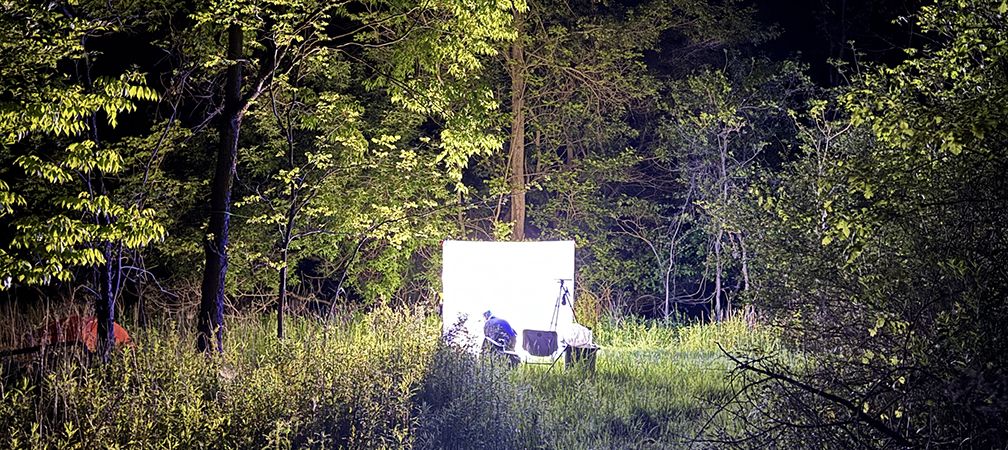
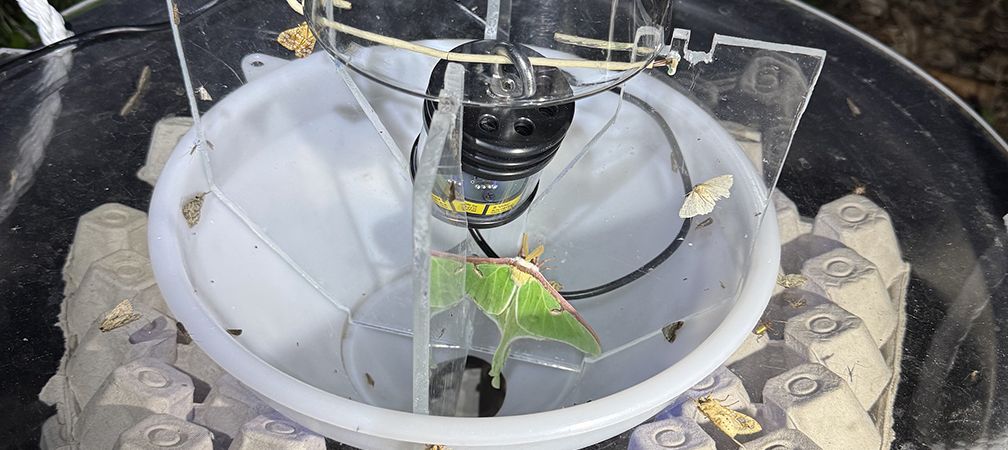
Compared to their diurnal counterparts, moths are relatively under-surveyed. Most species are nocturnal and inconspicuous, and documenting them requires specialized survey techniques – sheets and live traps baited with light or food. It also requires dedicated surveyors willing to stay up all night!
On the evening of June 24, 2024, a team of volunteers (Roberta Buchanan, Mark Buchanan, Paul Carter, Pete Chapman, Scott Connop, Deryl Nethercott, Dale Buchner, and myself) from Lambton Wildlife set up two light sheets and two traps across the Sydenham River Nature Reserve property. We documented hundreds of individual moths well into the night, and even more when we opened the traps the following morning. Then came the real fun: sorting through thousands of photos and identifying every moth.
Identifying all these moths is no trivial task. There are over 3,000 species of moths in Ontario, so field guides include only the most common species. Encountering moths that aren’t in the guide is common, and several groups of moths are notoriously hard to identify, even for experienced moth-ers. My approach is to photograph every moth, upload these photos to iNaturalist with my tentative ID, and wait for confirmation by a moth expert. For those who don’t know, iNaturalist is an online platform where you can post photos or recordings of an organism and crowdsource identifications from experts all over the world.
To keep track of the growing species list, I created an iNaturalist project which automatically consolidates all the moth observations from the property. The strength of this approach is that it stays current, as taxonomic changes and revised identifications will update the species list automatically. This makes it more reliable over time than a static checklist, which inevitably becomes outdated. As of 2026, we have documented 196 species of moth that first night, 13 of which are considered vulnerable at some level. After a second survey in May 2025, the total moth species count at Sydenham River Nature Reserve stands at 328, including 30 vulnerable species.
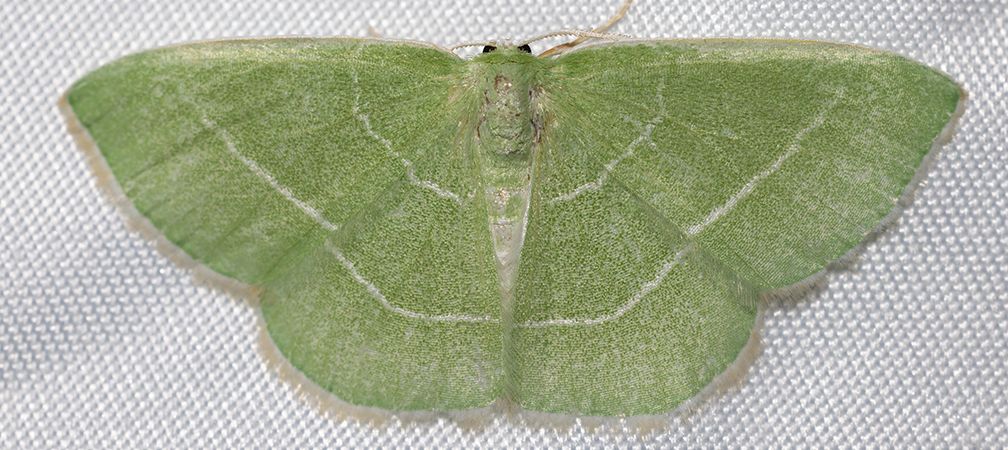
Fast forward to July 2025. I was checking my iNaturalist and saw there was a comment on one of my moth observations from the 2024 survey. Someone disagreed with my identification of what I believed to be a common white-fringed emerald, suggesting instead a species I hadn’t heard of – a Tuscarora emerald.
I quickly checked the range map, and my excitement spiked: this was a very rare moth, with only about fifty observations, all from the eastern United States – mostly localized populations in the Appalachians. If this was actually a Tuscarora emerald, it would likely represent the first record for Canada.
The identifier, Daniel Kluza (d_kluza on iNaturalist), a New Zealand-based biologist and iNaturalist taxonomy curator, pointed out a critical detail: our moth lacked the pure white spot on top of the abdomen which is present on the white-fringed emerald. This was a subtle difference, but potentially a decisive one. I needed a second opinion.
I reached out to Seabrooke Leckie, co-author of the Peterson Field Guide to Moths of Northeastern North America, and asked what she thought of it. Her response was unequivocal:
“I pulled out the Moths Of North America fascicle for this group to have a look at the official description of both species, Tuscarora and White-fringed, and I agree that this is Tuscarora. What a find!… Besides the presence/absence of the white spot at the base of the abdomen, the fascicle also says the white costa is very narrowly bordered inwardly by an apricot colour, and the AM and PM lines are wider than in White-fringed, both of which appear present here. There are no other eastern species that have both the white fringe and no markings on the abdomen.”
What makes this record especially meaningful is not just the rarity of Tuscarora emerald, but the way in which it was found. It was the result of methodical work by a team of volunteer community scientists, combined with the expertise of moth specialists. Not too long ago, access to such expertise was a significant roadblock, but it’s now easily facilitated through platforms such as iNaturalist.
We don’t know if this observation represents a previously overlooked population, a vagrant individual, or a northern range expansion driven by climate change. What is clear, however, is that protected places like Sydenham River Nature Reserve continue to demonstrate their conservation value in unexpected ways. When we take the time to look closely and collaboratively at under-surveyed groups like moths, we reveal hidden layers of biodiversity, uncovering the true richness of landscapes we thought we already knew.
The camera used to shoot Christopher Nolan's upcoming epic The Odyssey -- the first movie ever to be shot entirely on IMAX cameras -- has gone on public display in Los Angeles.
Medicine Hat police confirmed an 11-year-old boy died following a suspected drowning Monday at Echo Dale Regional Park in the southeastern Alberta city.
Recent studies have shown the climatic envelope for blanket bog peatlands to be contracting, yet questions remain about what will happen to existing peatlands as they pass outside of this shrinking bioclimatic envelope.
DigiBog, a process-based model, accurately predicts peat depth in an area of very complex topography. This presents a significant advancement in modeling peat depth in areas with complex terrain. The implications of peat expanding at a faster rate on the relatively dry and steeper slopes, compared to the wetter basins, is contrary to the current thinking.
Despite being at the edge of the future climatic envelope for blanket bog, under all climate scenarios, the site continues accumulating peat until 2100, with the greatest accumulation occurring under the moderate Representative Concentration Pathway (RCP) 4.5 scenario.
While peat thickness generally depends on wetness, wetness does not fully explain accumulation patterns in blanket bogs, with some very wet areas having only shallow peat accumulation.
Tom Winter’s conceptual model proposed that wetland vulnerability to climate change depends on wetness and the position within the hydrological landscape. Baird et al. [2026] does indeed show peat depth to have moderate to strong correlations with wetness. However, greater recent peat accumulation, and predicted future accumulation, is away from basins which contradicts Winter’s “wetter is better” and may be partially explained by the ability of peatlands themselves to engineer and alter landscape wetness.
Overall, ecohydrological models that are process-based are better than simple bioclimatic models for assessing future peatland carbon, when accounting for accumulation rates and spatial patterns.
Citation: Baird, A. J., Young, D. M., Ramirez, J. A., Gill, P. J., Morris, P. J., Peleg, N., et al.(2026). Assessing the response of blanket peatlands to climate change using the DigiBog model and winter’s concept of the “hydrologic landscape”. Water Resources Research, 62, e2025WR042050. https://doi.org/10.1029/2025WR042050
—Paul Whitfield, Associate Editor, Water Resources Research, with input from Joshua Ratcliffe
Echoes of the 1940s Circus: Steam Trains, Big Top Lights and Forgotten Wonders
Description
A cinematic journey through a fictional vintage circus world inspired by the atmosphere of the 1940s: steam trains arriving through clouds of smoke, crowded railway platforms, canvas tents rising at dawn, performers preparing behind the scenes, glowing fairground lights, brass bands, trapeze artists, ringmasters, clowns, fortune tellers, animal acts, travelling caravans and the quiet moments hidden between spectacle and exhaustion.
This collection evokes the golden age of travelling circuses as if seen through the lens of an old documentary photographer, but with the visual richness of modern cinematic photography. Warm amber lights, deep shadows, smoky interiors, velvet costumes, weathered wood, worn posters, dusty roads and dramatic faces create a world suspended between memory, theatre and dream. Each image suggests a fragment of a larger story: the arrival of the circus by train, the construction of the tent, the anticipation of the crowd, the tension before the performance, the intimacy of backstage rituals and the melancholy beauty of a show that exists only for one night before disappearing again.
The series blends realism and fantasy, presenting the circus not only as entertainment but as a temporary city of artists, workers, animals, music, mystery and human emotion. It captures both the grand spectacle and the fragile backstage humanity of a travelling world built from canvas, light, discipline and illusion.
All images have been generated by Artificial Intelligence.
Collagen-rich and deeply flavorful, there’s a reason this thrifty cut is a favorite of home cooks and chefs alike. Oxtail contains meat, bones and cartilage, which melt into a delicious sauce when braised in the slow cooker. Look for meaty pieces that are at least 2 ½-3 inches or larger in diameter for the best value.
RD Tip: If oxtail is hard to find, you can swap them out with just about any meat-on-the-bone, like short ribs, beef shanks, or even bone-in chicken thighs.
Slow Cooker Braised Oxtail and Carrots
Ingredients
4 lb. (1814g) oxtails
1 tsp ground black pepper
1/2 tsp salt
1 tbsp olive oil
3 tbsp no salt-added tomato paste
1/2 cup (113g) dry red wine (such as Pinot Noir or Merlot)
2 cups (360g) low-sodium beef broth
1 tsp granulated garlic or garlic powder
2 bay leaves
1 small sprig rosemary
1 large yellow onion, chopped
3 large carrots (475g), cut into 1/2-in. thick coins
2 celery stalks, sliced
1 large parsnip, chopped
2 tbsp cornstarch
Directions
Season the oxtails with pepper and salt. Heat the oil in a large non-stick pan over medium-high heat. When the oil is hot, add the oxtails to the pan (in batches if needed, to avoid overcrowding the pan.) Cook, turning occasionally, until browned all over, about 10 minutes. Add to the slow cooker.
Pour off the fat in the pan. Return the pan to medium-high heat and add the tomato paste. Cook, stirring constantly, about 2-3 minutes, or until it begins to brown. Add the wine and simmer for another 1 minute, scraping up the brown bits on the bottom of the pan. Add the broth, granulated garlic, rosemary and bay leaves and stir to combine.
Pour the wine mixture over the oxtails in the slow cooker. Nestle the celery and onion around the oxtail. Cover and cook on low in a large (6.5qt/6L) slow cooker for 8–9 hours (or on high for 4-5 hours) until oxtail reaches an internal temperature of 190-205°F, adding the parsnips and carrots during the last 2-3 hours of cooking.
Transfer the oxtails and vegetables to a large serving bowl with a slotted spoon. Discard the bay leaves and rosemary sprig. Cover meat and vegetables with foil. Set aside.
Pour the cooking liquid into a gravy separator and let it stand for a few minutes so the fat rises; discard the fat (alternatively, pour the cooking liquid into a large measuring cup, let sit for a few minutes, then spoon the fat off the top and discard.) Pour the defatted cooking liquid into a small saucepan. Bring the cooking liquid to a boil over medium-high heat and simmer for 4 minutes.
In a small bowl, combine the cornstarch with 2 tbsp water and stir to combine. Add to the cooking liquid and simmer until thickened, about 2 minutes. Season sauce with additional salt and pepper, if desired. Pour the sauce over the oxtails and vegetables and serve.
Serves: 6 | Serving Size: 2 medium oxtails, 2/3 cup vegetables, 1/3 cup sauce

 Login
Login