Normal view

  • ✇Latin America Reports
  • The prediction markets betting on Colombia’s upcoming election John Boscawen
    Prediction market giants Kalshi and Polymarket are showing a recent surge in bets on right-wing populist Abelardo de la Espriella to be the eventual winner of Colombia’s presidential election at the end of May.  The markets are out of line with conventional polls in Colombia, which have leftist candidate Ivan Cepeda comfortably leading the race with de la Espriella in second, followed by center-right candidate Paloma Valencia.  In the last week, however, bets on de la Espriella to win
     

The prediction markets betting on Colombia’s upcoming election

9 May 2026 at 20:22

Prediction market giants Kalshi and Polymarket are showing a recent surge in bets on right-wing populist Abelardo de la Espriella to be the eventual winner of Colombia’s presidential election at the end of May. 

The markets are out of line with conventional polls in Colombia, which have leftist candidate Ivan Cepeda comfortably leading the race with de la Espriella in second, followed by center-right candidate Paloma Valencia. 

In the last week, however, bets on de la Espriella to win the election have increased relative to bets on his rivals.

On May 1, de la Espriella was given a 28.8% chance of victory whilst Cepeda was given 38% on betting market Kalshi. As of May 8, de la Espriella has overtaken Cepeda by 1 percentage point, reaching 42%. 

Polymarket shows a similar trend. De la Espriella’s odds have risen from 28% to 39% over the last seven days, though he still trails Cepeda, who remains on 41%.

Over time, the race has been more measured. Since September of last year, Kalshi bet data show de la Espriella and Cepeda wrangling for first and second places until March when Valencia exploded onto the scene following her win in the right wing political party primary in which de la Espriella did not participate. She has since dropped – both on prediction markets, and in the polls. 

Sergio Guzmán, director of Colombia Risk Analysis, isn’t convinced of the predictive power of betting markets in the case of Colombia’s elections.

He observes that, before the Colombian primaries in March, Valencia was unfancied on betting markets. She stormed to victory with 3,236,286 votes in the primaries while her party obtained 16% of the vote share in legislative elections. Meanwhile, de la Espriella declined to take part in a primary, but the party he leads, Movimiento de Salvación Nacional, won only 4% of the vote share. Cepeda’s party, Pacto Historico, held a primary in October 2025 which he won with 1,186,095 votes.

“The best information we have suggests that Cepeda and Paloma have the highest proven ability to get votes,” Guzman told Latin America Reports. “To me, that suggests something is off in the prediction markets.”

The Poll Weighting Index from news website La Silla Vacia combines polling data from the five authorized polling companies and finds that de la Espriella has 24% of voter intention, while Cepeda has 38%. 

This would be sufficient to earn the right-wing populist a place in the second round, but the same poll index suggests de la Espriella would lose the second round by three points to Cepeda.

The trouble with prediction markets for polling 

Whilst prediction markets are not new, the recent rise in the popularity of sites such as Kalshi and Polymarket, presents challenges to democratic processes that require greater public understanding. 

Unlike polls, prediction markets do not measure voting intentions but the hunches of investors. They allow users to trade cryptocurrency-based shares on future events. Correct predictions pay $1 per share; incorrect ones lose their value.

Thus, rather than being an average of users’ probability beliefs, prediction markets are skewed towards the predictions of those with more capital to commit and are vulnerable to manipulation by those with the means to influence the perception of the likelihood of an outcome. 

There is some evidence that prediction markets have outperformed polls on electoral margins forecasting, but both get significantly more accurate closer to the predicted event and should not be treated as reflecting the probability of an outcome. 

Kalshi’s market for bets on the Colombian presidential election is relatively shallow, with only USD $385,390 bet at the time of writing, making the odds particularly volatile, and potentially vulnerable to manipulation.

Coljuegos, the state-owned body responsible for regulating online gambling in Colombia, does not recognize either Kalshi or Polymarket as an authorized operator.

Changes to Colombia’s poll process 

The discrepancy between poll data and prediction market data may partly reflect the age of the available polling data. In Colombia, the most recent authorized surveys were conducted no later than April 30, meaning all publicly available polling is now more than a week old.

Prediction markets such as Kalshi and Polymarket, by contrast, update continuously, with odds shifting hour by hour as traders react to new information.

While most polling data isn’t instantaneous, the increased delays stem from electoral polling regulations introduced in Colombia last year. The rules effectively impose a gagging order on polls until the National Electoral Council (CNE) has reviewed their methodology and respondent metadata.

As a result, the publication of voter intention polling has slowed considerably, often lagging by more than a week.

Spanish polling and consulting firm GAD3 has suspended polling operations on Colombia’s presidential elections, arguing that the new requirements make reliable research impractical. 

In a statement, the company said it was “unfeasible to carry out social research with the minimum guarantees of rigor and operational viability.”

The prediction market phenomenon entering Latin American politics – as it has around the world – will be an interesting trend to watch. 

For his part, Guzmán suspects that the prediction markets are more reactive than predictive, but understands that people need “a place where they can go to soothe their anxiety,” in the absence of more regular polling updates.

Featured image: Screenshot of Kalshi market for Colombia’s upcoming election taken on May 9.

Image credit: Kalshi

The post The prediction markets betting on Colombia’s upcoming election appeared first on Latin America Reports.
  • ✇Latin America Reports
  • Colombia renewables conference comes at critical moment for global energy Steve Hide
    Bogotá, Colombia – The first global summit on “Transitioning away from Fossil Fuels” kicked off today in Santa Marta, Colombia, with 50 country delegations and dozens of civil society organizations in attendance. Unlike other climate conferences, the six-day meeting will focus on implementing measures to end dependence on oil, coal, and gas, rather than negotiating international environmental commitments.  The summit comes at a pivotal time for global energy, with conflict in the Middle Ea
     

Colombia renewables conference comes at critical moment for global energy

24 April 2026 at 16:58

Bogotá, Colombia – The first global summit on “Transitioning away from Fossil Fuels” kicked off today in Santa Marta, Colombia, with 50 country delegations and dozens of civil society organizations in attendance.

Unlike other climate conferences, the six-day meeting will focus on implementing measures to end dependence on oil, coal, and gas, rather than negotiating international environmental commitments. 

The summit comes at a pivotal time for global energy, with conflict in the Middle East restricting oil and gas supplies and creating economic woes for countries reliant on fossil fuels.

Because of the ongoing oil turmoil, the conference came at the “best possible moment” to shift world opinion towards renewables, said Colombia’s environment minister Irene Vélez.

Talking to the UK’s Guardian newspaper this week, the minister, who was a prime mover of the conference, said nations were “at a fork in the road” in their choices between clean power sources such as solar or wind, or continuing to back fossil fuels that created climate crises and conflict.

It promised to be a “coalition of the willing”, said the minister, providing a road map to support nations already dedicated to transitioning from fossil fuels.

The conference organizers were combative in refusing to invite nations and organizations wedded to climate change denial.   

“Whatever nations have not yet taken that decision, then this is not the space for them. We are not going to have boycotters or climate denialists at the table,” Vélez told the Guardian.

Behind the conference is the Fossil Fuel Treaty Initiative, an alliance of nation states, technical bodies, communities and individuals “working to secure a global just transition from coal, oil and gas”.

According to the initiative, globally nations were planning to extract 120% more fossil fuels by 2030 than the “amount consistent with managing the impacts of climate change” – taking warming past the point of survival.  

“The science is unequivocal. For the last decade, oil, gas, and coal have been responsible for 86% of the CO2 pollution heating our planet, as well as causing one in five deaths worldwide from fossil fueled-air pollution.”

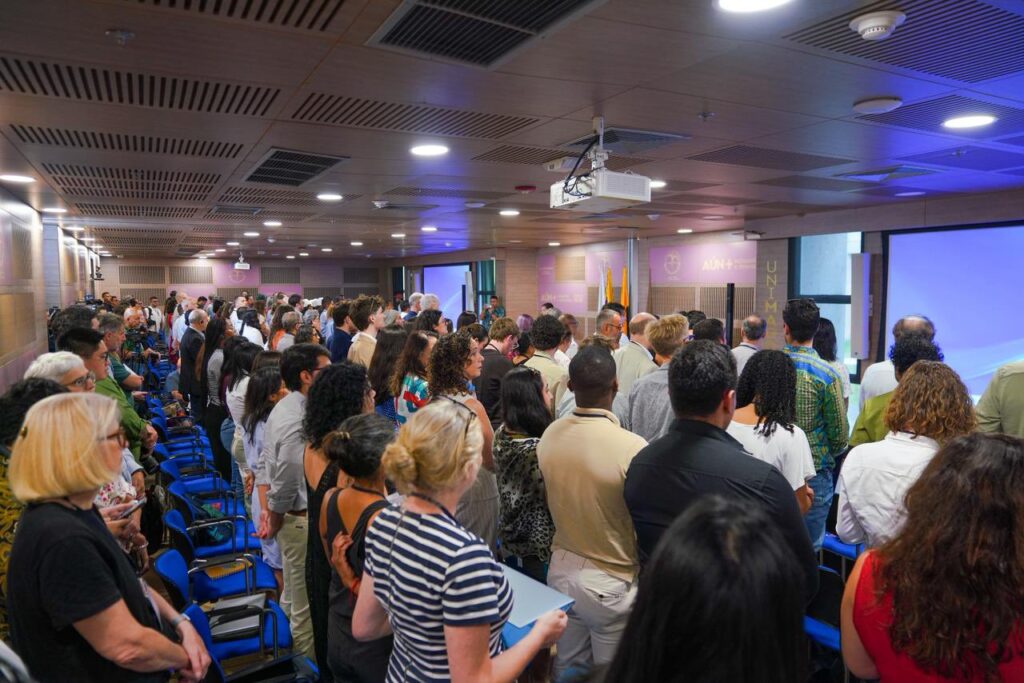
Delegates at the inauguration of the fossil fuel conference on Friday. Image credit: @MinAmbienteCo via X

For three decades global climate negotiations had focused on managing the symptoms of the crisis — fossil fuel emissions — while ignoring its root cause: the unchecked proliferation of oil, gas, and coal extraction.

This was a theme picked up by Kevin Koenig, director of climate and energy at Amazon Watch, a California-based nonprofit supporting indigenous communities attending the conference.

The last major summit, COP 30, was held last year in Brazil and saw “fossil fuel lobbyists outnumbering country delegates” he told Latin America Reports, adding that declarations at the end of that meeting “barely mentioned fossil fuels at all”.

In Santa Marta he expected things to be different: “This is the conference that is finally going to address the elephant in the room and get to the source of the climate change problem.”

Several factors were contributing to a momentum towards renewables, added Koenig, with recent data showing that cities and even whole countries have run for weeks off renewable energy as the Middle East crisis exposes the dangers of oil addiction.

“This is the moment where we are seeing both wars linked to fossil fuels politics and dependencies, but also for the first time renewables energies are not just theoretical, they are real, and decision-makers know they are scalable,” said Koenig. 

This was supported by data from the Center for Energy and Clean Air, which reported that global power generation from fossil fuels fell in the first month after the U.S.- Iran conflict closed the Strait of Hormuz – a vital waterway for oil tankers – while energy generated by solar and wind power increased.

Another conference goal was to identify economic and legal barriers to transitioning to renewables, said Koenig.

An example was the hegemony of interconnected global norms feeding fossil fuel dependence, such as arbitration laws that punished small countries in international courts if they attempted to free themselves from big oil contracts. This architecture kept countries dependent, he said.

“Countries transitioning get beat up in arbitration courts or penalized by credit rating agencies. When Ecuadorians voted to keep fossil fuels in the ground, for example, their credit rating went down.”

In countries like Colombia, fossil fuels were also linked to localized conflict and armed groups, explained Koenig; over 30 years Amazon Watch has supported many indigenous communities under attack for defending their territories against drilling.

“Some countries use oil extraction as a reason to open areas, saying ‘we can militarize it and it will be safer’. In fact, oil and energy infrastructure are a magnet for armed groups, for political attacks or blackmail,” he explained.

Inga indigenous guards in Putumayo, Colombia. Their traditional lands are under threat from oil exploration and illegal mining. Photo: Steve Hide.

That dynamic was more visible than ever on the world stage.

“Fossil fuels are fueling dictatorships, violence, conflict and authoritarian regimes,” said Koenig. “The Middle East crisis underscores the urgency to transition.”

“Yes, abandoning fossil fuels is about climate – but also about security and democracy.”

Featured image description: Delegates register at the fossil fuel conference in Santa Marta on April 24, 2026.

Featured image credit: @MinAmbienteCo via X

The post Colombia renewables conference comes at critical moment for global energy appeared first on Latin America Reports.
  • ✇Latin America Reports
  • Bukele-inspired Abelardo de la Espriella wins first round of Colombia elections John Boscawen
    Bogotá, Colombia – Hard right provocateur Abelardo de la Espriella won a shock victory in the first round of Colombia’s presidential elections Sunday, and will head to a run-off with leftist Iván Cepeda in June.  The most recent voter intention polls had predicted Cepeda beating de la Espriella in the first round by an average of eight points. With over 99% of votes counted, de la Espriella leads Cepeda, by nearly three percentage points (43.7% to 40.9%).  A run-off election will ta
     

Bukele-inspired Abelardo de la Espriella wins first round of Colombia elections

1 June 2026 at 00:57

Bogotá, Colombia – Hard right provocateur Abelardo de la Espriella won a shock victory in the first round of Colombia’s presidential elections Sunday, and will head to a run-off with leftist Iván Cepeda in June. 

The most recent voter intention polls had predicted Cepeda beating de la Espriella in the first round by an average of eight points.

With over 99% of votes counted, de la Espriella leads Cepeda, by nearly three percentage points (43.7% to 40.9%). 

A run-off election will take place on June 21 since no candidate achieved over 50% vote share.

Read more: Candidate guides for the 2026 Colombian elections: Abelardo de la Espriella

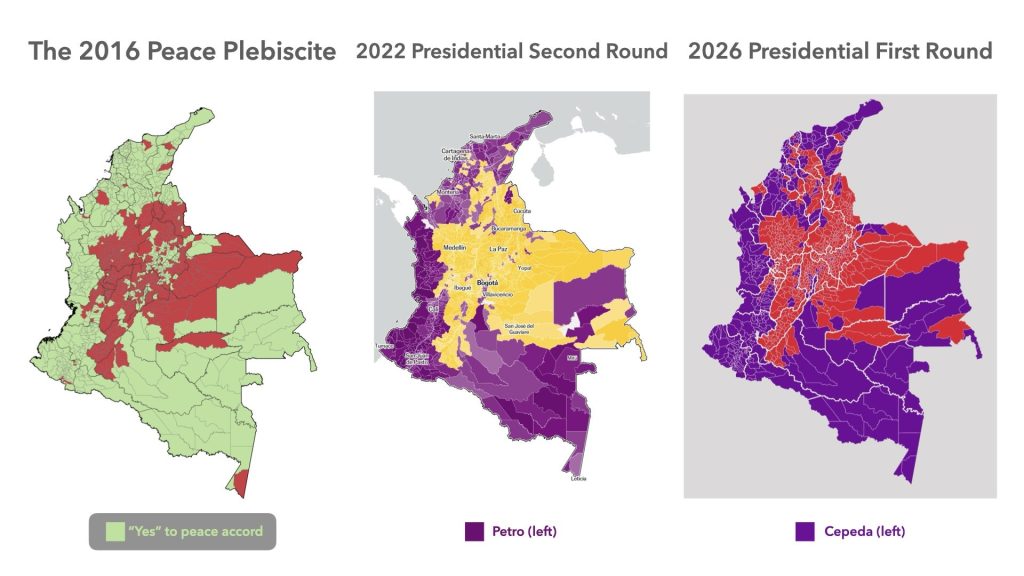
Voting closely followed political divisions seen in previous elections — including in 2022 when Gustavo Petro won the presidency, as well as the 2016 plebiscite for a peace agreement with FARC rebels — with voters rural areas impacted by Colombia’s armed conflict voting for Cepeda while voters in the heart of the country (save the capital Bogotá) voting for de la Espriella’s Defensores de la Patria ticket. 

Image credit: WOLA’s Adam Isaacson via X.

Paloma Valencia, a right-wing senator backed by former President Alvaro Uribe, was considered a favorite to make it to the second round alongside Cepeda as recently as early May, but her campaign ran out of steam in the final weeks and she ended with less than 7% of the vote.

Yann Basset, a political scientist from the University of Rosario in Bogotá told Latin America Reports that he expects Valencia’s supporters will rally around de la Espriella, handing him a victory in the run-off in three weeks’ time.

De la Espriella, who has run a slick, AI-augmented social media campaign, promised to “defeat the tyranny of the left.” 

His proposals include the construction of 10 mega-prisons, a la El Salvador strongman Nayib Bukele, and militarization of the whole territory in order to combat illegal armed groups. 

Read more: Candidate guides for the 2026 Colombian elections: Iván Cepeda

For his part, Cepeda ran on a continuation of Petro’s Historic Pact for Colombia party, including continuing efforts to achieve “Total Peace” with its many armed groups and narrowing the inequality gap in society. 

“Colombia can and should be a just country. A country in which each citizen and every community has effective access to indispensable rights, property and services for a fulfilling life,” Cepeda said on the eve of elections. 

Sunday night, Petro said he would not accept the preliminary count results, and defiant Cepeda supporters at the campaign event in the Tequendama Hotel in Bogotá were heard chanting “No pasarán!” (“They will not pass!”), referring to their right-wing rivals. 

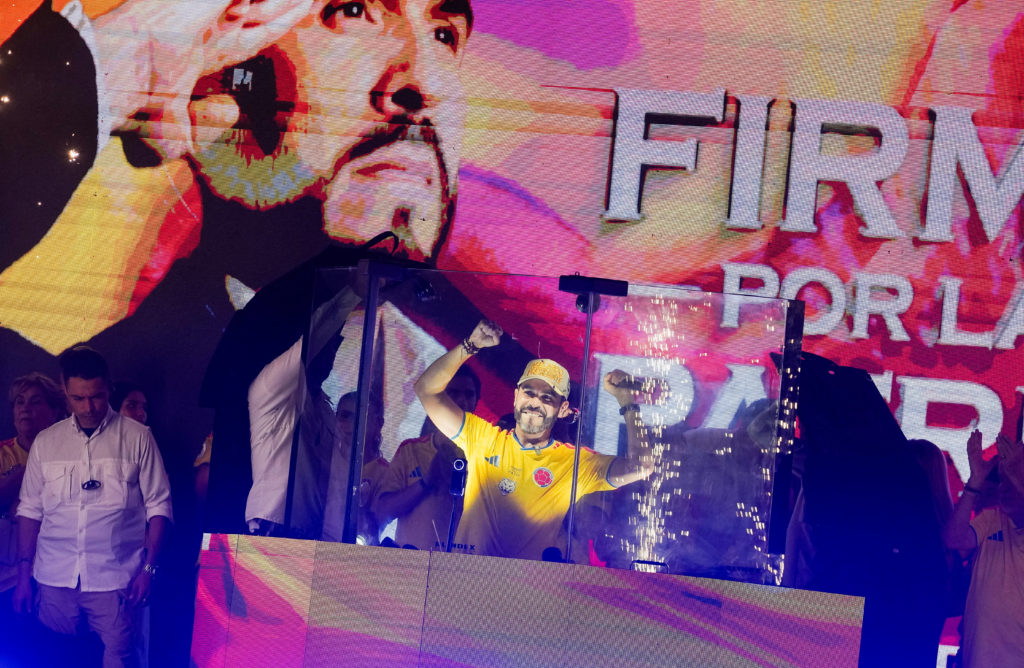
Featured image: Abelardo de la Espriella at a campaign rally in Nariño, Colombia in April 2026.

Image credit: Abelardo de la Espriella on X.

The post Bukele-inspired Abelardo de la Espriella wins first round of Colombia elections appeared first on Latin America Reports.
In Colombia, De la Espriella and Cepeda head to a runoff as Petro questions the results

1 June 2026 at 06:49

Colombia will hold a presidential runoff between two candidates who embody irreconcilable visions for the country. Abelardo de la Espriella, the ultraconservative lawyer who ran as the outsider promising to break with everything, won the first round with 43.7% of the vote, with 99% of polling stations counted. Iván Cepeda, the candidate of the governing left, received 40.9%.

Seguir leyendo

Abelardo de la Espriella arrives at his polling station in Barranquilla this Sunday, May 31.Iván Cepeda, at his polling station in south Bogotá, this Sunday, May 31.

💾

© EPV

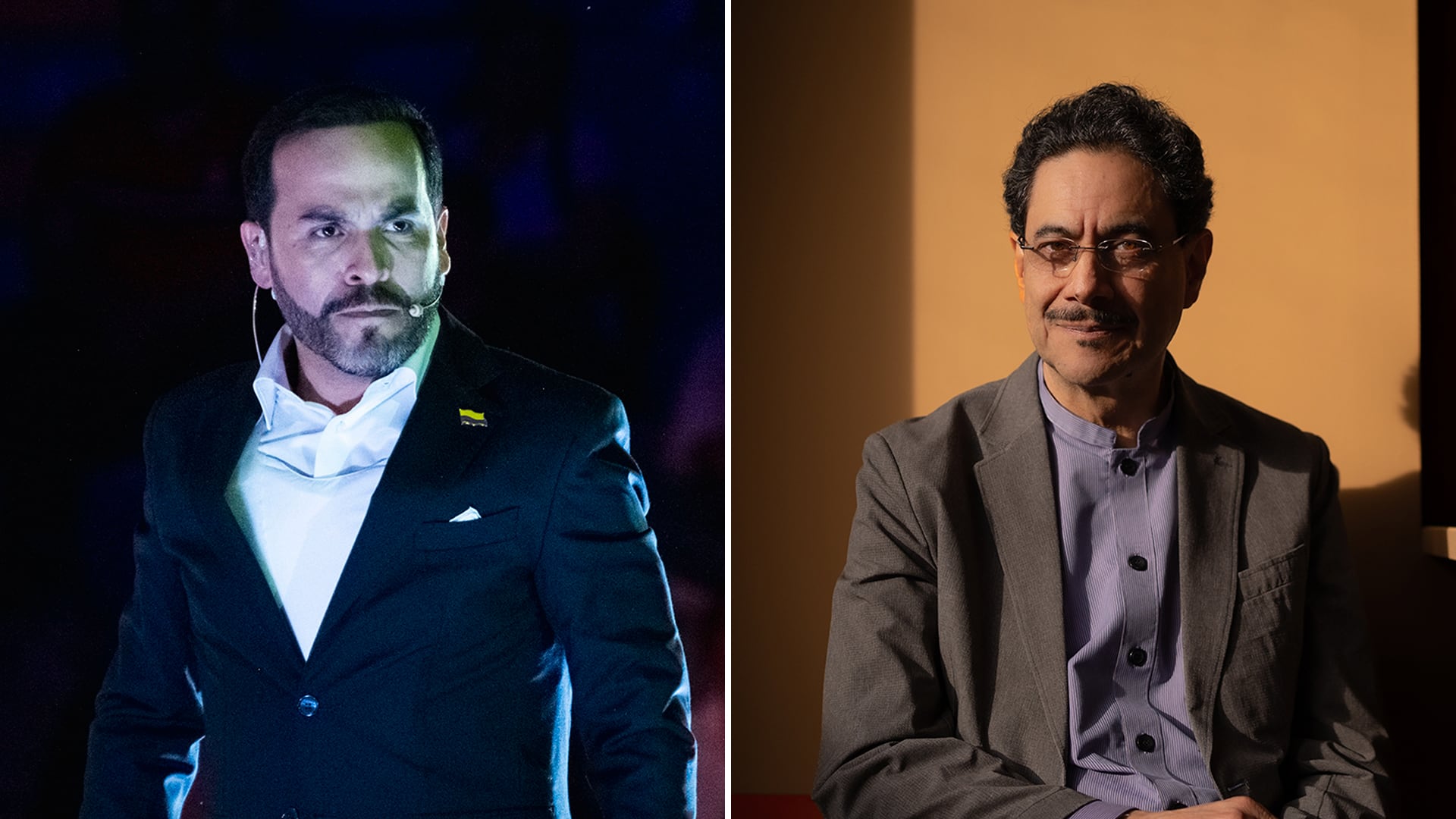
Abelardo de la Espriella and Iván Cepeda.
  • ✇Latin America Reports
  • Venezuela contradicts Colombia claims about military strikes near border Amelia Makstutis
    Medellín, Colombia – The Venezuelan government on Wednesday published a declaration saying it regretted recent violence in the Catatumbo region of Colombia just days after Bogotá announced bombing in cooperation with Caracas. The statement muddies the waters about whether or not Venezuela was involved in the military operations against the National Liberation Army (ELN) rebels near the two countries’ joint border, which allegedly killed 7 guerrilla fighters.  “The Bolivarian Republic of Ve
     

Venezuela contradicts Colombia claims about military strikes near border

14 May 2026 at 23:23

Medellín, Colombia – The Venezuelan government on Wednesday published a declaration saying it regretted recent violence in the Catatumbo region of Colombia just days after Bogotá announced bombing in cooperation with Caracas.

The statement muddies the waters about whether or not Venezuela was involved in the military operations against the National Liberation Army (ELN) rebels near the two countries’ joint border, which allegedly killed 7 guerrilla fighters. 

“The Bolivarian Republic of Venezuela expresses its profound concern and regrets the escalation of violence in the border region of Catatumbo,” read a statement shared on X by Foreign Minister Yvan Gil.

The declaration came after Colombian President Gustavo Petro said on Monday that he had ordered the bombing in cooperation with Venezuela. 

“I gave the order to bomb the ELN camp in accordance with the agreement reached with the Bolivarian government of Venezuela,” wrote Petro on X.

Petro appeared to allude to an agreement with Caracas to cooperate on tackling cross-border crime following his visit to Venezuela in April. 

But Caracas appeared to wash its hands of the recent bombing operation; while it did not directly acknowledge the bombing or Petro’s statement, its declaration said that it “rejects any armed action that compromises the peace, stability, and security of border communities.” 

It added that the only way to preserve peace and stability in the region is through “mechanisms of understanding and mutual respect, avoiding actions that can aggravate tensions or generate greater risks for border populations, who for decades have faced the consequences of a conflict out of their control.”

Since last year, Catatumbo has been the site of what has been described as “the most serious humanitarian crisis of recent times” in Colombia. In January 2025, a family of three, including a nine-month-old baby, was killed, marking the collapse of fragile peace pacts between the ELN and the Frente 33 – a dissident faction of the demobilized FARC rebels – and triggering a humanitarian crisis on a scale not seen in the country for over a decade.

The Red Cross said that 2025 was one of the most complicated years for humanitarian conditions in Colombia: more than 235,000 people were individually displaced, over 176,000 people have been unable to move freely because of armed conflict, and there has also been a sharp increase in cases of mass displacements.

Venezuela’s statement highlights the cross-border nature of the conflict, noting that the country “has historically suffered the consequences of Colombian internal conflict.” Colombian armed groups like the ELN and dissident FARC factions have traditionally had a significant presence in Venezuela and were known to have ties to the Nicolás Maduro regime.

But both the interim government under Delcy Rodríguez and Petro have been under pressure from the White House to confront guerrilla groups.

This article originally appeared on The Bogotá Post and was re-published with permission.

Featured image description: Colombian President Gustavo Petro and Venezuelan Interim President Delcy Rodríguez at a meeting in Caracas on April 24, 2026.

Image courtesy of: Colombian President’s Office.

The post Venezuela contradicts Colombia claims about military strikes near border appeared first on Latin America Reports.
The keys to Abelardo de la Espriella’s first-round victory in Colombia: anti-Petro and anti-politics sentiment

4 June 2026 at 09:00
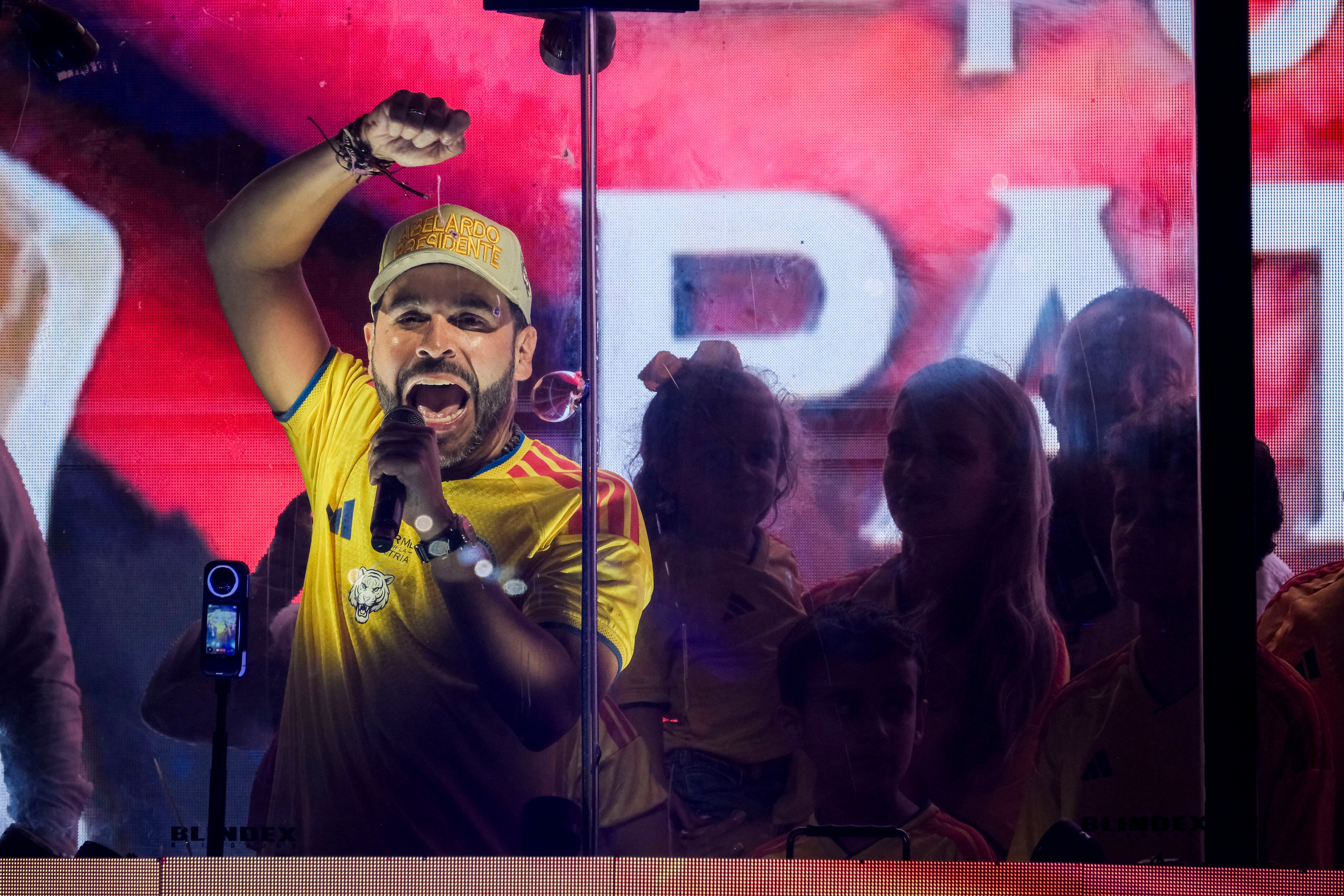
Abelardo de la Espriella delivers a speech in Barranquilla on May 31.

Abelardo de la Espriella surprised many with his first-round victory in Colombia with 44% of the vote. The leader in the polls had consistently been left-wing senator Iván Cepeda, with the far-right candidate appearing in second place. However, those polls showed Cepeda hovering around 40% of voter intention — and he received just that. They also reflected a significant rise for the far-right candidate in recent weeks, as well as a loss of appeal for traditional right-wing candidate Paloma Valencia. In those surveys the two of them together polled roughly between 35% and 40% of voting intention. In the end, De la Espriella reached 44% and Valencia managed only 6%.

Seguir leyendo

Abelardo de la Espriella votes at La Enseñanza school in Barranquilla on May 31.

Germán Vargas Lleras, Colombia’s former vice president and two-time presidential candidate, has died

9 May 2026 at 03:04

Medellín, Colombia – Colombian politician Germán Vargas Lleras died Friday in the capital Bogotá, according to Semana magazine. His death brings an end to a political career spanning more than 30 years, including as a senator, minister, vice president, and two-time presidential candidate. 

On Monday, Vargas Lleras was admitted to the Intensive Care Unit at the Luis Carlos Sarmiento Angulo Cancer Treatment and Research Center in Bogotá. He was later transferred to another hospital where he lost a battle with cancer he had been fighting for years. He was 64 years old. 

Political career

Born in Bogotá on February 19, 1962, Vargas Lleras grew up in a political family. His grandfather, former President Carlos Lleras Restrepo, was a pillar of the country’s Liberal Party. 

He would go on to make a name for himself on his own, serving as a city councilman, congressman, minister, and ultimately leader of the Cambio Radical political party.

Vargas Lleras first ran for president 2009. He traveled the country, participated in debates, and garnered nearly 1.5 million votes. It wasn’t enough to win, but he finished third. 

The winner of the election, Juan Manuel Santos, would later call on him to serve as a minister in his cabinet. 

In 2014, Santos chose him as his running mate for reelection. Together they won in the runoff, and Vargas Lleras took office as vice president on August 7 of that year. 

Once his term as vice president ended, Vargas Lleras did not sit idle. In 2018, he ran again for president, this time with the “Mejor Vargas Lleras” coalition backed by Cambio Radical. 

His policy proposals included  infrastructure, housing, and a more efficient public administration.

In the first round, he received over 1.4 million votes but finished fourth, knocking him out of the runoff race. His campaign stated that he would not officially endorse either of the remaining candidates, Iván Duque and Gustavo Petro. 

Over time, he kept a lower profile, though he never completely stepped away from politics.

During his career, Vargas Lleras would survive two assassination attempts and a “parapolitics” scandal in which he was accused, but never charged, with benefitting politically from his connections to warlord “Martin Llanos”.

Health issues

In his later years, his health gradually got in the way of politics; reportedly, he suffered from a benign meningioma, a tumor in the membranes surrounding the brain and spinal cord, which was detected in 2016 after a fainting spell. 

On March 11, former President Álvaro Uribe commented on his condition, saying, “My best wishes for the health of Dr. Germán Vargas Lleras, a distinguished patriot whom I respect despite our occasional disagreements.”

During his final months, the former vice president stayed out of the public eye, though he briefly reappeared on March 3  in a video concerning the March 8 parliamentary elections. 

Upon learning of his death, former President Santos wrote on X that he is “deeply saddened” and described Vargas Lleras as “an exceptional colleague.”

Current President Gustavo Petro also mourned the political leader’s death: “Both in the Senate and on the campaign trail, he behaved like a gladiator. As someone who often disagreed with him, I regret that his seriousness in debate will be lost,” he said on his X account.

Featured image: Germán Vargas Lleras

Image credit: Germán Vargas Lleras via Facebook.

The post Germán Vargas Lleras, Colombia’s former vice president and two-time presidential candidate, has died appeared first on Latin America Reports.

Toby Muse, author: ‘We live in a world that Pablo Escobar could never have imagined’

British-American writer and journalist Toby Muse has immersed himself in the underworld of drugs for more than 15 years. He has infiltrated narcotics labs and traveled through guerrilla camps in the Colombian jungle, in order to understand the aspirations and deprivations that drive thousands of people into the trafficking networks. Through his work, the 50-year-old – born in Chichester, United Kingdom – dismantles the failed promises of the war on drugs, while offering a stark portrait of the global cocaine empire.

Seguir leyendo

© Mónica Villamiza (Capitán Swing)

Writer and journalist Toby Muse, last April at his home on the outskirts of Washington, in a photo provided to EL PAÍS.

In less than a year, 1 in 5 minors in Colombia suffered online sexual violence, UNICEF, ECPAT, and INTERPOL warn

14 May 2026 at 17:52

Bogotá, Colombia – Around 21% of Colombian minors aged between 12 and 17 have been victims of online sexual abuse in the past year, according to a report published last week by UNICEF-Innocenti, ECPAT International, and INTERPOL. 

The report, “Disrupting Harm,” covered 25 countries including Colombia and examines how technology use, including new tools like artificial intelligence (AI) are helping to facilitate online abuse. 

The investigation was made between 2023 and 2025, and the results are alarming: around 860,000 Colombian adolescents experienced some type of digital sexual abuse or exploitation in just one year (2024) . 

Data also pointed to gender and economic disparities. A quarter of young women surveyed said they’d been victims of this type of abuse or exploitation while 17% of young men said the same. In poorer, rural areas of the country, 29% of minor respondents said they’d been victimized while 17% living in urban areas said they had been. 

In addition to social dynamics in Colombia, including deep-rooted “machismo”, prevalent domestic and gender based violence, and extreme wealth inequality, technology is increasingly becoming a factor in the abuse of children. 

According to a 2025 study by the Communications Regulation Commission (CRC), during the past year, 81% of teenagers between 14 and 17, and 55% of pre-adolescents aged 10 to 13, reported having their own cell phones. 

Experts say that since the pandemic, interactions among children and adolescents have increased significantly. Cell phones have become a ‘fundamental’ tool for maintaining social status and escaping reality, especially for those facing family problems.

“It is essential that children do not fear being punished or having their phones taken away for responding to a message. We saw in the study that this is one of their biggest fears: losing their connection to the rest of the world,” Camila Perera, a specialist at the Office of Research and Data for UNICEF Innocenti, told Latin America Reports.

Nearly half of the reported cases of abuse happened on social media platforms such as Facebook (80%), WhatsApp (30%), and Instagram (17%), while 14% were linked to online gaming networks.

In addition, 2% of victims reported that artificial intelligence was used to create fake explicit content using their faces – highlighting a newer phenomenon that became widely discussed last year after Elon Musk’s AI chatbot Grok began creating millions of sexualized images of people online. 

With the introduction of such technologies, regulators and parents are struggling to keep up. 

“Minors, with their superior digital skills, moved much faster than any safety measures could. While they advance, protection protocols simply cannot keep up,” Fabio González Florez, Project Leader at ECPAT International, told Latin America Reports.

“There is a serious obligation to stay informed, and that doesn’t require a postgraduate degree. Tutorials are everywhere, and every platform offers parental controls that we must learn to use,” he added.

A stranger behind a screen? The ‘real’ danger

Contrary to popular belief, the threat is not always an anonymous hacker hiding in the dark; in fact, only 30% of victims met their aggressor online.

In half of the documented cases, children were abused by someone they already knew, including family members, neighbors, and classmates. Due to this approach, some of the minors can’t recognize the abuse or feel safe enough to ask for help.

“There’s a common expression: ‘stranger danger’, the idea that we must only be looking for outsiders. However, the majority of the abusers are actually the ones close to the family,” stated González.

The findings are also exposing another difficult situation: one in five cases of online sexual abuse against a minor was made by another minor. It was found that some victims will look to target or recruit their peers to re-victimize in exchange for incentives or “freedom.”

The report also highlights that victims often suffer from severe mental health issues, including anxiety, depression and propensity to self harm. 

Even if many minors prefer to remain silent, when they decide to speak out, they usually look for their mothers, siblings, or a friend. This is a message about the importance of creating trust-based relationships with children.

“Beyond digital parenting, we must ensure the kids see their parents as sources of protection. They need to be someone they can talk to about sexuality, consent, and limits without being judged,” Perera recommended. “It is about being a source of trust so they can come to us with their doubts and curiosities.”

Despite existing channels in Colombia, such as the ICBF’s 141 line or the National Police’s “¡A Denunciar!” portal, the study found that formal reporting is almost non-existent between minor victims.

Protection measures: Are they enough?

With increased connectivity via the internet, the threat landscape for online abusers of Colombian children expands immensely. 

“Our obligation is to work with our 196 member countries; also, we have specific resolutions focused on child protection,” a member of INTERPOL, who requested anonymity because of the sensitivity of their work, told Latin America Reports. “Another critical measure is urging countries to adopt protocols to detect and block URLs containing sexual abuse and exploitation material to prevent the commercialization of such content.”

However, risks remain in an increasingly interconnected world: “A single image of a Colombian child can be reproduced globally across time and geography; therefore, the response to protect them must be a national priority”, the INTERPOL member said. 

Finally, the investigation calls on digital companies to contribute to risk reduction by incorporating prevention into platform design and improving safety measures. The research is also looking for new prevention tools for transforming both physical and digital spaces and eliminating the conditions that facilitate violence.

This issue requires concrete actions from all sectors: the protection system, families, and technology companies.

Featured image credit: UNICEF

The post In less than a year, 1 in 5 minors in Colombia suffered online sexual violence, UNICEF, ECPAT, and INTERPOL warn appeared first on Latin America Reports.
  • ✇Latin America Reports
  • Colombia presidential candidates announce running mates as race narrows Alfie Pannell
    Bogotá, Colombia – Iván Cepeda and Abelardo de la Espriella, two of the frontrunners to be the next Colombian president, have announced their choices for vice president following Sunday’s legislative elections and presidential primaries. Cepeda selected Aida Quilcué, a senator and Indigenous leader, to join him on the ticket for the left-wing Historic Pact (Pacto Historico), which won the most congressional seats on Sunday. Meanwhile, de la Espriella, a hard-right outsider, announced today th
     

Colombia presidential candidates announce running mates as race narrows

10 March 2026 at 21:21

Bogotá, Colombia – Iván Cepeda and Abelardo de la Espriella, two of the frontrunners to be the next Colombian president, have announced their choices for vice president following Sunday’s legislative elections and presidential primaries.

Cepeda selected Aida Quilcué, a senator and Indigenous leader, to join him on the ticket for the left-wing Historic Pact (Pacto Historico), which won the most congressional seats on Sunday. Meanwhile, de la Espriella, a hard-right outsider, announced today that he will run alongside ex-finance minister José Manuel Restrepo. 

But the big winner in Sunday’s primary, right-wing Paloma Valencia of the Democratic Center (Centro Democrático) party, has yet to announce her running mate amid mounting speculation.

Cepeda sticks to his guns

On Monday, Cepeda formally announced Aida Quilcué as his running mate. A leader of the Nasa Indigenous group, Quilcué has a record as a staunch defender of human rights and as an advocate for ethnic minorities in Colombia.

She was integral to the negotiation of the ethnic chapter of the 2016 peace accord with the Revolutionary Armed Forces of Colombia (FARC) and has been a key figure in Colombia’s Indigenous rights movement. 

Last month, Quilcué made national headlines when she was kidnapped in her home state of Cauca, in the Colombian Pacific, by dissidents of the FARC. 

Miguel Jaramillo Luján, a Colombian political strategist, described Cepeda’s choice of Quilcué as a “symbolic” one which entrenches his stance as an advocate of peace and human rights.

But the analyst also noted that the selection may not be the most politically savvy move: “From an electoral standpoint, I believe that this is a concentric circle and does not add much electoral power to Iván Cepeda, who I think is acting symbolically but overly prideful in this decision,” Jaramillo told Latin America Reports

De la Espriella’s establishment pick

Abelardo de la Espriella, a criminal defense attorney, has styled himself as an anti-establishment political outsider. His traditional values, tough on crime campaign has been successful so far, regularly placing him in second place in presidential polls.

Today, ‘The Tiger’, as he has styled himself, announced his running mate: José Manuel Restrepo.

Restrepo is an economist at the Rosario University in Bogotá and served as President Ivan Duque’s Minister of Finance and Public Credit from May 2021 to August 2022, running the country’s finances during the COVID-19 pandemic. Before that he was Minister of Commerce, Industry, and Tourism beginning in 2018.

“I think the selection of José Manuel Restrepo… represents an attempt to counterbalance de la Espriella, who has no experience in public office,” said Jaramillo.

While de la Espriella is an outsider, he must take on Cepeda and Valencia, both sitting senators since 2014. Restrepo burnishes the criminal lawyer’s bid by adding proven governance credentials.

When announcing his running mate on Tuesday, de la Espriella said: “My choice of vice president was not driven by political calculation… it was clear to me that a renowned academic, an outstanding economist, and a highly qualified former minister and technician will undoubtedly be the best travel companion.”

Paloma Valencia in the spotlight

On Sunday, Paloma Valencia received over 45% of votes in presidential primaries, although Cepeda and de la Espriella were both absent from the contest.

Valencia’s win, as well as her Democratic Center party’s strong showing in legislative elections – winning the second highest number of seats – bolsters her position in the presidential race, according to experts. 

“From the [primaries], it’s clear that Paloma Valencia is the right-wing’s principal candidate,” Sergio Guzmán, director at Colombia Risk Analysis, a political risk consultancy, told Latin America Reports

Before Sunday’s vote, de la Espriella had been dominating conservative polls. Now, it is unclear which conservative candidate will attract the most voters in May’s election.

Whoever emerges as the winner must face off with Cepeda and will be under pressure to  win over centrist Colombians, said Guzman.

One way to achieve this is by selecting running mates with a broader appeal.

Sunday’s primaries highlighted the widespread popularity of Juan Daniel Oviedo, who was on the same list as Valencia and won 17% of the total votes. The former director of the National Administrative Department of Statistics (DANE), Oviedo is considered center-right and notably more moderate than Valencia.

Valencia is under mounting public pressure to pick Oviedo as her running mate, according to Jaramillo, but the two differ on key issues and Oviedo has specified strict conditions for joining Valencia’s ticket.

“We openly show fundamental differences. For example, I believe in peace,” Oviedo told Colombian radio station Caracol on Monday. “You cannot take positions that do not recognize that the [2016 peace] agreement must be implemented and that it requires more than just bullets to get rid of criminals,” he added.

Valencia has staked her campaign on law and order, promising a ‘mano dura’, or ‘iron fist’, against crime and armed groups in Colombia. Her politics follow those of her party’s founder, ex-president Álvaro Uribe, who waged war on the FARC rebels from 2002 to 2010. 

Today, Valencia told Caracol that she will not compromise on this: “I am an Uribista and I have my values and principles… Neither he [Oviedo] will change nor will I change.” 

But Valencia said she remains open to running alongside Oviedo, with the two due to meet today to discuss a possible joint ticket. She is also considering four other possible running mates, according to Colombian newspaper El Tiempo, with her decision due by Friday.

Jaramillo argues the best move for Valencia is not to pick Oviedo, as he is legally bound to support her as they ran under the same list in the primaries.

He believes she should distance herself from Uribe – arguing Uribistas are more likely to back de la Espriella – and instead court the moderate vote by choosing a center-left candidate.

But Guzmán says that is unlikely: “She seems to be going in a different direction.”

Featured image description: Left to right: Iván Cepeda, Paloma Valencia, Abelardo de la Espriella.

Featured image credit: @PactoCol via X / @PalomaValenciaL via X / @ABDELAESPRIELLA via X

The post Colombia presidential candidates announce running mates as race narrows appeared first on Latin America Reports.

Pro-Trump lawyer De la Espriella pulls ahead in Colombia's presidential race with promise of crime crackdown

De la Espriella, whose rise reflects a shift in Latin America towards leaders favoring heavy-handed crime policies, is expected to gain more support in the June 21 runoff.

  • ✇Latin America Reports
  • What Venezuela is watching ahead of Colombia’s elections on Sunday Julio Blanca
    Caracas, Venezuela — Colombia is preparing to elect President Gustavo Petro’s successor on Sunday in a race that has generated significant regional interest, especially next door in Venezuela.  As sister nations, Colombia and Venezuela’s relations — which have been strained for years under former President Nicolás Maduro — play a key factor in everything from politics, migration, the economy, security and the fight against drug trafficking.  Interim president Delcy Rodríguez will undou
     

What Venezuela is watching ahead of Colombia’s elections on Sunday

29 May 2026 at 15:46

Caracas, Venezuela — Colombia is preparing to elect President Gustavo Petro’s successor on Sunday in a race that has generated significant regional interest, especially next door in Venezuela. 

As sister nations, Colombia and Venezuela’s relations — which have been strained for years under former President Nicolás Maduro — play a key factor in everything from politics, migration, the economy, security and the fight against drug trafficking. 

Interim president Delcy Rodríguez will undoubtedly be keeping an eye on which candidate succeeds, given the vast differences in how the presidential hopefuls say they’ll interact with Venezuela’s government. 

Of the three leading candidates, two — the Centro Democratico’s Paloma Valencia and Defensores de la Patria’s Abelardo de la Espriella — have signaled they’d follow Washington’s lead on Venezuela while the current leader in the polls, leftist Iván Cepeda (Pacto Histórico), has remained quiet despite his past support for Chavismo. 

The elections are also shaping up to be the most polarizing in recent memory. 

“Of all the societies I have studied, Colombia is perhaps the one with the most extreme positions—people who identify more strongly with the right or those who identify more strongly with the left,” Carmen Beatriz Fernández, a political consultant and professor of public communication, political systems and electoral campaigns, told Latin America Reports.  

Colombian news outlet La Silla Vacia’s poll rankings have Cepeda ahead by 8 percentage points, followed by de la Espriella and Valencia. According to pollster AtlasIntel, if elections were to go to a run-off between Cepeda and de la Espriella today, the hard-right de la Espriella would win. 

“Cepeda is the candidate who, in theory, would have the strongest ties to Chavismo, but it’s no less true that de la Espriella has never denied his close relationship with Alex Saab, right? So, that’s where the extremes perhaps meet,” said Fernández

De la Espriella, a lawyer by trade, famously represented Maduro’s alleged money launderer and also allegedly received payments from Saab’s front companies, according to an investigation by journalist Daniel Coronell. 

Venezuelan political columnist and international affairs expert Beatriz de Majo, told Latin America Reports, “I have my reservations about de la Espriella, because for us he could be a huge surprise. He is a man who does not seem to be entirely above board in every aspect of his conduct, and God only knows what kind of surprise he might have in store for us now. However, it feels as though that battle will undoubtedly be decided between Cepeda and de la Espriella.”

De Majo said it’s hard to gauge where Colombia is heading following four years of Petro’s administration. 

“The electoral process in Colombia’s case is particularly interesting because the country’s compass has been turned off during the four years of Petro’s administration. It really wasn’t possible to tell from the outside where the country was headed,” she said. According to De Majo, Petro’s only defining project, his “Total Peace” plan, “was never even close to being achieved.”

Should his political successor Cepeda win, said de Majo, we could see an outflow of capital from Colombia to Venezuela and elsewhere. 

“Capitalism in Colombia is deeply entrenched; it is an enormously industrious country, and it is highly likely that if Cepeda wins, there will be a massive migration of capital from Colombia to Venezuela,” she commented.

While Colombia’s wealthy had threatened to move their money abroad when Petro was first elected, Spanish newspaper El País recently reported on companies setting up now to help Colombians move their assets should Cepeda win, saying that Panama, Spain, Costa Rica and the United States were the most sought after countries for relocating Colombians. Venezuela wasn’t listed. 

On the other hand, De Majo thinks that if de la Espriella is elected, he’ll follow the U.S.’s lead for the most part and will not prioritize relations with Venezuela. 

“If de la Espriella wins, he has said on more than one occasion that he will align with the United States, and moreover because that has been the Colombian trend in recent decades. They have been under the control and protection of the U.S. Armed Forces, and things went very well for them—until the Petro administration—in everything related to drug control,” she said. 

Since September 2025, the U.S. has killed nearly 200 alleged drug traffickers by bombing boats in the eastern Pacific ocean and Caribbean, including Colombians. The Trump administration sanctioned Petro for allegedly allowing  “drug cartels to flourish” and in March The New York Times reported that prosecutors were investigating Petro — the administration later assured him he faces no current charges. 

What about Venezuelan migrants?

According to data from Colombia’s migration office, there are more than 2.8 million Venezuelans in Colombia, by far the country that has received the highest number of Venezuelans fleeing poor economic conditions. 

Despite the gravity of the issue,  de Majo doesn’t see the election outcome impacting migrants, who are more likely to be watching what happens in Venezuela to see if they can return home. 

“The situation of Venezuelans in Colombia will not depend so much on what Colombia does to help them, but rather on what happens in Venezuela, because if a democratic process and freedoms are truly restored in Venezuela and the economy takes off again, the first Venezuelans to return to the country will not be those in Europe or the United States; they will be those in Colombia,” she said.

Featured image: Colombian President Gustavo Petro met with interim President of Venezuela Delcy Rodríguez on April 24, 2026.

Image credit: Gustavo Petro via X.

The post What Venezuela is watching ahead of Colombia’s elections on Sunday appeared first on Latin America Reports.

❌
Subscriptions