Normal view

  • ✇Latin America Reports
  • Guatemala Supreme Court revokes arrest warrant for Colombia Attorney General   Alfie Pannell
    Bogotá, Colombia – The Supreme Court of Guatemala has overturned 26 arrest warrants issued last year by the country’s Public Prosecutor’s Office, which targeted high-profile figures including Colombian Attorney General Luz Adriana Camargo.  In a decision made public on Monday, the country’s high court ruled that the prosecutor’s office did not have the authority to issue the warrants in June last year.  The court order marks a setback for Guatemala’s Public Prosecutor’s Office, which right
     

Guatemala Supreme Court revokes arrest warrant for Colombia Attorney General  

14 April 2026 at 23:43

Bogotá, Colombia – The Supreme Court of Guatemala has overturned 26 arrest warrants issued last year by the country’s Public Prosecutor’s Office, which targeted high-profile figures including Colombian Attorney General Luz Adriana Camargo. 

In a decision made public on Monday, the country’s high court ruled that the prosecutor’s office did not have the authority to issue the warrants in June last year. 

The court order marks a setback for Guatemala’s Public Prosecutor’s Office, which rights groups have condemned as a rogue and politically-motivated body.

“[The Prosecutor’s Office] exceeded its legal powers by unlawfully issuing arrest warrants without having the legal authority to do so,” declared the Supreme Court in its ruling.

“The issuance of arrest warrants is a power reserved for trial judges… who are responsible for overseeing the investigation,” it continued.

In addition to targeting Camargo, the warrants issued last year sought the arrest of former Colombian Defense Minister and current Ambassador to the Holy See, Ivan Velasquez.

Both high-ranking Colombian officials were accused of obstruction of justice, corruption, and influence peddling during their tenure overseeing an investigation into bribes paid to Guatemalan officials by Brazilian construction giant Odebrecht. 

Camargo and Velasquez helped lead the United Nations-backed International Commission against Impunity in Guatemala (CICIG), which investigated the Odebrecht case, a sweeping corruption scandal in which the construction firm was found guilty of bribing officials in 10 Latin American countries.

But the warrants, spearheaded by Guatemalan public prosecutor Rafael Curruchiche, were widely decried at the time. 

Guatemala’s own government condemned the move, writing, “these actions are carried out with a clear political objective, without grounding in the national and international legal system.”

“These are part of a series of actions by the Public Prosecutor’s Office, the Attorney General of the Republic and judges associated with corruption that have distorted the meaning of justice in Guatemala,” added the Guatemalan government at the time. 


For years, Guatemala has seen a power struggle between its Attorney General’s Office, led by Maria Consuelo Porras, and the government.

Consuelo Porras has been condemned by rights groups for her efforts to block anti-corruption efforts in the country, which have seen her sanctioned by 40 countries, including the United States.

Public Prosecutor Curruchiche has also been widely condemned for interfering in democratic processes, suspending then-presidential candidate Bernardo Arevalo’s party during elections in 2023; Arevalo went on to win.

Following the Supreme Court’s ruling overturning the warrants, Curruchiche said he would launch an appeal in the country’s Constitutional Court. 

Featured image description: Colombian Attorney General Luz Adriana Camargo gives a speech.

Featured image credit: @FiscaliaCol via X

The post Guatemala Supreme Court revokes arrest warrant for Colombia Attorney General   appeared first on Latin America Reports.

  • ✇Latin America Reports
  • Colombia renewables conference comes at critical moment for global energy Steve Hide
    Bogotá, Colombia – The first global summit on “Transitioning away from Fossil Fuels” kicked off today in Santa Marta, Colombia, with 50 country delegations and dozens of civil society organizations in attendance. Unlike other climate conferences, the six-day meeting will focus on implementing measures to end dependence on oil, coal, and gas, rather than negotiating international environmental commitments.  The summit comes at a pivotal time for global energy, with conflict in the Middle Ea
     

Colombia renewables conference comes at critical moment for global energy

24 April 2026 at 16:58

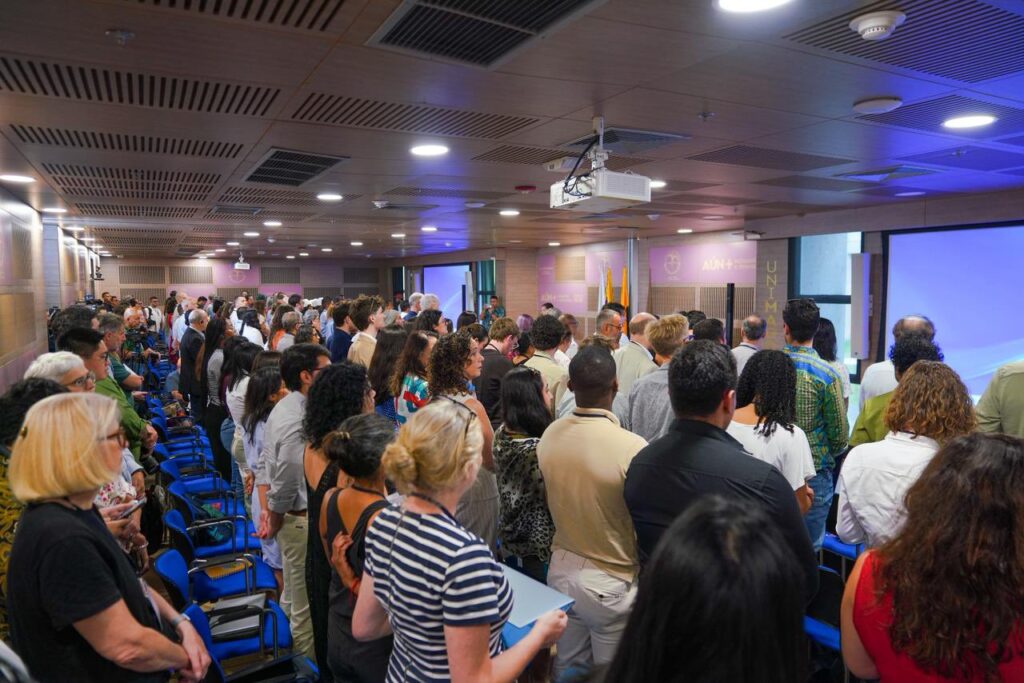
Bogotá, Colombia – The first global summit on “Transitioning away from Fossil Fuels” kicked off today in Santa Marta, Colombia, with 50 country delegations and dozens of civil society organizations in attendance.

Unlike other climate conferences, the six-day meeting will focus on implementing measures to end dependence on oil, coal, and gas, rather than negotiating international environmental commitments. 

The summit comes at a pivotal time for global energy, with conflict in the Middle East restricting oil and gas supplies and creating economic woes for countries reliant on fossil fuels.

Because of the ongoing oil turmoil, the conference came at the “best possible moment” to shift world opinion towards renewables, said Colombia’s environment minister Irene Vélez.

Talking to the UK’s Guardian newspaper this week, the minister, who was a prime mover of the conference, said nations were “at a fork in the road” in their choices between clean power sources such as solar or wind, or continuing to back fossil fuels that created climate crises and conflict.

It promised to be a “coalition of the willing”, said the minister, providing a road map to support nations already dedicated to transitioning from fossil fuels.

The conference organizers were combative in refusing to invite nations and organizations wedded to climate change denial.   

“Whatever nations have not yet taken that decision, then this is not the space for them. We are not going to have boycotters or climate denialists at the table,” Vélez told the Guardian.

Behind the conference is the Fossil Fuel Treaty Initiative, an alliance of nation states, technical bodies, communities and individuals “working to secure a global just transition from coal, oil and gas”.

According to the initiative, globally nations were planning to extract 120% more fossil fuels by 2030 than the “amount consistent with managing the impacts of climate change” – taking warming past the point of survival.  

“The science is unequivocal. For the last decade, oil, gas, and coal have been responsible for 86% of the CO2 pollution heating our planet, as well as causing one in five deaths worldwide from fossil fueled-air pollution.”

Delegates at the inauguration of the fossil fuel conference on Friday. Image credit: @MinAmbienteCo via X

For three decades global climate negotiations had focused on managing the symptoms of the crisis — fossil fuel emissions — while ignoring its root cause: the unchecked proliferation of oil, gas, and coal extraction.

This was a theme picked up by Kevin Koenig, director of climate and energy at Amazon Watch, a California-based nonprofit supporting indigenous communities attending the conference.

The last major summit, COP 30, was held last year in Brazil and saw “fossil fuel lobbyists outnumbering country delegates” he told Latin America Reports, adding that declarations at the end of that meeting “barely mentioned fossil fuels at all”.

In Santa Marta he expected things to be different: “This is the conference that is finally going to address the elephant in the room and get to the source of the climate change problem.”

Several factors were contributing to a momentum towards renewables, added Koenig, with recent data showing that cities and even whole countries have run for weeks off renewable energy as the Middle East crisis exposes the dangers of oil addiction.

“This is the moment where we are seeing both wars linked to fossil fuels politics and dependencies, but also for the first time renewables energies are not just theoretical, they are real, and decision-makers know they are scalable,” said Koenig. 

This was supported by data from the Center for Energy and Clean Air, which reported that global power generation from fossil fuels fell in the first month after the U.S.- Iran conflict closed the Strait of Hormuz – a vital waterway for oil tankers – while energy generated by solar and wind power increased.

Another conference goal was to identify economic and legal barriers to transitioning to renewables, said Koenig.

An example was the hegemony of interconnected global norms feeding fossil fuel dependence, such as arbitration laws that punished small countries in international courts if they attempted to free themselves from big oil contracts. This architecture kept countries dependent, he said.

“Countries transitioning get beat up in arbitration courts or penalized by credit rating agencies. When Ecuadorians voted to keep fossil fuels in the ground, for example, their credit rating went down.”

In countries like Colombia, fossil fuels were also linked to localized conflict and armed groups, explained Koenig; over 30 years Amazon Watch has supported many indigenous communities under attack for defending their territories against drilling.

“Some countries use oil extraction as a reason to open areas, saying ‘we can militarize it and it will be safer’. In fact, oil and energy infrastructure are a magnet for armed groups, for political attacks or blackmail,” he explained.

Inga indigenous guards in Putumayo, Colombia. Their traditional lands are under threat from oil exploration and illegal mining. Photo: Steve Hide.

That dynamic was more visible than ever on the world stage.

“Fossil fuels are fueling dictatorships, violence, conflict and authoritarian regimes,” said Koenig. “The Middle East crisis underscores the urgency to transition.”

“Yes, abandoning fossil fuels is about climate – but also about security and democracy.”

Featured image description: Delegates register at the fossil fuel conference in Santa Marta on April 24, 2026.

Featured image credit: @MinAmbienteCo via X

The post Colombia renewables conference comes at critical moment for global energy appeared first on Latin America Reports.

  • ✇Latin America Reports
  • Bolivia dismisses Colombia ambassador after Petro comments Alfie Pannell
    Bogotá, Colombia – Bolivia’s government ordered Colombia’s ambassador to leave the country just days after Colombian President Gustavo Petro expressed support for ongoing anti-government protests. “The Bolivian government has decided to request that the Ambassador of the Republic of Colombia accredited to the country conclude her diplomatic duties in Bolivian territory,” read a statement on Wednesday morning by Bolivia’s Ministry of Foreign Relations. The ministry expressed its disapprov
     

Bolivia dismisses Colombia ambassador after Petro comments

20 May 2026 at 18:25

Bogotá, Colombia – Bolivia’s government ordered Colombia’s ambassador to leave the country just days after Colombian President Gustavo Petro expressed support for ongoing anti-government protests.

“The Bolivian government has decided to request that the Ambassador of the Republic of Colombia accredited to the country conclude her diplomatic duties in Bolivian territory,” read a statement on Wednesday morning by Bolivia’s Ministry of Foreign Relations.

The ministry expressed its disapproval of Colombia’s involvement in its domestic affairs amid mounting anti-government protests.

“Bolivia considers it essential that any external assessment or statement regarding the country’s internal situation be made with responsibility, diplomatic prudence, and full respect for… institutions,” continued the statement.

While the government did not explicitly mention Petro, the measure came just days after the Colombian president weighed in on the protest movement, describing it as a “popular insurrection” in an X post last Sunday.

In recent weeks, miners, teachers, farmers and Indigenous groups have been calling for President Rodrigo Paz to resign over economic hardships, including soaring inflation and the suspension of fuel subsidies.

Bolivia’s foreign ministry responded to Petro the same day, saying his words, “do not reflect the relation of friendship, respect and cooperation between the peoples of Bolivia and Colombia.”

Petro, whose term ends in August, did not backtrack following the Ambassador’s dismissal.

“If they expel the ambassador simply for proposing dialogue ​and mediation, it means we’re sliding toward extremism that could lead ​to a very difficult situation for the Bolivian people,” the president told Caracol radio today.

Despite the spat, Bolivia’s foreign ministry said diplomatic channels remained open and the expulsion did not count as a full-scale rupture in relations.

The government added that it had granted Ambassador Elizabeth García Carrillo “the appropriate period of time in accordance with current international standards” to leave the country.

Featured image description: President Gustavo Petro (L) and President Rodrigo Paz (R). I

Featured image credit: Wikimedia Commons

The post Bolivia dismisses Colombia ambassador after Petro comments appeared first on Latin America Reports.

  • ✇Latin America Reports
  • Colombia mining accident kills 9 after warnings about gas build-up John Boscawen
    An explosion yesterday at a coal mine near Bogotá, Colombia has left nine miners dead and six more in hospital, with one in a serious condition.  The incident took place at the La Trinidad mine at 3PM local time in the town of Sutatausa, 44 miles north of Bogotá. The accident happened despite the National Mining Agency (ANM) saying it warned of gas leaks at the site after an inspection of the mine on April 9. Following the explosion, fifteen miners were trapped at a depth of around 600m
     

Colombia mining accident kills 9 after warnings about gas build-up

5 May 2026 at 19:14

An explosion yesterday at a coal mine near Bogotá, Colombia has left nine miners dead and six more in hospital, with one in a serious condition. 

The incident took place at the La Trinidad mine at 3PM local time in the town of Sutatausa, 44 miles north of Bogotá.

The accident happened despite the National Mining Agency (ANM) saying it warned of gas leaks at the site after an inspection of the mine on April 9.

Following the explosion, fifteen miners were trapped at a depth of around 600m below the surface. Three of the miners were able to exit the mine by their own means, while a further three were brought out alive after around an hour, according to the mayor of Sutatausa, Jhonatan Ojeda, speaking to El Dorado Radio.

The six surviving miners were taken to Ubaté Regional Hospital, where five were found to be in a stable condition, though showing signs of inhalation of toxic gases. 

But the sixth survivor was reported this morning to be in a grave condition with possible central nervous system damage. He was kept alive by means of invasive mechanical ventilation until he could be transported to a critical care center at the Fundación Santa Fe in Bogotá.

The manager of the hospital at Ubaté thanked the governor and the ambulance service for the speed of their response.

A press release from the ANM confirmed that the emergency was caused by an accidental explosion inside the gallery of the section called La Ciscuda.

“The National Mining Agency expresses its solidarity with the families of the victims and regrets this mining accident in which, thanks to timely rescue efforts, six miners were rescued alive.”

The ANM have confirmed that their operatives visited the mine in question on April 9 and noted issues concerning the accumulation of gas, management of coal dust, and ventilation processes. 

The inspectors delivered a list of safety recommendations to be enacted within thirty days. Twenty-five days had passed between the inspection and the accident. It is not yet clear which of the recommended safety measures had been taken. The mine is operated by the company Carbonera Los Pinos.

This is the second mining-related tragedy to afflict the town of Sutatausa in recent years. In March 2023, 21 miners were killed in an explosion at the El Hoyo coal mine, also caused by a build-up of gas.

Featured image description: Photograph of a section of the remaining tunnel at State Mine.

Featured image credit: Wikimedia Commons.

The post Colombia mining accident kills 9 after warnings about gas build-up appeared first on Latin America Reports.

  • ✇Latin America Reports
  • Bolivia dismisses Colombia ambassador after Petro comments Alfie Pannell
    Bogotá, Colombia – Bolivia’s government ordered Colombia’s ambassador to leave the country just days after Colombian President Gustavo Petro expressed support for ongoing anti-government protests. “The Bolivian government has decided to request that the Ambassador of the Republic of Colombia accredited to the country conclude her diplomatic duties in Bolivian territory,” read a statement on Wednesday morning by Bolivia’s Ministry of Foreign Relations. The ministry expressed its disapprov
     

Bolivia dismisses Colombia ambassador after Petro comments

20 May 2026 at 18:25

Bogotá, Colombia – Bolivia’s government ordered Colombia’s ambassador to leave the country just days after Colombian President Gustavo Petro expressed support for ongoing anti-government protests.

“The Bolivian government has decided to request that the Ambassador of the Republic of Colombia accredited to the country conclude her diplomatic duties in Bolivian territory,” read a statement on Wednesday morning by Bolivia’s Ministry of Foreign Relations.

The ministry expressed its disapproval of Colombia’s involvement in its domestic affairs amid mounting anti-government protests.

“Bolivia considers it essential that any external assessment or statement regarding the country’s internal situation be made with responsibility, diplomatic prudence, and full respect for… institutions,” continued the statement.

While the government did not explicitly mention Petro, the measure came just days after the Colombian president weighed in on the protest movement, describing it as a “popular insurrection” in an X post last Sunday.

In recent weeks, miners, teachers, farmers and Indigenous groups have been calling for President Rodrigo Paz to resign over economic hardships, including soaring inflation and the suspension of fuel subsidies.

Bolivia’s foreign ministry responded to Petro the same day, saying his words, “do not reflect the relation of friendship, respect and cooperation between the peoples of Bolivia and Colombia.”

Petro, whose term ends in August, did not backtrack following the Ambassador’s dismissal.

“If they expel the ambassador simply for proposing dialogue ​and mediation, it means we’re sliding toward extremism that could lead ​to a very difficult situation for the Bolivian people,” the president told Caracol radio today.

Despite the spat, Bolivia’s foreign ministry said diplomatic channels remained open and the expulsion did not count as a full-scale rupture in relations.

The government added that it had granted Ambassador Elizabeth García Carrillo “the appropriate period of time in accordance with current international standards” to leave the country.

Featured image description: President Gustavo Petro (L) and President Rodrigo Paz (R). I

Featured image credit: Wikimedia Commons

The post Bolivia dismisses Colombia ambassador after Petro comments appeared first on Latin America Reports.

  • ✇Latin America Reports
  • Colombia presidential candidates announce running mates as race narrows Alfie Pannell
    Bogotá, Colombia – Iván Cepeda and Abelardo de la Espriella, two of the frontrunners to be the next Colombian president, have announced their choices for vice president following Sunday’s legislative elections and presidential primaries. Cepeda selected Aida Quilcué, a senator and Indigenous leader, to join him on the ticket for the left-wing Historic Pact (Pacto Historico), which won the most congressional seats on Sunday. Meanwhile, de la Espriella, a hard-right outsider, announced today th
     

Colombia presidential candidates announce running mates as race narrows

10 March 2026 at 21:21

Bogotá, Colombia – Iván Cepeda and Abelardo de la Espriella, two of the frontrunners to be the next Colombian president, have announced their choices for vice president following Sunday’s legislative elections and presidential primaries.

Cepeda selected Aida Quilcué, a senator and Indigenous leader, to join him on the ticket for the left-wing Historic Pact (Pacto Historico), which won the most congressional seats on Sunday. Meanwhile, de la Espriella, a hard-right outsider, announced today that he will run alongside ex-finance minister José Manuel Restrepo. 

But the big winner in Sunday’s primary, right-wing Paloma Valencia of the Democratic Center (Centro Democrático) party, has yet to announce her running mate amid mounting speculation.

Cepeda sticks to his guns

On Monday, Cepeda formally announced Aida Quilcué as his running mate. A leader of the Nasa Indigenous group, Quilcué has a record as a staunch defender of human rights and as an advocate for ethnic minorities in Colombia.

She was integral to the negotiation of the ethnic chapter of the 2016 peace accord with the Revolutionary Armed Forces of Colombia (FARC) and has been a key figure in Colombia’s Indigenous rights movement. 

Last month, Quilcué made national headlines when she was kidnapped in her home state of Cauca, in the Colombian Pacific, by dissidents of the FARC. 

Miguel Jaramillo Luján, a Colombian political strategist, described Cepeda’s choice of Quilcué as a “symbolic” one which entrenches his stance as an advocate of peace and human rights.

But the analyst also noted that the selection may not be the most politically savvy move: “From an electoral standpoint, I believe that this is a concentric circle and does not add much electoral power to Iván Cepeda, who I think is acting symbolically but overly prideful in this decision,” Jaramillo told Latin America Reports

De la Espriella’s establishment pick

Abelardo de la Espriella, a criminal defense attorney, has styled himself as an anti-establishment political outsider. His traditional values, tough on crime campaign has been successful so far, regularly placing him in second place in presidential polls.

Today, ‘The Tiger’, as he has styled himself, announced his running mate: José Manuel Restrepo.

Restrepo is an economist at the Rosario University in Bogotá and served as President Ivan Duque’s Minister of Finance and Public Credit from May 2021 to August 2022, running the country’s finances during the COVID-19 pandemic. Before that he was Minister of Commerce, Industry, and Tourism beginning in 2018.

“I think the selection of José Manuel Restrepo… represents an attempt to counterbalance de la Espriella, who has no experience in public office,” said Jaramillo.

While de la Espriella is an outsider, he must take on Cepeda and Valencia, both sitting senators since 2014. Restrepo burnishes the criminal lawyer’s bid by adding proven governance credentials.

When announcing his running mate on Tuesday, de la Espriella said: “My choice of vice president was not driven by political calculation… it was clear to me that a renowned academic, an outstanding economist, and a highly qualified former minister and technician will undoubtedly be the best travel companion.”

Paloma Valencia in the spotlight

On Sunday, Paloma Valencia received over 45% of votes in presidential primaries, although Cepeda and de la Espriella were both absent from the contest.

Valencia’s win, as well as her Democratic Center party’s strong showing in legislative elections – winning the second highest number of seats – bolsters her position in the presidential race, according to experts. 

“From the [primaries], it’s clear that Paloma Valencia is the right-wing’s principal candidate,” Sergio Guzmán, director at Colombia Risk Analysis, a political risk consultancy, told Latin America Reports

Before Sunday’s vote, de la Espriella had been dominating conservative polls. Now, it is unclear which conservative candidate will attract the most voters in May’s election.

Whoever emerges as the winner must face off with Cepeda and will be under pressure to  win over centrist Colombians, said Guzman.

One way to achieve this is by selecting running mates with a broader appeal.

Sunday’s primaries highlighted the widespread popularity of Juan Daniel Oviedo, who was on the same list as Valencia and won 17% of the total votes. The former director of the National Administrative Department of Statistics (DANE), Oviedo is considered center-right and notably more moderate than Valencia.

Valencia is under mounting public pressure to pick Oviedo as her running mate, according to Jaramillo, but the two differ on key issues and Oviedo has specified strict conditions for joining Valencia’s ticket.

“We openly show fundamental differences. For example, I believe in peace,” Oviedo told Colombian radio station Caracol on Monday. “You cannot take positions that do not recognize that the [2016 peace] agreement must be implemented and that it requires more than just bullets to get rid of criminals,” he added.

Valencia has staked her campaign on law and order, promising a ‘mano dura’, or ‘iron fist’, against crime and armed groups in Colombia. Her politics follow those of her party’s founder, ex-president Álvaro Uribe, who waged war on the FARC rebels from 2002 to 2010. 

Today, Valencia told Caracol that she will not compromise on this: “I am an Uribista and I have my values and principles… Neither he [Oviedo] will change nor will I change.” 

But Valencia said she remains open to running alongside Oviedo, with the two due to meet today to discuss a possible joint ticket. She is also considering four other possible running mates, according to Colombian newspaper El Tiempo, with her decision due by Friday.

Jaramillo argues the best move for Valencia is not to pick Oviedo, as he is legally bound to support her as they ran under the same list in the primaries.

He believes she should distance herself from Uribe – arguing Uribistas are more likely to back de la Espriella – and instead court the moderate vote by choosing a center-left candidate.

But Guzmán says that is unlikely: “She seems to be going in a different direction.”

Featured image description: Left to right: Iván Cepeda, Paloma Valencia, Abelardo de la Espriella.

Featured image credit: @PactoCol via X / @PalomaValenciaL via X / @ABDELAESPRIELLA via X

The post Colombia presidential candidates announce running mates as race narrows appeared first on Latin America Reports.

Colombian presidential candidate de la Espriella thanks Trump for endorsing his campaign

3 June 2026 at 21:18
Writing on the Truth Social platform, Trump offered his "complete and total endorsement" for de la Espriella, calling him an "intelligent, strong and tough leader" who will take on a "radical leftist Marxist," referring to progressive Iván Cepeda, in the June 21 runoff election.

  • ✇Latin America Reports
  • Conflict-hit regions face security concerns ahead of Colombia presidential election Catherine Ellis
    Bogotá, Colombia – Human rights defenders, analysts and social leaders in Colombia have expressed concern about the humanitarian situation in conflict-affected regions ahead of the country’s presidential elections on Sunday. Although the National Liberation Army (ELN) and several dissident groups of the now-defunct FARC rebels have announced temporary ceasefires during the election period, rights groups say fears remain high over violence, mobility restrictions and intimidation in remote area
     

Conflict-hit regions face security concerns ahead of Colombia presidential election

29 May 2026 at 21:36

Bogotá, Colombia – Human rights defenders, analysts and social leaders in Colombia have expressed concern about the humanitarian situation in conflict-affected regions ahead of the country’s presidential elections on Sunday.

Although the National Liberation Army (ELN) and several dissident groups of the now-defunct FARC rebels have announced temporary ceasefires during the election period, rights groups say fears remain high over violence, mobility restrictions and intimidation in remote areas.

Lina Mejía, coordinator at the humanitarian organization Vivamos Humanos, said there were still significant risks surrounding conditions during and after the vote.

“It’s not just a question of whether armed groups will respect the elections themselves, but also whether there will be mobility restrictions, whether electoral materials will be protected from attacks after the vote, and whether communities will be free from intimidation,” she told Latin America Reports.

Humanitarian organizations say that while armed groups often refrain from directly attacking polling stations, elections can still be affected by the broader security environment in areas where armed actors exercise territorial control and over illicit economies linked to coca production, illegal mining and extortion.

According to the Electoral Observation Mission (MOE), 386 municipalities across 31 departments have been identified as having some level of electoral risk linked to violence and the presence of armed groups. 

The organization said the number of municipalities at risk had increased compared to earlier assessments and called for stronger protections during the electoral period, especially in regions like Catatumbo and the southwest of the country, including Cauca, Meta and Guaviare.

This week, at least 50 fighters were reportedly killed in Guaviare during a three-hour battle between rival FARC dissident factions. The faction led by Iván Mordisco allegedly attacked a camp belonging to the rival Calarcá group.

Both factions rejected the 2016 peace agreement that led thousands of members of the former FARC guerrilla movement to demobilize.

In Catatumbo, a region along the border with Venezuela, clashes over the past few months between the ELN and FARC dissident faction Frente 33 have kept security conditions volatile.

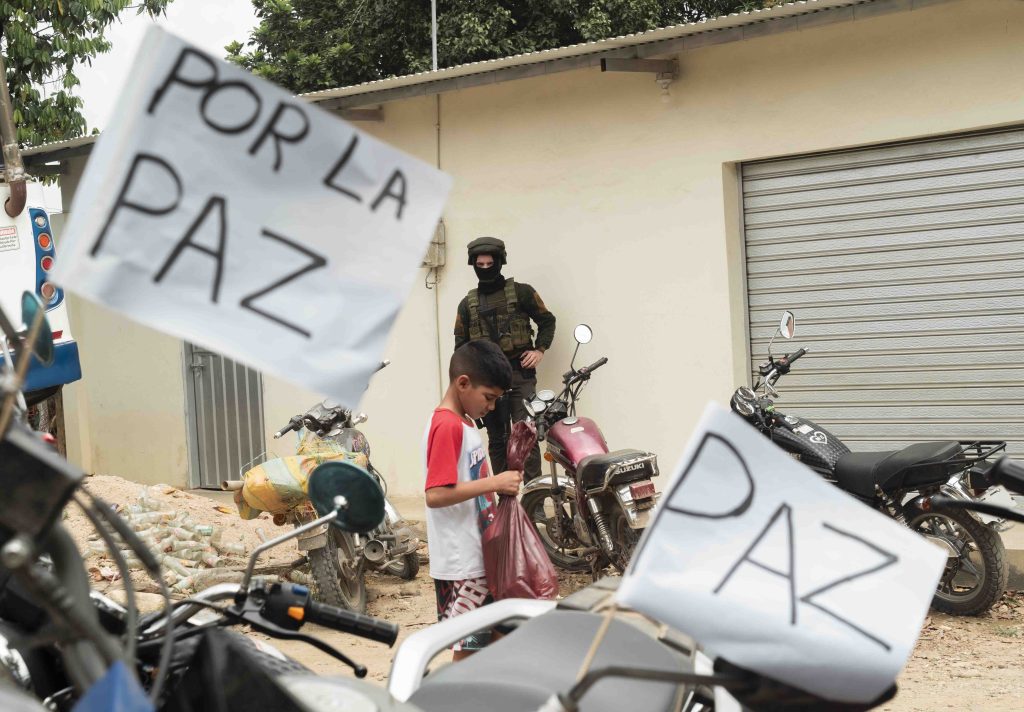
Humanitarian caravan in Catatumbo with peace signs. Credit: Lucas Molet.

Just this month, Freiman Velásquez, a social leader and member of the Association for Peasant Unity of Catatumbo (Asuncat), was assassinated in Tibú. He was killed alongside his sister and two of his bodyguards. The attack has been attributed to the ELN.

Despite the violence, Carmen Garcia, a social leader in Catatumbo, said elections can sometimes bring brief periods of calm.

“There is one positive thing in the territory: when it comes to voting, the armed actors usually respect the process,” she said.

In Catatumbo, the ELN announced a ceasefire beginning Saturday afternoon until after the elections.

But Garcia, who runs an organization rescuing young people from recruitment by armed groups, said many residents no longer trust such agreements following recent killings and security violations in the region.

“Before, the word of the ELN meant something. The word of the FARC meant something. If they said there would not be an attack, you knew there would not be one,” she told Latin America Reports. “But now people no longer truly believe in ceasefires.”

Rights groups say the violence forms part of a broader deterioration in the humanitarian situation in Colombia.

According to Vivamos Humanos, more than 350 violent incidents were recorded during the first five months of 2026.

These include homicides, mobility restrictions, and the presence of anti-personnel mines and improvised explosive devices.

“Among the main impacts are restrictions on mobility and movement, as well as homicides, and the presence of anti-personnel mines, unexploded ordnance and improvised explosive devices,” said Mejía.

Concerns have also intensified in the southern Colombian department of Caquetá. On May 12, audio messages circulated on social media by a FARC dissident group announcing an armed strike across the Caquetá and Caguán river basins, restricting river and road movement.

“We campesinos are in an extremely difficult situation. It’s so tense,” one resident of Cartagena del Chairá, Caquetá, told Latin America Reports. He and other residents were concerned that the strike might affect the ability to vote due to movement restrictions.

The resident said communities had been forced to carry identification documents issued by one armed group and threatened if they failed to do so.

While the strike ended a few days after it was announced, Colombia’s Ombudsman’s Office, the Defensoría del Pueblo, warned that the situation reflected an ongoing pattern of intimidation and territorial control by armed groups.

“This threat adds to a situation that is not new: since December 2025, communities in Putumayo, Caquetá and Amazonas have faced armed strikes and severe restrictions on movement,” the organization said in a statement published on May 15.

The Defensoría also called for “urgent measures” to guarantee the transport of electoral materials and the installation of rural polling stations in remote areas “to guarantee free and peaceful elections on May 31.”

Featured image description: Graffiti from FARC dissidents and the ELN in the city of Cucuta

Featured image credit: Lucas Molet.

The post Conflict-hit regions face security concerns ahead of Colombia presidential election appeared first on Latin America Reports.

  • ✇Latin America Reports
  • The ‘global far right’ in Colombia – lessons from history (Perspective)  Charlotte Eaton
    On May 24, Colombia’s President Gustavo Petro posted on X denouncing an “international alliance of the ultra-right” which was seeking to interfere in presidential elections being held this Sunday.  The so-called “Hondurasgate” responds to a series of audios leaked in late April indicating an alleged conspiracy between the United States, Israel and Argentina to destabilize left-wing governments in Latin America, including in Colombia.  Leaked recordings, first published by Diario Red, a
     

The ‘global far right’ in Colombia – lessons from history (Perspective) 

29 May 2026 at 15:20

On May 24, Colombia’s President Gustavo Petro posted on X denouncing an “international alliance of the ultra-right” which was seeking to interfere in presidential elections being held this Sunday. 

The so-called “Hondurasgate” responds to a series of audios leaked in late April indicating an alleged conspiracy between the United States, Israel and Argentina to destabilize left-wing governments in Latin America, including in Colombia. 

Leaked recordings, first published by Diario Red, allegedly tie former Honduran President Juan Orlando Hernandez to conservative actors in these countries who set out to spread disinformation about leftist governments in Mexico, Colombia and Brazil. 

Such international coordination is not new; since at least last August there have been reports of the far right in Colombia developing increasingly sophisticated ties with extremist groups in Latin America, Spain and the United States. 

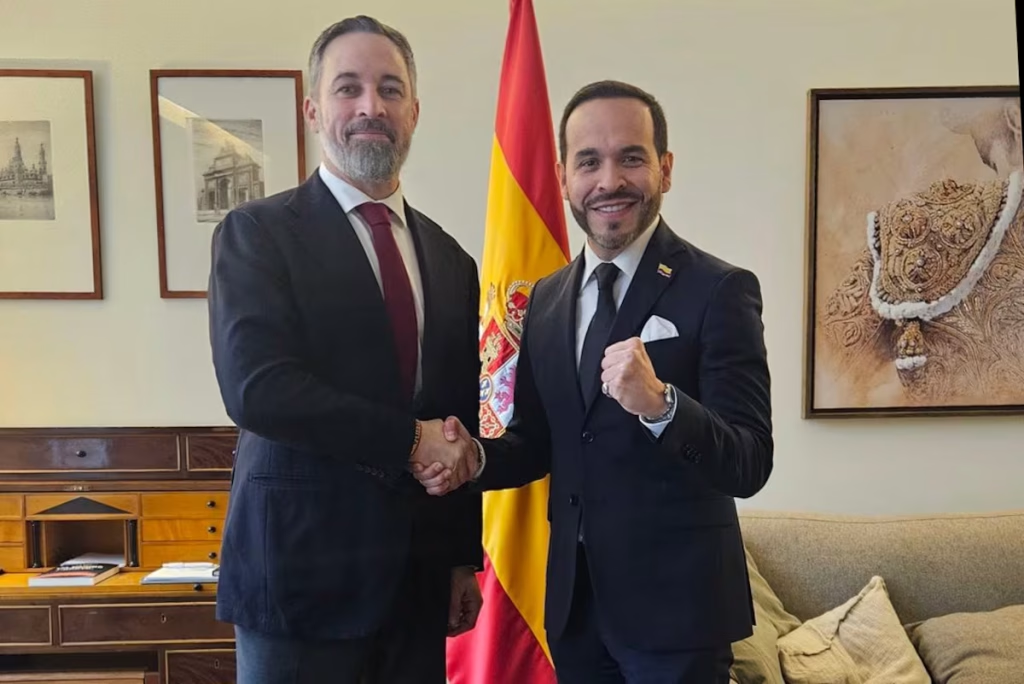
These cross-border networks include significant figures in Colombian politics. In January, presidential hopeful Abelardo de la Espriella travelled to Madrid where he met Santiago Abascal, leader of far-right Spanish Vox party, and participated in the Foro de Madrid, an alliance of right-wing leaders and groups across Europe and the Americas. 

A recent investigation by Bellingcat and Cerosetenta also connected Jorge Rodríguez, ex- congressional candidate for the Centro Democrático, to an alleged member of the global neonazi group Active Club in Bogotá. Rodríguez has been a keen supporter of another contender for the presidency, the Centro Demcrático’s Paloma Valencia.

As Petro’s post suggests, there are also more powerful influences at play. On May 20, Republican Senator Bernie Moreno told a meeting of the Atlantic Council that the United States might not recognize the result of Sunday’s elections if there is evidence of voter intimidation. 

Moreno, who is of Colombian origin and has been invited to oversee the elections as an international observer, also denounced the Petro administration and claimed it would be an “abject disaster” if the country voted in another leftist government. 

Santiago Abascal and Abelardo De La Espriella met in Spain in January 2026. Image credit: Vox

Colombia’s history with the global far right 

As a historian of 20th-century Colombia, focussing particularly on political and social developments in the mid-1900s, I am aware that Colombia’s growing entanglement in the global far right also has historical precedents.

In the late 1930s and early 1940s, various right-wing groups across the country cultivated cross-border connections with fascist-inspired groups in Europe and Latin America. 

In the context of Liberal social reformism, Conservative weakness and a growing fear of communism, several movements emerged across the country (but principally in Bogotá and Medellín) which sought inspiration from Nazism, Italian fascism and, most importantly, Spanish Catholic nationalism. 

The onset of the Spanish Civil War (1936 to 1939) allowed these groups to forge tangible links with their European counterparts in the form of fundraising campaigns for Nationalist troops in Spain, propaganda visits from representatives of General Francisco Franco and the establishment of local branches of the Falange Española, a fascist political party. 

These connections strengthened the Colombian far right financially and politically, making them a not insignificant force in the country. 

Colombia in the mid-20th century was clearly a very different political and social scene. For starters, it had a bipartisan political system and the Catholic Church played a very influential role in politics. 

However, it is worth taking note of the consequences of this previous international mobilization, particularly as the far right plays a much more significant role today. 

Firstly, the growing audacity of right-wing movements led to the halting of a reformist agenda which, although imperfect, did aim to improve the lives of many Colombians. 

It also increased political polarization in the country and infused popular and official Conservative discourse with a particular religious-based nationalism that would have disastrous consequences in the late 1940s when Colombia saw the outbreak of a more-than-decade-long informal civil war. 

Colombian President Laureano Gómez (1950-53) admired General Francisco Franco’s fascist government in Spain and in 1953 promoted a corporatist constitutional reform bill. He was deposed in a military coup that same year. Image credit: Señal Memoria

Finally, the sense that the country’s interests were better served as part of a wider conservative ideal, contributed to a constitutional reform bill in 1953 which sought to turn Colombia into a confessional corporatist state along the lines of Franco’s Spain. 

This bill failed but provoked a coup that inaugurated the country’s only 20th-century dictatorship which was succeeded by a 16-year power sharing agreement that set the scene for the emergence of guerrilla movements from the 1960s.

Of course, no one can predict the long-term impacts of the upcoming election result. However, the events of the 1930s and 1940s should give pause for thought about what the involvement of certain presidential candidates in the global far right could mean for Colombia’s future. 

The opinions and analysis expressed in this column are solely those of the author and do not necessarily reflect the views of Latin America Reports.

The post The ‘global far right’ in Colombia – lessons from history (Perspective)  appeared first on Latin America Reports.

  • ✇Latin America Reports
  • Venezuela contradicts Colombia claims about military strikes near border Amelia Makstutis
    Medellín, Colombia – The Venezuelan government on Wednesday published a declaration saying it regretted recent violence in the Catatumbo region of Colombia just days after Bogotá announced bombing in cooperation with Caracas. The statement muddies the waters about whether or not Venezuela was involved in the military operations against the National Liberation Army (ELN) rebels near the two countries’ joint border, which allegedly killed 7 guerrilla fighters.  “The Bolivarian Republic of Ve
     

Venezuela contradicts Colombia claims about military strikes near border

14 May 2026 at 23:23

Medellín, Colombia – The Venezuelan government on Wednesday published a declaration saying it regretted recent violence in the Catatumbo region of Colombia just days after Bogotá announced bombing in cooperation with Caracas.

The statement muddies the waters about whether or not Venezuela was involved in the military operations against the National Liberation Army (ELN) rebels near the two countries’ joint border, which allegedly killed 7 guerrilla fighters. 

“The Bolivarian Republic of Venezuela expresses its profound concern and regrets the escalation of violence in the border region of Catatumbo,” read a statement shared on X by Foreign Minister Yvan Gil.

The declaration came after Colombian President Gustavo Petro said on Monday that he had ordered the bombing in cooperation with Venezuela. 

“I gave the order to bomb the ELN camp in accordance with the agreement reached with the Bolivarian government of Venezuela,” wrote Petro on X.

Petro appeared to allude to an agreement with Caracas to cooperate on tackling cross-border crime following his visit to Venezuela in April. 

But Caracas appeared to wash its hands of the recent bombing operation; while it did not directly acknowledge the bombing or Petro’s statement, its declaration said that it “rejects any armed action that compromises the peace, stability, and security of border communities.” 

It added that the only way to preserve peace and stability in the region is through “mechanisms of understanding and mutual respect, avoiding actions that can aggravate tensions or generate greater risks for border populations, who for decades have faced the consequences of a conflict out of their control.”

Since last year, Catatumbo has been the site of what has been described as “the most serious humanitarian crisis of recent times” in Colombia. In January 2025, a family of three, including a nine-month-old baby, was killed, marking the collapse of fragile peace pacts between the ELN and the Frente 33 – a dissident faction of the demobilized FARC rebels – and triggering a humanitarian crisis on a scale not seen in the country for over a decade.

The Red Cross said that 2025 was one of the most complicated years for humanitarian conditions in Colombia: more than 235,000 people were individually displaced, over 176,000 people have been unable to move freely because of armed conflict, and there has also been a sharp increase in cases of mass displacements.

Venezuela’s statement highlights the cross-border nature of the conflict, noting that the country “has historically suffered the consequences of Colombian internal conflict.” Colombian armed groups like the ELN and dissident FARC factions have traditionally had a significant presence in Venezuela and were known to have ties to the Nicolás Maduro regime.

But both the interim government under Delcy Rodríguez and Petro have been under pressure from the White House to confront guerrilla groups.

This article originally appeared on The Bogotá Post and was re-published with permission.

Featured image description: Colombian President Gustavo Petro and Venezuelan Interim President Delcy Rodríguez at a meeting in Caracas on April 24, 2026.

Image courtesy of: Colombian President’s Office.

The post Venezuela contradicts Colombia claims about military strikes near border appeared first on Latin America Reports.

News Wrap: More people arrested for breaking curfew at New Jersey ICE detention facility

1 June 2026 at 22:45
In our new wrap Monday, police in New Jersey arrested more protestors for breaking a curfew around an ICE detention facility, election denier Tina Peters was released from prison, Colombia's presidential election is set for a runoff, protesters in Kenya demonstrated against plans by the U.S. government to set up an Ebola quarantine facility and Serena Williams is returning to the tennis court.

  • ✇Latin America Reports
  • Nearly 100 human rights defenders killed every year in Colombia: UN report Lily O'Sullivan
    Medellín, Colombia – During each of the last nine years around 100 human rights defenders have been assassinated in Colombia, according to a United Nations (UN) report published this Thursday. The 972 deaths recorded between 2016 and 2025 make Colombia “one of the most dangerous countries in the world” for such activists, according to the UN’s High Commissioner for Human Rights, Volker Türk.  Following the historic peace accords between the government and the Revolutionary Armed Forces of
     

Nearly 100 human rights defenders killed every year in Colombia: UN report

19 March 2026 at 21:06

Medellín, Colombia – During each of the last nine years around 100 human rights defenders have been assassinated in Colombia, according to a United Nations (UN) report published this Thursday.

The 972 deaths recorded between 2016 and 2025 make Colombia “one of the most dangerous countries in the world” for such activists, according to the UN’s High Commissioner for Human Rights, Volker Türk. 

Following the historic peace accords between the government and the Revolutionary Armed Forces of Colombia (FARC) in 2016, the report noted a gradual increase in assassinations. 

This was linked to the state’s inability to maintain a strong presence in areas previously controlled by the guerrilla group. 

Over 70% of identified perpetrators were armed non-state actors, with the majority of cases analyzed by the report involved in drug trafficking, illegal mining, illegal logging, and human trafficking. 

The number of attacks and threats against human rights defenders investigated by the UN between 2022 and 2025 was 2,018, however this is thought to represent “only a fraction” of the true number due to underreporting and the lack of efficient government records of such cases. 

The report recognized the work of the current Historic Pact (Pacto Histórico) government of Gustavo Petro, which has publicly recognized the gravity of the situation and worked to develop a national strategy to counter it. 

This included the 2022 law that established peace as a matter of state policy, recognizing the state’s responsibility to “guarantee human security” through a “territorial and intersectional approach”. 

However, the UN says the state’s response has failed human rights defenders due to its fragmented nature that lacks coordination between national, departmental, and municipal authorities. 

“In addition to ensuring accountability for the murders that have taken place, addressing the structural causes of this human tragedy through a comprehensive approach must be a priority for all relevant authorities in Colombia, in order to protect human rights defenders and enable them to carry out their vital work safely,” Türk said. 

High levels of impunity have also persisted, with only 55 out of the 800 cases investigated between 2022 and 2025 ending in sentencing. In over half of these cases, no suspects have been identified. 

Nearly a quarter of victims identified by the UN were Indigenous (23%) highlighting a disproportionate effect on this population that represents less than 5% of Colombians. 

Other disproportionately affected groups include Afro-Colombians, LGBTQ+ individuals, rural community leaders and environmental protectors, as well as political leaders. 

The report concluded by urging the Colombian state to take action to combat this issue, recommending institutional reforms and criminal investigations into perpetrators.

Feature image credit: Leon Hernandez via Flickr.

The post Nearly 100 human rights defenders killed every year in Colombia: UN report appeared first on Latin America Reports.

❌
Subscriptions