Normal view

  • ✇Popular Science
  • Hamsters run on wheels for a surprisingly joyful reason Jennifer Byrne
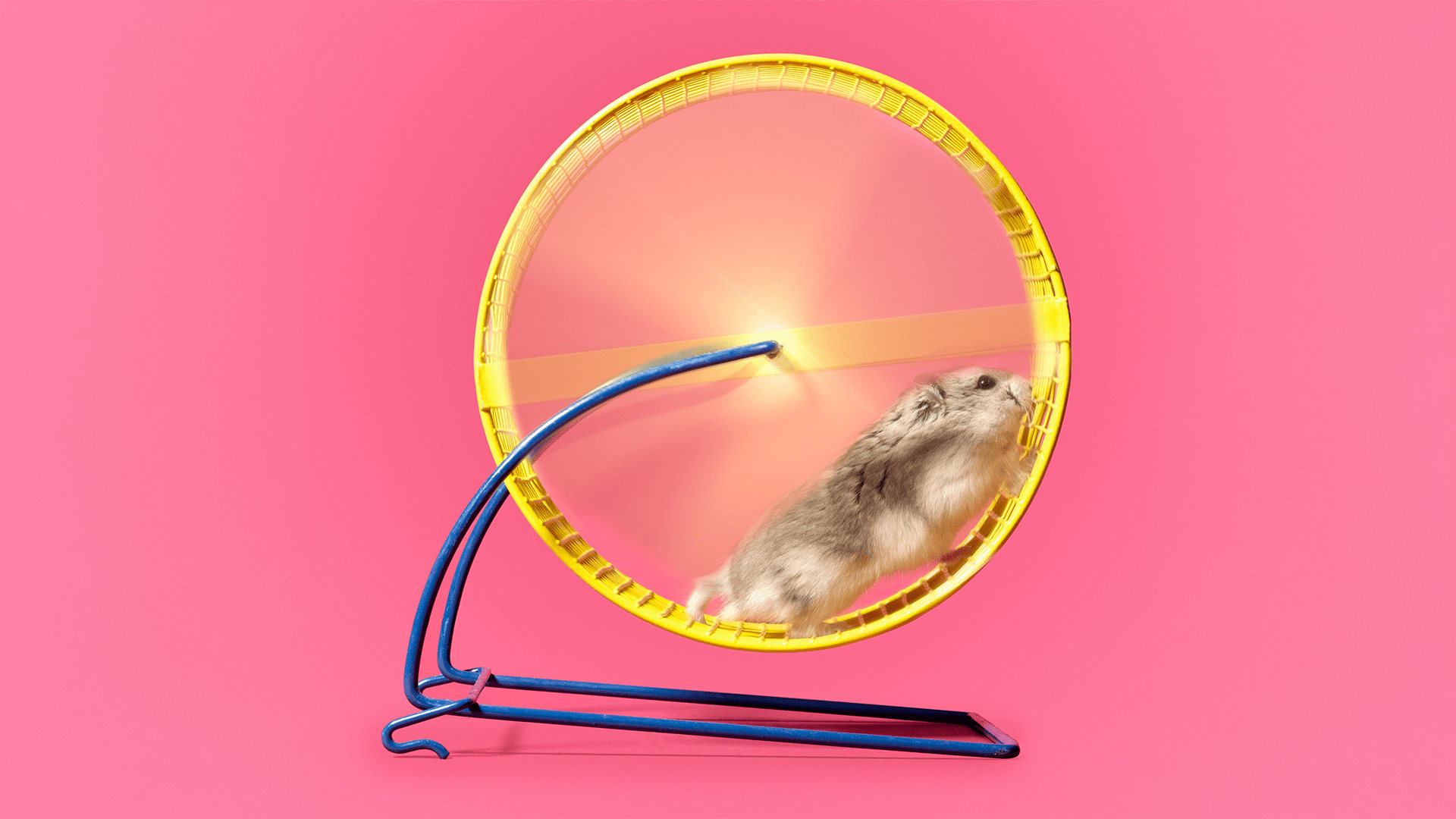
    Everyone who has ever owned a hamster knows the sound: the small, relentless squeak of the exercise wheel, usually starting around two in the morning. As you watch your cute furball running toward no destination whatsoever, you might wonder: What’s going on here? Is little Hammy acting out of restlessness or boredom?  For decades, scientists assumed it was exactly that: a neurosis, an artifact of captivity, the hamster equivalent of doing push-ups in prison.  But in 2014, researcher Joh
     

Hamsters run on wheels for a surprisingly joyful reason

27 May 2026 at 13:03

Everyone who has ever owned a hamster knows the sound: the small, relentless squeak of the exercise wheel, usually starting around two in the morning.

As you watch your cute furball running toward no destination whatsoever, you might wonder: What’s going on here? Is little Hammy acting out of restlessness or boredom? 

For decades, scientists assumed it was exactly that: a neurosis, an artifact of captivity, the hamster equivalent of doing push-ups in prison. 

But in 2014, researcher Johanna Meijer conducted a study that suggested a less depressing scenario. When wild mice came across a wheel in their natural habitat, they got on the wheel and ran—sometimes for up to 18 minutes at a stretch.

So if it’s not boredom or neurosis (wild mice surely have plenty of more important tasks than wheel running), what is it? 

Dr. Theodore Garland Jr., a professor of biology at UC Riverside, has spent more than 30 years trying to figure that out. 

“There’s still a lot of controversy about what, exactly, wheel running means to an organism,” Garland says. “What is it? What is the organism trying to do?”

Why wild mice run on wheels just like your hamster

In Meijer’s 2014 study, published in Proceedings of the Royal Society B, she and her colleagues placed exercise wheels in two different locations: a green urban area and a dune area not accessible to the public. For more than three years, they recorded wildlife activity at both locations.

They found that wild mice closely mirrored the behavior of their cage-dwelling counterparts. At both locations, the mice frequently ran on the wheels—often for lengths of time equal to the “workout” durations of captive mice.

Although food was initially used to attract animals to the wheel, the researchers found that wheel running continued even after the food was removed. This suggests that the animals not only ran voluntarily on the wheel, but did so without any external reward. 

The wheels attracted more than just mice, too. Shrews, frogs, and even slugs were recorded using the equipment (a few snails were excluded from the study due to “haphazard” movements on the wheel). But wild mice used the wheel far more than another animal, accounting for 88 percent of all wheel runners. 

Hamsters aren’t the only creatures that like running on wheels. Video: Wild Animals Caught On Hamster Wheel, Live Science

So, why do rodents specifically enjoy a run to nowhere? Are slugs simply less committed to their cardio?

According to Garland, rodents are simply built for it—bigger home ranges, faster metabolisms, and the aerobic capacity to sustain speed over distance.

“A toad isn’t going to be running 10 kilometers in a day,” Garland says. “Whereas a chipmunk could be.”

Dopamine keeps mice and hamsters coming back for more

But that’s only part of the story. The more interesting question is why any animal would choose to do it at all.

According to Garland, the drive to run on wheels among free-ranging animals is not fully understood, but the behavior is likely tied to the reward centers of the brain. 

Dopamine is viewed as the final common denominator,” Garland says, referencing the neurotransmitter that delivers a sense of pleasure to the brain’s reward system. Similar to a human working out at the gym, mice get a dopamine boost every time they run on their trusty wheel. 

In Garland’s own lab, mice placed in larger, rat-sized wheels will sometimes slow down mid-run and rather than jumping off as the wheel keeps spinning, complete a full 360, and keep going. It serves no obvious purpose. It looks, for all the world, like a bit of acrobatics, as if the little mouse is creating its very own roller coaster.

“I’m hesitant to use the ‘F-word’ about lower vertebrates,” he says, “but it’s hard to ignore the idea that they’re getting some sort of pleasure or enjoyment out of it.” 

Related 'Ask Us Anything' Stories

The reward system may explain the drive, but Garland sees something even more elemental at work—something similar to the “zoomies” dogs and other young animals get. 

A baby horse, Garland notes, will sometimes just tear around a field for no apparent reason—solo, unprompted, burning energy for the sheer joy of it. “We used to call it nip-norting,” he says, “just going crazy, even without another individual to egg it on.”

Exercising at a young age leads to lifelong habits, even for hamsters

Rodents’ love of running on wheels might even have implications for humans. Some of Garland’s work suggests that, when introduced at a young age, wheel running can become a lifelong habit.

In his study, Garland found that mice given access to a running wheel immediately after weaning, at just three weeks old, ran significantly more as adults.

“It’s got to be something up here,” Garland says, indicating the brain. “Their reward system has been permanently tweaked.”

Whatever it is keeping these little guys running, an early start seems to predict an ongoing practice. The implications, Garland believes, extend well beyond mice. For instance, cutting physical education from school curricula, he says, could be “a huge public policy disaster,” leading to adults who aren’t used to exercising.

“If you’re a kid who never gets to play basketball or tennis,” he says, “and then you get to college, and your friends are playing pickup games, it’s probably not even on your radar to do that kind of thing.”

Of course, none of this is on your hamster’s radar at all. They’re just galloping away, keeping you awake with the endless rotation of their squeaky wheel. But all that running can also lead to some good: Recently, a resourceful young YouTuber rigged his brother’s hamster wheel to charge his phone.  

But no need to worry—the clever teen isn’t exploiting the toil of a joyless captive. Hammy, it seems, is just doing what comes naturally. 

In Ask Us Anything, Popular Science answers your most outlandish, mind-burning questions, from the everyday things you’ve always wondered to the bizarre things you never thought to ask. Have something you’ve always wanted to know? Ask us.

The post Hamsters run on wheels for a surprisingly joyful reason appeared first on Popular Science.


  • ✇Popular Science
  • Color doesn’t exist—at least not how you think Jennifer Byrne
    Red means stop. Red means danger. Red means passion. The color conjures up a whole range of emotions and associations. It inspired an entire Taylor Swift album. And yet if someone asked you to describe what red actually looks like, without pointing at something red, you’d hit a wall almost immediately.  So why is it that a color so evocative and distinctive as red (or any color, for that matter) still manages to elude our attempts to nail it down with words?  If you just now said, “It’s be
     

Color doesn’t exist—at least not how you think

6 May 2026 at 13:02

Red means stop. Red means danger. Red means passion. The color conjures up a whole range of emotions and associations. It inspired an entire Taylor Swift album. And yet if someone asked you to describe what red actually looks like, without pointing at something red, you’d hit a wall almost immediately. 

So why is it that a color so evocative and distinctive as red (or any color, for that matter) still manages to elude our attempts to nail it down with words? 

If you just now said, “It’s because color doesn’t exist,” well played!  If you’re like me and your face just turned an indescribable shade of red, welcome to the club. 

“There is no color in the world,” says American neuroscientist Christof Koch. “There are photons of a particular wavelength emitted by the sun that strike an object, and then get reflected into the eye of the viewer. The electrical activity that’s generated there then travels up into the cortex of the brain, and gets processed into something we call color.”

In other words, red isn’t something out there in the world waiting to be objectively and uniformly experienced. It’s something your brain makes up. So does color even actually exist? Neuroscientists think maybe not. At least not in the way we think it does. 

Does color even exist? Short answer: Not really.

Koch, a Meritorious Investigator at the Allen Institute for Brain Science, discusses the subjective experience of color using a famous thought experiment called Mary’s Room. Introduced in the 1980s by the philosopher Frank Jackson, the experiment involves a hypothetical neuroscientist, Mary, who lives in a black-and-white room. Mary knows everything there is to know about color: the wavelengths, the photoreceptors, the way color is processed within the visual cortex. She has read every paper and has conducted every experiment. But Mary has never actually seen color.

One day, Mary leaves the black-and-white room. And for the first time in her life, she sees a red tomato.  

The question Jackson posed is deceptively simple: When Mary sees the red tomato, does she learn something new?

Jackson’s answer was yes. Despite knowing everything science could conceivably tell her about color, Mary is confronted by something that no textbook could convey—the actual experience of seeing red. 

“The feeling, the phenomenal quality, whatever you call it—the experience is subjective,” Koch says. “People have invented a dozen words or more to describe it. It remains inexplicable.”

That “it,” Koch says, is the experience itself—the felt sensation of seeing red that no amount of scientific language has ever quite managed to pin down.

Related 'Ask Us Anything' Stories

Philosophers call that experience a quale (pronounced KWAH-LAY) the felt, first-person experience of something: the redness of red, the sharpness of pain, the taste of coffee. Unlike the wavelength of red, which can be measured precisely, a quale can’t be objectively measured. It’s entirely an inside job.

Koch says the Mary’s Room thought experiment argues against materialism—the philosophical view that everything in the universe, including human experience, can be explained by physics. If materialism is right, there’s nothing science can’t eventually account for. Mary’s Room suggests otherwise: There are some things that science simply can’t explain.

Everyone see colors differently, but not that differently

For the most part, we go about our days equipped with this surprisingly loose consensus on our shared reality. If your blue isn’t quite the same as my blue, it’s close enough not to cause trouble most of the time. But every once in a while, something happens that reminds us how differently our brains can construct the same reality. 

In 2015, a photograph of a striped dress went viral for a reason that had nothing to do with fashion. The dress appeared blue and black to many, but millions of people looking at the same image saw white and gold, and couldn’t fathom how anyone could see it differently. In what now seems like a quaint public rift, the internet divided around the hotly debated reality of blue/black versus white/gold.

“It’s as though they were looking at the same screen,” says Koch. But “half the population saw one movie and the other half saw a different movie.” 

The explanation, says Koch, has to do with how the brain handles ambiguous lighting. Every time you look at an image, your brain makes an automatic, unconscious calculation about the overall brightness of it. This calculation is based on your habits and life experience. 

Research by NYU neuroscientist Pascal Wallisch, drawing on more than 13,000 participants, found that early risers were significantly more likely to see the dress as white and gold, while night owls tended to see blue and black

Because early risers spend more waking hours in natural daylight, their brains are calibrated to filter out blue light, leaving white and gold. Night owls, accustomed to warmer artificial light, filter that out instead and land on blue and black. 

“You get up early in the morning and see a lot of sunlight, or you get up very late and are primarily up at night with artificial light,” Koch says. “So depending on that implicit assumption, your brain gives rise to these two different percepts: white and gold, or blue and black.” It’s not a conscious, deliberate decision you take to view the dress one way or the other. 

Does this dress look blue and black or white and gold? Your answer might have to do with whether you’re an early riser or night owl. Video: What Colour Is This Dress? (SOLVED with SCIENCE), AsapSCIENCE

For Koch, the dress is a window into something fundamental about human perception.

“There is input from the world, but then your particular brain might make a set of assumptions, and my brain might make a different set of assumptions,” he adds. “We obviously agree most of the time, though, or else we wouldn’t have evolved.”

And for the most part, we do agree. A species that couldn’t agree on some basic shared realities wouldn’t have gotten very far. So don’t worry: Your understanding of red is probably pretty similar to my understanding of red.

We all have unique, built-in filters that change how we see the world

The dress, it turns out, is just the beginning. Koch cites the concept of the “perception box.” Writer and researcher Elizabeth R. Koch (no relation) coined the term in 2021 to describe the hidden forces that shape how we see the world. 

According to this theory, we each have our own unique perception box. Think of two people standing in front of the same abstract painting. One sees something beautiful and moving: The other sees a mess. Same painting, completely different experience. That’s your perception box at work. It’s shaped by your genes, your upbringing, and every experience you’ve ever had. 

“We all live in slightly different perception boxes,” he says. “The walls are invisible, and they can expand or shrink, driven by our genes, our neural wiring, our experience.”

Those walls, Koch says, determine far more than which colors we see. They shape how we interpret relationships, how we process emotions, and even how we react to the evening news. Two people can look at the same event and come away with completely different realities, not because one of them is lying, but because their perception boxes are simply built differently.

When it comes to the color red, you can measure its wavelength. You can map exactly what happens in the brain when the eye encounters it. But the actual experience of redness—that felt, interior, indescribable thing—lives inside your perception box, and nowhere else.

“This applies to any conscious experience,” he says. “It applies to pain, say, due to an infected tooth, or the distress you experience when someone leaves you. It’s true for taste, for boredom, for mystical experience, and for psychedelic experience. It has the same ineffable quality.”

Which brings us back to red. You’ve always known it when you’ve seen it. But that color you see? It’s yours and yours alone.

In Ask Us Anything, Popular Science answers your most outlandish, mind-burning questions, from the everyday things you’ve always wondered to the bizarre things you never thought to ask. Have something you’ve always wanted to know? Ask us.

The post Color doesn’t exist—at least not how you think appeared first on Popular Science.
  • ✇Popular Science
  • Animals have personalities. Here’s what shapes them. Jennifer Byrne
    We tend to think of wild animals as being spared from the messy business of personality: the family dramas, the psychological wounds, the baffling quirks that keep resurfacing like whack-a-moles. Turns out, nobody gets out of that. Animals have personalities, too, and many of the same complex forces that shape our personalities shape theirs. “They’re not spared,” says Dr. Alison M. Bell, a behavioral ecologist at the University of Illinois Urbana, tells Popular Science. “Life is hard for t
     

Animals have personalities. Here’s what shapes them.

7 June 2026 at 11:53

We tend to think of wild animals as being spared from the messy business of personality: the family dramas, the psychological wounds, the baffling quirks that keep resurfacing like whack-a-moles.

Turns out, nobody gets out of that. Animals have personalities, too, and many of the same complex forces that shape our personalities shape theirs.

“They’re not spared,” says Dr. Alison M. Bell, a behavioral ecologist at the University of Illinois Urbana, tells Popular Science. “Life is hard for them, too.”

But life is also “rich,” says Bell, full of ups and downs, wounds and triumphs, just like human lives.

It’s one of those truths that is both surprising and incredibly obvious, especially for those of us with pets. And yet the study of animals’ personalities has faced resistance—in part because accepting it means accepting that animals are far more like us than some are willing to admit.

Personality and social psychologist Dr. Sam Gosling noticed a telling pattern among his colleagues in animal research: On coffee breaks, they’d talk freely and enthusiastically about the personalities of the animals they studied, even their pets at home. Then the break would end.

“They’d finish their tea breaks, put on their scientist white coats, and stop any kind of talk about that,” he says. 

But reluctance to engage with the topic scientifically doesn’t mean the evidence isn’t there. Decades of research across species has made one thing abundantly clear: Animals do have personalities. Here’s what the science has to say about what makes your pet special, whether they’re super smart, a risk taker, or a homebody.

1. Animals are shaped by their early environment

For animals, as for humans, the earliest experiences often form the deepest scars or the greatest strengths. 

Animals are influenced by “the early life environment,” Bell says. “They’re influenced by their early interactions with parents and siblings.”

This principle is perhaps most evident in our pets. Bell cites an example familiar to many of us: the traumatized shelter dog with a troubled past.

“Pets who are coming from an animal shelter, or have maybe experienced abuse, they don’t forget that,” says Bell. “That leaves a lasting effect.” 

Yet many of us don’t extend this understanding to, say, childhood trauma in a squirrel. But according to Bell, the same concepts apply to any animal, wild or domestic. A squirrel neglected by its mother carries that experience forward, just as we do. 

“This principle definitely applies to other organisms,” says Bell. 

2. Genetics are important, but not the main factor 

As with humans, genetics are also an influential force in animal personality. Perhaps you might expect animals to be more genetically hardwired than us, driven by pure instinct and with few individual variations. But according to Bell, genetics accounts for only about 35 percent of animal personality—the same as in humans. 

Teasing apart personality traits that come from genetics versus the environment is easier in animals than in humans, according to Gosling. For example, researchers can swap bird eggs between nests to determine whether chicks end up more like their genetic parents or the birds that raised them.

“Because of the experimental control that animal studies afford, our estimates of these effects can be much more precise than they can [be] in humans,” Gosling says. “In humans, we have to deal with them in the messy world.”

Related 'Ask Us Anything' Stories

As for which matters more, genetics or environment, the answer is complicated. 

“These studies have shown that there are genetic factors, environmental factors, biological non-genetic factors, and all kinds of other things that influence animal personality,” he says.

3. Personality varies by species

Beyond factors like genetics and environment, animal personality is also shaped by something more fundamental: the species itself. 

As an evolutionary biologist, Bell says she is particularly interested in biological diversity and its role in shaping personality across species.

“What interests me is what are the behaviors animals do that are really, really important for that particular critter, that species?” she says. “If I’m studying a parrot, what’s going to be important is the food they’re eating, the predators they might encounter, their threats, their opportunities, and their habitats. What are the behaviors that matter to that animal?”

The answer, she notes, varies widely depending on the evolutionary needs and challenges of an individual species. Those factors “will be different for a parrot compared to a fish, compared to a whale, compared to a termite,” she says. 

4. Personality is stable, but changeable

Another notable aspect of personality is continuity—the extent to which an individual’s personality remains consistent or changes over time. Bell says animal personality tends to be pretty stable over a lifetime. 

Bell describes a “signature” that persists from the juvenile to the adult stage, even as behavior naturally changes across life stages. In her research on stickleback fish, Bell and her colleagues have observed consistent personality traits in individual fish.

“We can measure them repeatedly,” she said, “and find that the individuals that were risk-takers yesterday are also the risk-takers tomorrow, and next month.”

Cat on robotic vacuum cleaner in house
Some cats hide from robot vacuum. Others stand on top of them. Their risk taking or nervous approach might all come down to personality. Image: Getty Images / witthaya_prasongsin

But that signature is not immutable, says Bell. Experience can alter it. “New environments, social interactions, even changes in health might influence behavior,” Bell says.

Whether animals can change their personalities more or less than humans over a lifetime remains an open question. 

“I don’t see any theoretical reason why we should expect more or less change in humans than in other animals,” says Gosling, though Bell notes that the answer likely varies widely across species. 

5. Human nature may be holding us back

Another factor shaping our understanding of animal personality is surprisingly close to home: human resistance to accepting it.

Part of the problem, according to Bell, is that accepting the concept of animal personality requires a sort of double reckoning: We have to be willing to see ourselves as less exceptional than we thought, while simultaneously being willing to see animals as more complex than we previously believed.

“Both of those things have to happen, and I think that’s challenging to conventional thinking,” she says. 

Why that resistance persists, even in the face of mounting evidence for animal personality, may say more about human psychology than animal behavior. 

“The most surprising thing to me is how surprising it [the fact that animals have unique personalities] is to people,” says Bell. 

In Ask Us Anything, Popular Science answers your most outlandish, mind-burning questions, from the everyday things you’ve always wondered to the bizarre things you never thought to ask. Have something you’ve always wanted to know? Ask us.

The post Animals have personalities. Here’s what shapes them. appeared first on Popular Science.

  • ✇Popular Science
  • Why sloths risk their lives to poop Jennifer Byrne
    Every week, without fail, the three-toed sloth takes a breathtaking, almost suicidal risk—all for the sake of a bowel movement. Or, to put it in terms familiar to anyone who has sat through a long Zoom meeting, a “bio-break.” With fast-moving predators lying in wait, being on or near the ground is the number one cause of mortality in sloths. And because sloths have among the slowest metabolisms ever recorded in animals, the climb down the tree and back up represents one of the biggest energy
     

Why sloths risk their lives to poop

15 May 2026 at 13:03

Every week, without fail, the three-toed sloth takes a breathtaking, almost suicidal risk—all for the sake of a bowel movement. Or, to put it in terms familiar to anyone who has sat through a long Zoom meeting, a “bio-break.”

With fast-moving predators lying in wait, being on or near the ground is the number one cause of mortality in sloths. And because sloths have among the slowest metabolisms ever recorded in animals, the climb down the tree and back up represents one of the biggest energy expenditures of their entire week.

“It’s like if I had to go on a 5K run down the middle of an interstate, just to use the bathroom,” University of Wisconsin-Madison wildlife ecologist Dr. Jonathan Pauli tells Popular Science. “It’s really costly, and it’s really risky.”

Which begs the question: Why do three-toed sloths take such risks for a poo? Why not just do the sensible thing and poop from the trees?

The answer involves mutualism—a relationship where all parties benefit—between sloths, moths, and that precious pile of dung sloths risk their lives to leave behind. 

Sloths are home to flightless moths

The key to this whole system turns out to be a much smaller and less glamorous creature: sloth moths (Cryptoses choloepi). These moths spend their entire adult lives in sloth fur—yes, entire. The moment a moth finds and colonizes its slow-moving host, it loses the ability to fly. Permanently.

That’s OK, because sloth moths don’t need to fly once they find their sloth homes. Instead, the moths hitch a ride with the sloth to the base of the tree for its weekly poop session. 

Some sloths do a little wiggle or dance when they’re trying to poop. Video: Have you ever seen a Sloth POOP Dance?, The Sloth Conservation Foundation

After the sloth has deposited its dung on the forest floor, pregnant female moths jump off the sloth into the dung pile (because they can’t fly, they literally hop), lay their eggs, and that’s pretty much the end of the moth. 

Meanwhile, a new generation of sloth moths is dreaming big dreams. After hatching within the dung, the newborn larvae quickly commence chowing down on the dung that spawned them. 

“Larvae will feed off the sloth dung. They actually chew a chamber into the sloth dung,” Pauli says. “The larvae then pupate and emerge as moths.”

And then, for one fleeting moment, sloth moths can fly. The newly emerged moths drift up into the canopy of the tree, find and inhabit a sloth host, and the cycle begins again. The moths are permanently grounded. Until, one day, their offspring will make that brief, one-way flight all over again. 

Algae creates a sloth’s green camo coat

Enter the third player in this strange triumvirate: algae.

Because the moths are flightless, many of them live out their entire lives in the sloth’s fur and die there. As they decompose, they release nitrogen and phosphorus directly into the sloth’s coat. 

Pauli describes the sloth’s peculiar water-absorbing hair as “almost like a hydroponic growth area” for algae. 

More moths means more fertilizer, and more fertilizer means more algae, specifically Trichophilus, or “hair-loving algae,” a species found nowhere on earth except sloth fur. Pauli likens the effect to a ghillie suit (the head-to-toe camouflage gear snipers wear to vanish into foliage). The algae turns the sloth’s fur green enough to disappear into the forest canopy.

A sloth up high on a tree branch in a forest in Costa Rica with green fur.
The algae living on sloths gives their fur a green hue, helping the slow-moving animals blend into the forest canopy. Image: Getty Images / zen rial

But that algae also serves another purpose beyond being cool living camo. It’s also a potential food source for these slow-moving mammals.

Do sloths farm algae on their bodies? Maybe.

To find out whether sloths were actually eating this nutrient-rich algae, Pauli and his colleagues did something that sounds alarming but is apparently just a normal Tuesday in wildlife ecology: They pumped the stomachs of roughly a dozen three-toed sloths. 

What they found wasn’t all that surprising: lots of Cecropia leaves, a staple of sloths’ diet. But they also found Trichophilus algae. And since Trichophilus exists nowhere on earth except sloth fur, there was only one way it could have gotten there: The sloth ate its fur. Testing the algae, Pauli and his team found it to be digestible and lipid-rich—a potentially valuable supplement to a diet of nutritionally poor leaves.

What the team of researchers don’t know is whether it matters. Is the sloth cultivating, munching on, and extracting nutrition from its own self-grown snack?  

“It could be totally trivial and unimportant,” Pauli says. “It could be that they incidentally get a little bit in their stomach, it’s all by accident. It would be like the equivalent of me eating a Snickers bar too quickly and accidentally eating part of the wrapper.”

Or it could be that sloths are deliberately consuming it, extracting real nutrition from the algae growing on their own bodies. Whatever is driving it, Pauli is fairly certain of one thing: The sloth isn’t doing it on purpose.

“It’s not conscious—I don’t think the sloth is ever thinking ‘Time to re-up my algae.’ I think it’s more that individuals that have these behaviors, that fortify these relationships with these other species, see fitness benefits. That’s why we see these behaviors persist.”

In other words, this whole system—from flightless sloth moths to algae to sloth diets—may be helping sloths survive. 

Which brings us back to that suicidal weekly commute. It turns out the sloth’s trip to the forest floor may be doing a lot more than answering nature’s call. In fact, it may be the key to maintaining the entire system. No ground trip, no moth-to-dung delivery. No moth delivery, no fertilizer. No fertilizer, no algae. And no algae means no camouflage, and possibly no nutritional supplement for an animal that can barely afford to lose either. Not bad for a bathroom break. 

In Ask Us Anything, Popular Science answers your most outlandish, mind-burning questions, from the everyday things you’ve always wondered to the bizarre things you never thought to ask. Have something you’ve always wanted to know? Ask us.

Related 'Ask Us Anything' Stories

The post Why sloths risk their lives to poop appeared first on Popular Science.

  • ✇Popular Science
  • Yes, you can be allergic to water Jennifer Byrne
    Your immune system has one job: to protect you. And most of the time, it does that job like a pro.  But occasionally it gets a bit overzealous, even paranoid. It mistakes harmless, even wonderful things—flowers, peanuts, cats—for threats, and attacks them (and you—mostly you) with a senseless, chaotic vengeance. For most allergy sufferers, this might mean giving up a few tasty foods, staying inside during high pollen counts, or rehoming the cat—or, more realistically, the person allergic t
     

Yes, you can be allergic to water

17 May 2026 at 12:11

Your immune system has one job: to protect you. And most of the time, it does that job like a pro. 

But occasionally it gets a bit overzealous, even paranoid. It mistakes harmless, even wonderful things—flowers, peanuts, cats—for threats, and attacks them (and you—mostly you) with a senseless, chaotic vengeance.


For most allergy sufferers, this might mean giving up a few tasty foods, staying inside during high pollen counts, or rehoming the cat—or, more realistically, the person allergic to the cat. But for a tiny number of people, the immune system decides to take aim at one of the most essential substances on earth: water.

Yes, it is possible to be allergic to water. And the condition is even stranger than it sounds.

“Imagine not being able to go into the pool, or the lake, or the ocean,” says dermatologist Dr. Amir Bajoghli, who has treated a patient with this rare condition. “My patient also has to take much faster showers, as you might imagine. It definitely interferes with quality of life.”

Yes, you can be allergic to water

The medical term for an allergy to water is aquagenic urticaria, a form of hives. The condition is so rare that only an estimated 100 to 150 cases have ever been reported. However, researchers believe many more cases go undiagnosed: When a patient comes in complaining of hives, “it could be water” is probably not the first thing that leaps to mind.

Close-up view , covered in red, itchy rash with fingers frantically scratching inflamed skin. Allergy Awareness
People with this rare condition break out in hives like these when exposed to water. Image: Getty Images / Yuliia Kokosha

“Honestly, a lot of general physicians aren’t even aware of it,” says Bajohgli, an adjunct professor at Georgetown University School of Medicine. “It’s rare, and it’s not on their radar.”

Although scientists don’t fully understand exactly how aquagenic urticaria works, they believe water itself isn’t the culprit. Rather, it appears that certain people’s skin responds differently to water contact, setting off a reaction in the skin’s outermost layer. This triggers the body’s mast cells (immune cells that sound the alarm during allergic reactions), which releases histamine, the troublemaking chemical responsible for allergic responses. 

Within minutes of water touching the skin, a person with aquagenic urticaria will develop raised, intensely itchy welts. The reaction typically lasts anywhere from 30 minutes to an hour, and the longer the exposure, the more severe the symptoms.

You can still drink water, but sweating can be a problem

Interestingly, and luckily, aquagenic urticaria does not interfere with the body’s need for life-sustaining hydration. In other words, drinking water is fine. When water is swallowed and processed by the gut rather than absorbed through the skin, it doesn’t trigger the same immune response, Bajoghli says.

“The gut, just like the skin and the lungs, is one of the first forms of defense,” he says, “but in this case, somehow, it’s not eliciting the response in the gut the way it does in the skin.”

Bajoghli notes that some patients with aquagenic urticaria do react to their own sweat, although his patient does not. Sweat, he explains, involves an entirely different biological process than external water making contact with the skin.

Scientists believe an unidentified substance in the skin may be triggering this reaction, although much remains unknown. 

“It’s still, medically, for us, a mystery,” he says.

How to test if you’re allergic to water

For better or worse (mostly better), water is inescapable. Because of its ubiquity, and also because aquagenic urticaria is something of a medical unicorn, it often takes a while for patients or doctors to connect the dots. 

Related 'Ask Us Anything' Stories

Once it occurs to the patient and provider that water could be the culprit, diagnostic testing is fairly straightforward. It typically involves applying water-soaked compresses to the skin and waiting. In most positive cases, symptoms appear within five minutes, although the test can take up to 30.

“We wait 30 minutes before we call it negative,” Bajoghli says.

The importance of very quick showers

So, what is life like for a person whose body treats H₂O as a sworn enemy? For Bajoghli’s patient, an active teenager involved in sports, the condition reshapes even the most basic daily routines. Among other things, this means really fast showers. 

“When he showers for about two minutes, the symptoms are more subdued and milder in nature,” Bajoghli says. “If he takes a longer shower, they’re more severe and they persist longer.”

The good news is that aquagenic urticaria is unlikely to cause a major allergic reaction. It is, however, chronic; patients should not expect it to resolve on its own.

Treatment options do exist, however. Bajoghli’s patient takes an antihistamine called cyproheptadine, which reduces symptoms enough to make that two-minute shower manageable. Timing is important: taking the antihistamine about an hour before water exposure helps maximize its effectiveness.

For patients who need more relief, Bajoghli says a newer drug called omalizumab has shown promise.

For now, the mechanisms behind aquagenic urticaria, including the identity of the substance—or antigen—that triggers it, remain poorly understood, and that knowledge gap makes it difficult to develop more targeted treatments.

“We’re really looking forward to finding out what that antigen is,” Bajoghli says, “and hopefully one day solving this.”

In Ask Us Anything, Popular Science answers your most outlandish, mind-burning questions, from the everyday things you’ve always wondered to the bizarre things you never thought to ask. Have something you’ve always wanted to know? Ask us.

The post Yes, you can be allergic to water appeared first on Popular Science.

❌
Subscriptions