There are over 283 million cars cruising the United States, and over 90 percent of them are still guzzling gas. Apart from the obvious environmental problems, fuel prices also continue to skyrocket thanks to the ongoing war in Iran. The average price for gas is currently around 33 percent higher than it was before the crisis, and there is little sign that those numbers are going down anytime soon.
The strain is forcing many drives to reconsider how they get around—and they’re getting creative
There are over 283 million cars cruising the United States, and over 90 percent of them are still guzzling gas. Apart from the obvious environmental problems, fuel prices also continue to skyrocket thanks to the ongoing war in Iran. The average price for gas is currently around 33 percent higher than it was before the crisis, and there is little sign that those numbers are going down anytime soon.
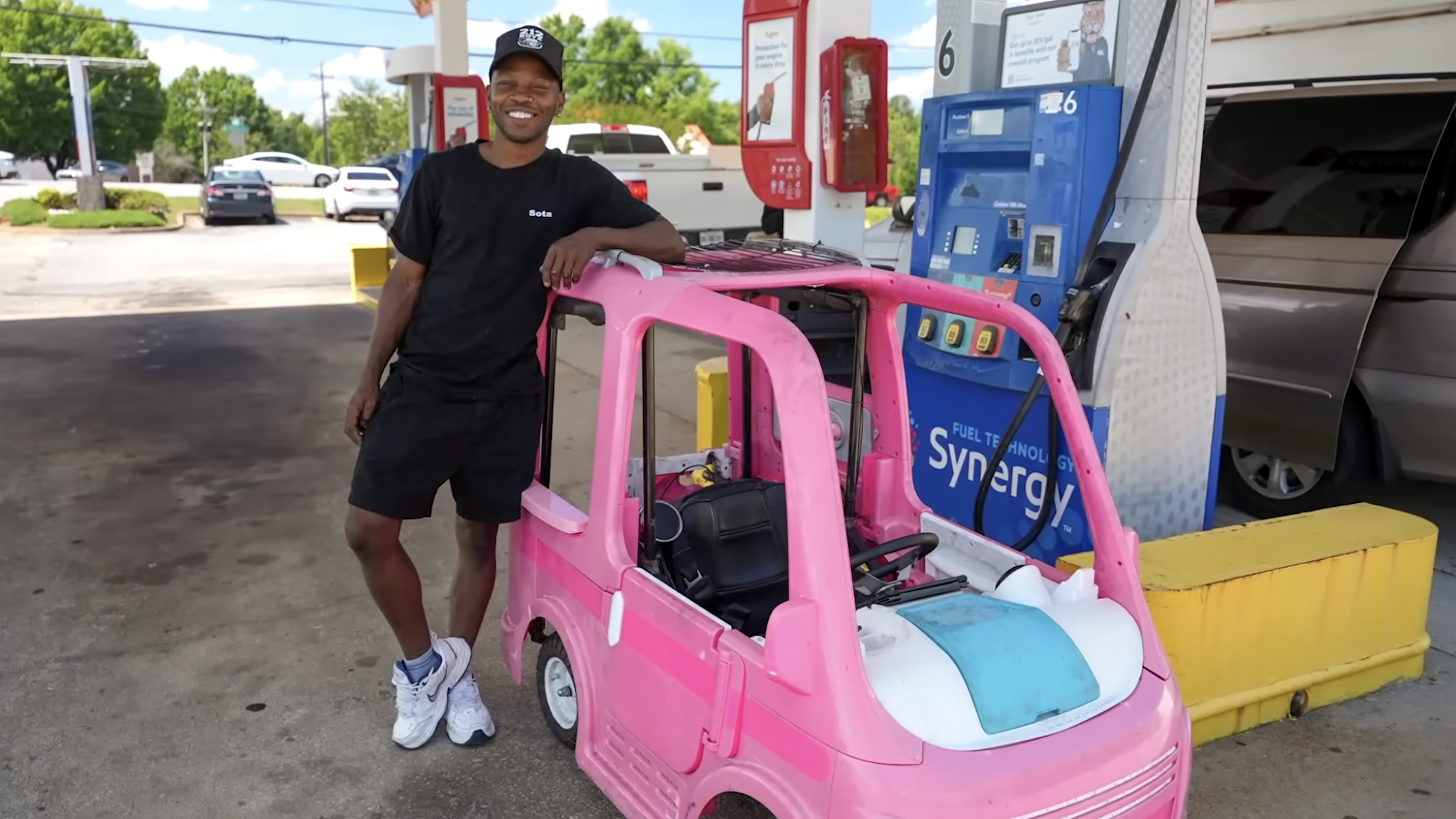
The strain is forcing many drives to reconsider how they get around—and they’re getting creative with it. In Georgia, a 30-year-old handyman is showing everyone how to properly adapt to uncertain times. According to a recent Reuters profile, Mali Hightower has retrofitted a discarded, bright pink Power Wheels Barbie Dream Camper with a two-gallon, one-piston engine for his shorter commuting needs.
“I drive this when I can,” Hightower said on May 19.
To get it going, a driver simply pulls the rip cord that’s attached to the former power washer engine. At less than four-feet-tall, the Dream Camper may not be the most comfortable ride for a full-grown adult,but it’s definitely cheaper. Hightower likely still prefers driving his 1996 Mercedes-Benz convertible, but with a full tank costing him around $90 right now, he’s more than willing to use his Power Wheels alternative for errands like grocery runs.
While somewhat surreal to see at a gas pump, the DIY solution underscores a more important issue: the need for more people to divest from fossil fuel rides in favor of public transportation and electric vehicles (EVs). Unfortunately, that’s easier said than done for many people. The U.S. is dramatically underfunded when it comes to options like commuter bus routes and trains, while EVs are still out of many people’s price ranges. The Dream Barbie Camper may be one-of-a-kind right now, but there’s a good chance that similar, intentionally constructed alternatives are on the way. At least those will be able to comfortably fit the driver.
For many years, Ferrari has done everything in its power to keep making large-displacement, throaty-engined hypercars for the wealthy. It's shunned any notion of environmental responsibility, lobbied countless lawmakers around the world for exemptions from EV mandates, fuel economy targets, and emissions standards — all while moving away from the aspirational bedroom-wall poster brand of the 1980s and toward an investment vehicle for wealthy 0.1%ers.
But last week, it finally brought an EV into
For many years, Ferrari has done everything in its power to keep making large-displacement, throaty-engined hypercars for the wealthy. It's shunned any notion of environmental responsibility, lobbied countless lawmakers around the world for exemptions from EV mandates, fuel economy targets, and emissions standards — all while moving away from the aspirational bedroom-wall poster brand of the 1980s and toward an investment vehicle for wealthy 0.1%ers.
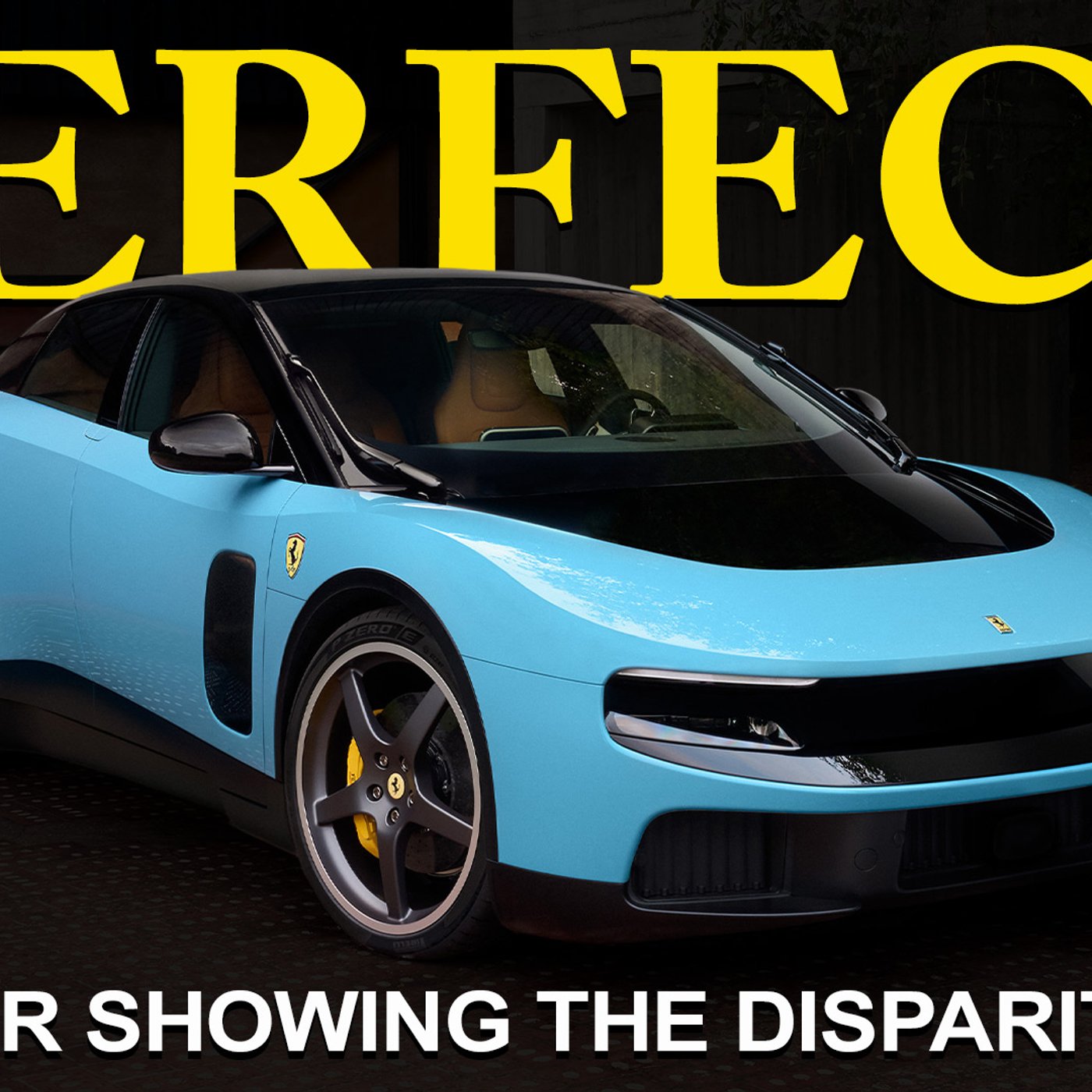
But last week, it finally brought an EV into the spotlight. The Ferrari Luce. Part engineering exercise, part design exercise in self-congratulation, the Luce may be built in-house — but it owes more to Apple's iconic computers of the late '90s and early 2000s than it does to most Ferraris that came before it. And, being a Ferrari, it will of course attract customers who will enthusiastically buy one for their collection, just as hardened automotive fans reject it with the vehemence of a rare-steak devotee presented with a mushroom burger.
But alongside the critique, the criticism, and yes, some pearl-clutching from the peanut gallery, we think the Ferrari Luce does one thing perfectly: it highlights the inequalities that exist in the EV world today — the issues we're seeing time and time again as affordable models become increasingly rare, and an obsession with the ultra-wealthy drives the conversation toward whatever is in vogue, rather than what actually makes the world a better place.
Let's go there.
⏱️ Episode Timeline
00:00 Introduction
05:13 That Escalated Quickly
06:22 About That Comment...
07:28 But First, Some Context
08:26 Support The Channel
09:01 The Ferrari Luce: What You Actually Get
10:46 Designed By Jony Ive (Yes, Really)
11:28 That Design. Where Have We Seen It Before?
13:30 Ferrari's Complicated Relationship With Electric
14:36 Who Actually Buys A Ferrari
17:02 What The Luce Really Reveals
19:49 People Need Affordable EVs. Not This.
21:03 Xiaomi SU7 Ultra vs Ferrari Luce: No Contest
24:44 Back To The Bedroom Wall
27:47 The Verdict
For many years, Ferrari has done everything in its power to keep making large-displacement, throaty-engined hypercars for the wealthy. It's shunned any notion of environmental responsibility, lobbied countless lawmakers around the world for exempt...
For many years, Ferrari has done everything in its power to keep making large-displacement, throaty-engined hypercars for the wealthy. It's shunned any notion of environmental responsibility, lobbied countless lawmakers around the world for exempt...
For many years, Ferrari has done everything in its power to keep making large-displacement, throaty-engined hypercars for the wealthy. It's shunned any notion of environmental responsibility, lobbied countless lawmakers around the world for exempt...
For many years, Ferrari has done everything in its power to keep making large-displacement, throaty-engined hypercars for the wealthy. It's shunned any notion of environmental responsibility, lobbied countless lawmakers around the world for exempt...
For many years, Ferrari has done everything in its power to keep making large-displacement, throaty-engined hypercars for the wealthy. It's shunned any notion of environmental responsibility, lobbied countless lawmakers around the world for exempt...
For many years, Ferrari has done everything in its power to keep making large-displacement, throaty-engined hypercars for the wealthy. It's shunned any notion of environmental responsibility, lobbied countless lawmakers around the world for exempt...
For many years, Ferrari has done everything in its power to keep making large-displacement, throaty-engined hypercars for the wealthy. It's shunned any notion of environmental responsibility, lobbied countless lawmakers around the world for exempt...
Modern autonomous vehicles are getting pretty darn good at seeing the world around them. That is, assuming that lighting conditions are ideal. Once rain, snow, or sudden bursts of bright light from first-response vehicles enter the equation, things start to get a bit dicey. A tiny new sensor component that is roughly the size of a grain of sand, could help solve that problem.
Called a photomemristor, the new sensor was engineered by researchers at Penn State. It breaks from the traditional a
Modern autonomous vehicles are getting pretty darn good at seeing the world around them. That is, assuming that lighting conditions are ideal. Once rain, snow, or sudden bursts of bright light from first-response vehicles enter the equation, things start to get a bit dicey. A tiny new sensor component that is roughly the size of a grain of sand, could help solve that problem.
Called a photomemristor, the new sensor was engineered by researchers at Penn State. It breaks from the traditional approach to computer vision sensors, and instead takes inspiration from good old-fashioned human eyeballs. In essence, it is akin to extra artificial eyes. In testing, the device adjusted between bright and dark lighting environments faster than contemporary methods.
Human eyes easily and innately transition between light and dark. Building that same ability in future autonomous vehicles could make them more reliable, even in inclement weather. That extra help could go a long way, especially as robotaxi companies like Waymo and Zoox prepare to put more and more of their driverless cars on public roads in the United States and abroad. The findings were published this week in the journal Nature Communications.
“By mimicking the way the eye works, we can create photomemristors that work much more reliably for applications in mixed lighting environments,” Larry Chang, an engineer at Penn State and a study co-author, said in a statement.
Where computer vision falls short
Driverless car vision models (and all computer vision systems, for that matter) are only as good as the data that they’re trained on. Though there’s been considerable effort to improve performance in bad weather and odd lighting environments, a quick look at the cities where driverless services are currently available tells a familiar story. Phoenix, San Francisco, Austin all are known for their long, sunny days.
But weather isn’t the only factor that can trip up a computer’s vision. More specifically, those systems can struggle in what the researchers behind this new sensor call mixed lighting conditions. One example of mixed lighting is something most drivers are familiar with—driving down a long, hilly road in the dark, only to have a car pop up on the other side of the lane with its high beams on. That sudden jolt from darkness to the light of the other car’s headlights and back to dark again is disorienting, but most human drivers can manage it and still keep some awareness of their surroundings.
That’s more difficult for machines. In that same scenario, the team notes, a driverless car stunned by the flash of an oncoming high beam may briefly lose track of other figures in its vicinity. That could include the faint hue of a red stoplight or the blurry outline of a deer scurrying by.
Using rods and cones
To address that issue, the Penn State engineers went back to basics and looked at what makes the human eye work well in that scenario. Our eyes contain rods and cones that help distinguish details in the dark. When a light source suddenly gets brighter, the pigments in the rods get temporarily “bleached” and slowly regenerate. The cone cells, meanwhile, stay unchanged during that process, which is what helps us keep track of contrasting details while the rods readjust.
With that naturally occurring process as inspiration, the team set out to build a custom-made photomemristor meant to more or less copy the interplay between the rods and cones in human eyes. They built the sensor out of two materials, a stretchy, gel-like plastic and a powdery compound called titanium oxide, with water flowing between them. The titanium oxide captures light from the environment, which is then converted into an electrical current. That voltage is then passed through the plastic’s conductive surface. In practice, the plastic would absorb more water and slightly swell up in darker conditions, while exposure to more light would cause it to desorb water. The idea, the team notes, was to create eye-like sensors that can “dynamically adapt to changing light conditions.
The team’s photomemristor is quite small, measuring only half a millimeter across. Despite its size, the component can convert light energy into electrical current to power advanced optical systems. Image: Provided by Jia Zhu. All Rights Reserved.
The device itself looks like a gold square, with a smaller square inside it and tiny holes dotted throughout. It’s also minuscule: one square measures just half a millimeter across, making it thinner than most credit cards. For this type of sensor to actually work in a computer vision system, several pieces would need to be connected to form arrays.
To test it, the team combined several of the sensors into a 4×4 array. The array was then paired with a neural network, which would act like the computerized brain in a driverless car or robot. Once combined, the team ran their new machine vision system through variations of a standard eye exam you might see at the optometrist. They placed an LED letter “F” against a background with lighting the team could control. The machine vision system, outfitted with the artificial eyes, had to keep track of and identify the F as the background switched from extremely bright to extremely dark.
After some initial training rounds, the system reported 95 percent accuracy in identifying the letter under mixed lighting conditions. That, the team said, outperformed traditional systems. While it still might not score quite as well as some humans on that test, it did have another leg up.Human eyes typically take somewhere between 20 and 30 minutes to fully adjust to major changes in light, but the team notes the system was able to adjust in a matter of seconds.
Seeing beyond cars
Though the artificial eyes worked well in this narrow test, including the sensors in actual cars you may see on the road is still a long way off. The team says the next step involves expanding the sensor set into a multimodal system capable of processing both visual and tactile data simultaneously. Eventually, though, they are hopeful this could help autonomous vehicles see a bit more reliably.
Beyond that, the team even thinks it’s possible a version of these artificial eyes could help create artificial optics that could provide renewed sight for visually impaired people. Those same eyes, they say, could also slot into humanoid robots to help them better navigate warehouses or other facilities where people normally work. That all sounds quite impressive, though it also starts sounding eerily similar to something out of the dystopian video game “Cyberpunk 2077.”
On this week's episode of TEN — Transport Evolved News!
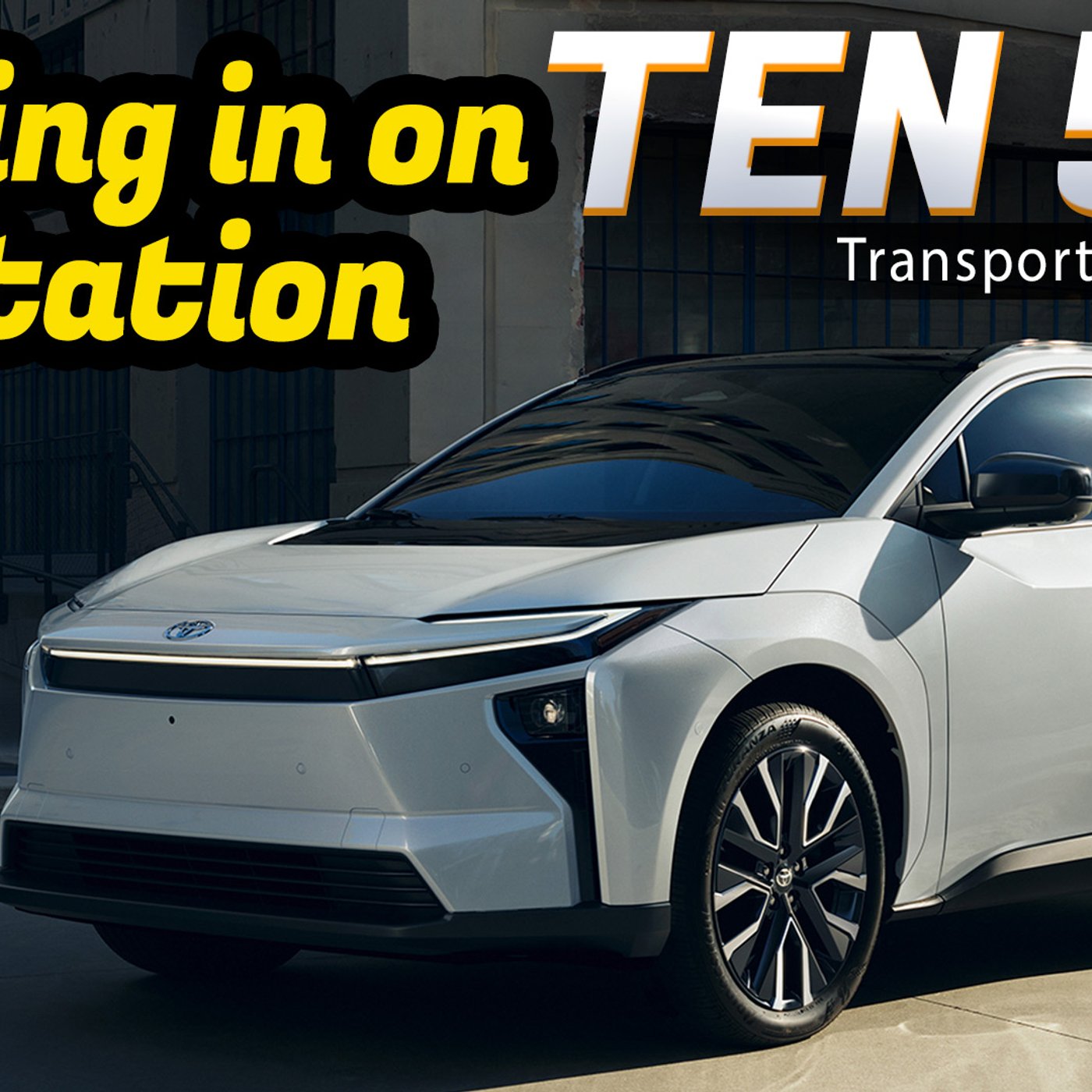
The Volkswagen ID. Polo is officially revealed, Toyota uses years of customer ignorance on EVs to become one of the strongest-selling EV brands of the year thus far, and President Trump's White House pays more energy companies to give up their wind leases and invest in fossil fuels.
Show notes, links and script at: https://www.transportevolved.com/2026/05/02/ten-580-vw-id-polo-here-toyota-cashes-in-trump-pays-to-ditch-wind/
👥 Today’s Spons
On this week's episode of TEN — Transport Evolved News!
The Volkswagen ID. Polo is officially revealed, Toyota uses years of customer ignorance on EVs to become one of the strongest-selling EV brands of the year thus far, and President Trump's White House pays more energy companies to give up their wind leases and invest in fossil fuels.
00:00 - Intro and sponsors
00:35 - Welcome
00:48 - Editorial note
01:08 - VW ID. Polo revealed
02:27 - BMW iX3/i3 and Mercedes GLC long-wheelbase launches in China
03:43 - BYD debuts two new models at Beijing Auto Show
05:03 - Audi Q4 e-tron updates
06:06 - Max Planck Institute paper on solid-state battery short-circuit risks
07:29 - Porsche sells Bugatti Rimac stake
08:32 - U.S. renewable outlook; China exports 68 GW of solar in March
09:34 - U.S. pays $2 billion in taxpayer money to "end wind"
10:55 - VW ID.3 becomes Germany's most popular EV
11:59 - Toyota EV sales soar 139% worldwide
13:09 - Sponsor: CCAN Action Fund
14:35 - Audi e-tron/e-tron Sportback recall: brake booster detachment
14:55 - Bluebird bus recall: loose wiper fasteners
15:06 - Mitsubishi Outlander/PHEV recall: liftgate gas spring
15:19 - Renault backs Lego Turbo R5 3E Project
15:44 - ACEA: EU electric trucks +40%, electric buses +36% in Q1
15:59 - China suspends robotaxi licensing after failures
16:14 - CATL executes HK$39.2 billion stock sale
16:27 - Webasto PTC air heater for commercial EVs
16:42 - Farizon V7E launch and SV cargo van update
16:54 - Porsche Cayenne Coupe Electric unveiled
17:07 - MAN autonomous e-Bus project
17:18 - ABB modular charging station system
17:32 - WeRide and Lenovo: 5-year, 200,000-vehicle deal
17:43 - China threatens retaliation over "Made In Europe Act"
17:55 - Bacolod, Philippines adds EVs to police fleet
18:10 - South Korea buys 500 electric police vans
18:21 - Go North East first with Enviro200EV next-gen buses
18:37 - MAN demonstrates bidirectional truck charging
18:51 - Bosch showcases Level 3 autonomy in China
19:05 - Solaris Bus lands major Sweden order
19:17 - GWM drops Ora 03 in UK
19:28 - GWM ORA5 coming to Europe this summer
19:38 - Stellantis refocuses on four core brands
19:51 - MG eyeing Spain for new factory
20:07 - DHL debuts second solar parcel ship
20:18 - Hanoi gets 120 new electric buses
20:29 - Hyundai pilot battery lease program in South Korea
20:40 - SMMT: 1 in 22 UK vehicles now electric
20:53 - Researchers target 4-litre 22 kW onboard charger for Europe
21:10 - Oslo launches new EV charging pricing structure
21:21 - Moia expands autonomous fleet to Orlando
21:34 - Hongqi rumored in Stellantis talks
21:50 - Nio upgrades to 900V
22:04 - Rolls-Royce unveils Project Nightingale EV
22:17 - Hyundai IONIQ V unveiled in China
22:28 - Tesla isn't the only carmaker dreaming about rockets
22:42 - Ann Arbor pilots home battery program
22:57 - Nio launches Onvo L80 in China at ¥17,700
23:13 - Bollinger Motors assets for sale
23:24 - Kia EV6 gets US price cut
23:39 - Recurrent: range loss shrinking in new EVs
23:53 - Ford Cobra Jet 2200: world's fastest electric dragster
24:08 - Washington State fund for business electrification
24:19 - Kia ramps up PV5 Van production
24:31 - Oregon expands EV fast charging
24:45 - Ford profits from tariff payments
24:58 - GM's big autonomous and Google Assistant plans
25:23 - Sponsor: EnergySage
26:44 - Ford replaces FCSP and Home Integration System
28:04 - Huawei cars can project movies from headlights
28:59 - Thanks and goodbye
30:26 - You Matter
On this week's episode of TEN — Transport Evolved News! The Volkswagen ID. Polo is officially revealed, Toyota uses years of customer ignorance on EVs to become one of the strongest-selling EV brands of the year thus far, and President Trump's ...
On this week's episode of TEN — Transport Evolved News! The Volkswagen ID. Polo is officially revealed, Toyota uses years of customer ignorance on EVs to become one of the strongest-selling EV brands of the year thus far, and President Trump's ...
On this week's episode of TEN — Transport Evolved News! The Volkswagen ID. Polo is officially revealed, Toyota uses years of customer ignorance on EVs to become one of the strongest-selling EV brands of the year thus far, and President Trump's ...
On this week's episode of TEN — Transport Evolved News! The Volkswagen ID. Polo is officially revealed, Toyota uses years of customer ignorance on EVs to become one of the strongest-selling EV brands of the year thus far, and President Trump's ...
On this week's episode of TEN — Transport Evolved News! The Volkswagen ID. Polo is officially revealed, Toyota uses years of customer ignorance on EVs to become one of the strongest-selling EV brands of the year thus far, and President Trump's ...
On this week's episode of TEN — Transport Evolved News! The Volkswagen ID. Polo is officially revealed, Toyota uses years of customer ignorance on EVs to become one of the strongest-selling EV brands of the year thus far, and President Trump's ...
On this week's episode of TEN — Transport Evolved News! The Volkswagen ID. Polo is officially revealed, Toyota uses years of customer ignorance on EVs to become one of the strongest-selling EV brands of the year thus far, and President Trump's ...
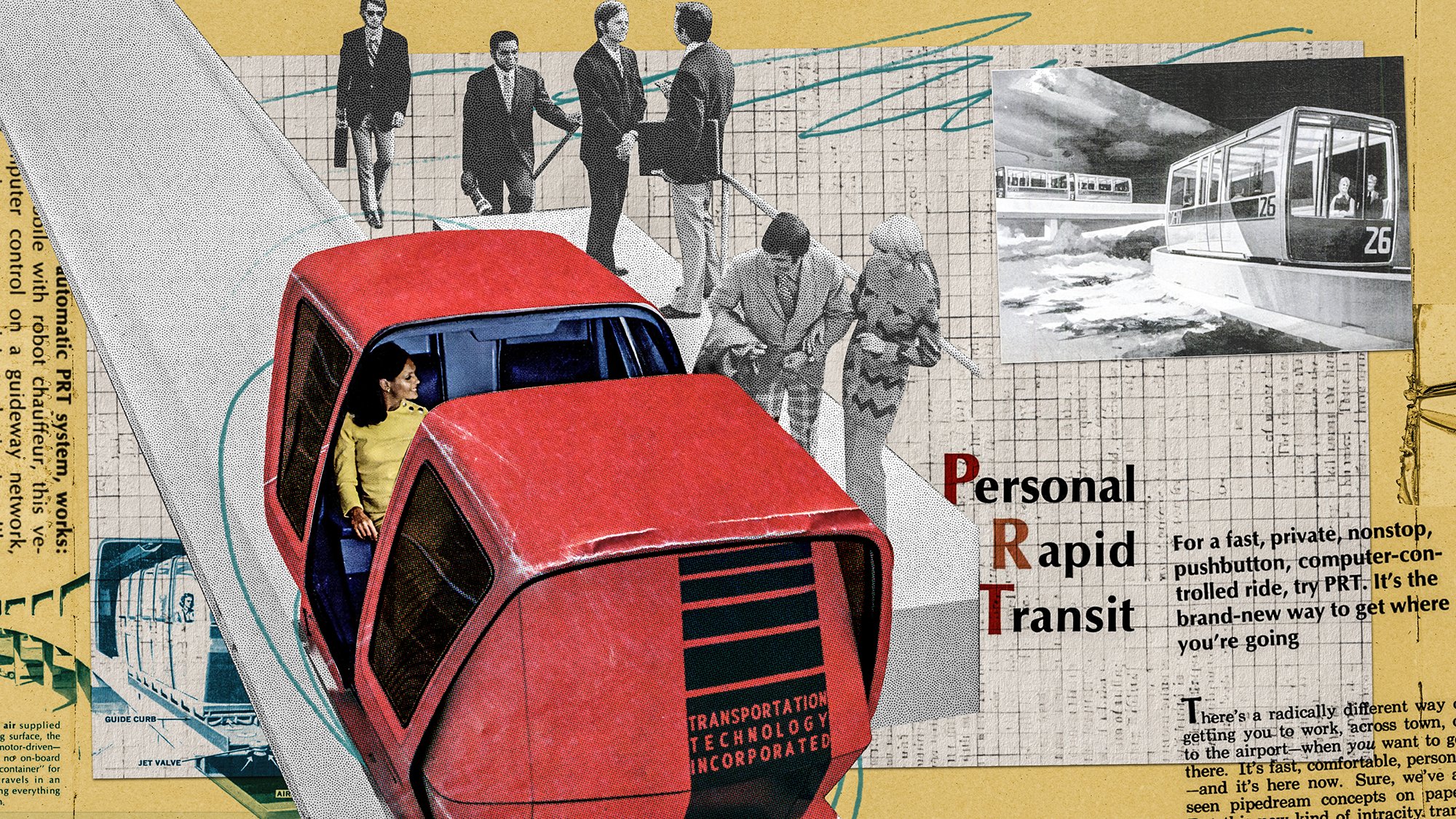
In 1953, Donn Fichter, a graduate student at Northwestern University in Chicago, had a simple transportation idea: What if you tipped an elevator on its side, enabling it to run horizontally, and set it loose in a city? Unlike conventional urban mass transit, elevators are responsive to individuals, callable with the push of a button, and not subject to schedules.
After completing his dissertation in 1958, “Automated Urban Circulation,” Fichter spent years turning that idea into a complete t
In 1953, Donn Fichter, a graduate student at Northwestern University in Chicago, had a simple transportation idea: What if you tipped an elevator on its side, enabling it to run horizontally, and set it loose in a city? Unlike conventional urban mass transit, elevators are responsive to individuals, callable with the push of a button, and not subject to schedules.
After completing his dissertation in 1958, “Automated Urban Circulation,” Fichter spent years turning that idea into a complete transit system design he called Veyar. At its core, Veyar would offer small automated cars running on lightweight guideways. The electric cars would be available at any hour and travel directly from origin to destination without stops, schedules, or drivers. “Personalized transit,” he called it, in which each car “is a self-operating vehicle which can go unattended.” To keep infrastructure construction costs low, he explained, “they have to utilize existing public right of way: the streets.” Fichter self-published the design in 1964, calling it “Individualized Automatic Transit and the City.”
For 60 years, personalized transit systems like Veyar gained support from generation after generation of transportation engineers, but none were ever built. That’s because personal rapid transit systems demanded infrastructure cities couldn’t afford and automation technology that didn’t yet exist. What finally solved both problems wasn’t a transit agency or a federal program, but rather the autonomous vehicle industry. Companies like Zoox and Waymo built Fichter’s system more practically, starting with the automation and letting existing streets serve as the guideways.
The origins of personal rapid transit
Donn Fichter was born in Minneapolis in 1926. After serving in the Army during World War II, he earned engineering degrees from Brown and Northwestern. He was the first serious advocate of what urban planners would eventually call personal rapid transit, or PRT—a vision of on-demand, automated, point-to-point city travel.
Fichter conceived Veyar at a time when traffic choked American cities. Cars gave riders individual freedom at the expense of gridlock. Buses, subways, and elevated rails offered more efficiency but subjected riders to fixed schedules and routes.
What no one had yet built, Fichter argued, was a third system that combined the automobile’s spontaneity and the subway’s separation from traffic, available to anyone at any hour without a driver, a schedule, or a transfer. Gridlock notwithstanding, the environmental stakes, he believed, made the solution urgent.
Even before the first Earth Day was celebrated in 1970, Fichter foresaw the “ecological imperative” to reduce our dependence on private automobiles. He made this case explicitly in a 1968 PRT planning paper, “Small Car Automatic Transit.” Fichter claimed that small, electrically-propelled, autonomous cars running on guideways would mean cleaner air, quieter streets, and cities less congested with the machinery of driving and parking.
Personal rapid transit systems catch on in the 1970s
“Your car is waiting,” wrote journalist Paul Wahl in a 1971 Popular Science feature on personal rapid transit systems. “On entering the car, you push a button to select your destination, then take a seat. The cabin is roomy, automobile-like in accommodations.”
Wahl went on to describe how a PRT trip might unfold: “The automatic vehicle moves away on the station spur, accelerating until it enters the stream of traffic on the guideway.” The car would then switch off the guideway at its destination spur, “with a central computer doing the driving.”
The experience Wahl described was precisely what Fichter’s Veyar system proposed. Small electric cars—sized for just a few riders—would run on slender elevated tramways threaded along existing streets. Stations every few blocks would keep cars queued and ready. Just like an elevator, a rider would board, close the door, press a button, and go. The car would merge into mainline traffic automatically, travel nonstop to the destination, and pull itself into the arrival station without further instruction. Then it would wait, callable for whoever needed it next. A computer would control the entire network. What the elevator had done for the skyscraper, Veyar would do for the city.
The Jetrail at Dallas Love Field was the world’s first airport car-to-plane monorail system. Suspended 17 feet above the ground, its 10 electrically powered 10- passenger cars, traveling at 15 mph, cover the three quarter mile distance between the satellite parking lot and the Braniff boarding area in under four minutes. Image: Popular Science, November 1971 issue
The federal bet on personal rapid transit begins with the Nixon administration
By the early 1970s, the idea attracted serious attention. As Wahl wrote, experts were “banking on it to relieve our metropolitan areas from the twin stranglehold of pollution and congestion.” The federal government committed $6 million to build and demonstrate four competing PRT systems at Transpo72, an international transportation exposition held at Washington, D.C.’s Dulles International Airport in 1972. One of those prototypes was destined for a small college town in West Virginia, where West Virginia University needed a better way to move students between its multiple campuses and downtown Morgantown, West Virginia.
At the same time, planners in Minnesota began drawing up blueprints for a city to be built from scratch on 50,000 acres of rural land—a place called the Minnesota Experimental City, or MXC. The new city was the brainchild of Athelstan Spilhaus, a polymath University of Minnesota dean who had already helped design the 1962 Seattle World’s Fair and co-invented submarine warfare instruments. Spilhaus wanted MXC to be a living laboratory, not a utopia, and personal rapid transit was to be its arteries.
The federal commitment to PRT in the early 1970s produced a brief but remarkable flurry of competing designs. Engineers at aerospace firms, university labs, and automotive companies developed more than two dozen distinct guideway systems—Monocab, TTI, Dashaveyor, Cabinentaxi, Aramis, staRRcar, and others—each with its own switching designs, propulsion method, and structural approach. No two were compatible. The proliferation reflected a significant engineering problem—no one had cracked the code on the automated control systems required to make PRT work. Wahl called this control system the “super-robot trainmaster.”
“The heart of any personal rapid transit system,” Wahl wrote, “is the central computer facility that runs things efficiently and economically, making it practical.” He described a fully autonomous system that not only controls all the cars, “but also handles vehicle distribution and scheduling.” In fact, the central computer would manage just about everything, he explained, leaving little to human operators who are prone to make mistakes. Unfortunately, at the time, such sophisticated automation technology did not exist.
Besides lacking the necessary automation, PRT systems demanded infrastructure cities couldn’t afford to build at scale, even with available federal funding. A network of lightweight guideways would need to be built above city streets, with stations every few blocks, for PRT to deliver on its promise. By the mid-1970s, federal funding had dried up, Transpo72 had come and gone without producing a single municipal contract, the Minnesota Experimental City project had been canceled, and PRT’s moment of official enthusiasm had passed—with one notable exception.
America’s first and only personal rapid transit system
The West Virginia University Personal Rapid Transit system, which opened in Morgantown in 1975, became the closest thing to a guideway-based automated transit system ever built for regular urban use in the United States. It connects the university’s three campuses and the downtown central business district via 8.7 miles of dedicated guideway and five stations, carrying riders in small electric vehicles on demand, without stops between origin and destination. And most importantly: The system works.
The West Virginia University Personal Rapid Transit system debuted in 1975. Video: WVU celebrates 50 years of its PRT system WBOY 12 News, WBOY 12 News
More fundamentally, Morgantown succeeded because it was built for a specific, constrained geography: a university town with four fixed nodes and a captive ridership. That configuration bears almost no resemblance to the open-city, go-anywhere network with stops every few blocks that Fichter had imagined, and it offers no blueprint for replication in a traditional urban setting. For a major city to build what Fichter described, it would have had to retrofit onto automobile-centric city streets dozens or even hundreds of miles of elevated guideway. It’s something no city has ever tried.
Driverless cars: PRT without the tracks?
And yet, six decades after Donn Fichter sketched his first Veyar pods, you can summon one of their descendants with your phone. Today, Waymo operates driverless electric vehicles across six major American cities, completing nearly half a million rides per week in 2025.
Amazon’s Zoox has deployed a uniquely designed robotaxi—no steering wheel, no pedals, carriage seating for four, bidirectional so it never needs to turn around—on the streets of San Francisco and Las Vegas. Between them and a growing field of competitors, the age of individualized automated transit has arrived—just not as anyone planned.
But do robotaxis really fit Fichter’s vision? A car can be summoned with the push of a button. It travels straight from origin to destination without stops. It is “a self-operating vehicle which can go unattended” as Fichter described Veyar in 1964.
Fichter would recognize robotaxis instantly as personalized transit. What’s missing is the “rapid” promise of a PRT system. Driverless taxis are subject to the same traffic-choked congestion that has plagued American cities for nearly a century.
Waymo has faced recalls for vehicles driving into flooded roadways, investigations into repeated failures to yield to school buses, incidents where robotaxis blocked emergency responders at active crime scenes, and acted as getaway cars. A citywide power outage in San Francisco in 2025 triggered a wave of vehicles simultaneously requesting remote confirmation checks, snarling traffic for hours. The riding experience remains geofenced to specific neighborhoods in specific cities.
When issues arise, the system relies on remote human operators—Waymo employs about 70, half of them based in the Philippines—to step in. But these are engineering problems being worked through, not evidence the concept is broken. Arguably, city streets become the guideways when they are filled almost exclusively with robocars, which would complete Fichter’s vision in spirit, if not in intent.
But robotaxis were built as a for-profit product, not as civic infrastructure. They are privately owned, unevenly distributed in cities, expensive on a per-ride basis, and poorly regulated across most of the United States.
What Fichter envisioned was a public system woven into the city—the way elevators are woven into buildings—affordable to everyone, and available at the push of a button. Waymo, Zoox, and their competitors have built something remarkable. But whether it someday resembles the civic infrastructure Fichter had in mind, or remains just another profit-based enterprise siphoning riders and revenue from transit agencies, is ultimately a policy question—one that cities and regulators have so far shown little urgency to answer.
In A Century in Motion, Popular Science revisits fascinating transportation stories from our archives, from hybrid cars to moving sidewalks, and explores how these inventions are re-emerging today in surprising ways.
Just a day after we gave you our breakdown on the difference between the money that some politicians said couldn't possibly be spent on Biden-era, already-apportioned funds for cleaner, greener transportation and energy, while at the same time calling for more than $1.5 trillion in funds to be sent to Department of War for the current conflict in Iran, we heard about a new bill submitted to the U.S. House of Representatives that will further impact EV fans across the U.S.
Enter the 1005+ page BU
Just a day after we gave you our breakdown on the difference between the money that some politicians said couldn't possibly be spent on Biden-era, already-apportioned funds for cleaner, greener transportation and energy, while at the same time calling for more than $1.5 trillion in funds to be sent to Department of War for the current conflict in Iran, we heard about a new bill submitted to the U.S. House of Representatives that will further impact EV fans across the U.S.
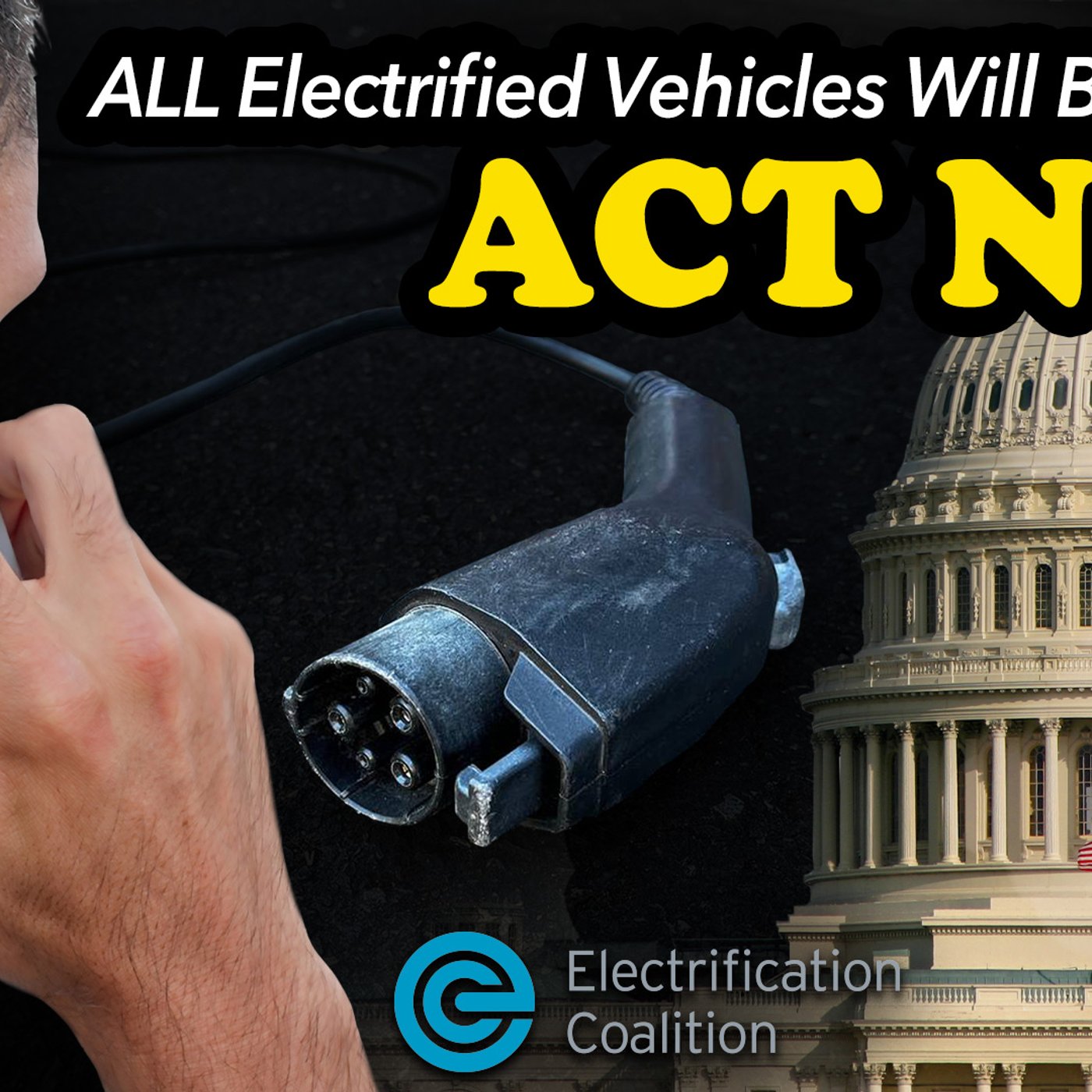
Enter the 1005+ page BUILD America 250 act. Introduced last week and due to be marked up by the end of this, it proposes massive changes to existing provisions for cleaner transportation. Covering the next 5 years, it would also impose new taxes on EV and plug-in hybrid owners, ensure no further NEVI funding is provided, and make it harder for disadvantaged communities and at-risk areas from making smarter choices about their infrastructure.
So today, Nikki is joined by Ben Prochazka, Executive Director of the Electrification Coalition, to break down what's actually in it and what you can do about it.
Show notes, links and transcription at:
⏱️ Episode Timeline
00:00 - Introduction
02:22 - What We're Covering Today
04:30 - Who Are The Electrification Coalition?
07:02 - Politics Are Important!
08:31 - BUILD America 250 Act: Red Flags
11:37 - The Impacts on EV Drivers
13:01 - Increasing Fees — And Plug-In Hybrids Too
14:32 - Gas Taxes Haven't Changed For Decades
15:13 - Other Key Provisions For EV Owners
16:16 - Impacts on Class 8 Big Rig EVs
18:07 - It's a Bipartisan Issue
19:03 - Support The Channel!
20:42 - Changes to Bus Programs
26:34 - What Can YOU Do To Get Involved?
28:39 - Thanks and Goodbye!
Just a day after we gave you our breakdown on the difference between the money that some politicians said couldn't possibly be spent on Biden-era, already-apportioned funds for cleaner, greener transportation and energy, while at the same time cal...
Just a day after we gave you our breakdown on the difference between the money that some politicians said couldn't possibly be spent on Biden-era, already-apportioned funds for cleaner, greener transportation and energy, while at the same time cal...
Just a day after we gave you our breakdown on the difference between the money that some politicians said couldn't possibly be spent on Biden-era, already-apportioned funds for cleaner, greener transportation and energy, while at the same time cal...
Just a day after we gave you our breakdown on the difference between the money that some politicians said couldn't possibly be spent on Biden-era, already-apportioned funds for cleaner, greener transportation and energy, while at the same time cal...
Just a day after we gave you our breakdown on the difference between the money that some politicians said couldn't possibly be spent on Biden-era, already-apportioned funds for cleaner, greener transportation and energy, while at the same time cal...
Just a day after we gave you our breakdown on the difference between the money that some politicians said couldn't possibly be spent on Biden-era, already-apportioned funds for cleaner, greener transportation and energy, while at the same time cal...
Just a day after we gave you our breakdown on the difference between the money that some politicians said couldn't possibly be spent on Biden-era, already-apportioned funds for cleaner, greener transportation and energy, while at the same time cal...
On this week's episode of TEN - Transport Evolved News!
Mexico's Olinia debuts as the country's first nationally-designed EV — built by Mexicans, for Mexicans. Ford teases its long-awaited Ranchero EV with spy shots emerging from Southern California skunkworks testing. And the U.S. Government doubles down on coal investment — even as solar and stationary battery storage hit record highs.
Show notes, links and script at: https://www.transportevolved.com/2026/06/13/ten-586-olinia-mexicos-first-nat
On this week's episode of TEN - Transport Evolved News!
Mexico's Olinia debuts as the country's first nationally-designed EV — built by Mexicans, for Mexicans. Ford teases its long-awaited Ranchero EV with spy shots emerging from Southern California skunkworks testing. And the U.S. Government doubles down on coal investment — even as solar and stationary battery storage hit record highs.
00:00 - Introduction and sponsor shoutouts
00:34 - Welcome to the show
00:48 - Correction: Mercedes eActros lowliner
01:09 - Olinia: Mexico's first national EV launches
02:47 - U.S. EV sales hit best month since tax credits ended
04:17 - Donut Lab solid-state battery expose
05:30 - BYD Flash Charging: China, UK & Canada
06:46 - GM Empower 2026: sodium-ion, V2G & Energy Pass
08:00 - Rivian R2 deliveries start
09:17 - Ford $30k Ranchero EV spotted, teases secret site
10:42 - EU auto package stalls; Brexit EV tariff delay called for
11:53 - US seeks ban on Chinese-nameplate vehicles
13:05 - Solar beats coal for first time; 91% of new US capacity; White House backs coal
14:37 - Sponsor: CCAN Action Fund EV Raffle
15:53 - Chrysler Pacifica Hybrid
16:35 - IC Bus CESB electric school bus recall
16:54 - Mitsubishi Eclipse Sportback = rebadged Nissan LEAF
17:12 - BMW Highway Assistant: 200M km hands-free
17:25 - Waymo buys Apple's AV proving ground, Wittmann AZ
17:40 - Lucid Gravity gets hands-free via OTA
17:53 - Ukraine adopts Wolfstorm electric motorcycle
18:05 - BMW iX3: 10,000 deliveries in first month
18:21 - Factorial & Stellantis begin solid-state road tests
18:36 - Dodge Charger Daytona coming to Europe
18:49 - Cadillac Lyriq keeps CarPlay & Android Auto
19:00 - Amazon tops 50,000 electric delivery vehicles
19:12 - Lucid delays Austria & Spain to 2027
19:24 - BYD Turkey plant on hold
19:35 - DAF launches electric truck route simulator
19:45 - Alaska Air & Hawaiian Airlines electrify Honolulu
19:56 - All of China's top 10 cars: EV or PHEV
20:06 - ForBat@Bau: EV construction research launches
20:18 - Mercedes-Benz adds GLC 250 & GLC 300 4MATIC
20:31 - Opel Astra stays in Rüsselsheim
20:43 - Rosenbauer & MAN make electric aerial ladder truck
20:58 - China updates EREV rules
21:08 - Skoda Epiq production starts in Spain
21:20 - CUPRA Tindaya enters production
21:33 - BMW secures Belgium's largest EV fleet order
21:46 - Factorial & Einride complete NASDAQ listings
21:58 - VW & Dresden unveil mobile charging robot
22:12 - Xpeng starts G6 production in Malaysia
22:23 - Seres launches Aiva brand
22:34 - Milence opens EV truck hub
22:47 - LiveWire S4 Honcho Mini Moto launches
23:00 - Mercedes-Benz axial flux motor production
23:11 - EU greenlights 1.5B euro battery investment
23:24 - Stellantis, Bolt & Pony.ai: Luxembourg AV program
23:38 - Green SM enters India
23:49 - Denza Z hypercar on sale
24:02 - Tokyo expands EV subsidies
24:15 - Tesla FSD ad, distracted driving
24:32 - Nissan, Oxford & GeLion: solid-state research
24:42 - Leapmotor C10 production starts in Malaysia
24:57 - Clean Motion AB: EVIG Memorial electric hearse
25:12 - Leapmotor B05 from 28,995 GBP in UK
25:26 - Kia EV4 gets maximum 3,750 GBP UK grant
25:40 - BMW iX3 LWB: 800km on a charge
25:56 - BYD threatens to sue over Pentagon military list
26:18 - Sponsor: You
27:15 - & EnergySage
27:55 - EVs prevented 262,000 deaths in China
29:02 - Waymo launches $30/month Premier subscription
30:28 - Closing sponsor acknowledgements
31:34 - Thank you & goodbye
On this week's episode of TEN - Transport Evolved News! Mexico's Olinia debuts as the country's first nationally-designed EV — built by Mexicans, for Mexicans. Ford teases its long-awaited Ranchero EV with spy shots emerging from Sout...
On this week's episode of TEN - Transport Evolved News! Mexico's Olinia debuts as the country's first nationally-designed EV — built by Mexicans, for Mexicans. Ford teases its long-awaited Ranchero EV with spy shots emerging from Sout...
On this week's episode of TEN - Transport Evolved News! Mexico's Olinia debuts as the country's first nationally-designed EV — built by Mexicans, for Mexicans. Ford teases its long-awaited Ranchero EV with spy shots emerging from Sout...
On this week's episode of TEN - Transport Evolved News! Mexico's Olinia debuts as the country's first nationally-designed EV — built by Mexicans, for Mexicans. Ford teases its long-awaited Ranchero EV with spy shots emerging from Sout...
On this week's episode of TEN - Transport Evolved News! Mexico's Olinia debuts as the country's first nationally-designed EV — built by Mexicans, for Mexicans. Ford teases its long-awaited Ranchero EV with spy shots emerging from Sout...
On this week's episode of TEN - Transport Evolved News! Mexico's Olinia debuts as the country's first nationally-designed EV — built by Mexicans, for Mexicans. Ford teases its long-awaited Ranchero EV with spy shots emerging from Sout...
On this week's episode of TEN - Transport Evolved News! Mexico's Olinia debuts as the country's first nationally-designed EV — built by Mexicans, for Mexicans. Ford teases its long-awaited Ranchero EV with spy shots emerging from Sout...
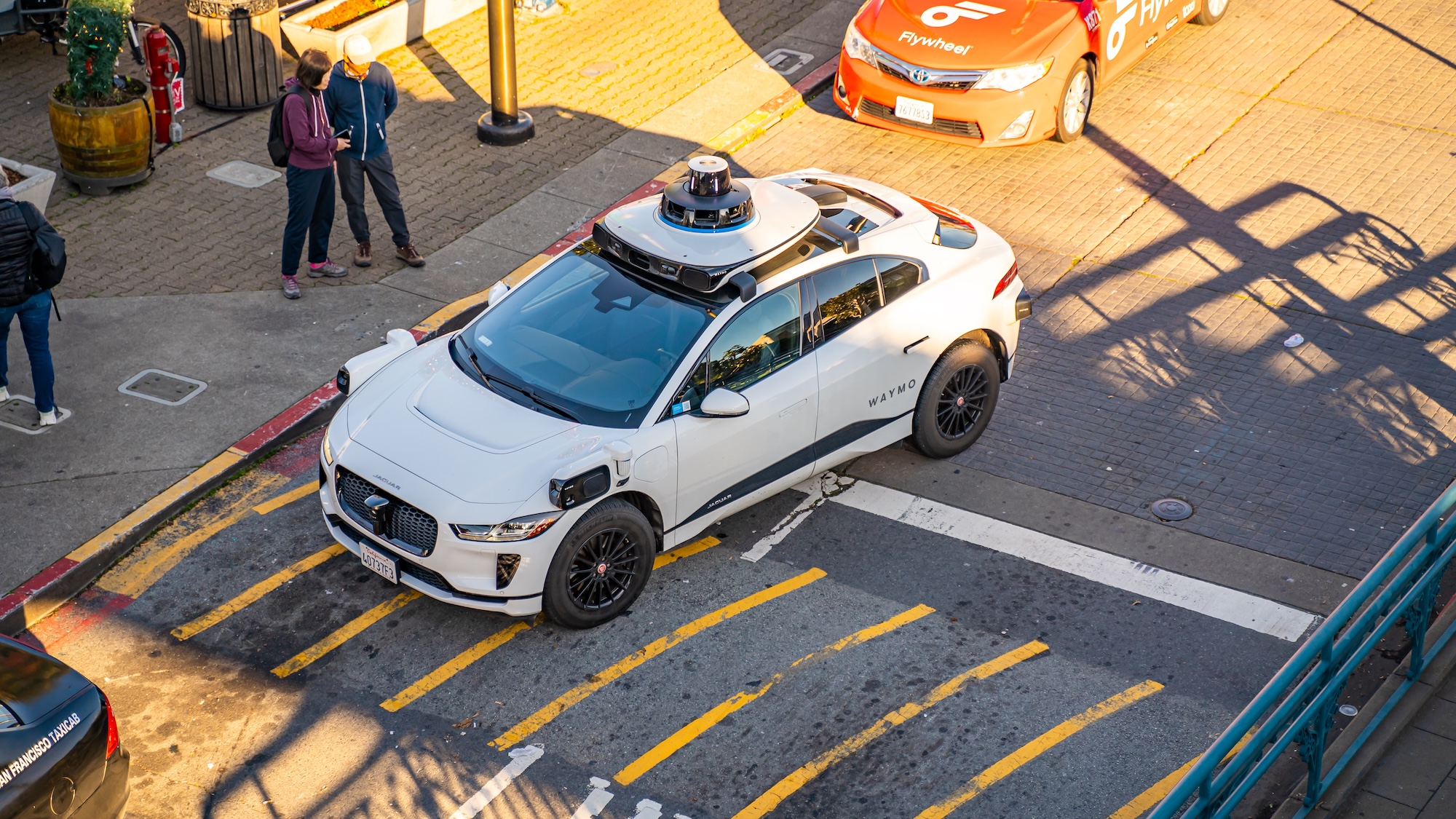
It may not have been the most thrilling getaway job, but San Francisco law enforcement said it’s one of the first crimes of its kind. It also remains unsolved after nearly six months. According to officials speaking with the San Francisco Chronicle, police are still investigating a case in which an unidentified man stole an arm-full of activewear from a local yoga studio, then fled the scene inside a self-driving Waymo taxi.
“I would think it would be easier to solve in a Waymo,” Sgt. Tim Fay
It may not have been the most thrilling getaway job, but San Francisco law enforcement said it’s one of the first crimes of its kind. It also remains unsolved after nearly six months. According to officials speaking with the San Francisco Chronicle, police are still investigating a case in which an unidentified man stole an arm-full of activewear from a local yoga studio, then fled the scene inside a self-driving Waymo taxi.
“I would think it would be easier to solve in a Waymo,” Sgt. Tim Faye told the newspaper on June 4.
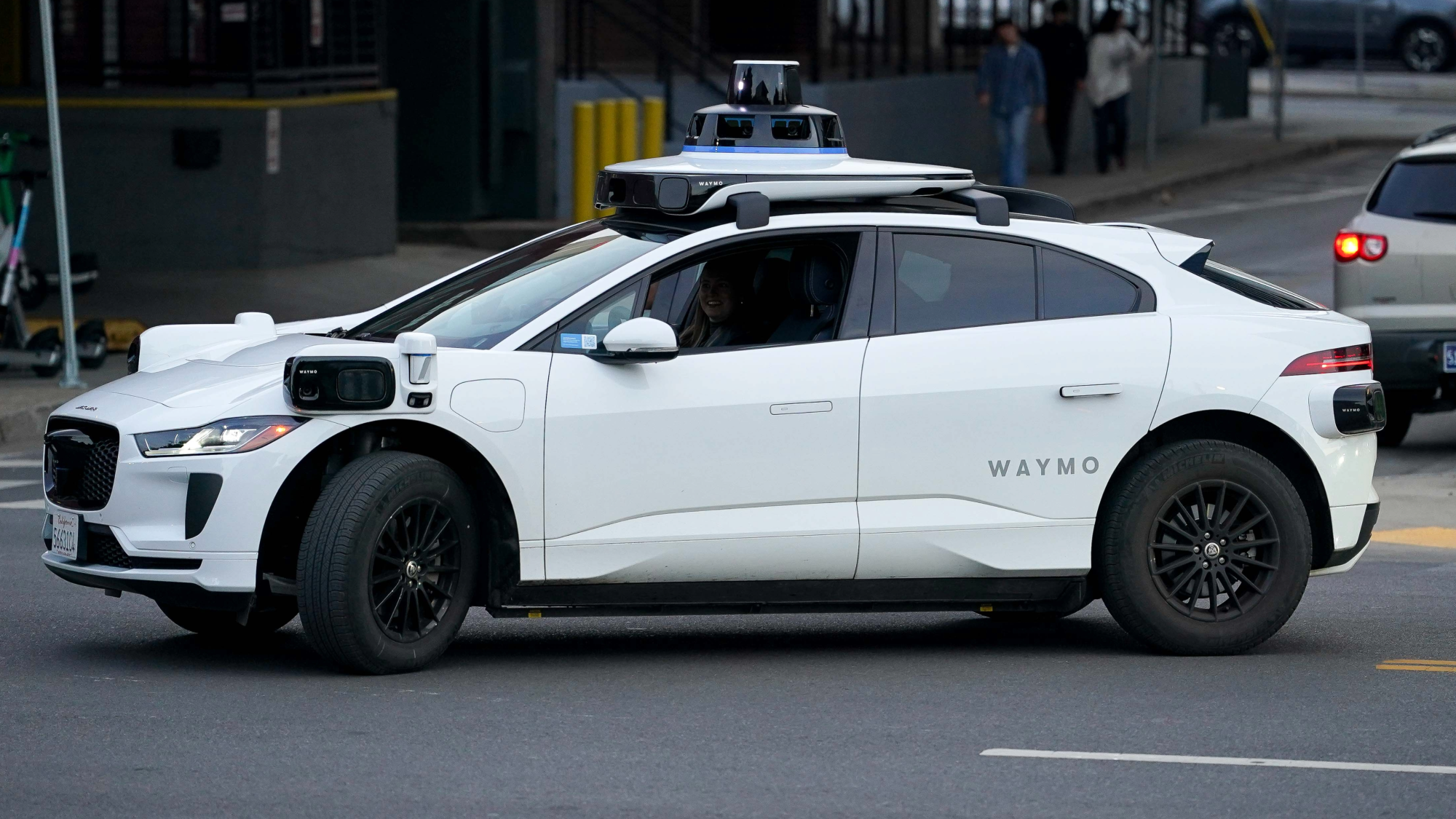
Anticipating an open-and-shut investigation is understandable, but the situation is actually more complicated than it seems. While police couldn’t comment on an active case, it’s almost certain the robber used a burner account or stolen phone to order the taxi service, which debuted its self-driving option to San Francisco customers in June 2024. The white Jaguar used during the getaway features around 29 high-definition cameras mounted inside and outside the autonomous vehicle that provide 360-degree vantages, but Waymo only temporarily retains recordings. The company erased all interior footage by the time investigators filed a search warrant in April 2026, and data privacy laws ensure that any faces captured on cameras outside the car must remain blurred.
Skeptical customers and safety concerns have restricted autonomous ridesharing to only seven cities across California, Arizona, Texas, Florida, and Georgia so far. That said, companies like Waymo are still aggressively pursuing plans to expand the service to other parts of the country. One of the only other similar crimes occurred last year in Los Angeles, when a suspect allegedly robbed a grocery store and then left in a Waymo. In that instance, police pursued the vehicle and successfully pulled the car over after turning on its emergency lights.
“It’s highly unusual in the first place that a Waymo is even used by a suspect,” added Sgt. Faye.
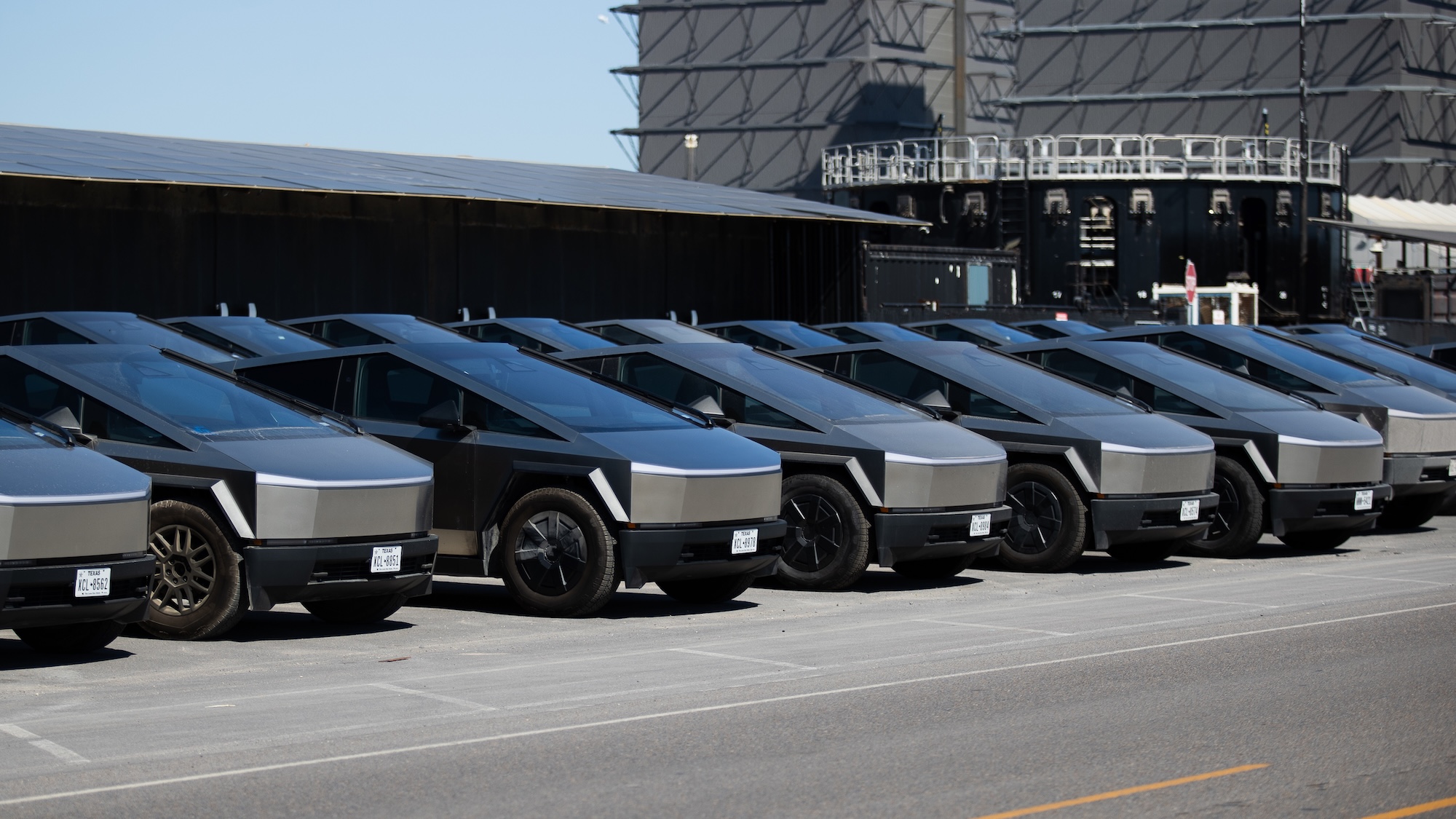
The wheels may be falling off the Tesla Cybertruck. No, seriously. According to a recent National Highway Traffic Safety Administration (NHTSA) recall alert, an estimated 173 of the stainless steel electric vehicles (EV) may be at risk of cracks forming in the brake rotor studs. These cracks could separate from their wheel hubs.
“Wheel hub separation can cause a loss of vehicle control, increasing the risk of crash,” the NHTSA explained in its recall. Such emergencies may even include an enti
The wheels may be falling off the Tesla Cybertruck. No, seriously. According to a recent National Highway Traffic Safety Administration (NHTSA) recall alert, an estimated 173 of the stainless steel electric vehicles (EV) may be at risk of cracks forming in the brake rotor studs. These cracks could separate from their wheel hubs.
“Wheel hub separation can cause a loss of vehicle control, increasing the risk of crash,” the NHTSA explained in its recall. Such emergencies may even include an entire wheel falling off the EV.
The 173 EVs span the Cybertruck’s 2024-2026 models, specifically those equipped with the optional 18-inch steel wheels. According to Kelley Blue Book, the EVs may start vibrating or issuing a noise before the wheel stud separates. Tesla is now offering affected vehicles free wheel hub and rotor replacements, as required by U.S. law.
The latest NHTSA alert is the latest in a string of recalls to affect the Tesla Cybertruck. Although the regulatory body awarded the EV a five-star overall safety rating, the vehicle line has received 11 recalls, four investigations, and 124 complaints since its debut in 2023. Previous recalls have involved faulty accelerator pedals from misapplied soap, malfunctioning windshields, and more.
Elon Musk once hyped the Cybertruck as the “finest in apocalypse technology” and “what Bladerunner [sic] would have driven,” but Tesla’s stainless steel EV simply hasn’t gained much traction. After over four years of production delay, the Cybertruck arrived about $20,000 more expensive than its original estimated base price. Tesla hoped to sell around 250,000 vehicles in 2024, but ended the year with less than 20 percent of their goal. Those numbers have continued to plummet, with barely 3,500 Cybertrucks sold within the last few months.
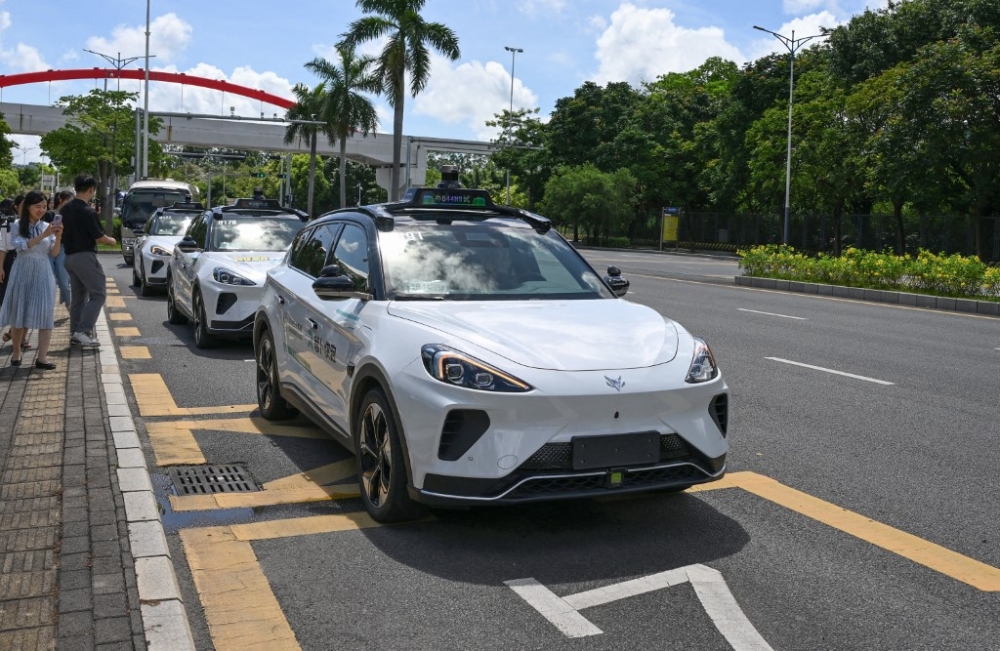
LONDON, June 11 — Chinese tech giant Baidu will start testing its autonomous vehicles in London “in the coming weeks”, US ride-hailing platform Lyft, its partner on launching the capital’s robotaxi service, told AFP yesterday.It comes after Wayve, a British startup specialised in artificial intelligence for self-driving vehicles, said Monday it was ready to launch its robotaxi service with Uber in London as early as this summer.Lyft executive Jeremy Bird told AFP
LONDON, June 11 — Chinese tech giant Baidu will start testing its autonomous vehicles in London “in the coming weeks”, US ride-hailing platform Lyft, its partner on launching the capital’s robotaxi service, told AFP yesterday.
It comes after Wayve, a British startup specialised in artificial intelligence for self-driving vehicles, said Monday it was ready to launch its robotaxi service with Uber in London as early as this summer.
Lyft executive Jeremy Bird told AFP that his company’s “autonomous vehicles will be on the (London) streets soon, in the coming weeks” after already arriving.
“They need to get inspected and pass (tests)... and then they’ll be out on the streets,” Bird said, adding that the company hopes to launch commercial operations this year.
Self-driving taxis are already in operation in the United States and in China, but a commercial deployment in London would be a first for Europe.
Customers will have to wait a little longer for fully driverless taxi rides in the British capital, however, as Wayve plans to launch its vehicles with an operator behind the wheel.
The American giant Waymo, a subsidiary of Google parent Alphabet, hopes also to launch its driverless vehicles in London by the end of 2026 after mapping the capital for several months.
The world leader in driverless cars currently operates in eleven US cities, while Baidu’s autonomous vehicle subsidiary — Apollo Go — operates in 27 Chinese cities and in Dubai.
The exact timeline for London’s rollout depends on the implementation of the UK framework for automated vehicles and on approvals by authorities.
Bird said Lyft will manage the fleet, and marketing on its app, for the London vehicles, while Baidu is producing the vehicles and their technology.
He said the taxi fares will “probably start as pretty similar” to rides carried out by human drivers.
Apollo Go provided 3.4 million driverless rides in the final quarter of last year, up 200 percent compared with the last three months of 2024, the company has reported.
It has a fleet of more than 500 autonomous vehicles in Wuhan, central China. — AFP
On this week's TEN — Transport Evolved News!
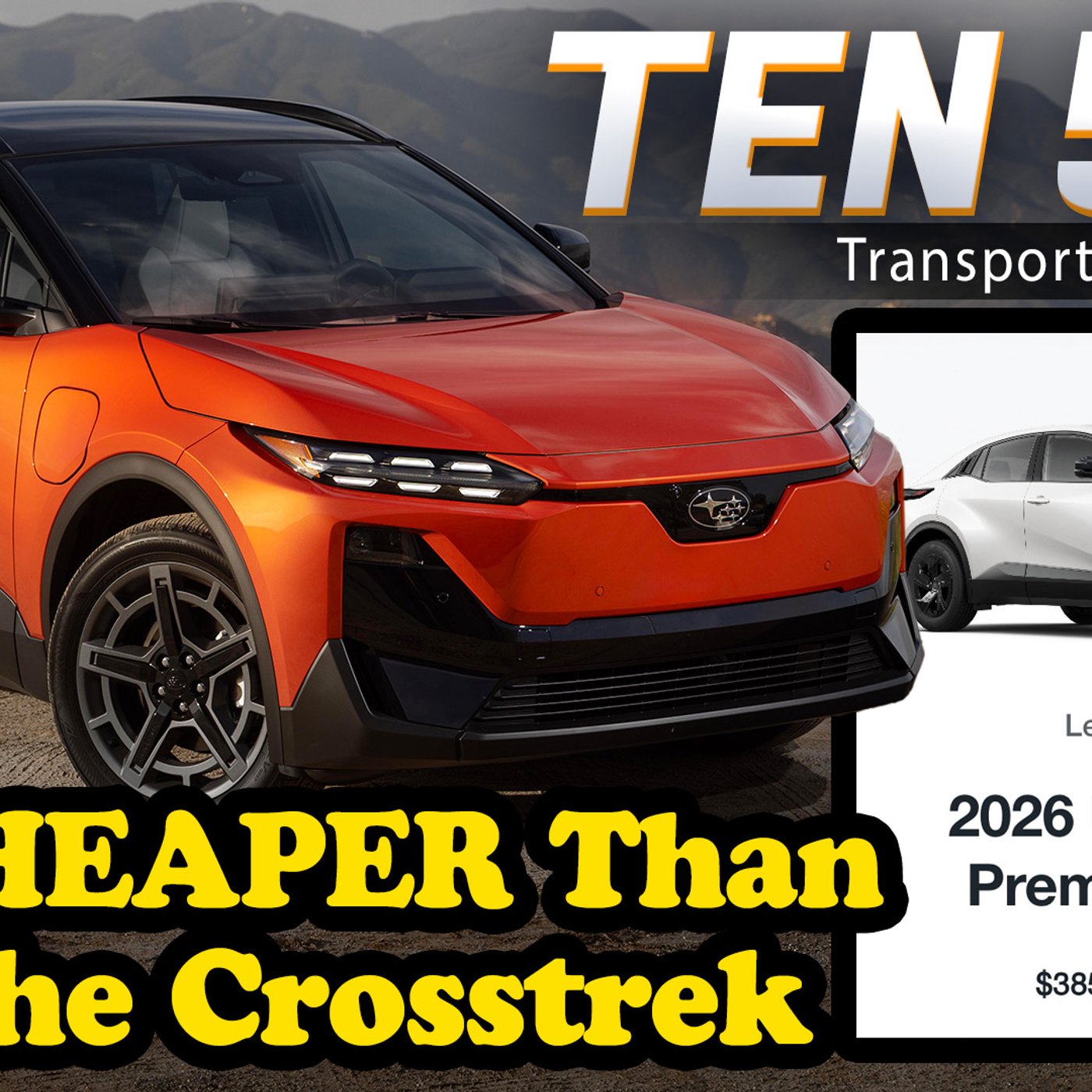
Lexus officially unveils its 3-row all-electric SUV - the 2027 Lexus TZ; Subaru's newest U.S. lease deals make its EVs cheaper than a comparable ICE model; and a Chinese plug-in hybrid that does what the Tesla Cybertruck couldn't: turn into a boat and cross a river without a bridge!
Show notes, links and script at: https://www.transportevolved.com/2026/05/09/ten-581-lexus-tz-subaru-lease-deals-the-plug-in-that-actually-floats/
👥 Today’s Sponsors
🌱 El
Lexus officially unveils its 3-row all-electric SUV - the 2027 Lexus TZ; Subaru's newest U.S. lease deals make its EVs cheaper than a comparable ICE model; and a Chinese plug-in hybrid that does what the Tesla Cybertruck couldn't: turn into a boat and cross a river without a bridge!
⏱️ Episode Timeline:
00:00 - Introduction and Sponsor Shoutouts
00:33 - Welcome to the show
00:45 - Rivian hints at R2 pickup and R2X variants; VW becomes Rivian's largest shareholder; Georgia plant expansion
01:41 - Mercedes-Benz prices the electric C-Class in Europe
02:52 - Porsche to discontinue the ICE Macan
04:02 - Lexus debuts its 3-row electric SUV
05:09 - Lucid withdraws year-end guidance, blames supplier issues
06:11 - Honda cancels its Canadian EV factory plans
07:07 - Nissan cancels U.S. EV production and closes a Sunderland line
08:06 - Massachusetts signs with Vineyard Wind; 165 wind projects blocked by the Trump Administration
09:10 - Ford teases its secret EV lab to select journalists
10:33 - Cheaper to lease a Subaru EV than an ICE Subaru!
11:38 - Sponsor Segment - CCAN Action Fund
12:55 - Tesla Cybertruck recalled for wheel stud issue
13:11 - Stellantis recalls Dodge and Jeep EVs for instrument panel fault
13:25 - California cops can now ticket autonomous vehicles
13:44 - EU and India launch joint EV battery recycling initiative
13:55 - Bloomberg NEF: EVs displaced 2.3M barrels of oil per day in 2025
14:07 - Mercedes-Benz ramps up electric GLC production
14:17 - Nissan tweaks the Ariya where it's still sold
14:29 - Spain announces €100M EV charging funding
14:39 - The Mobility House launches ChargePilot as a standalone product
14:51 - Kia cuts prices on the EV6 range
15:03 - Electra Battery Materials signs deal with the Canadian Government
15:15 - Australia extends its EV incentive scheme
15:28 - Tovion unveils its powered eTrailer
15:38 - eBusCo explores a partial sale to survive
15:48 - Two million EVs now on UK roads
15:59 - Zeekr X updated with faster charging
16:13 - Volkswagen denies BYD acquisition rumours
16:25 - BYD's latest sales figures
16:40 - ABB unveils its OM X-Series megawatt charger
16:53 - Geely rumoured to acquire part of Ford's Valencia plant
17:06 - Workhorse secures a 100-vehicle order
17:18 - Bosch updates its e-bike drive units
17:29 - BYD sells its most expensive EV ever
17:42 - Automobilwoche: VW working on new 'Gamechanger' production system
17:55 - Germany commits €1B to heavy-duty EV charging infrastructure
18:07 - Porsche Taycan sets new Nürburgring record
18:20 - Norway's first fully driverless autonomous bus is now in service
18:34 - Norway hits 98.6% EV sales in April
18:46 - Juiced Bikes is back from the dead
18:55 - BYD Flash charging coming to Australia and Aotearoa New Zealand
19:06 - Ford reinstates employee pricing for EVs
19:17 - Nivalis Energy acquires SolarEdge e-Mobility
19:29 - BYD Datang claims 100,000 orders since launch
19:42 - It's Electric bringing 1,000 charging stations to Philadelphia
19:52 - Greenlane expands electric truck charging into Texas
20:02 - Fraunhofer ISI: German auto industry further into EV transition than thought
20:15 - Rocsys unveils its S2 autonomous heavy-duty charging robot
20:27 - Global EV battery market hits 244.6 GWh in Q1
20:43 - DAF starts production of XG Electric and XG+ Electric trucks
20:54 - Segway launches a 60 mph electric dirt bike
21:15 - Sponsor Segment - You
21:54 - And EnergySage!
22:29 - Honda patents a simulated clutch for electric motorcycles
23:39 - Chery's Jetour G700 plug-in hybrid crosses a river. As a boat.
24:52 - Closing Sponsor Acknowledgements
25:58 - Closing messages
On this week's TEN — Transport Evolved News! Lexus officially unveils its 3-row all-electric SUV - the 2027 Lexus TZ; Subaru's newest U.S. lease deals make its EVs cheaper than a comparable ICE model; and a Chinese plug-in hybrid that does what...
On this week's TEN — Transport Evolved News! Lexus officially unveils its 3-row all-electric SUV - the 2027 Lexus TZ; Subaru's newest U.S. lease deals make its EVs cheaper than a comparable ICE model; and a Chinese plug-in hybrid that does what...
On this week's TEN — Transport Evolved News! Lexus officially unveils its 3-row all-electric SUV - the 2027 Lexus TZ; Subaru's newest U.S. lease deals make its EVs cheaper than a comparable ICE model; and a Chinese plug-in hybrid that does what...
On this week's TEN — Transport Evolved News! Lexus officially unveils its 3-row all-electric SUV - the 2027 Lexus TZ; Subaru's newest U.S. lease deals make its EVs cheaper than a comparable ICE model; and a Chinese plug-in hybrid that does what...
On this week's TEN — Transport Evolved News! Lexus officially unveils its 3-row all-electric SUV - the 2027 Lexus TZ; Subaru's newest U.S. lease deals make its EVs cheaper than a comparable ICE model; and a Chinese plug-in hybrid that does what...
On this week's TEN — Transport Evolved News! Lexus officially unveils its 3-row all-electric SUV - the 2027 Lexus TZ; Subaru's newest U.S. lease deals make its EVs cheaper than a comparable ICE model; and a Chinese plug-in hybrid that does what...
On this week's TEN — Transport Evolved News! Lexus officially unveils its 3-row all-electric SUV - the 2027 Lexus TZ; Subaru's newest U.S. lease deals make its EVs cheaper than a comparable ICE model; and a Chinese plug-in hybrid that does what...

 Login
Login