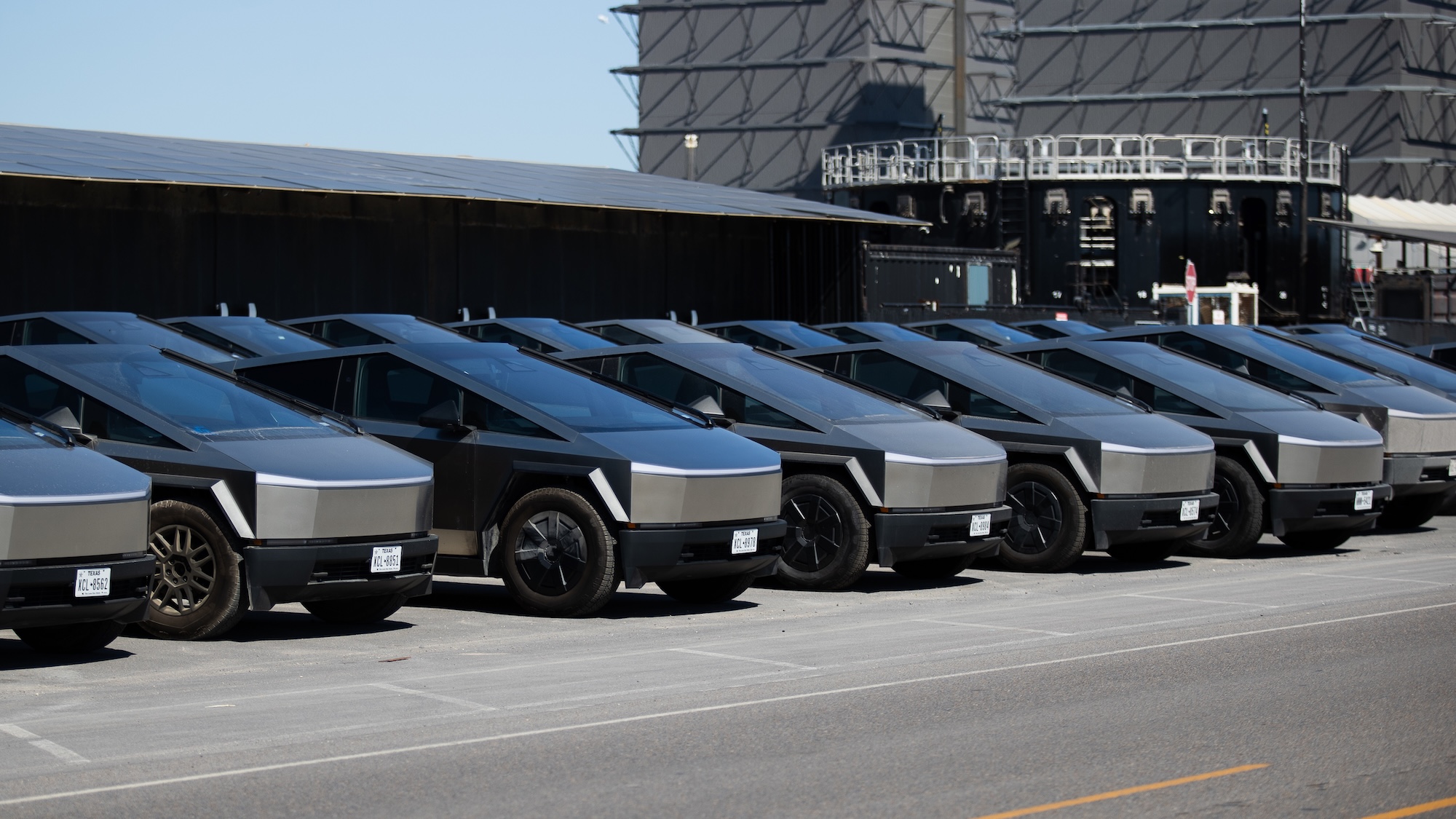
The wheels may be falling off the Tesla Cybertruck. No, seriously. According to a recent National Highway Traffic Safety Administration (NHTSA) recall alert, an estimated 173 of the stainless steel electric vehicles (EV) may be at risk of cracks forming in the brake rotor studs. These cracks could separate from their wheel hubs.
“Wheel hub separation can cause a loss of vehicle control, increasing the risk of crash,” the NHTSA explained in its recall. Such emergencies may even include an enti
The wheels may be falling off the Tesla Cybertruck. No, seriously. According to a recent National Highway Traffic Safety Administration (NHTSA) recall alert, an estimated 173 of the stainless steel electric vehicles (EV) may be at risk of cracks forming in the brake rotor studs. These cracks could separate from their wheel hubs.
“Wheel hub separation can cause a loss of vehicle control, increasing the risk of crash,” the NHTSA explained in its recall. Such emergencies may even include an entire wheel falling off the EV.
The 173 EVs span the Cybertruck’s 2024-2026 models, specifically those equipped with the optional 18-inch steel wheels. According to Kelley Blue Book, the EVs may start vibrating or issuing a noise before the wheel stud separates. Tesla is now offering affected vehicles free wheel hub and rotor replacements, as required by U.S. law.
The latest NHTSA alert is the latest in a string of recalls to affect the Tesla Cybertruck. Although the regulatory body awarded the EV a five-star overall safety rating, the vehicle line has received 11 recalls, four investigations, and 124 complaints since its debut in 2023. Previous recalls have involved faulty accelerator pedals from misapplied soap, malfunctioning windshields, and more.
Elon Musk once hyped the Cybertruck as the “finest in apocalypse technology” and “what Bladerunner [sic] would have driven,” but Tesla’s stainless steel EV simply hasn’t gained much traction. After over four years of production delay, the Cybertruck arrived about $20,000 more expensive than its original estimated base price. Tesla hoped to sell around 250,000 vehicles in 2024, but ended the year with less than 20 percent of their goal. Those numbers have continued to plummet, with barely 3,500 Cybertrucks sold within the last few months.
Electric vehicles are becoming more popular in Canada, according to a new survey report, but a large number of Canadians believe cold temperatures are a reason not to consider one.
Electric vehicles are becoming more popular in Canada, according to a new survey report, but a large number of Canadians believe cold temperatures are a reason not to consider one.
A Slate truck at its design studio in Long Beach, California, on December 19, 2025. | Myung J. Chun/Los Angeles Times via Getty Images
In May, Ferrari introduced its first entry into the electric vehicle market: the Luce. With an exterior like a Nissan Leaf, and an interior designed by the guy who designed the iPhone, it received a lot of hate. So, if Ferrari can’t make a cool EV, who can?
Enter the Slate truck. It’s a Jeff Bezos-backed, American-made compact truck with no bells, whist
A Slate truck at its design studio in Long Beach, California, on December 19, 2025. | Myung J. Chun/Los Angeles Times via Getty Images
In May, Ferrari introduced its first entry into the electric vehicle market: the Luce. With an exterior like a Nissan Leaf, and an interior designed by the guy who designed the iPhone, it received a lot of hate. So, if Ferrari can’t make a cool EV, who can?
Enter the Slate truck. It’s a Jeff Bezos-backed, American-made compact truck with no bells, whistles, or even AC — the antithesis of the Tesla Cybertruck. It’s kind of cute. And it might just get more Americans to drive an electric car.
At a time when American manufacturers have fallen far behind countries like China in the automotive industry, companies are still trying to get Americans excited about electric.
Andrew Hawkins is a transportation editor at The Verge who has been following the EV industry in the US. He tells Today, Explained co-host Sean Rameswaram about the problems stopping American drivers from fully adopting EVs and discusses whether this bare-bones truck can fix them.
Below is an excerpt of the conversation, edited for length and clarity. There’s much more in the full podcast, so listen to Today, Explained wherever you get podcasts, including Apple Podcasts, Pandora, and Spotify.
There’s another electric truck that we have to talk about.
Oh, yes, indeed. The Slate truck.
This to me represents the dichotomy in the EV market today, right? On the one hand, you’ve got your Ferrari Luce. That is a $640,000 car that no one you will ever meet will probably buy. And on the other hand, you’ve got this Slate Truck that is the most bare-bones two-seater that you could possibly imagine. There’s no radio, there’s no touchscreen, there’s no central screen inside the vehicle. There’s no paint. You even have to opt in to get power windows; otherwise, they will just give you the [window crank].
I love the idea of an electric truck that has manual roll-’em-down windows.
When I heard that, that blew my mind. This is a new startup. They’ve got a lot of investment cash from Jeff Bezos and some other people. This is their first vehicle. And the theory behind it is that we will make this thing as stripped-down as we possibly can. Take out all the bells and whistles. People can add a bunch of stuff. They could turn it into a small SUV by adding a back section to it if they want. They could add wrapping decals. You could personalize it and make it look however you want it to look. Or, you could just buy the bare-bones version.
The idea being that electric vehicles, as they stand today, are above the average cost of a new gas-powered vehicle. So, we need to bring this price down. How are we going to do that? Well, still the most expensive part about any electric vehicle is the battery. So, in order to have a good battery while still having a decent car, you need to take out everything else.
That’s how they’re saying that they’re going to sell this thing for under $30,000 when it eventually comes out at the end of this year.
So, unlike the [Ferrari] Luce, people responded well to this Slate truck. Why is it a truck? Why not a sedan?
Trucks are very popular in the US. They’re amongst the best-selling vehicles, typically. The Ford F-150, for example, was the best-selling vehicle in America for a long time.
But, this is America. We love our trucks. We love our big trucks. This is not a big truck. This is a small truck. And a lot of people have been saying trucks have gotten too big. They’re oversized behemoths out on the road that are dangerous to pedestrians that are out walking around. They don’t offer enough safety protections. And so, maybe we need to come back to more of a midsize or compact.
And then, obviously, gas prices are soaring. People are looking for something that’s a little bit more downsized in general. So, I think the truck prospect is an interesting one. Then again, trucks aren’t for everybody. If you want to turn this thing into a four-seater compact SUV, that’s something that will be an option to you, as well.
Okay, so this reason to make a little truck seems based on market research. People want a truck, and here’s a very different truck that we can offer them. What about this decision to literally strip away every single feature, including the paint, including the power windows, including the radio?
It’s a real risky bet from Slate. I think what they’re trying to say is that maybe cars have become too bloated, right? We’re starting to see a pullback from too many convenience features, especially in the car market with people feeling a lot of pressure on their pocketbooks and how expensive new cars have become. They’re looking for something that is a little bit more downmarket.
But also, I think it’s a reflection of where the expenses are in building a new car and a realization that you can’t just put out a car, especially an electric vehicle today, without some plan to make it profitable. One of the original mistakes of the auto industry, and especially the American auto industry, was that they could take a lot of their most popular cars, retrofit them to be electric, and that people would respond to them.
That was, I think, a pretty understandable bet from a lot of these companies. But, I don’t think they were really taking costs into effect for a lot of that. And what we ended up with was a lot of cars that were indistinguishable from their gas counterparts, but were 20 to 30 percent more expensive than those gas cars.
In so many ways, the automotive industry is a stand-in for our whole economy. We hold up the auto industry as being this kind of beacon which represents our innovativeness and our leadership on the global stage. And I think that we’ve ceded that leadership now to China.
China is now leading. They sell the most cars, they export the most cars, and they have the best technology. They’ve cracked the code on cheap EVs. I feel like America is always going to have an outsized reputation, but whether that reputation is actually earned anymore, I think is a very open question right now.
Do the people want EVs in this country yet, or do they still have range anxiety and a preference for the combustion engine? Does the war in Iran factor into how the people feel right now?
People vote with their pocketbooks, right? That’s where their preferences are today. And I think when electric vehicles were first gaining popularity, you heard a lot about charging anxiety. You heard a lot about range anxiety.
I think those are still considerations, but I feel, right now, the number one consideration for most people is, “I’m living paycheck to paycheck, and it’s costing me $80, $90 to fill up my F-150.” The used EV market right now is extremely attractive to a lot of people. You can get a very good electric vehicle for around $20,000. You take it home, you set up a home charger, you charge that thing overnight. You never have to go to a gas station again. That’s a pretty attractive proposition to a lot of people.
ABUJA, June 8 — There are two ways to think about electric vehicles in Nigeria.The first is that it’s beyond folly to own an EV in a place where power outages are a fixture of daily life: the few EV drivers around are known to occasionally charge their vehicles off diesel-guzzling, black-smoke-puffing building generators that complement the nation’s faltering grid.The other is this: if it’s possible to run an EV here, in a country where a vice president was once
ABUJA, June 8 — There are two ways to think about electric vehicles in Nigeria.
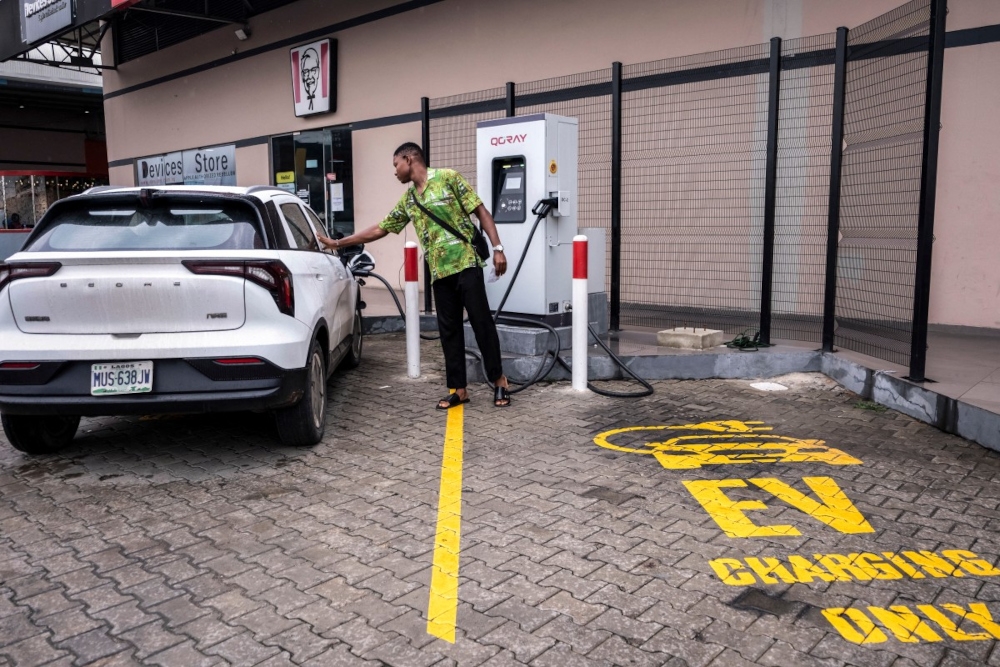
The first is that it’s beyond folly to own an EV in a place where power outages are a fixture of daily life: the few EV drivers around are known to occasionally charge their vehicles off diesel-guzzling, black-smoke-puffing building generators that complement the nation’s faltering grid.
The other is this: if it’s possible to run an EV here, in a country where a vice president was once accused of being linked to a generator company that profited off the nation’s grid collapse, then it’s possible anywhere.
If EVs are coming for the world, this is the rough-and-tumble frontier.
“When it comes to the electricity supply in Nigeria, it’s, I would say, location-based, because some sides (of town) have more light than others,” said EV owner Khalifa Abubakar Alhassan, speaking diplomatically.
Some 90 million Nigerians — a third of the nation — don’t have access to electricity at all, according to the World Bank. In May, a former energy minister was jailed for 75 years for money laundering linked to two failed hydropower projects.
But the government is pushing forward, aiming to make the country a hub for EV manufacturing while signing zero emissions pledges to slowly phase out new sales of autos with internal combustion engines.
For 22-year-old Alhassan, his neighbourhood in Abuja typically has “light”, the Nigerian English term for grid power, consistently overnight — perfect for charging his sleek, black sedan from China’s Neta Auto.
“I enjoy not buying fuel,” he added — not a small expense in a country where pump prices have jumped some 650 per cent since 2023, following the removal of a fuel subsidy, rampant inflation and shocks from the Iran war.
In Nigeria, ‘we adapt’
According to the International Energy Association, more than one-in-five new cars sold worldwide in 2024 were electric, though almost all of that occurred in China, Europe and the United States.
But Mosope Olaosebikan, CEO of NEV Electric, a manufacturer specialising in buses and three-wheeled tuk-tuk or “kekes”, is bullish on the sector’s growth: the charging station he is building will be capable of charging 3,000 vehicles a day — the largest on the continent, he reckons.
Challenges remain. Nigeria’s GDP is the fourth largest in Africa, but after years of mismanagement and corruption, its grid is often shakier than that of neighbouring, poorer countries.
When Olaosebikan was starting his company four years ago, a nagging question was, “Oh, there’s no ‘E’. So where would they charge?” he told AFP.
But “one way or another Nigerians are producing the electricity.”
Olaosebikan’s station will use solar and compressed natural gas to power its chargers, with the national grid as back-up.
“We adapt in this part of the world,” said Florence Boboye, of Lagos-based EV manufacturer Saglev.
Even when a driver charges their vehicle via a diesel generator — as one AFP reporter in Lagos recently saw a neighbour doing — that’s still cheaper, and possibly more efficient, than running a typical internal combustion vehicle, she noted — even if it looks a bit unseemly.
Infrastructure needed
On the sidewalk outside a charging station in downtown Abuja, women shading themselves with umbrellas sell mangoes and peanuts steps away from a Tesla Cybertruck.
Even cheap Chinese models that analysts say could upend the global industry are far out of reach for the millions of Nigerians in the informal economy.
But low-earners are still benefiting, said Dauda Adamu, 44, a bus driver in north-eastern Maiduguri, where the Borno state government has rolled out electric buses with fares as low as 50 naira (less than four US cents) in the face of rising petrol prices.
“When the vehicles arrived, the joy I felt even made me cry because I no longer have to deal with engine oil or anything stressful,” he told AFP.
On the federal level, Nigeria has approved green-friendly levies on heavy-engine vehicles, including gas-guzzling SUVs and trucks, set to go into effect in July. EVs are exempt.
Muhammad Abdulahi, 34, doesn’t worry about power outages — his home is completely off-grid, running on solar.
The Abuja resident drives a hybrid, whose extended range is useful for visiting family in Kaduna, considering there aren’t any charging stations along the 200-kilometre route.
He works in the renewable energy industry, but his main motivation for driving his hybrid is that it’s cheaper — something EV companies in Nigeria are capitalising on since the government removed fuel subsidies.
He’s thought about buying a fully electric vehicle — but until the country’s infrastructure catches up, “I would keep it within the city”. — AFP
Gas just broke $4 a gallon again — and this time, it happened in weeks, not months. The war with Iran and the closure of the Strait of Hormuz triggered what the International Energy Agency called the largest oil supply disruption in history, cutting roughly 20% of global petroleum from accessible markets and sending U.S. pump prices surging more than 30% since late February. Diesel has climbed above $5.60 a gallon. Analysts warn that if the Strait stays shut through summer, prices could reach $6
Gas just broke $4 a gallon again — and this time, it happened in weeks, not months. The war with Iran and the closure of the Strait of Hormuz triggered what the International Energy Agency called the largest oil supply disruption in history, cutting roughly 20% of global petroleum from accessible markets and sending U.S. pump prices surging more than 30% since late February. Diesel has climbed above $5.60 a gallon. Analysts warn that if the Strait stays shut through summer, prices could reach $6–7 a gallon.
At the same moment, the federal government pulled a $7,500 lever it had been offering EV buyers for three years. Trump’s One Big Beautiful Bill Act ended the IRA’s clean vehicle tax credit on September 30, 2026, sooner than almost anyone expected. For anyone considering an EV right now, both of these developments matter enormously, and they cut in opposite directions.
Here’s how EV math works in April 2026.
6 Benefits of Electric Cars
The benefits of owning an EV arguably outweigh any cons — from spending less money in the long run to making fewer trips to the repair shop. And it doesn’t stop there.
1. Gasoline Prices Have Never Made the Cost-Per-Mile Case for EVs More Clearly
With U.S. gas prices above $4 a gallon and diesel topping $5.60, the fueling cost gap between EVs and gas vehicles has widened sharply. The EIA’s March 2026 short-term outlook projected average retail gas prices of $3.34 per gallon for the full year — but that forecast was built on assumptions about the Strait reopening quickly. Prices are already well above that. Electricity prices, by contrast, remain stable and domestically produced.
A typical EV running on home electricity still costs roughly one-third as much per mile as a comparable gas vehicle — a savings that grows with every ten-cent jump at the pump. The current energy shock makes that argument harder to dismiss.
2. Energy Independence Means Something Different Now
The Iran war viscerally confirmed energy analysts argument that American households are deeply exposed to disruptions on the other side of the planet, even as the U.S. produces record quantities of domestic oil. Global crude oil prices are set by global markets, and domestic production buffers the shock but doesn’t eliminate it.
Charging an EV from the grid — or better, from rooftop solar — can insulate a household from price shocks. It’s a form of energy resilience that’s worth taking seriously as a financial and practical argument, not just an environmental one.
3. EV Range Has Left ‘Range Anxiety’ Behind
The 2021 version of this article listed 60-to-100 miles as a typical EV range. That figure is obsolete. As of 2026, the Lucid Air leads at 410 EPA-rated miles, the Hyundai IONIQ 6 Long Range delivers 361 miles, and the Chevrolet Equinox EV — the best-selling non-Tesla EV of 2025 — offers 319 miles starting under $35,000. Even mid-range EVs from mainstream brands now routinely clear 250 miles per charge.
The range question has effectively been answered for most everyday use cases. Long-distance travel remains more planning-intensive than gas, but it’s a planning question, not a stranding question, for most drivers on most routes.
4. Charging Infrastructure Has Reached Critical Mass
As of January 2026, the U.S. had nearly 68,000 public DC fast-charging ports, a 33% increase compared to 2024. Tesla’s Supercharger network alone accounts for over 52% of fast-charging stalls, and more than two-thirds of those are now open to non-Tesla vehicles. Ford, GM, Rivian, Hyundai, Kia, Mercedes-Benz, Volvo, and Stellantis have all adopted NACS, effectively granting their drivers access to the Supercharger network via native ports or adapters.
Reliability, long the Achilles heel of non-Tesla charging facilities that were often out of commission, is also improving. New stations are being built with redundant chargers, remote monitoring, and real-time availability data integrated into vehicle navigation. The experience of pulling up to a broken charger on a long trip is becoming less common, though rural coverage gaps persist.
5. Maintenance Costs Remain Lower — and the Gap Is Growing
EVs require no oil changes, no exhaust system. They need fewer brake replacements because regenerative braking extends pad life substantially. And they have significantly fewer moving parts subject to wear. A Consumer Reports analysis drawing on survey data from hundreds of thousands of members found that EV owners spent about half as much on maintenance and repair as owners of comparable gas vehicles; that’s an average savings of $4,600 over the life of the vehicle.
With inflation squeezing household budgets and the Iran war likely to push repair and parts costs higher as diesel-driven supply chain expenses rise, lower maintenance overhead matters more in 2026 than it did even a year ago.
6. State Incentives Fill Some of the Federal Gap — For Now
The federal $7,500 clean vehicle credit is gone. But the replacement focused on American-made cars makes up the gap. The One Big Beautiful Bill introduced a federal auto loan interest deduction of up to $10,000 annually through 2028, available for U.S.-assembled EVs financed with new loans. It’s a deduction rather than a credit, meaning it reduces taxable income rather than tax owed directly, and it phases out for households with incomes above $100,000 for a single person and $200,000 for couples.
State incentives come in many forms and have different eligibility rules. Several states with high EV adoption still offer significant savings, which are especially important now that federal credits are no longer available.
Colorado provides a $750 state tax credit for buying or leasing a new EV with an MSRP up to $80,000. There is also an extra $2,500 credit for EVs priced under $35,000, so budget-conscious buyers can save up to $3,250. You can assign the credit to a participating dealership and get the discount at the point of sale, so you do not have to wait until you file your taxes.
New Jersey’s Charge Up program gives up to $4,000 in point-of-sale rebates for eligible new battery-electric vehicles, applied directly at the dealership through June 30, 2026. The state plans to keep EV incentives active through 2030, with funding renewed each year. This is one of the strongest long-term commitments among states.
Oregon’s program has some important updates. The Standard Rebate, which offered up to $2,500 for any Oregon resident, was suspended in September 2025. The Charge Ahead Rebate, which provided up to $7,500 for income-qualified buyers, was suspended on December 5, 2025 due to limited funding. If you bought an EV during the eligible period, you still have six months from your purchase date to apply. Approved applications may be put on a waiting list for payment in spring 2026. New funding rounds may happen, but they are not confirmed yet. Check the Oregon DEQ’s program page before counting on the rebate.
California’s Clean Cars 4 All program is one of the most generous for income-eligible buyers. Low-income residents in certain air districts can get up to $12,000 toward an EV purchase, plus up to $2,000 for home charging or prepaid charging credits. If you do not need to scrap an old vehicle, you can get up to $7,500 through the Driving Clean Assistance Program. Both programs are income-based and run by regional air districts. Use the state’s DriveClean incentive search to see what is available in your ZIP code.
Massachusetts provides a $3,500 rebate through the MOR-EV program for buying or leasing a new qualifying EV with an MSRP under $55,000 at participating dealerships. If you meet income requirements, you can add another $1,500 through MOR-EV+, for a total of $5,000. There is also a $3,500 rebate for used EVs, but only for income-qualified buyers.
New York’s Drive Clean Rebate gives up to $2,000 off the purchase or lease of over 60 new EV models. The rebate is applied at the point of sale by participating dealerships across the state, and there is no income requirement. The amount depends on the vehicle’s range: you get the full $2,000 for EVs with over 200 miles of range on a 36-month lease or purchase, $1,000 for 40 to 199 miles, and $500 for shorter-range models or those with MSRPs above $42,000.
All of these programs depend on available funding and may change their rules. Check the DOE Alternative Fuels Data Center for the latest information before you buy.
Many automakers are also stepping in with manufacturer cash incentives and subsidized lease deals to offset the lost federal credit. Hyundai, for example, cut the price of its 2026 IONIQ 5 by nearly $10,000.
Photo: Shutterstock
5 Drawbacks of EVs
Of course, nothing is perfect, and electric cars are no exception. There are a few important factors to consider before signing on the dotted line at the dealership.
1. The Federal Tax Credit Is Gone — And the Replacement Is More Complicated
The $7,500 IRA clean vehicle credit that made EVs significantly more accessible to middle-income buyers expired on September 30, 2025. The $4,000 used EV credit expired at the same time. The EV charger installation credit survives through June 30, 2026, but only in eligible census tracts, such as low-income communities and non-urban areas.
The loan interest deduction that replaced the purchase credit is available only to buyers who finance a U.S.-assembled EV, ruling out cash purchases and vehicles assembled in Canada or Mexico (check the vehicle’s VIN: U.S.-assembled vehicles start with 1, 4, 5, or 7). This program is also an annual deduction on taxable income rather than a dollar-for-dollar credit, which means buyers in lower tax brackets get proportionally less benefit.
The net result is that the out-of-pocket cost of EVs is higher upfront in 2026 than in 2024–2025 for most buyers who don’t live in a high-incentive state. Automaker discounts and competitive leasing help, but the headline sticker shock is real.
2. Charging Can Still Be Slow — And Fast Charging Carries a Cost
DC fast charging, which can replenish an EV from 10% to 80% in 15 to 45 minutes depending on the vehicle, is increasingly available. But it comes at a premium: public fast charging costs significantly more per kilowatt-hour than home charging, and some networks charge idle fees after your session ends, so don’t leave your EV hooked up longer than needed. Home Level 2 charging (overnight, plugged into a 240V outlet) remains the most cost-effective option but requires an upfront equipment investment, and not everyone has access to dedicated parking.
The EV charger tax credit’s narrowed eligibility means many urban apartment dwellers and suburban homeowners outside those tracts get no federal help with installation costs.
3. Upfront Cost Remains Higher Than Comparable Gas Vehicles
The Chevrolet Equinox EV starts at $34,995. That’s genuinely competitive, and several EVs now undercut the critical $40,000 price point. But comparable gas hybrids remain several thousand dollars cheaper at purchase, a gap that the loan interest deduction only partially closes, and only over several years of ownership.
The economic argument for EVs is stronger over the lifetime of the vehicle than at the point of purchase. For buyers who are payment-sensitive or unable to finance, the math favors gas vehicles in the short term, even as gasoline prices strain monthly budgets.
4. Rural Charging Gaps Persist
The Biden administration’s $5 billion National Electric Vehicle Infrastructure program, which was funding charger buildout along highway corridors including in rural and underserved areas, was suspended by the Trump administration in early 2025. Private investment continues, but it concentrates in high-traffic corridors and urban markets where utilization rates justify the capital.
For drivers in rural areas or anyone frequently traveling through them, this remains a practical constraint. Home charging covers most daily use, but highway travel through low-density regions still requires careful route planning.
5. Policy Uncertainty Makes Long-Term Planning Harder
The EV market has experienced whiplash between 2022 and 2026 due to the IRA’s expansion of credits and their accelerated elimination. The OBBBA’s auto loan deduction expires at the end of 2028. Fuel economy standards have been relaxed. Several states are fighting against preemption of their own EV mandates. HOV lane access for EVs has been eliminated in New York and California.
None of this changes the fact that EVs make environmental or financial sense over a 10-year ownership horizon. It does mean that buyers should research current incentives carefully before purchase, verify vehicle assembly origin, and not assume that today’s program landscape will look the same in two years.
What You Can Do
If you’re weighing an EV purchase in 2026:
Check your state’s current incentive programs at the DOE Alternative Fuels Data Center (afdc.energy.gov) before assuming federal credits apply — they don’t.
Verify vehicle VIN origin before financing: only U.S.-assembled EVs (VIN starting with 1, 4, 5, or 7) qualify for the new loan interest deduction.
Request manufacturer incentives directly: automakers including Toyota, Hyundai, Ford, and GM have introduced their own cash discounts and subsidized leases to offset the lost federal credit.
Model the 5-year total cost, not just the sticker price: fuel savings, reduced maintenance, and available incentives often close the gap faster than the purchase price suggests.
If you rent or lack dedicated charging, factor public charging costs into your fuel savings estimate — DC fast charging at public stations costs more per mile than home Level 2 charging.
For rural buyers, check PlugShare or ABRP (A Better Route Planner) to map charging availability along your most common routes before committing to an electric vehicle—you’ll find the gaps are closing.
Editor’s Note: This article was originally written by Stephanie Braun on May 3, 2017, and was most recently updated in April 2026. Feature image courtesy of Shutterstock.

 Login
Login