With a stained glass window, light filters through to illuminate narrative scenes or geometric patterns, but it’s primarily the window itself that draws our attention. For Lesley Green of Bespoke Glass, these vibrant compositions certainly aren’t limited to these traditional apertures. “One of my personal obsessions is trying to convince people to hang glass on the wall instead of in the window, so you can really experience the pure color and texture of the glass,” she tells Colossal.
Besp
With a stained glass window, light filters through to illuminate narrative scenes or geometric patterns, but it’s primarily the window itself that draws our attention. For Lesley Green of Bespoke Glass, these vibrant compositions certainly aren’t limited to these traditional apertures. “One of my personal obsessions is trying to convince people to hang glass on the wall instead of in the window, so you can really experience the pure color and texture of the glass,” she tells Colossal.
Bespoke Glass creates a wide range of aesthetic and functional forms, conceived for both residential and commercial interiors. Some are designed to be screens or separators, such as behind a bar or between tables in a restaurant. Others are more sculptural, such as her three-dimensional sculptures that project onto the wall when the sun shines through them, interacting with local shadows. This display method also highlights the inherent textures of the glass itself, from waves to ridges to mottled patterns.
Using a hand-cut, traditional copper foil method of creating the stained glass, Green has also innovated some studio-developed techniques to produce three-dimensional objects. “Craftsmanship is extremely important to me as well,” she says. “Precise cuts and especially smooth solder lines are part of everything my studio produces.”
All pieces are available to be commissioned in custom colorways, and Green is also working on larger-scale versions of the sculptural works, plus multiple-piece collections designed to installed on the wall. See more on Instagram.
“Play is how we give permission,” says Vitor Freire, co-founder of the Amsterdam-based studio Imagination of Things. “Permission to challenge what’s fixed, rehearse what doesn’t exist yet, and close the distance between people who wouldn’t otherwise meet.”
Freire and co-founder Monique Grimord take play seriously and, in a new project, their studio created a vast repository of 169 artworks, designs, games, and more that have offered an unexpected encounter with imagination and joy. From Ra
“Play is how we give permission,” says Vitor Freire, co-founder of the Amsterdam-based studio Imagination of Things. “Permission to challenge what’s fixed, rehearse what doesn’t exist yet, and close the distance between people who wouldn’t otherwise meet.”
Freire and co-founder Monique Grimord take play seriously and, in a new project, their studio created a vast repository of 169 artworks, designs, games, and more that have offered an unexpected encounter with imagination and joy. From Rael San Fratello’s award-winning “Teeter-Totter Wall” to the healing Wind Phone project to a 12-foot puppet walking the world, Unruly Play is a multi-decade archive of participatory projects, public spaces, and digital creations that invite surprise and camaraderie.
“Our collaborators have always asked us where our ideas come from,” Gimrod says, “and the truth is that they come from references that rarely talk to each other—it can be a seesaw through a border wall or a phone booth connected to the dead… We wanted to create unusual dialogues and support new creative practices, and Unruly Play was our answer for that.”
Fully interactive, the project is searchable by theme or browsable through a shuffle feature. To dive deeper into the power of play, check out this compendium of artist-designed spaces.
Nestled amid plants native to the U.K., a giant figure of Gaia, or Mother Nature, sleeps in a verdant garden. With willow-branch locks shaped by artist Tom Hare and a crown of leaves, the figure’s face and shoulders are made from a fallen mature tree carved by Tim Wood. A winding pathway leads beneath an arch that extends the character’s torso, created in the tradition of dry stone walls and meticulously assembled by the family-run outfit Noble Stonework.
You’ll find Gaia in a garden title
Nestled amid plants native to the U.K., a giant figure of Gaia, or Mother Nature, sleeps in a verdant garden. With willow-branch locks shaped by artist Tom Hare and a crown of leaves, the figure’s face and shoulders are made from a fallen mature tree carved by Tim Wood. A winding pathway leads beneath an arch that extends the character’s torso, created in the tradition of dry stone walls and meticulously assembled by the family-run outfit Noble Stonework.
You’ll find Gaia in a garden titled “On the Edge” at this year’s RHS Chelsea Flower Show, which has taken the top prize of Garden of the Year. The project is a collaboration between designer Sarah Eberle and Campaign to Protect Rural England (CPRE), which champions the countryside and the sustainable practices necessary to protect and preserve its ecosystems.
Photo by Neil Hepworth/RHS
For this year’s exhibit, Eberle emphasized “edgelands,” or spaces between rural and urbanized areas like the borders of fields or even residential gardens. Think roadside berms or the seemingly unruly growth beside a canal. Often, these spots just look like a lot of weeds. Eberle sees not only the beauty, but the value, in these overlooked areas.
“These spaces connect millions of people to nature in everyday life, yet they’re undervalued and under constant pressure,” CPRE says in a statement. “This garden is an invitation to see them differently: not as ‘leftover’ land, but as living places that can recover and thrive with the right care.” Eberle’s choice of plants has a slightly wild aesthetic, with vines taking over the stone arch—redolent of the U.K.’s historic stone bridges—and a graceful yet somehow satisfyingly chaotic arrangement of plants we might associate with untamed overgrowth.
The garden’s design encourages people to consider using natural materials, cultivating local plants to help pollinators, and embracing “flaws” like old stumps or rocky areas that can be havens for wildlife. Amid nature’s innate rhythms, Gaia is a gentle protector who snoozes calmly with everything in balance. Eberele describes the effect: “A sense of abundance, a landscape under repair, the beauty in the ordinary. It’s about how it makes you feel—it’s almost a homecoming, an embrace, a hug.”
The Chelsea Flower Show is the flagship event of the Royal Horticultural Society, and it has been held on the grounds of the Royal Hospital since 1913, with the exception of a few skipped seasons during the two World Wars and in 2020. It’s not just limited to British gardeners, however: exhibitors from around the globe conceive of some of the most creative gardens imaginable. Tickets are available on the RHS website, and the show continues through May 23 in London.
Looking to upgrade your camera carry setup? This week’s Peak Design deals offer deep discounts on backpacks, slings, totes, messengers, travel systems, and accessories, with savings spanning both everyday carry and professional travel kits.
[Read More]
Looking to upgrade your camera carry setup? This week’s Peak Design deals offer deep discounts on backpacks, slings, totes, messengers, travel systems, and accessories, with savings spanning both everyday carry and professional travel kits.
Manuel Gual posted a photo:
Modular Metal Engineering Models: Vintage Construction Kits, Gears, Bridges and Mechanical Assemblies
Description
A detailed visual series exploring the world of vintage modular metal construction systems, inspired by classic engineering kits, mechanical model building and technical drafting culture. The collection presents carefully arranged perforated metal strips, brass gears, axles, pulleys, bolts, nuts, brackets, wheels, bridge trusses, gearbox assemblies,
Modular Metal Engineering Models: Vintage Construction Kits, Gears, Bridges and Mechanical Assemblies
Description
A detailed visual series exploring the world of vintage modular metal construction systems, inspired by classic engineering kits, mechanical model building and technical drafting culture. The collection presents carefully arranged perforated metal strips, brass gears, axles, pulleys, bolts, nuts, brackets, wheels, bridge trusses, gearbox assemblies, cranes, vehicle chassis and miniature mechanical structures laid out across workshop tables, blueprint sheets and clean studio surfaces.
The images combine nostalgic industrial design with precision engineering aesthetics: aged metal textures, brushed steel surfaces, brass components, technical drawings, exploded assembly layouts and realistic workshop lighting. The series moves from organized component catalogues and close-up mechanical studies to fully assembled structures such as bridge modules, gearboxes, steering systems, pulley frames, cranes and vintage vehicle models.
The overall mood is technical, educational and tactile, evoking model engineering, mechanical invention, mid-century construction toys, industrial prototyping and hands-on craftsmanship. This set is suitable for themes related to engineering education, mechanical design, STEM learning, vintage technology, maker culture, workshop creativity, structural design and the beauty of functional metal components.
These images have been generated by Artificial Intelligence.
Milan-based Filipina designer Mirei Monticelli creates biomorphic lighting fixtures that toe the line between sculpture and utility. Undulating outward and glowing from within, the artist’s works feel as if they are alive, quietly dancing wherever they stand or hang.
These gestural, biodegradable structures are crafted with hand-woven Banaca fabric made from Abacá, a fiber that grows abundantly in Monticelli’s native Philippines. The artist’s studio works directly with a community of weave
Milan-based Filipina designer Mirei Monticelli creates biomorphic lighting fixtures that toe the line between sculpture and utility. Undulating outward and glowing from within, the artist’s works feel as if they are alive, quietly dancing wherever they stand or hang.
These gestural, biodegradable structures are crafted with hand-woven Banaca fabric made from Abacá, a fiber that grows abundantly in Monticelli’s native Philippines. The artist’s studio works directly with a community of weavers in the Bicol province at the southeastern end of Luzon, sharing with Colossal, “We’ve developed the material together over time, so it’s not just sourcing, but a relationship.”
The laborious act of harvesting Abacá fiber has long been communal. From gathering the wild plant’s towering stalks and stripping them layer by layer to sun-drying bundles of knotted thread and hand-weaving the strands into functional textiles, the necessity of human connection has always been part of the process.
The term Banaca—coined by Monticelli—combines modern elements of design with a heritage technique that has been passed down for centuries. Monticelli’s contemporary subversion of a material so deeply engrained within Philippine culture further emphasizes the works’ metamorphic and dynamic presence. “Human rhythm is what gives the material its character, and it’s also why every piece feels alive when it’s lit,” says the artist.
Monticelli’s practice also incoporates techniques that echo garment construction and fashion. The artist shared that many of her methods are also learned from her mother, a fashion designer. Draping, volume-building, and creating shape are present in Monticelli’s lamps, underscoring a bodily essence within their surging forms.
Last month, the artist unveiled an installation titled “Pleasure Garden” at Milan Design Week, and often collaborates with interior designers, hospitality partners, and architectural studios to create immersive spaces. Find more from Monticelli on Instagram.
Photo by Juan PadillaPhoto by Juan PadillaPhoto by Juan PadillaPhoto by Juan Padilla
Debbie Lawson is known for her large-scale sculptures of life-size animals cloaked in ornamental carpets. Starting with an armature of wire mesh, masking tape, and Jesmonite resin, she meticulously cuts and tucks Persian carpet around every limb, building a surface that looks unbroken. As if the animals have materialized from within the textiles and are temporarily frozen in a stage of metamorphosis, we encounter them on the verge of making a move.
In the artist’s solo exhibition, In a Cow
Debbie Lawson is known for her large-scale sculptures of life-size animals cloaked in ornamental carpets. Starting with an armature of wire mesh, masking tape, and Jesmonite resin, she meticulously cuts and tucks Persian carpet around every limb, building a surface that looks unbroken. As if the animals have materialized from within the textiles and are temporarily frozen in a stage of metamorphosis, we encounter them on the verge of making a move.
In the artist’s solo exhibition, In a Cowslip’s Bell I Lie at Sargent’s Daughters, she provokes “questions about the relationships between decoration and nature, craft and camouflage,” the gallery says. The title is a line from Shakespeare’s The Tempest, when the spirit Ariel sings about freedom and the carefree, even charmed connection to nature following his release from forced servitude to the sorcerer Prospero. Several of the works seen here, including “Wild Dog Sundown,” “Red Eagle,” and “Black Cougar,” are included in the show.
“Wild Dog Sundown” (2025), carpet and mixed media, 92 1/2 x 61 3/4 x 24 3/4 inches
Lawson draws on the lineage of nature motifs in art, especially wildlife. She alludes to “the natural and animal forms hidden within decorative forms and patterns, from the frescoes of Pompeii to French Rococo moldings to Venetian stone carvings—the designs of William Morris and even the New York Public Library’s lions,” says a statement. Think clawfoot tubs, heraldic animals carved into hearths and other decorative interior elements, and the more modern form-meets-function works of Les Lalannes, which often incorporate birds and mammals into designs for benches and lamps.
The dialogue between art and decor parallels inherent tensions between interiors and the outside world—refinement and domesticity versus nature or indeed, the wilderness. Lawson also thinks about the gendered history of home life and craft, which has long been been associated with “women’s work.” This is deeply personal for the artist, as textile- and art-making go back generations in both her family and her hometown of Dundee, Scotland. She says, “I’m also thinking about women, including some of my near ancestors, so often confined by the constraints of the patriarchal society in which they/we lived, trapped in the daily grind and unable to pursue their own considerable creative talents or fully inhabit the world.”
Lawson’s camouflaged animals manifest from the backgrounds of carpets, emphasizing emergence itself. As these wild animals—leopards, cougars, bears, and more—are more clearly defined, they don’t break free from their patterns. Rather, they are indelibly characterized by the textile and can be clearly recognized for their unique individual traits. It’s not unlike how craft, especially textiles that were historically relegated to domestic settings and considered at least a notch or two below “high art,” has intently disrupted the art canon in recent decades.
In a Cowslip’s Bell I Lie continues through May 30 in New York. See more on Lawson’s Instagram.
“Red Eagle” (2026), carpet, steel, and mixed media, 116 1/8 x 78 3/4 x 21 5/8 inches“Arabian Leopard” (2024), carpet and mixed media, 63 x 90 1/2 x 13 3/4 inches“Black Cougar” (2025), carpet and mixed media, 70 7/8 x 29 1/8 x 13 3/8 inches“Prospero” (2026), carpet and mixed media, 52 x 19 3/4 x 18 1/2 inches“Alligator” (2025), carpet and mixed media, 30 x 43 x 16 inchesDetail of “Alligator”“Red Cougar” (2025), carpet, table, and mixed media, 90 1/2 x 63 x 31 7/8 inches“Gold Cougar” (2026), carpet and mixed media, 70 7/8 x 28 3/4 x 9 1/2 inches
Artists iterating on a seemingly mundane object is one of our favorite exhibition concepts. Vintage envelopes, coasters, and matchboxes are just a fraction of the items galleries have offered as unique canvases for small works, and now, we can add nighlights to that list.
On view through June 26, DUDD LITE is a collaboration between the design collective Dudd Haus and the gallery The Future Perfect. Curated through an open call that garnered nearly 400 submissions, the playful exhibition p
Artists iterating on a seemingly mundane object is one of our favorite exhibition concepts. Vintage envelopes, coasters, and matchboxes are just a fraction of the items galleries have offered as unique canvases for small works, and now, we can add nighlights to that list.
On view through June 26, DUDD LITE is a collaboration between the design collective Dudd Haus and the gallery The Future Perfect. Curated through an open call that garnered nearly 400 submissions, the playful exhibition presents more than 130 artist-designed nightlights made from stained glass, wood, seashells, ceramic, cotton, and more. The small works hover between sculpture and functional object, each reflecting a distinctive sensibility and approach to a household staple. See all designs on The Future Perfect website.
James Burial, “Doom n’ Bloom”Normalcy, “Extension Cord Germination”Chris Wolston, “Legs for Days”Nicholas Holmes, “Fire Light”Mark Dineen, “Rite Lite”Mikei Huang, “Wavy Night Dancer”
At Copenhagen Contemporary, Kengo Kuma and his team have honed in on the Japanese concept of komorebi, which reflects the unique interplay of light and shadow that occurs when the sun filters through the trees. The monumental, site-specific installation “Earth / Tree” harnesses this fleeting condition through a suspended canopy of wooden slats.
Curved with a central opening, the diaphonous structure floats above a brick platform and a pile of rubble. These two organic materials bridge Nord
At Copenhagen Contemporary, Kengo Kuma and his team have honed in on the Japanese concept of komorebi, which reflects the unique interplay of light and shadow that occurs when the sun filters through the trees. The monumental, site-specific installation “Earth / Tree” harnesses this fleeting condition through a suspended canopy of wooden slats.
Curved with a central opening, the diaphonous structure floats above a brick platform and a pile of rubble. These two organic materials bridge Nordic and Japanese cultures, which both value craftsmanship and continuity with the landscape.
Kuma—who was recently awarded the bid to design the new National Gallery in London—often focuses on “soft architecture,” a mode of working entwined with the environment and people who engage with the space. “Earth / Tree” translates this concept into the Danish museum, where it’s on view through February 21, 2027.
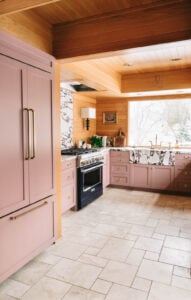
Ever since the pandemic, interior trends have been leaning towards bold, maximalist styles and colors. Lockdown taught us collectively that life is short, and more time spent at home has invited many to throw caution to the wind. If this is where we’re spending a large amount of our time, we should really love the space we’re inhabiting. Right? Say goodbye to sad beige and millennial gray—whimsy, playfulness, and color are in. The brighter, the better!
Ahead, I chatted with designers to get
Ever since the pandemic, interior trends have been leaning towards bold, maximalist styles and colors. Lockdown taught us collectively that life is short, and more time spent at home has invited many to throw caution to the wind. If this is where we’re spending a large amount of our time, we should really love the space we’re inhabiting. Right? Say goodbye to sad beige and millennial gray—whimsy, playfulness, and color are in. The brighter, the better!
Ahead, I chatted with designers to get their take on bright paint colors—how to choose them, where to paint, trending colors, and perhaps most importantly, how to get over any hesitancy when working with vibrant hues.
Choosing the right color for your home is a very personal decision. Lesley Myrick of Lesley Myrick Interior Design always starts her design process with the client, and never a trend. “A vibrant paint color has to be a commitment color, something you’ll still love when the design world moves on to the next thing,” she says. Myrick suggests paying attention to the colors you like to wear, what colors are already present in the room, and what the light is doing between 8 am and 8 pm.
“Vibrant color is high impact, which means it can’t be an afterthought. It has to be rooted in something specific and personal. Otherwise, you end up with a room that just looks loud instead of layered,” she continues.
In short, pick a color you love. Be sure it plays well with the other items in your space. Take the time to see how the light affects the paint color throughout the day. Have fun!
What Rooms Are Best for Vibrant Paint Colors?
Bright paint colors will energize a space, so opting for rooms that are lively, or are perhaps in need of some zest will work well. “A small space is the best place to go bold, because the color wraps around you and creates a complete mood,” Myrick says. “A powder room in a deep, glossy green or a saturated blue is going to be the most memorable room in the house.”
“I always recommend an entry way or hallway as great spaces to introduce vibrancy,” Daniele Doerge, a color expert from California Paints, shares. “From there, I love dining rooms and living rooms for vibrant tones as well. These areas are natural spaces to gather, and having a strong color can feel inviting and expressive.”
Myrick agrees. “Dining rooms are another natural fit, especially because you typically use them at night, when rich color looks its absolute best in low light,” she adds.
Hesitant to Use Vibrant Bright Colors in Your Home?
Neutrals can feel safe, and especially if you have maximalist tendencies, even a bit boring. But covering a room in a bright blue, cheery yellow, or bold chartreuse requires a healthy dose of courage. It’s totally normal to feel hesitant. Both Myrick and Doerge have a few tips to help calm your nerves.
Test Out Paint Samples
“First, paint is the least permanent design decision you will ever make,” Myrick reassures. “If you hate it in three years, you paint over it—that’s it. A bold color is not the irreversible commitment people think it is.” She also suggests getting large samples, painting them on two different walls, and living with them for a few days to make an informed decision. “Look at them in morning light, afternoon light, and at night. The same color will shift dramatically depending on the room and the time of day,” she shares.
Start Small
“Try painting cabinets or an interior door, or even add in an accent wall to see how you feel with the color,” Doerge recommends. “I also advise people to pair bold colors with some sort of grounded neutral or texture—whether that’s furniture, decor, or rugs.”
Go Bold or Go Home
Finally, Myrick recommends digging your heels in and committing with your full chest. “The half-hearted vibrant color, the one that felt ‘safer’ than the bold choice you loved, always disappoints. If you’re going to go bold, go all the way,” she urges.
What Bright Paint Colors Are Big Right Now?
Even though vibrant colors are inherently energizing, the right bold color can still feel calming and intentional. Colors inspired by nature are always a wise choice. “We’re seeing some trends towards vibrant colors rooted in nature—think golden yellows, clay-inspired corals, and lush greens that feel bright but still grounded,” Doerge shares.
If there’s one thing designers agree on, it’s this: the color you love is always the right choice. Bright paint colors aren’t a trend to chase or a risk to manage — they’re an invitation to make your home feel more like you. Start with the room that needs the most life. Paint a large sample. Live with it for a few days. And when you find the one that makes you feel something every time you walk in? Commit all the way. The half-hearted choice always disappoints. The bold one never does.
This post was last updated on May 22, 2026, to include new insights.

 Login
Login