Login
Login


Get With The Times (Part 12)

A final installment of cartoons looking toward the new ways of present times, or bringing backwards characters of the past up to speed. We’ll deal with a couple of features, a Garfield special, a recent Mickey Mouse, and a lot of up-to-date action from the Looney Tunes gang.
Garfield Gets a Life (Film Roman, 5/8/91), a half-hour prime-time special, could more appropriately be called “Jon Gets a Life”, dealing with the boredom that is Jon’s existence, and its contagious effect upon Garfield as well. The most exciting thing Jon seems to do is organize his sock drawer – two of them – by size, color, materials, blends, and all neatly tucked-in. When not occupied with socks, Jon counts ceiling tiles while flat on his back – and Garfield takes to doing the same thing, as they compare counts between the ceilings in the bedroom and living room. Garfield (perhaps for lack of anything better to do) tries to break Jon out of his rut, remembering an old copy on Jon’s bookshelf of “How To Make Friends and Fool the Rest”. Jon spots a chapter on getting dates, and attempts to follow it to the letter. Efforts to pick up girls in the park, at the beach, in the laundromat and at the video store fail miserably. Jon almost has accidental luck at a singles club (Club Ticky Tacky), as, while badly reading aloud from his book just for practice the line, “Hey there, would you like to dance with me?”, an equally-bored girl at the bar overhears him, and half-heartedly responds, “Sure, why not?” “YES!!”, shouts Jon, escorting her onto the floor. But Jon quickly loses her, by throwing her into a couple of forceful spins that spiral her right off the dance floor, then breaking into his own solo elaborate disco number (predicting Goofy’s in An Extremely Goofy Movie). Patrons of the club momentarily stare at the display, but, as the number reaches its close, the house lights go up, and Jon stands alone in an empty club, with total silence except for Jon’s last footfalls. Nevertheless, Jon strikes a closing Jon Travolta-style pose, only to hear from the rafters the voice of the D.J, yelling, “Hey, jerk. Disco is DEAD!” “What?? When??”, reacts Jon, and trudges away with Garfield, complaining how you learn a new dance, and 14 years later, they change it. “Go figure” responds Garfield in characteristic underplay.
A television ad by a dweebish-looking guy for his school, Lorenzo’s School For the Personality Impaired, intrigues Garfield and Jon – especially when mentioning such characteristics of the average students he helps as counting ceiling tiles and thinking disco is still in. Jon and Garfield arrive at Lorenzo’s meager institution (a run-down building complete with broken and partially-boarded windows and cracking plaster). They know they’re in the right place when they find every student in attendance looking up to count the ceiling tiles. Lorenzo dispenses rather meaningless advice, such as extend a hand to the one next to you and say, “Hi, my name is so-and-so”. Most of the students quote him verbatim, never including in the sentence their own name. Another suggestion is to make people believe you can speak a foreign language, by only sounding like you do. He thus utters French-sounding gibberish meaning nothing, then teaches Canadian by merely adding the syllable, “eh?” every few sentences.
Jon’s handshake extension during the class causes him to make the acquaintance of a moderately pretty girl, who is as unsure of herself as Jon is, and certain that she is blowing making a good first impression. Jon and the girl find themselves equally matched in awkwardness and shyness, and begin to open up to each other about it, being themselves – and really hit things off. Garfield is both amazed and puzzled that this is possible, having never thought Jon to have the potential for striking up any serious relationship. The two decide they’ve had enough education for one day, and step out for a bite to eat, then spend the entire evening on Jon’s porch, getting to know each other – and all the time being themselves, without following any of their professor’s advice. Things get personal for Garfield when he overhears Jon, carried away in conversation with the girl, refer to him merely as “his cat”. “Yesterday, I had a name”, Garfield complains to himself, seeing his best buddy and confidant relationship with Jon slipping away. Garfield lapses into a dream of what will happen if Jon marries, a toddler arrives, and the abuse he will endure as the toddler grabs at him and chomps upon his tail. He marches outside, seizing Jon by the collar and trying to shake some sense into him. The girl, taking her first notice of Garfield, reaches out to pet him behind the ear. “She’s trying to get to you by getting to me”. Garfield warns in thought and pantomime – but a few scratches in just the right places, and even Garfield finds himself being won over, resting in her lap as she scratches his back above his tail. However, the girl has pushed her luck, and an old nemesis of hers arises – an allergic sneezing fit when she is around cats. The two humans are heartbroken at this development, but Jon stays faithful to Garfield, giving his pet a hug. Garfield remarks at the value of having seniority. The two humans realize they can’t be a serious part of each other’s lives, but promise to see each other from time to time. Garfield still wants to ensure that things will stay this way, by promising to himself that their meetings will be chaperoned – riding along with the couple as Jon drives her home, not inside the car, but stuck to the rear window by suction cups on his feet and hands, just like so many plush Garfield ornaments decorated real-life car windows of the period.
• “Garfield Gets a Life” is on Dailymotion
My Generation G…G…Gap (Looney Tunes (unreleased, direct to video), Porky Pig, 3/31/04 – Dan Povenmire, dir.) – Hard to say if this one should have ever been produced. It was scrapped for theatrical release when box office on Looney Tunes: Back in Action failed to reach expectations (undeservedly). And it is definitely a departure for Porky, perhaps more jarring than Goofy’s 1950’s transformation to the “everyman”. Somehow, Porky is married? With a hip teenage daughter? (Where did Petunia fit into all of this, as she is never seen nor mentioned in the film.) Porky drives his daughter to her first rock concert, waiting outside the arena at a local coffee shop – where he sees a news story on TV about how out-of-control the concert tour has gotten at its previous venues, and sees a live shot from inside the area of his daughter wildly riding on the shoulders of a burly hunk. Porky spit-takes, and races for the arena, convinced that the performance is unsuitable for the likes of his young girl. A bulky gate attendant with a build reminiscent of construction worker Hercules from Bugs Bunny’s “Homeless Hare” refuses Porky entrance without a ticket, and even the influence of a talking Abe Lincoln on a five-dollar bill Porky offers the guard fails to impress him. Porky scolds Lincoln: “Y-y-you didn’t even try.” Yet, a couple of shapely girls get past the guard just on their good looks without any pass. Porky tries the same thing in drag, but just gets socked in the mush. Porky resorts to hiring a helicopter to lower him to the arena roof – however, the pilot is still giving him instructions when Porky jumps – and has not yet attached Porky’s safety cable. Porky falls through some high-tension wires, then crashes through the arena roof – in three dissected sections.
Inside, Porky lands inside an open guitar case next to the stage. The performance in progress has a rocker using guitars to smash everything on the stage – and Porky is the next “instrument” wielded. Bruised and battered, he is discovered by the guard. Running backstage, Porky ducks into wardrobe, and emerges wearing rocker’s garb, a mohawk wig, eye makeup resembling a member of Kiss, and two-foot tall platform shoes. Thinking he has spotted his daughter waiting around a dressing room backstage, Porky mistakenly demands that the young lady come home with him. She turns to reveal that she is a total stranger – and the other girls in the line would like to be taken home as well. Porky finds himself in the traditional predicament of all rockers – pursuit by an over-stimulated mob of women. He runs right into the guard, who fails to recognize him, and informs him that he should be on stage. Porky is deposited in the spotlight, while an almost stone-quiet audience tries to guess who he is. Porky tries to back away, but jostles a tall speaker, upon which someone has carelessly left a paper cup full of water. The water lands on a transformer, producing a short circuit, which makes its way up the cord of the microphone next to which Porky is standing. ZAP!! SIZZLE!! Porky engages in the most electrifying series of screams ever presented on stage, while a drummer in the back-up group behind him provides accompanying rhythmic beats. The whole stage blows up, and Porky is revealed next-to-naked. His daughter wails from the audience, “Daddy, how could you…” But the incident provides Porky with a new career, depicted in a mock TV commercial for a mail-away record album featuring 22 or so rock hits of other artists performed by a stuttering pig. As the list of hyphenated song titles scrolls across the screen, we fade out on Porky singing “B-b-b-bad to the bone.”
 Rabid Rider (Warner, Road Runner (CGI), 12/17/10 – Matthew O’Callaghan, dir.) – A late theatrical short, produced in CGI. Wile E. Coyote is rarely one to be intimidated by new advances in technology. But for once, a new innovation has him perplexed – mostly, as to what to do with it. Wile E. eagerly unpacks the crate of the Acme Hyper-Sonic Transport, and dons his protective safety crash helmet before mounting up. As Road Runner passes the boulder behind which he hides, Wile E. rolls into view – at a relative snail pace and in jerking and tenuous motion and direction, atop a self-balancing platform! The device makes sudden stops causing the coyote’s belly to jam into the handlebars, topples forward to smash his face into the ground and then rights itself again, rolls him face-first into a boulder, then shifts into reverse uncontrollably, taking Wile E. Past the camera, only to be knocked back into view as he is hit from behind by an oncoming truck. As Wile E. lies prone upon the pavement, his fingers nervously drumming, the conveyance rights itself and wheels its way up to his side, letting out a beeping signal to indicate that it is ready to go again.
 Wile E. knows this thing needs more speed. Standing atop it, he attempts to lasso the Road Runner passing around the neck, hoping to be towed like a chariot. His toss misses, but catches the next best thing – the air-fin of a passing sports car. Wile E. is off to the races, but has to do some fancy pulling of the “reins” to swerve and avoid being hit by oncoming traffic in the other direction. He finds himself rolling faster than the car he is tethered to, and facing the reflective rear of the back of a tanker truck between himself and the bird. Wile E. manages to fight the balancing instincts of his conveyance, leaning backwards to do a “limbo” pass under the truck’s axles. Now in front of the truck and still proceeding at a good clip, he lets go of the rope, and extends his arms in attempt to reach the Road Runner’s neck. But, the road reaches one of those inevitable T-intersections at the edge of a cliff, and Wile E. and the platform fall into the canyon below. They do not hit the ground, but come to rest straddling a pair of power wires, with the platform mid-way between two poles. Wile E. shimmies over to join his platform, but their combined weight bends the poles together at the top until their transformers touch. ZOWIE! A well-fried coyote and his platform shoot up into the air, striking into the bottom of a rock ledge overhanging above, then roll down the cliff face, Wile E. giving us a look as if to say, “Not again.” He and the platform roll past the Road Runner below, and come to rest in an intersection between a road and a train track. The platform’s wheels are sandwiched in the track bed between the rails and the cross-ties, and the machine rocks back and forth in its confined space helplessly, as Wile E. sees the approach of a train’s headlight. The coyote wisely hops off the track and his vehicle to avoid the train, only to get hit by a crossing truck. As the shadow of the train passes the flattened Wile E. in the roadway, the platform somehow emerges from the incident unscathed, and beeps again to signal that it is charged and ready for more.
 Wile E. has had enough of this troublesome contraption. Swinging it around himself several times, he hurls it off a cliff. The vehicle lands on a rock ledge, balanced on a fulcrum like a teeter-totter, with a massive boulder positioned on the other end. The boulder is propelled into the air, and lands mere feet behind the sulking coyote walking on a road. Wile E. is barely phased in his bad mood by the near-miss, but his bad luck isn’t over. A large delivery truck swerves to avoid collision with the boulder, and its trailer payload is thrown over the rock, landing again mere inches behind the fleeing coyote, and covering him in a cloud of dust as he falls to the ground. As the dust clears, a chorus of electronic beeps announces the rise from the ground, one by one, of an armada of self-balancing platforms carried by the truck, who line up on each side of the roadway like an advance guard for a royal procession. Who speeds down the middle of the rows, plowing over Wile E. in the process, but the Road Runner, aboard one of the platforms himself, uttering his “Beep beep” and riding off into the sunset, passing a canyon wall on which the words ‘That’s all, folks!” appear.
 Arthur Christmas (Aardman/Columbia/Sony, 11/23/11) attempts to bring the magical realm of Santa Claus into the modern hi-tech era. It also debunks a myth as to the everlasting nature of the man with the red suit and the white beard, who seems to have lived a good many lifetimes past the average human. There really wasn’t just one Santa, but several. In fact, the title has been passed down in the family for generations, the role of successor handed off twenty times since St. Nicholas to the most eligible of the clan, whenever one of those in charge reaches a stage of being past his prime.
The current Santa has already flown 70 missions. However, there’s been a lot of change to keep up with the demands of supplying toys to the entire world’s children in one night. No longer is the mission approached in the likes of a wooden sleigh. Instead, Santa’s vessel looks more like something out of Star Trek – the S-1, a giant, hovering behemoth of a space platform, complete with an underside of camouflaging cloaking panels to make it indistinguishable from the night sky as it moves into position to cover entire major cities. On a signal, an armada of elves drop on lines from the ship onto every rooftop, secure the area, and mass-unload the toys from panels in the bottom of the ship. Finding every which-way to enter into premises (one team is shown delivering presents to the president’s children in the White House by power-sawing a hole around a ceiling decoration of the Presidential seal), the elves scan sleeping children with a digital scanner that determines their percentage rating of naughty vs. nice before okaying the release of gifts from a supply chute. (One elf takes pity on a child who receives a borderline rating on the scanner, turning the device upon himself to register a more favorable rating and release the gifts.)
 All is going well, and is monitored at a massive mission control base carved into the ice below the North Pole, until a child almost awakens to see the current Santa (who, more or less as a figurehead, delivers a few select toys personally). An emergency protocol is initiated to get Santa out of the touchy situation, and in the melee, a bicycle intended for a little girl falls from the ship and rests somewhere below undelivered. At mission control, two offspring of the current Santa become aware of the situation: one Steve, the elder brother and presumed next-in-line for the Santa title, currently in charge of mission control, and the younger Arthur, who has no dreams or realistic hopes of ever becoming Santa, and is a soft-spoken, sentimental type in charge of answering the letters to Santa. Arthur is distraught at the thought of the little girl who wrote for the bicycle facing complete disappointment on Christmas day when her bike doesn’t arrive, while Steve, more concerned for his own self-image and obtaining the family’s prestigious title of Santa the 21st, is not about to have it laid upon himself as being the first to allow the family’s perfect record of gift-giving to be spoiled. Steve talks his befuddled and confused Dad into classifying a one-in-a billion misdelivery as an acceptable margin of error, and Dad and Steve refuse Arthur’s request to send the S-1 out again to make the botched delivery. But Arthur will not rest until he sees that bike delivered – even if no one else will help him.
 Arthur finds an unlikely source of assistance in the form of his cantankerous, headstrong, and a bit off-his-rocker Granddaddy, who was Santa before Arthur’s dad. Granddaddy claims he has a way to get Arthur to his destination to deliver the gift, and reveals out of hiding away in an ice cave something he’s been saving that no one else seems to know about – the original wooden sleigh previously used in his own heyday and by generations of Santas before him. Powered by magic dust distributed upon a team of reindeer, the “relic” can still make a top speed of 45,000 miles per hour, and maneuver under the hands of one trained in the reins to spin on a dime, streak through the skies like a comet, and fly to the moon and back if necessary (Granddaddy does so for Arthur, just for show). He remembers the good old days when the Clauses were the only humans who knew how to fly, and thinks of the present Santa (his own son) as a wimp who’d barely be able to control one of these babies. The Sleigh, in honor of the holiday, has been affectionately named “Evie”. Arthur experiences a white-knuckling but fascinating ride without the benefit of seat belts, and grows to have an equal admiration with Gramps for the ways of old, as Gramps shows him tricks like making a snowman out of cloud formations. But, a storyline we must have to support a feature-length CGI film, and a mishap places Gramps out of the driver’s seat and Arthur left holding the reins. Arthur does a good deal of globetrotting, arriving at the wrong destinations, losing the reindeer, and ultimately having the sleigh destroyed, while back at mission control, Dad and Steve finally get wind of Arthur’s secret mission, and embark on their own mission to rescue Arthur. Ultimately, all four surviving males of the Santa clan converge on the same location to try to right the wrong at the crack of dawn, but it is Arthur who, with his large heart (Steve in the course of the action discovering that he just doesn’t have a natural knack for getting along with children), receives the honor of placing the present under the tree. At Arthur’s suggestion, all of them hide behind a door, to witness the glee of the little girl when her present is opened. Dad remarks that in his 70 years, he’s always been too busy to see such an event firsthand – and realizes he should have made the time for it all this while. Even Steve is touched, and, with his blessing, allows Dad to pass the honor of the Santa title to – Arthur. By the next year, Arthur is at the helm of the S-1, but with a few changes. Its name has been changed to “Evie” in honor of the magic sleigh. And its power source is now the hooves of five thousand reindeer!
 Tokyo Go (Disney, Mickey Mouse Cartoons (TV), 7/12/13 – Paul Rudish, dir.) – Another of Mickey’s frequent international episodes from this series, this time set in Japan, providing plenty of opportunity for imaginative and colorful background art. Mickey plays a typical Japanese commuter, facing the day-to-day hustle and bustle of trying to get to work from the congested urban setting of a busy railway station, and facing the current rage of commuter technology, the bullet train. He purchases a ticket for the blue line, then attempts to follow the colored lines on the station floor to his train’s departure zone. Unfortunately, the blue line on the floor intersects at right angles to a red line, and a mob of pedestrian cross-traffic sweeps up Mickey, pressing him onward toward the red train instead of the blue one. As bad or worse than New York subways, Mickey is tightly crammed into the train doorway by a station guard, so that when the doors closed, Mickey is plastered between the door’s glass windows and someone’s butt. Mickey pops out of the collar of the passenger’s coat to get a breath of the meager air supply inside the car as the train takes off, with enough inertia around a curve to send shock waves to the street below, piling four cars one on top of the other. Mickey looks around, seeing the blue train out the windows running at equal speed on another track – then also sees a sign at the end of his car reading in both English and Japanese, “Exit”. Mickey slips his way through people’s pantlegs, briefcases, and collars, attempting to make his way to the exit door through the sardine-can of humanity. His pants are punctured by the spiked heels of a gang of punk teens, but he manages to pass over them by swinging from the hand-holder handles in the ceiling of the car like Tarzan. But one passenger is unavoidable – a Sumo, whose girth blocks the whole car. Mickey has to peel off his trousers, revealing a Sumo’s pant-bandana underneath. The Sumo meets his challenge, also peeling down to the same bandana, and the two circle one another for combat. They both charge one another – but Mickey ducks at the last second between the Sumo’s legs. The behemoth crashes into the remaining passengers at the end of the car, both knocking himself out and clearing a path so that Mickey can escape through the exit.
 Now, how to reach the proper train? The blue line is still speeding on a parallel track, but the speed of the trains makes any attempt to cross to the other seem impossible. Mickey is nearly blown away merely climbing onto the roof of the red train, and plays a dangerous game of dodging oncoming low signs and signals which protrude over the train roof as it passes them. Mickey shimmies every which way to miss being hit, and at one point even has to temporarily detach his ears to avoid disaster. More barriers in the form of poles or walls pass between him and the blue train to prevent a safe crossing. Finally, the blue track veers away, descending at an angle to a lower level, where its track passes under a bridge of the red line to cross at a right angle. Mickey’s last chance. In slow motion like a Japanese anime film, Mickey takes a daring leap from the bridge, passing a flock of ducks on the way down, and miraculously lands successfully upon the blue train’s roof. (How could he not be swept off or bounce given the blue train’s equal speed? But this is, after all, a cartoon.) In a matter of moments, the blue train screeches to a halt at its destination, and Mickey hurries from the local rail platform to a small park with a miniature red barn, entering the structure and flipping over a door sign in the window to read “Open”, then punching a time clock which finds him right on time. His job? The engineer of a Tokyo Disney duplicate of the “Casey Jr.” circus train ride known from Fantasyland in the States. Mickey displays a contented preference for the leisurely pace of this mode of travel, breathing a relaxed sigh as he circles the course with a load of happy children in tow.
World Wide Wabbit (Warner, Wabbit (Bugs Bunny), 9/22/15) – Yosemite Sam’s been in prison for 20 years, but finally tunnels his way out into the big city and freedom. “I’m free, I’m free…I’m broke”, he observes from his empty pants pockets. Conveniently, he has come up just outside the doors of a bank – the easy answer to his cash problems. He observes he has no firepower, but, setting up a running gag for the film, realizes that his pointing fingers pack as much ability to shoot up his surroundings as a pair of pistols. Thus, he marches into the bank, telling everyone to reach for the skies. The modern bank, however, is something absolutely new to him – no tellers, vault, or long lines, just Bugs at an ATM machine. So how do you hold the place up? Bugs tries to explain to him that everything’s gone digital – lots of ones and zeroes. Sam states he wants lots of bills with ones on them – followed by a lot of zeroes. Bugs continues that there’s nothing here to give, as its all on the Internet. “Okay – Hand over the Internet!!”, screams Sam. “Oh, boy”, mutters Bugs, realizing he’s dealing with a hopeless boob. Bugs again begins by informing Sam that the Internet isn’t something you just had over, and is hard to explain. He asks Sam to imagine a big delivery tube. “A big tube – got it!”. jumps Sam to conclusions, then checks outside for a kid’s drinking straw, an inner tube floating at a pool party, and even a girl’s tube top. “Eh, no”, cautions Bugs before he can touch it. Sam finally spots the biggest tube he’s ever seen, and runs into a subway tunnel, to be quickly run down by a train.
Bugs explains again that “tube” was merely a metaphor, and that digital information is in the cloud. Of course, Sam commandeers a hot air balloon to reach it, and Bugs makes sure he promptly falls out of its basket. Sam orders Bugs at trigger-finger point to take him to the Internet. Bugs leads him through a dark ventilation shaft, into a room where a game of turning on and off a pull-string light switch results in an unexplained change of locale and/or costumes with every pull of the switch (including lion’s dens, train tunnels, and even a gold room to which Sam just can’t return by turning the switch on and off again). Enough shenanigans, declares Sam, shooting away the pull string with a shot from his finger. Bugs finally tells him that the Internet is directly above them. Sam climbs a stepladder and saws a hole in the ceiling, then climbs up. “I’m on the Internet”, he shouts with jubilation – until he looks at his surroundings, and discovers he’s made his way right back into his jail cell, with a mob of police standing ready to capture him. As the sounds of police brutality echo from the hole above Bugs, Bugs climbs the stepladder himself, sticking a cell phone with camera up through the hole, and declaring “You’re on the Internet now, Doc.” As the live video records, the groggy voice of Sam is heard to say from the beating, “I’m up to a million hits already.”
Hareplane Mode (Warner, Wabbit (Bugs Bunny), 10/15/15) – Bugs is crossing the street, when Yosemite Sam careens down the road, texting while driving. The result is inevitable, with Sam’s car a wreck, and Bugs thrown onto the sidewalk. Sam has no concern for the victim he just collided with – only for his Smart phone, which bounced out of his convertible onto the pavement. Sam blames the rabbit for carelessly walking into the road when he could see Sam was texting, and threatens to sue when he notices a hairline crack in the screen of the phone. “I’m gonna sue the pants off ya”, he shouts, until Bugs points out he’s not wearing any pants – and also points to a billboard, advertising a new model phone available today. “Ya done me a favor”, Sam acknowledges in making him need a new phone, and Sam approaches the line in front of the “Phone Home” store, shoving all others to one side to be first in line. Who should be behind the counter in the store but Bugs, disguised as a typical teenage sales clerk, ready to seek revenge on this menace to society. “Gimme, gimme, gimme”, insists Sam, while Bugs deluges him in paperwork to sign and other red tape. Bugs demonstrates new security features, like a self-defense mode available at the push of a button, causing a gorilla fist to emerge from the phone screen and sock Sam in the jaw. Bugs sets a ringtone to a setting marked “Lion attack”. It goes off, emitting the sounds of a purring kitten. “That don’t sound like no lion attack”, complains Sam – until it signals a real lion to maul him. Bugs suggests switching to vibrator mode, but Sam insists it be nice and strong so he doesn’t miss any calls. Bugs sets the vibrator to “Apocalypse”. At a board meeting, an incoming call vibrates Sam right out of a skyscraper window to a 40-story drop. His mere leaning against a tree and a building when on the ground during phone rings brings down on his head a bee hive and a grand piano.
Sam returns to the store, demanding to return the phone. Bugs states be can’t understand why Sam is having issues – “That never happens with modern technology.” Bugs convinces Sam to keep the phone or be faced with the shame of using an older model, and resets Sam’s vibration lower. But Bugs isn’t through. That evening, he calls Sam, impersonating someone informing Sam that he’s won a grand sweepstakes prize, but interrupting the conversation with voice impressions of static, as if the signal is breaking up. Sam tries desperately to keep the connection going, first moving the phone all around the room for a stronger signal, then outside, then into the desert, and next the mountains. He finally re-establishes the call, shouting “Hello, hello…”, and brings down upon himself an avalanche. Then, the previous ring tone gets reactivated, and Sam is mauled by lions again. A bedraggled Sam returns to the store, again demanding a refund. Bugs pretends to be willing, but holds up the phone, dripping from melted snow from the avalanche, and states that he can’t take the phone back due to water damage. Sam insists that there’s no damage and he can prove the thing is working right, but everything he presses activates the gorilla punch, until he finally knocks himself out. Removing his disguise, Bugs remarks that this new model still had a few “Bugs” in it, then turns to the audience as if another customer, closing as he did in “Rabbit of Seville”: “Next!”
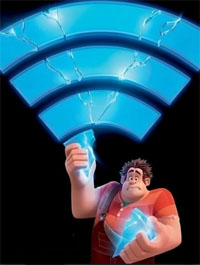
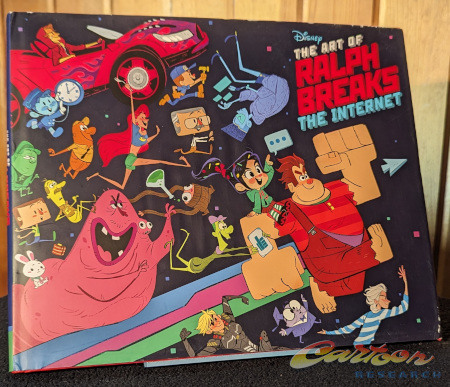 More than I can write about comfortably with my DVD temporarily mislaid and out of reach is Disney’s Ralph Breaks the Internet (11/21/18). A complicated tale finds Wreck-It Ralph and child racer Vanellope von Schweetz, two characters from old arcade games, in a dilemma when Vanellope’s video game, “Sugar Rush”, is rendered on the blink by Ralph’s helpful meddling in attempting to liven up the game for Vanellope by building her a new digital road. The steering wheel of the game becomes broken, and is only available as a vintage part at high cost in the resale market on the Internet. To keep the game from being scrapped by the arcade owner, Ralph and Vanellope travel through a Wi-Fi router to the world of the internet, structured like a magical city, in search of the replacement wheel and enough digital bucks to buy it. The mission, however, becomes rather unnecessary, as Vanellope discovers the existence of an online urban street racing game where everything is wild and unpredictable instead of the repetitive and tame race courses she has been used to, and decides she’d like to stay. Ralph feels his trust and friendship have been betrayed, and his own insecurity is built upon by a villainous character who creates clone duplicates of Ralph, merging into a colossal mega-monster. Ralph ultimately conquers the monster by conquering his own insecurities, realizing Vanellope is wise enough to make her own decisions, and he and the little girl part company as friends, staying in touch long-distance via video/email.
 The film is also remembered for a memorable, if self-promoting, incident where Vanellope, who is considered a princess in her Sugar Rush game, encounters a Disney website, and meets all the famous princesses of past Disney classics, rendered in CGI. There are some funny bits, like Cinderella defending herself from the intruder by breaking one of her glass slippers and wielding the broken half like a bottle in a barroom. There is even a crossover from Pixar’s “Brave” of Princess Merida, who speaks in a heavy Scottish dialect which the others admit no one can understand, as one princess adds, “She’s from the other studio.” By the end of the sequence, Vanellope has all the princesses thinking like her, and each wearing similar knit casual shirts like Vanellope instead of their usual gowns. I remember seeing a complete set of dolls from the sequence in the special shirts for sale at a Disney store for a high but not exorbitant price based upon the sheer number of dolls in the set. It was tempting but out of my reach, and I wonder how many people managed to acquire it (the only copy I have noticed intact on line selling for $179 bucks – not a bad rate of investment return).
Virtual Mortality (Warner, Looney Tunes Cartoons (Bugs Bunny), 11/25/21 – David Gemmill, dir.) – After all these years, Elmer is determined as ever to know the feeling of victory – of finally catching that wascally wabbit. His latest efforts have him axe-swinging over Bugs’ rabbit hole (his latest cartons don’t allow him to use a shotgun – but is axe-swinging any less violent?). Between swings, Bugs asks if he’ll ever give up. Not until he’s felt victory – just once. An idea hatches in Bugs’ head, appearing in the form of a light bulb – but a swing of the axe fractures the bulb’s glass. Nevertheless, the idea remains in Bugs’s noggin, and he runs with it. He and Elmer could go on like this all day, with Elmer accomplishing nothing. Or, Elmer could achieve the feeling of victory – right now. “I’m wistening…”, says a skeptical Elmer. Bugs reminds Elmer that they are now living a modern era of technological marvels, and demonstrates what he means by disappearing into his rabbit hole to tinker loudly with some tools within. Bugs emerges from the hole carrying an old football helmet, fastened to which are a set of yellow safety goggles, and a snorkel. Elmer asks what it is, and Bugs displays it as a virtual reality helmet. With this, Elmer can experience the virtual reality of capturing him – something that in all likelihood will never occur in the real world. Still not sure what to believe, Elmer is at least willing to try the device on. Bugs “activates the simulation function”, by clunking Elmer a resounding blow on the back of the helmet with a hammer. As Elmer’s blurred vision comes into focus through the goggles, he can’t believe the clarity and detail he sees – of course, of the real forest before him. But Bugs reminds him he is viewing a virtual world that “ain’t real”. To prove the point, he hands Elmer a lit “virtual bomb”. “Wow! It wooks so dangewous!” marvels Elmer. Elmer asides to the audience that if this was real, he’d be freaking out about now. But since it’s virtual, he can be fearless. KA-BOOM! Now Elmer marvels at how real the virtual pain feels.
Bugs giggles to himself at how good a setup that was, and too bad its over so soon. But the rabbit hasn’t counted on Elmer’s recuperative powers, and in a few moments, Elmer has him tied up in rope, thinking he has “virtually caught” the wabbit, and now gets to virtually cook him and find out how good he virtually tastes. As Bugs is twirled on a spit over an open fire, he realizes things are being carried a bit too far. So, in his usual manner, he bluffs, convincing Elmer to not settle for such a small prey in this virtual world, but to go for an even bigger “virtual rabbit” – like the one over there. Slipping out of his bonds, he points out a grizzly bear eating honey from a hive, with his back facing Elmer. Zipping around behind the honey tree, Bugs extends one hand out to simulate, with two fingers, long ears protruding from the bear’s head. Elmer takes the bait, and approaches the bear, grabbing his fur and ordering him to come along quietly. When the beast doesn’t respond, Elmer kicks him. “I’m talking to you”, Elmer shouts, then reminds the beast that this is virtual reality, and Elmer’s in charge. The bear comes face to face with Elmer and snarls. Elmer again marvels at how vicious-looking these virtual wabbits are. Soon, he is experiencing that remarkable virtual pain again.
Elmer walks wobbly over to Bugs, stating that he thinks he’s had enough of the virtual world. But Bugs convinces him not to be a quitter, and to experience what it would be like to virtually conquer his biggest fears. What are the things that frighten Elmer most in the world. He answers, fear of heights, and his mother. Bugs hands Elmer a “virtual” cel phone, calling up Mom, and Elmer, again reminded that this “ain’t real”, tells off his Mom in no uncertain terms, that he’s through having her pick out clothes for him at the store, and also through eating his vegetables – so gets “virtually” cut out of Mama’s will. “Congratulations” says Bugs, shaking Elmer’s hand in close-up, for conquering both his fears. Elmer is confused, as he hasn’t conquered his fear of heights. “Ya could’a fooled me, Doc”, says Bugs, noting how well Elmer has taken to virtual sky diving. The camera pulls back, showing both of them somehow in the middle of a free-fall. But only Bugs is wearing a parachute. Elmer slams into the ground, while Bugs uses his chute to make a graceful landing. Bugs finally asks for an opinion whether Elmer enjoys better virtual reality, or hunting in genuine reality. “Neither”, responds Elmer matter-of-factly. “I prefer metaphysical reality.” Elmer assumes a lotus position, floats upwards a few feet off the ground, and makes a departure from the cartoon through a worm hole. A puzzled Bugs looks at the audience, and closes with the observation, “Huh, I’m more existential myself, but different strokes for different folks.”
This series of articles will no doubt need supplementation as time goes on, and new trends, fads, music styles, or other changes roll around worthy of satire and comedy. Any ideas as to something worthy and modern that hasn’t made the medium of animation yet? You could have the inspiration for the LOL classic of tomorrow. Share your suggestions – – or better yet, get cracking on your own animated productions!