President Donald Trump will visit China from May 13 to 15, Beijing confirmed on Monday, with the US leader expected to discuss Iran and trade with his Chinese counterpart.
US President Donald Trump and Chinese President Xi Jinping before a bilateral meeting at the Gimhae International Airport terminal, in Busan, South Korea, on October 30, 2025. Photo: The White House, via Flickr.
Washington and Beijing have been at loggerheads over key issues ranging from trade tariffs to the Middle East
President Donald Trump will visit China from May 13 to 15, Beijing confirmed on Monday, with the US leader expected to discuss Iran and trade with his Chinese counterpart.
US President Donald Trump and Chinese President Xi Jinping before a bilateral meeting at the Gimhae International Airport terminal, in Busan, South Korea, on October 30, 2025. Photo: The White House, via Flickr.
Washington and Beijing have been at loggerheads over key issues ranging from trade tariffs to the Middle East war and Taiwan, which China claims as part of its territory.
“At the invitation of President Xi Jinping, President of the United States of America Donald J. Trump will pay a state visit to China from May 13 to 15,” a Chinese foreign ministry spokesperson said.
Trump is expected to push Xi on Iran while aiming to ease trade tensions, according to US officials.
China is a key customer for Iranian oil, mainly through independent “teapot” refineries that rely on discounted crude from the Islamic republic.
“This will be a visit of tremendous symbolic significance,” US Principal Deputy Press Secretary Anna Kelly told reporters on a call.
“But of course, President Trump never travels for symbolism alone. The American people can expect the president to deliver more good deals on behalf of our country.”
Trump’s first trip to China in his second term will feature pomp and ceremony including a tour of the Temple of Heaven in Beijing and a lavish state banquet, the White House said.
This is the first visit by a US president to China since 2017.
Taiwan’s President Lai Ching-te said Thursday he would be “happy” to talk to US leader Donald Trump — a conversation that would break more than four decades of diplomatic protocol and risk angering China.
Taiwan President Lai Ching-te delivers a speech to mark his second anniversary in office on May 20, 2026. File photo: Taiwan’s Presidential Office, via Flickr.
Trump told reporters on Wednesday that he would speak to Lai, as the White House weighs arms sales to the democratic island.
Taiwan’s President Lai Ching-te said Thursday he would be “happy” to talk to US leader Donald Trump — a conversation that would break more than four decades of diplomatic protocol and risk angering China.
Taiwan President Lai Ching-te delivers a speech to mark his second anniversary in office on May 20, 2026. File photo: Taiwan’s Presidential Office, via Flickr.
Trump told reporters on Wednesday that he would speak to Lai, as the White House weighs arms sales to the democratic island.
It was the second time since a summit in Beijing last week that Trump has said he would call the Taiwanese leader.
Such communication would be the first time since Washington switched diplomatic relations from Taipei to Beijing in 1979 that serving presidents of Taiwan and the United States would speak to each other.
Lai said Taiwan was “committed to maintaining the stable status quo in the Taiwan Strait” and that “China is the disruptor of peace and stability”, the Taiwanese foreign ministry said in a statement.
China ‘firmly opposes’ call
Lai would be “happy to discuss these matters with President Trump”, the statement said.
“I’ll speak to him. I speak to everybody,” Trump said, adding that he had a great meeting with Chinese President Xi Jinping during his state visit to Beijing last week.
US President Donald Trump addresses the nation on the shooting of two National Guard soldiers in Washington, DC, on November 26, 2025, from his residence in Mar-a-Lago in Palm Beach, Florida. Photo: White House, via Flickr.
“We’ll work on that, the Taiwan problem,” Trump said.
China’s foreign ministry said Thursday it “firmly opposes official exchanges” between the United States and Taiwan, as well as US arms sales to the island.
“China urges the United States to implement the important consensus reached during the meeting between the Chinese and US heads of state, honour its commitments and statements, handle the Taiwan question with the utmost prudence,” ministry spokesman Guo Jiakun told a press briefing.
He added that Washington should “stop sending wrong signals” to Taiwan.
After wrapping up his trip to Beijing, Trump suggested arms sales to Taiwan could be used as a bargaining chip with China, which claims the island is part of its territory and has threatened to seize it by force.
Since then, Lai’s government has been on the offensive, insisting that US policy on Taiwan has not changed and that Trump made no commitments to China on arms sales to the island.
Taiwan relies heavily on US support to deter any potential Chinese attack, and has been under intense pressure to increase its spending through investment in American firms.
President Donald Trump said Monday he was ready to discuss US arms sales to Taiwan during his visit this week to Beijing, as he suggested his personal chemistry with counterpart Xi Jinping would prevent a Chinese invasion of the island.
President Donald Trump in the Oval Office, the White House, on March 16, 2026. Photo: The White House, via Flickr.
The White House said Trump will bring along top US executives including his former nemesis Elon Musk and Apple’s Tim Cook for a trip expected
President Donald Trump said Monday he was ready to discuss US arms sales to Taiwan during his visit this week to Beijing, as he suggested his personal chemistry with counterpart Xi Jinping would prevent a Chinese invasion of the island.
President Donald Trump in the Oval Office, the White House, on March 16, 2026. Photo: The White House, via Flickr.
The White House said Trump will bring along top US executives including his former nemesis Elon Musk and Apple’s Tim Cook for a trip expected to focus heavily on the US president’s hopes to ramp up trade.
China said it hoped to achieve greater stability between the world’s two largest economies during the visit lasting Wednesday through Friday, the first by a US president since Trump went in 2017.
Asked if the United States should keep selling weapons to Taiwan, a key irritant for Beijing, Trump did not answer directly but said: “I’m going to have that discussion with President Xi.”
“President Xi would like us not to, and I’ll have that discussion. That’s one of the many things I’ll be talking about,” he said, speaking to reporters in the Oval Office.
Trump, after referencing Russia’s invasion of Ukraine, said of Taiwan, “I don’t think it’ll happen.”
“I think we’ll be fine. I have a very good relationship with President Xi. He knows I don’t want that to happen,” he said.
But Trump also noted that the United States was “very, very far away” compared with China.
When asked for a response to Trump’s remarks, Taiwan’s foreign ministry vowed to “continue to strengthen cooperation” with the United States, the island’s main security backer, and “build effective deterrence capabilities in order to jointly maintain peace and stability in the Taiwan Strait.”
Congress backs Taiwan
The United States recognizes only Beijing but under domestic law is required to provide weapons for the defense of Taiwan, a self-governing democracy which China considers its own.
From right: Taiwan President Lai Ching-te, Democratic Senator Jeanne Shaheen, and Republican Senator John Curtis pose at the Presidential Office in Taipei on March 30, 2026, during a bipartisan US Senate delegation’s visit to Taiwan. Photo: Lai Ching-te, via Facebook.
Under the 1982 “Six Assurances,” a key foundation of US policy on Taiwan after the switch of recognition, the United States said it would not “consult” with Beijing about arms sales to the island.
Trump has long berated allies as not spending enough on their own defense. Days ahead of his trip to China, Taiwan’s parliament Friday approved a US$25 billion defense spending bill, although it fell short of the government’s proposal.
Pointing to the vote by parliament, a group of US senators led by Jeanne Shaheen, the top Democrat on the Senate Foreign Relations Committee, said that Trump should immediately green-light a US$14 billion arms package to Taiwan.
“We urge you and your team to make clear that America’s support for Taiwan is inviolable,” wrote the senators, mostly Democrats but including two centrists from Trump’s Republican Party.
While discussing economic concerns, Trump should also state that “American support for Taiwan is not up for negotiation,” they wrote.
New sanctions over Iran
Trump delayed the trip once due to the war he launched with Israel against Iran, which is still rebuffing his appeals for an agreement.
China is the main international customer for Iran’s oil, which Trump has tried to stop all countries from buying through unilateral US sanctions.
Israeli Prime Minister Benjamin Netanyahu, in an interview Sunday with CBS News’ “60 Minutes,” said he was unhappy that Beijing had shared missile technology with Iran.
Trump’s Treasury Department on Monday issued sanctions against 12 individuals and entities it said facilitated the sale and shipment of Iranian oil to China.
US Secretary of the Treasury Scott Bessent (left) and Chinese Vice Premier He Lifeng during a bilateral meeting between the United States and China in Geneva, Switzerland, on May 10, 2025. Photo: Swiss Federal Department of Foreign Affairs, via Flickr.
The sanctions came even as Treasury Secretary Scott Bessent prepared to set up Trump’s visit during talks with Chinese Vice Premier He Lifeng in Seoul on Wednesday.
Bessent and He have been the chief negotiators for the United States and China on all trade and economic issues.
In Beijing on Monday, foreign ministry spokesman Guo Jiakun said that top-level diplomacy was “irreplaceable” between the two countries.
“China is willing to work with the United States in the spirit of equality, respect, and mutual benefit, to expand cooperation, manage differences, and inject more stability and certainty into a volatile and intertwined world,” he told a briefing.
Asked about US pressure on Iran, Guo said only that China’s position on Iran was “consistent” and that Beijing would continue to play a “positive role” in promoting a ceasefire and peace talks.
Taiwan has launched a website for Chinese citizens to leak intelligence, inviting those “who share the same values of democracy” to collaborate on reporting on Beijing.
China claims democratic Taiwan is part of its territory and has threatened to use force to take it, while Taipei accuses Beijing of using espionage and infiltration to weaken its defences.
The headquarters of Taiwan’s National Security Bureau in Taipei. Photo: Taiwan’s National Security Bureau.
Taiwan’s National Securit
Taiwan has launched a website for Chinese citizens to leak intelligence, inviting those “who share the same values of democracy” to collaborate on reporting on Beijing.
China claims democratic Taiwan is part of its territory and has threatened to use force to take it, while Taipei accuses Beijing of using espionage and infiltration to weaken its defences.
The headquarters of Taiwan’s National Security Bureau in Taipei. Photo: Taiwan’s National Security Bureau.
Taiwan’s National Security Bureau (NSB) introduced the platform with a one-minute AI-generated video showing a Chinese civil servant witnessing colleagues being removed and investigated, “reflecting a pervasive atmosphere that everyone is on edge under China’s totalitarian regime”, it said in a statement.
An “increasing number” of people have approached agencies in Taiwan “wishing to provide various types of information”, it said.
It added the reporting channel was based on “practices adopted by intelligence agencies in the United States, the United Kingdom, and Israel”.
The NSB said it would “rigorously filter”, evaluate and follow up submissions to the platform using technology.
The bureau did not immediately respond to AFP’s request for further comment on Monday.
By Matthew Walsh and Ludovic Ehret
Pentagon chief Pete Hegseth struck a measured tone towards China at a major defence forum on Saturday, noting “rightful alarm” over Beijing’s military build-up but saying the United States sought a “stable equilibrium” in Asia.
US Secretary of Defence Pete Hegseth speaks during the 23rd Shangri-La Dialogue summit in Singapore on May 30, 2026. Photo: Jam Sta Rosa/AFP.
Hegseth’s headline speech at Singapore’s Shangri-La Dialogue, which brings together t
Pentagon chief Pete Hegseth struck a measured tone towards China at a major defence forum on Saturday, noting “rightful alarm” over Beijing’s military build-up but saying the United States sought a “stable equilibrium” in Asia.
US Secretary of Defence Pete Hegseth speaks during the 23rd Shangri-La Dialogue summit in Singapore on May 30, 2026. Photo: Jam Sta Rosa/AFP.
Hegseth’s headline speech at Singapore’s Shangri-La Dialogue, which brings together top defence officials and experts from around 45 countries, contrasted with his strongly confrontational remarks on China at last year’s gathering.
Unlike Beijing, which has sent a panel of military experts and scholars instead of defence minister Dong Jun for the second year running, Hegseth is leading a bumper US delegation to the event that provides chances for both open debate and behind-closed-doors diplomacy.
“When we look across the region today, there is rightful alarm regarding China’s historic military build-up and the expansion of its military activities in the region and beyond,” Hegseth said.
Washington does not seek “needless confrontation in the region”, but rather “a genuinely stable equilibrium (in Asia) that works for Americans as well as our allies”, he said.
That means “a favourable but durable balance of power in which no state, including China, can impose its hegemony and hold the security or prosperity of our nation and our allies in question”, he added.
China’s Major General Meng Xiangqing of the National Defense University, the head of the Chinese delegation, attends the 23rd Shangri-La Dialogue summit in Singapore on May 29, 2026. Photo: Jam Sta Rosa/AFP.
He said the United States sought “respectful” and “good-faith” engagement with Beijing, adding: “I wish my counterpart was here at this conference, but I look forward to other options when we can cross paths.”
Trump visited China this month, talking up “fantastic” trade deals but giving few details and later suggesting Washington could use its arms sales to self-ruled Taiwan as a bargaining chip with Beijing.
There had been “no change” in Washington’s stance towards Taiwan, but “any decision about future Taiwan arms sales… will rest with” US President Donald Trump, Hegseth said.
That day, he also took potshots at Beijing’s absent minister, saying: “We are here this morning, and somebody else isn’t.”
Chinese delegate Da Wei, director of the Center for International Security and Strategy at Beijing’s Tsinghua University, said this year’s address was “much more moderate”.
However, he found Hegseth’s depiction of China “ironic”, adding: “Everyone in the room must have been thinking: who is really hegemonic?
“Given what the US is doing in Iran and has done in Venezuela, I think it’s clear to everyone,” Da said.
US delegate Tammy Duckworth, a Democratic senator and strong Trump critic, said she was “somewhat disturbed” by Hegseth’s remarks, viewing them as overly conciliatory towards China.
US Senator Tammy Duckworth is seen during the 23rd Shangri-La Dialogue summit in Singapore on May 30, 2026. Photo: Mohd Rasfan/AFP.
“I worry that this administration is being distracted into wars that they’ve started in other parts of the world at the expense of our commitment here in the Indo-Pacific,” she told reporters.
Instead of Dong, China has sent experts and scholars from its army’s academic institutions, led by Major General Meng Xiangqing of the National Defense University.
Analysts have said Dong’s no-show reflects Beijing’s confidence as an established power with little inclination to answer publicly for its assertive moves in the region.
But some argue that China is also running the risk of having no senior policymaker present if two major security issues come up: reopening the Strait of Hormuz, and Beijing’s claim to Taiwan.
Hegseth again urged US allies to spend more on their own defence, singling out South Korea, Japan, Australia and the Philippines for praise while threatening consequences for nations that “free-ride on the generosity of the American taxpayer”.
“Those days are over. Allies who refuse to step up and carry their own weight for our collective defense will face a clear shift in how we do business.”
Iran threat
Hegseth’s remarks came as a peace deal between the United States and Iran to end their war remained elusive.
US Secretary of Defence Pete Hegseth speaks during the 23rd Shangri-La Dialogue summit in Singapore on May 30, 2026. The International Institute for Strategic Studies, via Flickr.
A White House official told AFP on Friday that Trump, who is weighing a final decision on a potential accord, would only commit if Iran met all his conditions.
But Iran has said “no final agreement” is in place, and its state media has rebutted parts of Trump’s characterisation of the deal.
Hegseth said Washington was “more than capable” of restarting the war if it wanted.
The head of the Pentagon is also due to meet his British and Australian counterparts as part of the AUKUS security alliance.
Australian media outlets have reported, citing unnamed sources, that the AUKUS nations are expected to announce a major project, perhaps involving uncrewed underwater vehicles.
TAIPEI, June 1 — Taiwanese fans of K-pop boy band BTS are turning to Yue Lao, the Taoist god of love and marriage, in the hope that divine matchmaking will connect them with seats for their upcoming shows in the southern Taiwanese city of Kaohsiung.“It’s really hard to get tickets for BTS concerts, so everyone says praying to the God of Love is the most efficient. After all, it’s another kind of matchmaking,” said fan Jessie Chuang, 26.Over the weekend, a group
TAIPEI, June 1 — Taiwanese fans of K-pop boy band BTS are turning to Yue Lao, the Taoist god of love and marriage, in the hope that divine matchmaking will connect them with seats for their upcoming shows in the southern Taiwanese city of Kaohsiung.
“It’s really hard to get tickets for BTS concerts, so everyone says praying to the God of Love is the most efficient. After all, it’s another kind of matchmaking,” said fan Jessie Chuang, 26.
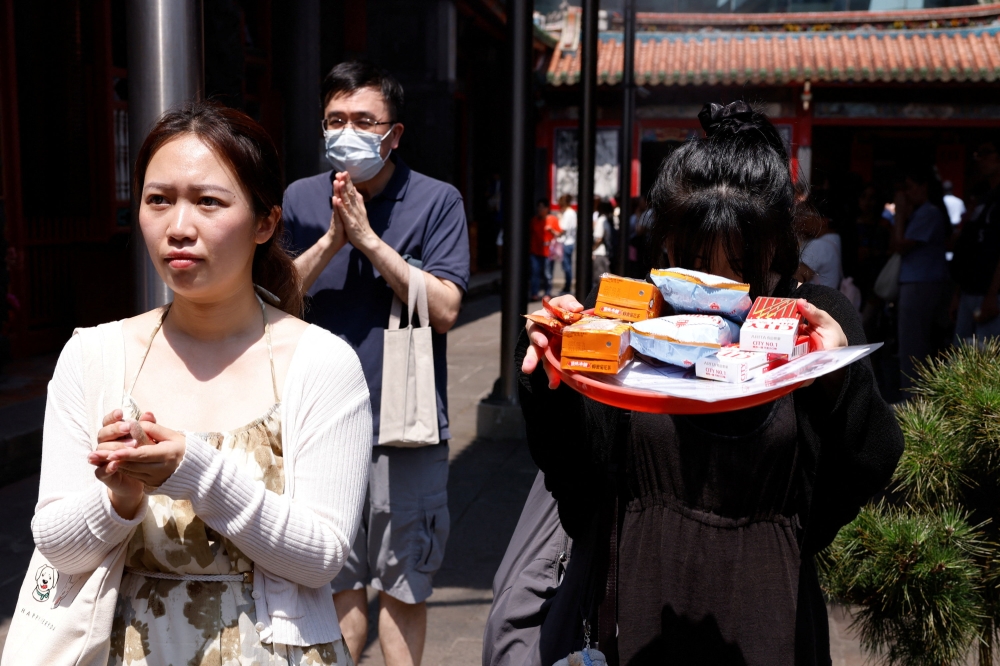
Over the weekend, a group of K-pop fans, mostly BTS fans, laid out snacks in purple packaging - the official BTS group colour - along with group merchandise, concert seat maps and wish lists on an altar table at Taipei’s Bangka Longshan Temple.
BTS fans prepare snacks, group merchandise, concert seat maps and wish lists to be placed on an altar table as they pray to Yue Lao, the god of love in Chinese mythology who oversees relationships and marriage, at Taipei’s Bangka Lungshan Temple, in hopes of securing a concert ticket, in Taipei, Taiwan, May 30, 2026. — Reuters pic
The trend started on social media a couple of years ago. Taiwanese K-pop fans believe Yue Lao will use his red thread of fate to connect those destined to meet - in this case, connecting fans with a concert seat.
“If you truly believe in it, your wish will come true,” said university student Ye Yu-ting, 22.
The last time BTS performed with all their members in Taiwan was in 2018.
The group announced their long-awaited world tour in early 2026 and will perform three shows in Kaohsiung on November 19, 21 and 22. — Reuters
US President Donald Trump on Friday warned Taiwan against declaring formal independence after concluding his visit to China, whose leader Xi Jinping had pressed him not to support the self-ruling island.
US President Donald Trump and Chinese President Xi Jinping tour the Hall of Prayer of Good Harvest at the Temple of Heaven in Beijing on May 14, 2026. Photo: The White House, via Flickr.
Trump ended the state visit claiming to have made “fantastic” trade deals, although the details were v
US President Donald Trump on Friday warned Taiwan against declaring formal independence after concluding his visit to China, whose leader Xi Jinping had pressed him not to support the self-ruling island.
US President Donald Trump and Chinese President Xi Jinping tour the Hall of Prayer of Good Harvest at the Temple of Heaven in Beijing on May 14, 2026. Photo: The White House, via Flickr.
Trump ended the state visit claiming to have made “fantastic” trade deals, although the details were vague, and he did not appear to secure any breakthrough with China over his stalemated war on Iran.
Trump invited Xi for a reciprocal visit to Washington in September, signalling both sides will likely seek stability in the often turbulent relationship between the world’s two largest economies.
On a key issue for Xi, Trump made clear he opposed a declaration of independence by Taiwan and appeared to question why the United States would defend the island in case of attack.
“I’m not looking to have somebody go independent. And, you know, we’re supposed to travel 9,500 miles to fight a war. I’m not looking for that,” he told Fox News’ “Special Report with Bret Baier.”
“I want them to cool down. I want China to cool down,” Trump said.
“We’re not looking to have wars, and if you kept it the way it is, I think China’s going to be OK with that.”
The United States recognizes only Beijing and does not support formal independence by Taiwan, but historically has stopped short of explicitly saying it opposes independence.
Under US law, the United States is required to provide weapons to Taiwan for its defence, but it has been ambiguous on whether US forces would come to the island’s aid.
Xi had begun the summit with a warning on Taiwan, whose President Lai Ching-te considers the island already independent, making a declaration unnecessary.
Xi told Trump that missteps on the sensitive issue could cause “conflict”.
Referring to comments by Secretary of State Marco Rubio, who said US policy toward Taipei was unchanged, Taiwan’s foreign ministry thanked the United States for showing “it supports and values Taiwan Strait peace and stability”.
No details on ‘fantastic’ deals
On Friday, Boeing confirmed that China had made an “initial commitment” to buy 200 aircraft, a deal previously announced by Trump. The company said more orders could follow.
Trump also said Beijing would buy American oil and soybeans.
US President Donald Trump and Chinese President Xi Jinping at Zhongnanhai in Beijing on May 15, 2026,. Photo: The White House, via Flickr.
“We’ve made some fantastic trade deals, great for both countries,” he said after a walk with Xi in the gardens of Zhongnanhai, a central leadership compound next to Beijing’s Forbidden City.
“We’ve settled a lot of different problems that other people wouldn’t have been able to solve,” Trump added, without providing specifics.
Xi promised to send Trump rose seeds for the White House Rose Garden and said it was a “milestone visit”.
But beyond Boeing, there were no other formal announcements from companies or from China on trade deals.
The reserve on the Chinese side echoes the tone of the summit as a whole, where Trump’s overtures to Xi — whom he described as a “great leader” and “friend” — were met with a more muted response.
“Trump got the optics he was looking for and the Chinese were happy to give them to him,” said Jacob Stokes, a senior fellow at the Centre for a New American Security.
Little on Iran
Trump had delayed the trip once due to the war in Iran, which has rebuffed his appeals for a peace agreement and retaliated by exerting control over the key Strait of Hormuz, sending global oil prices soaring.
US President Donald Trump and Chinese President Xi Jinping at Zhongnanhai in Beijing on May 15, 2026. Photo: The White House, via Flickr.
Trump said Xi had assured him that China was not preparing military aid to Iran. Israel has alleged that Beijing has provided key missile technology to Tehran.
The Chinese foreign ministry on Friday released a statement on Iran saying “shipping lanes should be reopened as soon as possible”.
Trump also acknowledged that he could not persuade Xi to free Jimmy Lai, the imprisoned Hong Kong pro-democracy media tycoon whose cause is broadly backed in Washington.
“He told me, Jimmy Lai is a tough one for him to do,” Trump told reporters.
Bonnie Glaser, managing director of the German Marshall Fund’s Indo-Pacific program, noted that Trump had already sounded half-hearted in his public comments on Lai.
“My sense is that the Chinese see that this is not a top priority for the United States,” she said.
“What Trump seems to want most is purchases of American products — that appears to be his highest priority.”
The two leaders had been expected to discuss extending the one-year tariff truce that paused their frenetic 2025 trade war, struck during their last meeting in October.
But Trump told reporters on the way home that it “wasn’t brought up”.
By Matthew Walsh
Japan’s defence minister took a veiled swipe at China on Sunday, pledging to keep strengthening the military despite Beijing’s criticism of Tokyo’s increasingly muscular security stance.
Japan’s Defence Minister Shinjiro Koizumi delivers a speech during the fifth plenary session of the 23rd Shangri-La Dialogue summit in Singapore on May 31, 2026. Photo: Mohd Rasfan/AFP.
Under Prime Minister Sanae Takaichi, Japan has quickened its pivot towards a more proactive defence
Japan’s defence minister took a veiled swipe at China on Sunday, pledging to keep strengthening the military despite Beijing’s criticism of Tokyo’s increasingly muscular security stance.
Japan’s Defence Minister Shinjiro Koizumi delivers a speech during the fifth plenary session of the 23rd Shangri-La Dialogue summit in Singapore on May 31, 2026. Photo: Mohd Rasfan/AFP.
Under Prime Minister Sanae Takaichi, Japan has quickened its pivot towards a more proactive defence policy, further shaking off — with US encouragement — its pacifist outlook in place since the end of World War II.
The change has drawn frequent rebukes from Beijing, which has accused Tokyo of following a reckless policy of “new militarism” that could destabilise the region.
Japanese Defence Minister Shinjiro Koizumi hit back on Sunday, saying “nothing could be further from the truth”.
“Think about it. There is a country that has a huge arsenal of nuclear weapons and strategic bombers,” Koizumi said at the annual Shangri-La Dialogue in Singapore.
“Japan has neither of such weapons. And yet, Japan is labelled (as) ‘new militarism’. Isn’t it strange?” he said, without mentioning China by name.
China is thought to possess hundreds of nuclear warheads and has been rapidly developing its military in recent years.
A diplomatic spat between the Asian rivals has been rumbling since Takaichi suggested in November that Japan might intervene militarily if China were to attempt to seize Taiwan, the self-ruled island that Beijing claims is part of its territory.
Japanese Prime Minister Sanae Takaichi attends an event on May 29, 2026. Photo: Sanae Takaichi, via X.
Koizumi said that China was expanding its military capabilities “without sufficient transparency” and that its military activities were “a matter of serious concern for Japan”.
Tokyo would “steadily build up its defence capabilities and make continuous updates with a high degree of transparency”, including in the fields of artificial intelligence, uncrewed systems as well as cyber and space defence, he said.
“Japan’s past as a peace-loving nation has been valued by the region and by international community. This fact will not be shaken by false claims, because it is a fact,” he said.
Maritime disputes
In a meeting with his Philippine counterpart Gilberto Teodoro, the two countries confirmed that Japan would aim to transfer Abukuma-class destroyers and TC-90 aircraft to the Southeast Asian nation during Japan’s fiscal year 2027, a Philippine statement said.
Manila has been eyeing the Abukuma-class vessels — which are being retired by Japan — for some time, with the military sending a contingent to examine them in 2025.
The countries have been deepening defence ties in the shadow of China’s naval ambitions, announcing that they will discuss intelligence sharing and open maritime border talks condemned by Beijing as an “illegal” violation of its expansive territorial claims.
Teodoro singled out Beijing’s activities in the South China Sea for criticism, saying Manila “will not sacrifice our territorial integrity and sovereignty because our constitution does not allow us”.
Philippines’ Secretary of National Defence Gilberto Teodoro delivers a speech as he attends the sixth plenary session of the 23rd Shangri-La Dialogue summit in Singapore on May 31, 2026. Photo: The International Institute for Strategic Studies, via Flickr.
“To do so would be to subvert the popular, democratic and free mandate that the people gave our political leaders, unlike some autocratic systems where the mandate comes from above, dictated down.”
Beijing claims almost the entire South China Sea despite an international ruling that its assertion has no legal basis.
As Teodoro spoke, China’s People’s Liberation Army Southern Theater Command issued a statement online saying it had “conducted combat readiness patrols” in the waters and airspace around Scarborough Shoal, the site of a years-long territorial dispute with the Philippines.
The patrols “serve as an effective countermeasure to cope with all sorts of rights-violation and provocative acts” around the shoal, “an inherent part of China’s territory”, the statement said.
The Shangri-La Dialogue is Asia’s top defence forum, bringing together security officials and experts from about 45 countries.
In contrast to Japan — and its ally the United States — China has sent a watered-down delegation that does not include its defence minister, Dong Jun, for the second year running.
Koizumi said he was “feeling sad that we were unable to have the opportunity to have a meeting this time”.
President Donald Trump said he had made “fantastic trade deals” with China’s Xi Jinping, as the pair met on Friday at final talks of a superpower summit that according to the US leader has also reaped a Chinese offer to help open the Strait of Hormuz.
US President Donald Trump (left) poses for photos with Chinese President Xi Jinping during a visit to Zhongnanhai Garden in Beijing on May 15, 2026. Photo: Evan Vucci/Pool/AFP.
Trump had arrived in Beijing seeking to seal deals in sectors in
President Donald Trump said he had made “fantastic trade deals” with China’s Xi Jinping, as the pair met on Friday at final talks of a superpower summit that according to the US leader has also reaped a Chinese offer to help open the Strait of Hormuz.
US President Donald Trump (left) poses for photos with Chinese President Xi Jinping during a visit to Zhongnanhai Garden in Beijing on May 15, 2026. Photo: Evan Vucci/Pool/AFP.
Trump had arrived in Beijing seeking to seal deals in sectors including agriculture, aviation and artificial intelligence, as well as to contain differences between the two sides in a number of tense geostrategic areas — not least the Middle East war.
Trump’s overtures to Xi, whom he described as a “great leader” and “friend”, have so far been met with more muted tones by the Chinese leader.
But the US leader said “a lot of good” has come out of the visit.
“We’ve made some fantastic trade deals, great for both countries,” he said after a walk with Xi among the rosebushes in the gardens of Zhongnanhai, a central leadership compound next to Beijing’s Forbidden City.
“We’ve settled a lot of different problems that other people wouldn’t have been able to solve,” he added, without providing details.
Xi said it was a “milestone visit”, and that the two sides had to date established “a new bilateral relationship, which is a relationship of constructive strategic stability”.
He promised to send Trump seeds for the White House Rose Garden.
‘Help on Hormuz’
In an interview with Fox News after the first day of the summit wrapped, Trump said Xi had agreed to several US wishlist points.
China’s President Xi Jinping (right) and US President Donald Trump at the Great Hall of the People in Beijing on May 14, 2026. Photo: Mao Ning Chinese Foreign Ministry Spokesperson, via Facebook.
On the topic of the war in Iran, the US president said Xi had effectively assured his counterpart that China was not preparing to militarily aid Tehran, which has essentially closed the Strait of Hormuz.
“He said he’s not going to give military equipment… he said that strongly,” Trump told Fox.
“He’d like to see the Hormuz Strait open, and said ‘if I can be of any help whatsoever, I would like to help,'” Trump added.
Asked whether the two leaders had discussed Iran, the Chinese foreign ministry on Friday released a statement calling for “a comprehensive and lasting ceasefire”.
“Shipping lanes should be reopened as soon as possible in response to the calls of the international community,” it added.
Taiwan policy ‘unchanged’
The warm handshakes and pomp on Thursday were somewhat overshadowed by a blunt warning from Xi on a much longer standing geopolitical flashpoint, Taiwan.
Taiwan flag aboard the island’s coast guard vessel. Photo: Kuan Bi-ling, via Facebook.
Shortly after talks started, Chinese state media reported Xi had told Trump that missteps on the sensitive issue of Taiwan could push their two countries into “conflict”.
The Fox News interview did not touch upon Taiwan, and Trump did not comment to reporters when asked about the matter on Thursday.
US Treasury Secretary Scott Bessent told CNBC the president would say more “in the coming days”.
Secretary of State Marco Rubio told NBC on Thursday though that “US policy on the issue of Taiwan is unchanged… as of the meeting”.
Beijing had raised the topic, he said, but “we always make clear our position, and we move on to the other topics”.
Taipei responded Friday thanking Washington “for repeatedly expressing its support”.
Boeing, oil, soybeans
Trump did not spell out on Friday the trade agreements that he said had been sealed with China.
Chinese President Xi Jinping and US President Donald Trump attend talks with high-ranking officials in Beijing on May 14, 2026. Photo: Mao Ning Chinese Foreign Ministry Spokesperson, via Facebook.
However, in the Fox interview, Trump said one big business deal struck involved Xi agreeing to purchase “200 big” Boeing jets.
Shares of the US aviation giant fell after Trump’s comments, in a sign the market had expected a more robust purchase from China.
The US president also said Beijing had also voiced interest in buying US oil and soybeans.
China, which is the key foreign customer of Iranian oil, bought small amounts of US oil before Trump imposed tariffs last year.
It has sharply slowed down purchases of US soybeans, turning instead to Brazil.
Bessent told CNBC that Trump and Xi were talking about setting up “guardrails” for the use of artificial intelligence.
Bessent said the world’s “two AI superpowers are going to start talking”, though US export controls on the advanced technology to China remain a sore point in relations.
Taiwan said Monday that China’s maritime operation in waters to the east of the island democracy was “provocative” and “expansionism in disguise”.
Photo: Taiwan Presidential Office, via Flickr.
Chinese ships are conducting a “law enforcement operation” in response to talks between Japan and the Philippines to draw a boundary in waters to the east of Taiwan, Chinese state media said Saturday.
China, which asserts Taiwan is part of its territory, called the talks “illegal” and has claim
Taiwan said Monday that China’s maritime operation in waters to the east of the island democracy was “provocative” and “expansionism in disguise”.
Photo: Taiwan Presidential Office, via Flickr.
Chinese ships are conducting a “law enforcement operation” in response to talks between Japan and the Philippines to draw a boundary in waters to the east of Taiwan, Chinese state media said Saturday.
China, which asserts Taiwan is part of its territory, called the talks “illegal” and has claimed exclusive control over the waters.
“It’s nothing but expansionism in disguise that threatens regional peace & stability,” Taiwan’s National Security Council chief Joseph Wu wrote on X.
Taiwan Foreign Minister Joseph Wu speaks to HKFP at the Ministry of Foreign Affairs in Taipei, Taiwan, on May 14. Photo: MOFA (Taiwan R.O.C).
Defence Minister Wellington Koo said the Chinese actions were “provocative”.
Koo told reporters that the move was a “cognitive warfare operation” designed to claim that the waters off Taiwan’s east coast fell within China’s “enforcement jurisdiction”.
Taiwan’s coast guard has deployed seven patrol vessels to monitor the Chinese ships.
The Taiwanese vessels expelled four Chinese ships from waters off the island’s southernmost tip on Sunday.
The ships have since moved further east, Taiwan’s coast guard said Monday, after an hours-long standoff.
Japan fired surface-to-ship missiles and sank an old warship in waters between the Philippines and Taiwan as part of major military exercises that include US forces, angering China.
A Japan’s Type 88 surface-to-ship missile system is launched during the maritime strike of Balikatan exercise in Paoay, Ilocos Norte on May 6, 2026. Photo: Jam Sta Rosa/AFP.
Prime Minister Sanae Takaichi has accelerated Japan’s shift towards a more muscular defence policy, further casting off — with US encoura
Japan fired surface-to-ship missiles and sank an old warship in waters between the Philippines and Taiwan as part of major military exercises that include US forces, angering China.
A Japan’s Type 88 surface-to-ship missile system is launched during the maritime strike of Balikatan exercise in Paoay, Ilocos Norte on May 6, 2026. Photo: Jam Sta Rosa/AFP.
Prime Minister Sanae Takaichi has accelerated Japan’s shift towards a more muscular defence policy, further casting off — with US encouragement — Tokyo’s pacifist stance in place since the end of World War II.
The firing on Wednesday of two Type-88 missiles formed part of exercises in the Philippines between US, Australian, Filipino and Japanese troops as well as contingents from France, New Zealand and Canada.
Japanese and Philippine defence ministers observed the launch in the northern province of Ilocos Norte, some 400 kilometres (250 miles) from Taiwan, an AFP reporter at the scene said.
The two projectiles hit the target, a retired Philippines navy corvette, around 75 kilometres offshore in the South China Sea, causing it to sink, officials said.
The 19-day Balikatan exercises, meaning “shoulder-to-shoulder” and which wrap up Friday, have involved some 17,000 military personnel including Japanese combat troops for the first time.
Japanese Prime Minister Sanae Takaichi. Photo: Sanae Takaichi, via X.
Japan in recent years has moved to obtain “counterstrike” capabilities while hiking military spending and deepening security cooperation with regional allies including the Philippines.
Last month Takaichi’s government relaxed the country’s self-imposed rules to allow exports of lethal military hardware, seeking to grab a larger slice of the booming global market.
Last year Japan’s Mitsubishi Heavy Industries won a landmark order from the Australian navy — Takaichi was in Canberra this week — to supply 11 warships.
Missile drill angers China
Long-frosty China-Japan ties have worsened after Takaichi, seen as an arch-conservative and security hawk, suggested in November that Japan might intervene militarily in any Chinese attempt to take Taiwan.
China, which regards the democratic island as part of its territory and has not ruled out force to annex it, was furious over the comments, advising its citizens to avoid Japan and imposing trade restrictions.
Chinese foreign ministry spokesman Lin Jian during a press conference on March 20, 2026. Photo: China’s Ministry of Foreign Affairs.
On Wednesday Beijing lashed out at the missile test, calling it “another example of the Japanese right-wing forces’ push for accelerated remilitarisation of Japan.”
Foreign ministry spokesperson Lin Jian told a regular briefing that “not only has Japan, the aggressor, failed to deeply reflect on its historical crimes, it has even sent military forces overseas and fired offensive missiles under the pretext of security cooperation.”
Yee Kuang Heng, a professor in international security at the University of Tokyo, said that the missile test to sink a ship was “particularly significant as island defence is a shared concern of both Japan and the Philippines.”
Another important component was the participation of Japan’s Amphibious Rapid Deployment Brigade (ARDB) in counter-landing drills with US, Philippine and Canadian forces, Heng added.
“Balikatan 2026 also saw the maiden deployment of Japan’s ShinMaywa US-2 amphibious aircraft for air-sea rescue and medical procedures, especially important given the long sea lanes in the region,” Heng told AFP.
China accused Japan’s defence minister on Monday of spreading “baseless” claims and sowing confusion, a day after he took a veiled swipe at Beijing.
Defence Minister Shinjiro Koizumi had pledged on Sunday to keep strengthening Japan’s military and warned China was expanding its capabilities without sufficient transparency.
Japan’s Defence Minister Shinjiro Koizumi delivers a speech during the fifth plenary session of the 23rd Shangri-La Dialogue summit in Singapore on May 31, 2026. Photo:
China accused Japan’s defence minister on Monday of spreading “baseless” claims and sowing confusion, a day after he took a veiled swipe at Beijing.
Defence Minister Shinjiro Koizumi had pledged on Sunday to keep strengthening Japan’s military and warned China was expanding its capabilities without sufficient transparency.
Japan’s Defence Minister Shinjiro Koizumi delivers a speech during the fifth plenary session of the 23rd Shangri-La Dialogue summit in Singapore on May 31, 2026. Photo: The International Institute for Strategic Studies, via Flickr.
His comments follow a months-long diplomatic spat between the Asian rivals, which began when Prime Minister Sanae Takaichi suggested in November that Japan could intervene militarily if China attempted to seize Taiwan, the self-ruled island claimed by Beijing.
China’s foreign ministry said on Monday that Koizumi’s comments were “entirely baseless”.
“They appear pale and feeble in the face of a series of historical and legal facts and figures,” ministry spokesman Lin Jian told a news briefing.
“This Japanese official deliberately… attempts to turn the tables and sow confusion,” Lin said.
“Japan’s so-called dialogue is nothing but hypocrisy — a performance put on for appearances, devoid of any genuine sincerity,” he added.
Under Takaichi, Japan has quickened its pivot towards a more proactive defence policy, further shaking off — with US encouragement — a pacifist outlook, which has been in place since the end of World War II.
Koizumi made his comments at the annual IISS Shangri-La Dialogue in Singapore, saying China’s expanding military capabilities were “a matter of serious concern for Japan”.
Tokyo would “steadily build up its defence capabilities and make continuous updates with a high degree of transparency”, including in the fields of artificial intelligence, uncrewed systems as well as cyber and space defence, he said.
Beijing has frequently rebuked Tokyo for its pivot and said following a reckless policy of “new militarism” that could destabilise the region.

 Login
Login