Normal view

  • ✇Vox
  • The Supreme Court just handed down two surprisingly timid Voting Rights Act decisions Ian Millhiser
    Justice Neil Gorsuch wants to make it impossible to sue for violations of the Voting Rights Act. | Mario Tama/Getty Images On Monday, the Supreme Court decided not to thrust another dagger into the nearly lifeless corpse of the Voting Rights Act. The Voting Rights Act of 1965 is arguably the most successful civil rights law in American history. Before the Roberts Court began to dismantle it, the VRA included a web of provisions intended to prevent states from denying anyone the right to
     

The Supreme Court just handed down two surprisingly timid Voting Rights Act decisions

19 May 2026 at 20:05
Justice Neil Gorsuch
Justice Neil Gorsuch wants to make it impossible to sue for violations of the Voting Rights Act. | Mario Tama/Getty Images

On Monday, the Supreme Court decided not to thrust another dagger into the nearly lifeless corpse of the Voting Rights Act.

The Voting Rights Act of 1965 is arguably the most successful civil rights law in American history. Before the Roberts Court began to dismantle it, the VRA included a web of provisions intended to prevent states from denying anyone the right to vote because of their race. And the law started to dismantle Jim Crow voter suppression almost immediately after it took effect. Just two years after it became law, Black voter registration rates in Mississippi grew from 6.7 percent to 60 percent.

But the Supreme Court’s Republican majority loathes this law. As Justice Elena Kagan wrote in a 2021 dissenting opinion, her Court “has treated no statute worse” than the Voting Rights Act. As a young White House lawyer, future Chief Justice John Roberts unsuccessfully pushed then-President Ronald Reagan to veto a 1982 amendment to the VRA that the Court recently repealed in Louisiana v. Callais (2026).

After Callais, it is unclear whether the VRA has any remaining force whatsoever.

The two orders the Court handed down on Monday, meanwhile, concerned an alternative proposal to strangle the Voting Rights Act that Justice Neil Gorsuch floated in a concurring opinion in Brnovich v. DNC (2021), the same case where Kagan said that her Court has treated no law worse than the VRA. But the Monday orders neither endorsed Gorsuch’s theory nor rejected it — it merely asked two lower courts that previously considered this theory to consider it again.

The orders came in two cases, Turtle Mountain Band v. Howe, where the lower court backed Gorsuch’s attempt to further neutralize the VRA, and Board of Election Commissioners v. NAACP, where the lower court rejected Gorsuch’s attack on the law.

It’s unclear why this Supreme Court, which has been so relentlessly hostile toward the VRA, decided to punt this latest fight until some future date. It’s also unclear whether this fight still matters, as the Court has already bled the Voting Rights Act so deeply that the law may no longer actually do anything.

Still, as it appears there is still one more big legal dispute looming over this most diminished of federal laws, let’s take stock of just how much of the Voting Rights Act remains.

Does the Voting Rights Act still do anything at all?

Before the Republican justices started to dismantle the VRA in Shelby County v. Holder (2013), the law used several mechanisms to ensure that voters of color were not locked out of power. As originally enacted in 1965, the law required states with a history of racist election practices to “preclear” any new election laws with officials in Washington, DC, to ensure that those laws did not target voters because of their race. This provision was effectively repealed by Shelby County.

Meanwhile, the 1982 amendment required some states to draw a minimal number of majority-Black or majority-Latino legislative districts. And it forbade a state election law that “results in a denial or abridgement of the right of any citizen of the United States to vote on account of race or color,” even if the plaintiffs challenging that law could not prove that it was enacted with racist intent. 

This 1982 amendment was effectively repealed by Callais.

That said, Callais does say that a Voting Rights Act plaintiff may still prevail in very limited circumstances. The law, Justice Samuel Alito claimed in his Callais opinion, “imposes liability only when the circumstances give rise to a strong inference that intentional discrimination occurred.” So a voting rights plaintiff may still win their case if they can show that a state law was motivated by racist animus.

Realistically, however, this means that the post-Callais Voting Rights Act does no independent work whatsoever. As Alito acknowledges in Callais, the Constitution already contains a voting rights provision — the 15th Amendment — that, in Alito’s words, “bars only state action ‘motivated by a discriminatory purpose.’” So state laws that intentionally discriminate on the basis of race were already illegal before the VRA became law.

Indeed, even prior to the VRA’s enactment in 1965, the Supreme Court did occasionally strike down state election laws that intentionally discriminated on the basis of race, holding that they violated the 15th Amendment. The Voting Rights Act was necessary not because Jim Crow voting laws were legal, but because Jim Crow states were creative. Whenever a court did strike down a state law intended to keep Black people from voting, Southern states would typically respond by enacting a new law that achieved the same goal in a different way — thus forcing civil rights advocates to bring another lawsuit that could take years before another judge issued a new injunction against the new law.

The whole point of preclearance was to prevent racist laws from ever taking effect, and thus prevent Jim Crow lawmakers from outrunning slow-moving courts that were struggling to enforce the 15th Amendment.

Meanwhile, while Jim Crow lawmakers were often quite explicit about their white supremacist goals, by the 1980s most lawmakers who still harbored racist beliefs were shrewd enough not to say such things out loud. The 1982 amendment, which targets state election laws that have negative racial impacts — even if the plaintiffs cannot prove racist intent — was designed to ensure that the VRA would still function even in a world where plaintiffs could not produce direct evidence that a state law was enacted for racist reasons.

The combined effect of Shelby County, Brnovich, Callais, and similar cases, in other words, is to return (or, perhaps, retvrn) US voting rights law to 1964. While some shell of the Voting Rights Act remains on the books, it does not appear to do any independent work that isn’t already done by the 15th Amendment.

And that brings us back to Gorsuch’s proposal in Brnovich, which, if taken to the extreme, could potentially leave voting rights plaintiffs even worse off than they were prior to the Voting Rights Act’s enactment.

Gorsuch wants to make it impossible to sue for violations of the Voting Rights Act

Gorsuch’s concurring opinion in Brnovich suggests that the Voting Rights Act does not include an “implied cause of action.” This means that, if Gorsuch’s view were to prevail in the Supreme Court, no private plaintiff would ever be able to bring a lawsuit alleging a violation of the VRA ever again (although the federal government would still be able to do so, assuming it was controlled by a president who supports voting rights). 

Some federal laws state explicitly that certain individuals or institutions may sue in order to enforce them. When a federal law does not contain such explicit language, however, the Supreme Court has developed a set of rules governing when private parties may sue to enforce the law.

Until last year, these cases were governed by the rule the Court most recently laid out in Health and Hospital Corporation v. Talevski (2023), which held that a federal law may be enforced by private lawsuits if it is “‘phrased in terms of the persons benefited’ and contains ‘rights-creating,’ individual-centric language with an ‘unmistakable focus on the benefited class.’”

Thus, for example, if a federal law says that “no state may prevent an athletic person from riding a bicycle,” this law would be enforceable by private lawsuits because the law’s text focuses on the people who benefit from it (athletic people). A similar statute saying that “states shall not impede access to bicycles” would be unenforceable by private lawsuits, because that hypothetical law lacks the “individual-centric language” demanded by Talevski.

Two years after Talevski, however, the Court appeared to abandon its framework. In Medina v. Planned Parenthood (2025), the Court considered whether a statute that permits “any individual eligible for medical assistance” under Medicaid to choose their own health provider could sue after a state denied Medicaid benefits to patients who choose Planned Parenthood as their health provider. 

Although this statute clearly permits Medicaid patients to file lawsuits, at least under the Talevski rule, the Court’s Republicans issued a confusing majority opinion disallowing the suit. It is unclear whether Medina was intended to overrule Talevski, or if it was merely a one-off decision that the Republican justices reached because they did not want to rule in favor of an abortion provider.

That said, Medina does include several pages suggesting that federal laws that use the word “right” in their text may be enforced through private lawsuits.

So, with these two competing frameworks in mind, consider the language of the Voting Rights Act:

No voting qualification or prerequisite to voting or standard, practice, or procedure shall be imposed or applied by any State or political subdivision in a manner which results in a denial or abridgement of the right of any citizen of the United States to vote on account of race or color…

Under Talevski, the VRA may be enforced via private lawsuits because the statute is phrased in terms of the people who benefit from it (“any citizen of the United States”). Similarly, while the Medina decision is difficult to parse, it does suggest that statutes that use the word “right” may be enforced by private lawsuits. And that word is front and center in the Voting Rights Act.

Gorsuch’s Brnovich opinion is only a paragraph long, so it does not explain how Gorsuch reached the odd conclusion that the VRA does not authorize private lawsuits. Gorsuch doesn’t even specify whether he thinks that Talevski’s framework, Medina’s framework, or some secret third thing should govern VRA lawsuits.

But he did write that opinion, and it was joined by Justice Clarence Thomas. So it appears that there are at least two votes on the Supreme Court to cut off private lawsuits under the VRA altogether.

One uncertain question is whether these two justices would still permit private plaintiffs to sue under the 15th Amendment. Like the Voting Rights Act, the 15th Amendment’s language (“The right of citizens of the United States to vote shall not be denied or abridged by the United States or by any State on account of race, color, or previous condition of servitude”) should permit suits under either Talevski or Medina. But, if Thomas and Gorsuch are willing to shut down VRA suits in the absence of any law or precedent justifying such an outcome, why wouldn’t they also shut down 15th Amendment suits?

We don’t know. But on Monday, the Court decided to delay resolving this question — the question of whether any private plaintiffs may sue under the VRA — until some future date. So we will have to wait until then to find out if Thomas, Gorsuch, or any other justice wants to make federal law even less favorable to voting rights plaintiffs than it was under Jim Crow.
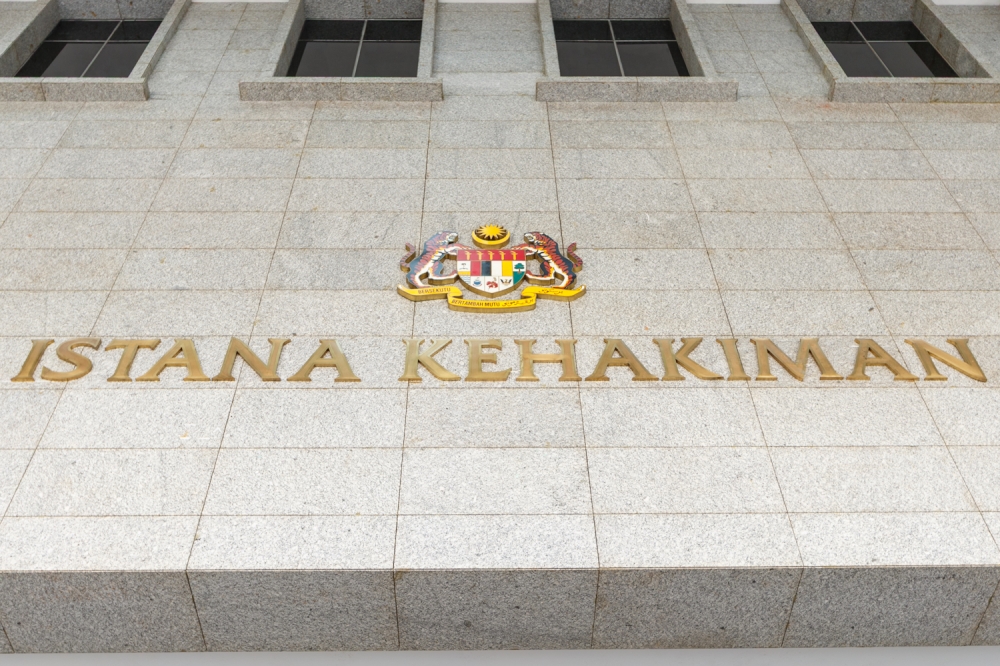
Lawyer seeks Federal Court’s leave to appeal over Agong’s refusal to declare emergency five years ago

3 June 2026 at 11:54

Malay Mail

PUTRAJAYA, June 3 — Lawyer Syed Iskandar Syed Jaafar Al Mahdzar has filed an application at the Federal Court seeking leave to appeal in relation to his judicial review challenge concerning the former Yang di-Pertuan Agong’s refusal to a request by the then prime minister to declare a state of emergency five years ago.

When contacted by Bernama, Syed Iskandar confirmed that the notice of motion was filed last Friday through law firm Messrs R.Kengadharan & Co.

On May 4 this year, the Court of Appeal three-man bench comprising Federal Court judge Datuk Collin Lawrence Sequerah and Court of Appeal judges Datuk Supang Lian and Datuk Dr Alwi Abdul Wahab, dismissed Syed Iskandar’s appeal.

Syed Iskandar had filed an originating summons in 2020, seeking a declaration that the Constitution (Amendment) Act 1981 (Act A514), which added Clauses 8 (a) and (b) to Article 150, is unconstitutional, null and void and of no effect on the ground that it violated the basic structure of the Federal Constitution.

He named the Malaysian Government and 10 others as defendants in the suit.

On February 15, 2024, the High Court in Kuala Lumpur dismissed the originating summons. The court ruled that Article 150(8) does not violate the basic structure of the Federal Constitution and cannot be struck down under Article 40(1), which states that the Yang di-Pertuan Agong shall act on the advice of the Cabinet.

In dismissing Syed Iskandar’s appeal, Justice Sequerah ruled that matters concerning emergency powers under Article 150 of the Federal Constitution are non-justiciable.

“A court would not be equipped to decide on the legality of the Yang Di-Pertuan Agong’s satisfaction of national threats as it would be impossible to adduce all available facts before the courts, and as such it would be inappropriate for a court exercising powers of judicial review to make value judgments of non-judicial nature,” he said in his grounds of decision.

He further said that there was a need to include Clause 8 to exclude the court from reviewing the proclamation of emergency and any related ordinance, as certain sensitive information is only available to the Executive, and it was not wise for such sensitive information to be disclosed to the public and be subjected to judicial review.

Justice Sequerah added that the courts were also ill-equipped to deal with matters involving national security. — Bernama

  • ✇Hong Kong Free Press HKFP
  • 4 plead guilty to rioting at PolyU during 2019 protests Hillary Leung
    Four men have pleaded guilty to rioting during the siege of the Hong Kong Polytechnic University (PolyU) campus amid the anti-extradition protest and unrest seven years ago. District Court in Wan Chai. File photo: Hans Tse/HKFP. Cheung Chung-yiu, 24; Cheung Chin-ming, 29; Chan Chun-hei, 22; and Chan Yuen-ming, 33, appeared at the District Court on Monday morning to enter their pleas. The four defendants were not prosecuted when they were first arrested in 2019 and 2020. However, they w
     

4 plead guilty to rioting at PolyU during 2019 protests

19 May 2026 at 04:25
PolyU siege

Four men have pleaded guilty to rioting during the siege of the Hong Kong Polytechnic University (PolyU) campus amid the anti-extradition protest and unrest seven years ago.

The District Court in Wan Chai, Hong Kong, on November 2, 2023. Photo: Hans Tse/HKFP.
District Court in Wan Chai. File photo: Hans Tse/HKFP.

Cheung Chung-yiu, 24; Cheung Chin-ming, 29; Chan Chun-hei, 22; and Chan Yuen-ming, 33, appeared at the District Court on Monday morning to enter their pleas.

The four defendants were not prosecuted when they were first arrested in 2019 and 2020. However, they were re-arrested in June 2024 and charged with rioting at PolyU between November 14, 2019 and November 20, 2019.

The events at the Hung Hom campus were one of the most violent episodes during the protests and unrest in 2019, with protesters setting fires with petrol bombs as they faced off against police.

A fifth defendant, Lai Chun-kit, was not present. He has not attended hearings since October 2024, and an arrest warrant has been issued for him, The Witness reported.

PolyU protest
Protesters outside the Hong Kong Polytechnic University in Hong Kong on November 17, 2019. Photo: Studio Incendo.

According to the prosecution, CCTV footage captured the defendants’ behaviour during the riot. Cheung Chung-yiu was seen moving barriers to block a footbridge, while Cheung Chin-ming and Chan Chun-hei were filmed taking containers from a laboratory.

Chan Yuen-ming was seen walking around the university campus and taking a large flask and two bottles with him.

Mitigation

The four defendants had initially planned to plead not guilty and go forward with a trial, the court heard, but later changed their minds.

During mitigation, Cheung Chung-yiu’s lawyer said that the defendant had gone abroad to study before he was re-arrested in 2024, while Cheung Chin-ming’s lawyer told the court that his client had supported victims of the Wang Fuk Court fire in its aftermath.

"November 17" police arrow leg Hong Kong Polytechnic University
A bridge leading to the Hong Kong Polytechnic University set on fire on Nov. 17, 2019. Photo: Viola Kam/United Social Press.

A legal representative for Chan Chun-hei said the defendant was only 16 at the time of the incident. He worked in the construction sector and became a father at 21, his lawyer said, adding that he regretted what he had done when he was younger.

Chan Yuen-ming’s lawyer said his client was tricked into working at a scam farm in Thailand, returning to Hong Kong in 2022 after his family paid a ransom. He suffers from post-traumatic stress disorder, the lawyer said.

The lawyer added that Chan Yuen-ming was sentenced to 18 years and five months in prison for a drug trafficking offence, and that he stands to face a long time in prison.

The four defendants will be sentenced on June 8. Rioting is punishable by up to 10 years’ imprisonment, although jail terms handed down at the District Court are capped at seven years.

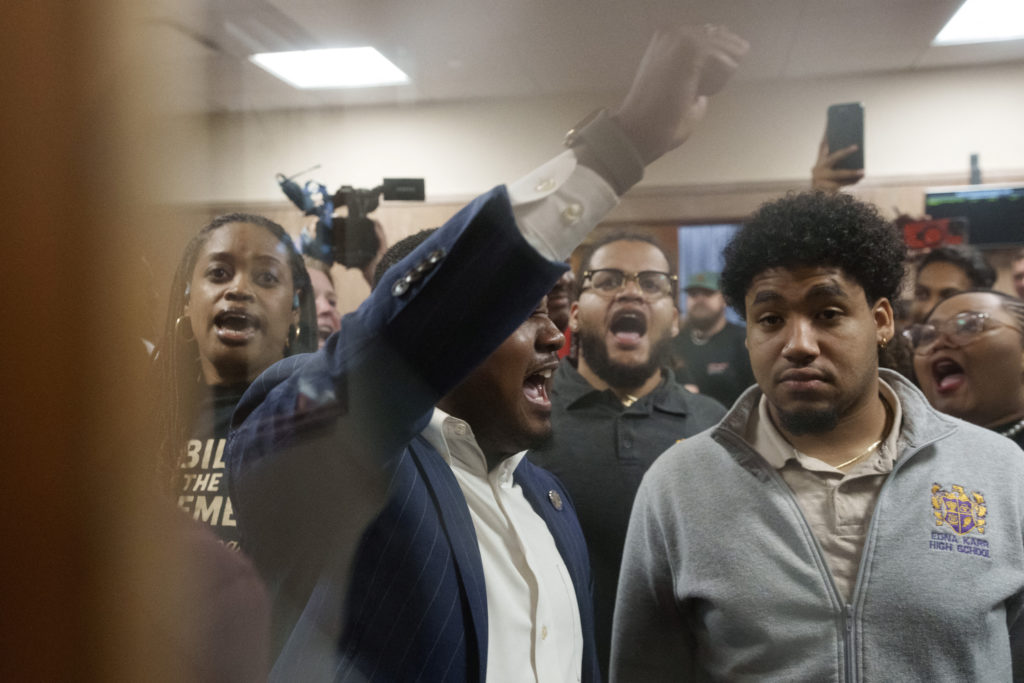
Louisiana passes new congressional map to eliminate majority-Black district, give GOP another seat

29 May 2026 at 19:03
Approval of the new House map came a month after the U.S. Supreme Court struck down the state's current map as an illegal racial gerrymander, weakening the landmark 1965 federal Voting Rights Act.

  • ✇Deadline
  • Jafar Panahi’s One-Year Prison Sentence Upheld By Iranian Judge Glenn Garner
    Following a retrial for his “propaganda activity against the regime,” Tehran Revolutionary Court has upheld Jafar Panahi’s one-year prison sentence. On Sunday, the It Was Just An Accident writer/director’s attorney Mostafa Nili announced that Judge Iman Afshari rejected their objections and fully upheld the in-absentia verdict, on the grounds of making an “underground and problematic […]
     

Jafar Panahi’s One-Year Prison Sentence Upheld By Iranian Judge

7 June 2026 at 16:20
Following a retrial for his “propaganda activity against the regime,” Tehran Revolutionary Court has upheld Jafar Panahi’s one-year prison sentence. On Sunday, the It Was Just An Accident writer/director’s attorney Mostafa Nili announced that Judge Iman Afshari rejected their objections and fully upheld the in-absentia verdict, on the grounds of making an “underground and problematic […]

  • ✇Vox
  • The next victim of the Supreme Court’s voting rights decision will be workers Ian Millhiser
    Meet your new king. | Chip Somodevilla/Getty Images President Donald Trump’s Department of Justice released an opinion on Tuesday that, in the likely event it is embraced by a Republican-controlled federal judiciary, would make it significantly harder for plaintiffs who face employment discrimination to prevail in court. The opinion was released by the Office of Legal Counsel, an institution that interprets federal law and the Constitution for executive branch officials, and is signed b
     

The next victim of the Supreme Court’s voting rights decision will be workers

10 June 2026 at 18:05
Justice Sam Alito
Meet your new king. | Chip Somodevilla/Getty Images

President Donald Trump’s Department of Justice released an opinion on Tuesday that, in the likely event it is embraced by a Republican-controlled federal judiciary, would make it significantly harder for plaintiffs who face employment discrimination to prevail in court.

The opinion was released by the Office of Legal Counsel, an institution that interprets federal law and the Constitution for executive branch officials, and is signed by T. Elliot Gaiser, the head of that office. Gaiser is a former law clerk to Justice Samuel Alito, author of the Supreme Court’s recent decision in Louisiana v. Callais, which repealed a 1982 amendment to the federal Voting Rights Act and greenlit a new round of gerrymandering by white Southern Republican lawmakers.

Gaiser’s opinion argues that Alito’s attack on the Voting Rights Act in Callais applies with equal force to anti-discrimination law in employment. And, if you accept Alito’s opinion in Callais as legitimate, then Gaiser’s approach to employment discrimination is hardly a stretch. Indeed, it is the next logical move in the Republican Party’s broader campaign to weaken civil rights protections for racial minorities. 

Notably, one day after Gaiser released his opinion, Trump’s Department of Transportation announced that it was applying Callais to its regulations. So it appears that this administration wants to implement Alito’s views throughout the executive branch.

The 1982 law that Alito targeted in Callais provided that voting rights plaintiffs who challenged a state election law did not need to prove that state lawmakers acted with racist intent in order to prevail. Under that law, which was repealed by Callais, a state law that “results” in voters having their right to vote diminished due to their race may also be challenged.

For 40 years, the Supreme Court interpreted this “results” test to sometimes require states to draw a minimum number of legislative districts where Black or Latino voters can elect their candidates of choice. After Callais, white lawmakers are now free to draw maps that will only elect white Republicans, so long as they claim that the purpose of those maps is to lock Democrats out of power and not to target voters of color.

Gaiser’s opinion, meanwhile, concerns a 1991 federal law that sometimes permits an employment discrimination plaintiff to prevail if they can show that an employer engages in a “practice that causes a disparate impact on the basis of race, color, religion, sex, or national origin.” This framework, which is known as “disparate impact,” is similar to the one laid out in the pre-Callais Voting Rights Act, because it sometimes permits a civil rights plaintiff to prevail without proving that the employer acted with racist or otherwise impermissible intent.

Given these similarities, Gaiser’s core argument — that Callais’s framework also applies to disparate impact suits — is likely to prevail before a Republican Supreme Court. Quoting from Callais, Gaiser argues that federal employment discrimination law “imposes liability only when the circumstances give rise to a strong inference that intentional discrimination occurred.” 

There are two upshots to this conclusion. One is that it should be significantly harder for many employment discrimination plaintiffs to prevail. The other, which is potentially even more significant, is that elected officials should lose much of their power to remedy discrimination of all kinds, and the scope of civil rights law should be determined primarily by the Supreme Court.

Both the Voting Rights Act’s results test and employment discrimination’s disparate impact test, after all, were enacted into law by Congress. But the Republican Party’s consistent position on civil rights laws is that democratically enacted civil rights laws must bow to the whims of Republican justices.

Disparate impact, explained

In fairness, disparate impact lawsuits predate Congress’s decision to endorse them in 1991. The Supreme Court first embraced the idea that employment practices that have a disproportionate impact on racial minorities may be illegal in its unanimous decision in Griggs v. Duke Power (1971).

Griggs involved an employer who had historically employed both Black and white workers who did not have a high school diploma, but it restricted all Black workers to the lowest-paying jobs. Shortly after Congress banned employment discrimination in 1964, this employer instituted a new policy preventing people without a high school diploma from transferring out of the lowest paying jobs, but it grandfathered in white employees without a high school education who were already in higher paying roles.

The Court ruled against the employer. While the justices acknowledged that there are often valid reasons for an employer to require its employees to have a certain level of education, the fact that white workers without a high school diploma had historically performed well in some of this particular employer’s higher-paying roles suggested that Black workers without a high school education would also perform well in those roles. 

Griggs established that, when an education requirement or similar barrier has a disproportionate negative impact on workers of a particular race, the requirement must actually be “a reasonable measure of job performance.” 

Congress later codified this rule in the 1991 law, which forbids employment practices that have a disparate impact on certain groups of workers, unless the employer can show “that the challenged practice is job related for the position in question and consistent with business necessity.” 

Republican judges, however, have long been skeptical of these disparate impact suits. In Ricci v. DeStefano (2009), for example, five of the Court’s Republicans rejected a lawsuit challenging an exam that the city of New Haven, Connecticut, used to screen firefighters seeking a promotion, even though nearly all of the applicants who passed the test were white. In a separate concurring opinion, Justice Antonin Scalia suggested that the 1991 law endorsing these suits may be unconstitutional.

But that law, and a similar law that permits disparate impact suits in housing discrimination cases, are still technically good law today. During the Obama administration, the DOJ used disparate impact lawsuits against lenders accused of widespread housing discrimination. The mortgage lender Countrywide, for example, agreed to pay $335 million to settle a claim that it “charged higher fees and rates to more than 200,000 minority borrowers across the country than to white borrowers who posed the same credit risk.”

Disparate impact suits may also be key to preventing employers from using biased algorithms in hiring.

Suppose, for example, that an employer uses artificial intelligence to screen job applicants. The AI has a hidden bias that disproportionately screens out Black candidates, but the employer itself has no discriminatory intent. Can the employer be sued under a disparate impact theory? A California federal court is currently wrestling with this issue in a case called Mobley v. Workday.

Notably, the judge hearing the Mobley case rejected the plaintiffs’ claim that employers who use this AI engaged in intentional discrimination, but allowed the case to move forward on a disparate impact theory.

The Republican Party’s approach to civil rights law is fundamentally anti-democratic

The question of what protections racial minorities should enjoy in housing, employment, election law, and elsewhere is fraught. The United States is a much less racist place than it was in 1971, when Griggs was decided and the American South was still clawing its way out of Jim Crow, but the nation is far from a bastion of racial equality.

In 2024, according to US census data, the median white household earned $88,010 in annual income, while the median Black household earned just $56,020.

Ordinarily, when the United States faces a difficult policy question like what, if anything, should be done to close racial gaps, it leaves that question to elected officials. Congress decided, when it enacted the 1982 amendments to the Voting Rights Act, to prevent many states from locking Black and Latino voters out of power in Congress. And it decided, when it enacted the 1991 law codifying disparate impact lawsuits, to permit those lawsuits to move forward.

The fundamental premise of both the Callais decision and Gaiser’s Office of Legal Counsel opinion, however, is that these difficult policy questions should be removed from the democratic process and given to a Republican judiciary. And the Republican justices believe that America has largely solved its racism problem, and so laws like the amended Voting Rights Act or the ones enabling disparate impact suits are no longer necessary.

Setting aside whether that is the correct position, it is far from clear why six Republican lawyers in black robes have more insight into US civil rights policy than the people American voters elected to make these decisions.

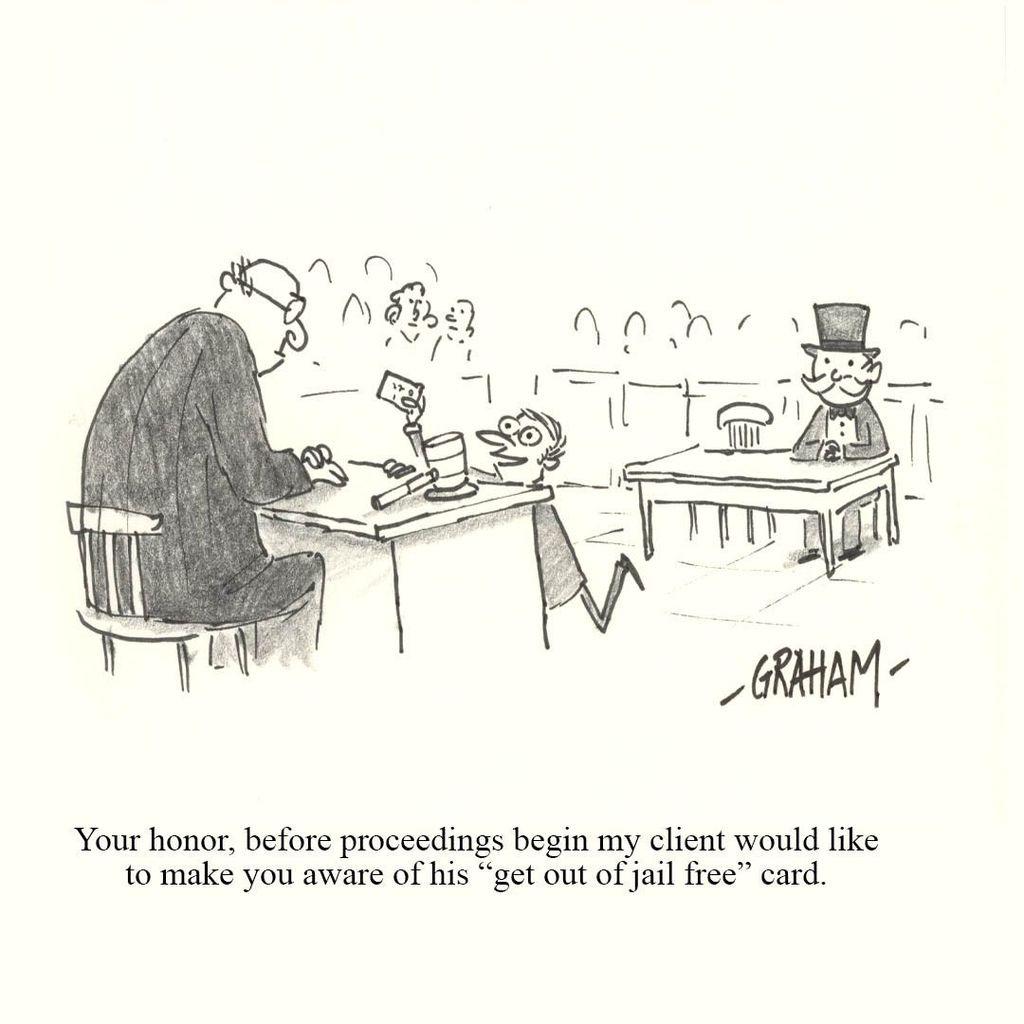
Above the system. #grickledoodle #monopoly #jail #court #cartoon #art #draw…

19 May 2026 at 16:01

Above the system. #grickledoodle #monopoly #jail #court #cartoon #art #drawing #funny #humor

A cartoon illustration of the Monopoly Guy sitting in a courtroom while his lawyer presents a card to the judge. Caption reads "Your honor, before proceedings begin my client would like to make you aware of his "get out of jail free" card."

2 women jailed up to 4 years, 10 months in money laundering case involving HK$280M smuggled from mainland China

8 May 2026 at 12:14
HK customs money laundry

Two Hong Kong women convicted of money laundering have been jailed for over three years for transporting over HK$280 million cash from mainland China to Hong Kong between 2018 and 2019.

An aerial view of Lok Mak Chau check point on the Hong Kong border near the mainland Chinese city of Shenzhen. Photo: Kyle Lam/HKFP.

Luo Xiaoping was sentenced to four years and ten months at the District Court, while Xiang Yurong was jailed for three years, local media reported.

The two were convicted after a trial, in which they pleaded not guilty to a total of four counts of money laundering.

Luo was accused of bringing cash through border checkpoints, with over 100 instances during which she carried more than HK$1 million per trip, the court heard. She was accused of smuggling around HK$270 million cash.

Xiang brought money into Hong Kong an average of 10 times per month during the period of the offence, carrying around 200,000 to 300,000 RMB each time. She transported cash to Hong Kong as many as three times in a single day.

In total, the two of them handled over HK$280 million of illicit cash, the court heard.

District Court Deputy Judge Lily Wong said she accepted the fact that Xiang and Luo were just “mules,” but their offence inevitably brought a negative impact on Hong Kong and mainland China’s financial systems.

Hong KOng police
Customs and Excise Department. Photo: Kelly Ho/HKFP.

The two were arrested in September 2019, but were only charged in April 2023.

The defense argued that there was a delay in prosecution. They said that customs officers could have stopped Luo much earlier, yet they only took action after she had successfully transported cash into Hong Kong numerous times.

However, Judge Wong disagreed with this argument, describing Luo as “acting with a gambler’s mindset” and committing the crimes out of pure greed, Ming Pao reported.

According to the Organized and Serious Crimes Ordinance, “dealing with property known or believed to represent proceeds of indictable offence,” or “money laundering,” is punishable by a maximum penalty up to 14 years’ imprisonment and a fine of HK$5 million.

Hong Kong Customs and Excise Department said in a statement on Thursday that this is the first money laundering conviction involving travellers transporting large amount of cash-related items across the border since the Cross-boundary Movement of Physical Currency and Bearer Negotiable Instruments Ordinance came into effect in July 2018.

Under the ordinance, anyone carrying over HK$120,000 in cash into Hong Kong must declare the sum to customs officers.

  • ✇Malay Mail - All
  • Sarawak cops raid cockfighting venue near Miri golf club, arrest 15 men Malay Mail
    KUALA LUMPUR, June 9 — Police have arrested 15 men after raiding an illegal cockfighting activity at a coastal hut near the Miri Golf Club area on Thursday afternoon.The 3.30pm raid was carried out by officers from the Miri district police headquarters following a tip-off on the activity at the location, according to a report by BuletinTV3.Miri police chief Asst Comm Mohd Farhan Lee Abdullah confirmed that all those detained were locals aged between 28 and 74.He
     

Sarawak cops raid cockfighting venue near Miri golf club, arrest 15 men

9 June 2026 at 02:44

Malay Mail

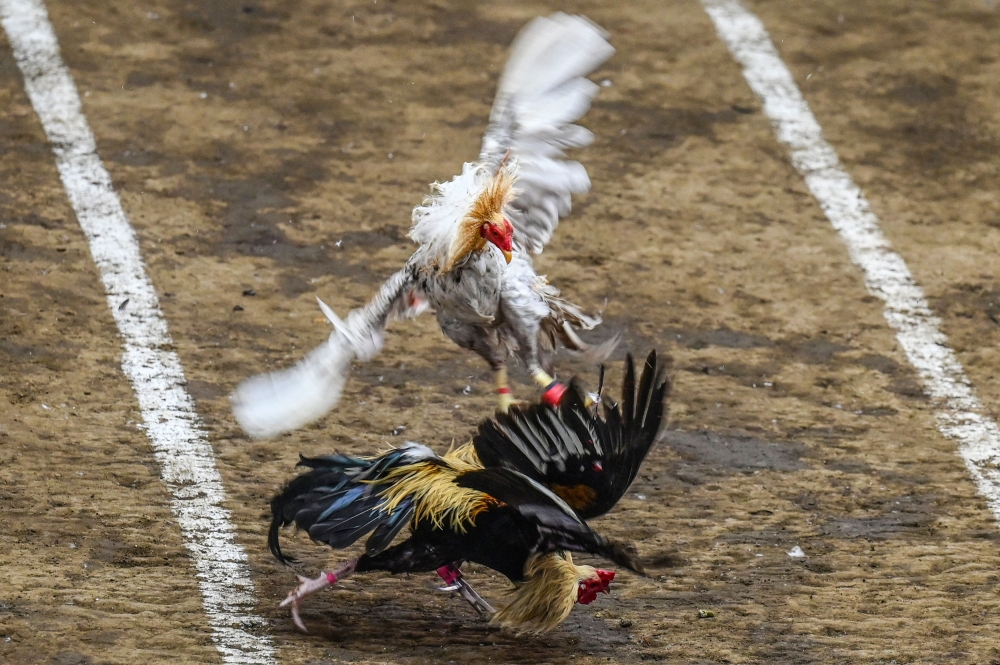
KUALA LUMPUR, June 9 — Police have arrested 15 men after raiding an illegal cockfighting activity at a coastal hut near the Miri Golf Club area on Thursday afternoon.

The 3.30pm raid was carried out by officers from the Miri district police headquarters following a tip-off on the activity at the location, according to a report by BuletinTV3.

Miri police chief Asst Comm Mohd Farhan Lee Abdullah confirmed that all those detained were locals aged between 28 and 74.

He said various items believed to have been used in the activity were seized during the raid, along with live and dead roosters found at the scene.

“Initial investigations found that all suspects admitted they were at the location for cockfighting purposes,” he said in a statement.

Police have completed investigation papers and all suspects were charged at the Miri Magistrates’ Court last Friday under Section 73(1)(g) of the Veterinary Public Health Ordinance 1999.

If convicted, they face a maximum fine of RM2,000 or up to six months’ jail, or both.

The court set June 12 for mention.

All accused were allowed bail of RM600 each with one local surety.

  • ✇Vox
  • The Supreme Court hands a rare victory to a death row inmate Ian Millhiser
    An image from 2000 of the Texas death chamber in Huntsville. | Joe Raedle/Newsmakers The Supreme Court announced on Thursday that it will not decide Hamm v. Smith, a case involving a genuinely difficult constitutional question about whether an Alabama inmate may lawfully be executed. The immediate upshot of this decision is that Joseph Clifton Smith, who’s at the heart of this case, will not be killed. Smith prevailed in the federal appeals court that previously heard his case. And the
     

The Supreme Court hands a rare victory to a death row inmate

21 May 2026 at 18:30
Image of the Texas death chamber
An image from 2000 of the Texas death chamber in Huntsville. | Joe Raedle/Newsmakers

The Supreme Court announced on Thursday that it will not decide Hamm v. Smith, a case involving a genuinely difficult constitutional question about whether an Alabama inmate may lawfully be executed.

The immediate upshot of this decision is that Joseph Clifton Smith, who’s at the heart of this case, will not be killed. Smith prevailed in the federal appeals court that previously heard his case. And the fact that the justices decided not to decide Hamm — they dismissed it “as improvidently granted,” to use the Court’s precise legal terminology — means that Smith’s victory in the lower court stands.

Though the full Court issued no opinion in Hamm, six justices joined at least one of three concurring or dissenting opinions revealing how they thought the case should have been decided. Justice Sonia Sotomayor’s concurring opinion offers a likely explanation for why her Court chose to make this case go away. Meanwhile, Justices Clarence Thomas and Samuel Alito’s dissenting opinions reveal some riffs among the Court’s Republicans.

In Atkins v. Virginia (2002), the Supreme Court held that it is unconstitutional to execute someone with an intellectual disability. The Hamm case largely turned on whether Smith’s IQ is low enough that he qualifies as intellectually disabled. But most of the justices appear to have thrown up their hands and determined that they are not well-positioned to determine Smith’s IQ.

Sotomayor’s opinion suggests that Alabama may have lost this case because of inept lawyering. Among other things, she points out that none of the expert witnesses that testified in a lower court, including Alabama’s own expert, used the same methods to determine Smith’s IQ “that Alabama now claims is necessary.” 

At least some constitutional protections against capital punishment are probably safe, for now.

Because the Supreme Court has the final word on questions of constitutional law, the justices are supposed to be reluctant to decide questions that are not fully vetted by lower courts, due to the risk that the Court could hand down an uncorrectable error if it decides a case too hastily. Thus, Sotomayor argues that her Court was right to “exercise caution” by not handing down the definitive word on a constitutional question that was not fully aired in other forums.

Meanwhile, at least some of the Republican justices appear to have backed away from more hardline positions that they took in the past. That means that at least some constitutional protections against capital punishment are probably safe, for now.

Most of the Republican justices appear to have made peace with Atkins

The Court’s right flank has historically opposed Atkins altogether. The late Justice Antonin Scalia, for example, claimed in Atkins that only “severely or profoundly” disabled people — perhaps those with an IQ of 25 or lower — are protected from execution. But, under the Atkins framework, people with an IQ of 70 or below are often ineligible for the death penalty. And people who test slightly higher than 70, such as Smith himself, may also sometimes show that they are intellectually disabled by pointing to other factors besides IQ.

But only Thomas, who wrote a dissenting opinion in Hamm that was joined by no one else, called for Atkins to be overruled.

It’s particularly surprising that Justice Neil Gorsuch, who previously has expressed very hardline views in death penalty cases, appeared to chart a more moderate course in Hamm. Gorsuch seemed to suggest in Bucklew v. Precythe (2019) that his Court should toss out the entirety of its past 60 years worth of cases interpreting the Eighth Amendment’s ban on cruel and unusual punishments, and instead adopt a new rule that would allow the government to impose very high penalties for minor crimes

But, of the three Hamm opinions, only Thomas cited Bucklew. And Gorsuch neither joined Thomas’s opinion nor did he join some parts of Alito’s opinion, which called for harsher rules in Atkins cases. So it appears that Gorsuch’s Bucklew opinion may be an orphan.

Alito, meanwhile, wrote a bifurcated opinion, major parts of which were joined by a total of four justices — Alito, Chief Justice John Roberts, Thomas, and Gorsuch. But only Thomas joined the part of Alito’s opinion which called for the most limits on Atkins.

The parts of Alito’s opinion that were joined by four justices largely concern the unusual facts present in Hamm

It’s safe to say that Smith’s claim that he is intellectually disabled is marginal. While courts consider whether a capital defendant’s IQ is below 70 in order to determine if that defendant is intellectually disabled, Smith took several tests that measured his IQ somewhere in the 70s — and none of them showed that he has an IQ of 70 or below.

Under the Court’s previous death penalty cases, the fact that a death row inmate tests slightly above 70 is not fatal to his Atkins case — in part because IQ tests have a margin of error and may overestimate a test subject’s IQ. But Alito essentially argues that someone like Smith, who took multiple tests that showed him with an IQ above 70, may be executed.

In the part of his opinion joined only by Thomas, meanwhile, Alito claims that “‘higher scores are likely to be more indicative’ of a person’s intelligence than the lower scores,” a rule that would potentially doom capital defendants with a wide range of scores, some of which are below 70.

Still, it’s notable that Alito focused his opinion so closely on the minutiae of the Hamm case, without making broader attacks on Atkins or on the general rule that intellectually disabled people may not be executed. It is tough to evaluate where the full Court stands on Atkins, as three justices — Elena Kagan, Brett Kavanaugh, and Amy Coney Barrett — were silent in Hamm. But it now appears likely that the Court’s current majority does not plan a wholesale assault on Atkins, or on the Court’s broader framework for determining which punishments are impermissible. That’s good news for inmates whose lives could be spared by Atkins and similar cases.

The Court’s Republican majority is often hostile to past precedents that were decided by more liberal justices. Indeed, at times, they appear to have been going through a checklist, overruling decisions where the Court’s right flank lost and transforming dissents by justices like Scalia or Thomas into majority opinions. But, for now, at least, it appears that Atkins is not on this Court’s checklist.

  • ✇Vox
  • Alabama’s new congressional maps do the one thing the Supreme Court still forbids Ian Millhiser
    Justice Clarence Thomas, face-palming. | Chip Somodevilla/Pool/AFP via Getty Images Allen v. Milligan, an Alabama redistricting case that is now before the Supreme Court for the third time, is a face-palm, wrapped in a head-desk, wrapped in some of the most incompetent legislative draftsmanship that has ever been presented to the justices. If Alabama Republicans have any sense, they will fire all of their lawyers. About a month ago, the Supreme Court decided Louisiana v. Callais, guttin
     

Alabama’s new congressional maps do the one thing the Supreme Court still forbids

2 June 2026 at 15:35
Justice Clarence Thomas, face-palming
Justice Clarence Thomas, face-palming. | Chip Somodevilla/Pool/AFP via Getty Images

Allen v. Milligan, an Alabama redistricting case that is now before the Supreme Court for the third time, is a face-palm, wrapped in a head-desk, wrapped in some of the most incompetent legislative draftsmanship that has ever been presented to the justices. If Alabama Republicans have any sense, they will fire all of their lawyers.

About a month ago, the Supreme Court decided Louisiana v. Callais, gutting the federal Voting Rights Act’s safeguards against legislative maps that lock voters of color out of power in the process. Callais effectively repealed a 1982 amendment to the VRA, which prohibited many state laws that have a negative impact of nonwhite voters, even if those laws were not drawn with racist intent.

After Callais, a plaintiff challenging a state’s legislative maps on racial grounds may only prevail “when the circumstances give rise to a strong inference that intentional discrimination occurred.”

As a practical matter, this is a very difficult bar for voting rights plaintiffs to overcome. Lawyers and judges are not mind readers. And state lawmakers normally aren’t foolish enough to state openly that they drew a particular map in a particular way because they wanted to maximize white power and minimize the voting power of nonwhite voters.

And yet, Alabama’s Republican-controlled legislature managed to enact congressional redistricting legislation that openly praises the European American character of much of the state.

Allen turns on congressional maps that the state enacted in a 2023 law, but which have never actually been used in an election. Much of the case turns on the law’s disparate treatment of two regions in the state: the Gulf Coast region of Alabama, and the state’s Black Belt.

While the Black Belt is actually named after the dark-colored soil in that region, it has a high African American population because many enslaved people were brought to the Black Belt prior to the Civil War. The Gulf Coast region, meanwhile, is predominantly white. As a lower court decision that struck down the 2023 maps explains, those maps keep “the Gulf Coast whole,” while simultaneously splitting the Black Belt in a way that shunts many of its Black voters into a majority-white district.

The mere fact that Alabama cracked up the Black Belt while keeping the Gulf Coast intact does not endanger its maps, at least under Callais. The decision is very favorable to gerrymandering, and permits states to draw maps that diminish Black representation so long as the state claims that it is doing so to dilute the votes of Democrats.

But here’s the rub: The 2023 law doesn’t just preserve the white-majority Gulf Coast region intact; it also praises the “shared culture” of that region which stems “from its French and Spanish colonial heritage.” France and Spain, of course, are European countries made up predominantly of white people.

The state legislature, in other words, didn’t just give the Gulf Coast more favorable treatment than it did the Black Belt. It explicitly referenced the Gulf Coast’s shared European culture when it did so. That sure gives rise to a strong inference that intentional discrimination occurred!

Will that be enough to persuade this Supreme Court to rule against Alabama’s maps? Who knows? The Court’s most recent gerrymandering decisions appear designed to permit states to draw whatever maps they want, without any federal judicial oversight whatsoever. And a decision in favor of Alabama’s 2023 maps would also benefit the Republican Party.

Six of the Supreme Court’s nine seats are held by Republicans.

But, even after Callais, one of the few things that states should not be allowed to do is draw maps for the explicit purpose of favoring European Americans, while simultaneously disfavoring African Americans. And yet Alabama’s maps may not be able to clear even this very low bar.

Democrats demand Trump ‘guarantee’ Bill Pulte will not serve as acting intelligence director after Clayton nomination – as it happened

This live blog is now closed.

The US supreme court has published its opinions, but none of the cases we’ve been watching for were part of the decisions today.

In comments reported by NBC News, House speaker Mike Johnson has said it is “stunning” to him that “House Democrat leadership has put out a statement saying that they’re willing to allow the number one national security tool to go dark over some political disagreement over a very short-term temporary appointment”.

Continue reading...

© Photograph: Michael Nagle/Bloomberg via Getty Images

© Photograph: Michael Nagle/Bloomberg via Getty Images

© Photograph: Michael Nagle/Bloomberg via Getty Images

❌
Subscriptions