Normal view

  • ✇Eos
  • Where Was Baltica 616 Million Years Ago? Saima May Sidik
    Source: Geochemistry, Geophysics, Geosystems About 600 million years ago, the continents wandered Earth, yet to settle into their current positions. Their locations during the Ediacaran (as this time is called) have been tough for scientists to pin down. Earth’s magnetic field appears to have behaved in erratic ways, and applying standard techniques to calculate the continents’ positions based on records of the magnetic field yields implausible results. In particular, scientists debate the l
     

Where Was Baltica 616 Million Years Ago?

5 May 2026 at 13:20
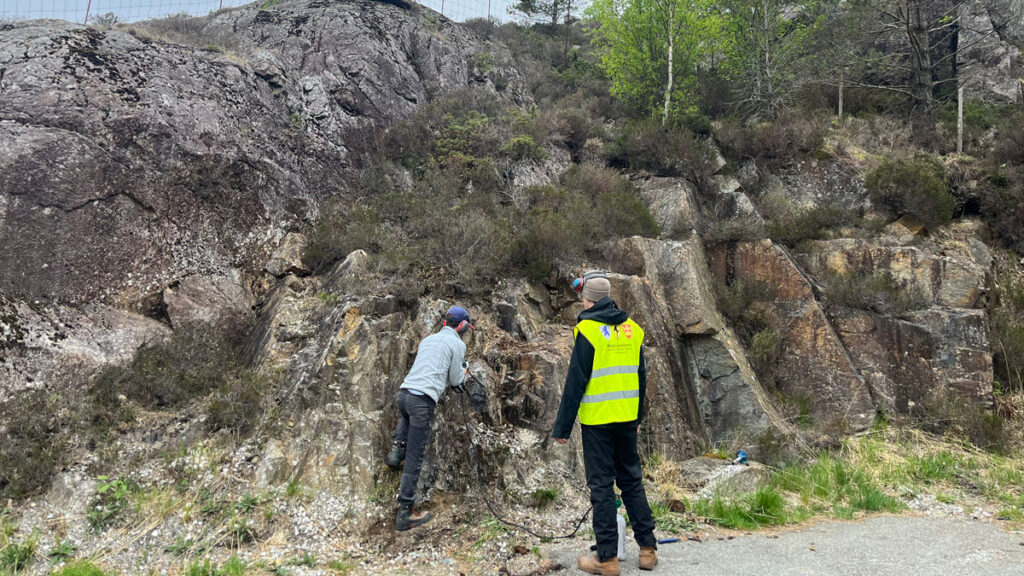
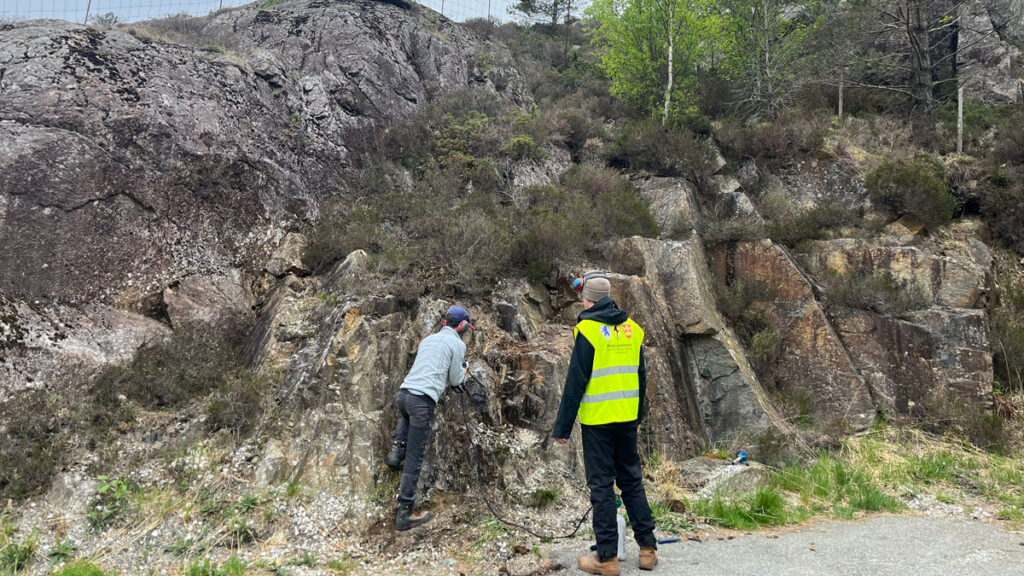
Two people, one wearing a yellow vest and one in a gray long-sleeved shirt, look up at a rock face.
Source: Geochemistry, Geophysics, Geosystems

About 600 million years ago, the continents wandered Earth, yet to settle into their current positions. Their locations during the Ediacaran (as this time is called) have been tough for scientists to pin down. Earth’s magnetic field appears to have behaved in erratic ways, and applying standard techniques to calculate the continents’ positions based on records of the magnetic field yields implausible results. In particular, scientists debate the location of an ancient continent called Baltica, which is now part of Europe.

To investigate, Xue et al. traveled to Egersund, Norway, to collect samples of rock that formed during a time when Baltica’s crust was being pulled apart, allowing magma to percolate up from below. As that magma hardened, it recorded snapshots of Earth’s magnetic field, storing information about Baltica’s position in the process.

The results of studying these samples revealed a much more complex picture of the ancient rocks than the scientists initially envisioned. The rocks contained a messy mix of at least six magnetic signals. Several appeared to have formed when more modern geological processes altered the original rocks. Three distinct signals may have survived from the Ediacaran period, two of which diverge from the most plausible Ediacaran signal, which places Baltica near the equator. These conflicting signals further support the idea that Earth’s magnetic field was behaving strangely at the time, adding new complexity to an already puzzling picture.

On the basis of the new results, the researchers place the Egersund paleomagnetic pole at 20.8°N, 89.0°E during the Ediacaran—which diverges from previous results—and suggest that Baltica was located near the equator, adjacent to the ancient continent Laurentia, but rotated slightly clockwise relative to previous reconstructions. The study demonstrates the convoluted nature of the magnetic signals preserved in ancient rocks and the importance of dissecting those records into their constituent components. Doing so, the researchers suggest, can shed new light on the enigmatic behavior of Earth’s magnetic field during the Ediacaran. (Geochemistry, Geophysics, Geosystems, https://doi.org/10.1029/2025GC012730, 2026)

—Saima May Sidik (@saimamay.bsky.social), Science Writer
A photo of a telescope array appears in a circle over a field of blue along with the Eos logo and the following text: Support Eos’s mission to broadly share science news and research. Below the text is a darker blue button that reads “donate today.”
Citation: Sidik, S. M. (2026), Where was Baltica 616 million years ago?, Eos, 107, https://doi.org/10.1029/2026EO260124. Published on 5 2026.
Text © 2026. AGU. CC BY-NC-ND 3.0
Except where otherwise noted, images are subject to copyright. Any reuse without express permission from the copyright owner is prohibited.
  • ✇Eos
  • 6.16亿年前波罗的大陆在哪里? Saima May Sidik
    Source: Geochemistry, Geophysics, Geosystems This is an authorized translation of an Eos article. 本文是Eos文章的授权翻译。 大约 6 亿年前,各大洲在地球上漂移,尚未最终定格在现在的位置。在埃迪卡拉纪时期,各大洲的位置对于科学家来说一直难以确定。地球的磁场似乎表现得异常不稳定,而利用标准方法根据磁场记录来计算大陆位置的做法却得出了一些难以置信的结果。尤其是,科学家们对一块名为波罗的大陆的古老大陆的位置存在争议,这块大陆如今是欧洲的一部分。 为了探究这一问题,Xue等人前往挪威埃格尔松德,采集了波罗的大陆地壳被撕裂、岩浆从下方涌出时形成的岩石样本。随着这些岩浆冷却凝固,它们记录了地球磁场的瞬时变化,并在此过程中存储了有关波罗的大陆位置的信息。 对这些样本的研究结果揭示了远比科学家们最初设想的更为复杂的古代岩石图景。这些岩石中至少包含了六种不同的磁信号,构成了一幅复杂的混合图景。其中一些信号似乎是在更现代的地质过程改变原始岩石时形成的。埃迪卡拉纪时期可能保存了三种
     

6.16亿年前波罗的大陆在哪里?

3 June 2026 at 12:42
两个人,一个穿着黄色背心,一个穿着灰色长袖衬衫,正抬头看着一块岩石表面。
Source: Geochemistry, Geophysics, Geosystems

This is an authorized translation of an Eos article. 本文是Eos文章的授权翻译。

大约 6 亿年前,各大洲在地球上漂移,尚未最终定格在现在的位置。在埃迪卡拉纪时期,各大洲的位置对于科学家来说一直难以确定。地球的磁场似乎表现得异常不稳定,而利用标准方法根据磁场记录来计算大陆位置的做法却得出了一些难以置信的结果。尤其是,科学家们对一块名为波罗的大陆的古老大陆的位置存在争议,这块大陆如今是欧洲的一部分。

为了探究这一问题,Xue等人前往挪威埃格尔松德,采集了波罗的大陆地壳被撕裂、岩浆从下方涌出时形成的岩石样本。随着这些岩浆冷却凝固,它们记录了地球磁场的瞬时变化,并在此过程中存储了有关波罗的大陆位置的信息。

对这些样本的研究结果揭示了远比科学家们最初设想的更为复杂的古代岩石图景。这些岩石中至少包含了六种不同的磁信号,构成了一幅复杂的混合图景。其中一些信号似乎是在更现代的地质过程改变原始岩石时形成的。埃迪卡拉纪时期可能保存了三种不同的信号,其中两种与将波罗的板块置于赤道附近的最合理的埃迪卡拉纪信号相悖。这些相互矛盾的信号进一步支持了地球磁场在当时异常活动的观点,使原本就扑朔迷离的图景更加复杂。

基于新的研究结果,研究人员将埃迪卡拉纪时期埃格尔松德古地磁极的位置确定在北纬20.8°、东经89.0°——这与之前的研究结果有所不同——并提出波罗的板块当时位于赤道附近,毗邻古老的劳伦古陆,但相对于之前的重建结果,其位置略有顺时针旋转。这项研究表明,保存在古代岩石中的磁信号极其复杂,并凸显了将这些记录分解成各个组成部分的重要性。研究人员认为,这样做可以为埃迪卡拉纪时期地球磁场的神秘行为提供新的线索。(Geochemistry, Geophysics, Geosystemshttps://doi.org/10.1029/2025GC012730, 2026)

—科学撰稿人Saima May Sidik (@saimamay.bsky.social)

This translation was made by Wiley. 本文翻译由Wiley提供。

Read this article on WeChat. 在微信上分享本文。

A photo of a telescope array appears in a circle over a field of blue along with the Eos logo and the following text: Support Eos’s mission to broadly share science news and research. Below the text is a darker blue button that reads “donate today.”
Text © 2026. AGU. CC BY-NC-ND 3.0
Except where otherwise noted, images are subject to copyright. Any reuse without express permission from the copyright owner is prohibited.
  • ✇Eos
  • Navigating the Past with Ancient Stone Compass Needles Aaron Sidder
    Source: Journal of Geophysical Research: Solid Earth Magnetic rocks with iron oxide concentrations act as natural chroniclers of Earth’s past continental movements. Using small samples of rocks, scientists can isolate magnetic grains that were frozen in orientation as the rock solidified. The magnetization of these grains acts as a miniature compass needle, pointing toward ancient magnetic poles. This same principle applies to extraterrestrial samples, such as meteorites and lunar rocks, whi
     

Navigating the Past with Ancient Stone Compass Needles

16 April 2026 at 13:09
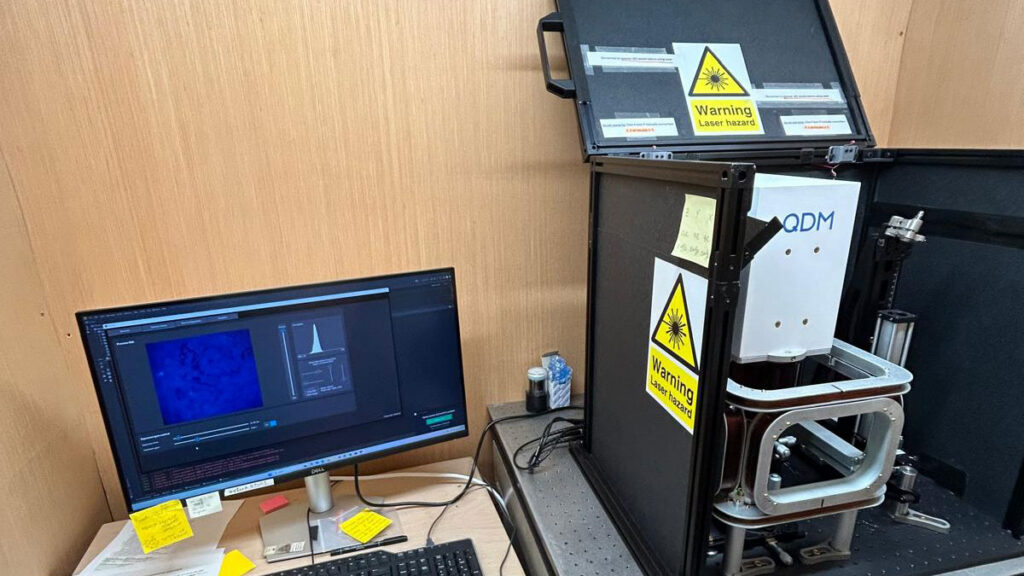
A computer and keyboard on a desk sit next to a complex microscope that says “QDM” on the top.
Source: Journal of Geophysical Research: Solid Earth

Magnetic rocks with iron oxide concentrations act as natural chroniclers of Earth’s past continental movements. Using small samples of rocks, scientists can isolate magnetic grains that were frozen in orientation as the rock solidified. The magnetization of these grains acts as a miniature compass needle, pointing toward ancient magnetic poles. This same principle applies to extraterrestrial samples, such as meteorites and lunar rocks, which preserve evidence of the early solar nebula’s evolution.

However, traditional bottle cap–sized bulk samples often contain a mixture of reliable and unreliable magnetic signals, resulting in complex data that hamper interpretation. To improve accuracy, researchers have turned to magnetic microscopy. This technique maps magnetic fields at submillimeter to submicrometer scales in thinly sliced rock sections using advanced tools like a quantum diamond microscope (QDM) or a cryogenic superconducting quantum interference device microscope. By creating high-resolution maps of individual magnetic particles, scientists can reconstruct ancient fields with much higher precision while filtering out muddy signals from unstable grains.

Despite its potential, magnetic microscopy is an emerging field with its own set of uncertainties. To help constrain measurement data, Bellon et al. combined QDM observations with computer modeling to analyze how a magnetic particle’s stray field—the magnetic flux that leaks into the surrounding space—decays as it moves away from the source. They specifically investigated how a particle’s internal magnetic structure and external measurement noise affect the accuracy of these reconstructions.

The study found that in iron oxides, the smallest and most magnetically stable particles produce signals that are strong at the source but fade rapidly with distance. In contrast, larger particles produce signals that remain detectable farther away. This creates a challenge: The most stable grains for long-term geological data (the smallest ones) are the hardest to detect if the sensor is not perfectly positioned or if sensor interference is present.

By quantifying measurement error, the authors provide a road map for the field of micropaleomagnetism. Their findings could allow researchers to better account for uncertainty, leading to more robust reconstructions of Earth’s magnetic history and a deeper understanding of planetary evolution. (Journal of Geophysical Research: Solid Earth, https://doi.org/10.1029/2025JB033133, 2026)

—Aaron Sidder, Science Writer

A photo of a telescope array appears in a circle over a field of blue along with the Eos logo and the following text: Support Eos’s mission to broadly share science news and research. Below the text is a darker blue button that reads “donate today.”
Citation: Sidder, A. (2026), Navigating the past with ancient stone compass needles, Eos, 107, https://doi.org/10.1029/2026EO260122. Published on 16 April 2026.
Text © 2026. AGU. CC BY-NC-ND 3.0
Except where otherwise noted, images are subject to copyright. Any reuse without express permission from the copyright owner is prohibited.
❌
Subscriptions