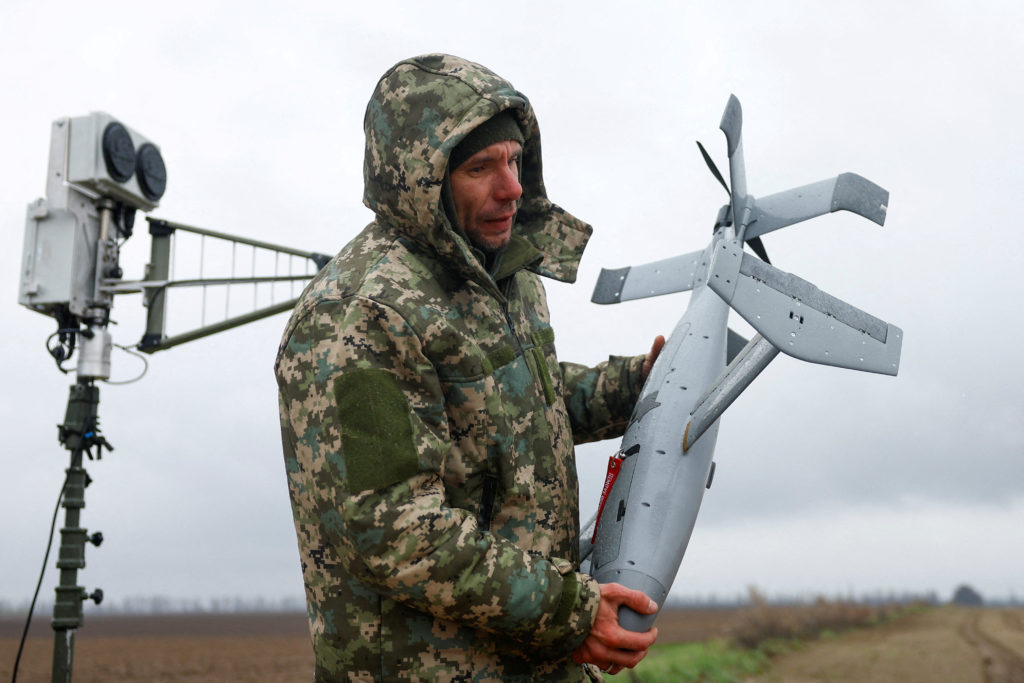
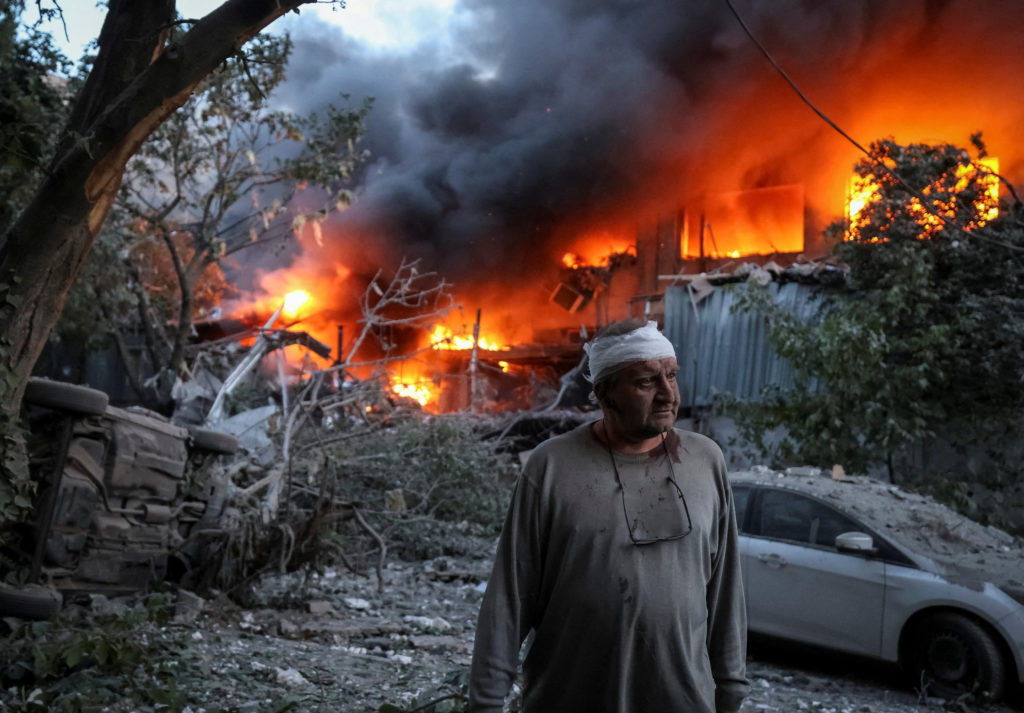
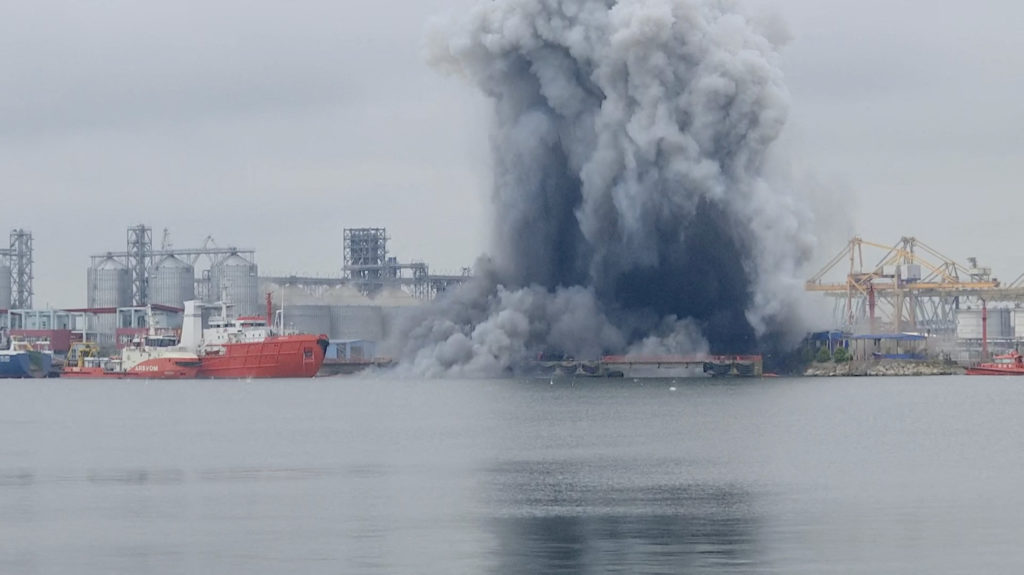
A Ukrainian drone attack killed one person and injured three in Russia's southern Krasnodar region, local officials said Saturday. Drone debris also sparked a fire at a sea terminal, local Gov. Veniamin Kondratyev said.
A Ukrainian drone attack killed one person and injured three in Russia's southern Krasnodar region, local officials said Saturday. Drone debris also sparked a fire at a sea terminal, local Gov. Veniamin Kondratyev said.
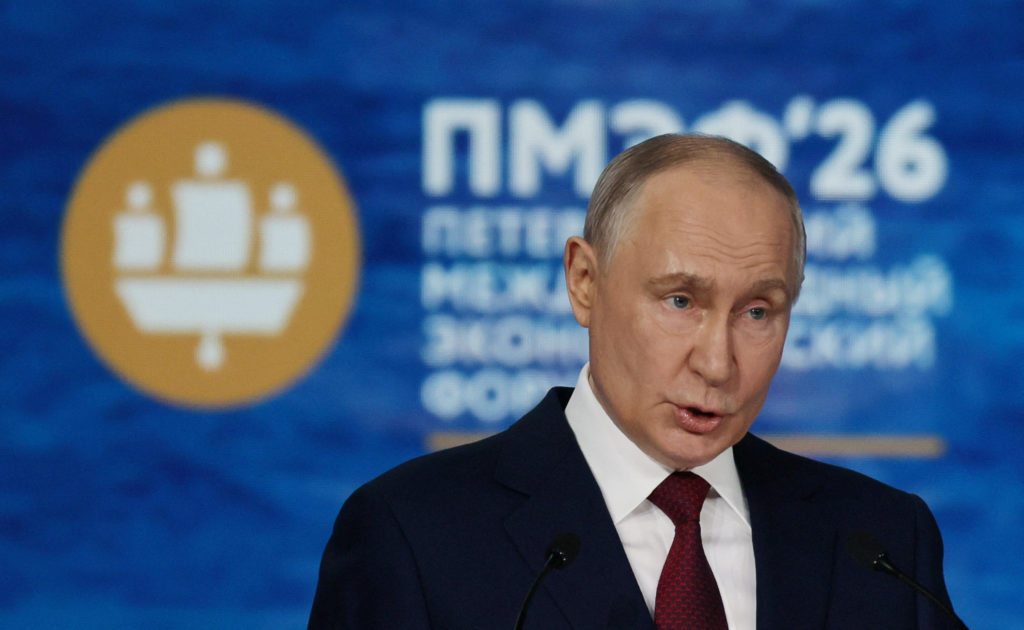
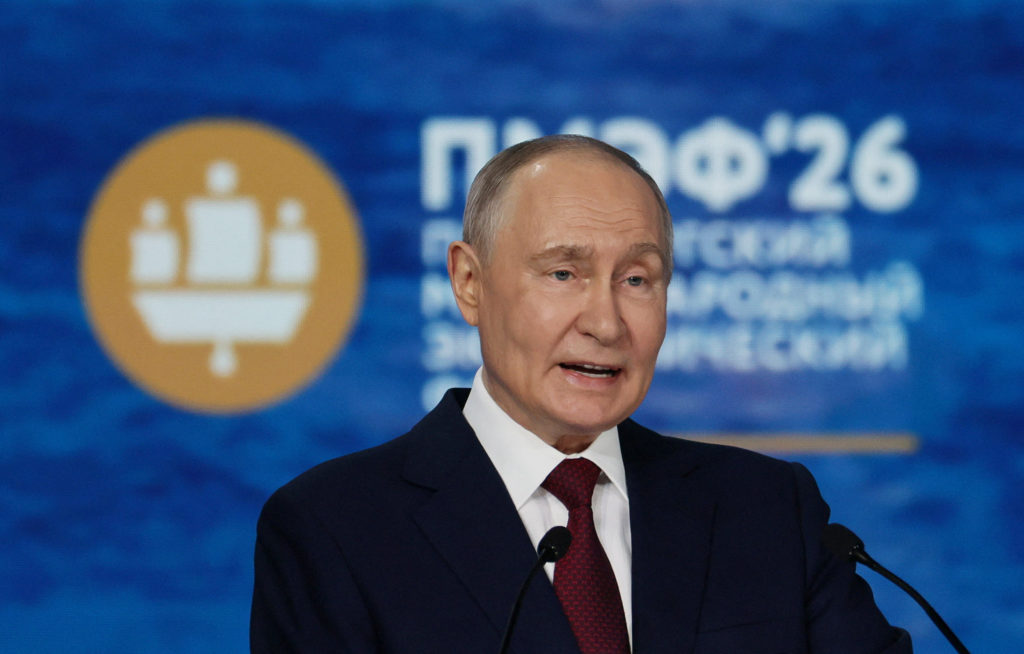
Russian President Vladimir Putin on Friday rejected a proposal by Ukrainian President Volodymyr Zelenskyy for a face-to-face negotiation on the conflict, saying he sees "no point" in it.
Russian President Vladimir Putin on Friday rejected a proposal by Ukrainian President Volodymyr Zelenskyy for a face-to-face negotiation on the conflict, saying he sees "no point" in it.
The 226-195 vote is a sign of impatience with President Donald Trump's approach to the war and represents the House's second major foreign policy break with Trump this week.
The 226-195 vote is a sign of impatience with President Donald Trump's approach to the war and represents the House's second major foreign policy break with Trump this week.
Headstones and American flags are seen at the Arlington National Cemetery during the Memorial Day, which is held annually to honor those who died while serving in the armed forces. | Celal Gunes/Anadolu Agency via Getty Images
The first observance of what came to be known as Memorial Day was on May 30, 1868, when a Civil War general called on Americans to commemorate the sacrifices of Union soldiers. It was initially called Decoration Day, for the practice of decorating graves with wreat
Headstones and American flags are seen at the Arlington National Cemetery during the Memorial Day, which is held annually to honor those who died while serving in the armed forces. | Celal Gunes/Anadolu Agency via Getty Images
The first observance of what came to be known as Memorial Day was on May 30, 1868, when a Civil War general called on Americans to commemorate the sacrifices of Union soldiers. It was initially called Decoration Day, for the practice of decorating graves with wreaths and flags. And there were so many graves — more than 300,000 men had died on the Union side, and nearly as many for the Confederacy. In total, more died on both sides of the Civil War than in every other US conflict through the Korean War, combined.
It wasn’t long, though, before remembrance began to be overshadowed by celebration. Within a year, the New York Times opined the holiday would no longer be “sacred” if parades and speeches became more central than the act of memorializing the dead. Which is precisely what happened, especially after Congress in 1971 fixed Memorial Day as the last Monday in May, making it the perfect launchpad for summer, with an increasingly perfunctory nod to the holiday’s original purpose.
The gap between those for whom Memorial Day is a moment of remembrance versus three days of hot dogs and hamburgers will likely only grow in the future, as veterans of previous wars pass away and the divide between America’s all-volunteer military and its civilians deepens. Fewer than 1 percent of the US adult population serves in the military, and those still signing up increasingly come from a small handful of regions and families with a history of military service. (You can include my own family in that ever rarer number: My brother is a retired Army captain who served in Iraq.)
With ever-inflating military spending — just over$1 trillion, according to one estimate — the footprint of the US military is hardly shrinking, but the number of those who will potentially be called on to give what Abraham Lincoln called the “last full measure of devotion” is.
Yet there’s a greater gap embedded in Memorial Day: It’s between those who died as warfighters (to use one of the Pentagon’s terms), and the far greater number around the world who have died not as war’s participants, but as its victims.
And this year, the gap hits differently. Memorial Day 2026 falls even as the United States is still enmeshed in a war it helped start. The conflict with Iran has killed thousands of people across the region in less than two months of fighting. The Human Rights Activists News Agency documented at least 1,701 Iranian civilian deaths, the majority of them caused by US and Israeli airstrikes.
At least 13 American service members have been killed so far during the war. They will be remembered this Memorial Day. The Iranian schoolchildren will not.
When civilians die in war
The past is not just a foreign country to us, but a bloody one. From the interpersonal to the international, conflict was a constant throughout much of human history. Between 1500 and 1800, there was hardly a year when great powers weren’t enmeshed in some kind of war.
Though war became somewhat less common as we entered the 1900s, it did not become less deadly. Far from it — while the death toll of war in the past was more chiefly concentrated among combatants, the 20th century saw the awful blossoming of total war, where little to no distinction was made between those fighting the war and the civilians on the sidelines, and new weapons enabled mass, indiscriminate killing.
Go back to the Civil War, which sits at the junction between battle as it had long been practiced and the greater horror it would become. Over 600,000 soldiers were killed in the conflict, against at least 50,000 civilians, ranging from those killed directly to the many who died in the wake of war, from starvation and disease.
That number was terrible, yet in the wars to come, it would only grow.
In the First World War, a roughly equal number of combatants and civilians were killed globally — approximately 10 million on each side. In the Second World War, more combatants were killed than in any other conflict in human history, a toll nearing 15 million. Yet for every soldier, sailor, or airman who was killed, nearly one and a half civilians would die, totaling, by one count, almost 40 million.
The last of the dead would come in Hiroshima and Nagasaki, when as many as 210,000 people — nearly all of them Japanese civilians — died in the first and so far only atomic bombings. Not only were these new weapons capable of murdering at a vastly larger scale than ever before, but they existed chiefly to threaten the lives of noncombatants.
Thankfully, given the weapons militaries now had at their disposal, World War II was the high mark for war deaths. In the decades that followed, deaths in battle for both combatants and civilians sharply declined, minus the occasional spike in conflicts like the Korean and Vietnam wars. Even with the recent resurgence of conflict,people around the world today are much less likely to die in war than their ancestors, which is one of the most undeniable — if tenuous — markers of our species’ under-appreciated progress.
Yet even in this era of comparative peace, civilians still bear the brunt of war when it comes, including when it is fought by the United States. According to Brown University’s Costs of War project, more civilians were likely directly killed in post-9/11 conflicts than fighters on either side — and when the number of indirect deaths from starvation and destruction are included, that gulf only widens.
In Ukraine, at least 12,910 civilians have been killed in the war as of March 31, including nearly 700 children, while nearly 31,000 civilians have been injured. In a single large-scale Russian missile attack on April 24, at least nine civilians were killed and 90 were injured, including 12 children.
In Ukraine, the UN has now verified at least 15,850 civilian deaths, including 791 children, since Russia’s 2022 invasion. The first four months of 2026 saw more civilians killed in Ukraine than the same period in any of the past three years, and April alone recorded the highest monthly toll since July 2025: 238 killed and 1,404 injured, with Russian missiles and drones doing most of the damage in cities far from the front.
In Gaza, the documented death toll has climbed past 72,000 according to the Gaza Health Ministry, with more than 172,000 wounded. A population-representative survey published in The Lancet earlier this year validated the ministry’s methodology and estimated that 3 to 4 percent of Gaza’s prewar population has now been killed violently. Add in indirect deaths from starvation, disease, and the collapse of medical infrastructure, and some estimates exceed 100,000. Of course, Israel itself has lost over 1,000 civilians in the October 7 attacks and in the fighting that has followed.
And the ongoing war in Sudan — which has received only a fraction of the global attention of Ukraine and Gaza — has led to horrifying levels of civilian death. Last year Tom Perriello, then the US envoy for Sudan, estimated that at least 150,000 people had died of war-related causes, while 13 million people have been forced to flee their homes.
And the war in Sudan, which has received only a fraction of the global attention of Ukraine and Gaza, has now entered its fourth year, with around 9 million Sudanese still displaced from their homes. Estimates of war-related deaths range from 150,000 to 400,000, and the UN now reports that drone strikes have become the leading cause of civilian death in the conflict, accounting for more than 80 percent of civilian fatalities in the first four months of 2026.
It’s not hard to imagine why. As the shift in perception around the Vietnam Veterans Memorial has shown — from unpatriotic atrocity to a celebrated work of national mourning — we can honor the sacrifice of service members who died in a war, even if we don’t believe in the war. But the death of those who died without a rifle in hand, who died in childhood and infancy, who died because they could not fight and could not be protected, shows war for what it ultimately is: a waste. And we can’t begin to know how to mark the unmarked.
America has been a historical exception in many ways, but perhaps no more so than that its civilian citizens have largely escaped the scourge of war. (Though the same, of course, can hardly be said for its Indigenous populations, so long treated as enemy combatants in their own land.) Americans have fought and Americans have died, but at an ever-increasing remove, a distance that grows with each Memorial Day.
The general decline of war is one of our great accomplishments as humans, something to be unequivocally celebrated. Perhaps we would feel that more if we gave the deaths of civilians the same honor as that of soldiers — a new kind of Memorial Day that can begin here.
A version of this story was initially published in the Future Perfect newsletter. Sign up here to subscribe!
Update, May 25, 2026, 8 am ET: This story was originally published on May 31, 2023, has been updated to include new data on civilian deaths in Gaza, Iran, Israel, Lebanon, Sudan, and Ukraine, among other countries.
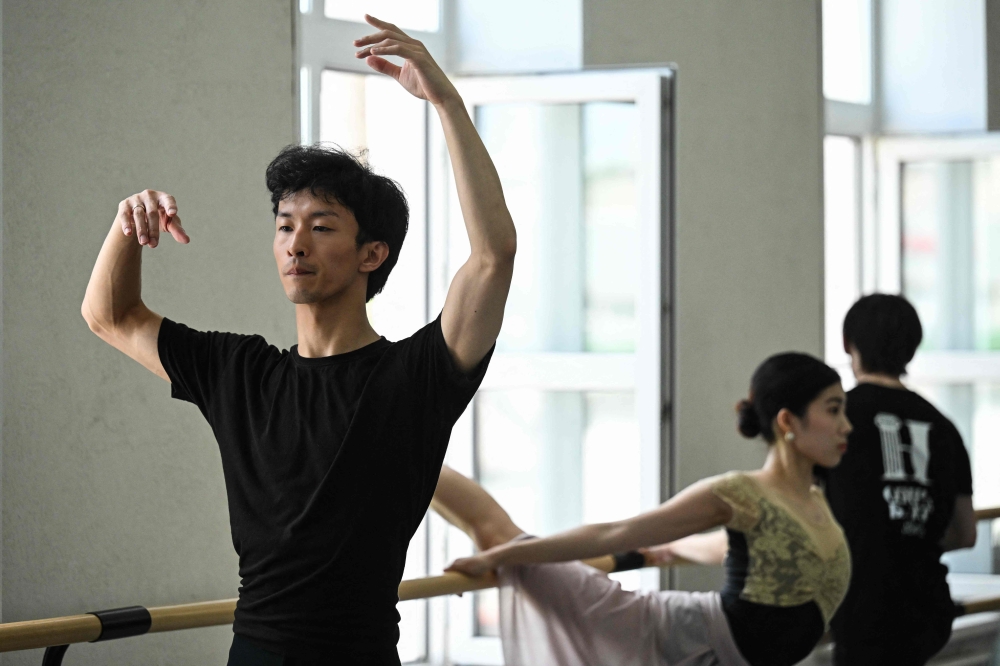
NIZHNY NOVGOROD, June 2 — En pointe, demi-pointe, entrechat — for Jotaro Kanazasi and Haruka Takemi, two Japanese dancers based in Russia’s historic city of Nizhny Novgorod, life revolves entirely around their art, even as the war in Ukraine occasionally interrupts their daily routine.Jotaro Kanazasi, 32, chose to settle in Russia 14 years ago, the country known for Moscow’s Bolshoi and St Petersburg’s Mariinsky theatres, to fulfil himself “fully as a dancer,” as
NIZHNY NOVGOROD, June 2 — En pointe, demi-pointe, entrechat — for Jotaro Kanazasi and Haruka Takemi, two Japanese dancers based in Russia’s historic city of Nizhny Novgorod, life revolves entirely around their art, even as the war in Ukraine occasionally interrupts their daily routine.
Jotaro Kanazasi, 32, chose to settle in Russia 14 years ago, the country known for Moscow’s Bolshoi and St Petersburg’s Mariinsky theatres, to fulfil himself “fully as a dancer,” as he puts it in halting Russian.
Some foreign dancers chose to leave Russia after it sent troops to Ukraine in 2022, but Kanazasi decided to stay.
Japanese ballet dancer Haruka Takemi, 20, attends a ballet lesson at the Nizhny Novgorod Opera and Ballet Theatre in Nizhny Novgorod on May 17, 2026. — AFP pic
The villainous sorcerer Rothbart in Tchaikovsky’s Swan Lake, Albrecht in Adolphe Adam’s Giselle — Kanazasi moves from role to role as a principal dancer at the Nizhny Novgorod Opera and Ballet Theatre, some 400 kilometres (250 miles) east of Moscow.
“I love Russian ballet and always wanted to become a dancer, but there is no national ballet school in Japan, so I chose Russia,” says his compatriot Haruka Takemi, 20, who has lived in Russia for six years.
Absorbed in their lives as professional dancers, Takemi and Kanazasi admit they follow the news only loosely, including the war Moscow has been waging in Ukraine since February 2022.
A dancer wearing a pair of pointe shoes attends a ballet lesson at the Nizhny Novgorod Opera and Ballet Theatre in Nizhny Novgorod on May 17, 2026. — AFP pic
‘Staying in touch’
“My mother constantly sends me articles about Russia, about current events, about what is happening here, so that I stay informed,” says Takemi.
Russia has introduced huge censorship, unseen since Soviet times, during its military campaign.
Her home country Japan has backed Ukraine since the start of the Russian offensive and joined Western sanctions against Moscow.
“I am either at the theatre or at home, then back at the theatre again. I work all the time and concentrate only on ballet,” she said, adding that it is her family who “worries” about her.
In response to near-daily Russian bombardments, Ukraine regularly strikes Russian territory, saying it hits military and energy sites to degrade Moscow’s capacity to fund its offensive.
Nizhny Novgorod, though located more than 800 kilometres (500 miles) from Ukraine, has not been spared. A nearby refinery of Russian energy giant Lukoil in Kstovo has been targeted by Ukrainian strikes in recent weeks.
Japanese ballet dancer Jotaro Kanazasi, 32, attends a ballet lesson at the Nizhny Novgorod Opera and Ballet Theatre in Nizhny Novgorod on May 17, 2026. — AFP pic
“There are also difficulties with the internet — you have to use a VPN as apps are sometimes blocked. But I need to stay in touch with my family so they know I am safe,” Takemi adds.
Russia has imposed sweeping digital restrictions in recent months, limiting access to mobile internet in particular.
“There are quite a few Japanese dancers in Russia, who are graduates of the most prestigious Russian schools such as the Moscow State Academy of Choreography, the Vaganova Academy in St Petersburg and the Perm school,” says Valeri Konkov, director of the Nizhny Novgorod ballet company.
Making a career as a classical dancer in Japan is difficult, the dancers say — and, despite difficulties linked to the war, Kanazasi is determined to stay, saying:
Massive Russian attacks across Ukraine overnight killed at least 22 people nationwide and wounded more than 130. Russia has stepped up the size and pace of its attacks on Ukrainian cities in recent months, but on the battlefront, Ukraine is trying to turn the tide. Nick Shifrin reports on Ukraine's efforts, and speaks with retired U.S. Army Col. Robert Hamilton for more on the war.
Massive Russian attacks across Ukraine overnight killed at least 22 people nationwide and wounded more than 130. Russia has stepped up the size and pace of its attacks on Ukrainian cities in recent months, but on the battlefront, Ukraine is trying to turn the tide. Nick Shifrin reports on Ukraine's efforts, and speaks with retired U.S. Army Col. Robert Hamilton for more on the war.
Ukrainian President Zelenskyy is accusing Russia of choosing war over peace, after Russian President Putin rejected his request for an in-person meeting. Putin spoke at an annual economic forum in St. Petersburg, a city on edge after several Ukrainian airstrikes earlier this week. Nick Schifrin reports.
Ukrainian President Zelenskyy is accusing Russia of choosing war over peace, after Russian President Putin rejected his request for an in-person meeting. Putin spoke at an annual economic forum in St. Petersburg, a city on edge after several Ukrainian airstrikes earlier this week. Nick Schifrin reports.
An annual United Nations report documenting sexual violence in conflicts worldwide has included Israeli forces for the first time since the review began more than 15 years ago for their treatment of Palestinian detainees. Israel denies the accusations.
An annual United Nations report documenting sexual violence in conflicts worldwide has included Israeli forces for the first time since the review began more than 15 years ago for their treatment of Palestinian detainees. Israel denies the accusations.
The maritime incident occurred a week after a Russian aerial drone that was part of an attack on Ukraine went astray and struck an apartment building in Romania's eastern Danube port city of Galati, injuring two people in the NATO member country.
The maritime incident occurred a week after a Russian aerial drone that was part of an attack on Ukraine went astray and struck an apartment building in Romania's eastern Danube port city of Galati, injuring two people in the NATO member country.
Welcome to The Hill's Defense & NatSec newsletter {beacon} Defense &National Security Defense &National Security The Big Story Putin pours cold water on Zelensky meeting Russian President Vladimir Putin poured cold water on the prospect of meeting with Ukrainian President Volodymyr Zelensky in person, arguing there is no reason to have diplomatic talks to...
Welcome to The Hill's Defense & NatSec newsletter {beacon} Defense &National Security Defense &National Security The Big Story Putin pours cold water on Zelensky meeting Russian President Vladimir Putin poured cold water on the prospect of meeting with Ukrainian President Volodymyr Zelensky in person, arguing there is no reason to have diplomatic talks to...

 Login
Login