Normal view

  • ✇The Paris Review
  • The Ultimate Fighting Championship Goes to Washington Stephanie Cuepo Wobby
    Photograph by G. Edward Johnson, via Wikimedia Commons. Licensed under CC BY 4.0. In an apt omen of things to come, the first prefight press conference for UFC Freedom 250 opened with an AI-generated promotional video and ended with an unplanned altercation. It was early May; the Ultimate Fighting Championship’s “D.C. Takeover”—the culmination of Donald Trump’s promise to bring the UFC to the White House—was still more than a month away. But UFC President Dana White convened the event’s stars fo
     

The Ultimate Fighting Championship Goes to Washington

16 June 2026 at 14:00

Photograph by G. Edward Johnson, via Wikimedia Commons. Licensed under CC BY 4.0.

In an apt omen of things to come, the first prefight press conference for UFC Freedom 250 opened with an AI-generated promotional video and ended with an unplanned altercation. It was early May; the Ultimate Fighting Championship’s “D.C. Takeover”—the culmination of Donald Trump’s promise to bring the UFC to the White House—was still more than a month away. But UFC President Dana White convened the event’s stars for a quick Q&A in Newark, New Jersey. Most of the fighters came dressed in suits, button-downs, or athleisure, but heavyweight Josh “the Incredible Hok” Hokit arrived wearing a long black cloak, an American-flag-themed skullcap, and matching gloves—candy cane stripes trailing down every finger, a solid blue block across his knuckles, an eagle glaring out from the back of each hand. 

Hokit, a former NFL player who transitioned to MMA because he “wanted to do a real man’s sport,” has a penchant for answering journalists’ questions in rhymes. This presser was no exception. He aimed his insults at Brazilian fighter Alex “Poatan” Pereira, in an attempt to goad him (and White) into setting up an official bout, now that the former middleweight champion had moved up to Hokit’s weight class. (“Alex gained some weight and now he thinks he’s King Kong / but his girl said the steroids killed his ding dong.”) When a reporter asked Hokit about going face-to-face with Pereira, he escalated: 

I come to devour.
You will know the day, you will know the hour.
I’m gonna give Pereira a golden shower!

(In case anyone missed the subtext, he went on: “I’m not just gonna win. I’m gonna PISS ON HIM.”) But as Pereira, only two seats away, calmly responded to the poem via translator, Hokit seemed to grow more agitated (“He speaks English!”), pointing and yelling at Pereira—and, soon, at a third fighter, Ilia “El Matador” Topuria, for trying to mediate this too-long exchange between two people who weren’t even scheduled to fight each other. In the end, Hokit was thrown out, forcing the press conference to finish less than half an hour after it had started.

The energy was more subdued when the athletes reconvened a month later for the kickoff press conference in front of the Lincoln Memorial, where local children, in UFC Freedom 250 T-shirts, ushered the fighters to their seats and the reporters noticeably avoided asking Hokit questions. The heavyweight, leaning into the caricature of a person with a dissociative disorder à la M. Night Shyamalan’s Split, replaced his cloak with a black suit and a boonie hat and introduced himself as “Josh,” apologizing for the past behavior of the “Incredible Hok.” Josh, who frequently interrupted questions directed at others, was no better than his alter ego. In response to the last question—again, not directed at him—he cut in, ostensibly to apologize, then called Topuria’s ex-wife a “stripper from Miami.” The second his mouth left the microphone, White—whose podium was perfectly situated in front of Abraham Lincoln’s statue—concluded the press conference. 

***

The MMA promotion’s “once-in-a-generation” event promised fighter meet-and-greets, a ceremonial weigh-in, and a live concert featuring a country-rock band. The weekend would end with a seven-bout fight card on the South Lawn, simulcast on Paramount subscribers’ screens across the Americas. Headlining the main card were two championship bouts: for the lightweight title, interim champion1 Justin “the Highlight” Gaethje—who once asked an opponent to break his nose so that the UFC would cover surgery for his deviated septum—ended Topuria’s undefeated streak by technical knockout after the fourth round. The heavyweight interim title, meanwhile, went to Ciryl “Bon Gamin” Gane, who finished Pereira via knockout in the second round. 

Every bout on the main card, save for Gane and Pereira’s, featured an American-born fighter, many of whom had lobbied for an opportunity to fight on June 14, posting Instagram videos and giving podcast interviews about what an honor it would be to represent the country in such a historic event. Notably missing were the UFC greats (and liabilities) Jon Jones—the youngest champion in history, whose near-perfect record shows one loss (for illegal elbows) and one no-contest2 (for a doping violation)—and Conor McGregor, who once flew from Dublin to New York to throw a dolly at a bus.

The collaboration had been in the works since at least last July, when, at the kick-off event for America’s yearlong birthday celebration, Trump had first teased the idea. “I even think we’re going to have a UFC fight,” he told the Des Moines crowd, a plan later confirmed by White, as well as by Karoline Leavitt, who claimed the president was “dead serious.” Cue the dream cards and the campaigns. Jones renounced his two-month retirement from the Octagon, and McGregor—who had visited the White House for Saint Patrick’s Day four months prior—announced his return after a five-year hiatus, even claiming he’d signed a contract to fight in what was then being referred to as “UFC White House.” (No one believed him.)

Over the following months, amid escalating military conflicts, details gradually emerged. The date moved up from Independence Day to Flag Day, or the U.S. Army’s birthday, which this year also happened to be a Sunday,3 Trump’s eightieth birthday, and the first day of the G7 Summit. (France ultimately delayed the summit’s schedule by a day to accommodate Trump.) There would be weigh-ins on the steps of the Lincoln Memorial; walkouts from the Oval Office to the Octagon. Renderings showed an outdoor arena on the South Lawn for an exclusive, invite-only crowd of five thousand, and a stadium in the Ellipse for up to eighty-five thousand members of the general public. The total production cost, upward of eight figures, would all be on the UFC’s dime.

White has always cast Trump as a kind of UFC savior. The organization, cofounded in 1993 by the entrepreneur Art Davie and the Brazilian jiujitsu Grand Master Rorion Gracie, changed hands twice within its first decade—a side effect of John McCain’s nationwide campaign to ban what he called “human cockfighting.” Nearly insolvent by 2001, the franchise’s beleaguered owners sold it off to a casino-executive couple and their childhood friend, Dana White. By then, the legal tides were starting to turn: the New Jersey State Athletic Control Board began creating a regulatory framework for the sport, in the process, permitting some fights in-state. One month after the sale, the new owners held their first event, UFC 30, at the only venue willing to host them: the Trump Taj Mahal. To hear White and Trump tell it, the fight launched a decades-long friendship that even survived the latter’s short-lived partnership with a rival MMA promotion. But the truth is that Trump’s casino had already hosted the UFC under its previous ownership, and, according to the former executive James Werme, UFC 30 had been arranged prepurchase. Also: Trump was absent from both events. But the watered-down story—about White’s ingenuity and Trump’s generosity—sounds better than the reality of their transactional partnership and the benefits they’ve stood to gain from it.

President Donald Trump congratulates Kevin Holland after UFC 316 in Newark, New Jersey, June 7, 2025. Official White House photograph by Daniel Torok, via Wikimedia Commons. Public domain.

Fast-forward to 2016, during the Republican National Convention, when White extolled the nominee—who would later earn the dubious distinction of becoming the first sitting president to attend a UFC event while being impeached—as a “fighter who will fight for this country.” (Also in 2016: the sale of the UFC to Ari Emanuel, Trump’s former talent agent.) Eight years later, as the crowd celebrated Trump’s second win in Palm Beach, White spoke again. By 2024, the UFC had already elbowed its way into the mainstream, having widened its audience when it became the first professional sports organization to bring back live events during the pandemic. After congratulating the president-elect, White thanked the podcasters who had endorsed Trump during his campaign, including the “mighty and powerful” Joe Rogan, a UFC commentator who—you guessed it—called the fights at UFC Freedom 250. 

White, who has repeatedly denied any political allegiances, has both transformed the UFC into something of a meeting place for Trump and intertwined it inextricably with members of his circle. The former DOGE leader Elon Musk, for example, joined the board of directors of the UFC parent company Endeavor in 2021; that same year, the Oracle CEO Larry Ellison became a shareholder after the company’s IPO. Four years later, Ellison’s son, David, acquired Paramount Global with approval from Trump’s FCC. Then the newly merged Paramount Skydance signed an exclusive, seven-year, $7.7 billion deal with the UFC—a risky break with the pay-per-view model on which the game had always relied. 

Last Thursday, Secretary of State Marco Rubio—who’d attended UFC 327 in April in lieu of attending peace negotiations with Iran—signed, in a televised ceremony, a vague memorandum of understanding with White to “mark a new public-private partnership” to “collaborate on the global growth of mixed martial arts,” indicating that perhaps this will not be the last time we’ll see the Claw at the White House. Two days later, the UFC commentator Daniel Cormier posted, then deleted, screenshots of direct messages from Eric Trump, who had asked him for insider betting information—namely, whom he was rooting for and which fighters had injuries. (“I’ll cut to the chase,” he allegedly wrote. “Are any of the fights tomorrow rigged?”) The son of the president later denied having ever contacted Cormier. 

UFC Freedom 250 was a spectacle—a “gimmick,” as Trump called it—that gave two showmen the opportunity to publicly flex their might and turn a profit while doing so; one need only look at the UFC and the Trump Organization’s websites, where you can purchase a gold medallion featuring Trump’s profile or bid on the name card Hokit used in the very press conference from which he was thrown out. But commemorative memorabilia aside, all of this peddling and pontificating about the UFC’s value would be for naught if Trump had no real skin in the game. Three months ago, as he talked up UFC Freedom 250, the president reportedly purchased “between $15,001 and $50,000” worth of stock in TKO Group Holdings, the parent company of Zuffa Boxing, the WWE, and, of course, the UFC.


[1] An interim champion is the temporary champion for a weight class when its current champion is presently unable to participate in a title bout. The two champions then face off in a “unification bout,” which determines the true, undisputed champion for their weight class. If, due to injury, inactivity, or an internal conflict with the promotion’s leadership, a unification bout can’t be produced, the inactive fighter will be stripped of their title and the active fighter will be promoted. 

[2] A no-contest decision is a bout result that occurs due to an unforeseen circumstance—like a debilitating eye poke early in the bout, or, in Jones’s case, misconduct discovered after he had already won the bout. It counts as neither a win nor a loss in the fighter’s record. It also has its own category; Jones’s record, with twenty-eight wins, one loss, and one NC, is 28-1-1.

[3] All U.S.-based UFC events happen on Saturday evenings, with the main card of the UFC numbered events (previously pay-per-view) usually going live at 9 P.M. EST, ending at 1 A.M. the following morning. White, who has compared the UFC to the NFL, predicted “Super Bowl–type numbers” for UFC Freedom 250. According to White, the event, which unlike the Super Bowl was not available to watch on cable television—and which ended at 1 A.M. Monday morning—“exceeded” all broadcasting expectations. 


Stephanie Cuepo Wobby is a writer and a former U.S. Army combat medic. Her work has been published by The Baffler, The Point, and Guernica, among other publications.

This piece has been updated to reflect Justin Gaethj’s new nickname—“the Highlight,” rather than “the Human Highlight”—and to correctly specify the Trump scion who allegedly messaged Cormier. It was Eric, not Donald Jr.

  • ✇The Paris Review
  • Three Horses Missouri Williams
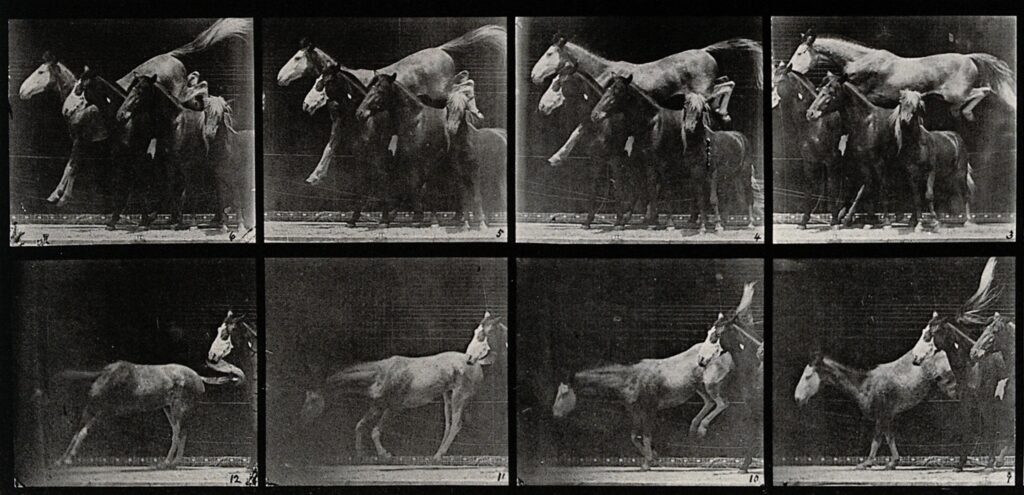
    A horse jumping over three ponies (detail). Photogravure after Eadweard Muybridge, 1887, via Wikimedia Commons. Licensed under CC BY 4.0. I’ve never much liked horses. The first time I meet my sister-in-law is at the stables, where she keeps an enormous bay stallion with the same name as her brother, my husband. When the two of them were younger, this caused confusion: it was hard to tell which Václav she was talking about; which one, horse or boy, had behaved badly. Playing willing is a newcome
     

Three Horses

19 June 2026 at 14:00

A horse jumping over three ponies (detail). Photogravure after Eadweard Muybridge, 1887, via Wikimedia Commons. Licensed under CC BY 4.0.

I’ve never much liked horses. The first time I meet my sister-in-law is at the stables, where she keeps an enormous bay stallion with the same name as her brother, my husband. When the two of them were younger, this caused confusion: it was hard to tell which Václav she was talking about; which one, horse or boy, had behaved badly. Playing willing is a newcomer’s role in any family scene, so I ride my sister-in-law’s horse when she insists. This Václav is old, gentle, and toothless. Still, I cling to the reins. I’m much too afraid of falling. Later, in the car on the way back to the city, my sister-in-law tells me about the astronomical sums of money the animal consumes each month and the two jobs she juggles to pay for his keep, and I think of the opening of Aristophanes’s comedy The Clouds, in which a father, Strepsiades, listens to his son, Pheidippides, as he sleeps and dreams of chariot races, and laments that “his madness for horses has shattered my fortune.”

I prefer to encounter horses at a safe distance. The difference between the immaterial horses who have galloped through my reading and the material horses that surprise me on walks in the countryside, big and breathing heavily, sidling up to fences with their long tongues lolling and buzzing with flies, never stops surprising me. Like death in a tragedy, the horses in Greek theater always seem to be happening offstage. In the final scene of Euripides’s Hippolytus, the battered body of the eponymous subject is hauled out for us to see; after being terrified by Poseidon, Hippolytus’s horses dashed his chariot against the rocks. The gravely injured boy then reconciles with his father, Theseus, before giving up the ghost. A messenger lets us know that the horses themselves have disappeared. He doesn’t know where.

The Clouds was first staged at the City Dionysia in 423 B.C.E., where it came last in the competition, much to Aristophanes’s disappointment. (A year later, in The Wasps, he lambasted the undeserving audience, putting a stirring self-defense in the mouths of his chorus: “Last year you betrayed him, when he sowed the most novel ideas … none ever heard better comic verses.”) Throughout the play, a satire of the rampant philosophizing of the time, horses and ideas are opposed, the earthly arena of the former contrasted with the celestial flurry of the latter. When Strepsiades first encounters Socrates, the thinker is suspended in the air in a basket; the status of contemplation is literally lofty. As Strepsiades watches, Socrates beseeches the clouds, which carry our thoughts, to grant the bankrupt man the gift of philosophy (which will help him escape his creditors). In this novel cosmology, there is no Zeus, no Helios and his horses to pull the sun across the sky, just the Whirlwind that sets bloated, colicky ideas thumping up against one another. Strepsiades learns what Socrates has to teach him and is so taken by the philosopher’s ideas that he sends Pheidippides to study in Socrates’s stable of disciples (for which Aristophanes invented the word phrontistērion, meaning “place of pondering,” and which is often translated, hilariously, as “thoughtery”). The dialogues that follow leave the spectator suffering from a kind of rhetorical whiplash, surrounded by absurdities on all sides. The satire is so punishing that in his Apology, Plato, Socrates’s real student, portrays Aristophanes as partially responsible for the negative public image that led to the execution of his mentor some twenty-four years later.

By the end of The Clouds, Pheidippides has been transformed into an adroit reasoner. During his time in the Thoughtery he becomes pale and emaciated and equivocal; his warm-blooded, horse-loving nature disappears for good. It turns out that, for Strepsiades, a son who doesn’t love horses is a son who doesn’t love anything. Soon after his great alteration, Pheidippides beats his father and uses his newfound reason to justify doing so: “When I thought only about horses, I was not able to string three words together without a mistake, but now that the master has altered and improved me and that I live in this world of subtle thought, of reasoning and of meditation, I count on being able to prove satisfactorily that I have done well to thrash my father.”

After listening to my sister-in-law describe her own financial ruin, I decide that if I ever have a child, they will never know that a horse is a thing you can have. I hope that for them horses will be mere scenery, as innocuous as hedgerows, barely worth comment. My distrust of horses goes beyond the desire to save some money, because in some essential way I agree with Aristophanes’s Socrates that what’s most interesting is the world that we have fabricated, the figures that we set against one another. The horses worthy of attention, I will insist, are the horses that carry our metaphors. I’m not convinced that this is true, but I have always struggled to recognize animals beneath their coverings of meaning. They are always more useful to me that way.

***

I would describe Turgenev’s “The End of Chertopkhanov” as a story about the difficulty of recognizing a horse. It’s possibly the saddest story I know.

The first description of its protagonist arrives one story earlier in A Hunter’s Album, the collection in which this work appears. In “Chertopkhanov and Nedopyuskin,” Chertopkhanov cuts a ridiculous if endearing figure, with puffy cheeks and glassy eyes darting about “as if he were drunk.” When the narrator visits Chertopkhanov in the village of Bessonovo, he is described shuffling around his gloomy dwelling in a greasy dressing gown, with his wasp-faced lover, Masha, and penniless confidant, Nedopyuskin. (I imagine something like the decaying Beale family home of Grey Gardens, only Russian and sometimes mirthful.) By the time “The End of Chertopkhanov” comes about, Chertopkhanov’s lover has disappeared and his friend has died, and he falls into ruin soon after. The only thing that lifts his cloud of despair is the appearance of an excellent horse, whom Chertopkhanov calls Malek Adel.

This horse is the unexpected reward for a good deed, and he arrives like something from a fairy tale, ridden into town by the scruffy little man, known only as “the Jew,” whom Chertopkhanov had earlier saved from being murdered by a group of anti-Semitic peasants. When Chertopkhanov sees Malek Adel for the first time, his heart starts “hammering in his breast.” Like Pheidippides, “he was a passionate devotee of horse-flesh and knew a good horse when he saw one.” He accepts the Jew’s ridiculously low price, and takes the horse. Malek Adel becomes the center of his small world. The nature of his value is not made clear: Though the narrator assumes that Chertopkhanov prizes Malek Adel for how splendid he makes him seem to his neighbors, Turgenev’s description of how the horse appears through his owner’s eyes is so emotional, so full of feeling. A more generous reader might think that the down-on-his-luck aristocrat has found something to love at last.

Then Malek Adel vanishes. Chertopkhanov is woken up from a bad dream by the sound of distant neighing. His loss has a formal, strident quality: confronted with the empty stable, “Chertopkhanov’s head began to spin just as if a bell had begun to toll in his skull.”

It’s funny that the story is called “The End of Chertopkhanov,” because what makes it tragic is Turgenev’s refusal to end on any of its gradually escalating losses. Chertopkhanov is not finished by the disappearance of his lover, the death of his friend, or even by the theft of Malek Adel. If he were, the story would merely be sad. Instead, Chertopkhanov is broken by the return of his horse and his growing fear that this horse, although in all aspects the same, is not in fact Malek Adel.

After a yearlong quest and the fairy-tale-ish recovery of Malek Adel from a distant marketplace, a story that he recounts to his astonished groom, Perfishka, Chertopkhanov falls into a pattern of obsessive doubt and compulsive behavior. There is not only something implausible about Malek Adel’s reappearance but something newly strange in his character. He begins to worry that this horse is not Malek Adel after all: “He almost constantly … subjected Malek Adel to examination, riding off a great distance and then testing him, or, creeping into the stable, locking the door behind him and standing right in front of the horse’s head, he’d start looking him in the eyes and asking in a whisper: ‘Are you he? Is it you? Is it you?’ and then he’d either study him, intently, hour after hour, or, in an access of joy, he’d mutter: ‘Yes, it’s him! Of course it’s him!’ or then again he’d be doubtful and even be covered in confusion.” His former happiness gives way to torment: the renewed presence of the horse is even worse than its absence. The endless demand for certainty that the challenge of loving again necessitates for Chertopkhanov slowly crushes him. The story is what the philosopher Stanley Cavell might call a tragedy of skepticism, and it ends much as can be expected: Chertopkhanov shoots the horse that he can no longer bear to be around.

But I try to make myself remember that the story isn’t just Chertopkhanov’s tragedy but Malek Adel’s too. All these troubled ways of looking—associative, symbolic, allegorical, skeptical, suspicious—enact their own peculiar violence on whatever they take as an object. The projection leaves a trail of destruction in its wake.

***

Soon after I read Turgenev’s story for the first time, my friend Veronika takes a photograph of a horse during an unguarded moment on the Sussex Downs. I like it so much that it becomes my desktop background for the next six years. Whenever I look at it, I feel as if I’m seeing an animal for the first time. This horse is so obvious, so absolutely unselfconscious. It’s so much realer than any other horse I’ve encountered, even the ones that I’ve ridden. At first I think that my impression must come from the positioning of the horse’s head in the center of the frame or that it belongs to the strange brightness of the image, but then I decide it’s just a great example of what a photograph can do. In The World Viewed, Cavell describes the way that photography levels hierarchy, reducing the primacy of the human figure: “Photographs are of the world, in which human beings are not ontologically favored over the rest of nature, in which objects are not props but natural allies (or enemies) of the human character.” Perhaps if Veronika were to spend her life photographing horses, I’d find it harder to dismiss them. It would make for a more crowded world, at least.

Photograph by Veronika Korjagina.

In the end it turns out that I need the real horse, too. After my daughter is born I feel as if just about anything could happen to her. My friend’s wife suggests that I put iron underneath her crib. Following tradition, this is supposed to protect a baby from witchcraft, but she says it might help with all the other stuff too. In the absence of certainty, a newly dangerous world, this seems better than doing nothing. I text my sister-in-law and she brings me one of Václav’s iron horseshoes the very next day. Together we stand by the crib and look at it. The shoe is so ugly, the metal is corroded and, in some places, rusted through, and there’s a flaky white substance on one side that I think must be either glue or old keratin. It’s nothing like the smooth, lucky symbol I imagined, just matter, something material at last. We put it there anyway.


Quotes taken from the following translations: Aristophanes: The Eleven Comedies (1912), trans. unknown; Sketches from a Hunter’s Album (1990), trans. Richard Freeborn.

Missouri Williams is a writer and editor. Her first novel, The Doloriad, was published in 2022 and won the Republic of Conciousness Prize. Her second book, The Vivisectors, is out now. 
  • ✇The Paris Review
  • A Diary from the Psychic Capital of the World Greta Rainbow
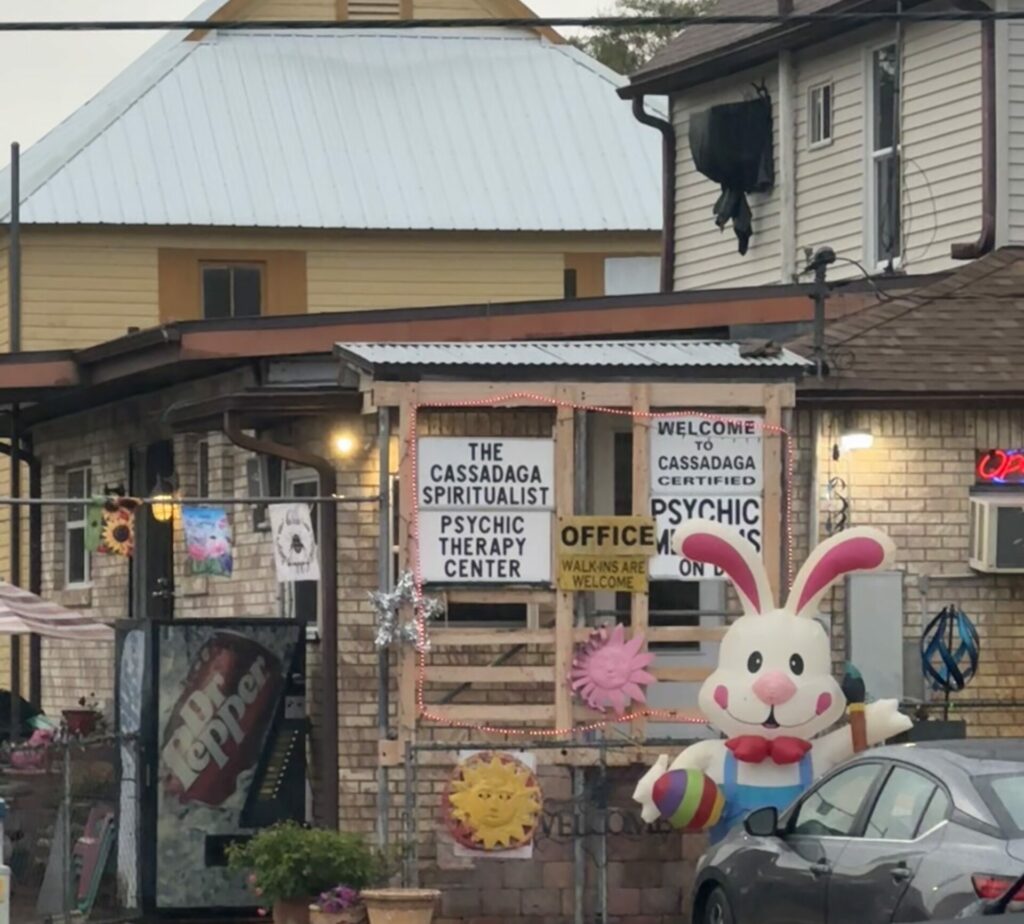
    Cassadaga front office. Photograph by Greta Rainbow. Friday, March 27, 2026 When I waded into the Florida humidity, Mom and Mimi were waiting for me at curbside pickup, three hours after the worst airport security I’d ever experienced. The TSA line at JFK had snaked around the sidewalk. I’d cut shamelessly.  I hugged my mother first, then her mother. I’d last seen Mimi at Uncle Dan’s funeral almost two years before, and I hadn’t been down to Florida in ten. I used to spend every spring break in
     

A Diary from the Psychic Capital of the World

12 June 2026 at 14:06

Cassadaga front office. Photograph by Greta Rainbow.

Friday, March 27, 2026

When I waded into the Florida humidity, Mom and Mimi were waiting for me at curbside pickup, three hours after the worst airport security I’d ever experienced. The TSA line at JFK had snaked around the sidewalk. I’d cut shamelessly. 

I hugged my mother first, then her mother. I’d last seen Mimi at Uncle Dan’s funeral almost two years before, and I hadn’t been down to Florida in ten. I used to spend every spring break in New Smyrna Beach, poking lizards and watching late-night TV in a room covered in glow-in-the-dark stars. I liked to watch my mother be mothered by a grandma who would never let us call her that.

Mimi asked what I wanted to do now, by which she meant, did we mind stopping at an antique mall nearby. This was my childhood, Mom said. Mimi had been a Boston antiques dealer, a detail covered in Mom’s memoir in progress, which I’ve read and Mimi hasn’t. The book is about being raised by hippies, and how you can feel loved without feeling safe. 

I’d conceived of my role that weekend as moral support in general, and specifically in the project of locating lost paperwork involving dead men. Such items included a trove of love letters sent to Mimi in the early sixties, which Mom wanted for book research, and stock certificates belonging to Dan, who, despite practicing as a Manhattan lawyer, did not have a will—thus rendering Mimi, his sister, the executor of the estate. She’d come into the role after Dan was murdered on a spring afternoon, while walking on a bike path outside of Albany. We still don’t have answers. In the fall, a twenty-five-year-old man was charged with one count of second-degree murder—seemingly not premeditated, a random act of insane violence against a practicing Buddhist.

That was also the reason for the one activity I’d added to the itinerary. Sometime in the past decade, someone told me that there is a Psychic Capital of the World. The Psychic Capital of the World happens to be an unincorporated community in central Florida called Cassadaga, and is twenty-three miles from Mimi’s house. She’d been there before, by virtue of living nearby and being the kind of person who would go to a Psychic Capital of the World, which is one of the ways that we are alike.      

But she hadn’t gone in years and thus could not vouch for the currently practicing psychics. (Many of them, at Cassadaga and elsewhere, are quacks lacking the gift, she said. Not all are as talented as the tarot card reader at the Russian Tea Room in Boston who once predicted that Mimi’s two daughters would each birth two daughters.) She once went to a Sunday-morning séance with Dan, actually, which doesn’t surprise me. He was very spiritual, if not a Spiritualist, the belief system at Cassadaga: an understanding that individuals continue to exist after the change called death, and that it’s possible to communicate with them.

Photograph by Greta Rainbow.

According to an online calendar, there would be a séance at Cassadaga on Saturday. I called the number and the medium answered. I felt compelled to tell him everything about us, but I worried he’d google things like Dan’s case, tainting the experience I wanted to believe could be legitimate. Anyway, he was all business; he’d hold three spots. We talked about it over drinks at the Sea Vista Motel and Tiki Bar, with a view of the part of the beach where cars are allowed to drive, and beyond it, the rolling Atlantic. Mom and Mimi said they’d go, mostly because they love me. Admission was twenty-five dollars in advance and thirty at the door. Mimi said that if he really was psychic, he’d already know we were coming.

That night, we stayed at Mimi’s new house in a development atop a swamp, bought with Dan’s lawyer money. Her old house, which she still owns and Mom thinks she’ll never sell, is a shrine to a life’s worth of stuff that once was valuable, materially or sentimentally, but has been tarnished by rat shit and smoke damage. The new place has a screened-in porch Mimi calls the lanai, and we watched a family of ducks line up in a row, then peel off one by one, while she dragged on a cigarette.

Photograph by Greta Rainbow.

Inside, on Mimi’s bed, we went through little sacks of jewelry. She let me take a sterling swordfish charm, a spiral chain bracelet, a jewel-encrusted costume ring, and a frog whose mouth hinges open—a roach clip. There’s a silver walnut pillbox that I really wanted, but Mimi wasn’t ready to give it away. This exasperated my mom; she had me point it out again so she’d know, for when Mimi dies.

Saturday, March 28, 2026

I dressed in all black, which Mimi said would let the spirits know who to come to. Around my neck I wore a brass whistle. It belonged to Dan and had been issued by the army, and it slotted into the hollow of my throat. Should we take some of Dan with us? Mimi asked. So I scooped a thimble of his ashes into a rinsed-out anchovies jar and he rode shotgun in the pocket of the door as we headed west, when the storm started. The windshield wipers were no good. We sailed along as if in a submarine.

Photograph by Greta Rainbow.

Cassadaga was gray and dripping wet. In the Seneca language, Cassadaga means “water beneath the rocks,” according to some people; to others, it’s “rocks beneath the water.” I spied a few figures huddled under awnings. We got our bearings at the bookstore and welcome center, which offered crystals and merch, and in the back was a bulletin board, on it a yellow paper advertising the Saturday Night Live Séance, limited to twelve participants. Come and join with people of like minds and you may receive a message.

Two women behind the register were talking about the weather. One singsonged, Weird energy today. What do you mean? I asked. It’s not good or bad, she said, it just feels weird, like it does sometimes. 

A block over was Horseshoe Park, featuring a spiral meditation walk, and the Fairy Trail, a tiny jungle of trinkets and carved trunks. Inside a heart of white rocks, we scattered our bit of Dan. We kept crisscrossing another family: three kids running around and a woman who seemed to be their grandmother, scolding them. I couldn’t hear exactly; the Spanish moss seemed to soak up the sound. 

We were due at the Slater House, a meeting venue that hosts a library of Spiritualist texts, at 7 P.M. We had a couple hours to kill and headed to Sinatra’s Ristorante, Cassadaga’s only restaurant inside its only hotel, owned by Frank’s grandniece. In the lobby, freelance psychics lounged on couches, making meaningful eye contact. There was a wooden Meditation Station, which looked like a confession booth missing the priest’s side. We ate but didn’t drink, adhering to the pamphlet’s warning that attendees under the influence of mind-altering substances (alcohol / drugs) will not be admitted.

Photograph by Greta Rainbow.

It was still light out, but the lamp was on above the door of the little white house, which we opened to meet Reverend Phil. The front room was sparse and also white. Unsmiling and dry, the reverend stepped aside to let us pass into a dim and carpeted room, and I saw he had a white ponytail down his back.

Eleven chairs were arranged in an oval. Three people were already sitting, all tattooed millennials in selvage denim, who told Mimi the comfy armchair had her name on it. After us entered another threesome: middle-aged women I recognized from Sinatra’s, where they’d been at the bar with goblets of red wine. A wide-eyed woman sat with her feet planted firmly on the floor. She introduced herself as Angel, amazingly, and said she was training under the Reverend, who entered last, big and barefoot.

Phil first told us about the origins of Spiritualism in New York in the 1840s, when two sisters reported rappings on their bedroom walls. He showed us a conical horn two feet long and known as a ghost trumpet. If the energy was strong enough, it would supposedly hover off the floor, though I worried we were all too green and skeptical for anything to happen. Phil gestured for each of us to go around and share. Mimi, to his left, kicked us off, but said only her first and last name, refusing to give a crumb. So that was all that I, and the other seven, gave too. (I felt the bloom of shame that people would assume my last name had been chosen rather than inherited. Of course a girl named Rainbow would be at a séance on a Saturday night.) 

We turned off the lamps and the room was bathed in red, from the ceiling lights. The Reverend led us in a guided meditation. You are walking through a forest. You reach a beach. You walk ten steps. One. Two. Three. Four. Five. Six. Seven. Eight. Nine. Ten. An animal joins you at your side; that’s your spirit animal. You come to a bonfire. A figure emerges from the flames and hands you a crystal. They retreat. Another figure emerges. They walk with you. Open your eyes.

It was hard for me to meditate. The whole time I thought about how I was supposed to be not thinking. In trying to let go I grasped what was right in front of me tighter. My spirit animal did join, a little tabby cat brushing my ankles, though it might have been only because Phil told us that, if we felt called to speak aloud a message from Spirit, not to let the cat get our tongue. I saw Uncle Dan in the flame, but it might have been because I wanted to see him there, because I don’t know many people who have died, because, at that moment, I might still have had his remains on my hands. 

Phil asked Mimi, first again, if she would share what she saw. She described a green crystal and the cat that had been her spirit animal, too. Then Phil and his apprentice riffed on that. They stepped into her vibration. They saw an older gentleman; he was slapping his knee. He had a boisterous laugh. He was cracking Phil up. It’s not Dan, Mimi said. She saw their father instead. Phil asked Mimi if she had a bucket list, because her father wanted her to do everything on it. It’s a pretty short list, Mimi said. 

Angel described Mimi as independent, leery of people—like a cat. But loyal, once she lets her guard down. Angel said: You don’t need people. Or rather, you don’t want to appear like you do. I stole a glance at Mom. 

ANGEL: I also feel that you have an archangel that’s watching over you. Gabriel, possibly. A strong, strong white spirit.

MIMI: I feel protected all the time by the spirit world. 

When it was my turn, I froze up. I described the red hair of my mom’s friend Holly, who I had seen in my meditation. She is still alive, but Reverend Phil was describing her like she was dead. I started panicking that the red hair was about my little sister, whom I worry about constantly. I crossed and uncrossed my fingers and my toes. Dan appeared to me as a shock of white, smirking. I understood that he knew everything but was reticent to reveal it. Phil said some platitudes about how Dan was proud of me, but the expression I’d seen was more bemused.

Angel felt a lot of love surrounding and coming from me. Thank you, I told her. This was about making us feel good, I realized. The sign in the welcome center had advertised healing services. One of the Sinatra’s girls saw a green orb hovering in the corner of the room. Yep, that would be Uncle Dan, Phil said. I didn’t see anything in the corner of the room. 

At the beginning, Phil had told us that the other séance participants might begin to appear differently to us, the features of the deceased projecting over faces or blending in. By the way, he told me now, you’re transfiguring. You’re a Victorian queen wearing a crown. Someone else transfigured too and she said she could feel it in her face, she was taking deep breaths and rocking back and forth. I thought maybe it benefited the experience to come under the influence of drink.

I preferred Angel. She could read people. She identified an unresolved pain in Mom, which I agreed with—not in a catastrophically tragic way, just in that she carries the weight of everyone she loves within her. Phil, meanwhile, described Uncle Dan as some kind of honky-tonk who was knocking back forties in heaven, when Dan would never—he was always very concerned about inflammation.

It took more than two hours to go through the nine of us, and the last three still felt rushed. By far the most time was spent on Mimi, Mom, and me. I think Phil wanted to convince us. At the very end, he said he was getting one more message. It was Uncle Dan. He’s asking you—Phil turned to Mimi—have you found the letter yet?

Photograph by Greta Rainbow.

Sunday, March 29, 2026

It was too cold to lay on the beach and I wanted to go to Mimi’s hoarding house, to see if it matched up with my memory. A hurricane had destroyed the treehouse in the backyard. Inside, there were stacks of paper everywhere, which we three picked up and shuffled through and put down again. We left without finding the love letters from long ago, nor the certificates we’d need to access Dan’s corporate shares that had gone missing only because Mimi had misplaced them. I had no sense of what kind of letter Dan had wanted us to find. 

In the evening, we talked about the séance, remembering phrases, wondering about the other people there. No, the Reverend might not have had the gift, but I liked him, by the end. I think that, after hearing a stranger describe what Dan wasn’t, I understood a little better what he was. Mimi didn’t like Phil. She said, He should get a haircut and a real job.

But I do feel angels watching over me, Mimi said. Do you think that’s true for everyone?

I considered. I think everyone feels special. I think you have to, to survive. Because why else get up every day, if you’re not living a unique life? Maybe not every soul is looked after by someone who holds power in the universe. But does everyone believe they are?


Greta Rainbow is an editor of The Creative Independent, an arts columnist for The New York Review of Architecture, and a lead contributor to Blank, a literary newsletter from Dirt Media.

  • ✇The Paris Review
  • The Vanishing Library: Timothy Ely’s Odd Little Book from Outer Space Max Ross
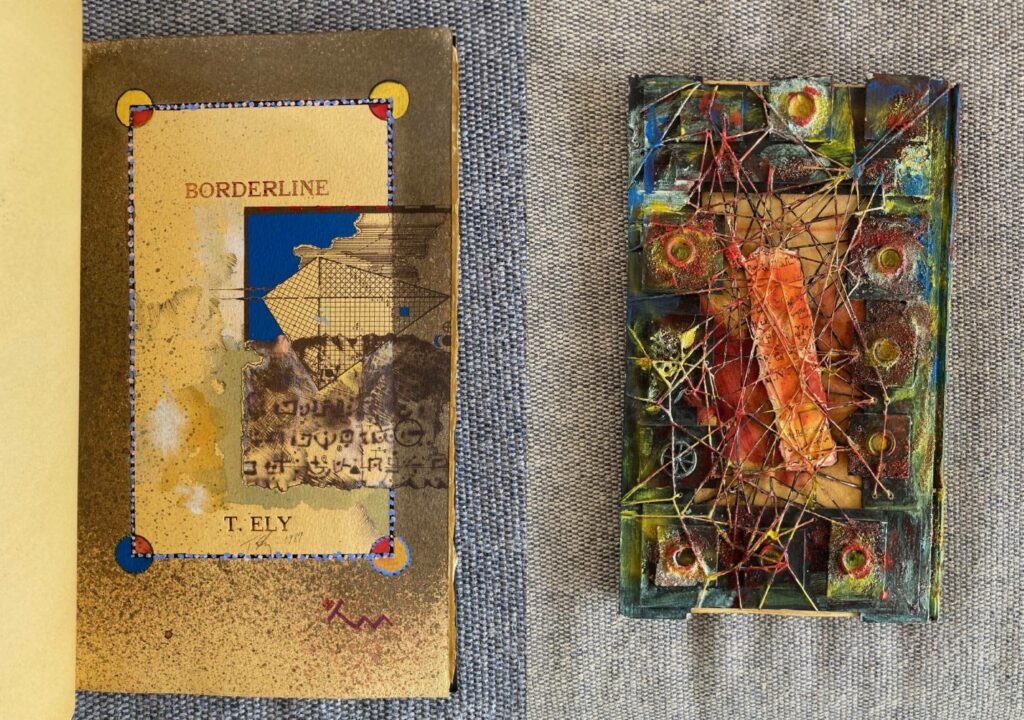
    Borderline by Timothy Ely, front (left) and back (right) cover. Photographs by Max Ross. Late in the week I got an email from one of my book dealers. He was at a fair in New York and thought he’d found a buyer for Timothy Ely’s Borderline, a unique artist’s book I’d placed with him on consignment. It was welcome news; we’d been trying to sell Borderline for two years. Before traveling to New York, he’d asked if we might lower the price, from ten thousand dollars to seven thousand and five hundr
     

The Vanishing Library: Timothy Ely’s Odd Little Book from Outer Space

9 June 2026 at 14:00

Borderline by Timothy Ely, front (left) and back (right) cover. Photographs by Max Ross.

Late in the week I got an email from one of my book dealers. He was at a fair in New York and thought he’d found a buyer for Timothy Ely’s Borderline, a unique artist’s book I’d placed with him on consignment. It was welcome news; we’d been trying to sell Borderline for two years. Before traveling to New York, he’d asked if we might lower the price, from ten thousand dollars to seven thousand and five hundred, and I’d agreed that it seemed like time. 

Nothing was finalized, my dealer said, but he was optimistic. The prospective buyer had asked to be looped in if anyone else made an offer, and also wanted to know more about the book’s provenance. In my reply I explained how it had come into my possession: My father, a lawyer and book collector, had done some legal work for the founder of Granary Books, a publisher specializing in artists’ editions. As payment, he was able to buy titles from Granary at cost. He’d acquired a dozen or so through this arrangement, and Borderline was one of them. I’d inherited it when he’d died, about four years earlier. 

I didn’t want to sell Borderline, exactly. Like all the books I’d inherited, it was a little holy to me. To let it go would be to let go of another part of my father. I didn’t want to let more of him go. I’d begun to feel I was erasing him, forsaking him. He’d built his collection over four decades: a few hundred titles—first editions, special editions, illustrated editions—that, taken together, expressed him as vividly as a self-portrait. I knew who my father was because I’d worked to understand his tastes. His shelves held Joyce, Borges, Wallace Stevens, Frank O’Hara, John Ashbery; invention, philosophy, sensitivity, sensuality, beauty. 

(He’d joked once, after coming out, that he’d never been in the closet but between book covers.) 

I’d sold most of his collection indiscriminately. Idiotically. I’d had only a long weekend to clear his house after he died. I was in a fugue state of grief and made decisions rashly. An edition of Animal Farm that I sold for five hundred dollars was listed by its buyer for twenty-five hundred the next month. I accidentally included a copy of Lysistrata that was illustrated and signed by Picasso in a grocery bag of detective novels I dropped off at a Goodwill. Now, four years later, I clung to the books of his I still had, afraid I would squander them, too.

But I couldn’t keep Borderline. It didn’t belong to me. I mean this metaphysically. I’d made a rule early on that, in order to keep one of my father’s books, I needed to be able to make it mine. A simple process: I would pick up a book, and, if it vibrated with magic, it was mine. Some did, some didn’t. I knew instantly. An early edition of Lunch Poems. A custom-bound Ulysses. Arion Press’s Trout Fishing in America.  

Borderline was inert. It’s less a book than a book-object. Published in 1989, its pages are filled with maps, charts, drawings of landmasses and planets. I think it’s supposed to be an atlas of an imagined universe, but it’s hard to say for sure. There’s no narrative; there’s nothing to read. It’s sixteen pages, about as thick as my pinky. The few words it contains are indecipherable, of no language. (The letters look Hebrew—if you don’t know Hebrew and have never seen Hebrew letters before.) The artist, Ely, created his own system of glyphs, which he derived from his studies of ciphers, cryptographs, hieroglyphs, calligraphy, alchemy, Kabbalah, UFO communications in sci-fi novels, and other synthetic languages. Flipping through Borderline, you get the sensation you’ve uncovered an artifact from another dimension, somewhere both ancient and futuristic. 

My father, I knew, responded to this type of artistic obsessiveness. He was drawn to the idea that Ely had spent years building a world that wasn’t really meant for anyone else: an exercise in absurdity and rigorousness and care. He also admired the book’s craftsmanship, how Ely had dyed the paper and tied the spine. The mastery appealed to him and he liked examining it with his own hands. But when I handled Borderline, my only thoughts were about how valuable it was and how careful I had to be with it. All it meant to me was that it had meant something to my father. This wasn’t enough, I’d learned, to make it magic. 

***

All weekend, as I took my daughter from playground to playground in Berkeley, I waited to hear if the sale had been finalized. Thoughts of my father popped in and out of mind.   

He’d been a private person, his interests had been solitary interests: reading, running, computer chess. I’d taken after him and was one of very few people who could share his privacy. We went running together and played chess together and read together, different books in the same room. But in my late twenties, shortly after finishing a graduate program in writing, I’d created a schism between us. I published a novella about him in a literary magazine, centering on his sexuality. It included what he’d told me about his first encounters with men, in his early forties; his ongoing relationship with my mother; his struggle to figure out why it had taken him so long to understand himself. It wasn’t a mean portrait, but I exposed him in ways he had no choice over; I turned his privacy public. We both lived in Minneapolis then and still got together every week for dinner, but he was more guarded after the novella came out, wary I would mine him for more material. 

One evening I went to his house and we played a few games of chess at his dining room table. He was a stronger player than I was and in one of our games he dismantled my position, removing pawn after pawn, so that my king was vulnerable to multiple lines of attack. 

“There,” he said, reaching across the board and tapping my king. “That’s about how I feel.”

“I know,” I said. 

“I know you know,” he said. “So that’s that. And now, we play again.” 

It’s a lousy thing to write about people you love. But I also understand my twentysomething self’s motives. I was a sophomore in high school when my father came out. Afterward, he often seemed like two people to me: the father I knew, and a new, independent—and suddenly sexualized—person who felt like a stranger. This stranger came with us everywhere: dinners, runs, museums, movies, chess. I found him unnerving. Who was this man? But I also sensed I needed to become comfortable with him, to reconcile him with the more familiar father. Writing provided the way. My novella, I suppose, was an attempt to chart out an atlas to the twin universes within him. 

***

“I am part pre-Gutenberg, part Victorian, and part Martian,” Timothy Ely has said of himself. “I was a stoker on the Nautilus. I swept up after William Morris.” 

Looking at his work from the past forty years, you might start to suspect this statement isn’t a self-description so much as a coded set of coordinates. Ely has made dozens of books in the course of his career, and each one of them is unique, a one-of-a-kind key to a one-of-a-kind place and time. They’re so meticulously constructed that it’s easy to believe he drew on firsthand experience of these spaces—even though they don’t exist. (Many of the books are kept in various terrestrial libraries, including the collections at Princeton, Yale, and the University of Texas, Austin.)

He’s traced the genesis of his career to a single day in graduate school, when he discovered the map collection in the basement of the Suzzallo Library at the University of Washington. There he found maps that broadened his worldview—or, more accurately, his universeview. Maps of air currents, the ocean floor, the solar system, Mars. Maps of anywhere you couldn’t actually go. He returned again and again. Over time, two ideas became central to his work: maps can be a means of expression; and it’s okay not to understand what fascinates you, and live instead within the fascination. 

“Discovering the Atlas was being touched by God or Rand McNally,” Ely has written. “It is about being awake and fully formed. The experience stands out for me as precisely how I see creativity working—connections are established, points connected and gelation occurs.” 

Every October, he celebrates the day he first visited the map collection. 

***

When my father became sick the distance between us collapsed. He lived with cancer for six years. I’d moved to the Bay Area by then—my girlfriend had taken a job in San Francisco—but I flew to Minneapolis frequently. I was with my father in the hospital for his first surgery and stayed with him as he convalesced, helping him around his house and picking up his prescriptions and groceries. I visited him through chemotherapy and radiation treatments, a sepsis scare, more surgeries, more treatments, the cessation of treatments. Meanwhile I was developing my own life. In these years I got engaged, then married, and became a parent myself. I was aware this all may have been catalyzed in some way by my father’s illness; I wanted him to see, before he died, that I’d established a life for myself. 

I no longer wrote fiction; my time was taken up with parenthood and my career. I worked in tech marketing now, a job that paid well enough to support my life in the Bay Area. But by the end of most days I’d used up the energy that once went into more personal projects. I journaled and occasionally sketched out story arcs, but I never finished anything. Now and then I could see the shape of a narrative forming from my father’s ordeal—but whenever I began writing I felt guilty, and put what pages I’d drafted in the recycling bin by my desk. 

He spent his last year in Palm Springs, to be near a cousin he’d grown up with. There was no winter there. I would visit every month or so—every two weeks, toward the end. He would ask me to bring him books: Dubliners, Billy Budd, The Death of Ivan Ilyich. He spent the year rereading great writers in the sun. On my last trip I took home all the books I’d loaned him. Penguin Classics editions, mostly. They’d been mine to begin with, but now they vibrate a little, too. 

***

The next Tuesday morning my book dealer emailed to say that Borderline had sold. I wasn’t surprised to find I was regretful. Another piece of my father gone, on some anonymous buyer’s shelf. 

I reminded myself I’d never connected with Borderline. But I had, at least, connected with my father. There were parts of him I’d never fully understand—but I would never be divested of my fascination with him. Not everything of his had to become mine.  

As we’d agreed, my dealer would get a 20 percent commission. Likewise, the buyer got a 20 percent discount, because he was also a book dealer. (I didn’t quite understand this, but apparently it’s industry standard.) Half of what was left would go to my sister, whom I haven’t mentioned because I’m forbidden to write about her. A chunk would go to taxes. The rest would go to my mortgage. Another sort of magic: Watch as I turn this library into interest payments. Poof. 


Max Ross is a writer and occasional bookseller. 

  • ✇The Paris Review
  • The Summer of Lion Meat Tere Dávila and Rebecca Hanssens-Reed
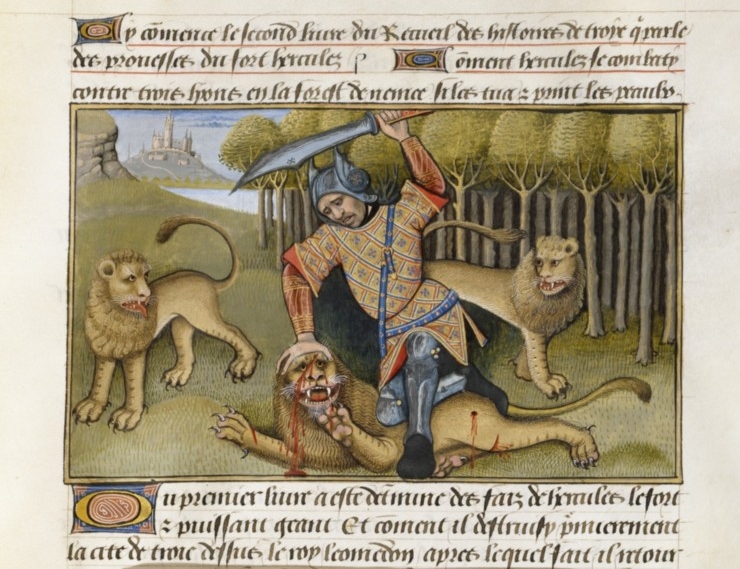
    Robinet Testard, via Wikimedia Commons. Public domain. Translator’s Note: This piece uses the medieval-period translation technique of inserting metacommentary directly into the text when a detail is dubious or has no verifiably accurate translation. The technique is used here to highlight, play with, and contribute to Dávila’s own footnotes regarding unreliable facts within the autofictional narrative. This version adds another layer to the communally constructed story, first published in Spani
     

The Summer of Lion Meat

Robinet Testard, via Wikimedia Commons. Public domain.

Translator’s Note: This piece uses the medieval-period translation technique of inserting metacommentary directly into the text when a detail is dubious or has no verifiably accurate translation. The technique is used here to highlight, play with, and contribute to Dávila’s own footnotes regarding unreliable facts within the autofictional narrative. This version adds another layer to the communally constructed story, first published in Spanish in 2019.


That was the summer I had to choose, in a matter of seconds, how I wanted to die; I recommend avoiding as best you can the sort of ill-advised predicament I found myself in thanks to a heat wave that had descended on Boston. I’d just finished my third year of college and had decided to finally take the programming course I’d put off all those semesters, but instead of staying in a dorm, where I’d have to cram into a tiny room with a complete stranger, I joined three classmates who were looking for a fourth person to split the rent for a house. The pluses: I’d have my own room, and, though I didn’t know my new housemates well, I’d chatted a handful of times with one of them, Tom,1 who was not only friendly but also pretty cute. The minus: the house wasn’t in Cambridge, where the campus is, but in Somerville, a nearby neighborhood that had fallen into decline and was, therefore, where my roommates could afford to live. I no longer remember why I was so hell-bent on sticking to this meager budget—my parents would have helped me out if I’d wanted to find a nicer place—but I suppose I wanted to assert my independence by making my own decisions, even if they were stupid.

My room in the attic seemed romantic at first, with a gable roof and a large picture window that let in lots of light, but by sundown I understood why no one else had claimed it (I was last to join the group). As the highest point in the house—like most old buildings in the Northeast, it was built for the cold, thus offering neither the perks of air conditioning nor a ceiling fan—that was where the heat accumulated from each protracted summer day. I quickly realized it was best to go up there only to sleep (or to attempt an uneasy approximation of sleep) and so I spent most afternoons languishing on the first floor, reading with a sheet thrown over the faux-leather sofa so my skin wouldn’t stick. But sometimes even this was unbearable. Then any excuse to escape the house was a good one—return a library book, make photocopies at Kinko’s,2 or, in one instance, go on an excursion that would take a very strange turn. I went out in search of a grocery store to satisfy a craving for cold, green, crisp grapes. 

“There’s a Foodmaster3 ten minutes from here,” Tom said, without offering to join. 

I wanted him to come with me. During that pre-GPS summer, in the prehistoric era before cell phones, if I made it anywhere based on the directions someone explained to me it was an act of God. My destination this time was somewhere within the uncharted territory of Somerville. I should have asked, but I didn’t dare. 

Twenty minutes later I had no idea where I was. Tom’s directions were shitty. I was nowhere near a supermarket and couldn’t even find anyone to ask for help. Houses were boarded up, the front yards overgrown; a sullen quiet occupied what had once been a neighborhood full of families dreaming of upward mobility, most of them workers for Ford Motor Company, who had left when the factories did. The houses had been split into apartments for cheap, short-term rentals, for people who didn’t have an interest in—rather, who didn’t have the means of—maintaining them. We could say they were transitory people, or people forced into transitory circumstances. I was delirious from the heat. Night was falling, but not the temperature. I was weighing whether to abort Misión Uvas (Mission Grape) and turn back when I saw a store that was open, not my Foodmaster but a small butcher shop. The sign read SAVENOR’S MEATS

I went inside, grateful for the cold air that bounced off the white, tile-lined walls (I suppose it’s easier to hose down when blood splatters). I was the only patron, but the butcher didn’t notice me; his back was turned, he was busy balancing the foot of a very large animal over the meat grinder. The whirring blades made a sharp screech we could describe as the carnal wail of a pterodactyl. The guy was not taking his eyes off them, so as not to lose a finger.4

I meant to ask him for directions, explain to him that I was lost, but I think if he had turned around then, if he’d noticed me the instant I walked in, he would have picked up that I was, in another way, really lost. I had no idea what I was doing sharing this stuffy house in a ghost town with three classmates I barely knew; I no longer knew what I’d been trying to prove to my parents and myself; I was lonely. And being lonely in Somerville was not ideal. I wish I could have seen his face in that moment. Instead, I decided to wait for him to finish what he was doing, and to entertain myself, I peered into the coolers. There is something alluring in what lies behind the cool glass of butcher shops and fishmongers, the juxtaposition, almost sensual, of death and freshness: opaline fish with precise eyes resting on ice; slices of red meat, bright and firm, stacked one on top of another; marbled trails of fat and muscle; ribs fanning out in a neat line. At least that’s how it is in typical butcher shops, which this one was not, as I learned when I read the first tag that labeled a fillet. 

Camel. Written in cursive on a little white square.

Bear, the next one read. Zebra. Giraffe. Animals we might see in a zoo rather than in a shop cooler. Yak. Python. Alligator. And in the last one, in delicate script: Lion. Arranged on ceramic plates, not the usual Styrofoam trays wrapped in cling film, the lion steaks were nearing a state of decay, or so it seemed, a whitish layer of mold forming on top. It appeared I had entered the twilight zone of extreme carnivores, a world with penguin breast and kangaroo loin, where the steaks are left to cure for weeks out in the open (that is, with bacteria) until achieving the perfect level of acidity—a process of dry aging. Around the mid-eighties, before Anthony Bourdain and his show Parts Unknown, before the media’s infatuation with eccentric celebrity chefs and Ferran Adrià’s kitchen lab, anyone would have been startled to see the items sold at Savenor’s, but a naive college student, we could argue, most of all. 

Who eats lion? I wondered, thinking of Elsa, the lioness of Born Free. The Lion King had not yet taken hold of our collective consciousness, thankfully—if it had, then a Simba sirloin really would have been scandalous. Who eats bear? Giraffe? Who would eat monkey? Then I remembered something I had read that claimed there were people in China who ate monkey brains;5 urban legends have circulated about the practice of eating them while the monkey is still alive, the guests sitting around a table specially designed with a slot where the animal is inserted and tied in, leaving only the tip of the head exposed. The skull is then sliced open, and the humans sink their teeth, or more likely their silver spoons, into the gray matter.6

Years later I would watch a similar scene, but with a human in place of the monkey, in Ridley Scott’s film Hannibal. The dynamic Dr. Lecter is not only a vicious cannibal but also a top-tier foodie, with a taste for dining on the liver of his victims, as he describes to the FBI agent Clarice Starling in The Silence of the Lambs, “with some fava beans and a nice Chianti.”7 Hannibal, who surely would have tried lion or hippo had accountant or nurse been unavailable, is not the only killer foodie, in fiction or in real life. Studies show that psychopaths use twice as many words when describing basic physiological needs, like food and water, suggesting a predatory nature to the way they view the world.8 After all, the best way to fully possess something is to ingest it, to internalize and process it. As the story says, in the rituals of cannibalism, after a battle, the most valiant and clever warriors were captured and prepared for dinner so that some traces of those qualities might be absorbed. 

That afternoon at Savenor’s I still knew nothing about Hannibal Lecter or the truth about cannibals; I only sensed that the content of those coolers had, like the mythic ritual, like the dinner of monkey brains, less to do with nutrition than with a drive for possession and domination. I read the little white card again: Lion.9 There he was, the king of the jungle, conquered by man, the worst predator of all. I imagined the word HELP! scribbled by coyotes and pumas with their bloody paws on the white tile, a message no one would see because the butcher would hose it all down at the end of the day. It didn’t matter whether the animals at Savenor’s had been killed there or had arrived as corpses or steaks; the place had something sinister, transfixing about it, and I was prey to morbid fascination. But my reaction was closer to surprise than dismissal: here is an example of the true power of food, of its ability to delight or to gag. My own diet, like that of everyone else I knew then, was limited to farm animals: cows, pigs, chickens, a duck every now and then; maybe you would glimpse some venison on my plate, but that was rare, and not even my puertorriqueñidad, my patriotic love of tripe full of coagulated blood,10  could save me from my shock. 

“Can I help you?”

Finally the butcher turned his attention toward me. He had finished his slicing, probably of Bambi.11 

The sun was setting by the time I walked out of Savenor’s, the gray sky not unlike the mold growing on the exotic steaks I’d just bid goodbye to, and an evening haze was blurring the edges around things—the sidewalk releasing all the day’s heat, making everything look tenebrous.12 Maybe it was the combination of exhaustion and my exaggerated imagination, but even the Foodmaster supermarket (in the end it was, as the butcher directed me, only three blocks away), with its aisles of placid grains, took on the tone of my nocturnal excursion, and my mood turned fluorescently macabre. Or probably it was the effect of the neighborhood, which had become worse over the final two blocks. As I was paying at the register for my anxious grapes, I thought, with more than a little apprehension, about how I had to go back, this time in the complete night, the same long and convoluted way I’d come.

“Do you know Perry Street?” I asked the cashier, who nodded. “What’s the fastest way to get there?” 

He pointed in the opposite direction I’d come from, proving I had very much gotten lost and taken an unnecessarily long route; I’d probably been going in circles within the very small border of the city limits. 

“Is it far?”

“No. Like a ten-minute walk.”

Bag of grapes in hand, I doubled back to where the cashier had pointed, onto a long street. At first it seemed like all the ones before, but soon it changed, turning deserted, darker, with no houses. I walked some more. On both sides of the street, weeds were growing in spacious abandoned lots. I looked behind me, considering whether to turn around and go back to the supermarket, but figured I had already made it past the halfway point. 

I didn’t see the first of two men until I was walking right past him. No way to know if he’d been watching me and was waiting, partially obscured, behind a metal column, a leftover structure from some defunct subway line, or if he was startled when he saw me and the reaction was instinctive. 

It’s a cliché but also true that time stops in these kinds of moments, or else it sprawls all around you and everything takes place in an expanded present: I walk past him. He’s thin, has a mustache; we make eye contact. I walk faster, but only barely. I don’t want to show my fear.13 He lifts his jaw in a gesture not meant for me. From the shadows on the other sidewalk emerges another man, this one big and burly. I notice some dumpsters in the empty lot to my right and know that’s exactly where I don’t want to end up, victim of a grisly hunt. My hearing, along with my other senses, bristles. I hear a click. I look behind me. The two men are following. The skinny guy has a knife in his hand.

With the magic of editing, we see, in National Geographic films or Planet Earth, a lion sprinting toward a gazelle, and the gazelle, though it sees the lion, remains still. We might want to yell something like “What are you waiting for, move!!!” but she is frozen, registering it all, assessing her options. In my case, one option arrived as a car turned the corner in our direction. 

I threw myself at it. The gleam of the headlights was so bright I closed my eyes, hoping I’d made the right call, that being run over was the better outcome. But the driver’s reflexes were as good as a Fast and Furious stunt double. With a blast of the horn they swerved around me. Behind me I heard screams and snapped out of my stupor. In track and field I was always placed in the slowest tier, which my gym coach, a cruel woman, called the “little turtle” group, but now adrenaline was taking over.14 My heels kicked up and I ran without looking back, not wanting to know whether they were following me or had decided I was a trophy not worth the effort. I didn’t slow down until I was at the front door of our house. I didn’t even notice—not until much later—that I’d made it home empty-handed, the grapes probably lying out there scattered and smushed in the middle of the street. 

I told my roommates about my scare, completely forgetting to mention the visit to Savenor’s.15 It wasn’t until much later that I remembered that strange place, and then it was with a tinge of doubt, like it might not really exist. But some places refuse to fade completely from our minds—the image that pops up when suddenly an event, idea, or mysterious trigger brings it into relevance—and then when the internet was invented, finally I was able to look it up, not by the name (which I’d forgotten) but by the phrase “lion meat near Boston.” Bingo. The website for Savenor’s Butchery appeared, with five stars on Tripadvisor and a narrative about its life in that unlikely abutment between Cambridge and Somerville. The owner, Jack Savenor, was a close friend of Julia Child, the iconic first celebrity chef in the U.S.,16 who had lived in Cambridge for many years, until the end of her life. You can read about this brief history, alongside a photo of Julia and Jack. In his apron, he’s preparing a cut of meat while she leans over the butcher block, whispering something into his ear. (Fitting, given one of her catchphrases was “Every woman should kiss their butcher.”) In honor of his friend’s French training, which led to her television show The French Chef, Jack had the phrase bon appetit etched into the sidewalk by the front door. It’s still there.17

I know because I recently traveled to Boston and took a cab to Savenor’s. On the way there I recognized the corner where the somewhat sinister Foodmaster had been, now occupied by a bougie Whole Foods. The neighborhood has gentrified and so has Savenor’s: they bought the adjacent building and converted it into an open-air café where bikes are parked next to a chalkboard announcing the latte of the day. They’ve modernized the butcher shop area, which now has better lighting for beholding the cuts of python, kangaroo, elk, and bear, as well as the llama patties, the camel sausage, the whole rattlesnakes, the lizard tails, the yak thighs (whose excrement, I learned, in contrast to horses and cows, is odorless), and, of course, the lion chops.

When I left the store, I walked all the way to Union Square, near Perry Street. I passed a Thai spa, a chocolatier, hipster dive bars, internet cafés, and a gluten-free donut shop. I looked for the house we’d rented that summer, but I couldn’t remember the number and didn’t recognize it anywhere. I can close my eyes and picture it—cream paint, three stories, picket fence—but that image exists only in my mind’s eye; in the real world, memory is both too little and too much. Overcorrecting the erosion of time with its own inventions, the mind fills in the lacunae of a story until we no longer know for certain if, for example, the sofa on the first floor where I used to read was faux leather or real, if I actually could hear the scrape of the meat slicer or see the butcher pushing a foot into a meat grinder, if the cashier at the Foodmaster was a boy.18 Or if, on the dark street where the two men crept up behind me, there were, as we described, train tracks. But if there weren’t, does that matter? I couldn’t find the street. I didn’t try to look for it. And I wouldn’t try again now, either, not out of laziness or a paranoia that I wouldn’t recognize it, but because of the possibility that the endeavor would be, best-case scenario, futile—I would never find it because it never existed—or worst-case, reckless. To return to the place where death once waited for me, and got so close, may be asking the angels for too much.

[1] Tom is his real name. His role is incidental in this story and the author couldn’t be bothered to change it, because, she writes in a footnote, the story contains nothing compromising about him. But even though the author says he was friendly and cute, it does seem somewhat compromising to his character that he didn’t offer to walk with her to the store that first time. As for the others, we try to be faithful to the events and not embellish much, not distort reality. Although all memory is, in the end, a distortion; time turns remembered images into something more vivid and detailed than they originally appeared, such that it’s difficult to distinguish between what happened and the memory of what happened.1.1 Or, for that matter, between what was written and what was translated. And so it doesn’t matter if his name was in fact different, or if we are certain that Tom’s name was Greg. 

[1.1]  Considering the amount of emphasis my author places on the unreliability of memory, the sense of fidelity as described in the text is not to the facticity of the events so much as to the force of the story as the events are told. It is in that spirit, then, that details have been added to verify the facts in this story that are in fact verifiable, with some additions of similarly salient details that I (the translator) have come across in my research. Some aspects of the story, also, could be considered part of our (the author and translator’s) collective textual consciousness, so to speak, and have thus been noted with the use of the first-person plural. In the medieval period it was common for translators to insert commentary on their theories and methods directly into the text, to openly cite their authority when a detail was difficult to believe, or to acquit themselves of their duty and thus justify a divergence from the original. “In story as we read,” “as saith the text,” “as mine author doth write,” “as it tells in the book,” and “so saith the French tale” were some of the tags often used to stylistically emphasize a dubious reference (and thus distance it from the translator), or to add an interpretive flourish to the style or meaning.1.2 

[1.2] For example, one might be reading about a demon that visits women in the night and come across the translator’s helpful elaboration: “Such a fiend, as the book tells us, is called Incubus.” There might even be more deliberation integrated into the text if the translator deemed it appropriate. In John Capgrave’s 1451 translation of Life of St. Gilbert of Sempringham, he explains that, in the story of a miracle performed on a sick man, the man was given a type of cloth that Saint Gilbert once wore. Because there was no definitive way to know exactly what kind of cloth it was, Capgrave added: “I suppose verily it was his alb, for mine author here setteth a word ‘subucula,’ which is both an alb and a shirt.” 

[2] The national photocopying chain started in 1970 in California, was acquired by FedEx in 2004, and four years later ceased to exist. Paul Orfalea, born in LA to Lebanese parents, nicknamed Kinko because of his curly red hair, opened the first Kinko’s with a sidewalk copy machine. At the time, copy machines were mainly available in offices. The copy shop effectively democratized the photocopy and gave birth to a wealth of punk movements, zines, and other countercultural print materials and scenes. Artist, curator, and activist Josh MacPhee described in an interview the special nature of the counterculture that blossomed in the early days of Kinko’s: “You knew that if you went into a Kinko’s in any urban area and stayed there long enough, you would find someone who was coming in to copy a zine or make a punk flier and you would be able to connect with them.”2.1 

[2.1] From the same interview with Josh MacPhee: “That’s part of why I like to figure out ways to play with or challenge authorship, because there’s a set of less visible realities that are a product of the valorizing of self-expression: for example, erasing the fact that all ideas are communal and all information is social.” 

[3] Full name: Johnnie’s Foodmaster, part of a chain of fourteen supermarkets that operated in the Boston metro area from 1947 to 2014. The Somerville location didn’t have the best selection or the best prices, and the vegetables weren’t always the freshest, but people in the neighborhood still patronized it because of its convenient location and because the cashiers (who wore long-sleeve white shirts with black ties) were kind. The Foodmaster was also known for having wall-to-wall carpeting, an odd choice for a supermarket. The color of the carpet was, unsurprisingly, brown.

[4] Beef, pork, and chicken are not the only things that get ground up in the huge processing plants in the U.S.; there are also fingers and whole human hands. In 2016, The Nation investigated workplace accidents at Tyson factories and reported an average of one amputation per month, almost all of them involving meat-grinder operators. Workers in the poultry industry are ten times more likely to have an accident caused by stress in production lines. If despite all this you’re still interested in being a butcher, you must be at least eighteen years of age, be able to spend countless hours in refrigerated spaces, have a steady hand for operating sharp tools, and, last but not least, possess a good sense of humor: the number of butchers who play around by, for example, making a steak toupée, is not small. Somewhat relatedly, the loss of fingers also became a popular topic online following the release of the iPhone 5s, which allowed users to unlock their phones using a fingerprint as the passcode. Fortunately, one cannot, in the case of a robbery, unlock a person’s phone using the owner’s severed finger; the system only recognizes the electric pulse of living cells. 

[5] The legend about eating monkey brains in China may have to do with a translation error: there is an edible fungus called the monkey-head mushroom, whose long white strands resemble the fur of primates like the macaque. In North America, this variety is more commonly known as “lion’s mane.”

[6] My author mentions perhaps the most well-known, albeit racist, depiction of this phenomenon set in India, in Indiana Jones and the Temple of Doom: brains served straight out of the monkey’s skull. In China during the Qing dynasty, some sources claim, the dish was served this way at banquets, but these days it’s illegal to serve monkey brains at a restaurant—also, eating them has been linked to illnesses such as transmissible encephalopathy.

[7] The film my author references here resolved a phenomenon known as the Mandela Effect, where a large group of people remember something differently from the known publicly accepted fact—a sort of collective misremembering that mystics might say is a sign of a parallel universe. One of the most iconic lines from The Silence of the Lambs, “Hello, Clarice,” is never actually said in the original movie. Strangely, Jim Carrey did an impression of this erroneous line in the 1996 film The Cable Guy, perhaps because the fake memory had already seeped into the public imagination (or else Carrey introduced it). Anthony Hopkins’s character finally uttered the famous phrase in Hannibal, released ten years after the original.

[8] Caveat: not everything you read is true. To prove even the most ludicrous point, there are no two words more effective than “studies show,” and the only thing worse is to add “recent,” as in, “recent studies show.” No need to offer a date or specific statistic, no matter if it’s the most nebulous of generalizations. Whatever was “recently” studied instantly overrides whatever you knew to be true before. Even still, the author likes this statistic about the dietary inclinations of psychopaths.8.1  

[8.1] I was curious, and wanted to provide an accurate translation, so I fact-checked. The study, conducted at Cornell University in 2011, and published in British Psychological Society, used statistical text analysis to examine the features of crime narratives provided by psychopathic homicide offenders. Psychopathic speech was predicted to reflect a predatory worldview, unique socioemotional needs, and a poverty of affect. In most cases, their stories included details about what they had to eat on the day of their crime.8.2

[8.2] A story by the author titled “Marae,” based on a real-life scandal triggered by the murder of a German tourist on holiday in Polynesia (his remains were found in a fire pit after he’d gone missing), satirizes the racist speculation that cannibalism was at play. Coverage of the murder often digressed into the so-called history of regional culinary practices. Some South Pacific cultures are believed to have practiced cannibalism until quite recently, reported news outlets in countries with long histories of colonialism. (One outlet published an article with a picture not of the victim but of Hannibal Lecter.) Most of this supposed history, though, was documented only by early European settlers, and few contemporary analyses (if any) look at evidence in the Maori language. 

[9] Eating lion is controversial but not illegal. Although in the last hundred years their population has decreased from two hundred thousand to under thirty thousand, the lion is the only large cat not in danger of extinction. They are sometimes eaten in China, Africa, and the U.S. In 2010, a restaurant in Arizona served lion burgers in honor of the World Cup in South Africa—but Savenor’s was selling it decades before then. Today, lions and lionesses doomed to become meatballs in Ohio (or Massachusetts) don’t come from the African savanna; they are bred in captivity or, in some cases, descended from zoo and circus animals rejected for being too aggressive or too old. 

[10] Boricua blood sausage would have been a worthy dish for the famous “black mass”10.1 held by the nineteenth-century writer Joris-Karl Huysmans. His scandalous novel Á rebours narrates the life of the eccentric aristocrat Jean Floressas des Esseintes, who, bored with bourgeois life and people (as Huysmans himself was—in doing research for the novel, he embedded in a group of Satanists), sets off in search of new pleasures, each increasingly intense and idiosyncratic. These include throwing a banquet for his failed erection where everything—dishes, tablecloths, food—is black. 

[10.1] There’s a slight discrepancy here: my author has attributed the black mass to Á rebours, though that scene from the book is in fact called the “black dinner.” There is, however, a licentious and hysterical satanic ritual called the “black mass” in another Huysmans’s novel, Là-bas

[11] Regarding the description of the butcher at work behind the counter at Savenor’s: I’m not sure if it was a meat grinder, as the author first wrote earlier upon entering the shop, or a meat slicer, as described here. I viscerally remember the ominous whir of its blade ever since I worked at a bakery where I had to operate one, which we used to slice smoked chicken for sandwiches made on fresh baguettes. The smaller the nub of chicken got, the more reluctant we all became to volunteer for sandwich duty. The most vivid part of the memory, besides that terrible sound, was the paltry beige of the chicken, limp like a human hand.

[12] The prose says “impartiéndoles tenebrosidad,” as if casting a gloomy or creepy aura on everything, but there is a slightly archaic tone to this word choice, more than one might see in gloomy or creepy, and tenebrous recalls the great giallo film directed by Dario Argento, Tenebre (1982), a metafictional work about an author who becomes embroiled in a series of mysterious murders that mirror his own novel. Argento, a master of gorgeous, brooding suspense, would surely depict this story with sharp camera angles, dramatic close-ups, and sudden bursts of color—green grapes, a flash of red light—that signal something ominous. My author does not know this director’s work because, when I tried to show her his earlier film Suspiria, we couldn’t find it streaming anywhere and reluctantly had to opt for Luca Guadagnino’s remake.

[13] It may seem counterintuitive, but running, or otherwise showing fear, is detrimental when facing certain predators. Usain Bolt, the fastest person in the world, runs a maximum of 27.29 miles per hour, while any old lion can reach fifty, and so running only ensures you will end up winded and dead. If a lion advances toward you, stay where you are (difficult, obviously), and try to make yourself bigger, wave your arms above your head, throw something, scream. Don’t climb a tree—the lion will climb it better than you. You’d be safest, the author says, sadly, if you were carrying a rifle, but we certainly don’t recommend this. 

[14] I hope to absorb by proxy my author’s reflexes in crisis—I was the fastest in high school (or so I recall) but in the moment that I too was attacked on the street by a stranger, like the gazelle on Planet Earth, my body’s only instinct was to freeze and let myself be tackled with a resigned grunt. When I think of this incident, I think almost exclusively about that awful, embarrassing grunt, and my horror that there’s someone somewhere out there in the world who heard my utterly craven death-rattle, an animal sound which I am certain that he will remember for the rest of his life. 

[15] We might wonder if Tom (Greg) felt bad about not offering to accompany her on that treacherous expedition, or if he remembers everything with a kind of shame that distorts his memory: maybe he recalls he did offer to go with her and my author, trying to play it cool, told him she could find her own way. If you’ve ever reunited with an old friend or a lover after a decade, you’ll know that a comparison of shared memories reveals each person’s respective anxieties or regrets more than any objectively true account of an incident. An ex I hadn’t seen in twelve years wanted desperately to apologize, for example, for insisting on concocting our own homemade saline contact solution to save money (it was so salty it burned my eyes), which I had completely forgotten about but, upon the memory being jogged, remembered it as something funny; while I, on the other hand, had been plagued with remorse over an incident around my having found it frivolous to cook an elaborate kangaroo curry while on a camping trip—a memory that no one else recalls and I may as well have invented. 

[16] In 1961 Julia Child started a (very sorely needed) culinary revolution in the States with the publication of her book, Mastering the Art of French Cooking. The first American celebrity chef was six-foot-two, a cancer survivor, a spy in World War II, and, by her own admission, an amateur with no instinct in the kitchen. Before taking classes at Le Cordon Bleu in Paris, where she lived for a number of years with her husband, Child was a fan of TV dinners. One of the first times she tried to cook duck, it exploded. Child died in 2004 at ninety-two years old. The famous kitchen at her home in Cambridge (the original, not a facsimile) is part of the permanent exhibits at the Smithsonian Museum in Washington, D.C.

[17] An on-and-off-again lover, now distant friend, lives in Somerville, and I have held back the urge to ask them to fact-check this, scope out the shop, send me a picture, and (what I really want) offer me insight on how much this area and this place might have changed in the seven years since this story was first written. The caveat: my ex-lover is a devoted vegan. My inability to commit to the same diet was one of few barriers in our short-lived romance—a touchy subject for us. 

[18] Similarly, I have reread these lines so many times now that I am certain the original version described the paint as cream-colored, and that the architectural feature of my author’s room was in fact a gable roof; must I verify with the Spanish? In translation, as in life, it can be difficult to detangle our own memories from the recollections we’ve heard from others. The narratives of our lives are constructed around the stories we tell each other. Like authorship, memory is also collectively made. So does it really matter, for example, which of us ventured into the history of Kinko’s in footnote 2? 


Tere Dávila is from San Juan, Puerto Rico, and is the author of three short story collections, a novel, and a book of personal essays. Her fiction has won Puerto Rico’s New Voices Award, two National Literature Awards, and, in Rebecca Hanssens-Reed’s translation, the O. Henry Prize.

Rebecca Hanssens-Reed is a translator and writer from Philadelphia. Her work has appeared in The Cleveland Review of Books, The New England Review, and The Offing. She runs the St. Louis-based reading series Public Practice, and is currently writing a book about the late translator Margaret Sayers Peden. 

  • ✇The Paris Review
  • What Is Poetry? Chelsey Minnis’s Frying Pan Full of Diamonds Jordan Castro
    Seth Lemmons, via Wikimedia Commons. Licensed under CC BY 2.0. Early on in Opera Fever, her newest collection of poetry, Chelsey Minnis asks: “Is this a poem or the back of a shovel?”—something that can literally take off the back of your head. This January, I read a dozen or so noir novels from the thirties and forties. People were smothered with towels, bludgeoned in bathtubs, beaten to death with glass decanters, and killed by stray bullets at dance marathons. Some weeks, I watched a noir fil
     

What Is Poetry? Chelsey Minnis’s Frying Pan Full of Diamonds

11 June 2026 at 14:00

Seth Lemmons, via Wikimedia Commons. Licensed under CC BY 2.0.

Early on in Opera Fever, her newest collection of poetry, Chelsey Minnis asks: “Is this a poem or the back of a shovel?”—something that can literally take off the back of your head. This January, I read a dozen or so noir novels from the thirties and forties. People were smothered with towels, bludgeoned in bathtubs, beaten to death with glass decanters, and killed by stray bullets at dance marathons. Some weeks, I watched a noir film every night. I watched YouTube videos about noir. Noir, one video explained, was a reaction to the Depression and the war: it gave form to a cynical vision of American life, depicting an amoral and violent world that many had come to think of as the dark reality underlying ordinary experience. The darkness feels revelatory and “real,” yet this effect was achieved through surreal German Expressionist-influenced artifice. Noir is highly stylized—chiaroscuro lighting, rain-slicked streets, hard-boiled speech—and yet it is one of the twentieth century’s great visual languages for representing “reality.”

When I first became interested in literature at fourteen, I was obsessed with realism in the form of “authenticity.” Writing, I thought, was self-expression. The more “honest” it was—and the more devoid of “unnecessary” flourish—the better. I liked Kmart realism and so-called alt-lit, in which authors expressed their bleak worldviews simply, in a seemingly unmediated manner. I listened to rap music, where being “real” was the archvirtue. But the older I got, the more “realness” as an aesthetic value felt pale and inadequate, if not deluded and impossible. Art that had once seemed to me, naively, to express real life, increasingly felt like an elaborate construction that used “authenticity” as a kind of crutch. Every so-called realism implicitly made claims about what counted as real, and what didn’t. But more obviously artificial modes know what noir’s aestheticized “realism” inadvertently shows: that the world isn’t simply there, but stylized into visibility.

⋆˙⟡˙⋆˙⟡ ˙⋆

My youthful view might be forgiven, considering that many foremost practitioners of literature seem to agree that poetry is rooted, more or less, in “authentic” feeling.

“Poetry,” Wordsworth wrote, “is the spontaneous overflow of powerful feelings: it takes its origin from emotion recollected in tranquility.”

Rilke counseled Franz Xaver Kappus, a young poet, to “Write about your sorrows, your wishes, your passing thoughts … with fervent, quiet, and humble sincerity.”

“Poetry,” Robert Frost later offered, “is when an emotion has found its thought and the thought has found words.”

But for Chelsey Minnis, poetry is “a frying pan full of diamonds” and “humorous like a crotch sparkle.” It is “like lickable mink”; “like crying while trying on different outfits”; “meat colored candy”; “a black letter in a black envelope,” “like getting your cage pushed from room to room”; “a fresh sheep’s heart in a mirrored box.”

⋆˙⟡˙⋆˙⟡ ˙⋆

What is poetry? Chelsey Minnis has been asking and answering this question since 2001. For the past twenty-five years, she has waged a sustained assault on the ideology of poetic sincerity—the belief that poetry becomes more truthful as it becomes more emotionally direct. Hers is one of the most exciting and ambitious contemporary literary projects that I know of. Her poems are blackly comic and hypnotically dense, filled with jarring juxtapositions and metaphors; they pressurize language until it becomes shiny and sharp, like the synthetic diamond from which her first collection, Zirconia, takes its title. With relatively few key words—fur, poem, baby, love, among others—her poetry achieves what all great poetry achieves: the creation of a world, with its own internal energy and logic, that permits nothing outside it, and feels new again upon rereading. Self-aware and playful, many of her poems describe themselves. They are “like waking up drunk in a lemon yellow room” or “like being slapped with a fish.” Feelings appear most authentically when dressed up in diamonds and fur. Minnis exposes poetic sincerity as a genre convention, then replaces it with a more honest fakery.

Zirconia (2001) establishes the linguistic and thematic tropes that still occupy her: sex, violence, glamour. The speaker in one poem opines:

someone should knock me down…and press me against blue tile……………. ………….……………………………………and shuck……………………..a gold sheath off me………………………………………………………….…..……….and push………….……………………… …………………………………………………… ………………………………………………..a shiny buzzer…………………………………………………….to make me slide down a glistening chute…………………

In her second collection, Bad Bad (2007), the conventions of the genre are foregrounded only to be perverted. The book includes no less than sixty-eight prefaces, many of which emphasize poetry’s status as an activity of leisure and object of luxury: “Poetry careers are a bad business…” (#2); “I would rather have a Gucci bag than a poem…” (#6); “If poetry is dead…then good.” (#9). As in Zirconia, pages at a time are made up primarily of ellipses. These poems never let one forget that one is reading a poem.

Poemland (2009) extends this metapoetic conceit, repeatedly redescribing poetry with imagistic metaphors: “This is a cut-down chandelier…”; “This is a seeping crystal…”; “This is soft baby clumsiness… / And the balls roll loudly across the floor…” The “This” that repeats across each page slips between the poem, writing the poem, and poetry itself. The cover of Poemland doesn’t display the author’s name, only a barcode against a backdrop of bright pink fur. Baby, I Don’t Care (2018) shifts Minnis’s focus to the conventions of romance. Like poetry, love, in Minnis’s work, is not deep feeling but inherited, theatrical speech. The collection repurposes Turner Classic Movie lines, film noir, and other Old Hollywood tropes. “Darling, pull yourself together.” “You’re a tigerskin rug of a man.” “I am a thing. A thing to be loved!”

Her most recent collection, Opera Fever, published in April by Wave Books, achieves a total synthesis of all her work so far. It gathers her major materials and sharpens them: the damaged glamour of Zirconia, the antipoetic self-awareness of Bad Bad, the recursive ars poetica of Poemland, and the cinematic address of Baby, I Don’t Care. Everything returns with a kind of late-style grandeur. Her speaker loves “with a vileness. . . / And all the nuance of uranium. .” Death is a “mirrored headboard”; “a man with doll’s eyes. .  / And everyone topless in diamond necklaces. . .” Luxury objects, gendered violence, fake-old-movie-sounding dialogue, commentary on poetry itself—all are raised to the level of opera: more melodramatic, more death-haunted, more musical, more artificial.

In all her poems, language has an immediate effect that is perhaps even more important than its literal meaning. It’s vital and surprising. Every poem has an electric, I-want-to-share-this-right-now quality. “Minnis is endlessly quotable,” Dwight Garner writes in his New York Times review of Baby, I Don’t Care, “so one has to work hard not to quote her endlessly.” But then: “Sometimes the only way to talk about this poet is to let her talk.” I’d like to let her talk here, too. Here is an excerpt from Opera Fever:

I don’t go around popping balloons with my cigarette. . .
I like to look at you through my drink. . .
I never wrote anything on a mirror with lipstick. . .
I sat at my abandoned poetry booth. .
While autumn burned down like scenery

Do you think poetry is mud on your pillow?
For someone very deserving of flavored syrup. . .
What do you want with a lot of filthy roses?
I loved you like a floating explosive. . .
So I wrote a letter with a broken clasp. .

Because each collection works as a whole, her work is difficult to render well out of context, and difficult to write about. Another Wordsworth quote comes to mind: “Every great and original writer … must himself create the taste by which he is to be relished.”

Minnis stages a world in which feeling is manufactured through inherited aesthetic forms. Through a kind of alchemy of artifice, she illuminates the depth and the transcendence of the surface, and creates a fugue in which images glitter, collide, and collapse: love is violence, and poetry is artifice, and love is artifice, and violence is poetry, everything’s ironic, and … what emerges is an esoteric system of near symbols in which image and impression, simile and sensation merge into a dazzling, demented, often hilarious performance. Her poems are not “emotion recollected in tranquility.” They are “like a clear vinyl raincoat over you.” The thing is, “you can still be stabbed through the raincoat.”


Jordan Castro is the author of the novels Muscle Man and The Novelist. He is the deputy director of the Cluny Institute and is on the board of the DiTrapano Foundation of Literature and the Arts.
  • ✇The Paris Review
  • Drinking Movies: Down and Out at Cannes Inney Prakash
    Screenshot of Ulrike Ottinger’s Ticket of No Return. I first got sober at the Cannes Film Festival in 2019. Two days into the festival, I woke up with my ever-present hangover in a hilltop apartment lent to me by a Parisian friend. After deciding to spend my modest savings on what should have been a cinephile’s fantasy vacation, my initial endorphin cloud cleared to reveal my true motivations: an attempt to escape depression, temporarily forget my unemployment, and ward off paralysis about what
     

Drinking Movies: Down and Out at Cannes

18 June 2026 at 14:00

Screenshot of Ulrike Ottinger’s Ticket of No Return.

I first got sober at the Cannes Film Festival in 2019. Two days into the festival, I woke up with my ever-present hangover in a hilltop apartment lent to me by a Parisian friend. After deciding to spend my modest savings on what should have been a cinephile’s fantasy vacation, my initial endorphin cloud cleared to reveal my true motivations: an attempt to escape depression, temporarily forget my unemployment, and ward off paralysis about what to do with my life. Nicolas Cage went to Las Vegas to drink himself to death in Leaving Las Vegas (dir. Mike Figgis, 1995), Tabea Blumenschein in Ticket of No Return (dir. Ulrike Ottinger, 1979) went to Berlin, and I went to Cannes.

In the Ottinger film, Blumenschein’s character, Sie, chooses Berlin because it’s unfamiliar—nihilism is easier to indulge in a place full of strangers. She tumbles through the night in a surreal and plotless sequence of vignettes that conjures the aimlessness of a good bender. Her drink of preference is cognac; she downs it several glasses at a time. After she picks up a homeless woman as her drinking buddy, the pair cavorts around town, now sousing in a bar, now a cafe, now a hotel. They’re followed by a chorus of three women in matching suits—embodying “Common Sense,” “Social Issues,” and “Accurate Statistics”—who babble about the dangers of alcoholism. “Did you know that between Moscow and Los Angeles,” asks Accurate Statistics, “only ten percent of the population is teetotal?”

Looking around, I felt that in Cannes the statistic might be 0 percent. Not that people were falling down drunk everywhere; it’s just the kind of place where the hands of the clock are lubricated by a steady stream of cocktails and champagne, and deals are made to the clinking of glasses. That second afternoon, as my temples throbbed with anguish, I recounted the number of drinks I’d had the previous day and into the night. My standard order was a well tequila with a tall glass of anything on draft. I was already in a precarious financial position, but my trip had turned me into a walking converter of EUR into ABV. The bars in Cannes had no stools for solitary lingering, so I’d head from one to the next without ever sitting down.

It had previously been suggested to me by friends, strangers, a therapist, and a tarot card reader that I had a problem with alcohol. Despite the fact that I’d been drunk almost every night from ages twenty-one to twenty-seven, I found this notion absurd. It might have been true that I drank because of my problems. Depression, penury, loneliness; these were ailments for which alcohol was a salve. However, I didn’t feel that alcohol made my life any more difficult than it already was. If anything, it made it a little more bearable, and often more fun. I found camaraderie in bars, and I hung around one back home in Detroit so often that they’d hired me as a bartender. The two or three times I’d been convinced to go to an AA meeting, they seemed exactly like how they were portrayed in movies: pathetic, cultlike gatherings in dingy, fluorescent-lit church basements.

But waking up in Cannes at 3 P.M., hungover and suicidal in the dark—in my drunkenness I had failed to deduce the process by which a simple mechanism lifted the metal grate covering the door to the balcony—compelled me to turn on my phone and google “AA meetings in Cannes.” It turned out that a group of British expats had established a meeting in an inconspicuous church on the far side of the Croisette. I made my bleary way there, walking past the Carlton Cannes, recognizable from To Catch a Thief (dir. Alfred Hitchcock, 1955), to the address listed online. Thankfully, the meeting was in a small, skylit room on the ground floor rather than in the basement. A lanky, acerbic Londoner who reminded me of Withnail from the nihilistic, liquor-drenched film Withnail and I (dir. Bruce Robinson, 1987)—ironically, Richard E. Grant, who plays Withnail, is allergic to alcohol—gave that day’s “qualification,” spending roughly twenty minutes recounting the series of events that had brought him before us. Whenever somebody gives this kind of testimony, the specifics are often quite entertaining—any number of addiction memoirs can attest to this—but the broad strokes remain the same: at some point in their life they discovered the power of substances, were beholden to them for a shorter or longer period of time, and eventually reached a point of such abject humiliation or near fatality that they became willing to do anything to quit.

The “Anonymous” part being foundational, I’ll omit this man’s name and the details of his story, but suffice to say that he had risen to a high place in his industry, drank himself into a self-imposed exile in the South of France, slit his wrists in public, and eventually been taken in by a sober boat captain who trained him to work as a sailor. If I was more receptive to his tale than any I’d heard before, I attribute that fact partly to the heavenly shaft from the skylight that illuminated this reformed sailor, and partly to the rugged charisma that made certain drinkers romantic figures to me in the first place, but partly, also, because it involved a suicide attempt. I had tried to kill myself when I was seventeen by swallowing pills and spent two weeks committed to a psychiatric ward. I drank every night, my self-mythologizing suggested, because I still thought about suicide every day.

Ticket of No Return is explicit on drinking as an expression of the suicidal impulse; at one point, we cut abruptly to Blumenschein’s character reciting Hamlet’s soliloquy “To be or not to be.” In the film, Ottinger herself appears, swigging a bottle of clear liquor and reading from a notebook: “As far as I know drunkards, they’d rather die than drink. Wondrous plan, to heighten a pleasure so that it leads to death.”

***

The first film I was able to get into after that meeting was an anniversary screening of The Shining (dir. Stanley Kubrick, 1980). I’d seen the film before, but this time I realized that it was about an alcoholic who tries to dry out. At the beginning of the film, Jack Nicholson’s character attempts to convince a skeptical Shelley Duvall that a move to the Overlook Hotel will buoy his freshly promised sobriety. We learn that the hotel’s previous caretaker went down by whiskey, and Jack’s fateful rendezvous with a spectral barman has become one of the movie’s most iconic scenes. Stephen King’s novel is even more explicit on the theme of alcoholism. On my earlier viewings, this had never seemed central or even more than tertiary to the plot—call it denial. A seasoned AA might’ve categorized the timing of my present revelation as a message from my “higher power.”

I stayed sober for five days at Cannes after a virtually unbroken six-and-a-half-year streak of drunken nights. Each day, I returned to the meeting in the small church and listened to another tale of substance-fueled abjection. I watched whatever movies I could get a ticket to. I stumbled into Tommaso (dir. Abel Ferrara, 2019), starring Willem Dafoe as a recovering-alcoholic artist living in Rome. I watched Moulin Rouge (dir. John Huston, 1952), about the artist Henri de Toulouse-Lautrec, who’s depicted dying, after years of alcohol abuse, in a drunken tumble down the stairs. Where were the cheerful films about drinking?

Afterward, still fragile, I bought a cheap flight to London and stayed in a hostel above a pub, where I promptly relapsed (the term favored by alcoholics). I plowed through what remained of my savings and returned home to Detroit, broke and prospectless. In a fugue state, I returned to the bar I used to work at—an Irish pub in a Mexican neighborhood, owned by an ornery Pole—and begged for my job back. Rejected, I insulted the owner. He insulted me. I stumbled out the door and into my car, speeding around the corner to my apartment, where I ran inside, grabbed a knife from a kitchen drawer, closed my eyes, and slashed away blindly at my arm. The rest is montage: a delirious ride to the hospital; a pathetic attempt at lying to the intake coordinator about the cause of injury; a wheeled admission to the emergency room; a transfer to a psychiatric ward in the nearby suburbs. I had been drugged at some point. When I woke, it was to the sound of my new roommate singing Buddy Holly’s “Everyday” in the shower adjoining our room. For the first time in years, in a locked-down psychiatric ward, I would have to survive without a drop of alcohol.

***

I was kept there for nine days. One afternoon, I flipped through the channels until I found Turner Classic Movies; Howard Hawks’s Only Angels Have Wings (1939) was on. Cary Grant poured Jean Arthur a drink and then one for himself. It’s the kind of shadowy mid-century film that is not about alcohol but is atmospherically drenched in it; it’s largely set in a bar and people are constantly doing shots. There was little to do in the ward and I watched as much TCM as I was allowed. On the day I was discharged, a nurse brought in a bootleg DVD of Glass (dir. M. Night Shyamalan, 2019), about people with superpowers confined to a high-security psychiatric facility, which seemed in poor taste, but as my ride arrived a few minutes into the movie and I never finished it, I can’t say for sure.

I finally had to admit I had a life-and-death problem, and once I was discharged from the hospital, I began attending AA meetings regularly. Some were uninspiring, just a few people in the much-dreaded fluorescent church basement. Others felt full, alive, diverse, and almost like normal social gatherings. The beaming positivity of certain recovering alcoholics can keep any locale from feeling too depressing. One meeting that I began to frequent took place at a bar in a museum. A group of seventy or so people sat before a splendid display of fine liquors while speaking deeply and profoundly of their inability to handle them. I sat down and raised my hand and said, “My name is Inney and I’m an alcoholic,” a litany I would come to repeat ad infinitum, a mantra for my desperate attempt to hang on to life.

I saw few people besides my roommates, and each day I returned home and watched movies. A screwball phase led me to the perfection of Holiday (dir. George Cukor, 1938), starring Cary Grant and Katharine Hepburn. Released a year before Only Angels Have Wings, it’s another not-about-drinking film that stands out for its explicit acknowledgement of its boozy atmosphere (this one cheerier). Hepburn’s character has a brother who is clearly an alcoholic, and whose drinking casts a curiously dark shadow on the otherwise lighthearted plot. She asks him what it’s like to get drunk.

“To begin with, it brings you to life … and then pretty soon the game starts. A swell game. A terribly exciting game. You see, you think clear as crystal, but every move, every sentence is a problem. It gets pretty interesting.”

“You get beaten though, don’t you?”

“Sure, but that’s good too. Then you don’t mind anything, not anything at all.”

I got a job at a bookstore and began to daydream about a move to New York City. I wanted a new environment, one not marked by familiar watering holes. In AA they call moves like this “pulling a geographic” (think Jack’s move to the Overlook Hotel) and recommend against them in the first year of sobriety. I reasoned that New York wasn’t like other places; it had more of everything, including AA meetings. I saved up enough to get myself started, found a gig working for a film festival, packed a single suitcase, and left Detroit and my life of drunkenness behind.

***

For my first few months in the city, I worked as an extra on TV shows like Succession and Billions and went to the movies all the time. I found myself drawn to avant-garde film screenings at venues like MoMA and Anthology Film Archives. Still sober, I placed great value in stroboscopic films that could simulate a feeling of delirium or intoxication without the aid of any substances, like Zen for Film (dir. Nam June Paik, 1965). The work consists of seven minutes of clear leader—transparent film—looped through a projector. All the eye perceives is the flicker of light and the dust and scratches that have accrued on the leader since its last projection. It’s a beguiling experience that recalled for me both the mesmeric aspect of being under the influence and the new-to-me meditative, clearheaded state that is its opposite. It’s an occasion for contemplativeness but also, like the human body, a record of its own deterioration.

Then I got lucky—I managed to find work as a film programmer at a small cinema, and, when the pandemic hit a few weeks later, I was able to stay on part-time, curating virtual selections while collecting unemployment. I found myself in the peculiar position of having more money and time than ever before, and took the opportunity to start an experimental film festival. Its niche and limited but nonetheless surprising resonance with a certain community of cinephiles would allow me to build a career in the coming years. Having seen Tommaso, I discovered more Abel Ferrara movies during lockdown, and that many of them dealt explicitly with substance abuse. The most compelling to me was The Addiction (dir. Abel Ferrara, 1995), which analogizes heroin addiction by way of vampirism. It opens with footage of the My Lai massacre, implicitly situating a seemingly individual problem within a larger context of social depravity. Lili Taylor plays Kathy, a philosophy student. She’s cornered in the night by a vampire who says, “Just tell me to go away,” but she can’t do it. While the subsequent bite turns her into a vampire, this failure of her will turns her into a pretentious determinist, quoting Kierkegaard and Nietzsche to narrate her downward spiral. “It’s the violence of my will against theirs,” she says of her increasingly hostile attitude. In AA, alcoholism is frequently defined as a disease of the will, and substance abuse as an attempt to combat it. “We drink to escape the fact we’re alcoholics,” as Kathy puts it.

In the bloom of a new life, my interest in AA fell by the wayside. I stopped attending meetings or maintaining contact with my peers and believed I had no problem staying sober on my own. When public life began to return in 2021, my colleagues at the cinema and I made a plan to attend Cannes. The 2020 edition had been canceled, and that year’s festival was returning two months later than normal, in the sweltering month of July (as opposed to balmy May). I’d be returning with a job, friends, and colleagues, determined to best the environment that had so thoroughly trounced me, forgetting it was also the environment that instigated my first bout of sobriety—a friend perhaps, rather than an adversary.

When we arrived, the heat bore down immediately. I could feel the drunkenness of my last time here in my bones. After settling in, I practically ran down the Croisette to the church where I’d had my first meeting, but it was locked. I returned to my hotel with a sense of foreboding. The Shining, I remembered, was not about madness induced by drinking but about the madness induced by not drinking without having found any substitutions.

I began to watch movies, to meet people and go out with my colleagues, but I remained on edge. It was as if the drunkenness of my first time in Cannes hadn’t quite worn off, or that I had been hit by a much-delayed hangover. “The old adage from Santayana,” says Kathy in The Addiction, “that those who don’t learn from history are doomed to repeat it, is a lie. There is no history. Everything we are is eternally with us.”

***

On the night of July 10, I dressed up in my brown satin tux, got a “Magnifique” from the red-carpet bouncer at the Grand Lumière, the festival’s flagship venue, and entered a screening of a famous actor’s latest directorial effort, about a con man’s relationship with his admiring daughter. I didn’t know a movie could be so bad. It genuinely depressed me how bad it was as I streamed out of the theater alongside hundreds of other spectators. It would be irresponsible to suggest that the quality of the film precipitated what happened next, but I’d be dishonest if I said it wasn’t a factor.

My boss, colleagues, and I ran into someone I vaguely knew from New York. He invited us to a party in the hills, so we hopped into an Uber and made our way to a large villa. At some point I was introduced to a film programmer who had fled Los Angeles after being canceled for sexual harassment and was now starting a film festival in NYC. Word had gotten around about his endeavors. Why was I in the position of having to make small talk with this man?

“I heard you’re starting an anti-woke film festival,” I said.

“It’s more post-woke,” he replied.

I thought this was the dumbest thing I had heard in a long time. Without a single thought, I walked toward the nearest open liquor bottle and took a swig. The tension in my body released immediately. I felt free, and for the next hour was the most charming version of myself I’d been on the entire trip. “You seem sharper,” my colleague said. I kept drinking.

By the time we got back to our Airbnb, my mood was turning. I soon broke into tears. My colleagues cornered me in a room to keep me away from our boss. I’ve rarely felt as gutted as I did the next morning, with my first actual hangover in two years; I knew I had made a mistake and was determined not to repeat it. To most people, one slipup might not seem like a big deal, but the program necessitates a reset. One year, six months, twenty-four hours—gone.

For the next few days, I wandered the Croisette like a zombie, seeing movies but not registering them. Every meal was tasteless, every conversation automatic. I didn’t drink, but I didn’t take any steps toward recovery either. I didn’t have a “sponsor” and had fallen out of touch with my peers in AA, so I made no calls. Eventually, I floated into In Front of Your Face (dir. Hong Sang-soo, 2021). The movie starts with the protagonist, an aging former actress, recalling a motivational mantra: “Everything I see before me is grace. There is no tomorrow. No yesterday, no tomorrow. But this moment right now is paradise.”

The film thrust me into confrontation with the aspect of AA I had most neglected the first time around. Steps two and three of twelve are as follows: “2. Came to believe that a Power greater than ourselves could restore us to sanity. 3. Made a decision to turn our will and our lives over to the care of God as we understood Him.When Hong’s dying actress intoned, “With every step I take on this Earth, let me accept things as You give them. Save me from fears about the future, and keep me in the present,” I heard a prayer that might as well be from the program. This was a God I could accept—the present, the here and now that had eluded me, except when drinking, or occasionally when immersed in a great film.

I tried to be present for the next few days, walking on the beach under the sun, floating in the sea, watching movies that seemed to have a finger on the pulse of human suffering, like Memoria (dir. Apichatpong Weerasethakul, 2021) and Drive My Car (dir. Ryusuke Hamaguchi, 2021). I reached out to an old friend in the program and was recommended a Zoom AA meeting, where I found a sponsor and decided to begin working the twelve steps in earnest. When I got back to New York, I started attending meetings every day and completed the remaining steps.

***

My next time at Cannes, in May of 2022, I felt solid. Alcohol flowed around me; aperitifs before screenings, cocktails at after-parties, drinks on the beach. In Brother and Sister (dir. Arnaud Desplechin, 2022), I watched Marion Cotillard sip gin first thing in the morning and was disinterested to the point of almost not noticing it. Almost. I returned to the church on the far end of the Croisette; it was unlocked. The man who’d spoken at my first meeting wasn’t there, but I recognized other faces. I recounted my tale of triumph, even if I felt a little dishonest in doing so. If my relapse had taught me anything, it’s that believing in a traditional narrative arc is a most dangerous impulse.

My first thought after waking and last before sleep is still usually about suicide. I’m less inclined to act on those thoughts now, but no amount of therapy, medication, meditation, exercise, or prayer has succeeded in dispelling them. Movies, thanks to whatever perverse processes they work on my psyche, serve the same purpose to some degree. I’ve returned to Cannes several times since relapsing now, and it’s become something I look forward to without complication—a reliably serene working holiday.

Still, there’s an addictive quality inherent to the experience of festivalgoing. You watch movies all day, go to parties at night, and rerun the gauntlet for days on end. The sheer volume of material consumed tends to overwhelm the contents of any specific film, until you encounter one whose force of artistry exceeds the aggregate experience. This year—my sixth at Cannes and fourth without drinking (I missed a year in 2024)—that moment arrived with a viewing of All of a Sudden (dir. Ryusuke Hamaguchi, 2026), a work of subtle but extraordinary spiritualism whose three-hour-plus runtime recalls the slow, graceful descent of a feather.

The film is about the director of a senior care facility named Marie-Lou, who by happenstance befriends Mari, a theater director with six months to live. Marie-Lou is attempting to institute a real-world care protocol called Humanitude in her workplace, while Mari is directing a one-man experimental production about the Italian psychiatrist Franco Basaglia, who was responsible for reforming and then abolishing psychiatric asylums in Italy. They are both invested in the ethics of care, in the ways we treat people, and the content of their conversations ranges from the way capitalism undermines these efforts to their personal relationships to death. Mari tells Marie-Lou, “This world is the best. I don’t want to leave it.” Shuffling out of the movie, I repeat her words under my breath. For a moment, I believe myself.


Inney Prakash is a film programmer and critic based in New York City. 
  • ✇The Paris Review
  • Announcing Our Summer Issue Emily Stokes
    As we were working on our new Summer issue, my partner and I began fostering a rescue dog, a seven-month-old pit bull named Woody. Left to his own devices on a sidewalk, Woody has the manner of someone searching for a lost earring. Often, having found the thing he was apparently looking for, he refuses to budge. It was only after we had spent a couple of weeks dragging him down our street that a friend advised that, without being given time to sniff at things, he was exhausting his body but not
     

Announcing Our Summer Issue

16 June 2026 at 15:00

As we were working on our new Summer issue, my partner and I began fostering a rescue dog, a seven-month-old pit bull named Woody. Left to his own devices on a sidewalk, Woody has the manner of someone searching for a lost earring. Often, having found the thing he was apparently looking for, he refuses to budge. It was only after we had spent a couple of weeks dragging him down our street that a friend advised that, without being given time to sniff at things, he was exhausting his body but not his mind, which was why he was often as antic after a walk as he was before. “Smelling is like reading for them,” the friend said.

I grew up being told that reading makes you a more empathetic, nicer person; more recently, I’ve heard that “deep reading” (which means, essentially, reading a book) is the best way to reclaim your atrophying attention span. For some, who might prefer to outsource the activity and receive a quick description of what it was like, it’s an anachronism. Headlines say that children are spending less of their spare time with books—in Britain, the problem is a “relentless” focus on literacy, which sounds particularly Roald Dahl. What all these conversations are missing, of course, is the fact that reading is one of the most mysterious, pleasurable pastimes we have—which is why we have put together a Summer issue that we believe will fill you with a strange feeling of yearning, like a dog at a tree stump who would like to stay longer than is feasible. So it was after my colleague Dennis passed me Shuang Xuetao’s “God’s Arrow,” which appears in print for the first time in our pages, in a translation by Jeremy Tiang, and is named after a weapon with magical powers. “If it flies through the air,” says an enigmatic benefactor of the kind we could all use, “hold in your mind what you want to happen, and it will come true.”

That’s not to say that the writing in these pages will give you what you think you want. Lucy Ellmann’s “MT” launches itself at the reader in the form of a sixteen-page catalogue of the nefarious activities performed by “men together” (“Men together, tear-gassing protesters. Men together drilling for oil. Men together shooting people in Bible-study groups. Men together itching to finger any control panel going …”). And Chigozie Obioma’s “The Yellow Leaf” takes us into the apartment of a couple who have recently fled Nigeria for Italy, where each finds themselves trapped in a different way. As Frederick Seidel has it in his new poem “Deadheads in the Dark,” “There’s nothing to sing except a song / Because it won’t be long. It’s all gone wrong.”

The image of a broken rainbow on the issue’s front cover is by Alex Da Corte. Some readers—especially, Da Corte recently said, “friends of Dorothy”—might recognize the rainbow as lifted from the cover of Mariah Carey’s 1999 album, where it’s spray-painted across her chest. The artwork’s title is The End—which, of course, is constantly receding. As a sage called Kermit once sang from his swamp, “Have you been half-asleep / and have you heard voices? / I’ve heard them calling my name. / Is this the sweet sound / that calls the young sailors? / The voice might be one and the same.”

Emily Stokes is the editor of  The Paris Review.

  • ✇The Paris Review
  • Idiots: On Munch and von Trier Karl Ove Knausgaard
    Edvard Munch, The Sick Child (1855–1886), via Wikimedia Commons. Public domain. The Sick Child by Edvard Munch is undoubtedly a highlight of Norwegian painting, still compelling and touching, still unsurpassed. The odd thing is that the painting seemingly came out of nothing: Munch was twenty-one years old when he painted it, he had hardly any education, hardly any experience as a painter, and he painted it on the very outskirts of provincial Europe, in a Kristiania where, only a few decades bef
     

Idiots: On Munch and von Trier

4 June 2026 at 14:00

Edvard Munch, The Sick Child (1855–1886), via Wikimedia Commons. Public domain.

The Sick Child by Edvard Munch is undoubtedly a highlight of Norwegian painting, still compelling and touching, still unsurpassed. The odd thing is that the painting seemingly came out of nothing: Munch was twenty-one years old when he painted it, he had hardly any education, hardly any experience as a painter, and he painted it on the very outskirts of provincial Europe, in a Kristiania where, only a few decades before, cows could be seen ambling through the streets. Equally odd is the fact that this painting, which marks the beginning of Munch’s artistic career, his first masterpiece, is also an end point: he never again made anything that came close to it. The Sick Child is an anomaly—it resembles nothing else from that period, and nothing else in Munch’s long life as an artist. He worked on it for a year, adding layer upon layer, then, scraping the paint off, added new layers, scraped them off, as if he were burrowing into something, or toward something. When he exhibited it at the Annual Autumn Exhibition in Kristiania in 1886 he still considered it unfinished, and titled it Study. At the exhibition the painting was ridiculed, people laughed and pointed at it, the newspapers slammed it. Nowadays this is difficult to understand. How could anyone ridicule something so palpably heartfelt and vulnerable, and so existentially threatening, for isn’t it the very image of deep emotion and existential threat? 

The Sick Child depicts a pale, gaunt, sickly girl propped up against a pillow in bed, her gaze directed at a woman sitting next to her and holding her hand. The woman’s head is bowed, we can’t see her face, only the girl’s. It is full of concern for the woman, who will have to go on with her life.  

The room is rendered almost without depth, our gaze has no way to travel into it, the surface stops it at every point. The bed, with its greenish covering, looks almost vertical. The walls, also greenish, in places dissolve into vertical, clearly painted stripes. There is a bottle of medicine on a chest of drawers in front of the bed to one side, to the other there is a small table with a half-filled glass. Both objects seem mere suggestions, painted just clearly enough that we can recognize them, but no more. The same applies to the girl’s and the woman’s hands, especially the girl’s one hand lying on the bedcover, it is unfinished, merely suggested, a “hand” rather than a hand. 

More than a hundred years after Modernism there is of course nothing shocking or provocative about this, nor anything incomprehensible; we have no difficulty reading and understanding the painting’s codes, nor in relating to what they signify. But back then, in 1886, the public saw only flaws and shortcomings, a lack of competence, sloppiness, the work of an amateur. Why? Because the motif, the sick or dying child, the sickroom, belonged to a genre—in other words, there were certain expectations for what it should look like, and certain ways of achieving this. And here, I think, is where it starts to get interesting, that an agreement existed between reality and its depiction, and that this was a given, so not subject to negotiation. Munch the twenty-one-year-old likely did not approach his painting with a theory about reality and our image of it, he probably didn’t confront his motif with notions about the arbitrariness of the rules of art, still less the arbitrariness of our image of reality. He wanted, quite simply, to paint something he had seen. And what he had seen, which he wanted to paint, was his sister Sophie’s sickbed, watched over by his aunt Karen. Sophie, with whom he had been very close, had died of a lung hemorrhage eight years earlier, in 1877. He had everything at his disposal—the form, the motif, the method, the talent. He got hold of a model to represent his sister, while Karen posed as herself, and he began to paint. But what should have been a simple matter, over and done with in a few weeks, evidently became more and more difficult the longer he painted. The problem was as simple as it was insurmountable: he couldn’t find a valid way to transfer what was in front of him, the room, the bed, the girl and the woman, to the canvas. It should have been simple, but it was impossible. Why? It wasn’t that he didn’t know how—only three years later he painted a sickroom according to all the rules of art, with spatial depth, well-modeled bodies, sunlight entering through a curtain that billows in the draft, and fully rendered details; a perfectly verisimilar room in the realist tradition. The only thing standing in his way must have been his experience of the room, in other words, an inner dimension. That is what he wanted to capture, that is what he was groping for, which nothing of what he had learned could help him find. He added layer upon layer of paint, scraped it off, added another. He was seeking something authentic, something true, and the paradox is that he found it at the point where the painting visibly became a painting, where the illusion of reality began to break down; that is, in art at its most artful—where “as if” no longer reigns. Borrowing a phrase from the language of film and theater, we might say that he broke the fourth wall.  

***

Once in a while, though not often, a book, a film, or a work of art grabs hold of me in ways that elude thought, that feel urgent, producing a kind of inner voraciousness, something constantly smoldering which occasionally flares up, and which while they last feel more important than anything else. The sensation is not unlike the feeling that sometimes arises when I write, those moments when the world and the self, time and place, simply cease to exist, and where what matters is not words but something else, something other, vague and indefinable, but powerful, agitated, harrowing, pleasurable, bordering on the manic—and again, voracious. The Brothers Karamazov was one such book for me, and The Idiots by Lars von Trier was such a film. But it can also occur with theoretical works. Ten years ago I curated an exhibition of Munch’s pictures in Oslo. During my research I happened upon a book in the bookstore at the old Munch Museum, it was by Stian Grøgaard and was entitled Edvard Munch: An Exposed Life. Grøgaard was a painter himself, but also a philosopher and a professor at the Art Academy in Oslo. I read his book in one feverish stretch on the plane home, and continued reading on the train from the airport. What the book does is to reset Munch by examining what was available to him at that time, in the 1880s in Kristiania, and how he related to it in his paintings, practically brushstroke by brushstroke. Grøgaard’s key concept is unlearning—when what you know and have mastered is no longer of any use, and to the contrary, it is a hindrance. For Munch himself it was presumably an unconscious process at first, governed by inner necessity, not necessarily understood—The Sick Child—while later it became the opposite, conscious and calculated, as we know it from his perhaps wildest painting, The Scream. One thing that both of these paintings did, albeit in very different ways, was to deny room to space. Space is continuity, continuity is time, time is a course of events, a course of events is storytelling, and storytelling is reconciliation. Not only is space a place other than our own, it is also a guarantee that whatever is happening will end, to be followed by something else. What is compelling about both The Sick Child and The Scream is their utter refusal to be reconciled. By denying room to space, they become a part of our space, acutely present, and the emotions they embody or awaken are impossible to deflect. What is interesting, of course, is that the means Munch used to get near to his subject were perceived by his contemporaries as the opposite: they were met with laughter, not sincere emotion. Whereas for us now, as I write this, in April 2026, the problem has perhaps become the opposite, since everything now is up close, everything feels urgent—I need only to reach for my phone and open a random news site to see a tragedy unfolding in real time. Images, which in Munch’s time were relatively exclusive objects, including photographs, have become the very things through which we see and experience the world. What we live in now is the moment. A concept such as the authentic has lost all meaning, not just because it is a cliché—for isn’t everything staged, including the authentic? Only an idiot asks such a question, for in a form like this, a piece of expository writing originally meant for a catalogue for an art exhibition, it is impossible to get beneath concepts, at least for me, and while concepts—for instance, “authentic,” “staged”—do have content, they are static and indeed formless, and form is decisive; only form can embody or realize the content of concepts, by bringing them into play. We see what we know, and what we know is confirmed by what we see. This is the closed circle we live within, and that is why, at least I think that is why, art exists. It seeks that which we don’t know. This is why the concept of unlearning is as relevant now as it was for Munch. And it is difficult to view the phenomenon of Dogme 95 in light of anything other than unlearning. As a means to come into contact with something the form would otherwise conceal. Not direct access to reality, of course, but a different kind of access.  

 ***

But before I go there, to The Idiots and its jumble of stagings that gravitate around the absolutely authentic, I would like to dwell for a moment on Munch, for during my work with the mentioned exhibition in 2017, not only did I read articles, monographs, and biographies about Munch, I also saw the 1974 film Edvard Munch, by the Brit Peter Watkins, a unique work of biographical cinematic art, almost shocking in its originality. It opens with Munch and a servant girl in a room, where after a few seconds Munch turns and looks straight into the camera. The illusion is broken before it has been properly established. The same holds for the ensuing scenes, which are performed as in a regular fiction film; we are there, watching Munch and his entourage live their lives, before the action is interrupted by interviews with the performers. They are still characters in Kristiania in the 1880s, but now evidently also participants in a kind of documentary—we seem to be behind the camera, and this transforms the remaining scenes into fiction, yet without for all that leaving fiction behind, since it is now second-order fiction. The actors are for the most part amateurs, many of them cast for their physical likeness to the characters they are playing—the lead actor in particular, Geir Westby, who is uncannily similar to the young Munch, but also Kåre Stormark, who plays Munch’s mentor, the anarchist and rabble-rouser Hans Jæger. The physical likeness creates a strange nearness to Munch’s time, whereas the acting, stiff and awkward, creates distance. There is also a voiceover, which, in documentary style, gives an account of contemporary events in the world. In this way, with all its breaches of illusion and efforts to make the medium, i.e., the form, visible, the film succeeds almost miraculously in delineating the conditions of Munch’s life, both political and personal, in a way that feels entirely true and strangely authentic. Seen from a distance, this is not wholly unlike the way in which the authentic shines through in The Sick Child, with its breaches of illusion and how it makes form visible. For the fact is that the time that produced The Sick Child is irrecoverably lost, and any approach which fails to take that into account is a lie, but that doesn’t mean it is inaccessible. In Grøgaard’s attempt to trace Munch’s physical process of painting and place it in a contemporaneous, painterly-technical context (what could and couldn’t be done in the 1880s), and in Watkins’ film, which gives an intense portrayal of the social environment Munch’s pictures sprang from, time isn’t captured, but rather brought into play in our own time. And it might be (though not necessarily!) interesting to see whether some of these elements reverberate in Lars von Trier’s films. After all, this exhibition curated by him includes pictures by Munch, and Watkins’s film is also on view here. On the other hand, that would be like entering his films through a side entrance and prowling around in them with eyes glued to the ground, hunting for details while ignoring the greater reality around one, which is what really matters. 

For I remember well the effect Trier’s films had when they came out, on myself and on the milieu I was part of—they were important, they were controversial, they were discussed, they left a mark. In my life as a writer, Trier is the only contemporary filmmaker who has had this kind of influence, and whose work it has been impossible not to engage with. The way in which the question of goodness, of the good, is challenged in the most grotesque fashion in Breaking the Waves, and how norms and morality come into view as if someone had lit a candle in the dark room they ordinarily dwell in. Emily Watson staring straight into the camera. Not so as to say, “This is a film,” but rather, “It’s just the two of us, see what’s happening to me.” The church bells in the sky toward the end. I can still clearly recall the dazed state I was in after seeing it for the first time, that Karamazov fire, the inner voraciousness. So too with the final scenes of Dancer in the Dark: the sound was cut and the only thing audible in the cinema were sniffles and sobs, there can’t have been a single person in there who wasn’t crying. That is Lars von Trier: his films are wildly manipulative, and the manipulation is obvious and yet impossible to guard oneself against—at least for me. Feelings trump intellect. And isn’t that what happens at every level in his films, actually? And which makes them so provocative for many viewers? Not only are you given an exposition of a moral philosophical question about the nature of the good in Breaking the Waves, you are forced to experience it, and the conflict which the good stirs up everywhere it appears is suddenly brought near to you, to your own emotions, your own morality.  

This is especially the case with The Idiots, to my mind Trier’s masterpiece, a film that does something that no contemporary novel I can think of comes even close to doing. Like many of Trier’s films, it starts with a basic premise and just puts it out there, into the world, then follows to see what plays out within and around it. Which is also Dostoyevsky’s method: What happens if Jesus comes to Saint Petersburg? What happens if a young man puts his abstract philosophical ideas into practice and kills a person? That Dostoyevsky’s novels are still so intensely vivid must at least partly be because the author himself doesn’t know what the consequences will be. His novels are explorations of ideas. These ideas are, as it were, rubbed down into the baseness of life, where they all but lose their identity as ideas, overwhelmed by all the flesh and blood down there. Stylistically the novels are interesting as well, with their persistently slapdash and unfinished air; scenes are often scantily sketched out, sentences frequently appear to have been simply flung down, with no touching-up, no polishing, no beauty of language. The interesting thing is that this doesn’t matter to the quality of the novels. Nor do the flawed plots, the improbable sequences of events seem to matter; strangely, they don’t detract from the novels’ credibility. Many artists have been influenced by this, of course, and Edvard Munch is one of them—on the morning of the day he died, January 23, 1944, he was reading Demons. If nothing else, recklessness is something he had in common with Dostoyevsky, that he painted fast, that he didn’t bother to fill in the details, that beauty was never his concern. As for what kind of relationship Lars von Trier has to Dostoyevsky, I have no idea, nor do I know what thoughts underlie his films—all I have to go by are the films themselves and a few incidental circumstances, such as that the script for The Idiots was written in four days. That is a truly frenzied pace, and must, or so I believe, have to do with being a writer who wants to get away from himself, wants to lose control over the writing, to break free from what he already knows and has mastered, which is by now familiar and therefore controlled, and into something else, which will be new even to him. But I am speculating. What is not speculation is Dogme 95, the manifesto that sought to eradicate cinematic conventions, conventions so freighted with habit that they are no longer able to carry anything other than themselves, by means of a few simple rules, which all have to do with the suspension of distance between the film and the world, in other words, with getting closer. Shooting must be done on location: presence. Music can only come from the place where the scene is being shot: presence. The camera must be hand-held: presence. The lighting must be from where the scene is being shot: presence. The action must take place in the present: presence. No effects are permissible, either technical or in terms of the action: presence. The result on Trier’s part, The Idiots, which came out in 1998, was (and here I must once again draw on my own experience) a film almost brutally close to reality. Which is odd, because what the Dogme restrictions do is to get rid of the “as if” of traditional cinematic language, which conceals precisely the fact that what we are watching is a film, not reality. In The Idiots the illusion is broken, the cinematic is not concealed, on the contrary, it emerges clearly: it is filmed with a handheld digital camera, which the viewer is constantly aware of, due to the jerky camera movements and the abrupt cuts. So that what we see is a group of actors in different environments, and that certainty never leaves us. Sometimes the microphone appears in the upper edge of the frame, and at regular intervals the action is interrupted by interviews with the participants, in documentary style. The reason this works so insanely well is of course that the film is also about staging. The actors play people who are playing mentally retarded, and their relations with their surroundings are constantly at breaking point, for the reactions of people around them are conflicted, since they too are playacting in the encounter, thus pulling the rug out from under any notion of the authentic, the true, the real.  

And yet that isn’t how the viewer sees the film. The rigging around the authentic is precisely that, mere rigging, a thing to analyze, but adding nothing to the emotion, which for me at least overshadowed all thought. The Idiots is about transgression. I know people who laughed until they cried while they watched it, and others who hate it and consider it infantile, its provocations hollow. As for me, I laughed initially, until the laughter stuck in my throat and my discomfort grew greater and greater. The bourgeois boundaries which the characters transgress against by playing idiots are my own boundaries. I want people to behave decently, to stick to their place, to live and die in the North. It was almost unbearable to watch them making fun of people. And at the same time I felt, and have always felt, a powerful urge to regress, to let go of everything and just fall. Just cry and cry, shout and scream, punch and kick, vanish into a total refusal to face the consequences. Or into utter passivity. For me, The Idiots was an exploration of that too, not just of hypocrisy, sectarianism, morality, and boundaries, which become visible only when they are transgressed, and real when they are felt. And if the film pulls the rug out from under the notion of the authentic, the true, the real, it is only to turn it around when the end arrives, the moment which the entire film may have been created to make space for, where all acting stops, where no illusions exist, and we see what Munch saw: a dead child. 


Translated from the Norwegian by Ingvild Burkey.

From an essay in Descendant: Lars von Trier and Nordic Art, edited by Anne Gregersen and Pernille Gøtze Johansson, which will be published by Strandberg Publishing in connection with an exhibition curated by von Trier at Willumsen’s Museum in Frederikssund, Denmark, opening June 6, 2026.

Karl Ove Knausgaard’s most recent novel is The School of Night.

Ingvild Burkey is a poet and translator.

  • ✇The Paris Review
  • Making of a Poem: Hannah Piette on “Nijinsky Dancing” Hannah Piette
    Nijinski Dancing by Lincoln Kirstein. All photographs courtesy of Hannah Piette. For our series Making of a Poem, we’re asking poets and translators to dissect the poems they’ve contributed to our pages. Four poems by Hannah Piette appear in our new Summer issue, no. 256. Here, she dissects “Nijinsky Dancing.”   How did this poem start for you? Was it with an image, an idea, a phrase, or something else? I was tasked in a drawing class to draw a figure in space. I knew at once where to find the f
     

Making of a Poem: Hannah Piette on “Nijinsky Dancing”

17 June 2026 at 14:00

Nijinski Dancing by Lincoln Kirstein. All photographs courtesy of Hannah Piette.

For our series Making of a Poem, we’re asking poets and translators to dissect the poems they’ve contributed to our pages. Four poems by Hannah Piette appear in our new Summer issue, no. 256. Here, she dissects “Nijinsky Dancing.”


How did this poem start for you? Was it with an image, an idea, a phrase, or something else?

I was tasked in a drawing class to draw a figure in space. I knew at once where to find the figure—in my giant, golden book Nijinsky Dancing. Although we cannot watch videos of Nijinsky dancing, the book assembles a photographic record of his motions. I was taking adult-beginner ballet classes and reading the New York School poet and dance critic Edwin Denby’s writings on dance. In his essay “Notes on Nijinsky Photographs,” he observes Nijinsky’s technique only through photographs and writes that Nijinsky discovered how to control the “variability” of a face, as his face transforms from role to role. I chose a photograph of him leaping, in the costume of a prince. 

It was one of my first drawings of a person. I couldn’t get his face right. I kept erasing it and drawing new faces over the half-erased marks. He looked askew, covered in charcoal smudges. It wasn’t the single photograph that was the beginning of this poem, but the shifts between his figures across the photographs and the shifts between his faces and the erased faces I drew. In his roles, Nijinsky “disappears completely,” Denby writes, and remains “detached” from the imaginary characters that take his place, and who exist “independently of himself, in the objective world.” I wanted to write a poem that would work toward this technique. Was it possible to write a poem in which my face completely disappeared? 

What were you listening to / reading / watching while you were writing this?

My friend gave me a copy of Nijinsky’s diaries, written in the months before he was diagnosed with schizophrenia and admitted to an asylum in 1919. I read the diaries aloud to my friend, and they terrified him. But I couldn’t stop. Of my unsteady drawing hand, Nijinsky assured me—“I know that jerky handwriting means kindness of heart.” Nijinsky had written down his theories of life, death, and feelings, and I believed every word. “Every person has ‘feeling’ but they do not understand what it is,” he writes. “I want to write this book in order to explain what feeling is.” His method of transmitting this theory required a direct syntax—“I write quickly but clearly.” The language produces a disjunctive melody, jumping between emphatic claims—“Love will destroy the need for governing,” “I am not Schopenhauer. I am Nijinsky,” “I can write in a trance, and this trance is called wisdom.” They choreograph agony and are sometimes cruel. I felt I was reading my own strange and forbidden thoughts. 

I was also reading Friedrich Hölderlin’s poetry alongside Friedrich Hölderlin’s Life, Poetry and Madness, Wilhelm Waiblinger’s account of his visits with Hölderlin. (I wrote the poem “Poetry and Madness,” which also appears in this issue of the Review, soon after “Nijinsky Dancing.”) Like Nijinsky, Hölderlin had also been treated in an asylum for acute schizophrenic psychosis, before he was taken into the care of a carpenter whose tower he lived in for thirty-six years. In his observations of Hölderlin’s life in that tower, Waiblinger writes, “He scribbles on any pieces of paper that he can get hold of, covering them with phrases which make no sense.” But those scribbles produce sense, just like the scribbles of Nijinsky, who insisted that even though his letters were “scattered,” his thoughts were not nervous—“They flow calmly not stormily.” “I am a madman with sense,” Nijinsky writes. Neither artist’s poetry retreats from sense but instead composes a clear and direct involvement with it. In his study The Language of Schizophrenia: Hölderlin’s Speech and Poetry,” Roman Jakobson writes that readings of Hölderlin are often limited by the prejudice that the “poetry of a lunatic” can be interpreted only as evidence of “linguistic degeneration.” But the central tension in Hölderlin’s work, Jakobson writes, is the contradiction between the poet’s difficulty in conversing with other people and his talent for “effortless, spontaneous and purposeful improvisations.” Although Nijinsky’s wife, Romola, wrote that Nijinsky was retreating from those around him and into his diary, his writing produced a spontaneous involvement with the world. He embraced human life with love. “I am a madman who loves mankind,” Nijinsky writes. “My madness is my love towards mankind.”

Where did you write this poem? Can you share photos of your workspace, or workspaces?

I wrote the poem in Berlin last summer, where I was studying German. Every morning I would read Nijinsky’s diaries on the train to German class, which was held in a former Soviet building in Alexanderplatz. From my limber German teacher, Olga, I didn’t learn much, but to her I loved to repeat, “Ich habe keine Kinder”—I have no children. As soon as I finished reading Nijinsky’s diaries, I wrote the poem on the balcony of the apartment I shared with my friend Isaac. We would write alongside each other, and I would read aloud my poems to him as soon as I had written them. Across the city we acted out our ideas for a movie we imagined making, where we would play each other’s long-lost twin. Isaac grew up dancing ballet. He is my own private Nijinsky. 

How did writing the first draft feel to you? Did it come easily, or was it difficult to write? (Are there hard and easy poems?)

I had spent so much time inside the rhythms of Nijinsky’s prose that by the time I sat down to write the poem, I was in what felt like a hypnotic trance. How would I snap out of it and write a poem of my own? I discovered a new kind of trance, a trance not of hypnosis but of play. To transform the language I had gathered from his diaries, I needed to break out of his repetitive syntax, which was sometimes painful to endure. I remembered why I love poetry—lineated verse generates the spatial possibilities of flight. I took pleasure in the poem’s leaps. I took pleasure in my attachment to Nijinsky, even though it wasn’t quite to Nijinsky but to myself combined with him, and to the dancing man I wanted to become. I didn’t know if he would be angry at me for writing the poem. I am prepared for him to punish me. To his blunt and devastating language of feeling, I had become apprenticed.

What was the challenge of this particular poem? 

The challenge wasn’t in assembling the poem but in the formal predicament that accompanied it. I didn’t want to write a dramatic monologue that imitated or inhabited one discrete speaking voice. What I had encountered in Nijinsky’s diaries was not a speaking voice but a language that performatively undermined the ego and unhooked voice from the body. I set out to write a poem that would perform not a stable persona, nor reconstruct a determinate psychological state, but rather would elaborate the formal movement of the photographs—a metamorphosing figure in plastic motion, one whose face could not be pinned down. This week I visited Nijinsky’s grave in the Montmartre Cemetery in Paris. On the tomb sits a statue of Nijinsky as the puppet Petrushka, in a jester’s hat. 

Denby writes that in the photographs, you can recognize Nijinsky’s “civilian face” only in the role of Petrushka, when “he is most heavily made-up.” Nijinsky’s face layered in makeup became an apt figure for the poem I wanted to write—one in which a “civilian face” could be recognized only through its effacement. Hölderlin abandoned his name and signed his poems with a new one, Scardanelli. He was attempting, as Jakobson writes, to “eliminate his ‘I’ from conversations,” and from his writing. I didn’t forgo the word I. But by choosing the name Nijinsky, I was working to eliminate my “I” by performing a figure who, like the poet, was always changing costumes—“I like to change I don’t like to look the same.” 


Hannah Piette is the author of the chapbook Screen Memory and an assistant editor of The Yale Review.

❌
The Paris Review