An explosion yesterday at a coal mine near Bogotá, Colombia has left nine miners dead and six more in hospital, with one in a serious condition.
The incident took place at the La Trinidad mine at 3PM local time in the town of Sutatausa, 44 miles north of Bogotá.
The accident happened despite the National Mining Agency (ANM) saying it warned of gas leaks at the site after an inspection of the mine on April 9.
Following the explosion, fifteen miners were trapped at a depth of around 600m below the surface. Three of the miners were able to exit the mine by their own means, while a further three were brought out alive after around an hour, according to the mayor of Sutatausa, Jhonatan Ojeda, speaking to El Dorado Radio.
The six surviving miners were taken to Ubaté Regional Hospital, where five were found to be in a stable condition, though showing signs of inhalation of toxic gases.
But the sixth survivor was reported this morning to be in a grave condition with possible central nervous system damage. He was kept alive by means of invasive mechanical ventilation until he could be transported to a critical care center at the Fundación Santa Fe in Bogotá.
The manager of the hospital at Ubaté thanked the governor and the ambulance service for the speed of their response.
A press release from the ANM confirmed that the emergency was caused by an accidental explosion inside the gallery of the section called La Ciscuda.
“The National Mining Agency expresses its solidarity with the families of the victims and regrets this mining accident in which, thanks to timely rescue efforts, six miners were rescued alive.”
The ANM have confirmed that their operatives visited the mine in question on April 9 and noted issues concerning the accumulation of gas, management of coal dust, and ventilation processes.
The inspectors delivered a list of safety recommendations to be enacted within thirty days. Twenty-five days had passed between the inspection and the accident. It is not yet clear which of the recommended safety measures had been taken. The mine is operated by the company Carbonera Los Pinos.
This is the second mining-related tragedy to afflict the town of Sutatausa in recent years. In March 2023, 21 miners were killed in an explosion at the El Hoyo coal mine, also caused by a build-up of gas.
Featured image description: Photograph of a section of the remaining tunnel at State Mine.
President Donald Trump is again seeking to boost the struggling U.S. coal industry, with an announcement expected Thursday to spend nearly $700 million to support coal-fired power plants and coal exports.
The coal industry can damage human health in myriad ways via dangerous working conditions and harmful pollution. But the income opportunities offered by the industry can also provide much-needed stability for certain communities, such as those in Appalachia’s coal country.
“Being employed is good for your health, but environmental pollution is bad for your health, and these two things are operating at the same time in some communities,” said Mary Willis, an epidemiologist at Boston University.
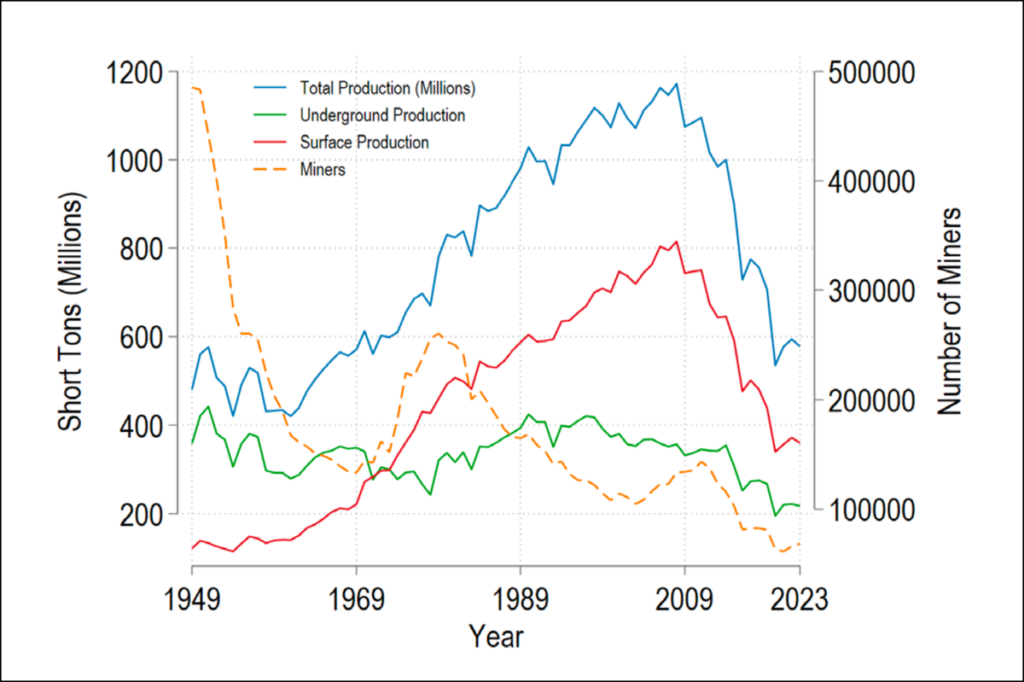
The industry, though, is changing. Total coal production in the United States peaked in 2008, and the number of miners has steadily dropped since then.
Total coal production peaked in the United States in 2008, after which the number of coal miners declined, too. Credit: Thombs et al.,2026, https://doi.org/10.1111/ruso.70034, CC BY 4.0
A new study coauthored by Willis and published in Rural Sociology delves into the effects of this decline on life expectancies across the United States and in Appalachia in particular. The results show that a disappearing coal mining industry has mixed effects on health, highlighting the importance of a “just transition”—a shift away from coal mining and toward clean energy that also prioritizes decent work opportunities for those left without a job.
“How do we balance these two conflicting priorities?” Willis said.
Delving into the Decline
Coal production and consumption are linked to many human health harms, including heart disease, asthma, lung cancer, mental illness, and more. But how those health impacts intersect with the broader economic effects of mining has not been well studied.
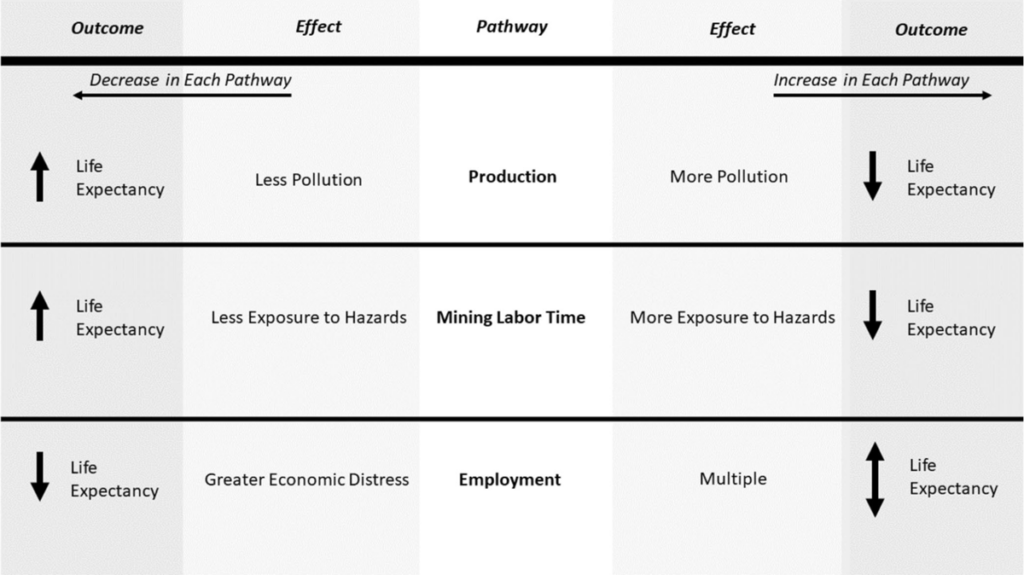
In the new study, the research team analyzed the effects of the declining industry through the lens of the social determinants of health, or how social structures influence health outcomes.
Researchers analyzed how coal mining impacts life expectancies via three pathways: production, mining labor time, and employment. Credit: Thombs et al., 2026, https://doi.org/10.1111/ruso.70034, CC BY 4.0
To study these effects, the team compared coal mining data from the U.S. Energy Information Administration to life expectancy data from the Institute for Health Metrics and Evaluation at the University of Washington from 2012 to 2019. Life expectancy is a metric that can be responsive to subtle changes in the environment, Willis explained. For example, the decommissioning of a coal-fired power plant a few miles away from a community may not affect residents’ day-to-day life but probably affects the scale of life expectancy across the population.
In coal-producing counties across the United States, the average life expectancy was 1.6 years lower than that in non-coal-producing counties. But the declining coal industry had more nuanced impacts on health in Appalachian communities, the researchers found. As coal production fell and miner labor hours decreased, life expectancy increased. But as the number of jobs available decreased, life expectancy decreased, too.
The findings suggest that the employment and associated economic impacts of a waning coal industry harm health. Previous studies documented similar increases in mortality in other regions where the fossil fuel industry has declined. Such research has indicated that these increased mortality rates may be partially driven by “deaths of despair” from drug and alcohol use and suicide related to economic distress. The association of these factors with mortality rates in coal country, the authors suggest, may be an area for future study.
Understanding that coal mining is associated with some positive economic and health effects is “an important perspective for understanding the sector as a whole,” said Lucas Henneman, an environmental engineer at George Mason University who was not involved in the new study. “It’s a really interesting piece of work.”
“This is just a really complex story that hasn’t been told yet—putting health into the context of these just energy transitions,” Willis said.
The complex reality of the coal industry extends beyond Appalachia. Most of the pollution related to the coal industry consists of toxins released when coal is burned, meaning those who bear the brunt of coal’s health impacts may not be located where coal is mined, Henneman said.
In fact, a 2023 study by Henneman and others found that before 2009, a quarter of all air pollution–related deaths of people on Medicare were attributable to coal burning. From 2013 to 2020, that number dropped to 7%, alongside a drop in coal consumption. A complete picture of how the coal industry affects health should also consider how pollution travels beyond coal country—where it’s burned, how it’s transported in the air, and who ultimately breathes it in, he said.
A Just Transition
“The question is how to provide [jobs] in a way that provides the same level of stability, same kind of income benefits, and isn’t too much of a shock to [communities’] way of life or sense of identity.”
The economic activity of a mine, through direct employment as well as businesses reliant on the mine and miners, “chases away other opportunities,” making the mine the economic backbone of the area, said Jonathan Buonocore, an environmental health scientist at Boston University and a coauthor of the new study. The concept of a just transition aims to ensure that employment opportunities in the wake of the coal industry’s decline reach these communities.
“The question is how to provide [jobs] in a way that provides the same level of stability, same kind of income benefits, and isn’t too much of a shock to [communities’] way of life or sense of identity,” Buonocore said.
Citation: van Deelen, G. (2026), As the coal industry fades, life expectancies in coal country shift, Eos, 107, https://doi.org/10.1029/2026EO260134. Published on 30 April 2026.
President Trump is expected to announce that his administration will put about $700 million to bolster coal. Trump is set to use wartime authority under the Defense Prevention Act to dole out $425 million to 13 existing coal plants and $75 million for an export terminal in California. He is also expected to announce $185...

 Login
Login