Initial analyses suggest that the earthquake this morning has the potential to have triggered significant numbers of landslides and areas of liquefaction.
At the time of writing, the impacts of the M=7.8 earthquake that occurred offshore the south coast of Mindanao in the Philippines remain unclear. Initial reports in the local press suggest 15 fatalities so far, but as always it could be the case that there is no information from those areas most seriously impacted.
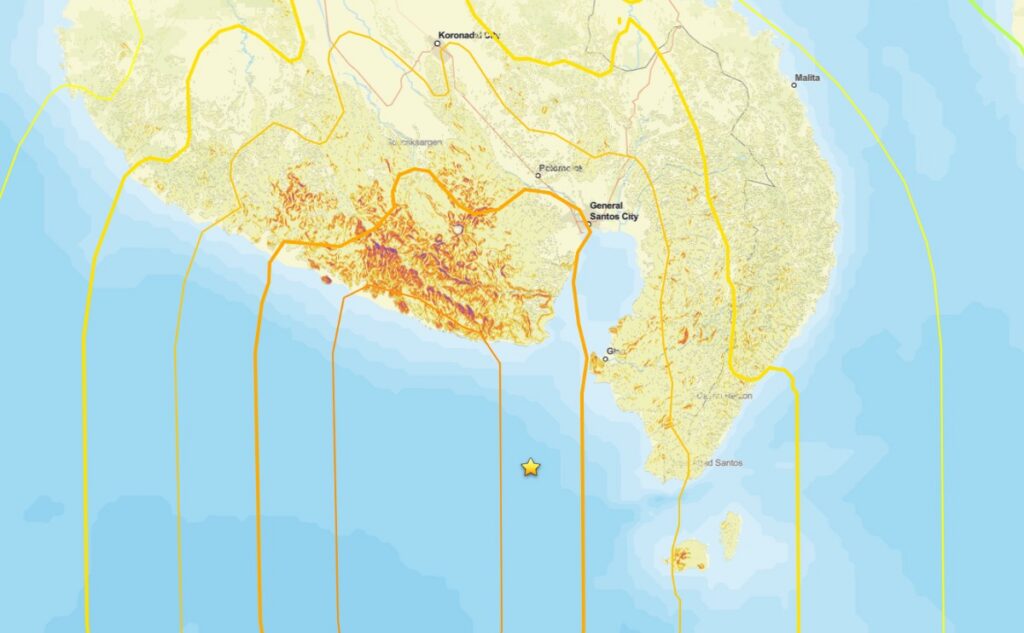
The USGS Pager site is the best source of information about potential landslide impacts, bearing in mind there is a high level of uncertainty. This estimates that the area exposed to landslides is at the high end of the “significant” scale and that the population exposed to landslides lies in the 1,000 to 10,000 people range. This is the Pager landslide hazard map:-
Initial Pager map of landslide hazard from the 8 June 2026 earthquake offshore Mindanao in the Philippines. Source: USGS.
The area with the highest level of landslide hazard is remote and rural, so we may not get good information from this area for a while.
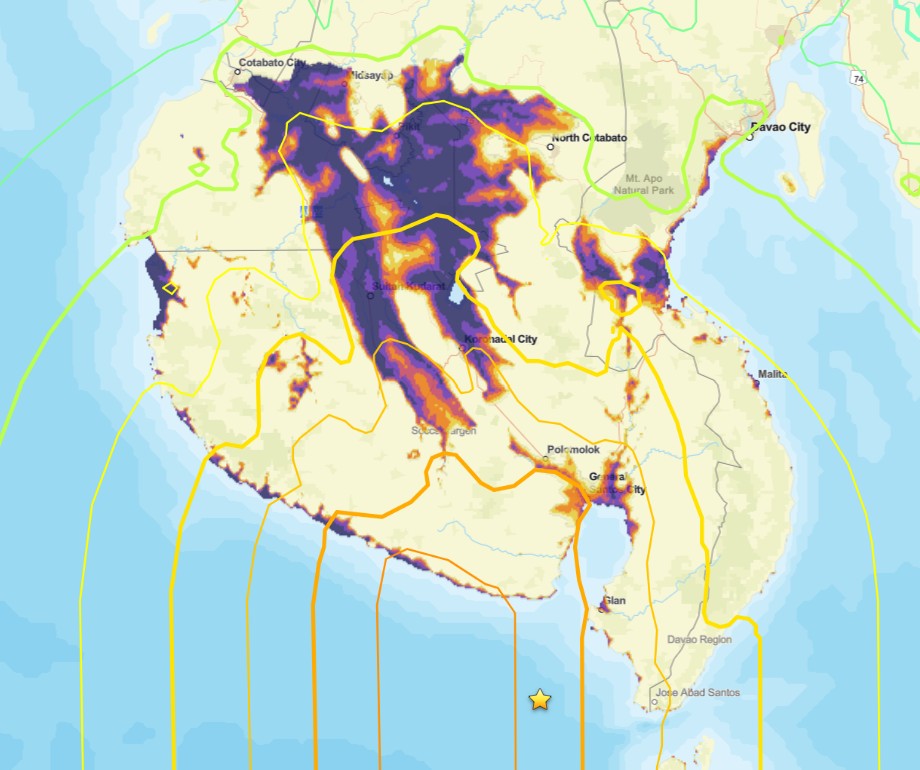
The potential for liquefaction may be even more serious, with a broad swathe having a high level of hazard:-
Initial Pager map of liquefaction hazard from the 8 June 2026 earthquake offshore Mindanao in the Philippines. Source: USGS.
One final point to note is that the Philippines is just entering the typhoon season. Fortunately, Mindanao is sufficiently far south to be away from the main typhoon zone. However, these storms are so large that they can bring very heavy rainfall – see for example Typhoon Bopha in 2012. A similar event this year could have very significant consequences.
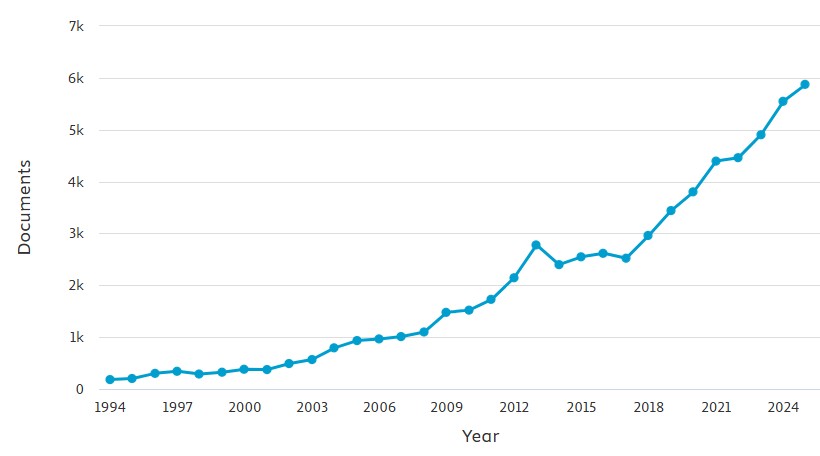
This graph, from Scopus, shows the number of research outputs per year that use the keyword “landslide”. It is simple and unfiltered:-
The number of outputs using the keyword “landslide” in the period 1994 to 2025 inclusive, via Scopus.
The extraordinary growth in productivity is clear – to put it into context, in 1994 the number of outputs was 182; in 2025, it was 5,875, a 32x increase. This is a remarkable improvement in the volume of our understanding of landslides, although it does not say anything about paradigm change.
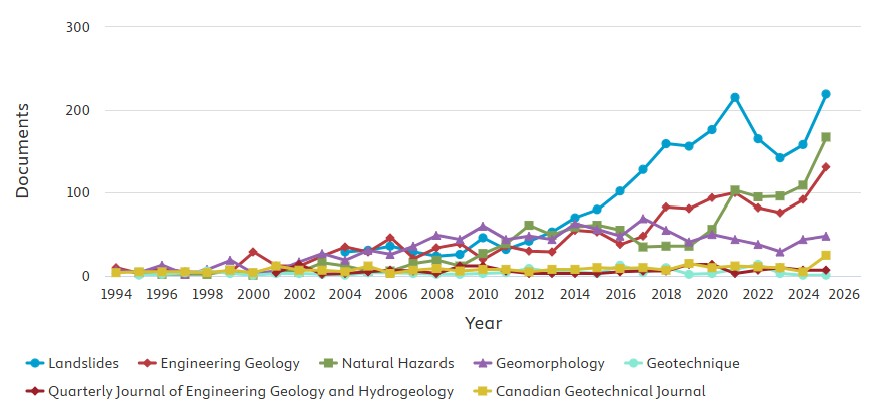
It is interesting to look at some of the key publications for landslide research:-
The number of outputs using the keyword “landslide” for selected key publications in the period 1994 to 2025 inclusive, via Scopus.
The journal Landslides started in 2004 and has shown remarkable growth (although note it still represents a tiny proportion of the total outputs per year). There are also large increases in the journals Natural Hazards and Engineering Geology, and a smaller increase for journal Geomorphology. On the other hand, those journals that traditionally would have been associated with landslide research, such as QJEGH, Canadian Geotechnical Journal and Geotechnique, have remained essentially static over time.
I suspect that this represents a growth in the academic areas researching landslides, and in particular a diversification from geotechnical engineering to a much more broader range of research that encompasses people with an interest in geomorphology, remote sensing, geophysics and natural hazards.
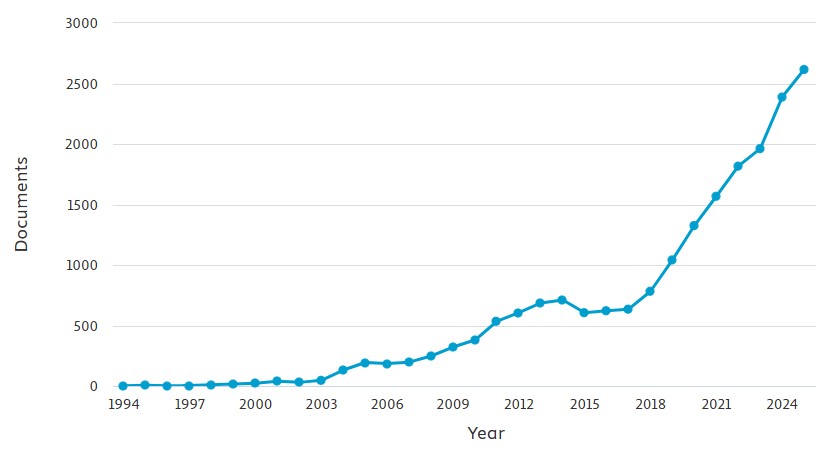
There is one other element that is important here too, which is the growth of landslide research in China. This graph shows the same data as above but with China as the national affiliation of one or more author:-
The number of outputs using the keyword “landslide” and with an affiliation from China in the period 1994 to 2025 inclusive, via Scopus.
The growth in landslide research productivity in China is explosive over the last ten years, and with 2,616 outputs in 2025, Chinese affiliated authors are now producing over 55% of the world’s landslide research. There is no doubt as to where the centre of gravity now lies in landslide science.
Rep. Joe Morelle, a Democrat from upstate New York, is a workhorse who is preparing for the upcoming midterm election by protecting the outcome from partisan subversion and ensuring the House majority is determined by the Committee on House Administration.
Gooseworx’s viral YouTube hit ‘The Amazing Digital Circus: The Last Act’ concludes the series with a shocking finale, exposing the secret of Jax (Michael Kovach).
The Juniper Events and sponsor groups will have a 24 hour early access to the event
(9am on the 4th of June – 9am on the 5th of June)
You can join the Juniper Events Group (free to join), using the following link pasted into your browser: secondlife:///app/group/8cac56c3-49a0-012c-2c35-7836985af398/about
This cask-strength whisky aged in brandy casks and is part of an acclaimed series, known for its full-flavored offerings. Here's what it tastes like and where to buy it.
 Login
Login