European champions Spain were held to a shock 0-0 draw by tiny World Cup debutants Cape Verde on Monday.
Regarded as one of the strong pre-tournament favourites, Spain had been expected to cruise past Cape Verde in their Group H opener in Atlanta.
But despite enjoying 74 per cent possession and laying siege to the Cape Verde goal, the 2010 world champions were unable to find a breakthrough against the underdogs from the volcanic archipelago of just 525,000 people, who are ranked as 2000-1 outsid
European champions Spain were held to a shock 0-0 draw by tiny World Cup debutants Cape Verde on Monday.
Regarded as one of the strong pre-tournament favourites, Spain had been expected to cruise past Cape Verde in their Group H opener in Atlanta.
But despite enjoying 74 per cent possession and laying siege to the Cape Verde goal, the 2010 world champions were unable to find a breakthrough against the underdogs from the volcanic archipelago of just 525,000 people, who are ranked as 2000-1 outsiders to win the World Cup by several betting websites.
Cape Verde’s Vozinha applauds fans after the FIFA World Cup 2026 Group H match between Spain and Cabo Verde at Atlanta Stadium on June 15, 2026 in Atlanta, Georgia, the US. — AFP
Not even the introduction of Barcelona superstar Lamine Yamal off the bench could engineer a goal for Luis de la Fuente’s men.
Cape Verde’s players and supporters, meanwhile, celebrated wildly after securing an improbable point in what was their first-ever World Cup match.
The underdogs, nicknamed the Blue Sharks, had never qualified for the World Cup, but were boosted in their bid to qualify for the finals after FIFA’s expansion of the tournament to 48 teams.
US President Donald Trump on Friday warned Taiwan against declaring formal independence after concluding his visit to China, whose leader Xi Jinping had pressed him not to support the self-ruling island.
US President Donald Trump and Chinese President Xi Jinping tour the Hall of Prayer of Good Harvest at the Temple of Heaven in Beijing on May 14, 2026. Photo: The White House, via Flickr.
Trump ended the state visit claiming to have made “fantastic” trade deals, although the details were v
US President Donald Trump on Friday warned Taiwan against declaring formal independence after concluding his visit to China, whose leader Xi Jinping had pressed him not to support the self-ruling island.
US President Donald Trump and Chinese President Xi Jinping tour the Hall of Prayer of Good Harvest at the Temple of Heaven in Beijing on May 14, 2026. Photo: The White House, via Flickr.
Trump ended the state visit claiming to have made “fantastic” trade deals, although the details were vague, and he did not appear to secure any breakthrough with China over his stalemated war on Iran.
Trump invited Xi for a reciprocal visit to Washington in September, signalling both sides will likely seek stability in the often turbulent relationship between the world’s two largest economies.
On a key issue for Xi, Trump made clear he opposed a declaration of independence by Taiwan and appeared to question why the United States would defend the island in case of attack.
“I’m not looking to have somebody go independent. And, you know, we’re supposed to travel 9,500 miles to fight a war. I’m not looking for that,” he told Fox News’ “Special Report with Bret Baier.”
“I want them to cool down. I want China to cool down,” Trump said.
“We’re not looking to have wars, and if you kept it the way it is, I think China’s going to be OK with that.”
The United States recognizes only Beijing and does not support formal independence by Taiwan, but historically has stopped short of explicitly saying it opposes independence.
Under US law, the United States is required to provide weapons to Taiwan for its defence, but it has been ambiguous on whether US forces would come to the island’s aid.
Xi had begun the summit with a warning on Taiwan, whose President Lai Ching-te considers the island already independent, making a declaration unnecessary.
Xi told Trump that missteps on the sensitive issue could cause “conflict”.
Referring to comments by Secretary of State Marco Rubio, who said US policy toward Taipei was unchanged, Taiwan’s foreign ministry thanked the United States for showing “it supports and values Taiwan Strait peace and stability”.
No details on ‘fantastic’ deals
On Friday, Boeing confirmed that China had made an “initial commitment” to buy 200 aircraft, a deal previously announced by Trump. The company said more orders could follow.
Trump also said Beijing would buy American oil and soybeans.
US President Donald Trump and Chinese President Xi Jinping at Zhongnanhai in Beijing on May 15, 2026,. Photo: The White House, via Flickr.
“We’ve made some fantastic trade deals, great for both countries,” he said after a walk with Xi in the gardens of Zhongnanhai, a central leadership compound next to Beijing’s Forbidden City.
“We’ve settled a lot of different problems that other people wouldn’t have been able to solve,” Trump added, without providing specifics.
Xi promised to send Trump rose seeds for the White House Rose Garden and said it was a “milestone visit”.
But beyond Boeing, there were no other formal announcements from companies or from China on trade deals.
The reserve on the Chinese side echoes the tone of the summit as a whole, where Trump’s overtures to Xi — whom he described as a “great leader” and “friend” — were met with a more muted response.
“Trump got the optics he was looking for and the Chinese were happy to give them to him,” said Jacob Stokes, a senior fellow at the Centre for a New American Security.
Little on Iran
Trump had delayed the trip once due to the war in Iran, which has rebuffed his appeals for a peace agreement and retaliated by exerting control over the key Strait of Hormuz, sending global oil prices soaring.
US President Donald Trump and Chinese President Xi Jinping at Zhongnanhai in Beijing on May 15, 2026. Photo: The White House, via Flickr.
Trump said Xi had assured him that China was not preparing military aid to Iran. Israel has alleged that Beijing has provided key missile technology to Tehran.
The Chinese foreign ministry on Friday released a statement on Iran saying “shipping lanes should be reopened as soon as possible”.
Trump also acknowledged that he could not persuade Xi to free Jimmy Lai, the imprisoned Hong Kong pro-democracy media tycoon whose cause is broadly backed in Washington.
“He told me, Jimmy Lai is a tough one for him to do,” Trump told reporters.
Bonnie Glaser, managing director of the German Marshall Fund’s Indo-Pacific program, noted that Trump had already sounded half-hearted in his public comments on Lai.
“My sense is that the Chinese see that this is not a top priority for the United States,” she said.
“What Trump seems to want most is purchases of American products — that appears to be his highest priority.”
The two leaders had been expected to discuss extending the one-year tariff truce that paused their frenetic 2025 trade war, struck during their last meeting in October.
But Trump told reporters on the way home that it “wasn’t brought up”.
By Catherine Lai
Hong Kong resident Lisa Lau put on a costume drama as she settled on the bed that occupies much of her tiny apartment, trying to take her mind off a looming eviction.
Lisa Lau, 48, sits on her bed in her subdivided housing unit in Kowloon on April 30, 2026. Photo: Peter Parks/AFP.
Subdivided flats like Lau’s three-square-metre (32-square-feet) home — made by splitting up an apartment into smaller units — are being phased out after a law to regulate them came into effec
Hong Kong resident Lisa Lau put on a costume drama as she settled on the bed that occupies much of her tiny apartment, trying to take her mind off a looming eviction.
Lisa Lau, 48, sits on her bed in her subdivided housing unit in Kowloon on April 30, 2026. Photo: Peter Parks/AFP.
Subdivided flats like Lau’s three-square-metre (32-square-feet) home — made by splitting up an apartment into smaller units — are being phased out after a law to regulate them came into effect in March.
Chinese President Xi Jinping has ordered the wealthy finance hub to resolve housing woes that are the result of decades of pervasive inequality, an acute housing shortage and eye-watering rents.
The Hong Kong government has given owners who register under the new system until 2030 to renovate their subdivided flats, but some landlords have already issued eviction notices to their tenants.
“I’ll stay here day by day,” Lau, a 48-year-old welfare recipient who had received an eviction notice months ago, told AFP.
“I don’t know (where to go),” said Lau, who lives on the equivalent of about US$930 a month, of which US$330 go for rent.
“I’m scratching my head.”
Infographic showing the layout of a subdivided housing unit in Hong Kong. Graphic: John Saeki/Nicholas Shearman/AFP.
The new rules ban flats smaller than eight square metres (86 square feet) and mandate safety and hygiene standards, such as having at least one openable window, a sink and a toilet in an enclosed space.
Authorities estimate that more than 220,000 people in the city of 7.5 million live in so-called “shoebox” flats, around one-third of which need major renovation.
Lau’s cubicle is one of nine in a single unit, separated by thin wooden dividers, in a 60-year-old building in one of Hong Kong’s poorest neighbourhoods, Sham Shui Po.
With no kitchen, she makes soup or noodles in a rice cooker placed on the bed.
She uses a shared toilet and shower, and has taped a foam board across the bottom of her doorway to keep out rats and cockroaches.
Unaffordable housing
Despite the cramped conditions, Lau is reluctant to leave a familiar area where she has built a social network, and hopes her application for transitional housing nearby would be approved.
“As long as the landlord doesn’t come (to evict residents), we are so at peace, we are so comfortable,” she said.
The Housing Bureau said over 100 households had already moved out of Lau’s building, and that it was helping the 40 that are left to find suitable accommodation.
Sze Lai-shan, deputy director of the Society for Community Organisation (SoCO). File photo: Kyle Lam/HKFP.
The Society for Community Organisation, an NGO that works with underprivileged groups, said the reform could help alleviate some of the worst living environments in Hong Kong.
But more government housing is needed, especially in the central areas, said Sze Lai-shan, the group’s deputy director.
“Don’t expect these people who live in very small flats to move into the new basic housing units. They won’t be able to afford it,” she said.
“A lot of the poorest people will be very dependent on the government to resettle them.”
The charity knows of around 300 households threatened with forcible eviction from subdivided flats, with more expected to follow, according to Sze — far more than the 35 notices the government said it had received.
Some residents have moved into public or transitional housing, while others have moved into other substandard flats as a temporary measure, Sze added.
‘Coffin homes’
Liu Xiaoli, who faces eviction from her subdivided flat, works two part-time jobs as a cook and cleaner to make ends meet after her divorce, and supports her daughter and granddaughter in mainland China.
Liu Xiaoli, 63, looks out of her subdivided housing unit in Kowloon on April 30, 2026. Photo: Peter Parks/AFP.
“If the rent here or in other places goes up, I really can’t afford it,” the 63 year-old told AFP, adding that she was unable to find alternate accommodation nearby.
“I couldn’t find any (apartments) that meet the government’s requirements,” she said.
“Right now, I’m just delaying as much as I can.”
In response to AFP’s inquiry, the government said it had “significantly increased public housing supply” with an aim to produce around 196,000 units in the next five years, and sped up the process for residents on the waiting list for public housing.
These measures would contribute to “reduced demand” for subdivided units, keeping rents at bay, a Housing Bureau spokesperson said in a statement.
The new rules do not apply to notorious “coffin homes”, cubicles stacked on top of each other like bunk beds in shabby dormitories.
Wan Hon-cheung, 64, has been living in a plywood box about the size of a single bed for the last 10 years, and hopes the government will improve conditions for residents like him as well.
He often gets bitten by bedbugs and walks with a cane, making climbing up and down from his bed difficult.
“For us lower classes… this is reality, there’s nothing to complain about.”
By Kang Jin-kyu
A Chinese dissident who has long been a thorn in Beijing’s side has escaped to South Korea on a rubber boat, his lawyer confirmed on Wednesday, after repeated attempts to flee China.
Chinese dissident Dong Guangping. Photo: Front Line Defenders.
Dong Guangping, a former policeman who was imprisoned for his activism, was found by South Korean authorities on Monday night drifting off the country’s west coast on a 3.3-metre (11-foot) rubber boat with a 9.9-horsepower engin
A Chinese dissident who has long been a thorn in Beijing’s side has escaped to South Korea on a rubber boat, his lawyer confirmed on Wednesday, after repeated attempts to flee China.
Chinese dissident Dong Guangping. Photo: Front Line Defenders.
Dong Guangping, a former policeman who was imprisoned for his activism, was found by South Korean authorities on Monday night drifting off the country’s west coast on a 3.3-metre (11-foot) rubber boat with a 9.9-horsepower engine, according to police.
He was taken to shore for questioning on suspicion of violating immigration laws.
The man’s lawyer, Kim Joo-kwang, confirmed his identity to AFP.
Dong, 68, is known for his opposition to the Chinese Communist Party (CCP) and his advocacy for political reform and human rights.
He was dismissed from his work as a policeman after signing a petition a decade after Beijing’s 1989 Tiananmen Square crackdown, according to US-based advocacy group Human Rights in China.
He later spent about three years in prison from 2001 for “inciting subversion of state power”, United Nations experts said, and was detained again in 2014 over Tiananmen-related activities.
Dong fled to Thailand with his family, who later resettled in Canada as refugees, but Thai authorities handed him over to Chinese police in 2015 despite his UN-recognised refugee status.
He was released from prison after completing his sentence in 2019.
But faced with constant police surveillance, harassment and a lack of access to housing, work and financial resources, he decided to flee again in an attempt to reunite with his family, according to a UN report from 2022.
Before arriving in South Korea, Dong made several failed attempts to flee China.
In 2019, he tried to swim to the Kinmen archipelago, a Taiwanese territory, but nearly drowned at sea. In 2020, he crossed into Vietnam, but was detained by Vietnamese police.
Dong’s attorney told AFP his client’s current situation is “highly likely to be a political asylum case”.
Full protection
Chinese-Canadian journalist and human rights activist Sheng Xue, who described Dong as a friend, said in a post on X Wednesday that Dong set off from Weihai, in China’s Shandong province, after “meticulous inspection and preparation”.
Chinese-Canadian human rights activist Sheng Xue. Photo: Sheng Xue, via X.
“Last night, I spoke with him on the phone… He hadn’t slept for over fifty hours and had been at sea for more than thirty hours,” she said.
His rubber boat was spotted by the captain of a fishing boat at 9:30 pm (1230 GMT) on Monday, about 18 kilometres (11 miles) northwest of Taean County, South Chungcheong province, who then alerted the police, according to Sheng.
The Coast Guard dispatched a patrol vessel that arrived at the scene about an hour later, and Dong was detained, she added.
South Korea has granted political asylum to a relatively small number of applicants since it began formally processing refugee claims in 1994, with an overall recognition rate in the low single digits despite tens of thousands of applications.
Critics say the low approval rate reflects strict screening and lengthy procedures, while the government maintains that decisions are made on a case-by-case basis and take security considerations into account.
Seoul’s foreign ministry did not respond to a request for comment.
The opposition People Power Party has called on the government to offer Dong “full protection”.
“It should take swift humanitarian measures to ensure that he can safely travel to Canada, where his family is anxiously awaiting him,” party spokesman Choo Hyun-chul said in a statement to AFP.
“This is a matter of a fundamental responsibility as a liberal democratic state.”
By Matthew Walsh
Japan’s defence minister took a veiled swipe at China on Sunday, pledging to keep strengthening the military despite Beijing’s criticism of Tokyo’s increasingly muscular security stance.
Japan’s Defence Minister Shinjiro Koizumi delivers a speech during the fifth plenary session of the 23rd Shangri-La Dialogue summit in Singapore on May 31, 2026. Photo: Mohd Rasfan/AFP.
Under Prime Minister Sanae Takaichi, Japan has quickened its pivot towards a more proactive defence
Japan’s defence minister took a veiled swipe at China on Sunday, pledging to keep strengthening the military despite Beijing’s criticism of Tokyo’s increasingly muscular security stance.
Japan’s Defence Minister Shinjiro Koizumi delivers a speech during the fifth plenary session of the 23rd Shangri-La Dialogue summit in Singapore on May 31, 2026. Photo: Mohd Rasfan/AFP.
Under Prime Minister Sanae Takaichi, Japan has quickened its pivot towards a more proactive defence policy, further shaking off — with US encouragement — its pacifist outlook in place since the end of World War II.
The change has drawn frequent rebukes from Beijing, which has accused Tokyo of following a reckless policy of “new militarism” that could destabilise the region.
Japanese Defence Minister Shinjiro Koizumi hit back on Sunday, saying “nothing could be further from the truth”.
“Think about it. There is a country that has a huge arsenal of nuclear weapons and strategic bombers,” Koizumi said at the annual Shangri-La Dialogue in Singapore.
“Japan has neither of such weapons. And yet, Japan is labelled (as) ‘new militarism’. Isn’t it strange?” he said, without mentioning China by name.
China is thought to possess hundreds of nuclear warheads and has been rapidly developing its military in recent years.
A diplomatic spat between the Asian rivals has been rumbling since Takaichi suggested in November that Japan might intervene militarily if China were to attempt to seize Taiwan, the self-ruled island that Beijing claims is part of its territory.
Japanese Prime Minister Sanae Takaichi attends an event on May 29, 2026. Photo: Sanae Takaichi, via X.
Koizumi said that China was expanding its military capabilities “without sufficient transparency” and that its military activities were “a matter of serious concern for Japan”.
Tokyo would “steadily build up its defence capabilities and make continuous updates with a high degree of transparency”, including in the fields of artificial intelligence, uncrewed systems as well as cyber and space defence, he said.
“Japan’s past as a peace-loving nation has been valued by the region and by international community. This fact will not be shaken by false claims, because it is a fact,” he said.
Maritime disputes
In a meeting with his Philippine counterpart Gilberto Teodoro, the two countries confirmed that Japan would aim to transfer Abukuma-class destroyers and TC-90 aircraft to the Southeast Asian nation during Japan’s fiscal year 2027, a Philippine statement said.
Manila has been eyeing the Abukuma-class vessels — which are being retired by Japan — for some time, with the military sending a contingent to examine them in 2025.
The countries have been deepening defence ties in the shadow of China’s naval ambitions, announcing that they will discuss intelligence sharing and open maritime border talks condemned by Beijing as an “illegal” violation of its expansive territorial claims.
Teodoro singled out Beijing’s activities in the South China Sea for criticism, saying Manila “will not sacrifice our territorial integrity and sovereignty because our constitution does not allow us”.
Philippines’ Secretary of National Defence Gilberto Teodoro delivers a speech as he attends the sixth plenary session of the 23rd Shangri-La Dialogue summit in Singapore on May 31, 2026. Photo: The International Institute for Strategic Studies, via Flickr.
“To do so would be to subvert the popular, democratic and free mandate that the people gave our political leaders, unlike some autocratic systems where the mandate comes from above, dictated down.”
Beijing claims almost the entire South China Sea despite an international ruling that its assertion has no legal basis.
As Teodoro spoke, China’s People’s Liberation Army Southern Theater Command issued a statement online saying it had “conducted combat readiness patrols” in the waters and airspace around Scarborough Shoal, the site of a years-long territorial dispute with the Philippines.
The patrols “serve as an effective countermeasure to cope with all sorts of rights-violation and provocative acts” around the shoal, “an inherent part of China’s territory”, the statement said.
The Shangri-La Dialogue is Asia’s top defence forum, bringing together security officials and experts from about 45 countries.
In contrast to Japan — and its ally the United States — China has sent a watered-down delegation that does not include its defence minister, Dong Jun, for the second year running.
Koizumi said he was “feeling sad that we were unable to have the opportunity to have a meeting this time”.
Myanmar’s coup-commander turned President Min Aung Hlaing touched down in China on Monday for talks with Xi Jinping, his first visit since taking over as civilian leader after Beijing-backed elections rejected by democracy monitors.
Myanmar’s President Min Aung Hlaing (left) shakes hands with Chinese President Xi Jinping on May 9, 2025, on the sidelines of Russia’s 80th Victory Day Parade in Moscow. Photo: MyanmarGov.
Min Aung Hlaing is hoping to expand trade and security ties with China,
Myanmar’s coup-commander turned President Min Aung Hlaing touched down in China on Monday for talks with Xi Jinping, his first visit since taking over as civilian leader after Beijing-backed elections rejected by democracy monitors.
Myanmar’s President Min Aung Hlaing (left) shakes hands with Chinese President Xi Jinping on May 9, 2025, on the sidelines of Russia’s 80th Victory Day Parade in Moscow. Photo: MyanmarGov.
Min Aung Hlaing is hoping to expand trade and security ties with China, a rare enduring partner for Myanmar after his 2021 coup ousted the elected government of Aung San Suu Kyi and diplomatically isolated the country on the world stage.
Relations have frayed in recent years over mushrooming internet scam centres along the countries’ shared border areas which both enlist and target Chinese citizens in lucrative cryptocurrency fraud, analysts say.
China has emerged as a key power-broker in the civil war sparked by the coup — variously backing the military, rebels and truces between them according to its security and economic interests, analysts say.
The one-party state also vocally backed recent polls excluding Suu Kyi’s party, punishing dissent with prison time and returning a walk-over win for pro-military MPs — who elected Min Aung Hlaing as president.
Democracy watchdogs described the transition as a charade to launder the reputation of the leadership, campaigning to recover from the pariah status many nations branded it with since the putsch.
Min Aung Hlaing landed in China to a red carpet welcome, according to images shared by his office, and spent the first hours of his five-day trip touring Beijing Aerospace City — the centre of China’s space programme.
Supply and demand
During his half-decade ruling Myanmar as military chief, Min Aung Hlaing made trips to China only for regional summits — meeting Beijing officials on the sidelines.
China hopes his first visit as civilian president will deepen “comprehensive strategic cooperation”, foreign ministry spokesman Lin Jian told reporters on Friday.
In addition to Xi, Min Aung Hlaing is also set to meet Chinese Premier Li Qiang and top legislator Zhao Leji.
Chinese Premier Li Qiang at the Annual Meeting of the New Champions 2023 in Tianjin, China, on June 27, 2023. Photo: World Economic Forum, via Flickr.
Beijing is a key provider of materiel to the Myanmar military and has also brokered a pair of landmark truces with two of the most powerful rebel factions that once challenged it in the borderlands with China.
While Myanmar has been massively impoverished by the civil war, it has also emerged as a major global supplier of mined rare earth minerals — vital for China’s production of renewable energy technology.
The first bill announced by Myanmar’s new crop of lawmakers proposes the death penalty for those who detain or violently coerce victims into working in scam centres, signalling the country’s intention to crack down.
Attention has also been drawn to the bilateral relationship between Myanmar and China by Beijing’s detention of a US scholar who studies Myanmar and stands accused of spying.
Min Zin, founder of the Institute for Strategy and Policy Myanmar (ISP-M), “has been subjected to criminal compulsory measures”, foreign ministry spokesman Lin told reporters on Friday.
Authorities are holding him “on suspicion of engaging in espionage activities that endanger China’s national security”, Lin said.
Min Zin was detained in the capital of China’s border province of Yunnan, a person with professional ties to the ISP-M told AFP anonymously because of the case’s sensitivity.
JERUSALEM: Somaliland’s de facto leader Abdirahman Mohamed Abdullahi met his Israeli counterpart on Sunday in Jerusalem in his first-ever state visit, which comes months after Israel officially recognised the breakaway African state.
In December, Israel became the first country to recognise the independence of Somaliland since it declared its autonomy from Somalia in 1991 following a civil war.
“The visit carries special significance,” said Abdullahi, according to a statement issued by the offic
JERUSALEM: Somaliland’s de facto leader Abdirahman Mohamed Abdullahi met his Israeli counterpart on Sunday in Jerusalem in his first-ever state visit, which comes months after Israel officially recognised the breakaway African state.
In December, Israel became the first country to recognise the independence of Somaliland since it declared its autonomy from Somalia in 1991 following a civil war.
“The visit carries special significance,” said Abdullahi, according to a statement issued by the office of Israeli President Isaac Herzog.
“It is the first state visit by a president of the Republic of Somaliland to another country, and we are deeply appreciative that the State of Israel has chosen to receive us with such an honour on this historic occasion,” Abdullahi said.
“Somaliland has been talking, has been reaching out to the world leaders for the last 35 years. They were asking only one question: to see us. Only one country desired to see us and recognise Somaliland, and that’s the government of Israel and its people.”
Somaliland enjoys a strategic position on the Gulf of Aden and has its own currency, passport and army, but has struggled to win international recognition amid concerns in many capitals that this would provoke Somalia and encourage other separatist movements in Africa.
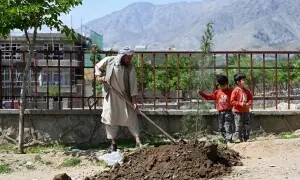
Under the shade of recently planted poplars in Afghanistan, village leader Ghulam Ali Poya is proud to see residents rediscover the value of trees after years of wartime deforestation.
“There were forests of pistachio trees,” he told AFP, gesturing to the bare mountains that surround Char Bagh’s mud homes.
“During the conflicts and the civil war, they were destroyed; no one could stop the logging.” From the 1979 Soviet invasion until the fall of the first Taliban government in the early 2000s, “
Under the shade of recently planted poplars in Afghanistan, village leader Ghulam Ali Poya is proud to see residents rediscover the value of trees after years of wartime deforestation.
“There were forests of pistachio trees,” he told AFP, gesturing to the bare mountains that surround Char Bagh’s mud homes.
“During the conflicts and the civil war, they were destroyed; no one could stop the logging.” From the 1979 Soviet invasion until the fall of the first Taliban government in the early 2000s, “around 50 per cent of Afghanistan’s forest cover was lost”, said Mohammad Nasir Shalizi, a researcher at North Carolina State University.
In eastern Afghanistan, timber smuggling to Pakistan drove massive logging, while in the more arid central and northern “pistachio belt”, residents used wood for heating and cooking.
This photograph taken on May 18, 2026 shows Afghan farmer Bas Begum Ahmadi (R) with her husband Abdul Samad Ahmadi standing next to paulownia trees at her family-owned plot. —AFP
But in the last two decades, deforestation has slowed “substantially”, Shalizi said.
Forest cover has increased 35pc nationwide since 2011, according to the National Statistics and Information Authority, though just 2.5pc of Afghanistan was forested in 2025 and cover is still shrinking in some areas.
But experts say communities are working to improve forest cover. Both the US-backed government, in place until 2021, and the current Taliban administration have supported tree-planting campaigns.
In Char Bagh, the Aga Khan Development Network funded a kilometre-square grove which includes poplars, paulownias, pomegranates and persimmons.
This photograph taken on May 11, 2026 shows pine seedlings at a nursery in Paghman district, Kabul province. Under the shade of recently planted poplars in northeastern Afghanistan. —AFP
‘A model’
The land belongs to farmer Bas Begum Ahmadi, who hopes to sell fruit and homemade jam, but it is also open to the community of 350 families.
“Having these trees makes me feel good; my environment is green, and we breathe fresh air,” said the 45-year-old, who tends the trees with her husband to support their four children.
This photograph taken on April 20, 2026 shows Afghan municipality workers and residents planting trees next to a park in Charikar district, Parwan province. —AFP
This “micro-forest” follows Japanese botanist Akira Miyawaki’s principles: dense planting of mostly local species of varying heights.
It is noticeably cooler than the surrounding bare fields and offers twigs for stove fuel and leaves that feed livestock.
Micro-forests “restore ecosystems, improve soil fertility, help climate resilience, and support community livelihood,” said Parisa Malikzada, Afghanistan agriculture coordinator for the organisation, which has planted 500 micro-forests in seven provinces.
Poya said the forest, next to a river, prevents soil erosion during flooding and offers “a model for people”.
This photograph taken on May 18, 2026 shows Afghan farmer Abdul Samad Ahmadi examining a paulownia tree at his family-owned plot, which supports a micro-forest in the Char Bagh area of Doshi district, Baghlan province. —AFP
“Everyone comes to have a look, and they’d like to have one too,” he told AFP.
In Afghanistan, where many places are hard to reach and the state has limited funds, community-based forest management is the most effective approach to reforestation, experts told AFP.
Penalties for tree cutting
Afghan authorities have set a goal of planting 200 million trees between 2023 and 2030, relying partly on NGOs, the United Nations and the private sector.
“Last year, the target was eight million, but in the end, 17 million were planted,” said Rohullah Amin, head of climate change at the General Environmental Protection Agency, where he has worked for more than a decade.
This year’s goal is nine million.
This photograph taken on May 11, 2026 shows deodar cedar seedlings at a nursery in Paghman district, Kabul province. Under the shade of recently planted poplars in northeastern Afghanistan. —AFP
Challenges include selecting native, climate-adapted species, water scarcity, and livestock damaging saplings.
Some forests have struggled with “lack of care or water”, Amin acknowledged, including one site where drought killed 70pc of the planted pines.
In some places, tribal councils protect forests and penalise residents who damage them. Elsewhere, “forest management associations” run by elected villagers and farmers have been set up.
The UN Food and Agriculture Organisation (FAO) has helped them plant five million trees since 2019, according to its climate change chief, Muhammad Safi.
Birds coming back
The government created nurseries to grow local species in places such as Paghman on state land on Kabul’s outskirts.
Head gardener Mahmood Khwajazada carefully tends almond, pine nut and walnut trees, as well as deodar cedars, for distribution nationwide.
“Our Prophet said, ’Even if you have only one day left, plant a tree,” he told AFP.
This photograph taken on May 11, 2026 shows Afghan farmers tending to a nursery in Paghman district, Kabul province. Under the shade of recently planted poplars in northeastern Afghanistan. —AFP
In Charikar, northeastern Afghanistan, where thousands of saplings were planted this year along streets, in parks and on hillsides, the municipality sees “a change” in people’s attitude towards trees.
Ahmad Khalid Sabiri, a resident, said he volunteered to help plant “because it’s beneficial for the environment”.
Experts said more work is needed to protect the remaining old growth, as well as planting in forests rather than just in urban areas.
Spearhead Shaheen Shah Afridi and Shadab Khan starred in Pakistan’s four-wicket win in their decisive third and final one-day international against Australia in Lahore on Thursday.
Shaheen grabbed 3-30 to bundle Australia out for 157 before Shadab added a fighting 29 not out to his two wickets, helping Pakistan to their winning target in 41.5 overs.
That gave Pakistan a 2-1 series win — their third successive ODI series victory over Australia – after they won the first match by five wickets in R
Spearhead Shaheen Shah Afridi and Shadab Khan starred in Pakistan’s four-wicket win in their decisive third and final one-day international against Australia in Lahore on Thursday.
Shaheen grabbed 3-30 to bundle Australia out for 157 before Shadab added a fighting 29 not out to his two wickets, helping Pakistan to their winning target in 41.5 overs.
That gave Pakistan a 2-1 series win — their third successive ODI series victory over Australia – after they won the first match by five wickets in Rawalpindi.
Left-arm spinner Matthew Kuhnemann’s career best 3-38 — including Babar Azam’s wicket for 40 — had given the visitors some hope of an unlikely win.
At 112-6, Pakistan were in a spot of bother but Shadab found an able partner in Abdul Samad as the duo added a match-winning 49 runs for the unbroken seventh wicket stand.
Shadab’s second boundary sealed the win, while Samad’s 18 not out included one boundary.
Shaheen praised a complete team effort.
“All bowlers executed plans well to keep Australia down to 157,” said Shaheen. “The conditions were tough for the batters but the players put in a great effort.
“I think it was a complete team effort throughout the series.”
Australian captain Josh Inglis praised his team.
“I thought the bowlers and the fielding group made a great effort to put us in a position to potentially win the game, but it wasn’t to be in the end,” he said.
“We have some young and inexperienced guys so it’s a great learning experience for them.”
Earlier, Shaheen was ably supported by Abrar Ahmed (2-19) and Shadab (2-28) as Australia’s innings folded in 42 overs after they won the toss and batted.
Spinners Abrar and Shadab built on Shaheen’s early strikes as Pakistan made a strong comeback after a disappointing loss in the second game.
Inglis top-scored with a 71-ball 65 which included eight boundaries and a six, with Marnus Labuschagne and Alex Carey scoring 19 each and Adam Zampa making 10.
Shaheen had Matthew Short caught off the second ball of the match before Inglis added 46 for the second wicket with Labuschagne and another 52 for the third with Carey.
But Australia lost their last seven wickets for a meagre 38 runs with two run outs also hurting their innings.
Australia won the toss and chose to bat against Pakistan at Lahore’s Gaddafi Stadium.
On Tuesday, an understrength Australia shocked Pakistan by 41 runs in the second ODI in Lahore, levelling the three-match series 1-1, with fast bowler Nathan Ellis taking a career-best four-wicket haul.
Teams
Pakistan: Sahibzada Farhan, Maaz Sadaqat, Babar Azam, Ghazi Ghori (wicketkeeper), Salman Ali Agha, Abdul Samad, Shadab Khan, Arafat Minhas, Shaheen Shah Afridi, Haris Rauf, Abrar Ahmed.
Australia: Josh Inglis, Matt Short, Marnus Labuschagne, Alex Carey, Cameron Green, Matt Renshaw, Cooper Connolly, Oliver Peake, Matthew Kuhnemann, Nathan Ellis, Adam Zampa.
At least 21 people, including 18 foreign nationals, were killed in a fire at a hotel in New Delhi on Wednesday, police and broadcaster CNN-News18 said, in one of the worst such incidents in the national capital since 2022. The dead included people from Bangladesh, Nigeria, Mozambique and Liberia, the broadcaster said.
Building fires are common in India due to a lack of firefighting equipment and routine disregard for safety regulations.
The fire broke out in the morning at Flourish Stay, a bed-a
At least 21 people, including 18 foreign nationals, were killed in a fire at a hotel in New Delhi on Wednesday, police and broadcaster CNN-News18 said, in one of the worst such incidents in the national capital since 2022. The dead included people from Bangladesh, Nigeria, Mozambique and Liberia, the broadcaster said.
Building fires are common in India due to a lack of firefighting equipment and routine disregard for safety regulations.
The fire broke out in the morning at Flourish Stay, a bed-and-breakfast in a congested neighbourhood in the south of the city, Delhi Police said in a statement.
“It is with profound sorrow that 21 persons have been declared dead in this tragic incident,” the force said.
Reuters could not immediately confirm the nationalities of the victims. Several people had jumped out of the burning building in South Delhi’s Malviya Nagar to escape the flames, witnesses said, with residents dragging mattresses from a nearby store to try to break their fall.
“People spread mattresses, and a woman from the third floor jumped on it with a little kid,” witness Sher Khan said.
Television footage showed two people jumping from a higher floor of the building as it was engulfed in flames, with smoke billowing out.
Local people who helped in the initial rescue said the fire broke out on the ground and first floors of the four-storey building, trapping those on higher floors.
“There is a mattress shop here … We took the mattresses from there and laid them on the road to help those who were jumping out of the building,” Wasim Raja, a local resident, told news agency ANI.
The police force said rescue and search operations were continuing, with more than 40 people taken to nearby hospitals for treatment.
The blaze was eventually brought under control with the help of eight fire engines, police said.
“All concerned agencies remain deployed at the spot to ensure every possible assistance to those affected,” the force added.
Prime Minister Narendra Modi called the incident “tragic”.
“My condolences to those who have lost their loved ones,” his office said in a statement on X.
The cause of the fire was not immediately clear.
Electrical short circuits, often caused by poorly maintained wiring, remain the leading cause of fire incidents in India.
In March, a fire at a government-run hospital in eastern India killed at least 10 critically ill patients.
By Emily Wang
Beijing cleaner Lin Meiqiong found her work a little easier the day she was paired with an unlikely new colleague — a tall, wheeled robot with AI-powered tidying skills.
An X Square Robot carrying a bottle to a rubbish bin as a housekeeper cleans the floor at a customer’s home in Beijing on May 21, 2026. Photo: Wang Zhao/AFP.
The 56-year-old and her white-and-silver partner, fitted with cameras and two mechanical claws, are part of a new human-robot cleaning service offer
Beijing cleaner Lin Meiqiong found her work a little easier the day she was paired with an unlikely new colleague — a tall, wheeled robot with AI-powered tidying skills.
An X Square Robot carrying a bottle to a rubbish bin as a housekeeper cleans the floor at a customer’s home in Beijing on May 21, 2026. Photo: Wang Zhao/AFP.
The 56-year-old and her white-and-silver partner, fitted with cameras and two mechanical claws, are part of a new human-robot cleaning service offered by Chinese household help platform 58.com.
It’s a baby step towards a future espoused by tech evangelists in which robots increasingly take over manual labour from humans — though at the moment, such services are largely a data-gathering exercise for companies and a novelty for curious customers.
“It’s definitely different,” Lin told AFP in between cleaning the kitchen and wiping down windows.
“I used to have to do everything myself,” she said. “It’s reduced the workload a bit.”
The cleaning service, a collaboration between 58.com and Chinese robotics company X Square, costs 149 yuan (US$22) for three hours and is available in Beijing and tech hub Shenzhen.
Helped into the apartment by an X Square engineer, the AI-operated Quanta X1 Pro robot uses its cameras to identify areas it could spruce up.
As Lin scrubbed the floor on her knees, it picked up rubbish and folded clothes strewn across a sofa.
Grasping a pair of dark grey trousers, it raised its upper body to stretch the fabric taut, before laying it flat and arranging it into neat halves.
The process took several minutes and resembled a child learning to fold clothes for the first time.
Future iterations of the robot will respond to voice commands and even be able to chat, said the engineer, Hu Bowen.
‘Better than a lab’
Around 200 households have booked the service since it was rolled out in March.
Tan Pei, who works in advertising and booked the robot to clean her Beijing flat, said she had chosen the service because she was interested to “see what it could do”.
An X Square robot tidies up a flat. Photo: X Square Robot Overseas Markets, via YouTube.
“Even though it’s not that perfect, there are still parts of it that surprised me,” such as folding a pair of trousers “quite well”, she said.
China’s robots have wowed audiences with fluid dancing and set-piece martial arts displays onstage, but their application and performance in real-life settings remains limited.
For companies like X Square, the logic of launching an imperfect service lies in data collection for so-called embodied artificial intelligence.
Unlike large language models trained on vast quantities of internet content, robots lack comparable real-world datasets.
“We don’t have a robot internet yet,” Christoforos Mavrogiannis from the University of Michigan told AFP.
“It is much more informative to put the robot out there and study what happens than staying forever in the lab.”
X Square engineer Hu said he sends his robots to work in a “completely unfamiliar environment”.
“That is very challenging, but this unfamiliar data is also very helpful for the robot’s growth.”
As investment into embodied AI booms, similar trials in China include robots directing traffic in cities like Hangzhou or working on factory floors.
On the domestic help front, firm GigaAI also plans to deploy 100 humanoid robots into households in central Wuhan this autumn for free home-service trials.
Investors have poured more than 57.7 billion yuan (US$8.5 billion) into China’s embodied AI industry so far this year, already soaring past the total for last year as a whole, according to business database ITjuzi.
‘Very elementary stage’
But a myriad of hurdles stand in the way of widespread deployment.
Engineers train humanoid robots to do household tasks at the X Square Robot facilities in Shenzhen, southern China’s Guangdong province, on May 22, 2026. Photo: Hector Retamal/AFP.
As the Quanta X1 Pro’s clothes folding demonstrated, robots still can’t match human dexterity.
“Even though many companies are working on building better hands and building autonomy for hands, we don’t have that yet,” the University of Michigan’s Mavrogiannis said.
There are multiple regulatory issues even once the physical capability is there.
Privacy will become a big issue, as robots would have access to huge amounts of personal data.
“We don’t know where that data is going, where it’s located… who is looking at that information,” said Valeria Alessandra Macalupu Chira from Queensland University of Technology.
The safety of clients and their homes is another unresolved issue.
“I think we are still at a very elementary stage,” said Yang Jianfei from Singapore’s Nanyang Technological University.
Robots currently require supervision by humans who can activate emergency stop functions, he noted, and there are not yet recognised industry-wide safety standards.
Experts agree broad adoption seems a long way off.
Asked whether she thought robots would revolutionise her industry, cleaner Lin did not seem too concerned.
“Compared with people, it’s obviously still not quite there,” she said. “After all, it’s a robot.”
Britain’s competition watchdog said on Thursday that it had opened an investigation into Irish carrier Ryanair over fees that parents must pay to sit with their children.
The no-frills airline requires at least one parent to sit with children aged two to 11 during a flight, but that means they must pay for what is called a “mandatory family seat”.
The Competition and Markets Authority (CMA) is investigating whether the fee, typically around ₤8 ($11) per flight, is “unfair” under consumer law.
Fo
Britain’s competition watchdog said on Thursday that it had opened an investigation into Irish carrier Ryanair over fees that parents must pay to sit with their children.
The no-frills airline requires at least one parent to sit with children aged two to 11 during a flight, but that means they must pay for what is called a “mandatory family seat”.
The Competition and Markets Authority (CMA) is investigating whether the fee, typically around ₤8 ($11) per flight, is “unfair” under consumer law.
For other passengers, reserving a seat is optional.
The CMA said it would determine whether Ryanair’s seat reservation fees mean parents are being charged to meet “child safety and disability-related obligations as set out under aviation rules”.
“The CMA understands that Ryanair is the only major airline flying out of the UK to impose this charge,” the agency added.
It also noted that Ryanair does not apply the fee on flights to and from Italy following action by the Italian civil aviation authority.
In response, Ryanair said its family seating policy “fully complies with all relevant laws and regulations”.
“Adults travelling with children pay one reserved seat fee, but can select reserved seats beside them for up to 4 children on the same booking free of charge,” the company said in a statement.
“Ryanair looks forward to disproving these false CMA claims during this bogus investigation,” it added.
The CMA said it expected to provide an update on the investigation within six months.
Infringing on consumer protection laws can lead to fines of up to 10 per cent of a company’s global revenue.

 Login
Login