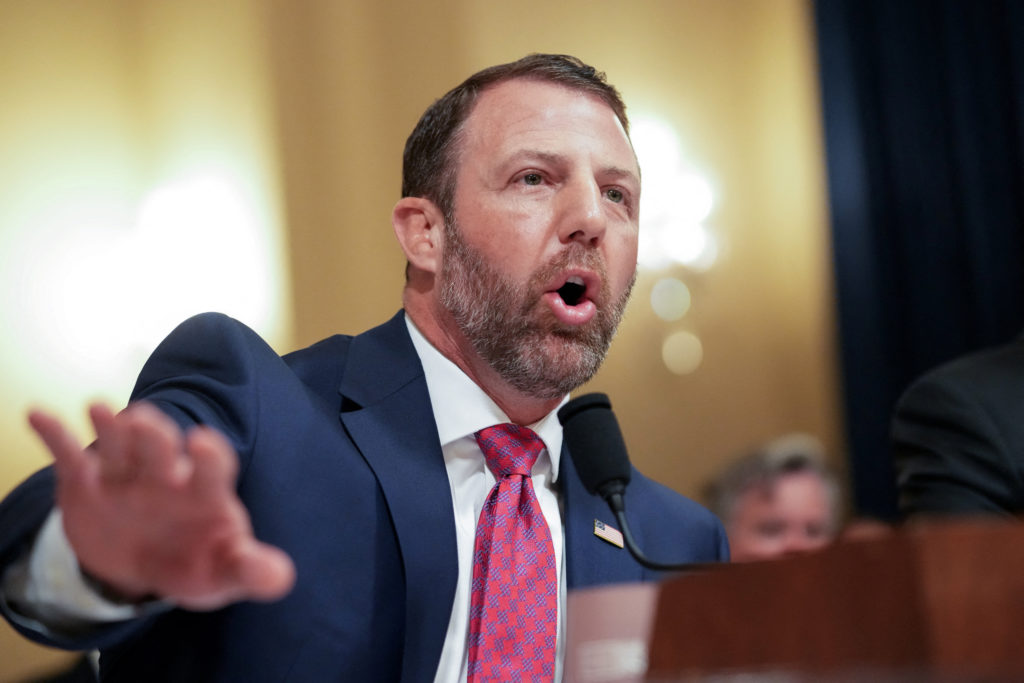
Homeland Security Secretary Markwayne Mullin didn't back down from his threats to pull Customs and Border Protection officers from airports on Wednesday.
Homeland Security Secretary Markwayne Mullin didn't back down from his threats to pull Customs and Border Protection officers from airports on Wednesday.
Pressure is growing on President Trump to back down from his controversial move to appoint Bill Pulte to lead the intelligence community in order to safeguard another priority— renewing America’s warrantless spy powers. A growing number of Democrats have threatened to not renew Section 702 of the Foreign Intelligence Surveillance Act (FISA) — even on...
Pressure is growing on President Trump to back down from his controversial move to appoint Bill Pulte to lead the intelligence community in order to safeguard another priority— renewing America’s warrantless spy powers. A growing number of Democrats have threatened to not renew Section 702 of the Foreign Intelligence Surveillance Act (FISA) — even on...
By Catherine Lai
Activists Lee Cheuk-yan and Chow Hang-tung once led thousands of Hong Kongers in candlelight vigils every June 4 to remember China’s 1989 Tiananmen crackdown.
A group of pro-democracy activists, including Lee Cheuk-yan, Chow Hang-tung, and Albert Ho, hold candles during a candlelight vigil at Victoria Park in Hong Kong on June 4, 2019, to mark the 30th anniversary of the 1989 Tiananmen crackdown in Beijing. It was the last official memorial event organised by the Hong Kon
Activists Lee Cheuk-yan and Chow Hang-tung once led thousands of Hong Kongers in candlelight vigils every June 4 to remember China’s 1989 Tiananmen crackdown.
A group of pro-democracy activists, including Lee Cheuk-yan, Chow Hang-tung, and Albert Ho, hold candles during a candlelight vigil at Victoria Park in Hong Kong on June 4, 2019, to mark the 30th anniversary of the 1989 Tiananmen crackdown in Beijing. It was the last official memorial event organised by the Hong Kong Alliance in Support of Patriotic Democratic Movements of China. Photo: Philip Fong/AFP.
This year, the pair are facing up to 10 years in jail after their trial under a Beijing-imposed national security law, during which they sought to defend the slogans they had chanted openly for decades.
Hong Kong and Macau used to be the only places on Chinese soil that permitted large-scale vigils to mourn those who died on June 4, 1989, when the government sent troops and tanks to crush protests calling for political reform.
But public commemoration has been effectively banned since the national security law’s introduction in 2020, following huge and sometimes violent pro-democracy protests the year before in Hong Kong.
Lee and Chow’s fate is a “gesture by the government to tell everyone where the boundary is, what is no longer allowed to be discussed”, Dennis, a 29-year-old Hongkonger who used to attend the vigils, told AFP.
“The space for public discussion is much smaller, if it even exists,” he said, using a pseudonym for fear of retaliation.
Lee and Chow, who organised the vigils as leaders of the now-defunct Hong Kong Alliance, are expected to receive their verdict in July on charges of “incitement to subversion”.
‘Space for discussion’
At the time, the Chinese government officially defined the Tiananmen protests as a “counter-revolutionary riot” driven by a “very small number of people”, justifying the use of force on June 4 as necessary to restore order.
It said around 200 protestors were killed, as well as several dozen soldiers.
The precise toll is unknown, but most other estimates range from 400 to over 1,000.
The Hong Kong Alliance, formed in May 1989 to support the demonstrators, began campaigning for redress after the crackdown.
For decades, its annual vigils were attended by tens of thousands, turning the city’s Victoria Park into a sea of candlelight.
The Tiananmen vigil in 2018. File photo: Catherine Lai/HKFP.
Calls to “end one-party rule” and “build a democratic China” were commonplace — a fact prosecutors in Lee and Chow’s trial now argue amounted to incitement to subvert the state.
Dennis remembers watching livestreams of the gatherings as a child, and debating their relevance as a university student when they came to be considered old-fashioned by some.
“At least before… whether you considered (the vigil) cheesy or not, there was still space for discussion,” he told AFP.
‘Everything has changed’
Former legislator Emily Lau said she no longer recognises her own city.
“Everything has changed, there are many things that you are not allowed to say, do not dare to say, won’t say… many media outlets have shut, much of civil society has vanished,” she told AFP.
In recent years, police have detained mourners around Hong Kong’s central Victoria Park and arrested multiple people for Tiananmen-related online posts.
Hong Kong artist Sanmu Chan is stopped and searched in Causeway Bay on June 3, 2026. Photo: Kyle Lam/HKFP.
Others will mark the day more subtly.
Dennis said he plans to listen to songs that were played at the vigils while walking around the area.
University student Laurie told AFP she didn’t “feel free speaking my mind… publicly” and would commemorate the day through prayers or a moment of silence.
“The issue is the lack of clear information on what is or is not allowed to (be talked) about, so people end up not saying anything altogether,” the 22-year-old said, using a pseudonym.
Hong Kong’s government told AFP it was committed to safeguarding the freedoms of citizens “that are protected by law”, but added that these were “not absolute”.
It warned that anyone using “the commemoration of a special day… to incite hatred” of China could be in violation of the city’s national security laws.
Zhou Fengsuo. File photo: Tom Grundy/HKFP.
Zhou Fengsuo, a student leader during the 1989 demonstrations, said it was a “great loss” that the gatherings could no longer influence a young generation of Hong Kong activists.
“Every year on June 4th this (vigil) became a topic of international concern,” he said.
“That’s a crucial factor why the legacy of June 4th, 1989, is still known to the world today despite the Communist Party’s attempts to smear and obliterate it.”
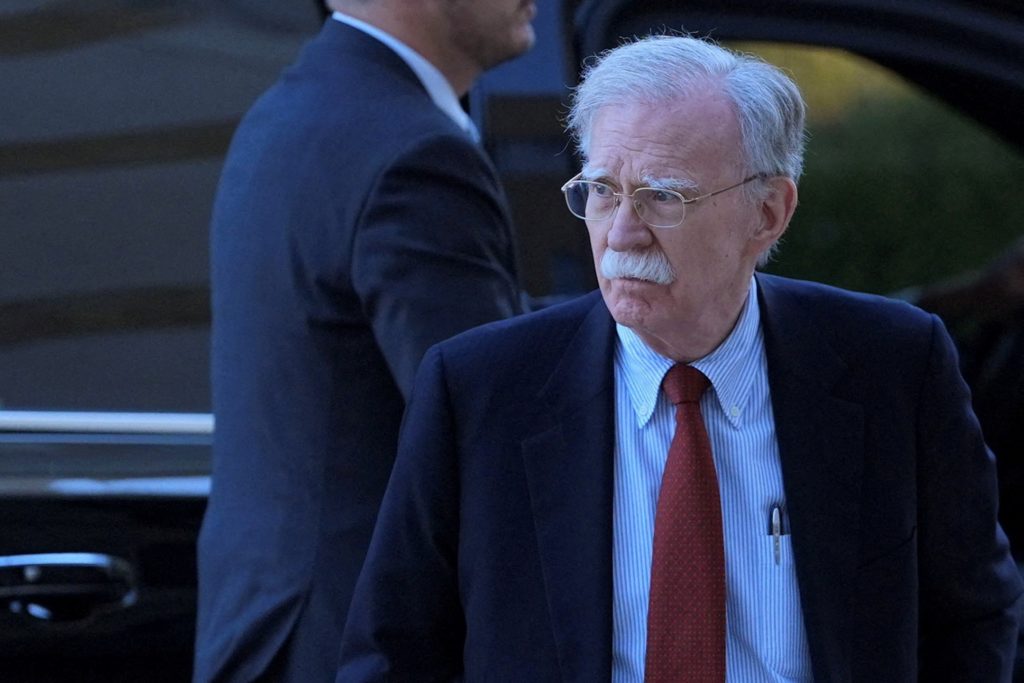
In our news wrap Thursday, President Trump's former national security adviser John Bolton agreed to plead guilty to a felony count of illegally retaining classified information, U.S. officials say a flesh-eating insect detected in Texas livestock has not spread, Hezbollah rejects a ceasefire agreement with Israel and Lebanon and thousands got a sneak peek of the Obama Presidential Center.
In our news wrap Thursday, President Trump's former national security adviser John Bolton agreed to plead guilty to a felony count of illegally retaining classified information, U.S. officials say a flesh-eating insect detected in Texas livestock has not spread, Hezbollah rejects a ceasefire agreement with Israel and Lebanon and thousands got a sneak peek of the Obama Presidential Center.
Making just one kilogram of regular milk protein can release up to 72 kilograms of CO₂-equivalent emissions. Now imagine making the same protein in a stainless-steel tank, using sugar or industrial byproducts, without any cows. That is what precision fermentation offers, and it’s already producing products you can find on retail shelves.
Methane from dairy cows is 28 to 34 times more potent than carbon dioxide at warming the planet over a century, and the world’s dairy cows produce a lot of it.
Making just one kilogram of regular milk protein can release up to 72 kilograms of CO₂-equivalent emissions. Now imagine making the same protein in a stainless-steel tank, using sugar or industrial byproducts, without any cows. That is what precision fermentation offers, and it’s already producing products you can find on retail shelves.
In our recent Sustainability In Your Ear interview with Brendan Niemira, the new Chief Science and Technology Officer at the Institute of Food Technologists (IFT), he described precision fermentation technology, which involves feeding microbes to make a variety of edible and industrial materials, as one of the biggest changes coming to agriculture. He described it as on par with the original domestication of livestock 25,000 years ago. Since then, humans have domesticated only about 50 animal species. Precision fermentation could allow for trillions of possible combinations of microbes to make almost anything.
That is a big claim. Here is what precision fermentation really means, why dairy is a great example of its environmental benefits, where this technology already outperforms cows, and where it still falls short.
What is Precision Fermentation?
People have been fermenting foods for thousands of years. Beer, yogurt, kimchi, and sourdough all rely on microbes to transform one ingredient into another. The big change in the last decade is that we can now control exactly what the microbes produce.
“We can specify what metabolite or nutrient we want to produce, and we can design a multi-species microbial ecology that will produce it,” Niemira said. Thanks to whole-genome sequencing, proteomics, and metabolomics, scientists now have a detailed map of what microbes eat, how they work together, and what they make. Engineers can add genetic instructions to yeast or bacteria so that, as they grow, they produce a target molecule such as a specific dairy protein, a vitamin, an enzyme, an industrial material, or a food preservative. Niemira summed it up as, “Garbage in, gumdrops out.”
While this is an oversimplification, it captures the engineering logic: with the right combination of microbes and feedstock, scientists can make food.
From Cow to Microbial Foundry
Dairy is a clear target because cow’s milk delivers a small group of proteins, mostly casein and whey, mixed with water, fat, lactose, and minerals. Precision fermentation can make these same proteins without relying on animals. Scientists insert the gene into a microbe to produce whey or casein, feed it a carbon source like dextrose or acetate, and the microbe produces the protein. Once filtered and dried, it can be used in products such as cheese, yogurt, ice cream, and protein powders.
Cows do this as well, but it takes a 1,500-pound animal that must be born, fed with forage and grain grown on irrigated land, kept healthy, milked twice a day, and eventually retired. Dairy cows typically live in a concentrated animal feeding operation (CAFO), which is a major source of air and water pollution. Microbes can do the same job in a tank in just days instead of years, with much less food and water.
The choice of feedstock is important and still changing. Most precision fermentation today uses purified sugar. The French company Standing Ovation, which raised $34 million to launch fermentation-derived casein in the U.S., uses acid whey, a byproduct from making cottage cheese and Greek yogurt that is expensive to dispose of, turning a cost center into a profit center. Other companies are exploring gas fermentation, using CO₂, hydrogen, or acetate as the carbon source.
Acetate-fed fermentation looks especially promising for the future, since acetate can be produced from captured CO₂ and renewable electricity, separating protein production from agriculture. Farmers, instead, could focus on higher-value artisanal uses of dairy milk, while working in much less polluted settings.
By the Numbers: Comparing Footprints
The best published comparison comes from California-based Perfect Day. Their animal-free whey was the first precision-fermented dairy protein to pass an ISO-compliant, third-party-reviewed life-cycle assessment. When compared to conventional whey produced at a CAFO, the benefits are clear:
Precision fermentation vs. CAFO dairy
Footprint metric
Precision fermentation vs. CAFO dairy
Greenhouse gas emissions
91–97% lower
Blue water consumption
96–99% lower
Non-renewable energy use
29–60% lower
Land use
78–90% lower in supporting studies
Sources: Perfect Day ISO-compliant LCA; supporting precision-fermentation life-cycle studies, 2021–2025.
Think of these numbers as the specs for a clean, large-scale industrial process. The environmental benefits depend a lot on the type of electricity used and the feedstock. A plant running on coal power loses much of its climate benefit, while one using renewables and processing food waste or other byproducts can do even better.
Even with these caveats, the difference compared to CAFO dairy is big. A typical California dairy CAFO emits about 438 kilograms of methane per hour on average, mostly from the cows’ digestion. They burp a lot. Cows make this methane as they digest grass, but microbes do not.
Precision fermentation is still developing. Three main challenges are slowing its adoption.
Cost. Recombinant dairy proteins still cost about $210 to $310 per kilogram to make, compared to $15 to $25 per kilogram for regular whey and casein. Engineering advances have significantly lowered the cost of precision fermentation over the past two years, and some developers expect prices to match the cost of certain traditionally grown proteins by the late 2020s.
Scale. The industry will need about a thousand times more global fermentation capacity by 2030 to meet the expected demand for alternative proteins. Building a single commercial fermentation plant can cost hundreds of millions of dollars. The U.S. still has less industrial fermentation infrastructure than some countries overseas.
Energy. Bioreactors consume a lot of energy, which already accounts for about 30% of their operating costs. Precision fermentation can help address climate change if these facilities use renewable electricity. If a fermenter runs on coal, it is not a climate solution.
There is also an ongoing debate about regulations and labeling. Proteins made by fermentation are chemically the same as those from cows and work the same way in cheese, yogurt, and baked goods. However, whether they can be sold as “dairy” is still being argued in several U.S. states.
Why This Matters Now
Conventional dairy is stuck in a high-emissions production system, one disrupted by climate change, so humanity needs alternatives. Heat stress reduces milk production in cows, drought raises feed costs, and areas with limited water must decide whether large-scale dairy farming is even possible.
Precision fermentation offers the same nutrition with a smaller, more resilient footprint that does not rely on rainfall, pasture, or feed grain. In some cases, a fermentation facility could switch between microbe populations and feedstocks to provide ample protein, vitamins, or other foods in a small region.
What You Can Do
Try dairy products made with fermentation. Ice cream, cream cheese, and protein powders that use Perfect Day’s ProFerm whey and similar ingredients are already available in stores. Buying these products shows retailers and investors that there is demand.
Check labels carefully. Terms like “animal-free dairy protein” and “non-animal whey” mean the product uses fermentation-derived ingredients. These differ from plant-based dairy alternatives, such as oat or almond drinks.
Support renewable energy policies in your state. The climate benefits of precision fermentation depend on having a clean electricity grid. The faster utilities switch to renewables, the better the results.
Push for transparency in life-cycle assessments. Encourage manufacturers to publish ISO-compliant LCAs. Independent checks help make sure environmental claims are accurate.
“This prosecution is, in fact, a trial of the law itself,” Hong Kong pro-democracy activist Chow Hang-tung told a court last month.
Hong Kong’s Tiananmen crackdown vigil. File photo: Etan Liam, via Flickr.
Chow, 41, made the remark during a defiant closing argument in her trial.
The barrister-turned-activist sought to challenge the legitimacy of the national security allegations against herself, former colleague Lee Cheuk-yan, and the organisation they led, which held Hong Kong’s cand
The barrister-turned-activist sought to challenge the legitimacy of the national security allegations against herself, former colleague Lee Cheuk-yan, and the organisation they led, which held Hong Kong’s candlelight vigils commemorating China’s 1989 crackdown on pro-democracy demonstrators in Beijing’s Tiananmen Square.
From 1990 to 2019, the Hong Kong Alliance in Support of Patriotic Democratic Movements of China organised the commemorative event every year on June 4 at Victoria Park, demanding accountability for the bloody crackdown and the democratisation of China, both taboos in the country.
Beijing imposed a national security law in Hong Kong in 2020, following the 2019 protests and unrest. In 2021, police arrested the Alliance’s leadership, including Chow, Lee, and Albert Ho. The Alliance voted to disband that year, ending its decades-long vigils and advocacy.
Chow, Lee, and the Alliance are standing trial for “inciting subversion” under the national security law, an offence that carries a maximum penalty of 10 years behind bars. Ho pleaded guilty when the trial opened in January.
HKFP looked at the events surrounding the establishment of the Alliance, the Tiananmen vigils it organised, and the ongoing trial of its leaders.
Chow Hang-tung, barrister and a leader of the Hong Kong Alliance in Support of Patriotic Democratic Movements of China, on March 21, 2021. Photo: Peter Parks/AFP.
Hong Kong prosecutors have argued that the case against the Alliance is not political and does not concern its activism, the vigils, or the 1989 crackdown. They allege that, however, the group had been calling for the overthrow of China’s ruling Communist Party (CCP) through its “end one-party rule” slogan – a key tenet of the Alliance since its founding.
For Chow, who represents herself in the trial, the prosecution has upended Hong Kong’s value of being a free-wheeling city that tolerates the kind of political dissent not permitted in mainland China.
The trial has in effect “cornered” the court, forcing it to choose its side between the rule of law and an authoritarian regime, she argued.
Alliance and 1989 Tiananmen crackdown
Massive pro-democracy demonstrations broke out in China in the spring of 1989, triggered by the death of Hu Yaobang, a former CCP leader seen as a reformist. Students and protesters gathered in Beijing’s Tiananmen Square for weeks, demanding political reforms and democracy, as the rest of the country rallied to support those in the capital city.
In May that year, the Alliance was founded in Hong Kong, and huge demonstrations were staged in support of protesters in mainland China.
Around 1.5 million people joined a mass rally on May 28, a day after celebrities like Anita Mui, Teresa Teng, Eric Tsang, and Jackie Chan took part in the Alliance’s benefit concert in support of the students’ movement.
Around 1.5 million people take part in a mass rally in Hong Kong in support of students protesting at Tiananmen Square in Beijing. Photo: 1989年的傳真 , via Facebook.
Lee personally went to Beijing to deliver donations raised during the concert. However, he was detained and made to sign a letter of remorse, around the time the tanks rolled in to crush the burgeoning movement.
The protests in Beijing ended in a bloody crackdown as Chinese troops dispersed protesters on June 3 and 4. Estimates of death tolls during the crackdown range from hundreds to thousands.
In the years that followed, the Alliance organised candlelight vigils at Victoria Park every June 4 to commemorate the dead and to keep the spirit of the 1989 pro-democracy movement alive.
The Alliance’s five tenets – release pro-democracy activists, vindicate the 1989 democracy movement, hold those responsible for the crackdown accountable, end one-party rule, and build a democratic China – were an integral part of the candlelight vigils.
Tens of thousands of people attended the commemorations every year. They lit candles, sang songs, observed a moment of silence, and chanted the Alliance’s five slogans, led by the group’s leaders.
Alliance leaders (from left) Lee Cheuk-yan, Chow Hang-tung, and Albert Ho appear on the giant screen at Hong Kong’s annual Tiananmen crackdown vigil on June 4, 2019. File photo: Todd R. Darling/HKFP.
In 2020, authorities banned the vigil for the first time, citing Covid-19 restrictions. They prohibited the gathering again the following year, also citing the pandemic. The Alliance was disbanded in September 2021, following the arrests of its leaders.
No official vigils have been held since 2019, but there is a heavy police presence at Victoria Park and nearby streets on June 4.
For four consecutive years, Victoria Park has been occupied by a pro-China food festival in early June, including the anniversary day of the bloody crackdown.
‘Weird’ prosecution
In her closing argument last month, Chow said the prosecution was “weird,” as the defendants had not disputed the alleged acts and instead, they embraced what they did.
“Ending one-party rule means putting an end to the status quo, in which those in power are not bound by the law,” she told the court in Cantonese. “What is really in dispute is what the law suppresses and what it protects.”
According to the prosecution, the Alliance’s calls to “end one-party rule” had exceeded the legitimate boundary of freedom of expression as the defendants intended to stoke hatred against Beijing. “Freedom is not absolute,” lead prosecutor Ned Lai told the court in Cantonese.
The last official Tiananmen crackdown candlelight vigil on June 4, 2019. File photo: Todd R. Darling/HKFP.
Chow said the prosecution’s argument had undermined the values long championed in Hong Kong, such as freedom of expression and the rule of law.
“Speaking out the truth has become stoking hatred. Seeking justice has become taking advantage of suffering,” she said. “Asking for accountability has become breaching the constitution. Demanding democracy has become inciting subversion.”
She maintained that the court must protect human rights when reaching a verdict in the case.
“What the court has been asked to ban, to punish in this case are, in fact, what society and the law should encourage… They are the core values of Hong Kong, the norms and ideals accumulated through generations,” she said.
“I hope the court will make a correct decision to safeguard the dignity and bottom line of the law, at a time when values are being reshaped,” she added.
Prosecutors have argued that there are no “lawful means” to end CCP rule after a 2018 constitutional amendment stipulated that the party’s leadership is the “defining feature” of China’s socialist system.
A pro-Beijing food carnival at Victoria Park on June 4, 2025, the anniversary of the Tiananmen crackdown. File photo: Kyle Lam/HKFP.
During his closing submission last month, Lee’s lawyer, Erik Shum, argued that prosecutors had presented a “tautological theory.”
“We ask: How exactly did the Alliance incite others to overthrow the CCP? And my submission is that the prosecution has always reverted to the claim that ending CCP rule is illegal,” Shum said in Cantonese.
Shum urged the court to draw a boundary for what is considered an acceptable political expression and what is not.
“The court must not pay lip service to human rights protections,” he said.
The three-judge panel – Alex Lee, Johnny Chang, and Anna Lai – has adjourned the proceedings, saying they hope to deliver a verdict in “mid or late July.”
In a letter from prison this week, Chow, who has been behind bars since September 2021, said she would go on a 37-hour hunger strike in commemoration of the 37th anniversary of the 1989 crackdown.
Keep your Data outside your PC or Laptop in a Pendrive or USB SATA SSD drive. Latter is recognized as a System drive on windows. System Recovery disk in USBdrive.When Computer fails you lose nothing, send it for repairs after pulling out Drives. Migrate to new PC or Laptop with ease.https://mastodon.sdf.org/@PortableAppshttps://portableapps.comUse PortableApps.com for your apps on your PC. Many apps are available for External drives. #computer #windows #data #freebee #wine #security
Keep your Data outside your PC or Laptop in a Pendrive or USB SATA SSD drive. Latter is recognized as a System drive on windows. System Recovery disk in USBdrive.
When Computer fails you lose nothing, send it for repairs after pulling out Drives. Migrate to new PC or Laptop with ease.
Federal Emergency Management Agency (FEMA) staffing losses after a tumultuous year at the agency are raising questions about whether it will be able to effectively respond to this hurricane season. While the Trump administration has backed off its most controversial ideas — such as outright eliminating FEMA or cutting its staff by 50 percent —...
Federal Emergency Management Agency (FEMA) staffing losses after a tumultuous year at the agency are raising questions about whether it will be able to effectively respond to this hurricane season. While the Trump administration has backed off its most controversial ideas — such as outright eliminating FEMA or cutting its staff by 50 percent —...
The US consulate in Hong Kong displayed commemorative candles in its windows on the 37th anniversary of the Tiananmen crackdown on Thursday, while other diplomatic missions paid tribute with social media posts.
Candles in the windows of the US Consulate General in Hong Kong on June 4, 2026, the 37th anniversary of the 1989 Tiananmen crackdown. Photo: Kyle Lam/HKFP.
The annual move is often blasted by local and Chinese authorities, and has been cited by Beijing as “evidence” of foreign int
The US consulate in Hong Kong displayed commemorative candles in its windows on the 37th anniversary of the Tiananmen crackdown on Thursday, while other diplomatic missions paid tribute with social media posts.
Candles in the windows of the US Consulate General in Hong Kong on June 4, 2026, the 37th anniversary of the 1989 Tiananmen crackdown. Photo: Kyle Lam/HKFP.
Candles in the windows of the US Consulate General in Hong Kong on June 4, 2026, the 37th anniversary of the 1989 Tiananmen crackdown. Photo: Tom Grundy/HKFP.
Hundreds, perhaps thousands, died when the People’s Liberation Army cracked down on protesters around Beijing’s Tiananmen Square in 1989.
Candles in the windows of the US Consulate General in Hong Kong on June 4, 2026, the 37th anniversary of the 1989 Tiananmen crackdown. Photo: Tom Grundy/HKFP.
Hong Kong used to be one of the few places on Chinese soil where annual vigils were held to commemorate the people who died in the 1989 crackdown.
Candles in the windows of the US Consulate General in Hong Kong on June 4, 2026, the 37th anniversary of the 1989 Tiananmen crackdown. Photo: Tom Grundy/HKFP.
But police banned the gathering at Victoria Park for the first time in 2020, citing Covid-19 restrictions, and imposed the same ban the following year.
Candles in the windows of the US Consulate General in Hong Kong on June 4, 2026, the 37th anniversary of the 1989 Tiananmen crackdown. Photo: Tom Grundy/HKFP.
No official commemoration has been held since the vigil organiser, the Hong Kong Alliance in Support of Patriotic Democratic Movements of China, disbanded in September 2021. Its leaders were arrested and are currently on trial.
Candles in the windows of the US Consulate General in Hong Kong on June 4, 2026, the 37th anniversary of the 1989 Tiananmen crackdown. Photo: Tom Grundy/HKFP.
Currently occupying Victoria Park – historically the site of Hong Kong’s vigils – is a five-day patriotic carnival organised by pro-Beijing groups.
Diplomatic commemorations
Earlier on Thursday, Britain’s embassy in China shared a social media post featuring an animation with scenes from the bloody crackdown. It was shared without commentary.
Photo: UK in China, via X.
The British consulate in Hong Kong posted a reel of a mobile phone held aloft with its torch on, apparently referencing the candlelit vigils.
Photo: UK in Hong Kong via Facebook.
Washington’s mission in Beijing shared a quote from US Secretary of State Marco Rubio stating: “Those who sacrificed to uphold their unalienable rights of free expression and peaceful assembly will be vindicated someday.”
Photo: U.S. Mission to China, via Facebook.
In response, China’s Foreign Ministry spokesperson Mao Ning said Beijing had “long since reached a clear conclusion regarding that political turmoil that occurred in the late 1980s.”
Chinese foreign ministry spokesperson Mao Ning. File photo: China’s Ministry of Foreign Affairs. Photo: China gov’t.
The Canadian consulate in Hong Kong shared a Facebook post, which read: “Today, Canadians honour the memory of all who lost their lives, were injured or went missing during the Tiananmen Square crackdown on June 4, 1989. Canada stands with the survivors and the families and loved ones who continue to demand accountability.”
Photo: Consulate General of Canada in Hong Kong & Macao via Facebook.
Meanwhile, the Australian consulate in Hong Kong shared on Facebook a photo of candles and a statement reading: “Today, we stand with communities worldwide in remembering those who lost their lives at Tiananmen Square on 4 June 1989. Australia remains steadfast in its commitment to upholding human rights, including freedom of association, of expression, and of political participation.”
Photo: Australian Consulate-General Hong Kong and Macau, via Facebook.
In June 2019, then-leader Carrie Lam said that the city’s annual vigils were “proof that Hong Kong is a free place.”
A Hong Kong court is now hearing a landmark trial of the Alliance and two vigil leaders, Chow Hang-tung and Lee Cheuk-yan. They are accused of “inciting subversion” under the national security law, an offence that carries a maximum penalty of 10 years behind bars.

 Login
Login