Alberta’s government recently claimed almost all Crown land in the province should be considered protected, even though caribou herds there are edging closer to local extinction as logging and oil and gas development continue to degrade and fragment their habitat.
Alberta’s claim comes in light of the federal commitment to meet an international target of 30 per cent land protection by 2030. As a Globe and Mail article reported, only 14 per cent of Canada’s land base is protected, so an addit
Alberta’s government recently claimed almost all Crown land in the province should be considered protected, even though caribou herds there are edging closer to local extinction as logging and oil and gas development continue to degrade and fragment their habitat.
Alberta’s claim comes in light of the federal commitment to meet an international target of 30 per cent land protection by 2030. As a Globe and Mail article reported, only 14 per cent of Canada’s land base is protected, so an additional 1.6 million square kilometres must be added over the next four years to meet the objective.
Alberta could be trying to take advantage of what some interpret as a grey area under the federal government’s vision: the category of “other effective conservation measures.” In March, Prime Minister Mark Carney recommitted to achieve Canada’s protected areas goal with a new nature strategy that identifies at least eight per cent of the target as Other Effective Area-Based Conservation Measures (OECMs).
“Nearly 60 per cent of the province’s land base is publicly managed Crown land,” Grant Hunter, Alberta’s environment and protected areas minister, said. “This represents about 40 million hectares that have been responsibly managed, stewarded and conserved for decades. Land use is regulated to protect watersheds, conserve wildlife habitat, support forestry and agriculture, enable outdoor recreation and allow for responsible, carefully managed resource development.”
OECM areas are managed for long-term conservation outside of traditionally regulated parks. Canada has clear criteria for them, including, “Conservation is year round and will be maintained in the long term,” and “conservation objectives are not threatened by other site objectives.”
They make sense in some places. Indigenous protected and conserved areas (many governed by Indigenous law) can be good examples. The muddying of OECMs comes in part from industry, which also proclaims “conservation” despite caribou declines and argues land under its purview should be designated as OECMs.
A 2019 article by Wilfrid Laurier University associate professor Christopher Lemieux and colleagues in Marine Policy outlined potential risks: “Ambiguous language used to define and prescribe application of OECMs is being used as the basis for a revisionist paradigm that promises to undermine national and international conservation standards, fracture partnerships, and jeopardize the integrity of Canada’s PA network.”
Other potential pitfalls hamper the path to securing Canada’s conservation objectives. Numbers-based targets contain inherent risks. An article by European scientist Piero Visconti and colleagues in Science notes, “percentage area targets disregard the quality of what is being represented, with degraded ecosystems given the same value as those that are still functionally intact.”
Protected areas are often too small to capture ecological processes. They can be islands of green in seas of development and extraction, lacking connectivity, often surrounded by deteriorated areas where wildlife that moves beyond the boundaries becomes threatened.
Nature is dynamic, constantly shifting and evolving over long periods that allow for adaptation. Climate change alters landscapes at a faster pace. As the international Wildlife Society points out, “Protected areas are havens of biodiversity across the globe, but under a warming climate, species using them may shift their niches to areas that are no longer protected.” So too might tree and plant species move outside of protected areas in response to a changing climate.
Parks are not panaceas for addressing the ecological crises we face, but they are a primary tool. The land outside of protected areas must also be managed for biodiversity outcomes. Landscape-level restoration is needed to repair damaged ecosystems. Buffer zones and connectivity corridors can create spaces for movement of wildlife and of ecosystems that migrate as the climate changes.
Ultimately, protected areas safeguard natural processes from deterioration as a result of development and industrial resource extraction, supporting resiliency. As a Frontiers in Science article recently underscored in response to the biodiversity crisis, “the top priority should be preventing the loss of intact biomes, ecosystems, natural processes, and species assemblages, as they are irreplaceable and cannot be quickly restored.”
Alberta’s grandstanding is just that; its announcement ignores its own protected areas legislation. The federal government must uphold OECM criteria and report on conservation outcomes, not just percentages. We must support Indigenous land governance and meet the land protection target by conserving healthy, resilient ecosystems — and pivot away from biodiversity loss and extinctions.
David Suzuki is a scientist, broadcaster, author and co-founder of the David Suzuki Foundation. Written with David Suzuki Foundation Boreal Project Manager Rachel Plotkin.
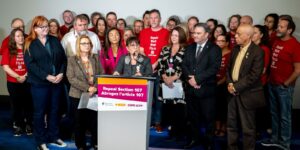
The fight to repeal section 107 from the Canadian Labour Code has progressed after the House of Commons had the second reading of the bill aimed at abolishing it.
Leaders from the NDP and Canada’s union movement have rallied around the bill, framing the repeal of section 107 as key to defending the right to strike. At the same time, smaller labour organizations are working to reclaim the political strike as a tool the labour movement can wield to assert workers’ rights.
Bill C-247 was t
The fight to repeal section 107 from the Canadian Labour Code has progressed after the House of Commons had the second reading of the bill aimed at abolishing it.
Leaders from the NDP and Canada’s union movement have rallied around the bill, framing the repeal of section 107 as key to defending the right to strike. At the same time, smaller labour organizations are working to reclaim the political strike as a tool the labour movement can wield to assert workers’ rights.
Bill C-247 was tabled in October and highlights how section 107 of the labour code has been used in the last two years to tilt the scales during collective bargaining. Section 107 gives the labour minister the power to do things that “seem likely to maintain or secure industrial peace” when they deem it expedient.
Section 107 has been invoked eight times in the last two years and has ended legal strikes being held by rail workers, flight attendants and postal workers.
“Every single time that a government oversteps and uses 107 or any other legislation to send workers back to work, they are undermining the work that happens at the [bargaining] table,” said Siobhan Vipond, vice president of the Canadian Labour Congress. “Let us be clear, every single time that 107 has been used by this government, it has been used in favor of the employer.”
NDP leader, Avi Lewis, expressed support for repealing section 107 in hopes it will balance the power at the bargaining table.
“No worker wants to give up their own wages to go on a picket line,” Lewis said, “but when you’re talking about bargaining in Canada, in a cost of living crisis, where people cannot afford groceries, cannot afford rent and mortgages, being paid a fair wage is our only hope for workers in Canada of getting out of this cost of living emergency, and it’s only the right to strike that balances the scales in labor negotiations, so that employers can’t just do what they want.”
For organizers like Emile Lacombe, who has been organizing with the Alliance Ouvrière (Worker’s Alliance) since 2024, this effort to amend the labour code is positive. But the ongoing attack on the right to strike signals a need to build more labour militancy.
“What we’re seeing right now is that the government is taking advantage of the fact that we’re disorganized, that we’re used to taking the legal route,” Lacombe said in an interview with rabble.ca. “The thing is that they have the upper hand on that department, because they can change laws, the bosses can hire better lawyers than us.”
Lacombe joined a panel at a conference held by the International League of People’s Struggles last week where he discussed the importance of reclaiming the political strike, a strike that happens not just to secure a fair deal but also to assert broader political or social demands.
Representing the Workers Alliance Emile spoke alongside speakers with the Immigrant Workers Centre, the International Migrants Alliance, Migrante Canada and the 1919 Workers Collective. All groups agreed that labour should build towards the political strike.
Lacombe highlighted that the history of the political strike is strong in Canada. Workers used the strike to fight against government austerity in 2015 and to stand up for the environment in 2019. Now, in a time where the NDP and unions are fighting to protect the right to strike, Lacombe said these large mobilizations of workers may be exactly what’s needed to demonstrate that workers’ hard fought wins cannot just be taken away. “If we want the right to strike, we need to prove it in action and to show it by defying back to work orders,” Lacombe said. “That’s the only way that we can ensure that we have this right.”
Although he reinvented himself as a kingpin in the nursing home business, former Ontario premier Mike Harris used to be best known for the water contamination fiasco that killed seven people and sickened thousands more in Walkerton, ON.
That tragedy led to a dramatic decline in support for his government and was considered a key reason Harris resigned as premier in 2002.
Not surprisingly, the premiers who’ve followed Harris have steered clear of anything that smacks of weakening government
Although he reinvented himself as a kingpin in the nursing home business, former Ontario premier Mike Harris used to be best known for the water contamination fiasco that killed seven people and sickened thousands more in Walkerton, ON.
That tragedy led to a dramatic decline in support for his government and was considered a key reason Harris resigned as premier in 2002.
Not surprisingly, the premiers who’ve followed Harris have steered clear of anything that smacks of weakening government surveillance of Ontario’s water systems.
Until now, that is.
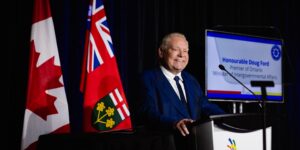
Shaking off the Walkerton bogeyman, current Ontario Premier Doug Ford is embarking on a plan that will effectively privatize aspects of the province’s water systems, with potential risks to our drinking water.
Ford is well aware of the political danger of being associated with any weakening of public management of water. This explains why he’s going out of his way to deny the label “privatization” applies to the changes in new legislation, which the government insists will keep our water “publicly owned.”
But, as law professor Joel Bakan and economist Jim Stanford noted in a piece in the Star yesterday, the new legislation creates a regime for water and wastewater services in Ontario that is effectively privatized — despite the Ford government’s attempt to deny what it’s doing amounts to privatization.
The Ford government’s keenness to put in place this new water regime — while disguising the fact that it involves privatization — raises the question: whose interests is the government serving in doing this?
Clearly, there’s no public pressure for our water systems to be redesigned to include profit-making. That’s because there would be no benefit for the public.
However, there is one group that would benefit significantly — private investors.
Indeed, private investors — particularly large global institutional investment firms that represent (among others) pension funds, insurance companies and very wealthy families — have trillions of dollars in capital and are keen to invest it in low-risk projects where they can earn returns as high as seven to nine per cent a year. And public infrastructure, including Ontario’s water system, fits that bill.
Under Ford’s legislation, water and sewage systems can be removed from the control of local governments — the plan is to start with Peel Region — and transferred to specially-created, profit-making corporations.
“Key decisions — including finances, contracts and water rates — would be made by corporate boards,” observes Meera Karunananthan, a geography professor at Carleton University.
She also says that the public would continue to be responsible for the debt from constructing the water infrastructure, while the profits would go to investors. “Simply put, the public bears the burden while shareholders capture the reward.”
The public is also potentially endangered. A 2002 public inquiry found that among the factors contributing to the Walkerton tragedy was the Harris government’s failed provincial oversight after it privatized water testing.
Harris was an unusually gung-ho privatizer, and his legacy of privatization — with all the associated risks — lives on in areas beyond water management.
He also encouraged privatization in Ontario’s long-term-care homes and then went on to benefit handsomely from the privatized nursing home industry he helped create. Shortly after retiring as premier, he became a significant shareholder and chairman of Chartwell Retirement Residences, a major private chain operating publicly-funded nursing homes.
Chartwell was among the for-profit nursing homes that were found to have higher death rates during the COVID pandemic than not-for-profit homes, according to a 2020 investigation by a team of Toronto Star reporters as well as a CBC probe. Harris retired as Chartwell chairman two years later, in 2022.
While public services and infrastructure offer lucrative opportunities for moneyed investors, there’s a reason not to hand over aspects of these vital provincial responsibilities to private interests which are, above all, focused on making profits.
Ontarians died needlessly in nursing homes and in Walkerton. Doug Ford should take note.
This article was originally published in the Toronto Star.
Ontario has established a regulatory body for the province’s 100,000 personal support workers. But they are not represented on the body which the workers call fundamentally flawed. Plus the LabourStart report about union events. And singing: ‘Hold That Line.”
Music credit: Robin Roberts (vocals) Peter Hicks and Geoff Francis (Lyrics). Used with permission.
RadioLabour is the international labour movement’s radio service. It reports on labour union events around the world with a focus on unions i
Ontario has established a regulatory body for the province’s 100,000 personal support workers. But they are not represented on the body which the workers call fundamentally flawed. Plus the LabourStart report about union events. And singing: ‘Hold That Line.”
Music credit: Robin Roberts (vocals) Peter Hicks and Geoff Francis (Lyrics). Used with permission.
RadioLabour is the international labour movement’s radio service. It reports on labour union events around the world with a focus on unions in the developing world. It partners with rabble to provide coverage of news of interest to Canadian workers.
Today’s episode of the Courage My Friends podcast series features the keynote discussion from the 34th annual Labour Fair at Toronto’s George Brown College. Founding representative of the Toronto Airport Workers’ Council Sean Smith and member of the Parkdale Housing Justice Network (PHJN) Matt Whitfield, discuss the crises of labour precarity and housing insecurity, how these are the outcomes of systems rigged against workers and communities and methods of effective grassroots and labour organiz
Today’s episode of the Courage My Friends podcast series features the keynote discussion from the 34th annual Labour Fair at Toronto’s George Brown College. Founding representative of the Toronto Airport Workers’ Council Sean Smith and member of the Parkdale Housing Justice Network (PHJN) Matt Whitfield, discuss the crises of labour precarity and housing insecurity, how these are the outcomes of systems rigged against workers and communities and methods of effective grassroots and labour organizing toward the building of working peoples’ cities.
On the housing “crisis”, Whitfield says:
“ The system is rigged … After years of skyrocketing housing prices and rental costs, I think it’s safe to conclude the housing system is not designed to provide people with affordable homes, no matter what politicians or developers or landlords might say. Instead, the housing system seems to be designed to extract as much wealth as possible from people who need a place to live.”
Reflecting on lessons from labour history, Smith says:
“ It’s funny, in Saskatchewan, people think co-op is like a big evil conglomerate like Walmart because they’re everywhere. But it’s the lifeblood of these small towns. And what it was is that the people had to find a system to unrig the system, and how they did that was by forming their own community and said, ‘You guys, your superstores, your Walmarts, you do your stuff. We’ll take care of ourselves.’ And workers did the same … that was workers’ ways of trying to collectively come together, form cooperatives. Collectivization, to work together to become a ‘we’ to take on the boss … A famous Irish trade unionist Jim Larkin said: ‘They’re only great because we are on our knees. Let us rise.’”
About today’s speakers:
Sean Smith is a retired airport worker and founding representative of the Toronto Airport Workers’ Council; the collective voice for Toronto Pearson’s 50,000 workers and 6 largest airport unions.
Matt Whitfield got his start in activism as a resident at the Occupy Toronto encampment in 2011. A long-time Parkdale resident, Whitfield’s been connected to tenant organizing in his building and neighbourhood for several years. In 2020 and 2021, he participated in a decentralized Parkdale-wide “Keep Your Rent” campaign, withholding all rent payments for fifteen months. He is currently an active member of the Parkdale Housing Justice Network (PHJN), a grassroots neighbourhood organization focused on resisting gentrification, building tenant power, and supporting our unhoused neighbours through mutual aid and collaborative action. Whitfield is also a member of the steering committee for the upcoming second annual People’s Assembly on Housing Justice, an event that brings together advocacy and activist groups from across Toronto.
Prime Minister Mark Carney recently released “A Force of Nature: Canada’s Strategy to Protect Nature.” It describes a vision “that protects, restores, and values nature as a foundation of our economy, sovereignty, and well-being, leading at home and globally, to ensure healthy ecosystems, resilient communities, and prosperity for present and future generations.”
What’s the link between the federal government’s commitment to protect and restore nature and its much-discussed commitment to stre
Prime Minister Mark Carney recently released “A Force of Nature: Canada’s Strategy to Protect Nature.” It describes a vision “that protects, restores, and values nature as a foundation of our economy, sovereignty, and well-being, leading at home and globally, to ensure healthy ecosystems, resilient communities, and prosperity for present and future generations.”
What’s the link between the federal government’s commitment to protect and restore nature and its much-discussed commitment to strengthen national security? It’s a good question.
“A Force of Nature” acknowledges that nature “provides essential defences. Wetlands absorb carbon and excess rainfall, forests prevent erosion, and healthy ecosystems reduce the impacts of severe weather. Protecting nature supports jobs, food security and Canada’s long-term competitiveness on the world stage.”
The 2024 federal report “Our North, Strong and Free: A Renewed Vision for Canada’s Defence” opens with a message from the defence minister: “One of the most important roles of any government is to protect its country and its people. In a rapidly changing world, we are committed to fulfilling this essential responsibility.”
Among other challenges, that report acknowledges security threats posed by climate change, stating, “Our Arctic is warming at four times the global average, opening the region to the world, which was previously protected by the Polar Ice Cap year-round. By 2050, the Arctic Ocean could become the most efficient shipping route between Europe and East Asia. We are seeing greater Russian activity in our air approaches, and a growing number of Chinese vessels and surveillance platforms are mapping and collecting data about the region.” Prime Minister Carney also released a plan to defend the North.
But what about Canada’s obligation to protect its citizens from climate change and biodiversity loss impacts that threaten drinking water (pollution, plastics), the air we breathe (forest degradation), homes (floods and fire events) and food systems (droughts, pollinator declines)?
The federal government seems oblivious to the connection between security and halting and reversing nature loss; there is a misaligned sense of passivity when climate change is identified as a threat. Yes, climate change is already here. But that doesn’t mean the government, which has the power to make laws and regulations, shouldn’t do everything it can to limit ongoing and future climate pollution that will exacerbate current threats, rather than building pipelines and approving new liquefied natural gas projects.
It’s possible to recognize that climate change and nature degradation are significant to national security, as evidenced by the United Kingdom’s 2026 national security assessment, “Global Biodiversity Loss, Ecosystem Collapse and National Security.” Its premise is that, “Nature is a foundation of national security. Biodiversity loss is putting at risk the ecosystem services on which human societies depend, including water, food, clean air and critical resources. The impacts will range from crop failures, intensified natural disasters and infectious disease outbreaks to conflict within and between states, political instability, and erosion of global economic prosperity.”
Canada gets a (dis)honourable mention in the U.K.’s assessment. It notes, “Ecosystem degradation is occurring across all regions. Every critical ecosystem is on a pathway to collapse (irreversible loss of function beyond repair)” and points to the “realistic possibility” of the ecological collapse of Canada’s boreal forest, starting in 2030.
The boreal forest is often referred to as “the lungs of the planet,” as it purifies air and provides oxygen. It also sequesters and stores carbon — in trees, mosses, lichens and soil. It’s being degraded by climate change impacts, industrial logging, mining and oil and gas extraction.
The U.K. doesn’t stand alone. The World Economic Forum’s “Global Risks 2026” report ranked threats by severity, identifying the top three long-term risks as extreme weather events, biodiversity loss and ecosystem collapse, and critical change to Earth systems. Clearly security isn’t merely a matter of protecting against invading armies. Canada’s approach must be integrated. Happily, the federal government can feed two birds with one seed: protecting and restoring natural ecosystems can support national security and deliver on Canada’s commitments outlined in the new nature strategy.
David Suzuki is a scientist, broadcaster, author and co-founder of the David Suzuki Foundation. Written with David Suzuki Foundation Boreal Project Manager Rachel Plotkin.
A Ponzi scheme is where the schemer gets one group of victims to pay another group of victims. Ponzi schemes require an ever-increasing flow of more money to survive. All Ponzi schemes eventually collapse.
High hydro rates were a big problem politically. So, In the 2018 Ontario provincial election Doug Ford promised to lower hydro rates by 12 per cent. Ford has not lowered hydro rates by even one per cent.
What Ford did do was hide and protect private profits with his electricity rebate
A Ponzi scheme is where the schemer gets one group of victims to pay another group of victims. Ponzi schemes require an ever-increasing flow of more money to survive. All Ponzi schemes eventually collapse.
High hydro rates were a big problem politically. So, In the 2018 Ontario provincial election Doug Ford promised to lower hydro rates by 12 per cent. Ford has not lowered hydro rates by even one per cent.
What Ford did do was hide and protect private profits with his electricity rebate program subsidy. The Financial Accountability Office has reported the cost to the public treasury from between $6 billion and $7 billion per year.
Last November first the Ontario Energy Board raised electricity rates by 29 per cent. This was done, as it has been done every November 1 and April 1 since June 2002 to pay the rates the deregulated electricity market charged.
Knowing this would not be good optics for him, Ford increased the electricity rebate program from 13 to 23.5 per cent, hiding the increase. Ford never talks about his 2018 promise anymore.
Just doing the math, $6.9 Billion plus 23.5 per cent equals a whopping $8.5215 billion and growing, that figure does not include the November 1 increase of 29 per cent. All paid for by the public treasury. Hard to believe that, on top of all that Ford wants to increase hydro rates by 72.6 per cent to prepay the billions for new nuclear plants that won’t be built for years.
Some history is required.
Like the con man who goes from town to town working their scam, in the 1990’s Enron was wandering the world selling their invention: The deregulated electricity market.
Claiming Ontario hydro was bankrupt because of a $34 billion debt, Harris deregulated our hydro. A debt that was almost entirely nuclear debt showing right up to today how expensive nuclear power is.
Harris then spent millions on a province wide ad campaign promising “lower rates” from his hydro deregulation legislation, as well as promising that “nothing will go wrong”.
Harris rammed through three pieces of legislation in 1998.Bill 35 The Energy Competition Act, The Electricity Act and the Ontario Energy Board Act. Harris then had Enron and a who’s who of private investors design Ontario’s electricity market, which is still the main cause of today’s high hydro rates. Harris’s legislation changed all non-profit at -cost hydro commissions into for-profit corporations. Harris’ promises of “lower rates and nothing will go wrong” was short lived.
After the Enron designed electricity market opened in June of 2002, by 2007 rates doubled, by 2010 rates had tripled and by 2018 rates had quadrupled.
This brings us to Ford’s election and the introduction of Ford’s Ontario electricity rebate hiding the problem. Conservative Alberta is doing the exact same scheme with their electricity rates. Electricity markets are notoriously easy to manipulate, as shown by failures in California and many places around the world.
The victims now paying more and more to fund this Ponzi scheme are all of us.
The crisis in both healthcare and education as well as other public services we all depend on is due to the underfunding and cuts to our critical public services to fund this scam and worst of all, Ford is also borrowing from future taxpayers by using deficit financing to pay for his scheme.
In a nutshell Ford is financing his scheme with social deficits in healthcare, education and public treasury deficits.
The deficit for 2026-27 is now $13.8 billion, indebting future generations.
In the middle of an affordability crisis, Ford’s scheme only protects private profits.
This Ponzi scheme like all others is unsustainable and will eventually collapse.
The Enron designed electricity market must be closed. Rates must be regulated and like nine countries in Europe and Australia we must get on the pathway of public green power and conservation.
Take a trip down memory lane with us… via the 2025 annual report!
Each year, rabble.ca releases a comprehensive annual report to share what we’ve been doing and how we spend the money we receive from the community and our sustaining partners. You can find our previous reports here.
While there are no regulations that require us to publish our annual report publicly, we feel it’s important to be transparent and open about how we operate, and truth be told, we’re proud of what we manage to
Each year, rabble.ca releases a comprehensive annual report to share what we’ve been doing and how we spend the money we receive from the community and our sustaining partners. You can find our previous reports here.
While there are no regulations that require us to publish our annual report publicly, we feel it’s important to be transparent and open about how we operate, and truth be told, we’re proud of what we manage to accomplish with a budget that’s a mere fraction of those of similar organizations.
All of this happened in front of the back drop of an increasingly belligerent US government under President Donald Trump. Canada felt the effects of tariffs against its economy and direct threats to its sovereignty.
In uncertain times like this, where right-wing extremism is on the rise, rabble’s work is more essential than ever. Our work would not be possible with out the support of our generous supporters, donors, and sustaining partners who make independent media possible.
Wanna revisit some of our best interviews from 2025 on rabble radio? Click here to listen now!
Our work is made possible by rabble rousers like you
If you like what you see in these pages, and if you want to support our work, please don’t hesitate — become a rabble community member right here!
The generous support from our dedicated readers is the foundation of everything that we do. For the last two decades rabble’s tried and true approach, which you play such an important role in, continues to prove how much can be achieved when we come together to support media democracy.
With your help, rabble’s going stronger than ever in 2025 – let’s keep building on that momentum!
Creation stories, or myths, that account for the origin of the universe, the Earth, the continents, mountains, rivers, life, or the first humans–these can provide a common purpose and unity.
Nation states have their own creation stories. But countries are demarcated by artificial political boundaries. Their creation stories tend to reflect history as written by the victors in politics and war. They are more likely to generate conflict, separatism, and polarization than indigenous creation storie
Creation stories, or myths, that account for the origin of the universe, the Earth, the continents, mountains, rivers, life, or the first humans–these can provide a common purpose and unity.
Nation states have their own creation stories. But countries are demarcated by artificial political boundaries. Their creation stories tend to reflect history as written by the victors in politics and war. They are more likely to generate conflict, separatism, and polarization than indigenous creation stories.
The woman who falls from the sky is a great Haudenosaunee (Iroquois) creation story. In many Indigenous creation stories, the first humans are interacting with other creatures.
Sometimes animals dive into the depths of the ocean to bring up the material that becomes the continents, like our own Turtle Island.
Sky people versus bringing up material from the depths—both are important aspects of creation.
The question isn’t whether stories are “true,” but whether they enrich our lives and cultures.
Western science has competing creation stories for the origins of life. Some scientists maintain that life came from the sky, perhaps from outside our planet, or from electrical processes in the atmosphere. Others say life came from rocks and gases in the depths of the oceans, before there was any land.
In the latter case, which increasing evidence supports, Earth is truly the mother of us all. Scientists have found signs of early life in the Earth’s oldest rocks, dating back nearly four billion years.
Back then there were no “higher organisms”: species with shells or skeletons that turned into fossils. Nonetheless, some of the first microorganisms formed sedimentary deposits that later became stone. The earliest signs of life in rocks are subtle, and a subject of scientific debate.
Creation of life was not a single point in time. Evolution has been a continuous process. For a billion years during the Proterozoic Eon, it seemed as if not much was happening. Gradually, however, the Sun’s energy, through the process of photosynthesis, was oxygenating the atmosphere. So-called “higher” life forms like fungi, plants and animals took their place alongside the microbes.
Science has given us an appreciation not only of how our world came to be, but how long it took to create the beauty we have now.
The first organisms–our most distant ancestors–appeared many kilometres deep in the oceans where Earth’s internal forces were pulling apart tectonic plates. There, under intense heat and pressure, and without sunlight or oxygen, they developed the metabolic pathways that all life forms rely on today.
While conditions in the ocean depths sound incredibly harsh to us, life still flourishes there in the absence of sunlight. Since life’s earliest days, microbes have fed upon the hydrogen and sulphur gases emitted from hydrothermal vents, providing the basis for increasingly complex food webs. Scientists continue to discover bizarre new species of fish, crabs, clams, and tube worms at the bottom of the sea.
Think of hydrothermal vents as the cradle of life–the warm womb of Mother Earth. When life originated around them, the Earth’s surface was a far more hostile environment, bombarded with cosmic radiation in the absence of a well-developed atmosphere.
Life has persisted and evolved for billions of years. Having developed the ability to tap into the Sun’s energy, our relatives and ancestors—non-human life forms–found a nearly infinite number of ways to thrive on surface lands and waters, covering them in beauty.
The good news is that this can continue for several more billion years. The Sun is only a middle-aged star.
The bad news is that we humans, mostly through excessive use of fossil fuel energy, are destroying life, reversing billions of years of evolution.
Science has given us a magnificent creation story for life itself. Wider appreciation of this story might help unify human cultures. It can serve as an overlay to the tribal and nation state creation stories that sometimes unite us, but too often pull us apart.
The climate crisis is not simply an isolated technological challenge. It’s part of a much larger “polycrisis.” After all, everything is interconnected.
The magnitude of this “system disequilibrium,” as Canadian author, social scientist and Cascade Institute executive director Thomas Homer-Dixon calls it, can cause a sense of hopelessness, but it is resolvable — with major changes in the ways we conduct ourselves on this small planet.
That’s the message of a comprehensive new study. The Wo
The climate crisis is not simply an isolated technological challenge. It’s part of a much larger “polycrisis.” After all, everything is interconnected.
The magnitude of this “system disequilibrium,” as Canadian author, social scientist and Cascade Institute executive director Thomas Homer-Dixon calls it, can cause a sense of hopelessness, but it is resolvable — with major changes in the ways we conduct ourselves on this small planet.
That’s the message of a comprehensive new study. The World Inequality Lab’s “Global Justice Report: A Plan for Equality & Prosperity Within Planetary Boundaries” — by 45 authors using databases compiled by more than 200 researchers from around the world — states that “it is possible to reconcile planetary habitability and high well-being for all, but only if the transformation rests on three pillars simultaneously.”
The pillars are rapid decarbonization of energy systems, a shift from overconsumption toward “sufficiency” (including reduced labour hours and raw materials use and large changes in food habits, land use and forest cover) and a “drastic reduction in inequality of income, wealth and power” between and within countries.
This will require significantly altering the power structures that now govern our world and that are driving us toward calamity. It would include “hefty wealth taxes on billionaires, sharp reductions in working hours, a change in diets and a shift of investment from materially intense sectors, such as industry and mining, to education and health,” the Guardian reports.
The majority of humans would benefit, as it would double the incomes of 89 per cent of the world’s population by 2100 and keep global heating below 2 C above the preindustrial average. It would also reduce the average workweek to about 2.5 days, increasing leisure time.
Wealth inequality would be sharply reduced, with the poorest half of humanity increasing its portion from two to 30 per cent, while the billionaire class would see its share fall from six to 0.05 per cent.
“Close to 90% of the world’s population would double their income between 2026 and 2100, and once leisure and a habitable planet are counted, more than 99% come out ahead,” WIL co-director and Paris School of Economics professor Thomas Piketty and others wrote in a Guardian article.
Piketty says the ideology of people currently in power or rising in the United States and many other countries can’t deliver what most of humanity needs.
“At the end of the day we’ll have to come to this kind of cooperative redistribution of resources and power because the alternative will simply lead to disastrous outcomes both on the environment, on the climate, but also on social grounds,” he told the Guardian.
Homer-Dixon argues that, although the interrelated crises may seem dire, they also present opportunities. That requires understanding how they connect, and how feedback loops exacerbate the problems. For example, fossil fuel consumption leads to climate change, which produces economic costs. “As people feel less economically secure, they support authoritarian leaders, but that then leads to a backlash against green policies, undermining efforts to reduce fossil fuel consumption.”
The opportunity, he says, is that this “delegitimizes the existing way of doing stuff, the existing vested-interest stakeholders who are hunkered down and don’t want anything to change.”
The Cascade Institute and the WIL report attempt to understand the holistic nature of the polycrisis to find solutions. Given that one underlying cause is wealth hoarding and inequality, the backlash from the ultra-wealthy and their political backers will likely heat up. The “Global Justice Report” notes that average per capita gross national income worldwide would increase for almost everyone but, “The exception would be the mega-rich, who would be highly taxed because they are most responsible for the climate crisis.”
As well as taxing the overly affluent, the report recommends measures such as “a global justice fund to finance the energy transition and oversee an increase in education and healthcare spending” and “a world sovereign fund, which would rebalance global holdings of public and private wealth closer to proportions last seen in 1970.”
It concludes that a better, more equal world is materially possible. “What stands in the way is not technical impossibility but political choice and the hard but crucial work of building a coalition behind it.”
It’s a coalition we should all get behind.
David Suzuki is a scientist, broadcaster, author and co-founder of the David Suzuki Foundation. Written with David Suzuki Foundation Senior Writer and Editor Ian Hanington.
When U.S. trade representative Jamieson Greer met with President Claudia Sheinbaum in Mexico City on May 27 to discuss the upcoming review of the Canada–United States–Mexico Agreement (CUSMA), Canada’s chief trade negotiator Janice Charette was not at the table.
Although Canada and the U.S. have each met with Mexican officials in advance of the review, Canada’s negotiating team has not publicly met with U.S. representatives over CUSMA at all, and the Americans are becoming increasingly voca
When U.S. trade representative Jamieson Greer met with President Claudia Sheinbaum in Mexico City on May 27 to discuss the upcoming review of the Canada–United States–Mexico Agreement (CUSMA), Canada’s chief trade negotiator Janice Charette was not at the table.
Although Canada and the U.S. have each met with Mexican officials in advance of the review, Canada’s negotiating team has not publicly met with U.S. representatives over CUSMA at all, and the Americans are becoming increasingly vocal about their complaints with Canada. U.S. Commerce Secretary Howard Lutnick went so far as to directly criticize Canada’s trade strategy in April, calling out the Carney administration, and saying that, “they suck.”
Tensions around trade have steadily been escalating between the Trump and Carney administrations over a series of disagreements in recent months. With the U.S. just freezing a long-standing military board with Canada and the Trump administration remaining upset over Canada lowering tariffs on some Chinese Electric Vehicles, the July 1 CUSMA review may be the next frontier for a fight.
On June 1, U.S. Trade Representative Greer will tell the US Congress what the Trump administration’s negotiating priorities are for the CUSMA review.
“Everything matters and nothing matters at the same time,” said Flavio Volpe, president of the Automotive Parts Manufacturers’ Association (APMA), in an interview with rabble.ca. Volpe has also served on the Ontario Premier’s Council on U.S. Trade.
“Our advice to the government has been to be tactical in giving us all a chance to see what the cards are, in as much as we can see them before we decide how to play them. It’s good that [the U.S. and Mexico are] meeting, but I do know that the Canadians and the Americans are constantly talking,” he said.
“There’s really no consequence either way of them not coming to an agreement this year,” said Stuart Trew, a Senior Researcher at the Canadian Centre for Policy Alternatives.
“The only important deadline from Canada’s perspective is some certainty around the tariffs, which are slowly destroying many of our industrial sectors, as they’re intended to do, right? That’s Trump’s plan. It’s not mysterious. He wants to kill our jobs so that they move to the States.”
What should we expect from the CUSMA review?
When the original CUSMA agreement was signed six years ago, it included a “sunset clause” that the deal would face a mandatory re-assessment on July 1, 2026. The “joint review,” as it’s called, was the first of its kind in a U.S. free trade agreement, and it forces the participants to decide every six years whether to extend the existing agreement, re-negotiate it, or abandon it for separate bi-lateral agreements. Unless the parties elect to continue with CUSMA, the agreement itself expires at the end of a 16-year period.
Initially, Canada and Mexico were opposed to these “sunset clauses,” saying they create uncertainty for business and investments between the North American trade block. Chrystia Freeland, who was Global Affairs Minister at the time, called it “absolutely unnecessary,” while other critics called it a “ticking time bomb.” At the time, the U.S. argued that the review process would prevent agreements from becoming “out of date,” and to make sure it was working as intended.
But according to Abram Lutes, Senior Research Officer at the Canadian Union of Public Employees: “The sunset clause is to keep the parties on their toes, right?” Lutes continued, “Basically to keep Canada and Mexico feeling a little bit uncertain, a little bit insecure in their relationship with the United States, as a way of the U.S. being able to table concessions or rearrangements down the line.”
Canada’s trade agreements with the U.S. have always been under some form of negotiation or another, ever since the very first Canadian–American Reciprocity Treaty between British North America and the United States in 1854. The so-called “Elgin-Marcy Treaty” was designed to reduce tariffs between the two fledgling populations and facilitate trade across their borders just as it was meant to remove any cause for Canadian annexation to the U.S., providing Canada economic benefits without the “political complications” of becoming part of the United States.
Fast forward more than 170 years to the present and now the economies of Canada and the United States, along with Mexico, are so profoundly intertwined, that it would be practically impossible to
“At the end of the day, we’re going to have a trade deal within North America. There’s no doubt about that. That will look pretty much the same as it does today,” said Jim Stanford, a Canadian economist and Director for the Centre for Future Work.
“This is similar to what Trump did in 2020, where for three years before that, you had bluster and threats and unilateral tariffs imposed. Obviously not as dramatic as what he’s doing this term, but then at the end he makes a couple tweaks and claims victory,” Stanford said.
Or as author Maude Barlow, founder of the The Council of Canadians, put it: “It’s not like before when we had no trade agreement. Now we have a trade agreement and we’re so integrated that so many of our workers are so dependent on the North American Free Trade integration that the eggs got scrambled into an omelet.”
What issues might actually be on the table?
Even if the U.S. is unlikely to abandon CUSMA upon review, and despite political bluster, there are some sticking points between Canada and the U.S. that can still be expected to surface this summer.
Trump’s “Section 232 tariffs” on steel and aluminum, which the U.S. administration says are meant to protect U.S. national security, have been especially painful for the Canadian and Mexican manufacturing sectors, and have also increased production costs for American manufacturers. It can be expected that this could become a significant issue on the negotiating table.
”They’re hurting General Motors, Ford, and the American divisions of Stellantis more than they’re hurting any other major company with these national security tariffs on automobiles,” said Volpe from the APMA.
Another point of contention is likely to be centered around the United States Trade Representative office’s Section 301 investigation, in which the U.S. has been assessing Canada’s ban on importing products that were made with forced labour.
Abram Lutes from The Canadian Union of Public Employees (CUPE) is also expecting issues around digital trade and services to also become contentious, and control over digital platforms in Canada could have far-reaching effects. The U.S. has expressed irritation at the Online News Act and Online Streaming Act in advance of the CUSMA review.
“The Trump administration is really interested in advancing language around digital trade and services, and this is basically coming from the US tech industry,” said Lutes. “This would really significantly restrict Canada’s policy space around developing domestic digital technology and around regulating US platforms.”
“There’s also things like basically dismantling regulations around Canadian content, regulations around French language content in places like Quebec. And also kind of making it very difficult for the Canadian government, for example, to combat disinformation that might be targeting Canadians on US platforms.”
Lutes has been closely following the effects the CUSMA joint review could potentially have on CUPE’s members, many of which work in the healthcare and energy sectors, and he said the interdependence of the energy grid is another issue that might come up.
“There’s a huge opportunity in this time to kind of rethink our energy mix and the way we approach energy policy,” he said. “A lot of energy development in Canada is very regionally uneven and is very oriented towards that kind of north-south integration. At the time Canada was electrifying, this was a very cheap and efficient way to go about it, but obviously has made us very reliant on the United States and it sort of limited the extent to which we have a genuine national energy system.”
Pharmaceutical regulation and U.S. access to the Canadian dairy market are also issues that arise during every recent trade negotiation between Canada and the U.S. just as fair wages and expanded rights for workers in Mexico also routinely come up.
It’s unlikely that Canada’s “trade diversification agenda” will meaningfully impact CUSMA because the new agreements with Europe, India, Japan, China and the UAE, as well as bi-lateral partnerships with Mexico, are with countries that have export economies, which sell products to Canada but import very little.
Nevertheless, all of these issues combined promise to transform the July 1 deadline from a boring review of the existing agreement into a high-stakes re-negotiation opportunity in which the Trump, Carney and Sheinbaum administrations might indeed be forced into a high-stakes game of chicken with 30 per cent of the world’s economy.
And for all the political theater and policy expectations that will ensue, we shouldn’t forget the irony of why we’re even reviewing free trade at all right now.
As the economist Jim Stanford said, “I will remind readers of rabble that when the CUSMA was signed, Trump hailed it as the best trade agreement ever signed in world history, and of course now he’s back to saying it’s horrible and neglecting the point that he’s the one who negotiated it.”
The first thing you noticed about Northlands wasn’t the horses. It was the ground, dust that caked onto your shoes like it held a grudge, cigarette butts mashed into the earth, the faint stickiness of spilled beer baking under a prairie sun that took its fleeting moment of strength seriously. This was Edmonton at the tail end of the 70s, and Northlands Park was not Churchill Downs, not Saratoga, nothing so polished it might show you your reflection. These grandstands on the prairie didn’t refle
The first thing you noticed about Northlands wasn’t the horses. It was the ground, dust that caked onto your shoes like it held a grudge, cigarette butts mashed into the earth, the faint stickiness of spilled beer baking under a prairie sun that took its fleeting moment of strength seriously. This was Edmonton at the tail end of the 70s, and Northlands Park was not Churchill Downs, not Saratoga, nothing so polished it might show you your reflection. These grandstands on the prairie didn’t reflect anything. They absorbed.
My great-grandfather loved it.
He dressed as if the Queen herself might be taking bets at the dollar window, pressed shirt, hat set just so, and took me along, a six-year-old trying to understand why grown men leaned so heavily over paper. They stood in clumps near the grandstand, hunched over their racing programs like parishioners who had misplaced their faith but kept the ritual. They studied numbers the way ancient peoples once read entrails. Convinced that somewhere between a horse’s past performances and its posted odds, there was a whisper of the future waiting to be decoded.
What you had to understand about those men was that most of them actually knew horses, not as sport, but as labour. These were the sons and grandsons of homesteaders from central Alberta, men who had grown up reading an animal’s temperament through a stall door, who knew the difference between a horse that was lazy and one that was conserving. They had hitched teams in February cold, coaxed draught animals through Chernozemic mud, watched their fathers decide by feel, smell and the set of an ear which horse could be trusted and which one couldn’t. That knowledge didn’t disappear when the farms gave way to suburbs and the oil patch. It just had nowhere useful to go anymore. So they brought it to Northlands on a Saturday afternoon and aimed it at the racing form, which was not quite the same thing.
My great-grandfather, however, was less interested in the statistics.
He would drift away from the grandstand and down toward the paddock, where the smell shifted from tobacco and fried onions to something more immediate, horse sweat, hay, the thick living odour of animals that had not yet decided whether to cooperate. He went looking for the louder truths. Which jockey had been drinking past midnight. Which one was distracted by a woman who was not his wife. Which horse had taken a bad step coming off the trailer but would run anyway because money had already been promised elsewhere. Which race was meant to be won, and which merely performed.
It was not science. It was closer to gossip with a backbone, a kind of roadside anthropology dressed up as instinct. He assembled his predictions out of fragments no one could chart, let alone quantify, reading faces, silences, the way a handler avoided a question by answering a different one. And less often than he told my great-grandmother, he walked away with a few dollars and a story, while the men with their pencils and programs folded their losses into neat, private squares.
It would take me years to understand that he wasn’t just betting on horses. He was betting on the room.
The fever didn’t cross generations. I’ve never been much of a betting man. Faith, even less so. Which perhaps explains why I find myself watching the Catholic Church the way my great-grandfather watched the paddock. I don’t have money on the outcome, but I do have the uneasy suspicion that something is being decided that the program isn’t telling me.
But before the Church, a brief history of the business it used to run.
Human beings have always wanted to know what comes next. This is not greed…exactly. It is something older and more anxious, the same impulse that sent Greek city-states to Delphi with questions about war and succession, willing to cross mountains and wait in line for days in exchange for an answer that was, by design, impossible to falsify. The Oracle did not predict the future. She licensed a version of it. And the priests who managed the operation understood something that would not be formally theorized for another two millennia: that if your prophecy is ambiguous enough, the believer will do the work of making it true.
The Church refined the franchise. For roughly twenty centuries, it held something close to a monopoly on the infrastructure of divine influence, not just prophecy but intercession, the idea that the future was not fixed but negotiable, that the right prayers offered through the right channels to the right saints, might, with appropriate humility and a modest donation, be bent in your favour. It was, in the language of a later era, a futures market. You invested in outcomes you could not control, through intermediaries who claimed privileged access to the counterparty, and you hoped for the best.
The returns were mixed. The Church will be the first to admit this, or at least the second.
Then came the disrupters.
What the United States Supreme Court did in 2018, when it struck down the federal ban on sports betting, was not simply legalize a pastime. It privatized prophecy and handed it to the market, which immediately did what markets do: innovated past the original use case and kept going until the lawyers got tired. Prediction markets, platforms where you don’t only place money on teams but on outcomes, took over. Games are no longer the only gambler’s tale. Betting on events, elections, appointments, investigations, the rise and fall of public figures, spread with the quiet efficiency of a particularly motivated weed.
The theology here is worth pausing on. Where the Oracle at Delphi asked you to trust a god, and the Church asked you to trust a God plus considerable administrative overhead, the prediction market asks you to trust the aggregate wisdom of people with financial skin in the game. It is, its proponents will tell you with the ardour of the freshly converted, more honest than prayer. The odds don’t lie. The market knows.
What the market also knows, it turns out, is how to be worked.
Army Master Sgt. Gannon Ken Van Dyke, a special forces soldier involved in the planning and execution of the operation to capture Nicolás Maduro, placed over $33,000 in bets on the prediction platform Polymarket, winning more than $409,000 on his own mission. When informed of the arrest, the President told reporters: “That’s like Pete Rose betting on his own team.” He then added, apparently without irony: “The whole world, unfortunately, has become somewhat of a casino.”
Meanwhile, the White House Management Office circulated an internal memo reminding staff that using privileged information to place wagers is a criminal offense and a violation of federal ethics regulations. A memo issued, it should be noted, the day after POTUS announced a pause in strikes against Iran, roughly 15 minutes before which more than $760 million in oil futures had changed hands. Someone had to be told, in writing, not to bet on the events they were engineering. The memo named Kalshi and Polymarket specifically. Both platforms count POTUS Jr. among their advisers and investors.
Then there is the journalist. Emanuel Fabian, a military correspondent for the Times of Israel, reported that an Iranian missile had struck an open area near Beit Shemesh on March 10. More than $14 million had been wagered on a Polymarket contract tied to exactly that question. Bettors who had taken the wrong side began contacting him, demanding he change his story. One message read: “After you make us lose $900,000 we will invest no less than that to finish you.” What makes the episode genuinely vertiginous is this: more than 90 per cent of the betting volume on that contract came after the event itself, as traders fought not over what would happen but over what had already happened — and who got to say so. The market was not predicting the future. It was litigating the past, at gunpoint.
This is the part that would have made Mark Twain set down his cigar. The Oracle at Delphi was corrupt, certainly, the priests took a cut and the prophecies were calibrated to keep the clients coming back, but at least the Oracle was pretending to receive messages from somewhere outside herself. The prediction markets have dispensed with even that courtesy. There is no Apollo. There is no Vatican, no saint’s intercession, no heaven toward which your investment is directed. There is only the platform, the position, and the quite legal possibility of posting odds on an outcome you intend to produce.
America has not become a casino. That metaphor is too warm, too associated with free drinks at the nickel slots and the democratically distributed possibility of winning. What it has become is something closer to a derivatives market in which the underlying asset is reality itself, and the house, as ever, does not lose, because the house is now also writing the events.
And then there’s the Catholic Church.
An institution that ran the Western world’s prophecy infrastructure for centuries finds itself in the new millennia as something it has rarely been: a dissenting voice. In a world where strongmen from the President of the United States to Putin to Modi to Netanyahu are running hard on fear, otherness, and the very profitable business of manufactured grievance, the Church appears, somewhat to its own surprise, to be back in the paddock, trying to read the room rather than rig it. Less Caesar, more Sermon on the Mount. Less Inquisition, more open hand. When bishops pick public fights with the Global Bully and his ideological minions around the world, when the rhetoric leans less toward fortress and more toward fellowship, you notice. It is, at minimum, an unexpected entry in the field.
A less charitable reading, of course, is that this is just the long game in a new costume. After the public-relations equivalent of a very bad hangover following the Ratzinger years, the institution did what institutions do: adjusted the tone, softened the lighting, brought out a more approachable face. It is, if you squint, the ecclesiastical version of what the Americans managed going from Bush to Obama, same house, different curtains, the world briefly fooled and then not, though the curtains were admittedly quite good. The Church has been rebranding since before the printing press. It knows how this works.
And yet. There is something faintly arresting, if you look at it the right way, about an organization that once claimed to broker the future now being outflanked, on prophecy, on the monetization of belief, on the sheer brass of trying to influence what comes next, by a platform with venture-capital backing and a terms-of-service agreement less people read than even their gospels. At least the Church, in its better moments, pretended the outcome was in someone else’s hands.
My great-grandfather never tried to influence the race. He went to the paddock to observe, not to arrange. If he was wrong, he was wrong. No reinterpretation, no appeal and no steak for dinner.
He had no platform. No position. No algorithm. Just attention, and a willingness to lose.
I’d like to think Leo’s Church, in this new and slightly awkward mood, is doing something like that. Not betting on the loudest horse, or the strongest, but trying, quietly, imperfectly, to read a race it no longer controls.
Though I admit, if history is any guide, I wouldn’t put the house on it.

 Login
Login