Normal view

  • ✇Latin America Reports
  • Mexico open to hosting Iran’s World Cup games amid war with US Aztec Reports
    The Mexican government, led by President Claudia Sheinbaum, said on March 17 that it is open to hosting Iran’s matches at the upcoming 2026 World Cup if FIFA agrees to the proposal – despite the recent U.S. intervention in the country.  The U.S. is a co-host of this year’s emblematic football tournament alongside Mexico and Canada.  Earlier, Iran’s football federation urged FIFA to consider relocating its World Cup matches from the U.S., citing safety concerns after recent U.S. airstrikes orde
     

Mexico open to hosting Iran’s World Cup games amid war with US

19 March 2026 at 21:17

The Mexican government, led by President Claudia Sheinbaum, said on March 17 that it is open to hosting Iran’s matches at the upcoming 2026 World Cup if FIFA agrees to the proposal – despite the recent U.S. intervention in the country. 

The U.S. is a co-host of this year’s emblematic football tournament alongside Mexico and Canada. 

Earlier, Iran’s football federation urged FIFA to consider relocating its World Cup matches from the U.S., citing safety concerns after recent U.S. airstrikes ordered by the administration of President Donald Trump.

U.S. officials have not yet responded to the matter. However, they had stated security preparations are ongoing for hosting matches at MetLife Stadium in New Jersey, one of the venues for the 2026 World Cup. 

President Trump commented on Iran’s participation, noting that it might not be appropriate for the team to play in the United States “for their own life and safety.” 

Meanwhile, Iran has insisted that if the U.S. cannot guarantee the security of its national team, it will not travel to the country. FIFA has not confirmed any specifics.

Mehdi Tak, President of the Iranian Football Federation, said he is “negotiating with FIFA to hold Iran’s World Cup matches in Mexico,” in a post on the Iranian Embassy in Mexico’s X account. 

As the decision ultimately rests with FIFA, rejecting Iran’s request to transfer its matches — a move that would pose a major logistical challenge — could risk the country’s participation. Despite this, FIFA said it is looking forward to all teams competing according to the schedule announced on December 6, 2025.

Meanwhile, Mexico is carrying out extensive security preparations for the World Cup matches it will host.

Mexico’s security preparations ahead of 2026 World Cup

As the 2026 World Cup approaches, the Mexican government reported enhancements to its security strategy, originally initiated and launched in 2024 under President Sheinbaum. 

Plan Kukulkán was initially developed to address broader security challenges including cartel-related violence, and has now been adapted to ensure the safety of soccer fans visiting Mexico’s major host cities — Mexico City, Guadalajara, and Monterrey — for the 2026 World Cup. 

Amid fears that recent cartel violence could flare again following the assassination of cartel leader “El Mencho”,  Plan Kukulkán deployed 100,000 personnel, including 20,000 armed forces and 55,000 public security agents, with additional support from civilian and private security teams.

“There is no risk for fans,” said Sheinbaum in late February. 

In addition to armed forces’ deployment, technological support includes 24 tactical aircraft for rapid response and 33 drones for aerial monitoring of stadiums, fan zones, and transport hubs. 
FIFA is also expected to conduct further reviews of Mexico’s security and mobility plans in the run-up to the event.

Featured image: Estadio Azteca in Mexico City.

Image credit: Alejan98 via Wikimedia Commons.

The post Mexico open to hosting Iran’s World Cup games amid war with US appeared first on Aztec Reports.

The post Mexico open to hosting Iran’s World Cup games amid war with US appeared first on Latin America Reports.

  • ✇Latin America Reports
  • New attorney general, ombudsman appointments in Venezuela draw criticism  Julio Blanca
    Caracas, Venezuela — Acting President Delcy Rodríguez’s government continues to make significant shake-ups within Venezuela’s institutions. Late last week, her administration announced the appointment of Larry Devoe as attorney general and Eglée González Lobato as the new ombudsman. Various NGOs have questioned the appointments on whether or not they show a willingness towards true political transition in the country following the United States’ capture of Nicolás Maduro on January 3. 
     

New attorney general, ombudsman appointments in Venezuela draw criticism 

15 April 2026 at 14:59

Caracas, Venezuela — Acting President Delcy Rodríguez’s government continues to make significant shake-ups within Venezuela’s institutions. Late last week, her administration announced the appointment of Larry Devoe as attorney general and Eglée González Lobato as the new ombudsman.

Various NGOs have questioned the appointments on whether or not they show a willingness towards true political transition in the country following the United States’ capture of Nicolás Maduro on January 3. 

The organization Transparencia Venezuela (Transparency Venezuela), dedicated to promoting transparency within public administration and exposing cases of corruption, noted on X that Devoe does not meet the necessary requirements for this position. 

“His professional background does not include experience as a judge nor prosecutor. His career has unfolded primarily at the Ombudsman’s Office and the National Human Rights Council, in addition to his role as the state’s representative before international bodies,” the NGO wrote.

1/8
Larry Devoe como fiscal general y Eglée González Lobato como defensora del Pueblo, ¿cumplen realmente con los requisitos para el cargo? https://t.co/FmHwdvhaIS pic.twitter.com/vwODVjrs1F

— Transparencia Vzla (@NoMasGuiso) April 10, 2026

Devoe has held various positions within the Chavista government. One of the most significant was as head of Venezuela’s National Human Rights Council, which supports “compliance with the instructions of the President of the Republic regarding national public policies on human rights.”

He also served as the State’s representative to the Inter-American Human Rights System, representing the government before the Inter-American Commission on Human Rights (IACHR), and defending Venezuela against its many human rights abuse allegations.

Devoe replaced outgoing Attorney General Tarek William Saab, who had served in that role for around eight years.

The organization also pointed out what they say is another key problem: “He does not hold a doctoral degree in criminal law, but rather a Master’s degree in Constitutional Law from the University of Valencia, Spain.”

In the case of González Lobato, the NGO argues she also does not meet the requirements of Article 280 of the Constitution for the position of Ombudsman: an official who “demonstrates proven competence in human rights matters.” 

Before entering politics, González Lobato served as legal counsel for the National Electoral Council (CNE). She is a sought-after voice for her expertise on electoral matters and has delivered critical statements against the opposition, which she has labeled “traitors.”

Ahead of disputed elections in 2024, she often went on television to argue that Maduro could win elections in the country without electoral fraud. The CNE would later certify elections in favor of Maduro, despite Venezuela’s opposition and international observers presenting evidence to the contrary. 

González Lobato replaces Alfredo Ruiz, who had held the position since 2017.

Transparencia Venezuela believes that neither of these appointments represents a change for these institutions, which are central to how the country functions.

“Without guarantees or fundamental reforms, reinstitutionalization is not possible,” they explained.

In a document signed by 60 NGOs, they denounced the selection process for lacking transparency, citizen participation, and independence, violating constitutional principles.

🇻🇪 Más de 60 organizaciones cuestionamos la legitimidad de la designación del Fiscal General y la Defensora del Pueblo en #Venezuela. Advertimos que las deficiencias del proceso no deben normalizarse, y exigimos una actuación independiente y respeto a los derechos humanos. pic.twitter.com/h6z3saqV8V
— Due Process of Law Foundation (@DPLF_info) April 10, 2026

Furthermore, they criticize Devoe’s track record due to his prior ties to bodies involved in political persecution, and point out González Lobato’s lack of experience in human rights.

Despite the objections, the NGOs urged new officials of their ethical and legal obligation to act independently of political power and to guarantee human rights without discrimination.

Specific demands also include the immediate cessation of political persecution, the release of arbitrarily detained prisoners, and the effective investigation of crimes against humanity identified by international organizations. 

Likewise, the NGOs urged both government institutions to cooperate fully with the International Criminal Court (ICC) and the United Nations (UN), conduct transparent visits to detention centers, and promote Venezuela’s re-entry into the Inter-American Human Rights System, in order to reverse the pattern of criminalizing dissent and restore public trust.

The political appointments come at a time when the government is seeking to project an image of “reinstitutionalization” and modernization to the international community. 

However, critics believe that they do not truly represent a sign of change in Venezuela, given that those appointed are still very much linked to the government of Delcy Rodríguez.

Featured image: Larry Devoe and Eglée González Lobato.

Image credit: Transparencia Venezuela via X.

The post New attorney general, ombudsman appointments in Venezuela draw criticism  appeared first on Latin America Reports.

  • ✇Latin America Reports
  • Maria Corina Machado receives symbolic ‘golden key’ in Madrid as Venezuelans welcome her Catherine Ellis
    Madrid, Spain – Hundreds of Venezuelans waving flags and chanting “libertad” filled a central Madrid plaza on Friday, as Venezuelan opposition leader, María Corina Machado, arrived for a symbolic ceremony to receive the ‘Llave de Oro’ – or ‘Golden Key.’ Some in the crowd had travelled from across the country to see her on her multi-day visit to Spain. Many sang along as an orchestra played well-known Venezuelan songs. Inside the city’s historic town hall — and broadcast on a large scre
     

Maria Corina Machado receives symbolic ‘golden key’ in Madrid as Venezuelans welcome her

17 April 2026 at 22:19

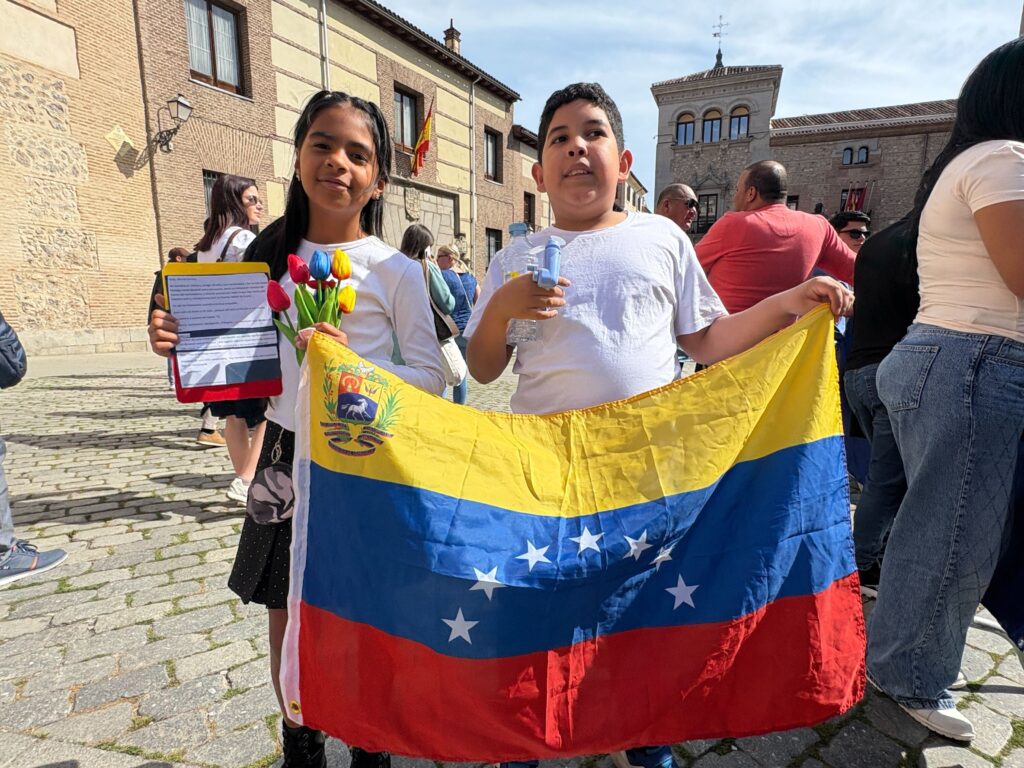
Madrid, Spain – Hundreds of Venezuelans waving flags and chanting “libertad” filled a central Madrid plaza on Friday, as Venezuelan opposition leader, María Corina Machado, arrived for a symbolic ceremony to receive the ‘Llave de Oro’ – or ‘Golden Key.’

Some in the crowd had travelled from across the country to see her on her multi-day visit to Spain. Many sang along as an orchestra played well-known Venezuelan songs.

Inside the city’s historic town hall — and broadcast on a large screen outside — Machado was given the prestigious award, an honor typically reserved for visiting heads of state.

The city’s mayor, José Luis Martínez-Almeida, said it recognized her “fight for freedom, democracy and peace” in Venezuela, describing her as “the embodiment of the Venezuelan people’s resistance”.

Machado, responding, first wished the mayor a happy birthday before saying she hoped to return to Venezuela soon.

“Keys open doors, and today they symbolize the opening to freedom for the Venezuelan nation,” she said, adding that she would one day reciprocate the honor in a free Venezuela.

Many Venezuelans at the event said they too planned to return home if political change comes.

Maribel Santiago, who said she has lived in Spain for 10 years, described Machado as a symbol of hope and optimism for her country.  “I have my suitcases ready,” she said. “When María Corina returns, I will return too.”

10-year-old Mónica (L) travelled from Málaga to Madrid with her mother for a ceremony honoring Maria Corina Machado on April 17, 2016. Image credit: Catherine Ellis for Latin America Reports.

Another Venezuelan in the crowd, 10-year-old Mónica, had travelled from Málaga with her mother to see Machado. After the ceremony, the Venezuelan leader stopped to speak to her and Monica presented her with flowers in the color of the Venezuelan flag and a card. “She’s such an important person to me,” she said. “I will never forget this day.”

The “Llave de Oro” has previously been awarded to only a small number of non-heads of state, underlining the political weight of the gesture.

Machado, who was awarded the Nobel Peace Prize in 2025, had earlier met leaders of Spain’s conservative Popular Party, including Alberto Núñez Feijóo, and also met the leader from the right-wing party Vox, Santiago Abascal..

She is not expected to meet Prime Minister Pedro Sánchez, who is hosting a separate gathering of left-wing leaders in Barcelona this weekend.  

Read more: Latin America’s left gather in Spain to counter far-right

Machado is due to take part in further events over the coming days, including a mass rally on Saturday expected to draw thousands from Spain’s Venezuelan diaspora and a visit to the Senate on Monday.

Spain is home to one of the largest Venezuelan communities in Europe — numbering close to 700,000 — many of whom fled the country’s prolonged political and economic crisis.

Machado also visited Edmundo González Urrutia in hospital. He had been expected to attend Saturday’s rally, but said he would be unable to join due to a follow-up medical procedure.

The retired diplomat stood in for Machado in the 2024 presidential election after she was barred from running and is widely believed by the opposition to have won the vote.

Machado has said she will return to Venezuela “soon”, although no date has been given.

Maria Corina Machado. Image credit: Catherine Ellis
Maribel Santiago attended the event in honor of Maria Corina Machado. Image credit: Catherine Ellis
Maria Corina Machado. Image credit: Catherine Ellis

Featured image: Maria Corina Machado embraces a young girl in Madrid at a ceremony in her honor on April 17, 2026.

Image credit: Catherine Ellis for Latin America Reports

The post Maria Corina Machado receives symbolic ‘golden key’ in Madrid as Venezuelans welcome her appeared first on Latin America Reports.

  • ✇Latin America Reports
  • Flávio Bolsonaro meets Trump amid bank scandal fallout Brazil Reports
    New York, US — Flávio Bolsonaro, the son of former President Jair Bolsonaro and a pre-candidate in Brazil’s upcoming elections, met on Tuesday with U.S. President Donald Trump at the White House.  While Bolsonaro’s eldest son shared a photo on X alongside Trump in the Oval Office, the Republican president has not commented publicly on the meeting as of the time of publication, nor did the meeting appear on his official agenda.  On Wednesday, Flávio posted a photo with Christopher Landau, the U
     

Flávio Bolsonaro meets Trump amid bank scandal fallout

27 May 2026 at 22:22

New York, US — Flávio Bolsonaro, the son of former President Jair Bolsonaro and a pre-candidate in Brazil’s upcoming elections, met on Tuesday with U.S. President Donald Trump at the White House. 

While Bolsonaro’s eldest son shared a photo on X alongside Trump in the Oval Office, the Republican president has not commented publicly on the meeting as of the time of publication, nor did the meeting appear on his official agenda

On Wednesday, Flávio posted a photo with Christopher Landau, the U.S. Deputy Secretary of State, the country’s number-two diplomat.

Bolsonaro’s visits took place just two weeks after current president and Flávio’s political rival, Luiz Inácio Lula da Silva, visited Trump. 

Shortly after his meeting with Trump in Washington, Flávio held a press conference in which he stated that he had asked the U.S. leader to designate the Comando Vermelho (CV) and the Primeiro Comando da Capital (PCC)—the country’s largest criminal factions—as “terrorist groups.” 

“Today, I had the honor of being received by the President of the United States, Donald Trump, in the Oval Office of the White House. I arrived at 3:00 PM and left the premises at 4:40 PM. I want to state, first and foremost, that this meeting was not brokered by any shady businessman; it was arranged by the President of the United States himself,” Flávio told the press. 

Com o Vice-Secretário de Estado americano Christopher Landau.@DeputySecState pic.twitter.com/MPFSPrSFjd

— Flávio Bolsonaro (@FlavioBolsonaro) May 27, 2026

The presidential hopeful stated that the American leader received him with “enormous cordiality” and that the very first thing he did was ask about his father, the conditions of his imprisonment, and how the family “was coping with the situation.” In March, the elder Bolsonaro was granted house arrest for a coup attempt sentence and has been in and out of the hospital and in poor health.  

“While Lula came to the White House to lobby on behalf of drug traffickers, I came to do exactly the opposite: to emphatically ask President Trump to designate the PCC and the Comando Vermelho as foreign terrorist organizations as soon as possible.” 

Lula’s main opponent in the polls, Flávio inherited his father’s political mantle after the latter was convicted of attempting a coup d’état in September 2025—a conviction that bars the family patriarch from running for office. 

On the other hand, Flávio’s visit to Trump also takes place amidst the political and financial scandal surrounding Banco Master, to which the heir to Brazil’s right-wing political dynasty may be linked. 

Reports published by The Intercept Brasil have revealed close ties between Flávio and Daniel Vorcaro—the bank’s former CEO, who is currently incarcerated and under investigation for allegedly leading a criminal enterprise involved in financial fraud, money laundering, corruption, and asset manipulation. 

Messages exchanged between the two, published by The Intercept Brasil, revealed that Vorcaro was one of the financiers of the film Dark Horse, about Flávio’s father. In an audio recording, Flávio is heard calling Vorcaro “brother” and demanding a portion of the R$ 134 million (US$ 26 million) investment.

The most recent polls have Lula beating Flávio in a run-off 47% to 43%.

Featured image: Flávio Bolsonaro met with U.S. President Donald Trump on May 26, 2026.

Image credit: Flávio Bolsonaro via X.

The post Flávio Bolsonaro meets Trump amid bank scandal fallout appeared first on Brazil Reports.

The post Flávio Bolsonaro meets Trump amid bank scandal fallout appeared first on Latin America Reports.

  • ✇Latin America Reports
  • United Nations negotiates with US to allow fuel into Cuba Raphael McMahon
    The United Nations (UN) has entered into formal negotiations with the United States regarding the entry of fuel supplies to Cuba amid acute fuel shortages caused by a U.S. oil blockade, said Francisco Pichón, the permanent representative of the UN to Cuba. Members of the UN Office for the Coordination of Humanitarian Affairs and the Trump administration are discussing ways “to ensure that fuel can be accessed for humanitarian purposes,” according to Pichón. The UN representative clarified
     

United Nations negotiates with US to allow fuel into Cuba

11 March 2026 at 23:02

The United Nations (UN) has entered into formal negotiations with the United States regarding the entry of fuel supplies to Cuba amid acute fuel shortages caused by a U.S. oil blockade, said Francisco Pichón, the permanent representative of the UN to Cuba.

Members of the UN Office for the Coordination of Humanitarian Affairs and the Trump administration are discussing ways “to ensure that fuel can be accessed for humanitarian purposes,” according to Pichón.

The UN representative clarified that those fuel supplies would be used for “emergency response operations” and to protect the access of “vulnerable people and groups” to “vital services”. 

The recent U.S. oil blockade on oil has led to a growing nationwide humanitarian crisis: many regions are facing prolonged power outages, hospitals are facing increasing pressure as life-saving treatments are disrupted, and the economy is crumbling as schools and workplaces reduce their operational hours. 

The U.S. campaign of economic pressure is widely seen as an attempt to force the Cuban regime into collapse or make its leader grant political concessions to Washington. Senior Republicans in the U.S. have repeatedly suggested that some form of regime change in Cuba is imminent.

During the Shield of the Americas Summit on Saturday, President Trump promised that “great change” was coming to Cuba and its “bad regime that has been bad for a long time.” 

On Monday, President Trump reiterated his warning, claiming that Cuba may soon face either a “friendly” or “unfriendly” takeover by the U.S. 

Republican U.S. Senator Lindsey Graham also told Fox News on Sunday that “the liberation of Cuba is upon us. It’s just a matter of time now.” 

Although there are reports that an economic deal between Washington and Havana could soon be announced, the “unfriendly” option remains a possibility. The U.S. administration’s strikes on Iran or its operation to capture Venezuelan President Nicolás Maduro could serve as templates for a potential military operation against Cuba.

Read more: U.S. Reportedly Closing In On Economic Deal With Cuba

Ricardo Torres, a Cuban economist and research fellow at the Center for Latin American and Latino Studies at American University, spoke to Latin America Reports about the current Cuban crisis and the various iterations of regime change that could occur as a result.

“Whatever emotional and material reserves [Cuban] people once had are now largely exhausted … if the United States strictly enforces the oil embargo, a negotiated solution will likely become inevitable, given the limited support Cuba is receiving from its allies,” the economist said. 

Venezuela, Cuba’s erstwhile closest regional ally, has stopped supplying the island with oil since the capture of President Nicolás Maduro by U.S. forces and in early March an oil tanker bound for the island from Russia – a traditional ally – reversed route under suspected U.S. pressure. 

Commenting on recent revelations about UN-U.S. negotiations, Torres pointed out that the discussions between the White House and the UN will likely be limited to “aid delivery” as opposed to opening an avenue for de-escalation. 

The U.S., he argued, “would [probably] favor a full [political] transition in Cuba” and an end to Communist party rule. Failing that, “they may be prepared to support a phased agreement that starts with building a more stable economic base and proceed from there,” the research fellow concluded. 

Featured Image: A horse-drawn cart in Cuba during the Cuban ‘Período Especial’, the term used to describe the Cuban economic struggles in the 1990s after the Soviet collapse. The scale of current fuel shortages in Cuba has not been seen since the ‘Período Especial’ 

Image Credit: Nick via Wikimedia Commons 

License: Creative Commons Licenses

The post United Nations negotiates with US to allow fuel into Cuba appeared first on Latin America Reports.

  • ✇Latin America Reports
  • What can Venezuelans expect from Delcy Rodríguez’s proposed minimum wage hike?  Julio Blanca
    Caracas, Venezuela — The minimum wage in Venezuela, which stands at 130 Bolívares (VES) or about $0.28 USD, is one of the population’s main pain points, as people have seen their incomes—and consequently their quality of life—plummet. Acting President Delcy Rodríguez last week promised a “responsible” increase to the minimum wage by May 1 (Venezuela’s Labor Day), but didn’t elaborate on specifics.  Latin America Reports spoke with economist Aarón Olmos from the Instituto de Estudios Su
     

What can Venezuelans expect from Delcy Rodríguez’s proposed minimum wage hike? 

14 April 2026 at 13:18

Caracas, Venezuela — The minimum wage in Venezuela, which stands at 130 Bolívares (VES) or about $0.28 USD, is one of the population’s main pain points, as people have seen their incomes—and consequently their quality of life—plummet.

Acting President Delcy Rodríguez last week promised a “responsible” increase to the minimum wage by May 1 (Venezuela’s Labor Day), but didn’t elaborate on specifics. 

Latin America Reports spoke with economist Aarón Olmos from the Instituto de Estudios Superiores de Administración in Caracas who outlined some of the effects a wage increase could have in the country amid continued political uncertainty following the January 3 capture of Nicolás Maduro by U.S. forces. 

“Whatever the amount, it will be welcomed by households in Venezuela because income levels have indeed fallen sharply; they are meager, they are poor. The Bolívar’s purchasing power has been lost. A foreign currency is used as the basis for calculating prices, and that erodes purchasing power,” Olmos said. 

The professor noted that it remains unclear whether this will be a direct increase in wages or in the bonuses the government allocates to certain public employees.

Based on data released by the Central Bank of Venezuela, which indicates the country earned $18.2 billion in oil revenues, Olmos believes there is a significant foundation for funding a substantial public payroll. 

“We’re talking about nearly nine million people—roughly seven million public sector workers and two million retirees,” he said. 

Aarón Olmos. Image credit: LinkedIn

But he cautions that the economic conditions should not be dependent solely on oil sales. “It is essential to recognize that Venezuela would have to diversify, that is, to generate revenue through different channels, not just oil. It has to be oil, mining, raw materials, semi-finished products, and finished goods; in other words, Venezuela would have to activate its entire productive apparatus so as not to depend solely on crude oil sales. The idea is not to depend on the volatility of the energy market but to revive the economy,” he said.

The economist noted that at the production level, some changes would also be necessary, such as revising Venezuela’s Labor Law to ensure that the wage increase works more effectively.

In the case of private companies, Olmos believes there will be adjustments to pay scales, even though this sector has always paid more than the minimum wage. 

“If you raise wages, well, you’ll see a price effect where the price-setter wants to appropriate this person’s surplus—this new income. And well, that appropriation of the surplus will affect both those who earn more and those who earn less,” he said. 

Companies will be on “high alert” he noted, acknowledging that they will have to adjust their pay scales in response to government sector wage increases. “Perhaps not in the same proportions, but clearly some tax adjustment should follow,” he added. 

Wage increases in recent years

The last minimum wage increase in Venezuela was decreed in March 2022, setting it at 130 Bolívars per month. Since then, this nominal amount has remained frozen, although the executive branch has applied adjustments to the “comprehensive minimum income” through non-wage bonuses.

For example, in May 2023, the food voucher (Cestaticket) was increased to the equivalent of $40 USD and the Economic War Bonus to $30 USD (for active workers), resulting in a minimum income of $70 USD per month indexed to the official exchange rate.

Subsequently, in January 2024, a new adjustment to these bonuses was announced to raise the comprehensive income to $100 USD, while still keeping the base salary at the same 130 Bolívars.

A year later, an increase in the total minimum income indexed to $160 USD per month was ordered for active public sector workers. 

This amount was achieved by adjusting the two non-wage benefits: the Cestaticket, which remained at the equivalent of $40 USD, and the Economic War Bonus, which was raised to $120 USD.

Featured image: Delcy Rodriguez.

Image credit: Government of Russia via Wikimedia Commons

The post What can Venezuelans expect from Delcy Rodríguez’s proposed minimum wage hike?  appeared first on Latin America Reports.

  • ✇Latin America Reports
  • Colombia presidential candidates announce running mates as race narrows Alfie Pannell
    Bogotá, Colombia – Iván Cepeda and Abelardo de la Espriella, two of the frontrunners to be the next Colombian president, have announced their choices for vice president following Sunday’s legislative elections and presidential primaries. Cepeda selected Aida Quilcué, a senator and Indigenous leader, to join him on the ticket for the left-wing Historic Pact (Pacto Historico), which won the most congressional seats on Sunday. Meanwhile, de la Espriella, a hard-right outsider, announced today th
     

Colombia presidential candidates announce running mates as race narrows

10 March 2026 at 21:21

Bogotá, Colombia – Iván Cepeda and Abelardo de la Espriella, two of the frontrunners to be the next Colombian president, have announced their choices for vice president following Sunday’s legislative elections and presidential primaries.

Cepeda selected Aida Quilcué, a senator and Indigenous leader, to join him on the ticket for the left-wing Historic Pact (Pacto Historico), which won the most congressional seats on Sunday. Meanwhile, de la Espriella, a hard-right outsider, announced today that he will run alongside ex-finance minister José Manuel Restrepo. 

But the big winner in Sunday’s primary, right-wing Paloma Valencia of the Democratic Center (Centro Democrático) party, has yet to announce her running mate amid mounting speculation.

Cepeda sticks to his guns

On Monday, Cepeda formally announced Aida Quilcué as his running mate. A leader of the Nasa Indigenous group, Quilcué has a record as a staunch defender of human rights and as an advocate for ethnic minorities in Colombia.

She was integral to the negotiation of the ethnic chapter of the 2016 peace accord with the Revolutionary Armed Forces of Colombia (FARC) and has been a key figure in Colombia’s Indigenous rights movement. 

Last month, Quilcué made national headlines when she was kidnapped in her home state of Cauca, in the Colombian Pacific, by dissidents of the FARC. 

Miguel Jaramillo Luján, a Colombian political strategist, described Cepeda’s choice of Quilcué as a “symbolic” one which entrenches his stance as an advocate of peace and human rights.

But the analyst also noted that the selection may not be the most politically savvy move: “From an electoral standpoint, I believe that this is a concentric circle and does not add much electoral power to Iván Cepeda, who I think is acting symbolically but overly prideful in this decision,” Jaramillo told Latin America Reports

De la Espriella’s establishment pick

Abelardo de la Espriella, a criminal defense attorney, has styled himself as an anti-establishment political outsider. His traditional values, tough on crime campaign has been successful so far, regularly placing him in second place in presidential polls.

Today, ‘The Tiger’, as he has styled himself, announced his running mate: José Manuel Restrepo.

Restrepo is an economist at the Rosario University in Bogotá and served as President Ivan Duque’s Minister of Finance and Public Credit from May 2021 to August 2022, running the country’s finances during the COVID-19 pandemic. Before that he was Minister of Commerce, Industry, and Tourism beginning in 2018.

“I think the selection of José Manuel Restrepo… represents an attempt to counterbalance de la Espriella, who has no experience in public office,” said Jaramillo.

While de la Espriella is an outsider, he must take on Cepeda and Valencia, both sitting senators since 2014. Restrepo burnishes the criminal lawyer’s bid by adding proven governance credentials.

When announcing his running mate on Tuesday, de la Espriella said: “My choice of vice president was not driven by political calculation… it was clear to me that a renowned academic, an outstanding economist, and a highly qualified former minister and technician will undoubtedly be the best travel companion.”

Paloma Valencia in the spotlight

On Sunday, Paloma Valencia received over 45% of votes in presidential primaries, although Cepeda and de la Espriella were both absent from the contest.

Valencia’s win, as well as her Democratic Center party’s strong showing in legislative elections – winning the second highest number of seats – bolsters her position in the presidential race, according to experts. 

“From the [primaries], it’s clear that Paloma Valencia is the right-wing’s principal candidate,” Sergio Guzmán, director at Colombia Risk Analysis, a political risk consultancy, told Latin America Reports

Before Sunday’s vote, de la Espriella had been dominating conservative polls. Now, it is unclear which conservative candidate will attract the most voters in May’s election.

Whoever emerges as the winner must face off with Cepeda and will be under pressure to  win over centrist Colombians, said Guzman.

One way to achieve this is by selecting running mates with a broader appeal.

Sunday’s primaries highlighted the widespread popularity of Juan Daniel Oviedo, who was on the same list as Valencia and won 17% of the total votes. The former director of the National Administrative Department of Statistics (DANE), Oviedo is considered center-right and notably more moderate than Valencia.

Valencia is under mounting public pressure to pick Oviedo as her running mate, according to Jaramillo, but the two differ on key issues and Oviedo has specified strict conditions for joining Valencia’s ticket.

“We openly show fundamental differences. For example, I believe in peace,” Oviedo told Colombian radio station Caracol on Monday. “You cannot take positions that do not recognize that the [2016 peace] agreement must be implemented and that it requires more than just bullets to get rid of criminals,” he added.

Valencia has staked her campaign on law and order, promising a ‘mano dura’, or ‘iron fist’, against crime and armed groups in Colombia. Her politics follow those of her party’s founder, ex-president Álvaro Uribe, who waged war on the FARC rebels from 2002 to 2010. 

Today, Valencia told Caracol that she will not compromise on this: “I am an Uribista and I have my values and principles… Neither he [Oviedo] will change nor will I change.” 

But Valencia said she remains open to running alongside Oviedo, with the two due to meet today to discuss a possible joint ticket. She is also considering four other possible running mates, according to Colombian newspaper El Tiempo, with her decision due by Friday.

Jaramillo argues the best move for Valencia is not to pick Oviedo, as he is legally bound to support her as they ran under the same list in the primaries.

He believes she should distance herself from Uribe – arguing Uribistas are more likely to back de la Espriella – and instead court the moderate vote by choosing a center-left candidate.

But Guzmán says that is unlikely: “She seems to be going in a different direction.”

Featured image description: Left to right: Iván Cepeda, Paloma Valencia, Abelardo de la Espriella.

Featured image credit: @PactoCol via X / @PalomaValenciaL via X / @ABDELAESPRIELLA via X

The post Colombia presidential candidates announce running mates as race narrows appeared first on Latin America Reports.

  • ✇Latin America Reports
  • Ecuador doubles tariff on Colombia to 100% Alfie Pannell
    Bogotá, Colombia – Ecuador will impose a 100% tariff on all Colombian imports beginning on May 1, according to a statement by the Ministry of Production, Foreign Trade, and Investment today. The move ramps up tensions between the two South American neighbors, which have imposed reciprocal levies of 50% in a trade war that began in January when Ecuador announced it would charge Colombia a “security fee”. “This measure is based on national security criteria and seeks to reinforce shared resp
     

Ecuador doubles tariff on Colombia to 100%

9 April 2026 at 23:44

Bogotá, Colombia – Ecuador will impose a 100% tariff on all Colombian imports beginning on May 1, according to a statement by the Ministry of Production, Foreign Trade, and Investment today.

The move ramps up tensions between the two South American neighbors, which have imposed reciprocal levies of 50% in a trade war that began in January when Ecuador announced it would charge Colombia a “security fee”.

“This measure is based on national security criteria and seeks to reinforce shared responsibility in a task that must be undertaken jointly to address the presence of drug trafficking at the border,” read a statement by the trade ministry on Thursday announcing the tariff hike.

Bogotá and Quito have clashed over border security issues in recent months, with Ecuadorean President Daniel Noboa accusing his counterpart of failing to deter criminal groups operating in the region.

Colombian President Gustavo Petro has defended his administration’s security record and imposed reciprocal levies against Ecuador.

The two countries were due to hold talks next week to resolve the trade war but these were cancelled yesterday amid a dispute over former Ecuadorean Vice President Jorge Glas. Quito recalled its Ambassador from Bogotá after Petro suggested Glas was a political prisoner and had not been treated humanely in jail.

The tariffs threaten economic shocks on both sides of the border; Ecuador imports medicine, sugar, vehicles and coffee from Colombia and exports wood panels, canned fish, frozen seafood, palm oil, and rice.

Featured image description: Colombia-Ecuador border photographed in 2020.

Featured image credit: Burkhard Mücke via Wikimedia Commons

The post Ecuador doubles tariff on Colombia to 100% appeared first on Latin America Reports.

  • ✇Latin America Reports
  • Another political prisoner dies in custody in Venezuela  Julio Blanca
    Caracas, Venezuela — Another political prisoner in Venezuela has died, NGO Foro Penal reported last Saturday. The news came just days after the Venezuelan government admitted that another political prisoner, Víctor Hugo Quero Navas, had died months earlier from medical complications while in state custody.  The deaths bring renewed attention to the plight of over 450 political prisoners that remain behind bars months after U.S. special forces captured strongman Nicolás Maduro.  José Ma
     

Another political prisoner dies in custody in Venezuela 

15 May 2026 at 18:53

Caracas, Venezuela — Another political prisoner in Venezuela has died, NGO Foro Penal reported last Saturday.

The news came just days after the Venezuelan government admitted that another political prisoner, Víctor Hugo Quero Navas, had died months earlier from medical complications while in state custody. 

The deaths bring renewed attention to the plight of over 450 political prisoners that remain behind bars months after U.S. special forces captured strongman Nicolás Maduro. 

José Manuel García Sabino, 31, was a former councilman from the northeastern city of Anaco and part of the ruling United Socialist Party of Venezuela (PSUV).

Before being jailed, he had denounced corruption inside the Mayor’s Office and the City Council to the disparagement of party officials. 

Local news outlets reported that García Sabino died on May 9 inside a police station. 

Initial reports indicated that he had taken his own life by self strangulation. However, after conducting a forensic examination, authorities determined that the cause of death was mechanical asphyxiation, leading the case to be classified as a homicide.

The Scientific, Penal, and Criminal Investigations Corps (CICPC) arrested 12 officers from the Anaco Municipal Police for their alleged involvement in the case. Following a hearing, six officers were detained.

In addition, they ordered the removal of Pedro Parra, who had served as director of the local police agency since 2022 and is now in custody.

García Sabino, the former councilman, was arrested on February 23 related to an investigation into alleged fraud involving an informal savings scheme known as Susú, used for the purchase of motorcycles.

That same day, his wife, Scarlet Ortiz, was also arrested related to the fraud investigation. Following García Sabino’s death, Ortiz was released from prison, where she had reportedly given birth to the couple’s child while she was being held. 

La esposa del exconcejal José García Sabino, asesinado en el retén de Polianaco, en El Tigre, estado Anzoátegui, fue liberada la noche de este martes. Scarlet Ortiz estaba recluida desde el 23 de febrero y dio a luz mientras era procesada por estafa agravada.

🎤 @susanaquijadac pic.twitter.com/8IBDNyXOV7

— El Noticiero Televen (@El_Noticiero) May 13, 2026

She posted a message on social media thanking God for her freedom and her lawyers for their efforts.

So far this year, the Venezuelan Prison Observatory has reported 16 deaths of detainees in state custody.

These deaths occurred amid deplorable conditions such as medical neglect, overcrowding, violence, institutional opacity, and the absence of basic safeguards for life.

The observatory stated on X that “behind this figure are men who fell ill without medical care, prisoners who died in overcrowded cells and prisons, families forced to pay for medicine, food, and supplies, and a state that maintains absolute control over these people but does not guarantee their lives.”

They are demanding that authorities conduct thorough and impartial investigations into the deaths.

Featured image: José Manuel García Sabino

The post Another political prisoner dies in custody in Venezuela  appeared first on Latin America Reports.

  • ✇Latin America Reports
  • Colombia’s top military commander says army facing increasingly sophisticated drones Catherine Ellis
    Bogotá, Colombia – The sophistication of drones used by armed groups is escalating rapidly in Colombia as the military expands efforts to tackle them, the commander of Colombia’s armed forces told Latin America Reports. “We are dealing with terrorists using drones carrying grenades that are dropped from different altitudes, as well as wire-guided drones,” General Hugo Alejandro López Barreto said, referring to some of the latest and most difficult drones to counter. On June 2, one person w
     

Colombia’s top military commander says army facing increasingly sophisticated drones

8 June 2026 at 18:00

Bogotá, Colombia – The sophistication of drones used by armed groups is escalating rapidly in Colombia as the military expands efforts to tackle them, the commander of Colombia’s armed forces told Latin America Reports.

“We are dealing with terrorists using drones carrying grenades that are dropped from different altitudes, as well as wire-guided drones,” General Hugo Alejandro López Barreto said, referring to some of the latest and most difficult drones to counter.

On June 2, one person was reportedly killed in a drone attack in La Tarra, in the conflict-ridden Catatumbo region. A day earlier, six children and one adult were seriously injured in Suárez, Cauca, in an attack authorities attributed to the Jaime Martínez structure of the FARC dissident group.

According to Colombia’s Ministry of Defence, 333 drone attacks successfully struck targets or caused damage in 2025, compared with 61 incidents in 2024 — an increase of 445 percent.

While the FARC disbanded under the 2016 peace accord, some splinter groups emerged. These factions, as well as the National Liberation Army (ELN) guerrilla group, frequently target each other and the military, with civilians often caught in the middle.

General Lopez explained that the military is employing a variety of strategies to counter the growing use of drones by these structures.

“We already have units deployed with anti-drone equipment that will allow us to counter the actions of these criminals and also target those carrying out these attacks against us,” he said. Lopez added that the armed forces were responding through a combination of ‘technical and non-technical measures,’ including protective equipment and weapons capable of bringing down the aircraft.

While drones have been used by Colombia’s armed groups for around a decade, initially for reconnaissance and intelligence gathering, their use in attacks has increased sharply in recent years.

The first recorded death linked to a drone attack occurred in 2024, when a 10-year-old boy was killed while playing football in El Plateado, Cauca.

According to defense analyst and drones expert, Camilo Mendoza, since armed groups began using drones in an organized way in 2024, they have gained the advantage over security forces.

“Groups use drones for both surveillance and attacks, and they have learned a great deal from Ukraine. Ukraine has been the laboratory of modern warfare for the last three or four years,” he explained.

“The success of drones, both in Colombia and in Ukraine, comes down to cost. Drones are very cheap and can do many things.”

According to Mendoza, who also wrote the book Colombia Under Drone Threat, the main groups using drones are the FARC dissident group Estado Mayor Central and the National Liberation Army (ELN), which employ the devices for both surveillance and attacks. The Clan del Golfo also uses drones, although primarily for reconnaissance purposes.

As the technology has evolved, so too have efforts to counter it. In October 2025, Colombia’s Defence Ministry launched BANOT, described as Latin America’s first military battalion dedicated to countering drone threats. Authorities have also invested in radio-frequency jammers and tactical radar systems as part of a broader anti-drone strategy and have an anti-drone shield planned.

But analysts say the pace of development means the military is struggling to keep up. Where initially groups were buying cheap drones in major cities or online sites, like Amazon, now they’re using more sophisticated ones, including First Person View (FPV) drones and fibre-optic drones, which pose challenges for security forces.

“The fibre-optic drones cannot be detected or jammed because the systems simply cannot see them,” Mendoza said.

Traditional anti-drone systems work by disrupting the signal between an operator and an aircraft. But newer drones can be modified to reduce the effectiveness of those countermeasures.

“All anti-drone systems in Colombia operate through the electromagnetic spectrum,” Mendoza explained. “They have no effect on these newer systems, and the drones can continue carrying out attacks even when battalions have anti-drone equipment.”

While analysts warn of the challenge drones pose to security forces, humanitarian organizations say civilians are increasingly bearing the consequences.

“This is not a new phenomenon, but the speed at which it is escalating is alarming,” Antonio Salvatore Armentano, Colombia representative at The United Nations Mine Action Service (UNMAS) told Latin America Reports. “Communities on the ground are absorbing a threat that policy frameworks have barely begun to name.”

In a recently released technical report on drones in Colombia, UNMAS highlighted that in many territories, the only available defence is “the visual and the acoustic detection by recognizing the distinctive ‘buzzing’ sound of drones and attempting to flee.”

While not all drones are used to attack — some are for surveillance — communities have no way of knowing, and so the sound or sight of drones induces psychological distress.

“The harm does not end when the attack does. Communities living under the sound of drones experience chronic fear and anxiety. Not every drone is armed – but no one on the ground can tell the difference. That uncertainty is itself a form of violence,” Armentano said.

As armed groups adopt increasingly sophisticated drones, humanitarian organizations warn that civilians are likely to face a growing share of the consequences.

Featured image description: A member of the Colombian Air Force holds a drone.

Featured image credit: Fuerza Aerospacial de Colombia.

The post Colombia’s top military commander says army facing increasingly sophisticated drones appeared first on Latin America Reports.

  • ✇Latin America Reports
  • Cuban energy minister announces country has run out of fuel oil and diesel  Raphael McMahon
    Cuba has “absolutely no fuel oil and absolutely no diesel”, according to the country’s Energy Minister, Vicente de la O Levy. His comments, made to state-run media on Wednesday, underline the severity of Cuba’s energy crisis, which has been intensified by a near-total U.S. blockade on fuel imports since January.  The effects of the fuel shortages were felt immediately, with widespread power outages on Wednesday night sparking protests in Havana. Though the protests soon dissipated, large s
     

Cuban energy minister announces country has run out of fuel oil and diesel 

15 May 2026 at 19:21

Cuba has “absolutely no fuel oil and absolutely no diesel”, according to the country’s Energy Minister, Vicente de la O Levy.

His comments, made to state-run media on Wednesday, underline the severity of Cuba’s energy crisis, which has been intensified by a near-total U.S. blockade on fuel imports since January. 

The effects of the fuel shortages were felt immediately, with widespread power outages on Wednesday night sparking protests in Havana. Though the protests soon dissipated, large sections of eastern Cuba remained in darkness on Thursday. 

While Cuba has domestic reserves of natural gas and crude oil, it lacks the money to maintain or upgrade its refineries, which are necessary to convert high-viscosity crude oil into fuel oil, essential to electricity generation. 

“Cuba is open to anyone that wants to sell us fuel”, Levy implored.

However, Cuba has largely been cut off from international oil imports by the U.S., which threatened to impose tariffs on any country supplying oil to Cuba and severed Venezuelan oil supplies to the Cuban state.

Despite this, Russia sent an oil tanker to help alleviate the crisis in March and China has also helped Cuba mitigate its reliance on imported fuel by helping install solar parks across the island. 

Nevertheless, it is unclear if any country would be willing to provide Cuba with enough oil to sustain its national grid indefinitely. There is also no guarantee that the U.S. would allow new foreign oil imports to arrive. 

The U.S. is reportedly considering sending the island a humanitarian aid package worth US$100 million to ease the effect of its own oil blockade of the island, with CIA Director John Ratcliffe visiting Havana yesterday to discuss “intelligence cooperation, economic stability, and security issues”. 

Ratcliffe is likely the first CIA Director to visit the island since 1953, as the U.S. and Cuba have been staunch geopolitical adversaries since the triumph of the Cuban Revolution in 1959. 

Although the two nations are involved in official diplomatic negotiations, tensions between Washington and Havana have been rising dramatically. The North American superpower has repeatedly threatened the Cuban leadership with political regime change and has ratcheted up punitive sanctions against officials and economic entities deemed to be linked to the Cuban regime. 

Although the U.S. claims its measures are solely targeted at the Cuban government, the punitive measures have contributed to an economic and humanitarian crisis that is harming many ordinary Cubans, with hospitals, schools and workplaces facing shortened operating hours because of power cuts. 

Critics of the Cuban regime, however, argue that the energy shortages and the humanitarian suffering in the Caribbean nation are a result of the political leadership’s authoritarianism, economic mismanagement and corruption.

Featured Image: An oil refinery near Regla, Cuba 

Image Credit: Marcel601 via Wikimedia Commons

License: Creative Commons Licenses

The post Cuban energy minister announces country has run out of fuel oil and diesel  appeared first on Latin America Reports.

  • ✇Latin America Reports
  • Bukele-inspired Abelardo de la Espriella wins first round of Colombia elections John Boscawen
    Bogotá, Colombia – Hard right provocateur Abelardo de la Espriella won a shock victory in the first round of Colombia’s presidential elections Sunday, and will head to a run-off with leftist Iván Cepeda in June.  The most recent voter intention polls had predicted Cepeda beating de la Espriella in the first round by an average of eight points. With over 99% of votes counted, de la Espriella leads Cepeda, by nearly three percentage points (43.7% to 40.9%).  A run-off election will ta
     

Bukele-inspired Abelardo de la Espriella wins first round of Colombia elections

1 June 2026 at 00:57

Bogotá, Colombia – Hard right provocateur Abelardo de la Espriella won a shock victory in the first round of Colombia’s presidential elections Sunday, and will head to a run-off with leftist Iván Cepeda in June. 

The most recent voter intention polls had predicted Cepeda beating de la Espriella in the first round by an average of eight points.

With over 99% of votes counted, de la Espriella leads Cepeda, by nearly three percentage points (43.7% to 40.9%). 

A run-off election will take place on June 21 since no candidate achieved over 50% vote share.

Read more: Candidate guides for the 2026 Colombian elections: Abelardo de la Espriella

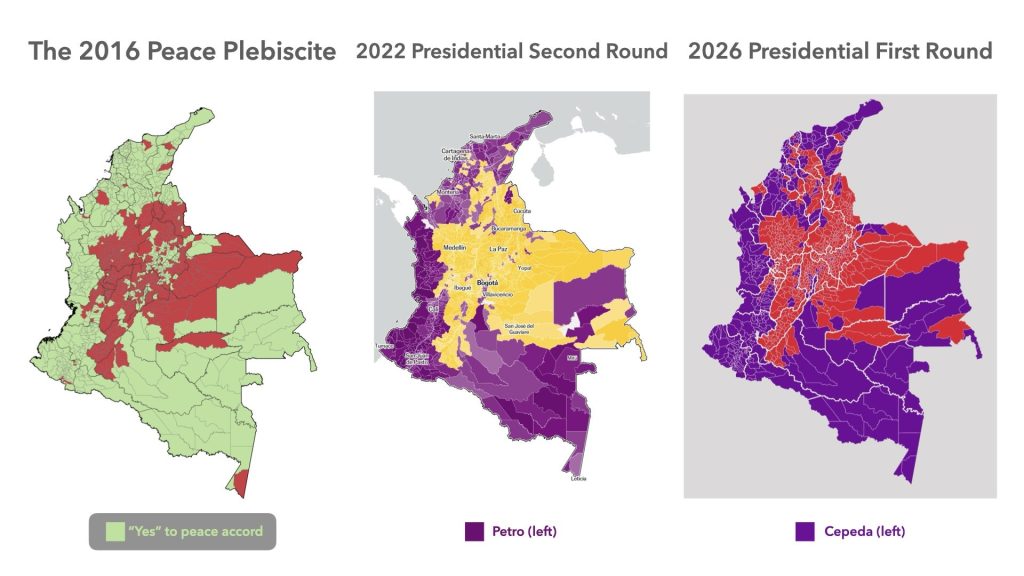
Voting closely followed political divisions seen in previous elections — including in 2022 when Gustavo Petro won the presidency, as well as the 2016 plebiscite for a peace agreement with FARC rebels — with voters rural areas impacted by Colombia’s armed conflict voting for Cepeda while voters in the heart of the country (save the capital Bogotá) voting for de la Espriella’s Defensores de la Patria ticket. 

Image credit: WOLA’s Adam Isaacson via X.

Paloma Valencia, a right-wing senator backed by former President Alvaro Uribe, was considered a favorite to make it to the second round alongside Cepeda as recently as early May, but her campaign ran out of steam in the final weeks and she ended with less than 7% of the vote.

Yann Basset, a political scientist from the University of Rosario in Bogotá told Latin America Reports that he expects Valencia’s supporters will rally around de la Espriella, handing him a victory in the run-off in three weeks’ time.

De la Espriella, who has run a slick, AI-augmented social media campaign, promised to “defeat the tyranny of the left.” 

His proposals include the construction of 10 mega-prisons, a la El Salvador strongman Nayib Bukele, and militarization of the whole territory in order to combat illegal armed groups. 

Read more: Candidate guides for the 2026 Colombian elections: Iván Cepeda

For his part, Cepeda ran on a continuation of Petro’s Historic Pact for Colombia party, including continuing efforts to achieve “Total Peace” with its many armed groups and narrowing the inequality gap in society. 

“Colombia can and should be a just country. A country in which each citizen and every community has effective access to indispensable rights, property and services for a fulfilling life,” Cepeda said on the eve of elections. 

Sunday night, Petro said he would not accept the preliminary count results, and defiant Cepeda supporters at the campaign event in the Tequendama Hotel in Bogotá were heard chanting “No pasarán!” (“They will not pass!”), referring to their right-wing rivals. 

Featured image: Abelardo de la Espriella at a campaign rally in Nariño, Colombia in April 2026.

Image credit: Abelardo de la Espriella on X.

The post Bukele-inspired Abelardo de la Espriella wins first round of Colombia elections appeared first on Latin America Reports.

❌
Latin America Reports