Normal view

  • ✇SoraNews24 Japan
  • Forget Tokyo go-karts – there’s a new way to sightsee on four wheels in Japan Oona McGee
    Machi Mobi offers a safer and more environmentally friendly way to see the tourist sites. For many overseas tourists in Tokyo, a tour around the city on four wheels means joining a fleet of go-karts. What many tourists don’t know, though, is there’s an alternative tour that’s safer for both drivers and the environment, and it’s called Machi Mobi. ▼ Machi Mobi (“まちモビ”) combines the Japanese word for “town” with “mobility”. According to organisers, the Machi Mobi experience is a new way to expl
     

Forget Tokyo go-karts – there’s a new way to sightsee on four wheels in Japan

16 June 2026 at 15:00

Machi Mobi offers a safer and more environmentally friendly way to see the tourist sites.

For many overseas tourists in Tokyo, a tour around the city on four wheels means joining a fleet of go-karts. What many tourists don’t know, though, is there’s an alternative tour that’s safer for both drivers and the environment, and it’s called Machi Mobi.

▼ Machi Mobi (“まちモビ”) combines the Japanese word for “town” with “mobility”.

According to organisers, the Machi Mobi experience is a new way to explore the city that sits somewhere between walking tour and sightseeing bus. The pace is slow and relaxed, and there are two modes of transport to choose from – rickshaw or Rodem. A Rodem is an electric mobility vehicle that can easily be operated by a wide range of people, including the elderly and those with mobility impairments.

Operating out of the Tokyo Midtown Yaesu shopping and business complex, this sightseeing experience offers guided street tours that take you around the Nihonbashi area. Each Rodem tour lasts around 90 minutes, with tickets costing 2,000 yen (US$12.46) on weekdays and 2,500 yen on weekends and public holidays, so you can take in the views at a leisurely pace.

After hearing about the Rodem experience, our reporter Natsuno Futon was keen to try it, but at the time it was Golden Week, a busy holiday period, so every tour was fully booked. She managed to make a reservation for a later date, but as luck would have it, it fell on a June day that happened to be pouring with rain. As the tour still operates on rainy days (as long as it’s not too rainy), Natsuno didn’t have to miss out for a second time, but that did mean she had to contend with the weather while she scooted around town.

It was a weekday afternoon so the streets weren’t too busy, and the meeting point was conveniently located right next to Tokyo Station’s Yaesu Exit. When she arrived, she was pleased to find that the staff had raincoats prepared for participants.

According to staff, some people do cancel when it rains, so they were happy to see Natsuno, who was joined by a few others on the day. After a quick briefing on the route and a rundown of the safety instructions, it was finally time to hop aboard the Rodem.

▼ With its rounded shape and low seating position, Natsuno felt as if she was riding on a giant ladybug.

▼ The controls were simple: a single hand-operated joystick lets you move forward, reverse, and steer.

As the tour group received instructions from the guide, Natsuno noticed that they received curious looks from passersby. Had she not known about the tour, Natsuno too would’ve been curious, because like the onlookers around them, she’d never seen such a cute mobility scooter before.

▼ Natsuno’s test ride was so fun it had her grinning like a Cheshire cat.

In reality, the scooter moves much more slowly than it does in Natsuno’s GIF, so she felt safe, secure and confident when the group finally took off.

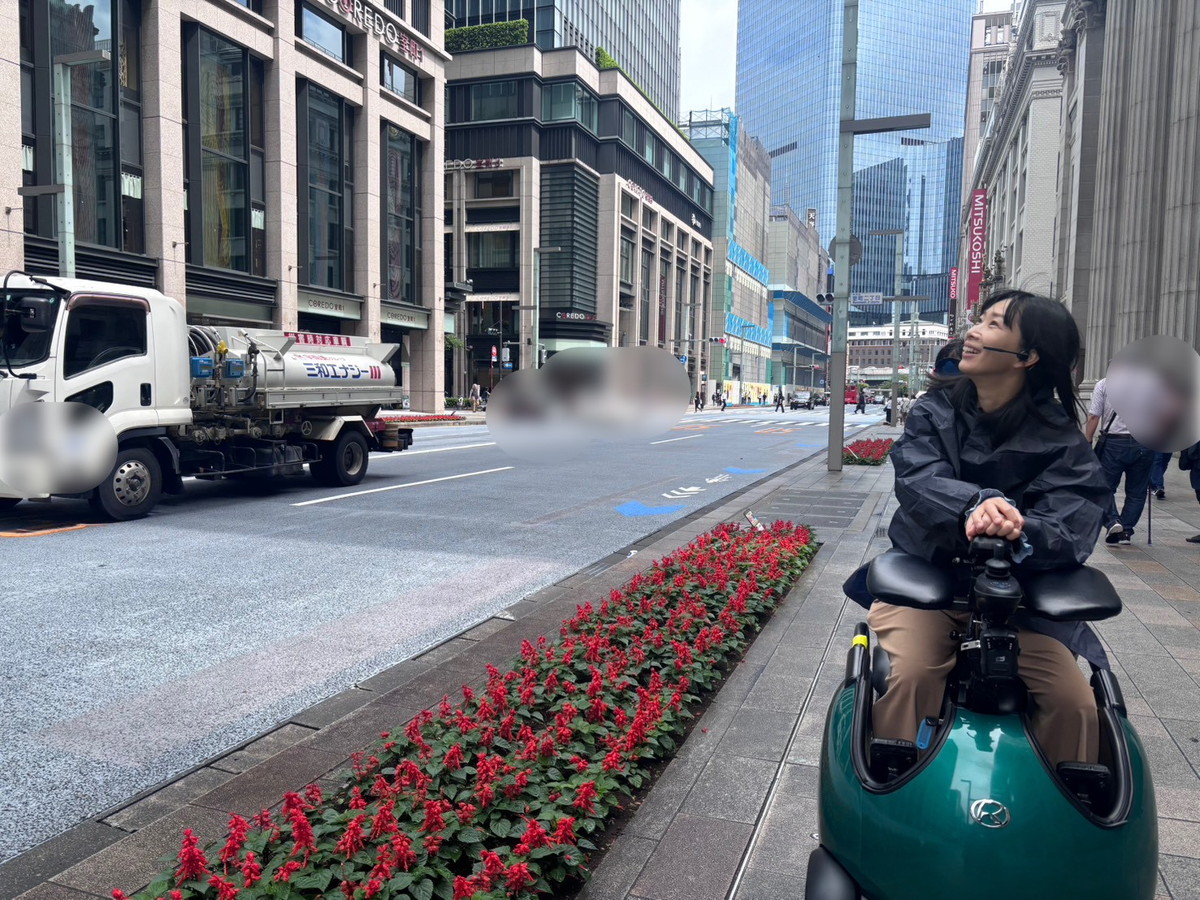
▼ Sitting in her cute Rodem, the rain couldn’t dampen her spirits.

As the group moved slowly along the sidewalk, this familiar street now felt somehow new to her.

Simply being on a Rodem changed how everything looked to her, and she was able to even enjoy the beauty of the roadside flowers as she trundled by.

Because the scooter moves much slower than walking pace, you naturally start noticing buildings and other details you’d normally overlook.

With staff members riding at the front and back of the group, Natsuno felt well looked after as she admired the city. The guide’s commentary was also really engaging, and she lost count of how many times she found herself surprised by what she’d heard.

▼ The guide’s commentary is delivered through bone-conduction earphones like the ones shown here.

Natsuno learned why there are no power lines or trees along the street known as Chuo-dori, and she also heard about the history of the Nihonbashi area and how redevelopment is steadily reshaping the neighbourhood, giving her a new appreciation for the area.

▼ About 15 minutes after departure, they arrived at the famous Nihonbashi bridge.

After stopping for a few photos, and to answer questions from passersby who wanted to know what they were riding, the tour continued on.

They heard more fascinating stories about the ornamental finials on the bridge (known as “giboshi” in Japanese) and the Nihonbashi River cruise. Natsuno has decided to leave out the details, though, so as not to spoil the experience for any future participants.

As they made their way further, like languid snails traversing the streets, Natsuno glanced up at the sky and realised the clouds had parted, blessing them with sunny weather.

▼ It was perfect timing as they were now nearing their next stop: Fukutoku Shrine, a lucky power spot.

Here, they were able to actually hop off their Rodems and pray at the shrine, which is famous for granting prayers pertaining to lottery wins, particularly for tickets to live concerts and stage performances.

After enjoying some time in this spiritual oasis, the group stepped back into their scooters and continued their tour through the city.

They listened to the tour guide’s food recommendations and interesting backstories about the history of various shops, before returning to the starting point about 90 minutes after the tour had begun.

Riding a futuristic-looking vehicle while exploring a city with roots going back to the start of the Edo period in 1603 made for a very memorable, and oddly fascinating, experience.

Despite having no particular interest in history, Natsuno found the tour to be incredibly insightful, and she reckons it will be even more enjoyable for history buffs. Regardless of whether you’re into history or not, the Rodem tour offers a completely different perspective on the city. It made Natsuno more aware of things she wouldn’t normally notice in Tokyo, like changes in sidewalk elevation, the pace of pedestrians, and how many people are actually looking at their phones while walking.

▼ Seeing Tokyo from a new perspective.

Each Rodem can accommodate either one person, or a parent and young child, making it a great activity for young families looking for a fun and relaxed way to see the sights. As a tour that can be enjoyed by a wide variety of ages, the Machi Mobi is a fun activity for both locals and overseas tourists, and a safer and more environmentally friendly alternative to Japan’s controversial go-karts.

Tour Details
Machi Mobi
 / まちモビ
Address: Tokyo-to, Chuo-ku, Yaesu, 2-1-4, Yaesu Central Square, Tokyo Midtown Yaesu
東京都中央区八重洲2-1-4 東京ミッドタウン八重洲 八重洲セントラルスクエア
Open: 9:30 a.m.-5:30p.m. Closed Tuesdays and Wednesdays
Tour times: Three departures daily (except Tuesdays and Wednesdays) at 10 a.m./1 p.m./3 p.m.
Tour Duration: 90 minutes per tour
Price: 2,000 yen (weekdays), 2,500 yen (weekends and holidays)
Bookings: Online reservations required via the official website
Website

Images©SoraNews24
● Want to hear about SoraNews24’s latest articles as soon as they’re published? Follow us on Facebook and Twitter!

George Kittle and Wife Claire Show Off Their Storybook Nashville Cabin — See Inside! (Exclusive)

9 June 2026 at 13:00
The San Francisco 49ers tight end and his wife purchased their home in late 2024 and worked with Pottery Barn to transform it into an off-season retreat

© <p>Pottery Barn</p>

  • ✇Camille Styles
  • Inside a Soulful California Home That Inspires A Slower Way of Living Nicole Ziza Bauer
    Editor’s Note: There’s something magical about a home that truly reflects its owner—a space that feels deeply personal, rooted in memory, and in harmony with its surroundings. That’s exactly the feeling you get stepping into Lily Riesenfeld’s thoughtfully curated home, featured in Sense of Place, a stunning book by my dear friend Caitlin Flemming and her mother, Julie Goebel. Together, they’ve built a body of work that celebrates the art of creating spaces infused with meaning. Step inside
     

Inside a Soulful California Home That Inspires A Slower Way of Living

15 May 2026 at 10:00
Dog in living room

Editor’s Note: There’s something magical about a home that truly reflects its owner—a space that feels deeply personal, rooted in memory, and in harmony with its surroundings. That’s exactly the feeling you get stepping into Lily Riesenfeld’s thoughtfully curated home, featured in Sense of Place, a stunning book by my dear friend Caitlin Flemming and her mother, Julie Goebel. Together, they’ve built a body of work that celebrates the art of creating spaces infused with meaning.

Step inside a special home that proves: our surroundings have the power to inspire, comfort, and connect us more deeply to what matters.

A Home Rooted in Place

When you meet Lily Riesenfeld, you can’t help but notice that she seems tethered to the earth with deep roots.

An advocate for environmentally friendly living, Lily seems deeply comfortable in her surroundings. Her 1921 black shingled home with mahogany doors and trim sits in harmony with the surrounding mighty redwood trees, and hiking trails meet the backyard. Lily and her family chose this home because it is located near the trails of Mount Tamalpais, with San Francisco Bay inlets to the east and the Pacific Ocean to the west.

Pin it

A Childhood Spent Outdoors

Lily grew up in Berkeley, California. When she was eight years old, her family bought a ranch in Healdsburg, California, a short drive from their home.

“Watching my mom and dad develop a vision for the ranch was special,” states Lily. Over the years, the family planted several hundred trees, built a ranch home, restored a redwood barn from the 1850s, and eventually planted one hundred acres of French varietal grapes. Her family developed the ranch with the idea for animals, the vineyard, and natural habitats to coexist. Lily’s favorite part of going to the ranch is sharing it with people who come to visit.

Along with the ranch in Healdsburg, where they spent most summers, the family also went to visit various family homes for two weeks every summer in Maine. As a child, Maine was somewhere she could be wild and free. The furniture on the porch, as well as the porch itself, in the home belonging to her great-grandparents, was painted in a celadon green that the family called “Gamby green,” after her great-grandmother. Gamby loved the shade so much that she even had a set of Wedgwood china made in the color. Many of the choices Lily has made in her home were inspired by her grandmother’s home in Maine, the family home in Berkeley, and the ranch in Healdsburg.

Pin it

Building a Life at the Intersection of Wellness and Purpose

During her early adult years, Lily began her work with a focus on personal wellness and launched her first entrepreneurial endeavor, The Lily Pad, located in Malibu. After meeting her husband and moving back to the San Francisco Bay area, Lily also cofounded The Pad Studios, which is both a Pilates and yoga studio. Over the years, she began developing purpose-driven events to help communities connect, launching a brand called the Kinship Experience. As those experiences evolved, “I began moving my work to the intersection of human health and global health,” states Lily. She then launched a summit called Futurewell.

Pin it kitchen

Today, Lily is an advocate for regenerative agriculture and works to advance healthy, equitable food systems. She is fundraising for a regeneratively built Center for Food and Agriculture, which will offer a permanent farmers’ market by the Marin Civic Center. “The building we have plans to erect will be drawing down more carbon and energy than it uses.”

A Home Designed in Harmony

Lily designed her Larkspur home with guidance from Caitlin Flemming. “Caitlin was a huge inspiration and the reason my home came together in the most synchronistic way possible.”

The colors within the home coexist in a calm harmony. Earth tones of deep greens, wheat, and a light shade of blue are mixed with a diversity of complementary patterns. All of these color choices can be found in the outdoors around her—the golden hills, the redwood trees (one of which is in her garden), and the light blues and grays of the water.

Walls in both the entry and the dining room are covered in a large-scale William Morris pattern. Curtains and pillows use smaller prints combined with a touch of wood-toned plaid in many rooms. Two petite vintage French chairs are covered in a hand-printed leaf pattern, continuing the spirit of the outdoors. Even the plates are a combination of patterns of vintage transferware in varying shades of green, along with pieces from her great-grandmother’s green Wedgwood.

If there is a heart to this home, it would unquestionably be the kitchen, where homemade tortillas sit wrapped in a linen towel by the stove and slow-simmering pinto beans are ready for anyone who is hungry. It’s a place to be nourished, and Lily is ready to welcome those in need of its healing power.

Pin it

10 Reflections on Home

1. What drew you to where you live?

It was definitely Mount Tamalpais and the hiking here. We didn’t even look at Berkeley, even though our families live there. We also thought it would be good to be a bridge away from our parents.

2. How do the surroundings of where you live inform your aesthetic in your home?

The colors of the nature where I live definitely inform my aesthetic.

3. What is your idea of home?

A place for people to gather and to feel comfortable—a place you instantly feel at ease.

4. What is your favorite season where you live? Why?

I would have to say late summer. Suddenly, the light changes, and there is a golden cast to everything.

Pin it

5. Is there anything you collect?

Anyone can see that I have a soft spot for wicker baskets and hats. I also love anything for the kitchen, especially interesting pottery.

6. How do you spend your weekends?

We spend our weekends hiking, cooking, and going to our children’s sporting events. When we can get away in the winter, I love going to our cabin in Sugar Bowl, which is very close to Tahoe, that was built in the 1930s to look like a Swiss village.

7. What can’t you live without?

Probably a latte in the morning. Of course, my children and husband, too! Also, my morning hike every day is what keeps me sane.

8. What elements turn your house into a home?

I think it feels like my home because it has a strong element of nostalgia. I also love adding layers of textures and textiles. This home is the opposite of stark.

Pin it

9. How does your home fuel your creativity?

I love styling meals and bringing people together at the table. Every Sunday, my mother-in-law comes to dinner, and I always make an effort to dress up and make a nice meal.

10. Are there people or businesses close to home that you rely on to fuel your creativity?

I have learned so much from Alice Waters, after having the pleasure of doing a few curated events alongside her. Alice’s specific direction taught me how to make an experience about food, and how to perfectly execute the presentation. For the purpose side of my work, I am inspired by local creatives such as Paul Hawken, Jack Kornfield, Dr. Daniel Siegel, and my dearest friend, Jennifer Siebel Newsom.

The post Inside a Soulful California Home That Inspires A Slower Way of Living appeared first on Camille Styles.

❌
Subscriptions