Julia Garner for Loewe. Photograph by Talia Chetrit; Courtesy of LoeweThe fashion calendar can be a confounding thing. Just when the weather warms up and the public starts shedding layers, unearthing long-abandoned sundresses—brands begin releasing their fall collections. Your current mind-set might be focused on how to style thong sandals, or which pair of shorts will be your go-to this year. But right on schedule, the fall 2026 campaigns are already rolling out right now. Of course, you have t
Julia Garner for Loewe. Photograph by Talia Chetrit; Courtesy of Loewe
The fashion calendar can be a confounding thing. Just when the weather warms up and the public starts shedding layers, unearthing long-abandoned sundresses—brands begin releasing their fall collections. Your current mind-set might be focused on how to style thong sandals, or which pair of shorts will be your go-to this year. But right on schedule, the fall 2026 campaigns are already rolling out right now. Of course, you have the option of admiring the laissez-faire French attitudes of Celine’s offerings to come, or perhaps daydreaming about the drama of Balenciaga’s Celine Song-directed world. Remember those pieces that call out to you, but keep them in the back of your mind—save the front for open-toe shoes and floppy, sun-protecting hats. Feel free to peruse the looks that will be everywhere next season, or check back here when you’re mentally ready to dive into some seriously chic fall fashion.
Loewe
Photograph by Talia Chetrit; Courtesy of Loewe
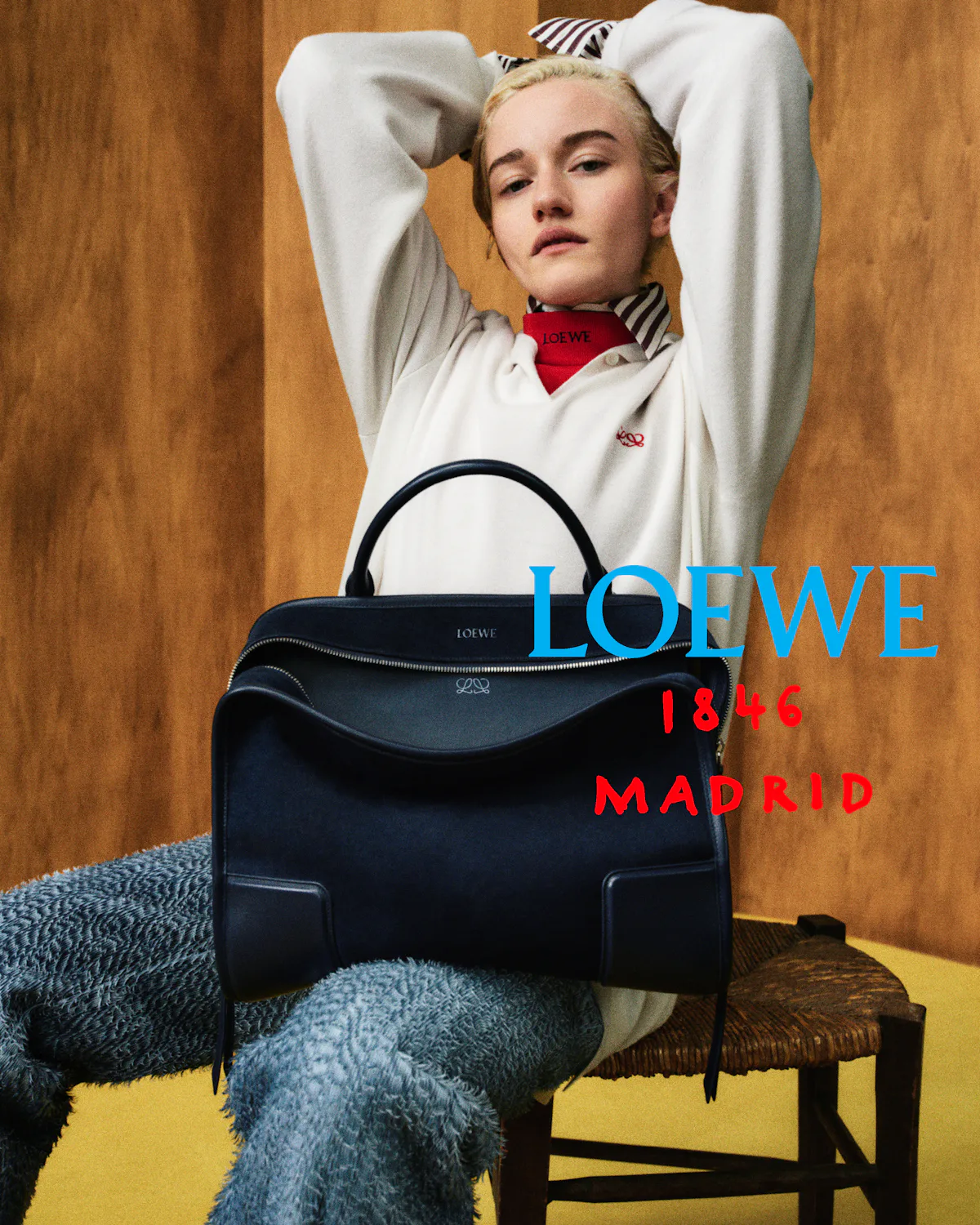
Loewe is celebrating its 180th anniversary with a campaign honoring almost two centuries of leather craftsmanship—and a playful spirit. Brand ambassador Julia Garner stars alongside Sissy Spacek and artist Kara Walker in the Talia Chetrit-shot images, showcasing an array of iconic Loewe handbags from across the decades.
Loewe
Photograph by Talia Chetrit; Courtesy of Loewe
From the Flamenco clutch (launched in the ’80s) to the Puzzle bag of 2015, the campaign highlights the enduring impact of these accessories. Also on display is the Amazona 180, which was introduced in 1975 and recently reimagined by creative directors Jack McCollough and Lazaro Hernandez for their debut collection at the house. The selection proves Loewe’s affinity for the past, as well as its ability to adapt to the present and lead the future.
Balenciaga
Courtesy of Balenciaga
Celine Song lent her directorial talent to Balenciaga for A New York Minute, the brand’s theatrical fall 2026 campaign, starring Love Story actor Sarah Pidgeon.
Balenciaga
Courtesy of Balenciaga
The campaign, which takes the form of three one-minute films, finds Pidgeon during a day in Manhattan as the actor engages in mundane tasks. She retrieves her dry cleaning, crosses a busy street, and takes a cab home. These are simple actions every New Yorker makes daily, but zoom out, and you will find it’s all movie magic.
Balenciaga
Courtesy of Balenciaga
Song’s videos act as an exploration of movie-making and city life. Of course, they’re also a meditation on Pierpaolo Piccioli’s latest offerings for the brand. Each scene finds Pidgeon in a different Balenciaga look, always with one of the brand’s classic bags in hand. It proves that Piccioli’s Balenciaga can be utilized in everyday life, but there is an added sense of drama to this wardrobe, even if you might not notice it at first.
Celine
Photograph by Zoë Ghertner; Courtesy of Celine
Celine invites you to a day at the beach in celebration of its fall 2026 campaign. The sun hides behind clouds, but the warmth comes from those around you. A group lounges on the sand and rocks and blocks each other from the whipping wind. They layer up in tailored coats with oversize shoulders and collegiate sweatshirts, protecting their belongings in patterned totes.
Celine
Photograph by Zoë Ghertner; Courtesy of Celine
Accessories are key. Beaded necklaces layer atop a short-sleeve knit and sunglasses cover almost every set of eyes. Color comes in the form of nautical stripes and green accents on a silk scarf. Red flannel provides a sense of nonchalance, as does the wind-blown hair and the up-close nature of Zoë Ghertner’s imagery.
Burberry
Photograph by Mario Sorrenti; Courtesy of Burberry
Burberry is getting in the football spirit ahead of the 2026 FIFA World Cup this summer. The brand has released its autumn 2026 campaign, “A Good Sport,” celebrating the energy of the sport’s fandom.
Burberry
Photograph by Mario Sorrenti; Courtesy of Burberry
Jason Sudeikis, who has become especially familiar with footy thanks to his work on Ted Lasso, stars in the campaign alongside actors Jodie Turner-Smith, Lucy Punch, and Stephen Graham. Also featured are Romeo Beckham, models Rosie Huntington-Whiteley and Neelam Gill, as well as football stars Eberechi Eze, Leah Williamson, Naomi Girma, and Son Heung-min.
Burberry
Photograph by Mario Sorrenti; Courtesy of Burberry
“Burberry has connected football fans across generations for decades,” says the brand’s chief creative officer, Daniel Lee. “It’s only right that we celebrate that this summer....There’s a certain attitude to being a good sport that is very British and very Burberry.”
Courtesy of Mirren Gordon-Crozier“Boobs are a big part of the show,” says Margo’s Got Money Troubles’s costume designer Mirren Gordon-Crozier. Anyone who has watched the Apple TV+ series starring Elle Fanning, Michelle Pfeiffer, and Nick Offerman knows that’s an understatement. Margo follows Fanning as Margo Millet, a college student with ambitions of becoming a writer who drops out after getting pregnant by her English professor. When she decides to keep the baby, she turns to OnlyFans to suppo
“Boobs are a big part of the show,” says Margo’s Got Money Troubles’s costume designer Mirren Gordon-Crozier. Anyone who has watched the Apple TV+ series starring Elle Fanning, Michelle Pfeiffer, and Nick Offerman knows that’s an understatement. Margo follows Fanning as Margo Millet, a college student with ambitions of becoming a writer who drops out after getting pregnant by her English professor. When she decides to keep the baby, she turns to OnlyFans to support her child, creating the sci-fi-inspired online persona Hungry Ghost. So yes, there are a lot of boobs—sometimes even green ones.
Gordon-Crozier was tasked with dressing both Margo and Hungry Ghost, two wildly different versions of Fanning’s character. Fortunately, the costume designer has plenty of experience transforming the 28-year-old actor. The pair have collaborated on five projects, including Margo, and have developed an easy shorthand over the years. “I know what looks good on her and what fabrics she likes,” Gordon-Crozier tells W, “But I always put her in itchy sweaters she complains about.”
Fanning and Gordon-Crozier on set. | Courtesy of Mirren Gordon-Crozier
Beyond the itchy sweaters, Margo saw Fanning in everything from 70-year-old knits to DIY cone bras while embodying her alien alter ego. Gordon-Crozier also relished dressing Pfeiffer as a kind of Real Housewives of Orange County reject, scooping up every fur-trimmed and snakeskin piece she could find across Southern California for the actor’s character, Margo’s mother, Shyanne. “She’s actually from Orange County,” Gordon-Crozier says of Pfeiffer. “So she was like, ‘This is who I would be if I hadn’t left.’” Below, Gordon-Crozier shares behind-the-scenes details from dressing the Margo cast—rounded out by Nicole Kidman, Greg Kinnear, Rico Nasty, Nick Offerman, and Thaddea Graham—along with exclusive images from the set.
Courtesy of Mirren Gordon-Crozier
“In the beginning of the show, Margo’s a student, and so I think she's trying to fit in,” Gordon-Crozier says. “She’s emulating her professor's style a bit, while putting her own twist on it. Like this knit [sweater] I got from the ’50s, but underneath she's wearing a red lace top.”
Courtesy of Mirren Gordon-Crozier
“It was really important for us to get this alien t-shirt right. We wanted to bring in that element of what happens later on in the script, like she’s looking at herself in the mirror and seeing herself in that t-shirt and getting ideas.”
Courtesy of Mirren Gordon-Crozier
“Margo is in that age range where she's definitely thrifting. She’s also probably taking clothes from her mother's closet, and they have a little bit of a magpie essence to them where they like sparkly and flashy things, but Margo wears them in a different way. So, I definitely wanted to incorporate Shyanne’s wardrobe into Margo’s.”
Courtesy of Mirren Gordon-Crozier
“For Shyanne, I took a lot of inspiration from the first two seasons of Real Housewives of Orange County before they went into logomania,” Gordon-Crozier says. “Michelle is so game for everything. She really got the character.”
Courtesy of Mirren Gordon-Crozier
“During the fittings, a big conversation was, ‘Does [Shyanne’s partner] Kenny like the cleavage? Is he okay with the cleavage? Or, does he want her to hide the cleavage?’ We decided to go with something in between. We would veil the cleavage a lot, and then every day, we would move her cross necklace up or down, depending on what Michelle was wearing, so it would lie perfectly.”
Courtesy of Mirren Gordon-Crozier
“Susie was one of my favorite people to dress,” Gordon-Crozier says of Margo’s roommate, played by Thaddea Graham. “I was really inspired by Rosanna Arquette's daughter, Zoë Blue. She has the most amazing style. It’s very whimsical. She'll wear a slip from the 1800s with a black choker. Susie's really creative, but we don't see that until later, when their basic roommates leave, and she can start being herself. We also found a lot of inspiration from real girls on Instagram with homemade, quirky style. Susie can crochet. She has a glue gun. She knows how to make her own stuff. But she's also figuring out her style. As the season progresses, you see that she becomes more and more of who she wants to be.”
Courtesy of Mirren Gordon-Crozier
“Susie is kind of the opposite of Margo in a way. She spends a lot more time thinking about her layers and what she's going to wear, who she's going to be that day.”
Courtesy of Mirren Gordon-Crozier
“Our whole thing with Margo is that she's a bit of a slob, so that's why sometimes her outfits are mismatched. She just grabs them from the ground.”
Courtesy of Mirren Gordon-Crozier
“Elle’s prosthetics were so good. We wanted to find a way to show her stomach, so we put her in this Poster Girl bodysuit,” Gordon-Crozier recalls. “But she’s not fully the Hungry Ghost yet, so she’s hiding it with a sweet little vintage ’70s cotton top. I think the lace skirt is Free People. She's always a mix of sexy and sweet.”
Courtesy of Mirren Gordon-Crozier
“This is what Margo wears to meet [her baby’s father] Mark's mother, so this is her dressing up. My assistant is very good at felting so we hand-felted this. We found a preexisting vest and just added those circles on. There’s a vintage ’70s lace top underneath.”
Courtesy of Mirren Gordon-CrozierCourtesy of Mirren Gordon-Crozier
“The older people in this show are a little stuck in the era when they were most beautiful and thriving, before reality kicked in. So Shyanne and Jinx [Nick Offerman], and even Lace [Nicole Kidman] are a bit stuck in the ’90s.”
Courtesy of Mirren Gordon-Crozier
“That is a Paco Rabanne skirt, which she wears twice. I liked it with the body suit because of the juxtaposition.”
Courtesy of Mirren Gordon-Crozier
“There are a few repeat hero pieces,” Gordon-Crozier says. “Margo has her hero cowboy boots, which Elle actually took home because she loved them so much. There’s also her hero denim jacket which she wears a lot. She wears this white lace skirt twice. And then the red tassel jacket she wears a couple of times, too. I tried to repeat as much as possible.”
Courtesy of Mirren Gordon-Crozier
“Lace’s wrestling costume was all made of latex. I’d never worked with latex before so that was an interesting challenge. You can't just cut and sew it. You have to go to a specialist.”
Courtesy of Mirren Gordon-Crozier
“This was in the beginning, when Margo didn't really know what her OnlyFans character was. We thought, ‘What would Susie have?’ Susie's into cosplaying, elves, and all that underworld stuff. So this is us essentially taking stuff from Susie's closet.”
Courtesy of Mirren Gordon-Crozier
“This is one of my favorite outfits,” Gordon-Crozier says. “It’s a Poster Girl top and a Victoria's Secret bra. The skirt is vintage from the ’80s. And there’s a vintage belt and metallic boots, which I think are from Santee Alley. This is where Margo and the Hungry Ghost come together. She's a little more confident and she is finding her style. It's a well-thought-out outfit for her—perfect for her going out on the town.”
Courtesy of Mirren Gordon-Crozier
“This is my favorite Shyanne look. It’s Roberto Cavalli and the boots are Paris Texas.”
Courtesy of Mirren Gordon-Crozier
“Both Margo and Shyanne are magpies. They like sparkly things. So I think Margo genuinely likes her maid-of-honor dress, even though it probably came right off the rack from Bloomingdale's. But there was something less generic about it that I liked. In reality, it is vintage and we paired it with a Collina Strada necklace.”
Courtesy of Mirren Gordon-Crozier
“As she progresses into the world of OnlyFans, she has little money and she buys herself some new things. She’s meeting up with [her OnlyFans friends Rose and KC] and she’s playing into what maybe she thinks they would wear too.”
Courtesy of Mirren Gordon-CrozierCourtesy of Mirren Gordon-Crozier
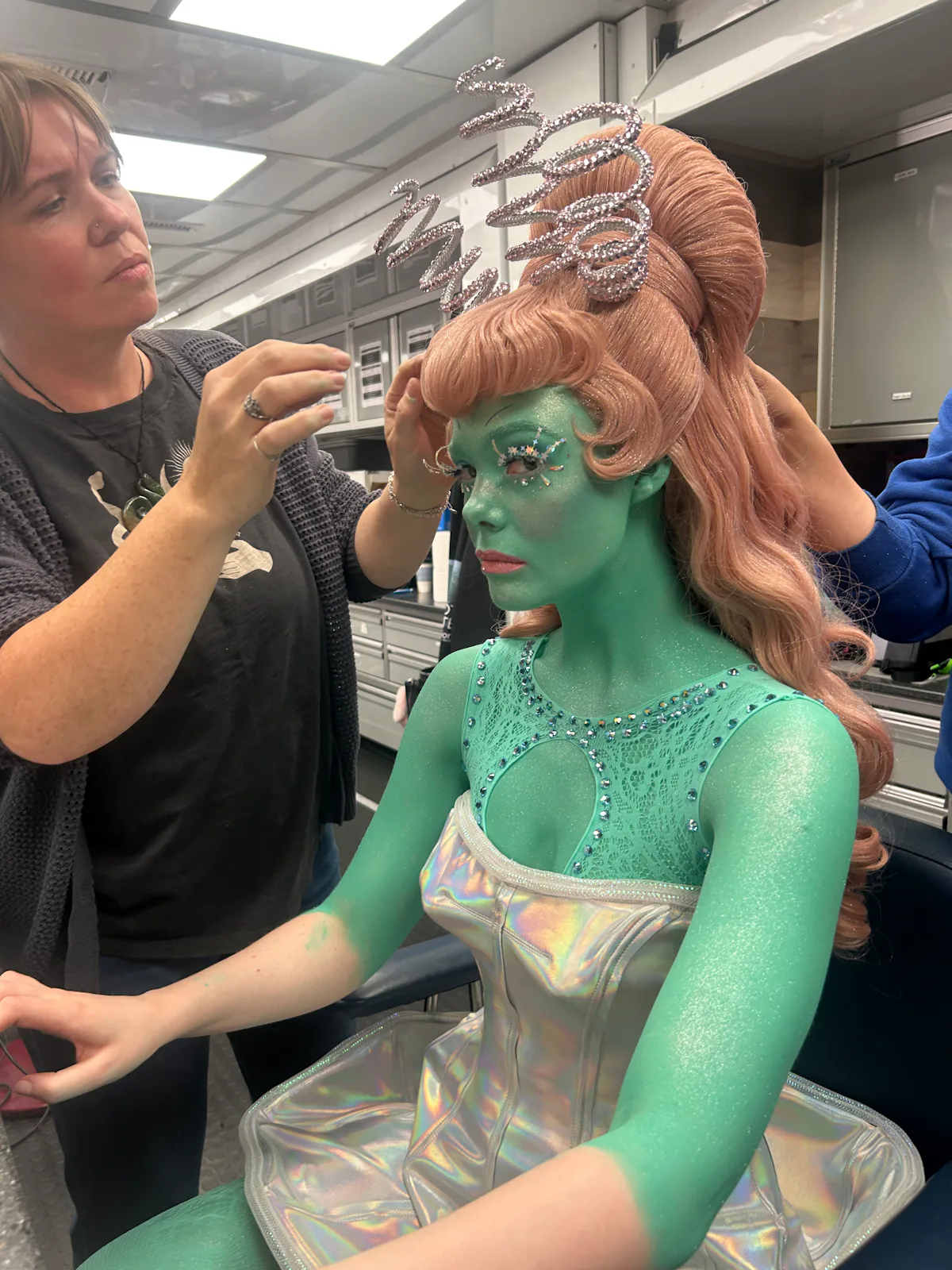
“We wanted [the Hungry Ghost look] to be DIY in a way because Susie is supposed to be making it all,” Gordon-Crozier says. “It's sort of janky, for lack of a better word, in a purposeful way, using things you can get at the store and are easily accessible. It’s a throwback to that [fall/winter 2017] Gucci ad from Alessandro Michele [and Glenn Luchford]. That was a big inspiration. So were the ’60s. We tested the body paint color a lot. Instead of a straight blue or green, we went with a teal.”
Courtesy of Mirren Gordon-Crozier
“The platform boots are from Dolls Kill. We got a lot of things from there. Elle helped me add little moons and aliens to them. Everything was custom-made and special. We also made the cones with the tassels. I purposely put the cones on the outside. It’s a little tongue in cheek.”
Courtesy of Mirren Gordon-CrozierCourtesy of Mirren Gordon-Crozier
“A lot of [Rico Nasty and Lindsey Normington’s] stuff was from Wasteland, Dolls Kill, and then costume houses like Western Costume or Palace. They just have the wildest things in there.”
Courtesy of Mirren Gordon-CrozierCourtesy of Mirren Gordon-Crozier
“Hair, makeup, and wardrobe collaborated a lot. Here, KC and Rose are cowboys, so we made their hair into lassos. Everyone in my costume department helped bedazzle the hats and belts, and we added the marabou to the bottom of the pants.”
Courtesy of Mirren Gordon-Crozier
“This is another one of my favorite outfits. The bodysuit is [J.Kim]. I don't even want to say where the skirt is from because Margo probably wouldn't be able to afford it. It’s Bode, but let’s say she found it at Wasteland and got a really good deal.”
Courtesy of Mirren Gordon-Crozier
“I’m obsessed with this look and the green. That coat is vintage—real mink. We got that from a costume house. Elle looks so good in these body suits, so we just kept putting her in them.”
Courtesy of Mirren Gordon-CrozierCourtesy of Mirren Gordon-CrozierCourtesy of Mirren Gordon-Crozier
“We had a bucket on set, and everyone would put their [soda] can tabs in it. We collected hundreds of them and sewed them all onto Susie’s Shadowheart costume. That was fun.”
Courtesy of Mirren Gordon-Crozier
“Lace was really fun to dress,” Gordon-Crozier says of Kidman’s character. “She’s a lawyer now, so I considered what sort of suits an ex-wrestler would be attracted to. I did a lot of ’90 silhouettes and superhero colors. This one is Thierry Mugler.”
Images courtesy of Getty, Shutterstock, and HBO. Treatment by Kimberly DuckI recently met a woman who raised me. Her name is Lena Dunham. I was invited to an event for her new memoir, Famesick, at Gloria Steinem’s house, sponsored by Warby Parker. I understand how many twists and turns that sentence took. I live a life that is both deeply unserious and never taken for granted. But I’ve been a self-proclaimed feminist and an internet obsessive as long as I’ve had −4.75 vision, so maybe the cultur
Images courtesy of Getty, Shutterstock, and HBO. Treatment by Kimberly Duck
I recently met a woman who raised me. Her name is Lena Dunham. I was invited to an event for her new memoir, Famesick, at Gloria Steinem’s house, sponsored by Warby Parker. I understand how many twists and turns that sentence took. I live a life that is both deeply unserious and never taken for granted. But I’ve been a self-proclaimed feminist and an internet obsessive as long as I’ve had −4.75 vision, so maybe the cultural crossover makes some sense.
I try not to pedestal people. It’s in no one’s best interest to have idols but it felt impossible not to geek out over the fact that I was somehow sitting cross-legged on the floor of Steinem’s home listening to her drop F-bombs and talk shit about Philip Roth, while in conversation with Dunham, the woman who inadvertently guided me through the shitstorm of my 20s via the blueprint of her hit HBO show, Girls. My entire personality and the early part of my writing career were built on the belief that I was a Jessa, when really I was a Marnie in Hannah’s clothing.
Photo by Alo Ceballos/FilmMagic
There’s a chance I came out the womb with a Jessa sensibility, but probably not, because she likely resembled a cherub baby, and I was born with jaundice. My internal monologue and hyper-niche, hyper-online brain were molded by women like Dunham and an army of mothers of pop culture that came before me.
I should make it clear that a mother, to me, can be anything. In the larger (read: gayer) sense of the word, a mother doesn’t have to be a parent or even a woman. The title is tossed around a bit too freely these days, but the root of the word, which stems from the Black and Queer ballroom scene, is about leadership, caretaking, paving a new way, and serving cunt. Use that information as a barometer and read along with an open mind.
These pop culture mothers gave me a backbone, a roadmap, an attitude problem, and some of my most basic values and ethics.
Madonna
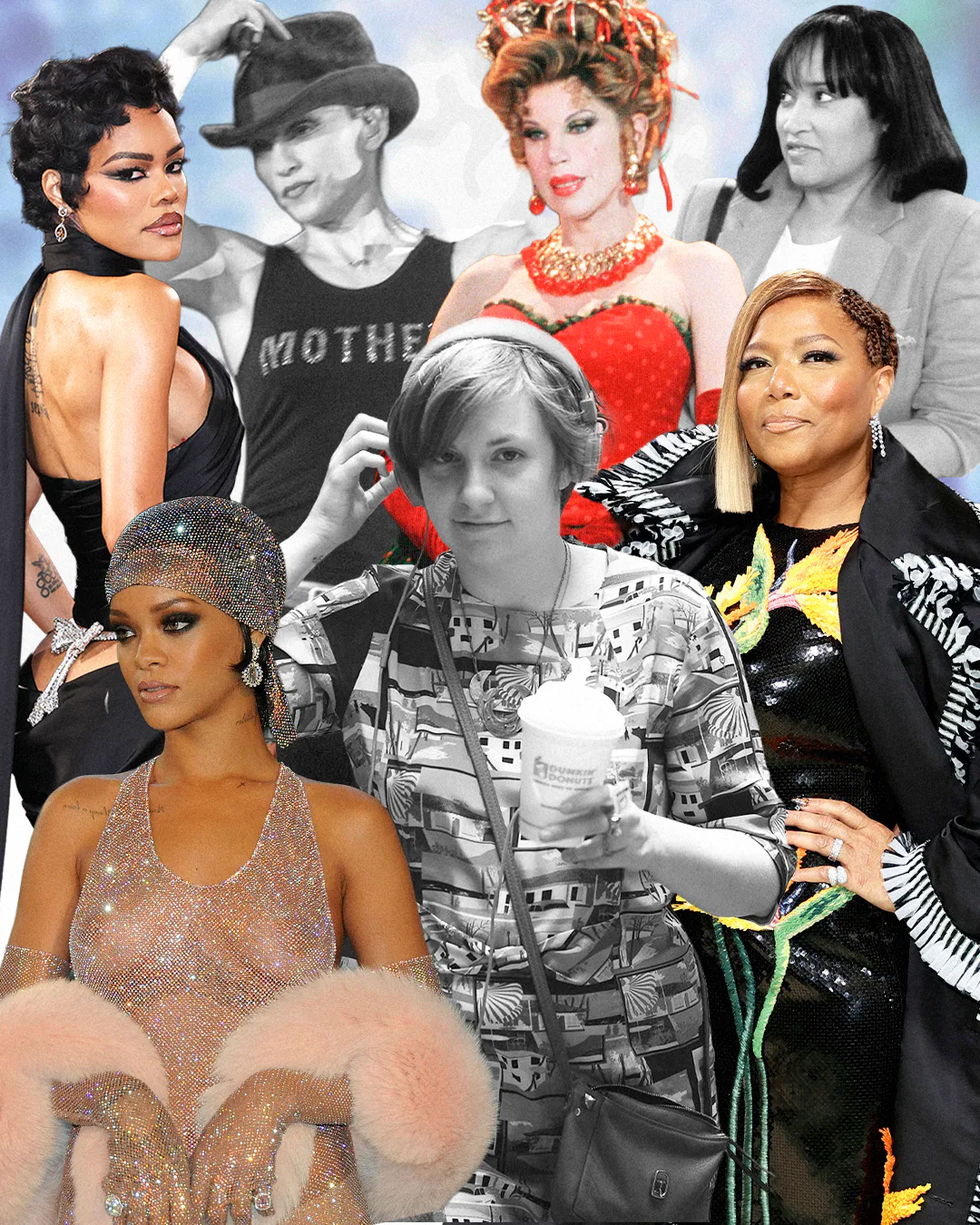
Madonna might sound like a cop out, but this is a very specific cosign. Madonna became my mother the second I saw what her knees could do during her 2001 Drowned World Tour, and it cemented for me when I FINALLY watched that one interview clip where she gets really hot and demands a fan. "I have a problem with the fact that there is no air in here, and I'm going to die. Open the door NOW!” The most beautiful thing a woman can be is dramatic. This brief exchange between her and some poor scrambling set PAs taught me the art of unabashedly advocating for my needs.
Photo by Jon Furniss
Rihanna
Rihanna is an actual cop out. I don’t care. This is my truth and I haven’t lied in two years. Having a mononym is mother behavior. Rolling a joint on your security’s bald head at Coachella is mother behavior. Having your shoulders back and your titties up and out, especially when covered in Swarovski crystals, is mother behavior. Never being anywhere on time is definitely mother behavior, just ask mine.
Photo by Larry Busacca/Getty Images
Martha May Whovier
Martha May Whovier (Christine Baranski) may not have had any children, but this woman gave natural birth to me when she thrust her hips forward and used a light cannon to decorate her Whoville estate. More domme femmes need to be represented in media. It is a scene that makes any young lesbian sit up straight. Keri Hilson said it first, but pretty girls really do rock. Most importantly, Martha May showed me love is not about looks but about mutual disdain for an opp. And Christmas.
Christine Baranski, Jim Carrey, Jeffrey Tambor in How The Grinch Stole Christmas, 2000 | Melinda Sue Gordon/Imagine Ent/Kobal/Shutterstock
Jackée Harry
I love it when a woman has a mouth on her—what can I say? I have one too, and I’m not afraid to use it, all thanks to Lisa Landry. Jackée Harryin Sister, Sister is a total mess (complimentary). And that’s what motherhood is to me: being both loud and often wrong. Motherhood is having a good blowout and sexual tension with your children’s father. Motherhood is always carrying a quippy retort in your back pocket and being totally insane.
Photo by ABC Photo Archives/Disney General Entertainment Content via Getty Images
Queen Latifah
Queen Latifah in Beauty Shop. Queen Latifah in Hairspray. Queen Latifah in Last Holiday. Queen Latifah in Ice Age. Queen Latifah in Thom Browne, always. Queen Latifah in Set It Off. Queen Latifah in Just Wright. Queen Latifah in the opening scene of Taxi. Queen Latifah in Bringing Down The House.
Photo by Udo Salters/Getty Images
The mom from Easy A (Patricia Clarkson)
Behind every great woman is her gay husband. I grew up with divorced parents, so it is always important for me to see healthy relationships on-screen. Rosemary Penderghast (perfect name, no notes) does the kind of soft parenting TikTok moms can only dream about. I would be entertained listening to Patricia Clarkson read a telephone book, but she and Stanley Tucci simply speaking the letter “T” or every single line reading in this scene from Easy A will change the trajectory of your life. It changed mine.
Tyra Banks having never yelled at a girl like that in her life (on ANTM)
I can’t in good faith call Tyra Banks a mother, but I did see the spirit of my mother leap out of her when she berated Tiffany on America’s Next Top Model, Cycle 4. Sometimes you watch a reality TV clip, and you're transported to the bra section in Nordstrom Rack at age 13.
Strega Nona
When someone says bring out your baddest bitch, it’s always Strega Nona for me. She may have been a witch, but she was a caretaker first. There’s nothing more maternal or Italian than a woman who constantly wants to feed you, especially with dense carbs. The story of Strega Nona is a lesson in community building as well as a warning about men who don’t know how to listen to directions (hint: it’s all of them).
Simon & Schuster
The Original Aunt Viv
I need to give (the dark-skinned) Aunt Viv her flowers, a bouquet, honestly, a botanical garden. This is a woman who is caring, patient, and strict with it when she needs to be. There is a dance class scene in The Fresh Prince of Bel-Air that is burned into my brain, in which Aunt Viv’s skill level is doubted by a group of younger dancers. Not only did it radicalize me about the importance of showing off, but learning the dance itself has proven to be an incredible party trick. An auntie can also be a mother, and we don’t talk about that enough.
Toni Collette
I simply couldn’t decide if Toni Collette was more mother in that one dinner scene in Hereditary that every good gay person is off-book on, or as all the versions of Tara Gregson in United States of Tara, a TV show too many people slept on, but not me! I will avenge you, Diablo Cody!
Showtime
Teyana Taylor (The Queen of New York)
To be a mother is to be a multi-hyphenate, by the way. From her abdomen in the Fade music video, to her belly and her machine gun in One Battle After Another, to the way she fixes her mom’s dress on the carpet, to the way her daughter fixes her dress on the carpet. My fingers are twitching, wanting to write something sexual, but I already did that with Christine Baranski, and you can just check my Twitter account for that.
Photo by Rodin Eckenroth/FilmMagic
The Nutbrown Hare from Guess How Much I Love You
In contrast to everyone above, this is going to sound like a major tonal shift, but please know I’ve been serious this whole time. This book is the reason why my mom calls me Bunny. This is the book that has been ours for forever. This is a book I will read to my future children if I need another way to tell them how much their mother loves them.
Kristina Bumphrey/Variety/Getty ImagesRumors about an American Psycho remake may persist, but until that classic film gets its official reboot treatment, there’s another Bret Easton Ellis project in the works. The author’s 2023 book, The Shards—his first novel in 13 years following 2010’s Imperial Bedrooms—has been adapted into an FX series by Ryan Murphy.The highly metafictional novel, which imagines a fictionalized version of Ellis as a teenager in 1980s Los Angeles at the center of a series o
Rumors about an American Psycho remake may persist, but until that classic film gets its official reboot treatment, there’s another Bret Easton Ellis project in the works. The author’s 2023 book, The Shards—his first novel in 13 years following 2010’s Imperial Bedrooms—has been adapted into an FX series by Ryan Murphy.
The highly metafictional novel, which imagines a fictionalized version of Ellis as a teenager in 1980s Los Angeles at the center of a series of disturbing murders, was originally released by Ellis as a serialized audiobook on his Patreon. Following the novel's publication, it was set to be adapted into an HBO series, with Luca Guadagnino directing (the Call Me By Your Name filmmaker is also reportedly attached to the American Psycho remake). But after Ellis had a falling out with the network over creative differences, Murphy signed on as Ellis’s new co-creator. Here’s everything we know so far:
Who is in the cast of The Shards?
The cast of the 10-episode series features some newer faces alongside recurring Ryan Murphy players. Igby Rigney will play Ellis, while Richard Gere’s son, Homer Gere—currently making his mark on another gritty teen drama with Euphoria—will play antagonist Robert. (It’s a fitting casting, given that Ellis has frequently spoken of the influence Gere’s American Gigolo character had on his work). The main cast is rounded out by Graham Campbell, Hayes Warner and Wes Bentley, with Kaia Gerber, Evan Rachel Wood, Jordan Roth, Owen Painter, and Daniel Dale in the supporting ensemble.
What will the plot of The Shards be?
Assuming the series sticks to the novel’s general structure, The Shards will tell the dark coming-of-age tale of a fictionalized, 17-year-old Ellis as he tries to determine the identity of a serial killer targeting classmates and families at his privileged prep school. The killer, known as “The Trawler,” plucks off members of Ellis’s elite inner circle one by one in increasingly disturbing ways. Set in 1981 Los Angeles among the children of Hollywood’s upper crust of directors, producers, and writers, The Shards is considered a thematic and tonal return to Ellis’s Less Than Zero and the nihilistic work that first made him a literary darling. With Murphy’s touch, the series is set up to be particularly gruesome.
How is Bret Easton Ellis involved?
Ellis is credited as a creator and writer on the series.
Is there a release date for The Shards?
The Shards wrapped production in March and is slated to premiere on FX in August 2026.
Gareth Cattermole/Getty Images Entertainment/Getty ImagesDuring her ongoing press tour for Steven Spielberg’s Disclosure Day, Emily Blunt has embraced an array of enchantingly structural designs by Alaïa, Stella McCartney, and more. Her latest romantic look, which also embraces medieval references and luxe glamour, continues to show she’ll always keep you guessing when it comes to fashion.On the red carpet for the sci-fi film’s official United Kingdom premiere, Blunt fittingly arrived to Rose C
During her ongoing press tour for Steven Spielberg’s Disclosure Day, Emily Blunt has embraced an array of enchantingly structural designs by Alaïa, Stella McCartney, and more. Her latest romantic look, which also embraces medieval references and luxe glamour, continues to show she’ll always keep you guessing when it comes to fashion.
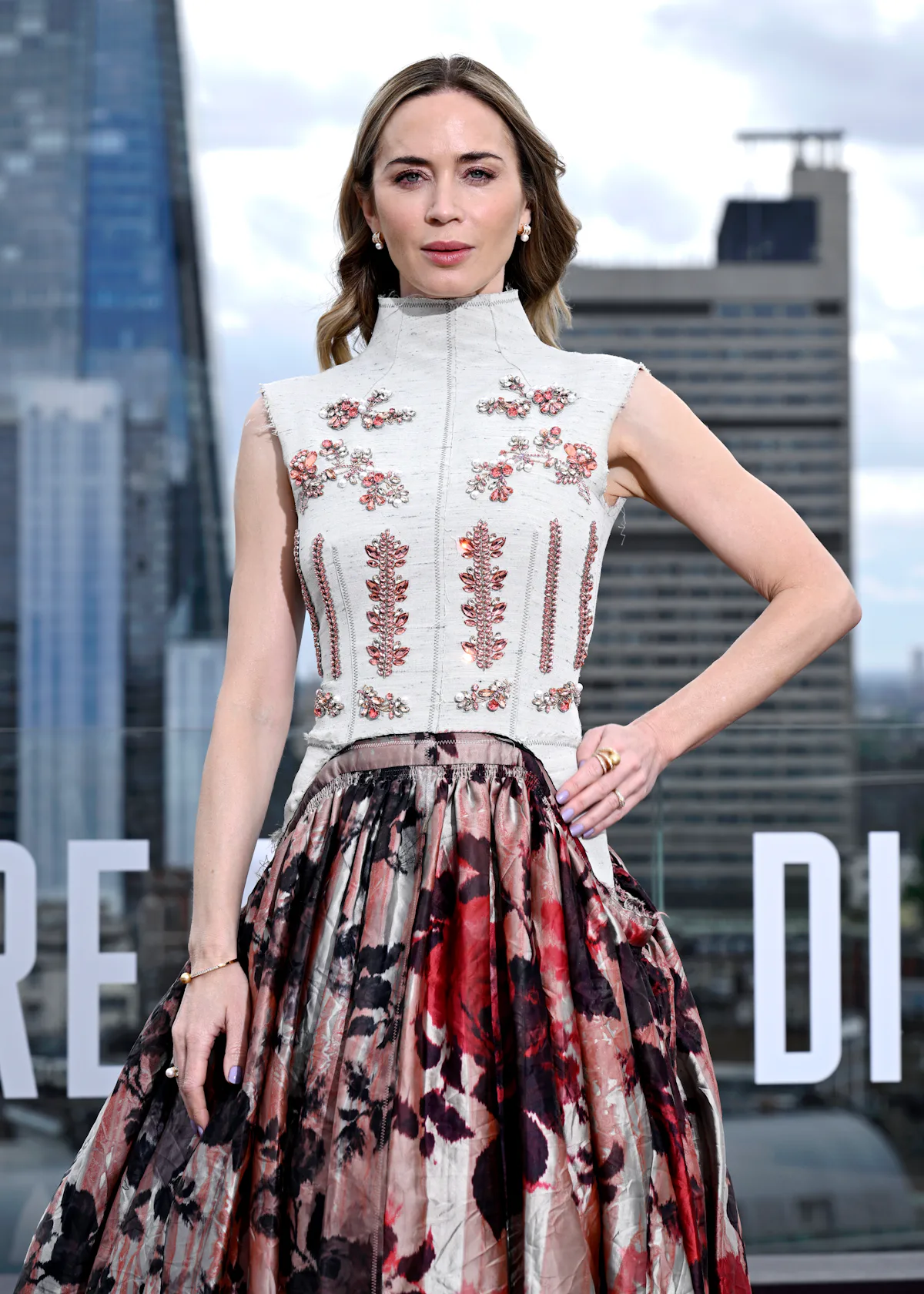
On the red carpet for the sci-fi film’s official United Kingdom premiere, Blunt fittingly arrived to Rose Court in a blooming Erdem ensemble. From the designer’s fall 2026 collection, her look featured a pale pink crushed silk midi skirt covered in a shadowy black and red rose print. However, its greatest statement came from a structured, heathered white top with a high neckline and flat shoulders, instantly bringing to mind the silhouette of knightly armor. The raw-hemmed piece was geometrically adorned with thin stitching and an assortment of swirling pink, coral, and silver-toned floral crystals, creating an ornamental finish.
Stylist Jessica Paster finished Blunt’s garden-worthy outfit with Mikimoto jewelry—a gleaming gold bangle, huggie earrings, and cocktail ring, each set with small diamonds and adorned with a single white pearl. The actor’s ensemble was complete with sheer tights and a set of pale brown satin sandals, simply finishing her look while allowing its adornments and soft jewel hues to serve as a focal point.
Gareth Cattermole/Getty Images Entertainment/Getty ImagesErdem Fall 2026 | Courtesy of Erdem
Blunt’s look originally walked the runway as part of Erdem’s fall 2026 show in the Tate Britain in London, which also marked the twentieth anniversary of Erdem Moralioğlu’s namesake label. Taking inspirations from both British artists from the 1800’s and 1900’s, as well as the UK’s ‘90s rave culture, the collection showed a darker side of his sophisticated eveningwear and outerwear—complete, of course, with a rich color palette, smatterings of jewels, and his signature garden’s worth of floral prints.
@dualipaAs the girl who’s perpetually on holiday, it makes perfect sense that Dua Lipa’s holiday wardrobe is wide-ranging. The singer’s been known to dabble in edgy, eclectic, and glamorous aesthetics within her own dynamic personal style—and she just continued that streak with a new sultry outfit. Her latest look effortlessly embraced spring’s trending bohemian style with a witchy touch.While enjoying golden hour, Lipa posed for an Instagram photo dump in a gauzy all-black Chloé outfit. The sin
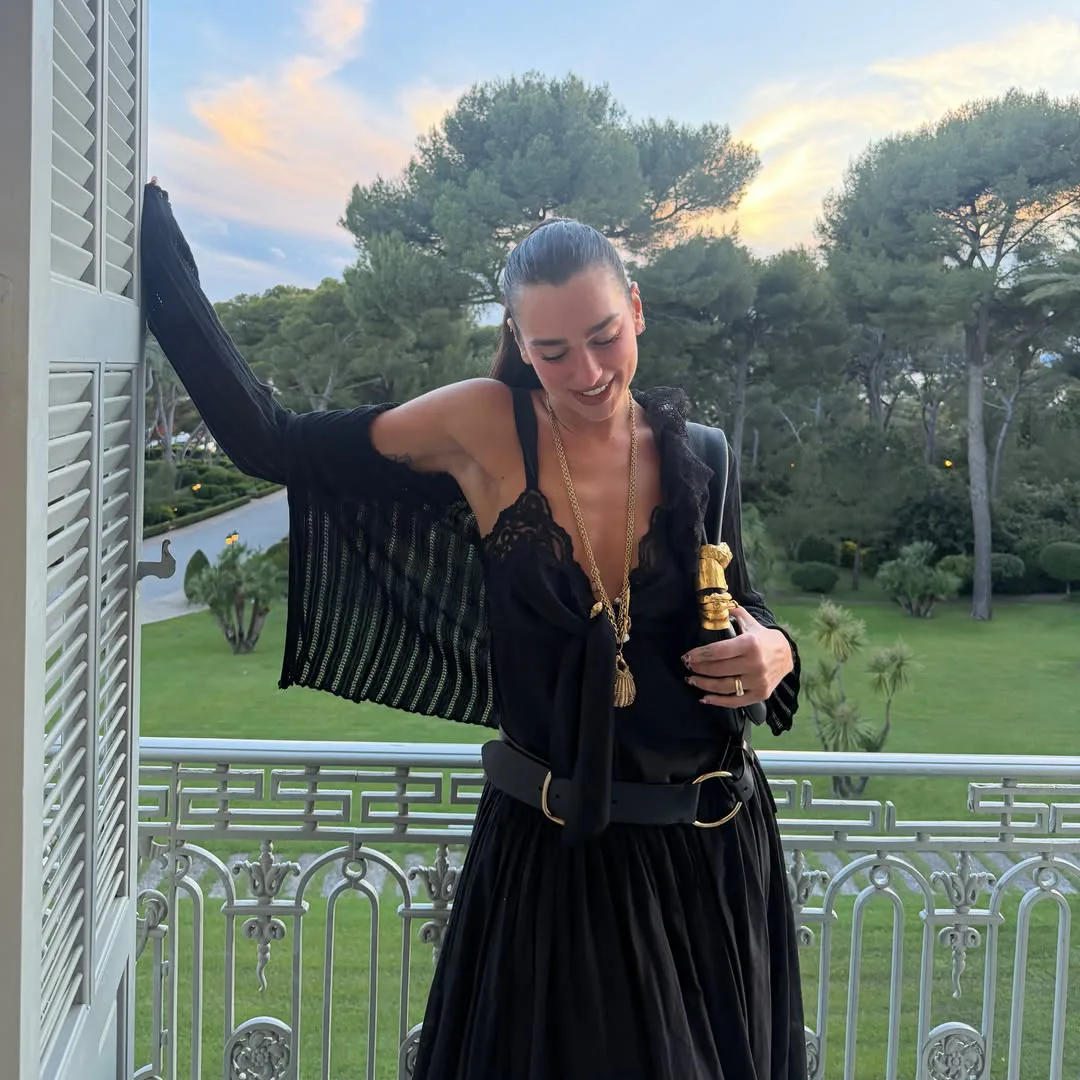
As the girl who’s perpetually on holiday, it makes perfect sense that Dua Lipa’s holiday wardrobe is wide-ranging. The singer’s been known to dabble in edgy, eclectic, and glamorous aesthetics within her own dynamic personal style—and she just continued that streak with a new sultry outfit. Her latest look effortlessly embraced spring’s trending bohemian style with a witchy touch.
While enjoying golden hour, Lipa posed for an Instagram photo dump in a gauzy all-black Chloé outfit. The singer’s swirling lace top and swishing ruffled skirt leaned into the label’s free-spirited ease, which she furthered with a gold ring–adorned leather belt from the French label. To ward off any summer breeze, she simply threw on a light, open-knit black cardigan from Ann Demeulemeester. Surely, Stevie Nicks would approve.
@dualipa
Indeed, Lipa’s outfit wouldn’t have looked out of place on American Horror Story: Coven either, thanks to its gothic palette. A similar supernatural feeling has been in the air lately when it comes to fashion, with stars like Margot Robbie and Hailey Bieber also stepping out in darker takes on light, warm weather friendly pieces.
A dangling gold Chloé necklace strung with seashell and bead charms added an extra boho touch. Her soft Schiaparelli Soufflé shoulder bag, accentuated with sculptural gold ring hardware, tied it all together.
@dualipa
Lipa’s witchy attire also flexed her own love for Chloé. In recent months, the singer’s worn a wide array of pieces from Chloé that have emphasized creative director Chemena Kamali’s exploration of archival symbols and femininity. Earlier this spring, Lipa was game to wear a swan-shaped clutch and blue dress from the brand’s pre–fall 2026 collection. Just last week, she similarly snapped photos in a bold array of outfits—including a pile of gold-toned Chloé necklaces atop a gauzy black dress. With her latest off-duty outfit, Chloé’s clearly found a loyal fangirl in Lipa. The singer is the latest in a wide-ranging group of celebrities embracing the label’s boho style this year, including Oprah Winfrey, Olivia Rodrigo, and new campaign star Apple Martin. As a true fashion fanatic, it’s only a matter of time before Lipa’s spotted in more of Kamali’s designs—or, the fashion gods willing, Chloé’s next viral front row.
Marc Piasecki/FilmMagic/Getty ImagesIt is quite the honor to get tapped as a member of the Cannes Film Festival jury. It signals the respect from one's cineam peers and trust in their taste. Members pick the festival’s winner, after all. But there is a lot of pressure on the jury, not only to choose deserving honorees, but also to show up to every red carpet and photocall looking worthy of the appointment. Throughout the festival, a jury member may attend dozens of events—often two or three in j
It is quite the honor to get tapped as a member of the Cannes Film Festival jury. It signals the respect from one's cineam peers and trust in their taste. Members pick the festival’s winner, after all. But there is a lot of pressure on the jury, not only to choose deserving honorees, but also to show up to every red carpet and photocall looking worthy of the appointment. Throughout the festival, a jury member may attend dozens of events—often two or three in just one day—and they need a new and appropriate look for each one. Not everyone is up for such a task, but when Demi Moore was appointed to the 2026 Cannes jury, there was no question that she could handle it.
Moore and her long-time stylist Brad Goreski have been taking us on a nonstop sartorial journey since the festival kicked off earlier this month. Starting with a playful Jacquemus number, Moore has brought glamour, sophistication, and a touch of camp with a wide array of ensembles. Truly, who would expect her to follow up a sparkling Tamara Ralph dress with that pink Matières Fécales number? Absolutely no one. And something tells us Moore has more in store as the festival continues. Below, a look at all of her ensembles thus far.
Andreas Rentz/Getty Images Entertainment/Getty Images
Moore attended the Chopard Miracle Gala on May 18 in a Nina Ricci look featuring the unexpected combination of a suit jacket and voluminous, tulle-layered skirt.
VALERY HACHE/AFP/Getty Images
On May 16, Mariacarla Boscono wore this fur Gucci top down the runway in New York during Demna’s resort 2027 show. Two days later, the top was on Moore at the Fjord premiere in the South of France.
Moore has been wearing a lot of Chopard jewels throughout the festival, which is fitting considering the luxury brand is a sponsor of the event. But when the actor attended the Kering Women in Motion Awards on May 17, she swapped out her regular gems for a Boucheron necklace, an especially striking piece that stood out against her purple, croc leather Gucci dress.
Michael Buckner/WWD/Getty Images
The actor looked very chic in an all-white look from Ami Paris with a Tod’s handbag, which she wore to the Ami Paris luncheon on May 17.
Samir Hussein/WireImage/Getty Images
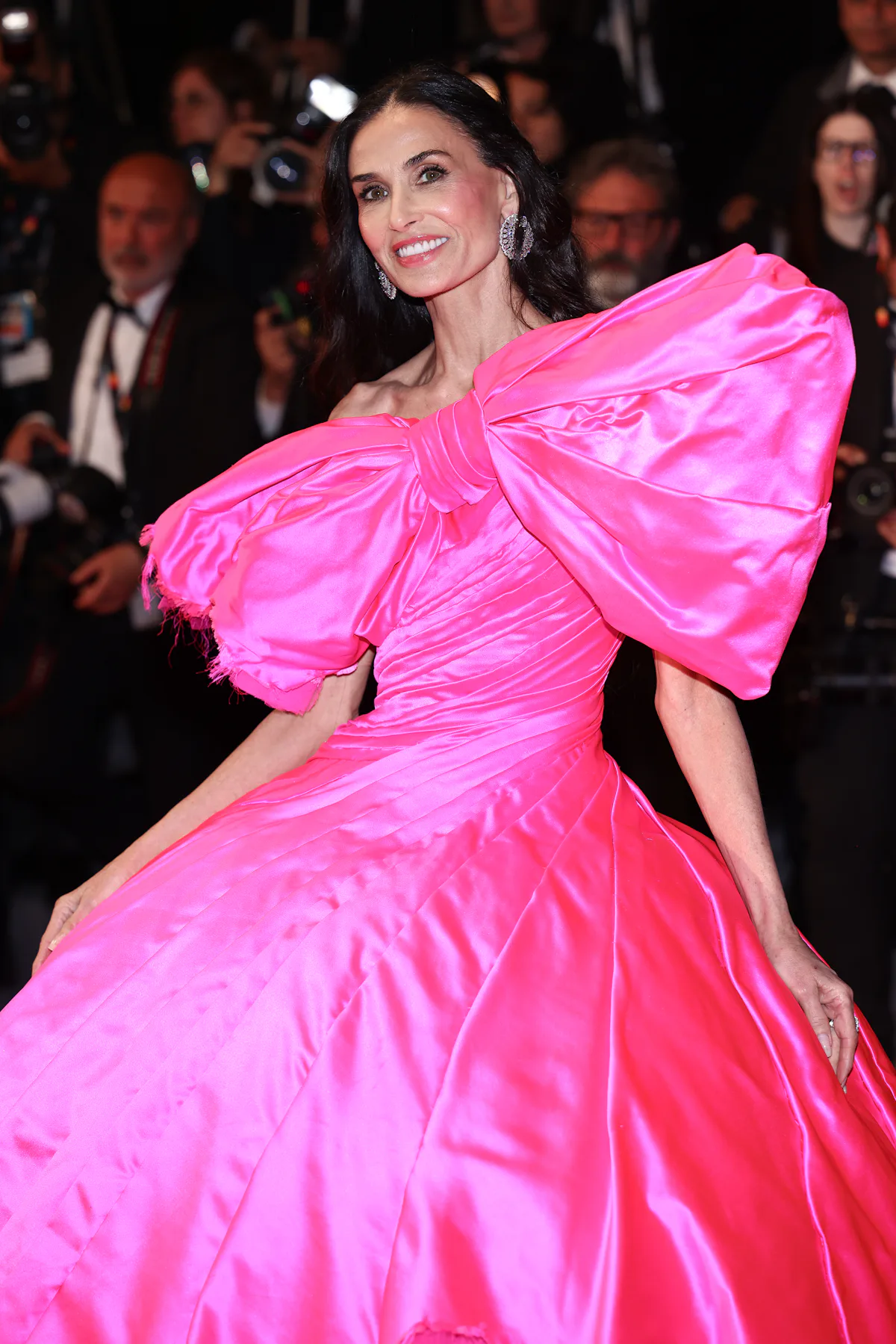
While for the most part, Moore has been bringing some classic red carpet glamour to Cannes, she decided to mix things up a bit for the Paper Tiger premiere on May 18. The actor arrived to the screening in a campy, hot pink Matières Fécales fall 2026 dress with a shredded hem and comically large bow.
Michael Buckner/WWD/Getty Images
As if the crystal-covered Tamara Ralph spring 2026 couture dress Moore wore to the Trophée Chopard dinner on May 15 wasn’t glamorous enough, the actor paired it with a gorgeous, ostrich feather shawl. Of course, she completed the look with Chopard jewelry.
VALERY HACHE/AFP/Getty Images
Moore’s Cannes luggage was packed with custom Gucci. The actor wore the brand once again to the Fatherland premiere on May 14.
The actor took a break from colorful gowns and wore a black tailored look from Magda Butrym, featuring knee-length bottoms and a peplum jacket, to the Nespresso x Brut party on May 14.
Moore attended the Red Sea Film Foundation’s Women in Cinema Gala on May 14 in a purple sequin halter-neck gown from Ashi Studio.
JB Lacroix/FilmMagic/Getty Images
The actor wore yet another custom Gucci look to the La Vie D'Une Femme premiere on May 13. The piece was inspired by a Gucci by Tom Ford spring 2003 mini dress Moore wore to the Matrix Reloaded premiere a top a pair of jeans.
Arnold Jerocki/Getty Images Entertainment/Getty Images
Moore attended the L’Oréal Paris Women of Worth dinner in an Ami Paris dress featuring a simple black t-shirt top and ivory skirt.
JB Lacroix/FilmMagic/Getty Images
By day two of the festival, it became clear that we were in for quite the fashion spectacle courtesy of Moore. The actor attended the jury photocall on May 12 in a colorful, polka-dotted Jacquemus fall 2026 dress.
Moore kicked off her red carpet appearances at the opening ceremony in a white, sequined custom Jacquemus dress and Chopard jewelry.
Arnold Jerocki/GC Images/Getty Images
Before the festivities truly began, Moore attended the Cannes jury dinner in a more casual look, courtesy of Gucci and featuring the brand’s new Borsetto bag.
Photograph by Colin Dodgson, styled by Sara MoonvesIn order to achieve a convincing, long-lasting self-tan, you’ve got to get the tone right. The best formulas today are designed to read like real skin: slightly golden, never flat, and free of that telltale orange cast. They blend seamlessly, develop evenly, and wear down in a way that looks more like a gradual fade than a patchy disappearance.From airy mousses that deliver color overnight to slow-build lotions that double as daily hydration, th
Photograph by Colin Dodgson, styled by Sara Moonves
In order to achieve a convincing, long-lasting self-tan, you’ve got to get the tone right. The best formulas today are designed to read like real skin: slightly golden, never flat, and free of that telltale orange cast. They blend seamlessly, develop evenly, and wear down in a way that looks more like a gradual fade than a patchy disappearance.
From airy mousses that deliver color overnight to slow-build lotions that double as daily hydration, there’s a formula for every routine and comfort level. The standout picks ahead are the ones that strike that sweet spot—natural-looking, low-maintenance, and able to hold their glow for days without turning streaky or dry.
If you’re seeking a tan that looks like it came from good lighting, not a bottle, this mist makes the process almost too easy. Sugared + Bronzed’s Sunless Tanning Water goes on completely clear and weightless, so there’s no guide color to navigate, and no risk of transfer while it develops. Instead, you’re left with a sheer, believable warmth that builds subtly and never tips into orange territory.
Mist it onto bare skin as part of your skincare prep or layer it over makeup for a subtle boost of warmth throughout the day. The ultralight texture means it won’t disturb what’s underneath, and because the color builds gradually, you can control the depth without ever overdoing it.
If you prefer a tan that quietly builds in the background, this is the kind of formula you’ll reach for daily. Lux Unfiltered is a gradual tanning lotion that doubles as a true body moisturizer, delivering a soft, believable warmth while smoothing and hydrating the skin at the same time. It goes on like your favorite lotion—no learning curve, no streak anxiety—and develops into an even, lit-from-within flush.
The real payoff is in the texture. Because it’s rich and conditioning, it helps blur dryness and uneven tone, which is exactly why the color ends up looking more natural and less “placed” on the skin. You can apply it like you would any body cream, building depth over a few days or maintaining an existing tan without having to start from scratch.
Achieve that deeper, just-back-from-vacation bronze (without it looking heavy or obvious) via this luxe mousse. It has a light whipped texture that glides over the skin and blends out effortlessly, making it perfect for tanning newbies. The product develops over a few hours into a warm golden tone that looks rich, but is never muddy or overly intense. What sets Iconic London’s Prep Set Tan Mousse apart is the finish. Instead of drying down flat, it leaves skin looking subtly radiant, almost like there’s a built-in glow beneath the color. That added dimension keeps the tan from looking one-note and helps it read more like real, healthy skin.
For a tan that feels more like skincare than self-tanner, this is the one to keep on rotation. Endless Summer is designed as a true daily moisturizer first, with a subtle, buildable tint that develops over time. It melts into the skin like a body cream, delivering that soft sunlit warmth that looks completely natural. You can use it daily to build depth or maintain an existing tan, and because the payoff is so controlled, it’s nearly impossible to overdo. The result is that understated “I’ve been in the sun a little” vibe: polished, hydrated, and easy to keep up.
Bali Body’s Self Tanning Body Milk has a fluid, milky texture that melts into the skin like a lightweight lotion, making it easy to spread evenly without the usual streak stress. Your tan will be deep, but it’ll still look soft and natural—plus, this product is packed with hyaluronic acid (to pull in moisture for a smoother and more even finish) and ceramides to help lock that hydration in.
Luna Bronze’s Glow Tanning Moisturizer builds color over a few days, giving you full control over the depth; you can stop at the slightest hint of warmth or layer it up for a more noticeable tan without ever overshooting. That gradual payoff is exactly why it works so well for fair complexions. Instead of depositing too much color at once, it adds a sheer, believable tint that enhances your natural tone. It’s also ideal as a maintenance product—something you can use in between self-tanning sessions to top up your color and extend how long your tan lasts without having to perform a full reapplication.
Looking for color on a deadline? This one actually delivers. Loving Tan’s Two-Hour Express Self-Tanning Lotion is made for those last-minute moments when you can’t wait overnight. You apply, let it develop for a couple of hours, rinse, and you’re left with a warm, even bronze that continues deepening.
What makes it feel more controlled than other express formulas is the lotion texture. It gives you more glide and playtime during application, so you can really work it into the skin and avoid patchiness. There’s also a visible tint as you apply, which helps map everything out and ensures you don’t miss spots—especially in trickier areas like elbows and knees.
If you want your self-tanner to feel invisible in your routine, this is the elevated version. Dior Solar’s Self-Tanning Drops are designed to be mixed directly into your moisturizer or serum, so you’re essentially turning your existing skincare into a custom self-tanner. The result is a gilded sheen that looks fully integrated, not sitting on top of your skin.
The beauty is in how adjustable it is. You control the depth by the number of drops you use, making it just as ideal for a sheer hint of warmth as it is for building a more noticeable bronze over a few days. Because it’s diluted into your skincare, the color develops evenly across the face and fades in a way that looks soft and natural.
PARIS June 13 — As SpaceX completed the biggest initial public offering in history, controversial entrepreneur Elon Musk saw his wealth blow past the symbolic – and unprecedented – level of a trillion dollars.Following strong demand for shares in the space technology as part of the IPO, they jumped more than 20 per cent when they began trading on the Nasdaq Friday.That lifted the estimated wealth of the South Africa-born Musk, 54, to above US$1 trillion (RM4.05 t
PARIS June 13 — As SpaceX completed the biggest initial public offering in history, controversial entrepreneur Elon Musk saw his wealth blow past the symbolic – and unprecedented – level of a trillion dollars.
Following strong demand for shares in the space technology as part of the IPO, they jumped more than 20 per cent when they began trading on the Nasdaq Friday.
That lifted the estimated wealth of the South Africa-born Musk, 54, to above US$1 trillion (RM4.05 trillion) , according to Bloomberg and CNBC.
That takes him into an uncharted zone of the mega-wealth stratosphere, leaving Google co-founders Larry Page and Sergey Brin, as well as Amazon creator Jeff Bezos trailing in his wake, according to data from Forbes and Bloomberg.
But what could a discerning unfathomably rich investor actually do with a cool trillion at his disposal?
That’s around the wealth produced over a year by entire countries, such as Switzerland or Poland (US$1,040 billion GDP in 2025, according to the International Monetary Fund).
Or, if you prefer, see it in terms of totalling three times the current value of France’s gold reserves.
Yet Musk’s wealth is considerably different to that afforded by precious metal, a tangible asset with safe-haven status owing to its reputation for stability.
Musk’s wealth mostly derives from his stock portfolio, the value of which fluctuates and can be decidedly volatile.
“If Elon Musk wanted to sell off a huge chunk of his shares to buy real estate or whatever, the stock price would drop hugely,” warned Alexandre Baradez, head of market analysis for investment company IG France.
That would mechanically see his total wealth follow the same trend.
“There’s the law of supply and demand,” Baradez said.
“But there’s also, and maybe even more importantly, the psychological effect: a massive sale of Elon Musk’s shares, given the strong influence he has on his companies’ strategies, would send a very strong signal to the market.”
Other investors would likely follow suit, which would further decrease the stock’s value, and ultimately, the fortune of a man who would revert from being a trillionaire to merely a multi-multi-billionaire. — AFP
Twenty-twenty-six is a big year for those who like their art with a side of pop culture. Many of the world’s major museums and galleries are banking on big names for their first shows. Take Ghosts by Eliza Douglas at Gagosian, which celebrates the artist’s first solo New York exhibition with a body of work that nods to the iconography of advertising. In London, Tate Modern showcases stunning Tracey Emin work that And Just Like That... fans might recognize, while the V&A is going all in on Sc
Twenty-twenty-six is a big year for those who like their art with a side of pop culture. Many of the world’s major museums and galleries are banking on big names for their first shows. Take Ghosts by Eliza Douglas at Gagosian, which celebrates the artist’s first solo New York exhibition with a body of work that nods to the iconography of advertising. In London, Tate Modern showcases stunning Tracey Emin work that And Just Like That... fans might recognize, while the V&A is going all in on Schiaparelli. Finally, the National Gallery of Iceland is celebrating Björk’s upcoming album with a three-work installation from the artist (plus an accompanying show from her frequent collaborator). Whether you’re fashion, music, or TV-minded, there’s something for you—and we’re still less than halfway through the ever-growing art calendar. More will come both in the U.S. and abroad, so if you’re planning some cultural stops for your next trip or just looking to see what’s on view in your neighborhood, consider this your all-encompassing guide to the can’t-miss art shows of the year.
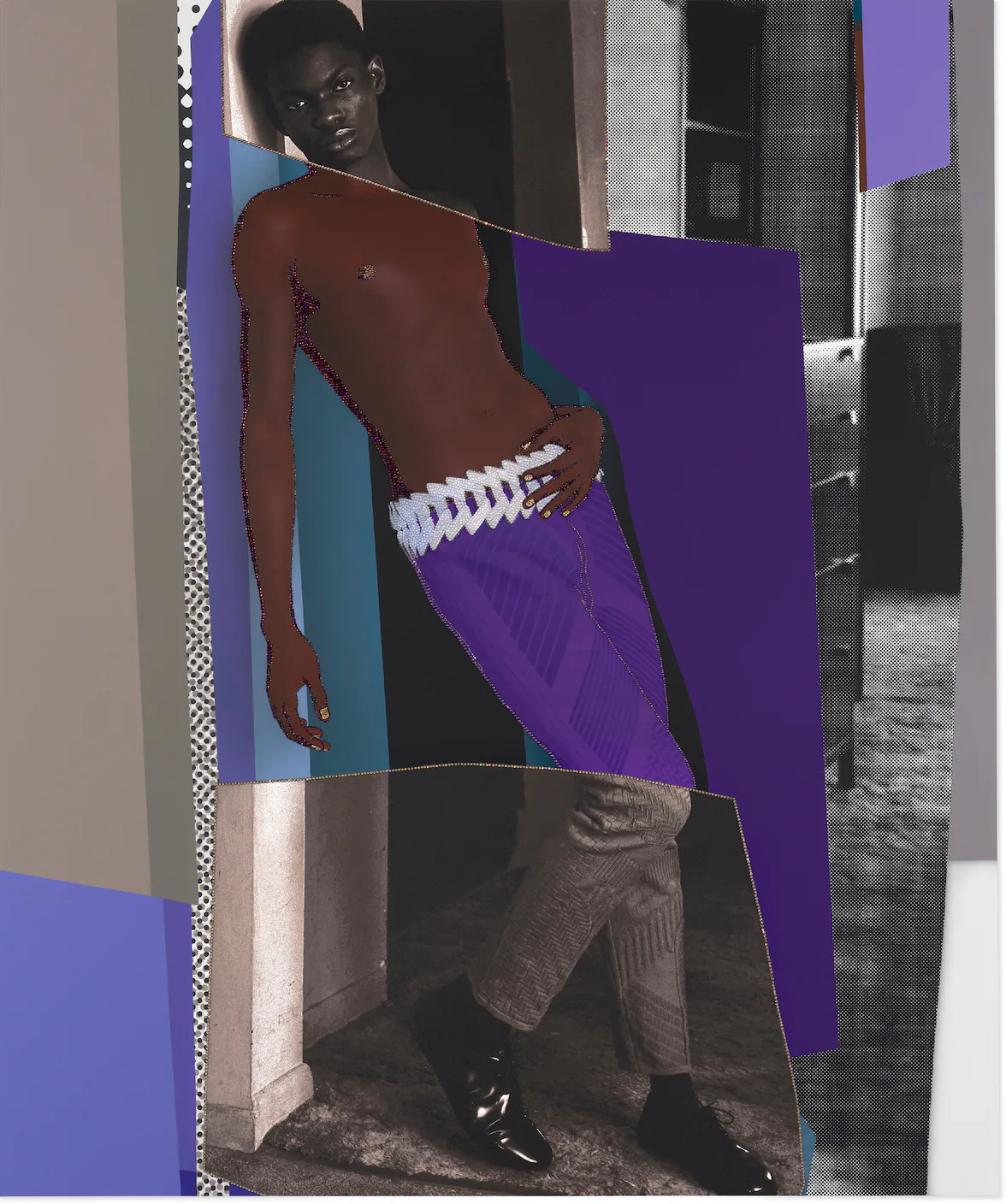
After two decades spent developing a highly influential, distinctive artistic practice centered on the depiction of Black womanhood, Mickalene Thomas has, for the first time, turned her creative eye toward Black masculinity. An entirely new body of work, Beneath the Moonlight, will be on display at the Shepherd in Detroit from June 6 through August 23, 2026, presented by Library Street Collective. The exhibition includes large-scale paintings, collages, and photography, as well as Thomas’s trademark staged settings. “The representation of masculinity spoke to me more, and using the Black male body as a vehicle, as a conduit to express those ideas that are resonant and paralleled to my concepts that I’m already working within with the female body,” Thomas said in a release. She worked with models beyond the gender binary to create her works, exploring themes of representation, stereotypes, and self-agency. She was inspired, in part, by the work of photographers like Quil Lemons and John Edmonds, who represent a new generation of artists grappling with themes of identity. To accompany the show, a catalog featuring original essays and interviews, designed by artist Bob Faust, will also be available for visitors to read. Beneath the Moonlight follows Thomas’s first major touring solo exhibition, All About Love, which debuted at The Broad in 2024.
Mickalene Thomas, Perfectly Purple Standing, 2026 | Courtesy of the Artist and Library Street Collective
Ghosts is filled with firsts. It is Eliza Douglas’s first solo exhibition in New York, her first at Gagosian, and the first in a new program at the gallery consisting of solo presentations by different artists curated by Francesco Bonami. “The unique and historic character of the Park Avenue and 75th Street location is an ideal space for a laboratory of fresh perspectives that will complement the gallery’s existing programming,” Bonami says of the series, which kicks off on May 12 with a display of Douglas’s “meta-paintings.”
The works in Ghosts borrow from the iconographies of advertising and popular culture, blending them with gestural abstraction. Through this practice, Douglas emphasizes art’s status as a consumable good. Those familiar with the artist’s work may recognize some of the pieces in Ghosts because they are reworkings of paintings she exhibited over the past decade at her gallery, Air de Paris. In this new show, she combines the existing compositions with selfies taken by her aunt, Leslie Kean, an investigative journalist who has long been reporting on UFOs and “otherworldly phenomena.” Douglas also pulls from a 2022 group exhibition at Gagosian London titled Haunted Realism, which explored the idea that the past continually haunts the present. Douglas has always toyed with the idea of hijacking, but Ghosts marks the first time she has incorporated such a practice into her production. The use of an existing body of work acknowledges the constant repackaging of cultural products. As theorist Mark Fisher says, “Those who can’t remember the past are condemned to have it resold to them forever.”
Ghosts is on view at Gagosian Park and 75th location through July 31.
Studio2M has opened in SoHo as a workshop and exhibition space—and for its inaugural exhibition, founder Abby Caulkins has asked French artist Marie Hazard and Portuguese designer Constança Entrudo to collaborate on a body of work. The result is Ad Hoc, an exhibition that provokes a dialogue between art and fashion while deconstructing the usual hierarchies found within both disciplines. Hazard provides tactile compositions with poetic narrative qualities and installations combining weaving, beading, and crochet. Similarly, Entrudo uses digitally layered textiles to explore the ideas of weaving as a language and the intersection of craft and technology. Together, they push the limits of traditional weaving practices, blurring the boundaries between fashion show and performance, and taking into consideration the connections between fabric, space, and the body.
Ad Hoc will be on view at Studio2M from May 7 to June 13.
Intrinsically tied with music and sound, dance and movement have always played an integral role in spaces of collective organizing for liberation across the globe. On view at MCA Chicago through September 20, 2026, Dancing the Revolution: From Dancehall to Reggaetón underscores the histories and lasting impact of dancehall and reggaetón across visual, political, and spiritual registers. The major exhibition looks at how these musical genres have expanded beyond their “grassroots origins” and now serve as major shapers of culture on a global scale.
Spanning painting, sound sculpture, installation, photography, and video, Dancing the Revolution features the work of over forty contemporary artists, including Isaac Julien, Edra Soto, and Alberta Whittle, to name a few. The works in the show meditate on the revolutionary power of dance, particularly within the realms of dancehall and reggaetón, and how the practice functions not only as a source of joy but also of resistance. From sexual liberation to political protest, Dancing the Revolution positions dance and music as pillars of Black Atlantic history and culture, in the Caribbean and beyond. —Daria Simone Harper
Comité Colbert presents “the most exclusive exhibition on French luxury held in New York,” at The Shed from May 26 to 31. Hidden Treasures, 250 Years of Franco-American Luxury Stories brings together over 65 French luxury maisons and cultural institutions, along with their never-before-seen American archives. Together, these pieces illustrate two-and-a-half centuries of friendship between France and the United States, and the role luxury has played in that relationship.
Each luxury brand is represented by one singular artifact, and together, a story is told about two countries and their cultural dialogue. Hidden Treasures explores the diplomacy, identity, and popular culture shared across the Atlantic. Jewelry, hotels, fragrance, liquor, and more are all represented in the exhibition, which attempts to portray the universal language of beauty. Christofle tableware from the Normandie collection and a Louis Vuitton trunk represent the luxury of cross-Atlantic travel. A 1933 gown designed by Cristóbal Balenciaga and worn by American socialite Mona von Bismarck exemplifies the influence of French couture on American style. Pieces from Berluti, Hermès, Chanel, and more luxury brands add to the narrative. A Celine scarf printed with U.S. Mail iconography and a Christian Louboutin heel inspired by Cinderella’s glass slipper, meanwhile, proves that inspiration flows both ways.
French ceramist Emmanuel Boos is bringing his glazed porcelain practice to NYC with his first solo show in the United States. A “glaze consultant” for Hermès and the recipient of the “Special Mention” award at the 2024 Loewe Foundation Craft Prize, Boos has long boasted a transatlantic career. But this show, Noir C’est Noir, takes border-jumping to a new level. From April 9, Raisonné will host over 70 of Boos’s unique works, including coffee tables, side tables, stools, vases, and other objects. Together, these pieces illustrate Boos’s distinct style and exploration of fragile beauty and humorous practicality.
Boos’s porcelain practice allows him to embrace imperfection and welcome the unexpected, which he calls “happy accidents.” Also important to the process is Boos’s arrangement of his work within a space. There’s a modular aspect to this practice, with pieces grouped into various unfixed cohorts. This provides a reflection of the artist’s own nomadic life, and his closely held belief that meaning always exceeds function. “My practice of glaze does not aim for mastery nor domination,” the artist said in a statement. “I wish to slip into the glaze and develop a friendly relationship with chaos and eventually trust chance. It is emotion, sensuality, poetry.”
A piece from Emmanuel Boos’s show, Noir C’est Noir. | Raisonné/Zach Pontz
In his debut solo show, Hard Feelings, Palestinian-American photographer Dean Majd chronicles a decade of brotherhood, grief, gore, and glory. As a young boy, the Queens, New York-born artist was often left alone, with only a camera in his hand to document his loved ones. But the sudden passing of a childhood friend in 2015 thrust him back into the nocturnal and hypermasculine graffiti and skate scenes, where the odyssey of Hard Feelings begins.
Driven by devastating loss and a desire to record truth, Majd captures deeply intimate portraits, demanding reflection and healing. In early imagery like geri on the hellgate bridge or bohemian rhapsody, risk and bliss alike appear in ritual and full force, from a young man undergoing a rite of passage, to friends sharing a hotel tub. The trust between Majd and his community is palpable, offering his sitters and viewers the opportunity to confront self-destruction head on. Brutality and tenderness unfolds as Majd’s community allows him to lens aftermaths of self-harm, abuse, and death. As both participant and observer, the artist’s visual language is unflinching and profoundly empathetic. Notably, Hard Feelings begins and ends with celebrations of life. —Ayesha Le Breton
Dean Majd, Mohamed (Prayer), 2020. | Courtesy of the Artist
The worlds of sporting and art combine in a series of works on display now at Gagosian’s Beverly Hills gallery. Over the past two decades, American artist Jonas Wood has turned prominent tennis matches into works of art, depicting these on-court battles in oil and acrylic paintings. The works are uniform in their vantage point, with each placing the viewer behind the baseline. Players and officials are nowhere to be seen, while spectators make an infrequent appearance in the form of abstract brushstrokes or dots.
Wood’s paintings blur the line between abstraction and Pop Art. A painted wood pattern surrounds Wimbledon with Wood Grain (2025), while the dotted audience of Mexican Open (2025) places the court in a star-filled galaxy. Homages to Roy Lichtenstein come in the form of works like Paris Olympics with Crying Girl (2025) and Dubai with Nude with Blue Hair (2026), where the late artist’s iconic Crying Girl (1963) and Nude with Blue Hair (1994) frame the courts. There is a standard followed with each painting: saturated colors, similar dimensions, and repeated elements. This uniformity allows the differences to come alive, making you ponder—and rethink—each piece.
Since her first solo show in New York in 1986, Lorna Simpson has explored concepts of race, gender, identity, and subjectivity, archiving Black lives and experiences in vivid, boundary-breaking form. She changed the language of photography, turning the media on itself as she framed Black women with their faces just out of view, text collaged on the images that hinted at and asked the viewer to question how the women were seen. In the decades since, Simpson brought her renowned conceptual experimentation to collage, film, sculpture, and—beginning at the 2015 Venice Biennale—painting. Now, the legendary artist is opening her first major European exhibition at Pinault Collection’s Punta della Dogana in partnership with the Metropolitan Museum of Art. Third Person, running March 29 through November 22 at the Venice museum, features over 50 of Simpson’s paintings, spanning 20 years. There’s a special focus on the aforementioned large-scale works from Okwui Enwezor’s Biennale, never-before-seen offerings from Simpson’s personal archive, and new paintings made especially for this exhibition. —Ashley Simpson
Lorna Simpson, Woman on Snowball, 2020 | Courtesy of the Artist and Punta della Dogana
Ever since Arts and Letters NYC got a curatorial team (including Jenny Jaskey and curator Kristin Poor) two years ago, the uptown establishment has been increasingly showing up on downtown feeds. Rotated on the half year, a new suite of exhibitions has recently taken over Arts and Letters’s enviable rooms, including a mutation of Jessi Reaves’s first institutional solo show, which opened at the Walker Art Center earlier this year, and now has been reconstituted in a new configuration for Arts and Letters.
Cushions for tetris-like banquets welcome visitors into Art and Letters’s right wing; sitting atop these hand-painted perches, as you are encouraged to do, one can pivot in place and survey the show’s topography—namely, an archipelago of free-standing sculptures populated by a flock of reusable water bottles. Each water bottle bears a different paper cut-out of a bird, and these flightless creatures are like everything in Reaves’s world—a recombination. Reaves first made a name for herself in sculpture by dressing down modernist icons, Marcel Breuer seats and Le Corbusier lounges—until only their vulnerable essentials were left. Now more than a decade in, her attentions have turned elsewhere: to the empty promises of pure function and the transformative powers of accumulation. Here, a Nalgene bottle becomes a paper crane, a WPA mural becomes a bench, an art show in one city is something else entirely in a different location. By the time you’ve sat down, you’ve forgotten there is a painting underneath you. —Kat Herriman
Jessi Reaves, Big vanity with modesty flap, 2025 | Photo by GC Photography. Courtesy the artist and Bridget Donahue, New York.
For the next several months, tea will be served in the rotunda of the Solomon R. Guggenheim Museum. The occasion? Artist Carol Bove’s monumental new survey, which has taken on the Frank Lloyd Wright masterpiece as a co-conspirator rather than an obstacle. Bove—whose work has long explored the juxtaposition of geometries, both found and made—draws out the patterns and repetitions embedded in the architect’s design. In doing so, she reveals that the museum’s famous circle is in fact composed of countless rings and discs, to which she adds several of her own in metal, fabric, and paint.
As you ascend the building’s signature spiral, you travel in reverse chronology through Bove’s career. You might notice you are also moving from dark to light; Bove has applied a black-to-white ombré that unfurls floor by floor. It is a minimal intervention with maximum impact. It all comes into focus the higher you climb—Bove has consistently, and gently, adjusted the essential forms we think we know so well. By doing so, she renews them, revealing truths that were hidden in plain sight. The most glaring and delightful example? A diamond-shaped cut Bove has made in a false wall, which reveals a Joan Miró work that hasn’t been seen for decades.
It is an exhibition that insists you slow down and unwind time. It warms you up for the act of steeping by creating the conditions conducive for it: ample seating and something to sip. —K.H.
The Biblical narrative of creation is explored in a modern context in Beginnings: The Story of Creation in the Middle Ages. Paintings by American artist Harmonia Rosales are shown in dialogue with transcripts from the Getty’s collection, situating her work within the world of visual storytelling and placing her paintings in direct conversation with medieval representations of creation. Rosales has long been known to draw on artistic methods from the Renaissance and Baroque periods, combining them with African diasporic histories. She continues this practice with Beginnings by contributing a contemporary perspective shaped by West African spiritual traditions, adding to the ongoing conversation around creation. In addition to previous work, including Portrait of Eve (2021), Beginnings will feature a new piece, created in response to the significant illuminated manuscript, Stammheim Missal.
Beginnings: The Story of Creation in the Middle Ages is on view at the Getty Center in Los Angeles from January 27 to April 19.
Leonard Baby’s new show may have a quirky title, but don’t be fooled. Resting Babyface features work from the New York-based artist, which he created during a period of profound sadness. As a result, the paintings on display encapsulate the essence of vulnerability and the complexities of personal experience. This is nothing new for Baby, who often draws on his past and emotions in his work, transforming trauma into acts of resilience and self-acceptance. In Resting Babyface, Baby turns the focus to two very vulnerable settings: the bedroom and a therapist’s office. With this new set of work, Baby explores themes of aftermath and introspection, using the paintings as personal confessionals meant to leave viewers in a state of discomfort and ambiguity.
Resting Babyface is on view at Villa Carlotta in Los Angeles from February 26 to March 11.
Leonard Baby, Group Therapy. | Courtesy of Half Gallery
This February, the ICA Boston turns its attention to an artist-led institution that has shaped the fabric of New England’s art community since 1977. Founded by Dana C. Chandler Jr., the African American Master Artists-in-Residence Program (AAMARP) is one of the longest-running Black artist residency programs. Therefore, its story resonates not just on a local level but a national and international one. AAMARP’s influence can be felt far beyond Boston through its alumni network of artists, educators, and organizers. Conceived originally as a Black artist-led exhibition space, AAMARP evolved into a living ecosystem: part studio collective, part political area, and part cultural refuge, where new modes of working could take root even as institutional support shifted around it.
As the first exhibition devoted to AAMARP’s far-reaching legacy, it was essential for Mannion Family Curator Jeffrey De Blois to spend lots of time with members past and present. Developed in close dialogue with the founder Chandler before his passing in 2025, the show arrives less like a retrospective and more as a constellation of practices whose collective energy points outward. At the exhibition, the story of AAMARP’s community-driven approach is told through the work of five decades of participants. There are some folks you know. The rest are discoveries. Rather than closing a chapter, the exhibition feels like an opening gesture. —K.H.
Dana C. Chandler Jr., For the Children We Strive, 1991. | Photograph by Hakim Raquib
This new exhibition from photographer Ming Smith traces an artistic journey shaped by movement, experimentation, and freedom. The Detroit-born artist came of age at a time when Europe offered Black artists greater opportunity and receptivity. Smith’s travels abroad, specifically in the 1970s in Paris, proved formative; there, she encountered the evocative work of photographers like Brassaï and Henri Cartier-Bresson while developing a visual language of her own. This exhibition reflects on how those early experiences continue to inform Smith’s practice, highlighting photographs—many of which have been printed for the first time—that capture fleeting moments infused with rhythm, intuition, and motion. Smith’s work resists photography’s long-standing impulse to define, document, or objectify Black subjects. Rooted in the core principles of the Black Arts Movement, her photographs expand the medium beyond realism, often confronting and subverting the gaze itself. Her signature use of blur and abstraction is both poetic and political, mimicking the improvisational spirit of jazz while responding to the ways Black Americans are rendered simultaneously invisible and hypervisible. A pioneer for Black women in photography, Smith’s legacy lies in her innovation, her fearless experimentation, and her unwavering commitment to capturing the depth and richness of Black life. —Che Baez
Courtesy of the Ming Smith Studios and The Gund at Kenyon College
Ming Smith: Jazz Requiem–Notations in Blue is on view at the Portland Museum of Art in Portland, Maine from February 6th to June 7th 2026.
For the German artist Max Jahn, frames are just as important as the imagery inside of them. As part of his practice, Jahn painstakingly chooses each border for his painted works from his father’s antique shop. They are personal to him—as personal as the colorful portraits he creates, which will be on view in the new show, Time Spent Looking. The exhibition features both portraiture (like Self With Fan, a painting in which Jahn is depicted coyly holding a floral accordion fan to his face) and still life. Jahn paints what he knows; his subjects often come from within his social circle. His relationships with them—and by extension, his depictions of them—are shaped by time and prolonged observation. He paints his sitters for an hour at a time over the course of a week, in varying lights for each session. But his work in self-portraiture arguably features his most familiar subject of all.
Installation shot from Time Spent Looking at Gratin, New York. | Photograph by Jason Wyche; Courtesy of Gratin
Hailing from Berlin and growing up in the aftermath of German reunification in the ’90s, Jahn was raised with the ghosts of a different era. He spent time at his father’s antique store on Motzstrasse, in the heart of the Schöneberg neighborhood, where painters and poets ruled before the Second World War. Otto Dix, the Dutch Masters he studied at school, Balthus, and more combine to create Jahn’s own signature style, now on display in his first solo show in New York.
Time Spent Looking runs from January 29 to Match 2026 at Gratin New York.
Multidisciplinary artist and composer Samora Pinderhughes centers his work on one urgent question: “What if we built a world around healing rather than punishment?” In Call and Response, a new exhibition at MoMA on view through February 15, 2026, Pinderhughes beckons audiences to ponder this inquiry alongside him. The show comprises two core components including a two-channel film created with Christian Padron, REAL TALK,which examines the impact of absence on families whose loved ones are incarcerated. It also features a series of performances and programming developed in collaboration with community organizations in New York City.
Samora Pinderhughes and Christian Padron, still from REAL TALK, 2025. | Courtesy of the artist.
With Call and Response, Pinderhughes considers how narratives of criminalization are applied to groups of people to justify violence against them. “As a country, we’re willing to allow basically anything to happen if there’s this illusion that it will protect us from [who]ever is deemed criminal,” the artist said. The show is part of his stint as the 2025 Adobe Creative Resident at MoMA, and builds upon his work as a creator of The Healing Project, a community arts organization founded in the spirit of prison abolition. It also underscores Pinderhughes’s commitment to unearthing how art, particularly collective sonic practices, might contribute to collective healing and liberation. —D.H.
Sterling Ruby is an artist who, over the years, has become larger than life, a boldfaced name in both the art and fashion worlds. His work, moving across sculpture, textile, ceramics and video, explores themes of violence and the impacts of social norms while remaining autobiographical. His fashion line, S.R. Studio L.A.C.A., echoes his love of craft and feels very much due after years of lending inspiration for designers like his close friend Raf Simons. On January 30, the Los Angeles-based multihyphenate will present his first solo show in several years, running until March 28. Ruby’s new work, titled Atropa for the nightshade herb known for its deadly quality, is inspired by the duality of the deeply poisonous yet medicinal plant and the mythology that surrounds it. The Greeks associated the genus with the cutter of the thread of life. Ruby uses it as a launch pad for stirring watercolor collages, bronze flowers, and graphite pen-and-ink studies that switch between decay and vibrant bloom. As in all of Ruby’s work, material exploration is at the heart of the show. So are themes of mortality. An as usual, the exhibition is not to be missed.—A.S.
The American photographer Catherine Opie broke into art-world fame with portraiture of her early ’90s queer family, often friends from the Los Angeles S/M scene captured in the style of Baroque paintings. Early self-portraits, Self-Portrait/Cutting and Self-Potrait/Pervert display incredible tenderness, giving viewers the opportunity to lay down assumptions and connect with Opie’s community with equal depth. Over three decades later, the seminal artist will present the first major museum exhibition of her work in the U.K. at The National Portrait Gallery, from March 5 to May 31. Catherine Opie: To Be Seen will explore intimacy, home, and family—the personal and the political—through the photographer’s images of these communities, surfers, high school footballers, and more. Opie is directly involved in the curation of the show, which will speak in dialogue with the permanent collection of the museum. —A.S.
The French multidisciplinary artist Marguerite Humeau is known for reimagining and creating extinct worlds. One extensive land art project saw mystics and scientists lending expertise as Humeau brought to life 84 sculptures that could survive the climate apocalypse on land deemed unfarmable. Another gave Cleopatra a reborn voice as she sang in the nine extinct languages she was recorded to know. Now, Humeau will open a solo show for the first time at White Cube’s New York gallery. Open from January 16 to February 21, the exhibition blends stalactite-like and bat-shaped sculptures with works on paper, all inspired by a trip to a bat cave in West Papua. As in the case of previous work, the cave is not just a cave, but rather a metaphor for the unknown and the unnamable. Pastel drawings mimic prehistoric cave drawings. Stalagmite and stalactite sculptures help us navigate our precarious environment. The pieces reference John Koenig’s The Dictionary of Obscure Sorrows (2021): can Humeau’s sculptures give emotion to words we have yet to invent? Her new work certainly makes us feel.—A.S.
The public will experience a different side of the perennial musical enigma Björk when she returns to her native Iceland to stage a new art exhibition at the country’s National Gallery. Echolalia, as the show is called, is comprised of three immersive installations, the first of which will provide the public with a peek into the artist’s upcoming album. The two other works, Ancestress and Sorrowful Soil, both honor Björk’s mother, environmental activist Hildur Rúna Hauksdóttir, who passed away in 2018. While these pieces were originally released with Björk’s 2022 album, Fossora, their presentation at the museum will allow for a more theatrical experience. Ancestress, specifically, features a film set in a remote valley in Iceland where a ritualistic procession is taking place. Björk and her son, Sindri Eldon, star—with contributions from filmmaker Andrew Thomas Huang and James Merry, Björk’s co–creative director and the designer of the masks and ritual objects worn in the video.
Those especially interested in Merry’s work will have the opportunity to stop by his show, Metamorphlings, running simultaneously with Echolalia at the National Gallery. The first museum retrospective of Merry’s work, Metamorphlings features 80 pieces offering a look into his artistic output over the last decade. Heavily focused on the mask, the exhibition showcases Merry’s craftsmanship while exploring the piece as a catalyst for performance and transformation. Using embroidery, metalwork, 3-D printing, and jewelry, Merry has created masks for Tilda Swinton and Iris Van Herpen; they will be on display together for the first time.
Echolalia runs from May 30 to September 19, 2026, while Metamorphlings runs from May 30 to October 3, 2026.
James Merry, Greenman, 2017. | Photograph by Tim Walker
The V&A is staging a century-spanning exhibition on Schiaparelli, marking the first time the fashion house will be the sole subject of a museum show in the U.K. Opening March 28, Schiaparelli: Fashion Becomes Art will trace the brand from its birth in the 1920s to the present day, exploring Elsa Schiaparelli, the woman, as well as her role as an innovator and key figure in interwar fashion. The exhibition will follow Schiaparelli around the world, from Paris to New York and London, with a focus on the latter—specifically, Schiaparelli’s British clients and the founder’s relationship with the city.
Over 200 objects will make up the exhibition, including archival garments, accessories, jewelry, paintings, photographs, sculpture, furniture, and perfumes. Some of Schiaparelli’s most unique designs—including the “Tears” dress and the famous upside-down shoe hat—will be on display, placed alongside art by her contemporaries like Pablo Picasso and Man Ray. The V&A worked with Schiaparelli and the fashion house’s current creative director, Daniel Roseberry, whose designs will also be featured.
Schiaparelli: Fashion Becomes Art will run through November 8, 2026.
Those who sit in small Venn diagram of And Just Like That... viewers and fine art lovers were likely horrified to see Tracey Emin’s seminal work imitated, and then tossed aside in the Sex and the City reboot’s final season. Luckily, Tate Modern is stepping in to provide Dame Emin with deserved credit, by mounting an expansive exhibition tracing four decades of the artist’s work—showcasing her most influential pieces alongside those that have never been exhibited until now. Through painting, video, textiles, neons, writing, sculpture, and installation, Emin has long challenged society’s view of the female body, as well as the line between public and personal. She did this most notably with her 1998 piece, My Bed, using the conversation that sparked around this controversial piece to further challenge the definition of art at the turn of the 21st century. At Tate Modern, My Bed and more work will be on display in a celebration of Emin’s raw and personal approach to artistic expression.
Tracey Emin runs at Tate Modern from February 27 to August 31, 2026.
Dan Flavin’s grids take center stage for the first time at David Zwirner New York, in a new exhibition that explores the matrix-like vertical artist’s body of work, which first gained prominence in the mid 1970s. Like much of Flavin’s fluorescent lamp-based pieces, the grids simultaneously highlight and redefine every space in which they’re installed. This latest exhibition features Flavin’s first two grids: untitled (for Mary Ann and Hal with fondest regards)1 and 2. Both created in 1976, they will be installed at Zwirner identically to their debut at the Otis Art Institute Gallery, Los Angeles, where they sat kitty-corner to one another in a single room. Other pieces, including four-foot creations like untitled (for you, Leo, in long respect and affection) 3 and 4, illustrate Flavin’s exploration of scale within the format. They are contrasted by untitled (in honor of Leo at the 30th anniversary of his gallery), which spans 24 feet. Flavin’s dedications within the work provide a second narrative to the exhibition, one that follows the many people who helped support the artist’s career. Former gallery director of the Otis Art Institute Gallery, Hal Glicksman (and his wife Mary Ann), plus his longtime New York dealer Leo Castelli are just some of the figures represented through this set of work.
Dan Flavin’s Grids will run from January 15 to February 21, 2026, at David Zwirner New York.
Gloria Klein, a contemporary artist known for her bold, expressive work, is championed in a new lively exhibition of paintings, and her first solo show, at Anat Ebgi in New York. Featuring works from the late 1980s and early ’90s, the exhibition immerses viewers in Klein’s hypnotic, repeated diagonal hatch marks that stack and shimmer across the canvas. While her work nods to Minimalism and Conceptual art, it is joyfully rooted in the Pattern & Decoration movement and the feminist embrace of so-called “women’s work,” transforming repetition, ornament, and labor into something bold and eye-catching. Klein’s stitch-like marks echo the crowded streets of New York, visual noise, and the early digital pulses of the 1980s. Visually addictive and intellectually playful, Crisis Management is an irresistible invitation to step into Klein’s radiant world, and the feminist spirit that animates it, up close.
Gloria Klein: Crisis Management is on view at Anat Ebgi through February 28, 2026.
Gloria Klein, Bon Voyage/Semaphore, 1987 | Courtesy of the estate of Gloria Klein and Anat Ebgi
John Shearer/WireImage/Getty ImagesThere’s only one party that boasts a guest list that includes Beyoncé, Nicole Kidman, Sabrina Carpenter, Lisa, and Zoë Kravitz: the Met Gala. They’re just a few of the A-list names who hit the red carpet at the 2026 event. The chair committee alone was enough to rival even the Oscar’s red carpet. This year, the theme of the evening was “Costume Art,” an exploration of how the body and clothing are represented in the Metropolitan Museum of Art’s vast collection.
There’s only one party that boasts a guest list that includes Beyoncé, Nicole Kidman, Sabrina Carpenter, Lisa, and Zoë Kravitz: the Met Gala. They’re just a few of the A-list names who hit the red carpet at the 2026 event. The chair committee alone was enough to rival even the Oscar’s red carpet. This year, the theme of the evening was “Costume Art,” an exploration of how the body and clothing are represented in the Metropolitan Museum of Art’s vast collection. The dress code further clarified red carpet expectations. Guests were asked to consider the idea that “Fashion is Art” when choosing their looks for the evening. Basically, the body is a canvas and designers are the artists bringing it to life.
The result was a surplus of art-inspired ensembles, as well as looks that featured more skin than fabric. Naked dressing has been a popular choice at the Met for years now, and with the theme literally mentioning the body, it more or less took over the stairs. At an event like the Met Gala, everyone is vying for attention, but with Beyoncé on the red carpet—especially after almost a decade without her there—it wasn’t easily achieved.
Beyoncé, who acted as a co-chair, alongside Kidman, Venus Williams, and Anna Wintour, attended not only in a custom Olivier Rousteing design, but she also brought her daughter, Blue Ivy, along. Both showed off their style in vastly different looks, but they were hardly the only ensembles worth studying. Many stars brought the drama to the 2026 Met Gala. Below, see all of the celebrity red carpet looks from the 2026 Met Gala.
Beyoncé
Photo by Jamie McCarthy/Getty Images
In Olivier Rousteing with Chopard jewelry.
Rihanna
Photo by Dimitrios Kambouris/Getty Images for The Met Museum/Vogue
In Maison Margiela with jewelry from Briony Raymond, Glenn Spiro, Fred Leighton, and Dyne.
A$AP Rocky
Photo by Dimitrios Kambouris/Getty Images for The Met Museum/Vogue
In Chanel.
Rosé
Photo by Matt Winkelmeyer/MG26/Getty Images for The Met Museum/Vogue
In Saint Laurent with Tiffany & Co. jewelry.
Madonna
Photo by Gilbert Flores/Variety via Getty Images
In Saint Laurent.
Kim Kardashian
Photo by Mike Coppola/Getty Images
In Allen Jones and Whitaker Malem.
Sabrina Carpenter
Photo by John Shearer/WireImage
In Dior with Cartier jewelry.
Cardi B
Photo by Theo Wargo/FilmMagic
In Marc Jacobs.
Doechii
Photo by ANGELA WEISS / AFP via Getty Images
In Marc Jacobs with David Webb jewelry.
Jennie
Photo by Gilbert Flores/Variety via Getty Images
In Chanel.
SZA
Photo by Julian Hamilton/Getty Images
In Bode with Maison Spoiled jewelry.
Charli xcx
Photo by Dimitrios Kambouris/Getty Images for The Met Museum/Vogue
In Saint Laurent with David Yurman jewelry.
Lisa
Photo by Dimitrios Kambouris/Getty Images for The Met Museum/Vogue
In Robert Wun with Bulgari jewelry.
Teyana Taylor
Photo by Dimitrios Kambouris/Getty Images for The Met Museum/Vogue
In Tom Ford by Haider Ackermann.
Kylie Jenner
Photo by Dimitrios Kambouris/Getty Images for The Met Museum/Vogue
In Schiaparelli.
Jisoo
Photo by Jamie McCarthy/Getty Images
In Dior with Cartier jewelry.
Hailey Bieber
Photo by Mike Coppola/Getty Images
In Saint Laurent with Belperron jewelry.
Kendall Jenner
Photo by Kevin Mazur/MG26/Getty Images for The Met Museum/Vogue
In GapStudio by Zac Posen with Buccellati jewelry.
Doja Cat
Photo by Jamie McCarthy/Getty Images
In Saint Laurent.
Zoë Kravitz
Photo by Theo Wargo/FilmMagic
In Saint Laurent with Jessica McCormack jewelry.
Margot Robbie
Photo by Dimitrios Kambouris/Getty Images for The Met Museum/Vogue
In Chanel.
Nicole Kidman
Photo by Jamie McCarthy/Getty Images
In Chanel.
Anne Hathaway
Photo by Mike Coppola/Getty Images
In Michael Kors Collection with Bulgari jewelry.
Hunter Schafer
Photo by Dimitrios Kambouris/Getty Images for The Met Museum/Vogue
In Prada.
Blue Ivy Carter
Photo by Mike Coppola/Getty Images
In Balenciaga with Henry & Henry jewelry.
Jay-Z
Photo by Dimitrios Kambouris/Getty Images for The Met Museum/Vogue
In Louis Vuitton with Briony Raymond jewelry.
Amanda Seyfried
Photo by Dimitrios Kambouris/Getty Images for The Met Museum/Vogue
In Prada with Tiffany & Co. jewelry.
Blake Lively
Photo by Mike Coppola/Getty Images
In Versace with Lorraine Schwartz jewelry.
Julianne Moore
Photo by Gilbert Flores/Variety via Getty Images
In Bottega Veneta with Messika jewelry.
Sombr
Photo by Mike Coppola/Getty Images
In Valentino.
Gigi Hadid
Photo by Mike Coppola/Getty Images
In Miu Miu with Jessica McCormack jewelry.
Odessa A'zion
Photo by John Shearer/WireImage
In Valentino with Pandora jewelry.
Colman Domingo
Photo by Dimitrios Kambouris/Getty Images for The Met Museum/Vogue
In Valentino with an Omega watch and Boucheron jewelry.
Kate Moss
Gilbert Flores/Variety/Getty Images
In Saint Laurent with A La Vieille Russie jewelry.
Carey Mulligan
Photo by Jamie McCarthy/Getty Images
In Prada with Tiffany & Co. jewelry.
Katy Perry
Photo by Dimitrios Kambouris/Getty Images for The Met Museum/Vogue
In Stella McCartney with a Miodrag Guberinic headpiece and Wempe jewelry.
Ayo Edebiri
Photo by Mike Coppola/Getty Images
In Chanel.
Laufey
Photo by Theo Wargo/FilmMagic
In Tory Burch and Bucherer jewelry.
Tyla
Gilbert Flores/Variety/Getty Images
In Valentino.
Venus Williams
Photo by Dimitrios Kambouris/Getty Images for The Met Museum/Vogue
In Swarovski.
Gracie Abrams
Photo by Dimitrios Kambouris/Getty Images for The Met Museum/Vogue
In Chanel.
Angela Bassett
Photo by Dimitrios Kambouris/Getty Images for The Met Museum/Vogue
In Prabal Gurung with Messika jewelry.
Claire Foy
Photo by John Shearer/WireImage
In Erdem.
Emily Blunt
Photo by Mike Coppola/Getty Images
In Ashi Studios with Mikimoto jewelry.
Tate McRae
Photo by Mike Coppola/Getty Images
In Ludovic de Saint Sernin and The Back Vault jewelry.
Chase Infiniti
Photo by Gilbert Flores/Variety via Getty Images
In Thom Browne with Marli jewelry.
Naomi Osaka
Photo by Mike Coppola/Getty Images
In Robert Wun with Lagos jewelry.
Irina Shayk
Photo by Dimitrios Kambouris/Getty Images for The Met Museum/Vogue
In Alexander Wang.
Tyriq Withers
Photo by Theo Wargo/FilmMagic
In Louis Vuitton with David Yurman jewelry and a Jaeger-LeCoultre watch.
Serena Williams
Photo by Mike Coppola/Getty Images
In Marc Jacobs with David Yurman jewelry and an Audemars Piguet watch. .
Camila Morrone
Photo by Mike Coppola/Getty Images
In Tory Burch with David Yurman jewelry.
Suki Waterhouse
Photo by Dimitrios Kambouris/Getty Images for The Met Museum/Vogue
In Michael Kors Collection and Boucheron jewelry.
María Zardoya
Photo by Dimitrios Kambouris/Getty Images for The Met Museum/Vogue
In Matières Fécales with Pandora jewelry.
Sarah Paulson
Photo by Gilbert Flores/Variety via Getty Images
In Matières Fécales with Boucheron jewelry.
Alyssa Liu
Photo by Dimitrios Kambouris/Getty Images for The Met Museum/Vogue
In Louis Vuitton with Pasquale Bruni jewelry.
Sarah Pidgeon
Photo by Mike Coppola/Getty Images
In Loewe.
Paul Anthony Kelly
Photo by Gilbert Flores/Variety via Getty Images
In Dior with a Vacheron Constantin watch.
Bill Skarsgård
Photo by Mike Coppola/Getty Images
In Thom Browne.
Olivia Wilde
Photo by Dimitrios Kambouris/Getty Images for The Met Museum/Vogue
In Thom Browne.
Damson Idris
Photo by Dimitrios Kambouris/Getty Images for The Met Museum/Vogue
In Prada.
Gwendoline Christie
Photo by Dimitrios Kambouris/Getty Images for The Met Museum/Vogue
In Giles Deacon.
Hoyeon
Photo by Michael Loccisano/GA/The Hollywood Reporter via Getty Images
In Louis Vuitton.
Ciara
Photo by Gilbert Flores/Variety via Getty Images
In Celia Kritharioti with Ofira jewelry.
Kris Jenner
Photo by Mike Coppola/Getty Images
In Dolce & Gabbana.
Romeo Beckham
Photo by Kevin Mazur/MG26/Getty Images for The Met Museum/Vogue
In Burberry with De Beers London jewelry.
Tom Sturridge and Alexa Chung
Photo by Dimitrios Kambouris/Getty Images for The Met Museum/Vogue
Sturridge is in Simone Rocha. Chung is in Dior.
Hudson Williams
Photo by ANGELA WEISS / AFP via Getty Images
In Balenciaga with Bulgari jewelry.
Connor Storrie
Photo by Mike Coppola/Getty Images
In Saint Laurent with Tiffany & Co. jewelry and an Omega watch.
Cara Delevingne
Gilbert Flores/Variety/Getty Images
In Ralph Lauren with De Beers London jewelry.
Stevie Nicks
Photo by Dimitrios Kambouris/Getty Images for The Met Museum/Vogue
In Zara by John Galliano with a Stephen Jones hat and Tiffany & Co. jewelry.
Sam Smith
Photo by Julian Hamilton/Getty Images
In Christian Cowan.
Bad Bunny
Kevin Mazur/MG26/Getty Images Entertainment/Getty Images
In Zara.
Gabrielle Union-Wade
Photo by Jamie McCarthy/Getty Images
In Michael Kors Collection with Tiffany & Co. jewelry.
Dwyane Wade
John Shearer/WireImage/Getty Images
In Michael Kors Collection and Jacques Marie Mage sunglasses and Tiffany & Co. jewelry.
Rauw Alejandro
Photo by Michael Loccisano/GA/The Hollywood Reporter via Getty Images
In Saint Laurent with Chopard jewelry.
Ningning
Photo by Mike Coppola/Getty Images
In Gucci.
Maude Apatow
Photo by John Shearer/WireImage
In Valentino couture with Brilliant Earth jewelry.
Ben Platt
Photo by Mike Coppola/Getty Images
In Tanner Fletcher.
Lena Dunham
Photo by Michael Loccisano/GA/The Hollywood Reporter via Getty Images
In Valentino.
Ejae
Photo by Julian Hamilton/Getty Images
In Swarovski.
Maluma
Photo by John Shearer/WireImage
In Tom Ford by Haider Ackermann with Bulgari jewelry.
Nia Long
Photo by Michael Loccisano/GA/The Hollywood Reporter via Getty Images
In Laquan Smith.
Troye Sivan
Photo by Jamie McCarthy/Getty Images
In Prada with Pandora jewelry.
Rebecca Hall and Morgan Spector
Photo by Mike Coppola/Getty Images
Hall is in Tom Ford by Haider Ackerman with Gabriel & Co. jewelry. Spector is in Tom Ford by Haider Ackerman with an IWC watch.
Lily-Rose Depp
Photo by Dimitrios Kambouris/Getty Images for The Met Museum/Vogue
In Chanel.
Naomi Watts
Photo by Jamie McCarthy/Getty Images
In Dior with Briony Raymond jewelry.
Patrick Schwarzenegger
Photo by Jamie McCarthy/Getty Images
In Public School with David Yurman jewelry.
Paloma Elsesser
Photo by Jamie McCarthy/Getty Images
In Bureau of Imagination by Francesco Risso with Bernard James jewelry.
Bhavitha Mandava and Awar Odhiang
Photo by Julian Hamilton/Getty Images
In Chanel.
Cher
Photo by Kevin Mazur/MG26/Getty Images for The Met Museum/Vogue
In Burberry.
Alex Consani
Photo by Julian Hamilton/Getty Images
In Gucci.
Liline Jacquemus and Simon Porte Jacquemus
Photo by Jamie McCarthy/Getty Images
In Jacquemus.
Keke Palmer
Photo by Mike Coppola/Getty Images
In Prabal Gurung.
Sunday Rose Kidman Urban
Photo by Dimitrios Kambouris/Getty Images for The Met Museum/Vogue
In Dior.
Danny Ramirez
Gilbert Flores/Variety/Getty Images
In Michael Kors Collection with Cartier jewelry.
Adut Akech
Photo by Jamie McCarthy/Getty Images
In Thom Browne.
Camila Mendes
Photo by Dimitrios Kambouris/Getty Images for The Met Museum/Vogue
In Manish Malhotra.
Janelle Monáe
Photo by Jamie McCarthy/Getty Images
In Christian Siriano with Rainbow K jewelry.
Amelia Gray
Photo by Gilbert Flores/Variety via Getty Images
In Saint Laurent with Chopard jewelry.
Yseult
Photo by Jamie McCarthy/Getty Images
In Harris Reed with Chopard jewelry.
Nicholas Hoult
Photo by Dimitrios Kambouris/Getty Images for The Met Museum/Vogue
In Prada with a Vacheron Constantin watch and Tiffany & Co. jewelry.
Coco Jones
Photo by Julian Hamilton/Getty Images
In Prabal Gurung.
Suleika Jaouad and Jon Batiste
Photo by Jamie McCarthy/Getty Images
Batiste in ERL with Cartier jewelry.
Ludovic De Saint Sernin and Ivy Getty
Photo by Jamie McCarthy/Getty Images
In Ludovic De Saint Sernin.
Emma Chamberlain
Gilbert Flores/Variety/Getty Images
In Mugler with Chopard jewelry.
Angel Reese
Photo by Dimitrios Kambouris/Getty Images for The Met Museum/Vogue
In Altuzarra with Smiling Rocks jewelry.
Jesse Jo Stark
Photo by Dimitrios Kambouris/Getty Images for The Met Museum/Vogue
In Burberry.
Rosie Huntington-Whiteley
Photo by Angela Weiss / AFP via Getty Images
In Burberry with Tiffany & Co. jewelry.
Louisa Jacobson
Photo by Dimitrios Kambouris/Getty Images for The Met Museum/Vogue
In Dilara Findikoglu.
Lila Moss
Photo by Dimitrios Kambouris/Getty Images for The Met Museum/Vogue
In Conner Ives.
Rachel Sennott
Photo by Dimitrios Kambouris/Getty Images for The Met Museum/Vogue
In Marc Jacobs.
Grace Gummer
Photo by John Shearer/WireImage
In Gabriela Hearst.
Chase Sui Wonders
Photo by Mike Coppola/Getty Images
In McQueen with Tiffany & Co. jewelry.
Rami Malek
Photo by Mike Coppola/Getty Images
In Saint Laurent with Cartier jewelry.
Laura Harrier
Photo by Jamie McCarthy/Getty Images
In Di Petsa with jewelry from Briony Raymond and Isabel Delgado.
Jaafar Jackson
Photo by John Shearer/WireImage
In Polo Ralph Lauren.
Ashley Graham
John Shearer/WireImage/Getty Images
In De Petsa with Zales jewelry.
Rachel Zegler
Photo by Kevin Mazur/MG26/Getty Images for The Met Museum/Vogue
In Prabal Gurung.
Law Roach
Photo by Dimitrios Kambouris/Getty Images for The Met Museum/Vogue
In Ami.
Ayesha Curry and Stephen Curry
Photo by Dimitrios Kambouris/Getty Images for The Met Museum/Vogue
In Balenciaga with Cartier jewelry.
Maya Hawke
Photo by Dimitrios Kambouris/Getty Images for The Met Museum/Vogue
In Prada.
Babyface
Photo by Kevin Mazur/MG26/Getty Images for The Met Museum/Vogue
Installation view, Yto Barrada, French Pavilion, Giardini, VeniceNo Venice Biennale has felt more roiled in controversy than the current edition. But despite the headlines, the artists are still here, putting in the effort to make some of their most ambitious work to date. Here are six who delivered.Sung TieuWhen you are invited to the Venice Biennale, you should endeavor to go all out. By this measure, Sung Tieu has met her moment. “It’s been a learning curve,” Tieu tells W, underselling the ma
Installation view, Yto Barrada, French Pavilion, Giardini, Venice
No Venice Biennale has felt more roiled in controversy than the current edition. But despite the headlines, the artists are still here, putting in the effort to make some of their most ambitious work to date. Here are six who delivered.
Sung Tieu
When you are invited to the Venice Biennale, you should endeavor to go all out. By this measure, Sung Tieu has met her moment. “It’s been a learning curve,” Tieu tells W, underselling the mammoth effort behind her most ambitious work to date. Tieu has transformed the German Pavilion, which she shares with the late artist Henrike Naumann, by cloaking its entire silhouette with a new one. The shell, made of thousands of tiles, is a trompe l’œil tessellated marble recreation of Objekt Gehrenseestraße, the Plattenbau housing complex in Berlin-Lichtenberg where Tieu spent part of her childhood and the past decade leading bus tours as part of a radical and ongoing artwork about the personally and socially loaded history of the site. Tieu’s Potemkin housing project takes care to recreate the decay and graffiti that colored the building’s final years since its decommissioning in 2003. In its original incarnation, it was little more than nine slab-construction towers that housed over 6,000 Vietnamese contract workers, each allotted roughly five square meters of living space. The title of the work is Ruin: in many ways, it feels like all the years of Tieu’s bus tours through Marzahn and Lichtenberg—the neighborhoods surrounding the former GDR dormitory complex—were building to this moment of erasure, whereby the German Pavilion, a symbol of fascist nationalism, is eclipsed by the true history of its legacy.
View of Henrike Naumann and Sung Tieu: Ruin, 2026, German pavilion, Venice | Photo by Andrea Rossetti
Inside the pavilion, Tieu takes the opportunity of a national stage to take pride in a homeland that is much more personal: her mother. Chocolate ladybugs, which have become a visual shorthand for childhood in Tieu’s work, are scattered throughout the space. “I liked the idea of being invited to show in a space, and arriving as a kind of infestation,” Tieu says of her insect hordes. “They feel like they are occupying.”
View of Henrike Naumann and Sung Tieu: Ruin, 2026, German pavilion, Venice | Photo by Andrea Rossetti
Gala Porras-Kim
It feels almost too fitting that the halls assigned to Gala Porras-Kim at the Arsenale were originally the rooms in which the tools of the shipyard were put on display—built, from the start, for exhibiting objects. Porras-Kim has established a name for herself in recent years as an interventionist in art’s most prestigious institutions; she embeds herself in them through visual research, and then uses that material to surface questions those institutions are asking themselves, but are not always forthright in sharing.
For her Venice Biennale presentation, Porras-Kim delves into a subject that feels entirely apropos to the environs of a sinking city: decay. More specifically, she is looking at what she calls “institutionally defined damage”—instances where moisture, sunlight, and time have taken their toll on an object now under the care of conservators. Porras-Kim is especially interested in the moments when an object considered irreversibly damaged by the institution that holds it is, through that very same deterioration, finding its way back into alignment. “Everything is getting destroyed anyway,” says the artist, who was born in Bogotá to a Colombian-Korean family, and now lives between London and Los Angeles. “Just how slow and perceivable can we recognize that damage.”
Gala Porras-Kim’s works in the Applied Arts Pavilion, a special project of La Biennale di Venezia and the Victoria and Albert Museum, London | Photo by Simone Padovani/Getty Images
The show includes new and existing work. As part of her longstanding interest in systems of distribution, Porras-Kim takes a deliberate approach to exhibition-making, traveling a core set of works she owns across presentations to ensure continuity with her past. Visitors familiar with her practice will recognize some of what's on view, but the exhibition also introduces new works that emerged from her collaboration with the Victoria and Albert Museum, which partnered with Porras-Kim for the Biennale's Applied Arts Pavilion.
Lubaina Himid
“So many artists tend to only work in specific parts of the pavilion, or cover it all up,” says Lubaina Himid, this year’s British Pavilion occupant. “I wanted to reveal it.” For Himid, this meant forgoing her usual sculptural moves, her iconic painted cutout figures that she used to fill the halls of the Tate back in 2021. Instead, Himid opted to let her paintings be paintings—ones that hang alone on otherwise bare walls above empty floors.
The space feels full anyway, thanks to a soundtrack pumping overhead—created with Polish-born, U.K.-based artist Magda Stawarska-Beavan, who has been collaborating with Himid for over two decades. The composition greets visitors at the door like a prelude and trickles and pours through the building, ushering them from the entrance to the back, where one can glimpse and hear the lap of the lagoon just beyond. There is an intentional bleed between the world outside and the composed world within.
Tailors, part of Lubaina Himid’s Predicting History: Testing Translation in Venice | Courtesy of the Artist and Eva Herzog/British Council
Himid’s paintings echo this uncanny recognizability. They are familiar but ever-so-slightly wrong—images of boatyards. Images of tailors, of kitchens. They flicker with the initial light of recognition and then get darker the longer we stare. Each carries text, labels that quietly undermine the painting and the room itself. “These are paintings that ask questions,” Himid says. “They ask if flies can ever settle. If water is always useful. If poison can taste delicious.”
Water is a recurring force flowing through more than forty years of Himid’s work. But it takes Venice, a city that was built on water and is now being taken back by it, to reveal just how many things she has been weaving together at once. Trade, colonization, globalization, climate collapse: the water carries all of it, and standing with these new paintings, you finally feel the weight of that accumulation.
Those looking to parse where the satire starts and ends with Himid should spend particular time examining figures’ clothing. Like Venice, steeped in fashion history through Fortuny and the competing fortunes of Pinault and Prada, Himid is deeply interested in the way how one dresses communicates. When in doubt, the clothes are the clues. And you are part of the show.
Sara Flores
Artist Sara Flores has spent the past two years as the subject of a feature documentary, The Hummingbird Paints Fragrant Songs, directed by Èlia Gasull Balada and Matteo Norzi, set to debut later this year. The on-set experience opened a new door into filmmaking, the first fruits of which Flores is debuting in Venice alongside the largest kené painting of her career. Flores has not demurred from the responsibility as the first Indigenous woman ever to represent Peru—she has embraced the specialness of the occasion by pushing herself and her medium to do things she’s never done before.
The film, Non Nete (A Flag for the Shipibo Nation), depicts a sustained image of kené moving in the wind. Kené is the visual and cosmological language of the Shipibo-Konibo people of the Peruvian Amazon. It is not decoration, and it is not pattern in the way we typically use the word. It is a living system—geometric, intricate, endlessly recursive—transmitted through generations of women. Flores learned it at fourteen, from her mother. She has painted every day since.
The pavilion sees that expertise in action via the largest work of Flores’s life, a canvas that took more than four months to complete. The artist worked through it daily, resting only on Saturdays; its scale demanded that kind of commitment, but the process stayed the same as always: listening to the designs, following where they led.
The film’s soundtrack, a whistled melody blown into an ayahuasca bottle at the opening of a ceremony, fills the space with a shaman’s invitation. “What gives the work its strength is that it remains faithful to where it comes from,” Flores says of her pavilion. “If it can stand in that space without changing its nature, then it already carries what it needs to carry. In this critical moment for the planet, in which people fight against one another, its message is as powerful and as simple as ever: we are all interconnected.”
Kandis Williams
If you pass Palazzo Nervi Scattolin at night, make a stop. One of the few examples of Venetian modernism, the iconic building has been given over for the Biennale to the Pier Luigi Nervi Foundation, which is projecting new moving-image work across its facade after dark as part of the exhibition If All Time Is Eternally Present, curated by Chiara Carrera and Marta Barina and supported by Bottega Veneta.
Several artists are featured in this open-air theater, but look out especially for Los Angeles-based artist Kandis Williams, whose contribution, A Travel Guide: Black Gothic in South Korean Horror (2025), feels especially prescient for the city and this moment. It is a tourist ghost story that follows Williams as a foreigner in South Korea. “The barriers to building a cohesive narrative out of a first travel to a different country,” she says, “are how I’m looking to undermine the notion of straightforward documentary films that engage an objectively expert or neutral tone.” The result is something more honest and more unsettling than expertise could produce.
Kandis Williams, If All Time Is Eternally Present displayed in public space on the façade of Palazzo Nervi Scattolin | Photo by Tiziano Ercoli
The film tracks the deep entanglement between Black American music and K-pop, and the more uncomfortable questions about image, and who gets to own a culture’s sound. For Williams, the Black traveler is always negotiating more than geography. “The Black traveler has to pass borders and thresholds of meaning from monster to fetish idol,” she adds. “These thresholds are often invisible and veiled in some sense, and hyper visceral in others.” K-pop, with its absorption of Black American music and what Williams calls the role of “images of Black women, especially Black femme pop stars” in “imperialist hyper-sexualities,” is another threshold to examine.
When asked about her inspirations for the work, Williams cites Renée Green’s Free Agent Media and the Negro Motorist Green Book as touchstones. These are works that track, in her words, “subjectivities that have to live and perform on the limits of perception of being human or recognizable as humans.” In Venice, a place so full of specters, it is hard to find a more pitch-perfect, drive-by score.
It is also a kind of teaser. Williams has big things ahead. She is fresh off a show at the Walker Art Center, and gearing up for solo exhibitions at the Rockbund Museum and the Serpentine Galleries. Get used to seeing her name.
Yto Barrada
The French Pavilion’s architecture unfolds like a gift box, a central room with four wings extending outward. The shape inspired Yto Barrada to pursue a subject that could be unfolded in as many directions. She found her seed in a line from the French Revolutionary orator Pierre-Victurnien Vergniaud, spoken in 1793 shortly before he was guillotined: “The Revolution, like Saturn, devours its children.” From there, the associations cascaded. Each room of Comme Saturne, curated by Myriam Ben Salah, takes the theme somewhere new through color theory, labor history, melancholy, the Luddite revolts. To pull it off, Barrada not only had to build up a library of puns and associations, but also put together a team of experts.
She started by moving back to France. Born in Paris and raised between there and Tangier, Barrada has long lived experienced both Moroccan and New York City life. But for this project she relocated the family for the year. “I wanted to work with local makers and collaborators,” she says. She began educating herself in a material she had never worked with before: wool. She found a master dyer specializing in wool, Charlotte Marembert, and an anthropologist of color history, Arnaud Dubois, and brought them together at her dye garden and residency space in Tangier, where the project began to take shape.
What makes Comme Saturne surprising is that Barrada didn’t arrive at the French Pavilion coasting. She is an artist with a long-established, international practice. Her work is held at MoMA, The Met, Tate Modern, and the Centre Pompidou; she could have made something consolidating what is already known about her. Instead, the artist went in the opposite direction. “I’m bored with my own works very quickly,” she says. The pavilion became a laboratory: for a material she had never worked with, for a color theory she had to learn from scratch. The artist burns away the familiar until something unexpected comes through.

 Login
Login