Normal view

Australia news live: Bondi royal commission says counter-terror capability ‘could be improved’ and urges action on gun buyback

30 April 2026 at 00:32

Meanwhile Penny Wong says China has agreed to facilitate exports of jet fuel to ease supply disruptions. Follow today’s news live

Chalmers understands calls for gas export tax, but says government focused on getting fuel for Australians

Chalmers said he understands calls to tax gas exports, but maintained the government was set on securing international supply arrangements during the ongoing fuel crisis. He told ABC News:

I understand that there is a constituency in the Australian community to go further … But there are also, as the prime minister said, really good reasons to prioritise these international supply arrangements particularly during this oil shock.

All of us have been prioritising getting fuel for Australia and for Australians to keep the economy ticking over and that’s why there are good reasons for the comments that the prime minister made yesterday.

We’ve been very upfront with people and said when we think about the intergenerational unfairness in the budget, in our economy, in our society more broadly, a couple of the drivers of that are in housing, are in the tax system.

Continue reading...

© Photograph: Lukas Coch/AAP

© Photograph: Lukas Coch/AAP

© Photograph: Lukas Coch/AAP

  • ✇Malay Mail - All
  • Jerome Powell: Fed chair who stood up to Trump set to finish tenure on top
    WASHINGTON, April 30 — US Federal Reserve Chair Jerome Powell, a soft-spoken central banker who chooses his words carefully, is perhaps an unlikely candidate to become one of the few figures who have stood up to President Donald Trump.Nevertheless, after months of insults, abuse and pressure to lower interest rates, Powell on Wednesday will address what is likely his last press conference as Fed chief — where he is seen by many as having prevailed over the browbe
     

Jerome Powell: Fed chair who stood up to Trump set to finish tenure on top

29 April 2026 at 23:00

Malay Mail

WASHINGTON, April 30 — US Federal Reserve Chair Jerome Powell, a soft-spoken central banker who chooses his words carefully, is perhaps an unlikely candidate to become one of the few figures who have stood up to President Donald Trump.

Nevertheless, after months of insults, abuse and pressure to lower interest rates, Powell on Wednesday will address what is likely his last press conference as Fed chief — where he is seen by many as having prevailed over the browbeating Republican.

In a statement in January, Powell revealed that Trump’s Justice Department had opened an unprecedented investigation into him and the Fed over cost overruns related to building renovations.

At the time, he warned the probe should “be seen in the broader context of the administration’s threats and ongoing pressure.”

Now, almost four months later, the tables have turned dramatically.

The Justice Department said Friday it would drop the probe, which was seen as part of a wider effort to pressure the Fed — after Trump attempted to unseat Fed Governor Lisa Cook over mortgage fraud allegations.

A key Republican senator had vowed not to clear the president’s nominee to replace Powell, Kevin Warsh, unless the investigation was over.

Powell, too, said in March he would not leave the Fed board — where his term as a governor, but not chair, concludes in January 2028 — as long as the probe was ongoing.

The fact that Powell felt the need to respond forcefully in January conveyed “just how serious the issue is,” said Jason Furman, a top economic adviser to former US president Barack Obama.

Now, all eyes will be on Powell on Wednesday to see if he will choose to continue on the board past his time as chair, a move that would be unusual but not unprecedented. It would also deny Trump an additional nomination to the powerful committee.

“We continue to believe he is more likely than not to remain on the Board,” said EY-Parthenon chief economist Gregory Daco. “The rationale is institutional continuity, not politics.”

Praise and criticism 

Powell, a 73-year-old former investment banker, took the helm at the Fed in 2018 after he was tapped by Trump to replace Janet Yellen. It was Trump’s first presidency.

Powell then withstood months of withering attacks from Trump for raising interest rates.

When Covid-19 took hold in 2020, the Fed rapidly slashed its benchmark rate to zero and rolled out new support measures, moves that helped to prevent a more severe economic downturn.

His tenure won him praise and criticism from all sides as he maintained the central bank’s independence.

Over that tumultuous period, Powell, who is also called “Jay,” managed to forge consensus among the diverse members of the Fed’s rate-setting committee.

In 2021, the wealthy Republican with no formal economics training was nominated by Democratic President Joe Biden to lead the Fed for a second term.

He proceeded to oversee a series of sharp rate hikes in 2022 to curb surging inflation after the pandemic, before beginning to cautiously lower rates again in 2024 and 2025 as he eyed the price effects from Trump’s sweeping new tariffs.

‘The guy who stood up’ 

As Trump returned to office, Powell again came under fire as the president lashed out — this time for not lowering interest rates more aggressively.

Trump has called Powell a “numbskull” and a “moron,” and in July went so far as to suggest he could be dismissed for “fraud” over the handling of a US$2.5 billion (RM9.87 billion) renovation project at the Fed’s headquarters.

Since Trump returned to the White House, Powell has proven willing to compromise in certain areas, such as by pulling back on the Fed’s work on climate change.

Brookings senior fellow David Wessel expects that Powell’s forceful response to the president will cement his legacy as “a Fed chair with a spine.”

“He will be seen as the guy who stood up for the independence of the Fed, and the rule of law,” Wessel told AFP.

Prior to his appointment to the central bank in 2012 by then-president Obama, Powell was a scholar at the Bipartisan Policy Center think tank.

The native of Washington earlier served in the US Treasury Department for a brief period under Republican President George H.W. Bush. — AFP 

Inflation jumps to 4.6% in Australia as Iran war fuel shock begins to bite

29 April 2026 at 02:32

Financial markets are betting the Reserve Bank will hike interest rates for a third straight meeting next Tuesday

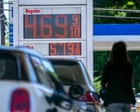
Inflation jumped to 4.6% in the year to March, from 3.7% the month before, in what the treasurer, Jim Chalmers, warned was the start of an Iran war-linked fuel shock that will ripple through the economy over coming months.

With consumer prices now growing at their fastest pace in two-and-a-half years, financial markets are betting the Reserve Bank will hike interest rates for a third straight meeting next Tuesday as officials struggle to manage the nightmare scenario of containing inflation even as growth is expected to slow sharply.

Continue reading...

© Photograph: George Chan/EPA

© Photograph: George Chan/EPA

© Photograph: George Chan/EPA

UK faces £35bn hit and risk of recession this year over impact of Iran war, thinktank warns

Niesr says even under best-case scenario, economy would grow at slower pace in 2026 and 2027 because of conflict

Britain is facing a £35bn economic hit and the risk of a recession this year as the fallout from the Iran war adds to the pressure on Keir Starmer’s government, a leading thinktank has warned.

The National Institute of Economic and Social Research (Niesr) said that even under a best-case scenario the UK economy would grow at a much slower pace this year and next because of the Middle East conflict.

Continue reading...

© Photograph: Victoria Jones/PA

© Photograph: Victoria Jones/PA

© Photograph: Victoria Jones/PA

As Putin Orders That the Economy Be Fixed, Russia Grasps for Solutions

24 April 2026 at 17:07
Another interest-rate cut highlights the narrowing path for the country’s central bank amid the strains of immense wartime spending.

Feeling gloomy about the economy? The ‘vibecession’ has arrived in Australia – but experts are less worried

24 April 2026 at 08:12

A poll shows most Australians think the country is either in a recession or will be soon. Economists have a different view

Australian households were already on edge before the bombs started falling in Iran.

The cost of living was high and inflation was accelerating again, forcing the Reserve Bank to start ratcheting up interest rates.

Continue reading...

© Photograph: Asanka Ratnayake/Getty Images

© Photograph: Asanka Ratnayake/Getty Images

© Photograph: Asanka Ratnayake/Getty Images

UK inflation rises to 3.3% amid biggest jump in fuel prices in more than three years

Annual March rate shows impact of Iran war, which also pushed up cost of food and air fares

UK inflation accelerated to 3.3% in March after the Iran war triggered the biggest jump in fuel prices for more than three years.

In the first official snapshot of the damage to living standards in Britain from the US-Israeli war on Iran, the Office for National Statistics (ONS) said the consumer prices index increased last month from a rate of 3% in February. The rise matched the forecasts by City economists.

Continue reading...

© Photograph: Finnbarr Webster/Getty Images

© Photograph: Finnbarr Webster/Getty Images

© Photograph: Finnbarr Webster/Getty Images

  • ✇The Guardian World news
  • Bank bosses called to meeting with Reeves over impact of Iran war on UK economy Rob Davies
    HSBC, Barclays, Lloyds, NatWest and Santander will this week discuss with chancellor how to limit effects of conflict Middle East crisis – live updatesThe bosses of Britain’s “big five” retail banks have been summoned to a meeting with the chancellor, Rachel Reeves, this week to discuss how to limit the economic impact of the crisis in the Middle East triggered by the US and Israel’s attacks on Iran.The chief executives of HSBC, Barclays, Lloyds, NatWest and Santander have been asked to attend a
     

Bank bosses called to meeting with Reeves over impact of Iran war on UK economy

19 April 2026 at 12:06

HSBC, Barclays, Lloyds, NatWest and Santander will this week discuss with chancellor how to limit effects of conflict

The bosses of Britain’s “big five” retail banks have been summoned to a meeting with the chancellor, Rachel Reeves, this week to discuss how to limit the economic impact of the crisis in the Middle East triggered by the US and Israel’s attacks on Iran.

The chief executives of HSBC, Barclays, Lloyds, NatWest and Santander have been asked to attend an emergency summit on Wednesday, amid increasing acceptance that a major economic hit from the Iran war is unavoidable.

Continue reading...

© Photograph: Leon Neal/Getty Images

© Photograph: Leon Neal/Getty Images

© Photograph: Leon Neal/Getty Images

❌