Normal view

  • ✇Cartoon Research
  • UPA’s “Christopher Crumpet’s Playmate” (1956) Steve Stanchfield
    First, some quick Thunderbean news: We’re cranking on sending out special sets this week – 8 in total! We’re trying hard to catch up on all of these and have this be the most productive year at Thunderbean. I’m particularly happy with this group of the special sets, and thanks to everyone who has contributed to these since it’s made so many of the real sets move forward. We also have two new ones (and all Lantz and all Columbia set) at the Thunderbean Shop, and will be working to get Rainbow P
     

UPA’s “Christopher Crumpet’s Playmate” (1956)

9 April 2026 at 07:01

First, some quick Thunderbean news:

We’re cranking on sending out special sets this week – 8 in total! We’re trying hard to catch up on all of these and have this be the most productive year at Thunderbean. I’m particularly happy with this group of the special sets, and thanks to everyone who has contributed to these since it’s made so many of the real sets move forward. We also have two new ones (and all Lantz and all Columbia set) at the Thunderbean Shop, and will be working to get Rainbow Parades volume 2 out the door soon as well as several other official sets. I’m really enjoying seeing many longer-term projects finally out the door, and I know many of you are super happy about that too!


Now- today’s film!

The loveliest thing about this period in time is that we have good quality versions of so many things that used to be only available in both less-than-great versions and standard def. It still makes you wish that *everything* was already available, but that’s of course asking for too much!

For the things that are still not available in HD, having access to a good 35mm scan often suits the bill.

Christopher Crumpet’s Playmate (1956) is a feast for the eyes in its simplicity and ‘modern’ aesthetic. Directed by brilliant animator Robert Cannon, it’s full of both the design sensibility and beautiful animation you would expect. T. Hee takes credit for story (along with Cannon) as well as design, with the great Jules Engel simply getting a credit for color. It’s nice to see a credit for voice actors Marvin Miller and Marian Richman, who provided voices for the first Christopher Crumpet film as well.

The film starts out with Christopher Crumpet’s father making Christopher return a very blue dog, suggesting Christopher play with an imaginary friend instead. From there, it’s a fun little story featuring incredibly supportive parents, something I think a lot of us would have loved. I was lucky in that my own parents really tried to help me with artistic pursuits the best they could. If you did have supportive parents and they’re still around, show them this little film!

Seeing this 35mm print projected recently was a feast for the eyes, and I’m glad to be able to share that print here. Seeing a high definition version on these really make a difference- you see the textures of the paint, the self ink lines on the cels, the detail of grids and phone cords in one scene- and the beautiful quality of motion.

While I don’t see this as a top cartoon from the studio, I find it pretty enjoyable as a little piece of entertainment- and I applaud UPA for making films like this one for families that could work like an animated storybook.

Have a good week all!


EDITOR’S NOTE: I’ve been waiting for one of my contributors to mention Christopher Crumpet’s Playmate – like the “secret word” on Groucho’s You Bet Your Life TV show – I descend within a special prize for this post. Over 20 years ago I helped organize and catalog Pete Burness’ archive (for his son) and among the material there were several pencil tests for various UPA shorts… among them, THIS.

The first one below is the raw scan of the film, which was negative. That’s how most pencil tests were screened, in negative form. No need to create a print – the pencil test was going to be thrown away after viewing. I took the liberty if inverting the neg and created a video with the image positive – easier to see the pencil lines. Enjoy them both.
– Jerry Beck
  • ✇Eos
  • The Cheekeye Debris Barrier Project Dave Petley
    In British Columbia a CAN$115 million project is almost complete to mitigate the risk posed by debris flows to the town of Squamish. Upstream of the town of Squamish in British Columbia, Canada, an extraordinary project is underway to mitigate the risk of debris flows. Known as the Cheekeye Debris Barrier Project, the scheme involves the construction of a concrete barrier that is 24 metres high across the Cheekeye Fan, designed to catch debris flows with a volume up to 2.4 million cu
     

The Cheekeye Debris Barrier Project

20 May 2026 at 08:15
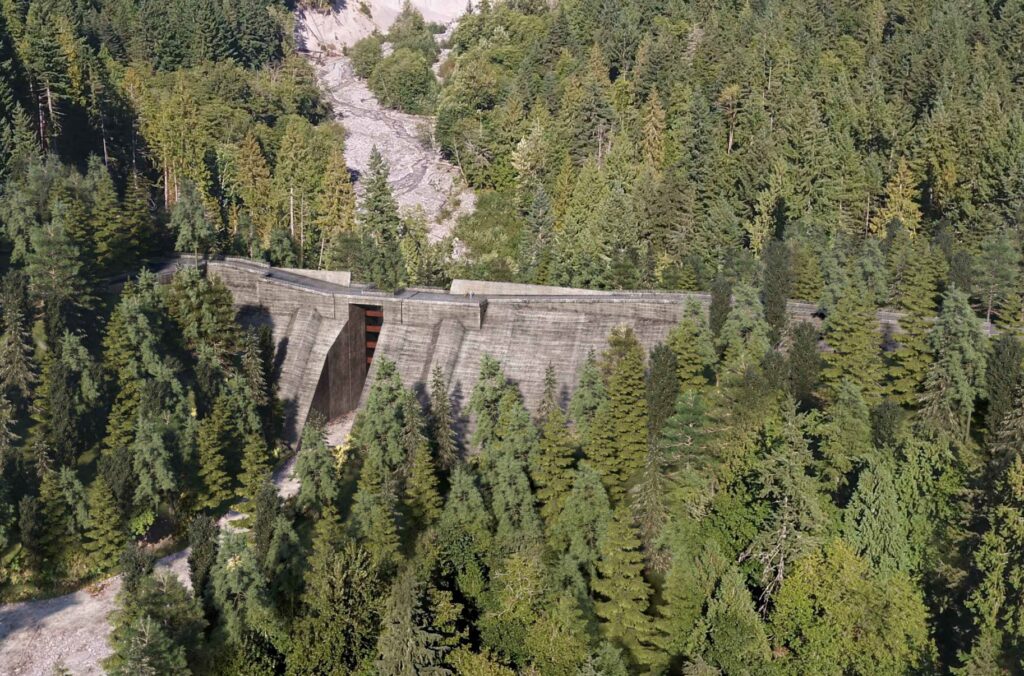
A render of the completed Cheekeye Debris Barrier.

In British Columbia a CAN$115 million project is almost complete to mitigate the risk posed by debris flows to the town of Squamish.

Image of a landslide partially covered with a transparent sand-colored overlay and the words “The Landslide Blog,” centered, in white

Upstream of the town of Squamish in British Columbia, Canada, an extraordinary project is underway to mitigate the risk of debris flows. Known as the Cheekeye Debris Barrier Project, the scheme involves the construction of a concrete barrier that is 24 metres high across the Cheekeye Fan, designed to catch debris flows with a volume up to 2.4 million cubic metres of debris.

The project is almost complete, with hand-over expected in the summer of this year. There is an excellent article about the project on The Tyee website, which includes some very interesting images of the structure. The estimated cost of the project is around CAN$115 million. The location of the Cheekeye Debris Barrier Project is [49.79417, 1123.10878]. This is a render of the final form of the barrier (but take a look at the images of the almost completed structure too):

A render of the completed Cheekeye Debris Barrier.
A render of the completed Cheekeye Debris Barrier. Image via the District of Squamish.

This is a fascinating project that makes a great case study for teaching, not least because both the detailed design considerations and the regulatory process for approving the programme are available in detail.

In terms of the detailed design considerations, there is an excellent open access paper in the Canadian Geotechnical Journal (Lesueur et al. 2025) that provides a very comprehensive analysis of the estimation of the potential volume and mobility of the debris flows on the Cheekeye Fan, and of the considerations that went into the final deisign of the structure.

In terms of the approval process, the District of Squamish has an online archive of documents and Council minutes that extends back to 2003.

I would highlight the challenges around determining the optimal size of a barrier of this type. The team has been balancing risk against cost, following the principle as outlined in Lesueur et al. (2025):-

“The local government specifies that tolerable debris-flow risks be reduced “as low as reasonably practicable” (ALARP), defined in this project as the point where the cost of additional mitigation measures is grossly disproportionate to the benefits gained.”

Thus, the barrier is not designed to stop the maximum credible debris flow, which is 5.5 million cubic metres (more than double the design event). This is pragmatic engineering at its best, and the Cheekeye Debris Barrier Project provides the level of detail that allows the decision-making process to be fully understood.

Reference

LeSueur, P. et al. 2026. Risk-informed design of debris-flow mitigation at Cheekeye FanCanadian Geotechnical Journal62: 1-16. https://doi.org/10.1139/cgj-2023-0008

Text © 2026. The authors. CC BY-NC-ND 3.0
Except where otherwise noted, images are subject to copyright. Any reuse without express permission from the copyright owner is prohibited.
❌
Subscriptions