Reading view

Mexico World Cup puts spotlight on protest movements

Mexico City, Mexico – As FIFA’s opening ceremony kicked off inside the Azteca Stadium on Thursday afternoon, a parallel scene played out on the streets surrounding it. 

Several social movements converged on Mexico City to protest what many activists are calling the “World Cup of Dispossession”, a tournament they say has been built on the backs of the country’s poorest citizens, while their most urgent demands go unmet.

Among the most prominent were the CNTE teachers’ union, collectives of searching mothers of the disappeared, and parents of the 43 Ayotzinapa students – trainee teachers who were forcibly disappeared in 2014.

The protesters mobilized mainly near the Azteca Stadium, blocking all major access routes to the venue and the Zócalo, where a massive fan fest had been programmed. 

Security forces deployed what city authorities called “the last mile” –  a security perimeter extending roughly one mile around the Estadio Azteca, designed to prevent anyone without a ticket from accessing the grounds. But even before reaching that cordon, some protest groups were surrounded and blockaded by police to prevent them from advancing.
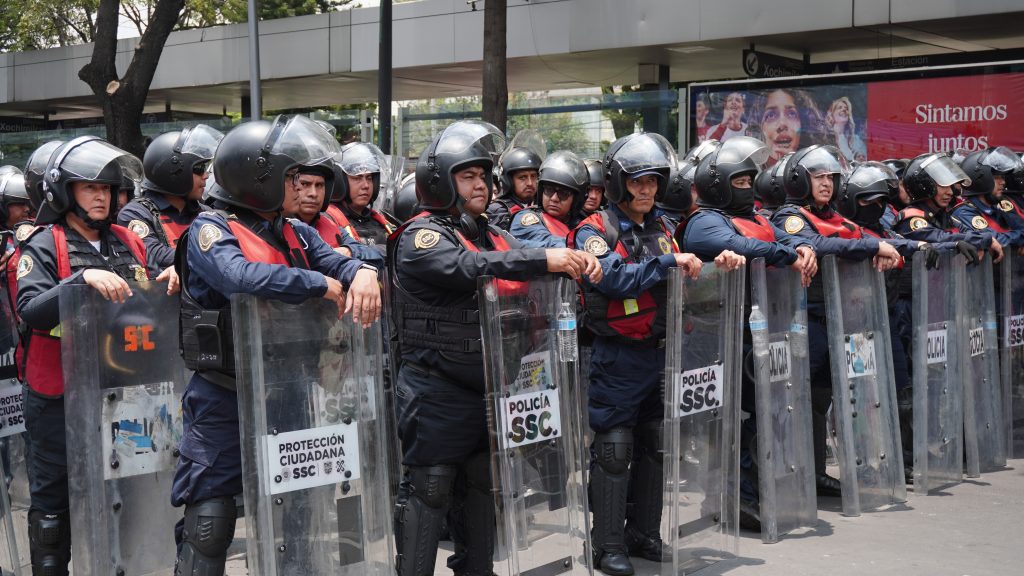
Riot police near the stadium in Mexico City. Image credit: Jorge Alfonso.

Several protesters were wounded during clashes with police and journalists detained during the day, among them independent reporter Axel Hernández, who was stopped while walking to the protests, his equipment searched under the pretext of an explosives check. “When they found nothing but posters, they claimed they were going to arrest us for putting up posters,” he told Latin America Reports

Police drove Hernández and a colleague 10 km from the point of detention before releasing them.

Aaron Gardúñez Jiménez, Director General of the Human Rights System Implementation Agency of Mexico City, acknowledged monitoring eight to ten simultaneous protest actions — some peaceful, some “complex” — but maintained that “despite the difficulties, freedom of expression was guaranteed throughout the day.” 

Erika, a member of the feminist collective “We exist because we resist,” who asked her last name to be anonymous for security reasons, had a personal reason to march: her daughter was murdered in 2023. From her perspective, the government is not merely failing to meet protesters’ demands, it is actively trying to silence them. “We want her [Sheinbaum] to listen to us, to put herself in our shoes and make a commitment,” she demanded.

Alejandro Gutiérrez, a Mexico City secondary school teacher and active CNTE member, said negotiations with the government were advancing but only superficially, with proposals that fail to address the union’s core demand: the repeal of the 2007 ISSSTE Law reform that dismantled handed pensions over to private capital management.
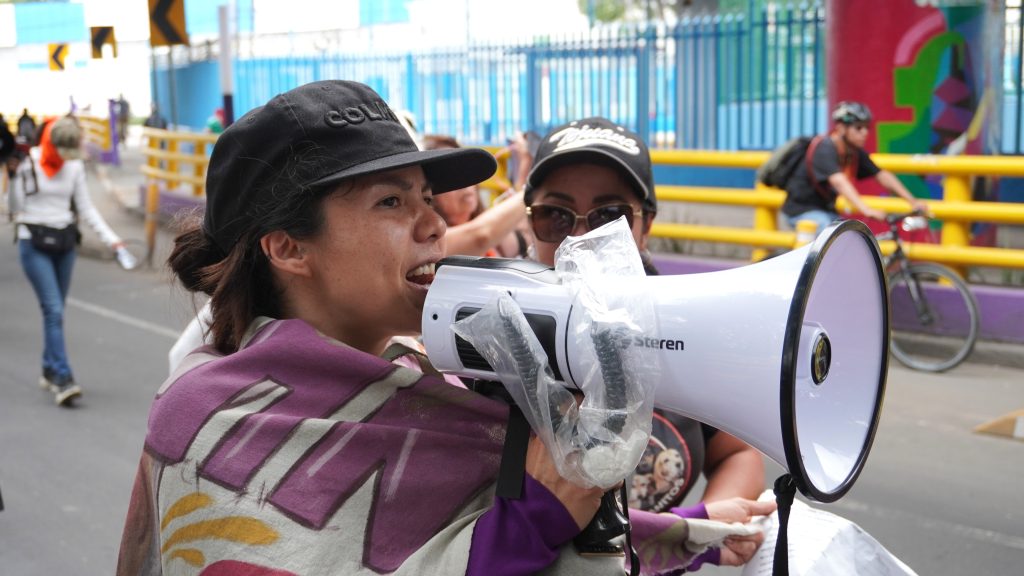
Activist protests the closure of Refugio Franciscano and the mistreatment of its animals. Image credit: Jorge Alfonso.

Sheinbaum between the global stage and the street

President Claudia Sheinbaum navigated the World Cup opening day under considerable political pressure. She had already announced she would not attend the opening match, gifting her ticket to a girl from a low-income family. When the Zócalo encampment threatened the fan fest, she acknowledged there were 18 alternative venues where people could watch for free.

Her tone throughout the week has been deliberately restrained. Sheinbaum invoked the spectre of historical repression directly: “They want us to fall into repression on the eve of the World Cup. We are not going to fall into that provocation. We are not Díaz Ordaz.” The reference is to Gustavo Díaz Ordaz, who ordered the massacre of student protesters at Tlatelolco in October 1968 — just days before Mexico City hosted the Olympic Games. As heirs of the left that emerged from those protest movements, Sheinbaum’s government is acutely aware of what any misstep would mean.

The World Cup as an amplifier

The president had initially denied there was any social unrest ahead of the tournament — a position that became increasingly untenable as the week progressed. Mexico is already navigating a deteriorating relationship with the United States ahead of July trade negotiations, political scandals, and lingering security concerns following a burst of cartel violence in Guadalajara in February.

While the World Cup presents an enormous economic opportunity for the country, projected to generate US$3 billion for hotels, restaurants and sports venues, it also provides a platform for social and political movements to take their battle to the world stage.

With stagnant teacher salaries, decades of impunity in the Ayotzinapa case, and a crisis of forced disappearances that has left over 100,000 people missing across the country, the stakes of the tournament in Mexico go far beyond the fulltime score.

Featured image description: A protestor holds a football next to a riot police officer.

Featured image credit: Jorge Alfonso.

The post Mexico World Cup puts spotlight on protest movements appeared first on Latin America Reports.

  •  

Cuba migration reform: a lifeline for the economy or a legal cover for repression? 

Mexico City, Mexico – Last month, the Cuban government approved a sweeping set of changes to its migration laws. 

Among the most consequential updates are the elimination of the 24-month limit on staying abroad without losing residency, the expansion of diaspora rights to own and invest in businesses on the island, and new travel-control capacities.

But some Cuban migrants and analysts argue the laws reinforce political repression and may simply be an effort to relieve pressure from Washington without fundamentally reforming the state.

An opening for the diaspora

For years, the “24-month rule” forced Cubans to return to the island every two years or face being declared “emigrés,” a status that stripped them of some of their domestic rights. 

Jesús Arboleya, a migration expert and researcher at the Center for Demographic Studies, explains that this limit never effectively curtailed emigration. Instead, it “acted as a counterproductive barrier that damaged the relationship between the diaspora and their homeland. It should never have existed”.

The new law replaces this with the concept of “effective residency”. This status is determined by spending more than 180 days in Cuba or 120 days while showing specific ties to the country, such as property, family, or bank accounts. Cubans who don’t meet these standards will be considered “residents abroad”.

Lázaro Blanco, a Cuban migrant who left the country three years ago and owns real estate and a small business on the island, sees these changes as an improvement that will make his life easier. 

“I travelled to Cuba frequently to see my family but also to maintain my residence and the rights over my business. I see it as a small step forward, one less thing to worry about,” he told Latin America Reports.

The new regulations also provide a specific residence category titled “investors and business”, which requires a specific application and an endorsement document from the Cuban entity with which the person will conduct business.

Of all the sections of the new migration rules, only those related to foreign investment have taken immediate effect, reflecting recent policy shifts announced by the Minister of Foreign Trade and Investment, Oscar Pérez-Oliva Fraga, who has prioritized attracting capital from the Cuban diaspora as a way out of the crisis. 

But while the legal path for investment is now open, the actual attraction of these funds “doesn’t depend exclusively on this measure”, according to migration expert Arboleya.

For some emigrants, the law changes nothing

Despite the reform’s forward-looking nature, it offers little comfort to those dispossessed in previous decades. In the past, the properties of Cubans who left the country were seized by the government with all their possessions inside, which caused resentment towards the government.

Leonor López, a Cuban living in Miami whose home was taken by the state when she departed in 2002, finds the reform hollow: “These new laws are just another scam among the many they’ve tried over the years to milk emigrants dry. Anyone who thinks they can go to Cuba to invest or build up capital under that government is delusional.”

For many, the reforms are superficial and won’t lead to significant changes unless they are accompanied by political change. Additionally, the lack of legal certainty for foreign companies and the state’s track record of debts cast a shadow of doubt over future investment projects on the island.

Critics say the law codifies political travel bans

Alexander Hall, a Cuban historian and activist, remains “regulated”—the official euphemism for being barred from leaving the country. The government cites “public interest” as the reason, a category Hall describes as “arbitrary, authoritarian” and a “violation of both the Cuban Constitution and the Universal Declaration of Human Rights”.

“There are also many documented cases of people who have not been allowed to return to Cuba.” Dissident activists Omara Ruiz Urquiola and Anamely Ramos are two of them — both, like Hall, have been denied their right to cross borders freely. 

The law officially allows the state to deny entry or exit based on concepts such as “security and national defence” or “public interest”. “When you set foot on Cuba, you are entirely in their hands”, said Cuban lawyer Eloy Viera, referring to the discretionary faculties this law gives to Havana’s government.

The new regulations do establish a formal path to appeal these prohibitions through administrative and judicial channels. While Hall is skeptical of their effectiveness, he is willing to use them as a “civic exercise” to highlight the “unjust character of institutional proceedings”.

He believes that public initiatives to challenge these measures are essential for those who “aspire to derogate these mechanisms and recover our rights”. Most alarming to activists is the new authority for the state to strip citizens of their nationality.

The law allows for the deprivation of citizenship for those who perform “acts contrary to the high political, economic, and social interests” of the Republic. Critics warn that this mimics tactics used in Nicaragua, where the government has mass-deprived activists and opposition figures of their citizenship to punish political dissent.

A reform shaped by external pressure?

On January 29, 2026, U.S. President Donald Trump signed an executive order declaring Cuba a national emergency and threatening tariffs on any country that supplied oil to the island. 

Months later, however, he allowed a Russian tanker to dock in Cuba, stating decisions would be made on a case-by-case basis. Then, four days before Cuba approved the new migration law, he signed a second executive order expanding the scope of sanctions to include companies in key Cuban economic sectors and foreign financial institutions.

The Cuban government has expressed willingness to accept economic reforms that could ease U.S. pressure, while maintaining that its political system is not up for negotiation. Whether the migration law represents a genuine opening or a calculated gesture to ease external pressure — without touching the structures of political control — remains to be seen.

Featured image description: Havana’s Jose Marti International Airport Terminal 3

Featured image credit: Tacorontey via Wikimedia Commons

The post Cuba migration reform: a lifeline for the economy or a legal cover for repression?  appeared first on Latin America Reports.

  •  

Mexico City teacher strike threatens to disrupt 2026 World Cup kick-off

Mexico City, Mexico – A national strike by hundreds of teachers affiliated with Mexico’s National Coordinating Committee of Education Workers (CNTE) has entered its fourth day, paralyzing much of the country’s capital. 

View Post(opens in a new tab)

The mobilization – which opposes pension reforms – escalated on Wednesday when protesters broke into the headquarters of the Public Education Secretariat (SEP), damaging the government building and injuring at least two police officers.

With no end in sight to negotiations between union representatives and authorities, the ongoing demonstrations threaten to disrupt the World Cup, which begins one week from today.  

The union has blocked highways connecting Mexico City to nearby cities, vandalized public monuments, and established a large encampment a few blocks from the presidential palace. 

The CNTE is simultaneously deploying actions in at least four other states, with more regions expected to join in the coming days.

The CNTE’s central demand is the derogation of a 2007 reform to a law passed by Mexico’s social security institute dismantling a solidarity-based pension scheme and shifting workers into individually managed private accounts. Teachers are also demanding a 100% salary increase and the elimination of the USICAMM, the body that oversees teacher hiring and promotions.

Negotiations have been conducted jointly by Secretary of Government Rosa Icela Rodríguez, Education Secretary Mario Delgado, and the director general of the ISSSTE, but no agreements have been reached so far. 

The three officials were formally authorized by President Claudia Sheinbaum to conduct and close negotiations on the government’s behalf, despite CNTE demands for a direct meeting with the president. 

Secretary Rodríguez said the state’s ability to grant concessions is limited by fiscal constraints: “What cannot be done is due to a lack of budget, not a lack of will.” 

Filiberto Frausto Orozco, a CNTE leader from Zacatecas, warned that if the government rejects their demands, “there will be no more negotiations.” 

The union has also threatened to disrupt the FIFA World Cup inauguration, scheduled for June 11 at Estadio Ciudad de México. 

Earlier this week, teachers blockaded Paseo de la Reforma and toppled statues of footballers installed to promote the tournament. 

Sheinbaum campaigned on promises to address teachers’ labor grievances, but after one and a half years in office, her government has yet to deliver on the pension reform rollback the CNTE has long demanded.

On the streets, rank-and-file teachers say they are prepared for a prolonged fight. Saray López Alamillo, who has been in the classroom for six years and is an active CNTE member, expressed full support for the union’s escalation strategy.

“In my school we have talked about it and we are ready to take this fight to the end,” she told Latin America Reports.

For many teachers, the cost of protest is immediate and personal. The government docks wages for each day teachers miss class while demonstrating. 

López Alamillo knows this firsthand: “Last year, they deducted 3,000 or 4,000 pesos from my paycheck for almost eight consecutive pay periods.”

The teacher added that the losses directly hurt her ability to cover basic household expenses. 

For some teachers those deductions are enough to keep them home. For others, like López Alamillo, the financial punishment only sharpens their resolve.

With negotiations deadlocked and the World Cup opening a week away, the standoff is entering a critical phase. Neither side has shown signs of yielding.

Featured image description: Union members marched in Mexico City this week.

Featured image credit: CNTE via Facebook.

The post Mexico City teacher strike threatens to disrupt 2026 World Cup kick-off appeared first on Latin America Reports.

  •  
❌