Artists Christian Rebecchi and Pablo Togni, who work as NEVERCREW, have a knack for bringing the immensity of nature to developed urban spaces. Their colorful, large-scale murals take a playful tack when it comes to portraying animals, often merging them with other objects such as instant photos or, most recently, a plastic punch-out toy. “Souvenir,” completed this year in Vienna, combines motifs of a large bear with other Arctic components, such as icebergs, a seabird, and a steamship.
“The natural environment appears transformed, filtered, made artificial: it is no longer a space experienced through relationship, but a distant construction,” the artists say in a statement. The work is “almost a simulation reflecting a perception of nature progressively emptied of empathy…Nature becomes something to observe, arrange, organize, as if it were a separate object rather than a system of which we are an integral part.”
Detail of “Bracketing”
Over the past few years, NEVERCREW has completed numerous architectonic paintings that depict the fragile balance between humanity and nature—specifically wildlife. Whales, bears, and elephants are depicted inside of terrariums or bundled into fabrics.
The animals’ very presence on the side of buildings, where they are contained within the bounds of the architecture, is a reminder of the tensions between—one might even say the incongruousness of—daily human activities and city infrastructure. For Rebbechi and Togni, bringing nature into these spaces highlights the importance of sustaining the relationship between humankind and nature.
“Bracketing” (2021), diptych, Jarville-la-Malgrange, Nancy, France. Curated by LeMur NancyDetail of “Bracketing”Detail of “Bracketing”“Gravity” (2021), Le Locle, Switzerland, for Exomusée“Switch” (2024), Wuppertal, Germany, for Urbaner Kunstraum Wuppertal, curated by Valentina MaoilovDetail of “Switch”Detail of “Switch”“Wire” (2023), Paradiso, Switzerland. Organized and curated by Freefox Architecture StudioDetail of “Souvenir”Detail of “Souvenir”
The ocean floor is covered with dead whales–but it is everything but a biohazard. When a whale dies, its body sinks to the ocean floor in a process called whale fall. The carcass then becomes its own complex ecosystem, nourishing and housing all types of marine life. Whale bones can then fossilize over time, leaving behind traces of what life looked like millions of years ago.
Now, scientists in the Indian Ocean have discovered an enormous whale graveyard. The collection of bones and communities supported by these whale falls stretches 745 miles across the seafloor 13,779 to 22,965 feet deep. The oldest whale fossil is roughly 5.3 million years old and the graveyard even includes a new species of extinct whale. The findings are detailed in a study published today in the journal Nature.
“The deep sea is far from barren—it’s dynamic, full of life and history,” Dr. Xiaotong Peng, a study co-author and engineer at the Chinese Academy of Sciences (CAS), tells Popular Science. “When a whale dies and sinks, it becomes an oasis, supporting unique communities for decades or centuries.”
In 2023, CAS team was studying the geology and biology of the southeast Indian Ocean’s hadal zone—the ocean’s deepest zone, extending from 19,680 to 36,000 feet-deep. While inside of a submersible, the divers spotted the first whale fossil 22,972 feet below the surface.
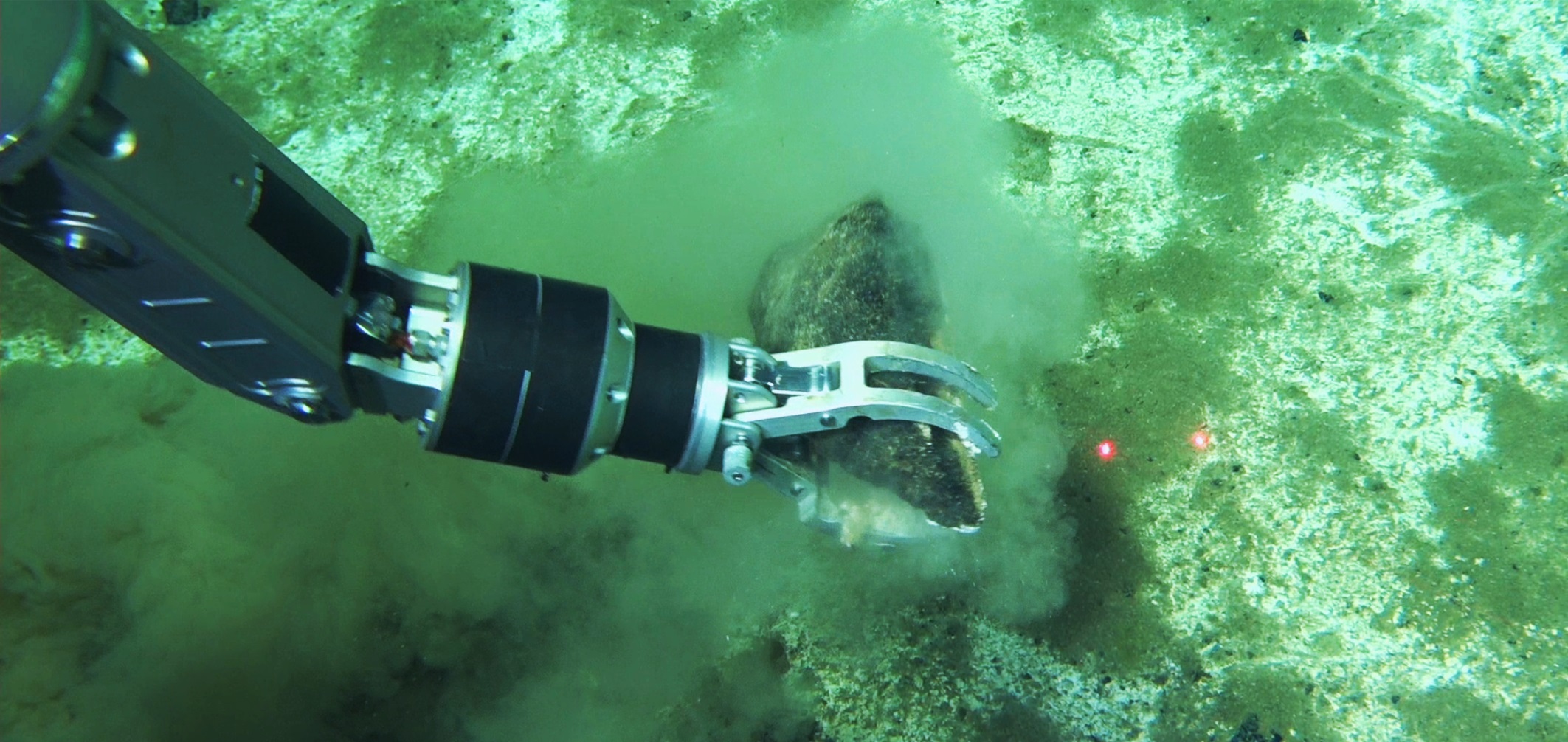
Recovery of whale fossil bones using the manipulator arm of the Chinese submersible Fendouzhe on the deep seafloor of the Diamantina Zone, a deep-sea rift in the Indian Ocean. Image: Global TREnD, IDSSE.
According to study co-author and geologist Dr. Peng Zhou, the remains were actually “quite easy to find” once the team began to search. “They looked unusual, so when the dive scientists first encountered them, they wanted to figure out what they were,” Zhou tells Popular Science.
Peng adds, “We immediately pivoted our objectives to systematically map, document, and sample these whale remains. So it really came down to curiosity meeting the technological capability to explore depths that had been largely inaccessible.”
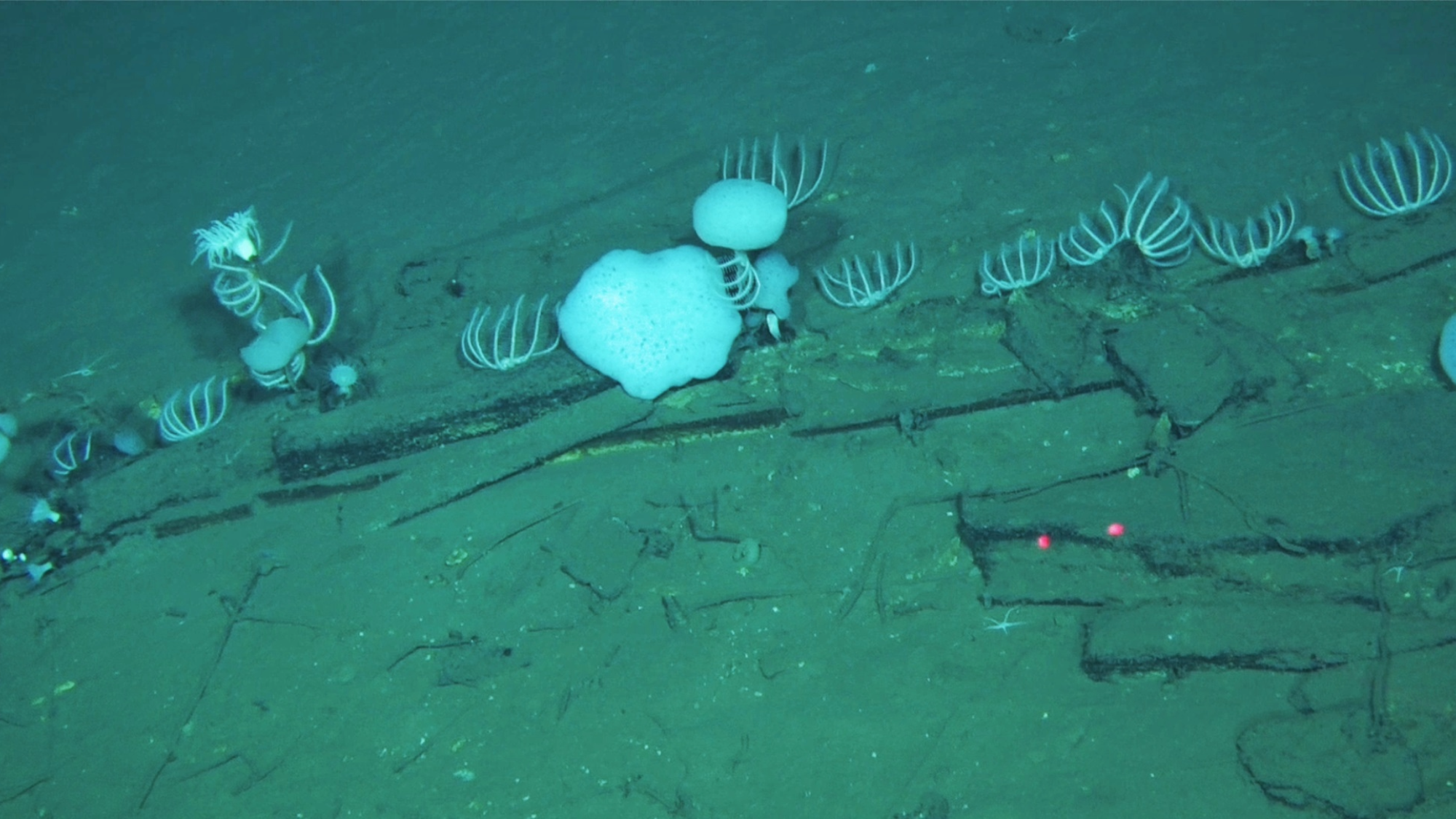
They documented 485 whale fossil sites from five active whale falls. The whale carcasses are home to a large community of jellyfish, brittle stars, bone-boring worms, and bivalves. Some of these species living in the carcasses may even be new to science, but that has not been confirmed. The oldest have been in the area for about 5.3 million years ago (the Pliocene era).
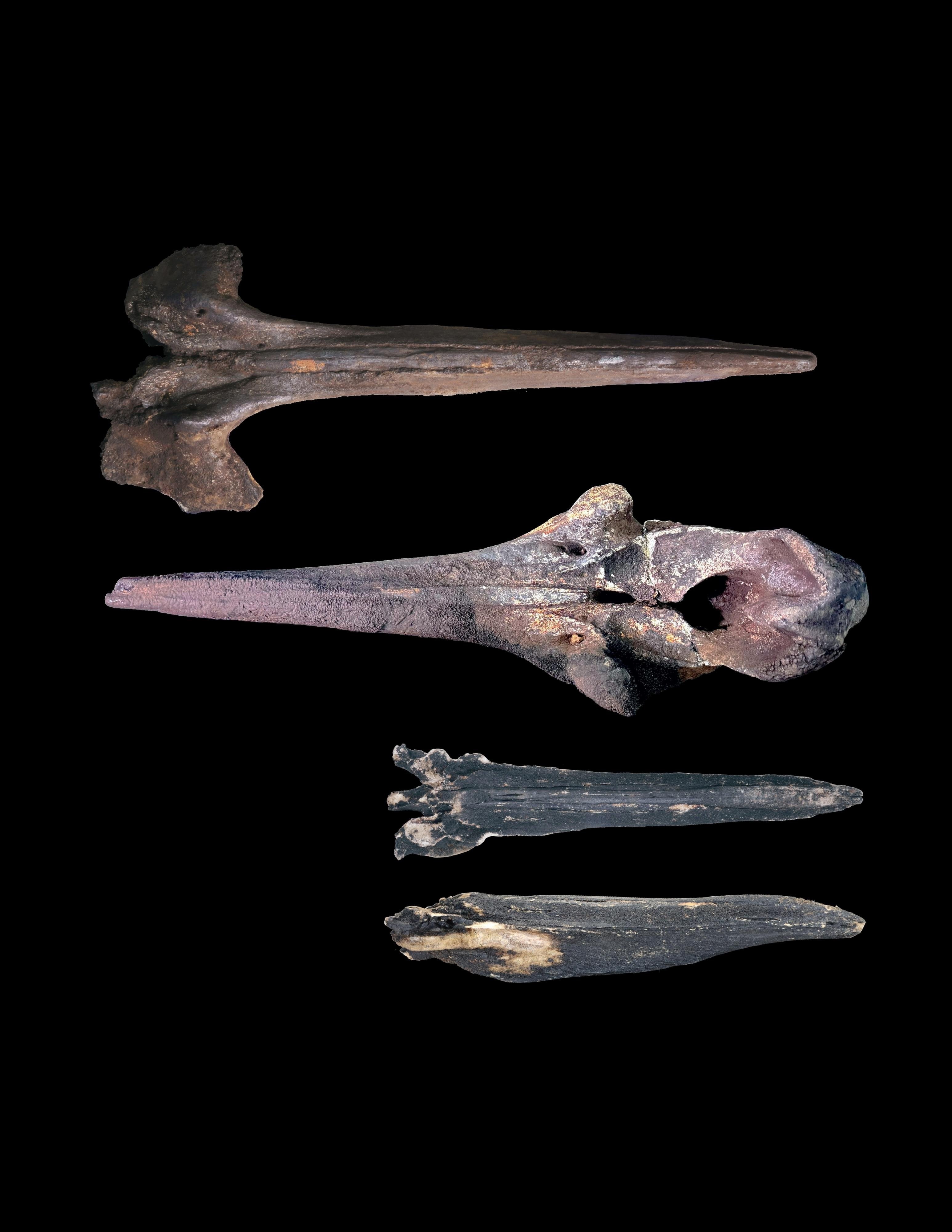
Fossil skulls of three beaked whales recovered from the seafloor at hadal depth of the Diamantina Zone, 6,584–-6,878 meters. The image shows two extinct beaked whale species, Pterocetus diamantinae sp. nov. (new species to science, on the top) and Izikoziphius rossi (the second skull), as well as an extant Andrews’ beaked whale, Mesoplodon bowdoini (two skulls on the bottom). Image: Global TREnD, IDSSE
Most of the whale fossils come from several species of deep-diving beaked whales. Some of the bones belong to beaked whales that still exist today. Others are from extinct whales, including a species new to science named Pterocetus diamantinae.
“Finding both extinct genera like Pterocetus and living species like Mesoplodon bowdoini preserved together in the same region, across 1,200 kilometres [745 miles] of seafloor at such extreme depths—that was truly unexpected,” says Zhou.
This fossil record is also continuous, so the team can track the population dynamics and evolution of deep-diving whales over time.
“These fossils give us a direct window into the Pliocene, about 5.3 million years ago,” study co-author and biologist Dr. Xikun Song tells Popular Science. “They show that beaked whales were already specialized deep‑divers in the Indian Ocean by that time. Beyond the whales themselves, the associated fossil fauna also tells us about the structure of ancient deep‑sea whale‑fall communities and broader deep‑sea biodiversity back then.”
This whale graveyard could reshape our understanding of both living and extinct beaked-whales. There are roughly 24 species of beaked-whale living today. However, their deep-sea habitat, likely low population numbers, and reclusive behavior make them difficult to study. Having such a large fossil deposit like this could help explain more about their reclusive lives.
The fossils are also shedding more light on the mysterious ecosystems living at the ocean’s deepest depths.
“Discoveries like this are possible because of curiosity, collaboration, and technology,” Peng concludes. “We’ve barely scratched the surface of the deep ocean, and there’s so much more waiting to be found.”
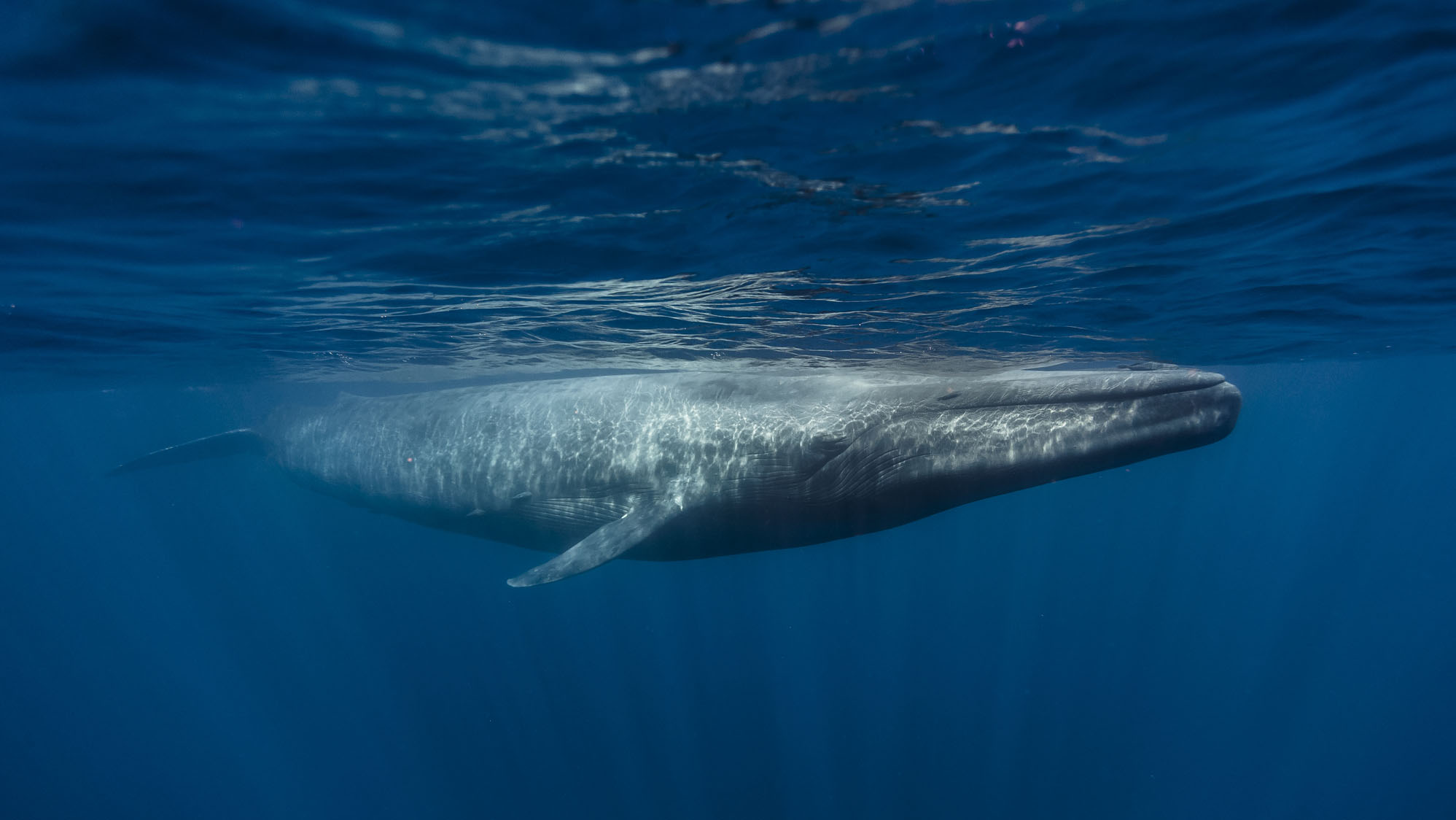
Think of the largest elephant you can. Now multiply that by 30. That’s the size of a blue whale, the largest animal to exist, ever. The ocean-going mammals weigh up to 330,000 pounds and can stretch over 100 feet, the length of a Boeing 737. Even the biggest dinosaur only weighed something like 75 tons, less than half the weight of a blue whale.
On land, the maximum size mammals can reach is limited by gravity. Large land mammals have huge bones, massive blood vessels, and strong legs to support their weight.
As animals get bigger, their weight increases much faster than the strength of their bones. At a certain point, an increase in size would lead an especially large animal’s legs to collapse under the weight of gravity.
In water, gravity doesn’t have the same effect. Instead, the buoyancy of water helps support the weight of aquatic mammals: a key factor in how blue whales reached their enormous size.
The energy sweet spot
But there is more to the story of how blue whales got so dang big.
Water conducts heat away from the body much faster than air so mammals need to be larger otherwise it’s impossible to stay warm. At the same time, as bodies increase in size, the energy needed to fuel them rises.
“What we found is that aquatic mammals are drawn toward an optimal body size, because of energetic tradeoffs,” he says. Their ideal size is a careful balance between how much energy they use weighed against how fast they feed. It’s not simply becoming as big as possible.“The ‘sweet spot’ is where [energy] income comfortably exceeds costs.” An aquatic mammal can only become huge if it feeds on enough food to offset the demands of a larger body.
Eating dense swarms of krill has led blue whales to become larger
Blue whales are able to grow much larger than other aquatic mammals because they feed on krill.
Krill are only about 2 inches long and swim slowly in tightly packed swarms. To take advantage of this, blue whales have developed huge mouths and a highly expandable throat pouch beneath their skin, so they can lunge forward and swallow enormous amounts of krill in one gulp. They’re capable of eating up to 794 pounds of krill in one mouthful. That’s the equivalent to roughly 16 vending machines.
The pouch is formed by deep folds that stretch from the bottom of their jaw to their navel, creating a stretchy extension of their mouth that balloons out to accommodate such a large intake.
Blue whales are able to eat the equivalent of 16 vending machines worth of krill in a single gulp. Video: See Blue Whales Lunge For Dinner in Beautiful Drone Footage, National Geographic
But lunging for food takes a lot of energy. “This feeding strategy only becomes energetically worthwhile at large body sizes,” says Elliott Hazen, an ecologist at NOAA Fisheries. “Blue whales survive on tiny prey because they have developed one of the most efficient bulk feeding systems in the natural world.”
When Goldbogen modeled the energy cost of each lunge against the energy gained from krill, he found that a single mouthful of krill can give blue whales more than 200 times as much energy as they use. That’s a really good payoff.
Blue whales are built for migration
But the whales’ size doesn’t just help as they feed, it also allows them to travel long distances. Krill can only be found in large numbers in isolated areas of the ocean so blue whales journey thousands of miles between their feeding and breeding grounds.
Their massive bodies means they can store huge amounts of energy as fat even when they’re not feeding. So even though blue whales end up using more energy than smaller animals, they burn it more slowly, at least relative to their size. This gives them even greater endurance.
A streamlined shape also reduces drag so they can move through the oceans with minimal energy.
Whales weren’t always giants
Blue whales haven’t always been so big. Fossil records show their ancestors, the Pakicetus, were wolf-sized land mammals that were only three to six feet long. This ancient ancestor actually lived on land and hunted in shallow water.
When the first whales appeared in the ocean around 40 million years ago, they were also a relatively modest size. For instance, one of the earliest known whales, Mystacodon selenensis, was only around 13 feet long, roughly the same size as a bottlenose dolphin.
Then, around 3 million years ago, the oceans changed. As massive ice sheets spread across the earth, temperatures dropped and wind patterns increased. This led to an increase in upwelling, a process where strong winds cause nutrient-rich water to rise up from the deep ocean. The extra nutrients led krill to cluster in dense swarms along coastlines favoring animals that could feed in bulk and travel long distances.
“Blue whales did not just get big because they could,” says McClain. “They got big because the ocean started serving food in a way that rewarded giants.”
Blue whales are now close to the limit of how large they can grow. As animals get bigger, their heart works harder to pump blood to the extremities, oxygen delivery becomes more difficult, and reproduction slows down.
In a 2019 study, researchers measured the heart rate of a blue whale using a small heart monitor. Whales can’t breathe as they dive so they slow their heart to reduce the oxygen they use and increase the time they can stay underwater. During deep dives the whale’s heart rate slowed to as low as two beats per minute, the minimum needed to keep vital organs alive.
Bigger blue whales would also demand more krill and at some point the energy cost would become unsustainable. They wouldn’t be able to consume enough krill to get the energy they needed.
“Although the ocean allows whales to become larger than any land animal in Earth’s history, biology and physics likely place an upper limit on how large they can evolve to be,” says Hazen.
So the next time you spot something moving through the waves, consider how the blue whale became a giant: an ocean changed by ice, a body shaped by water, and a feeding strategy built around swallowing tiny krill. Together those factors produced an animal whose size surpasses all other creatures on earth.
In Ask Us Anything, Popular Science answers your most outlandish, mind-burning questions, from the everyday things you’ve always wondered to the bizarre things you never thought to ask. Have something you’ve always wanted to know? Ask us.
The world’s largest whale graveyard has been discovered at the bottom of the Indian Ocean by Chinese scientists, who found that the vast expanse of both new and ancient carcasses supports huge communities of deep-sea life.
This handout photograph, taken in 2023 and released on June 10, 2026, by Global TREnD, IDSSE, shows a robotic arm manoeuvring a whale bone at the world’s biggest known whale graveyard, discovered by the Chinese submersible Fendouzhe, seven kilometres under the sea on the deep seafloor of the Diamantina Zone in the Indian Ocean. Photo: Handout/Global TREnD, IDSSE/AFP.
It is also the deepest and oldest known whale graveyard on Earth, according to research published in the journal Nature on Wednesday, with some fossils dating back 5.3 million years.
From inside a small submersible, the Chinese researchers saw an array of strange animals — many believed to be new to science — living off the whale carcasses.
A new, though extinct, species of whale was also identified among the nearly 500 skeletons found up to 7,000 metres deep along a 1,200-kilometre corridor of bones in the Indian Ocean west of Australia.
Lead study author Xiaotong Peng of the Chinese Academy of Sciences told AFP that the researchers were “astonished” when the scale of their discovery became clear.
It was known that when whales die and drop to the seafloor, their sunken bodies — called “whale falls” — provide a source of food to bottom-dwelling creatures.
“But discovering a necropolis of this scale was completely unexpected: the size of distribution, the depth and the age range were far beyond anything we had imagined,” Peng said.
The researchers had several theories for why so many whales died in this particular corridor, including that it is a popular foraging area and has a V-shaped trench that funnels carcasses to the ocean’s floor.
‘Truly incredible experience’
For the discovery, the Fendouzhe submersible carried out 32 dives in 2023 — though what it found was only revealed in Nature on Wednesday.
China’s Fendouzhe submersible. Photo: Institute of Deep-sea Science and Engineering (IDSSE).
The sub took up to three people on the dives, collecting the fossil samples using robotic arms.
Study co-author Zhou Peng said witnessing the whale graveyard “was a truly incredible experience”.
“The vibrant ecosystems we saw offered a completely different perspective on this otherwise dark and cold ocean floor.”
Among the animals they discovered living off the carcasses were jellyfish, worms, snails, crustaceans, brittle stars and molluscs called bivalves.
Extrapolating from the number of bones they found, most of which were from beaked whales, the scientists estimated there could be more than 10 million carcasses across the area called the Diamantina Zone.
The soft tissue and lipids inside those many carcasses “translates to roughly 6.7 million tonnes of sequestered carbon,” Xiaotong Peng said.
This provides an immense source of sustenance for animals, similar to how hydrothermal vents create their own ecosystems on the ocean floor.
Some of the animals seen by the scientists also live in hydrothermal vents and cold seeps, suggesting whale carcasses could help connect these deep-sea communities to each other.
While this is by far the largest whale graveyard yet found, fossils found during trawling suggest there could be others off South Africa, the Iberian peninsula and the Crozet islands, according to the study.
‘More blockbusters to come’?
University of Hawaii oceanographer Craig Smith, who discovered the first whale fall in 1987 but was not involved in the new research, told AFP it was “extremely exciting”.
This photograph, taken in 2023 and released on June 10, 2026, by Global TREnD, IDSSE, shows whale bones at the world’s biggest known whale graveyard, discovered by the Chinese submersible Fendouzhe, seven kilometres under the sea on the deep seafloor of the Diamantina Zone in the Indian Ocean. Photo: Handout/Global TREnD, IDSSE/AFP.
“The vast number of fossil whale falls documented, including a new species of beaked whale, is truly amazing and is of major importance to understanding whale evolution and whale distributions over geologic time,” he said.
Whale fall researcher Amy Baco-Taylor at Florida State University told AFP the “remarkable discovery” would “likely provide many new insights”.
“It does seem very strange” that so many whales died in this area, Baco-Taylor admitted, adding that “we don’t know enough about whale consciousness”.
US palaeontologist Stephen Godfrey compared the “truly unique discovery” to past major underwater finds, such as when scientists first identified hydrothermal vents teeming with life on the ocean floor in 1977.
He called for future submersible voyages to find more whale graveyards across the world.
This discovery “reminded me of a trailer for the first in a series of epic movies”, Godfrey commented in a linked Nature paper.
“I hope that there will be many more of these blockbusters to come.”

 Login
Login