Reading view

Thurber Thursday: New Additions to The Spill Library; Attempted Bloggery On A Recently Auctioned Thurber Drawing

New Addition(s) To The Spill Library

With the arrival this week of the Armed Services edition of Thurber’s masterpiece, My Life And Hard Times, the Spill library has moved closer to a completing the Thurber Armed Services editions. Just The Thurber Carnival and Is Sex Necessary remain. All in good time! (I’m in no hurry).

Read more about the Armed Services editions here.

below: the other Thurber titles in the Spill library


_______________________________________________________________________

Also this week

Some time back I posted the above photo of the well-used (tattered?) dust jacket covering my copy of Burton Bernstein’s Thurber: A Biography. I bought this copy in 1975, the year it was published, when I was in my last year of college, diving deep into The New Yorker‘s history. I’ve read Mr. Bernstein’s book through and through, again and again (and it shows). Each time the book comes off the shelf I imagine the jacket loses a small piece or two (I’ve been patching it for years).

Strolling through the internet the other day I was so pleased to see a copy of Mr. Bernstein’s book in near new condition (price paid: $3.85). My 51 year old copy can now take it easy; from now on this “new” one will do the heavy lifting.

________________________________________________-

Attempted Bloggery On A Recently Auctioned Thurber Original 

A Spill fave site, Attempted Bloggery, is all over the recently auctioned Thurber original shown above. Read it here!

________________________________________________________________

James Thurber’s A-Z Entry

James Thurber Born, Columbus, Ohio, December 8, 1894. Died 1961, New York City. New Yorker work: 1927 -1961, with several pieces run posthumously. According to the New Yorker’s legendary editor, William Shawn, “In the early days, a small company of writers, artists, and editors — E.B. White, James Thurber, Peter Arno, and Katharine White among them — did more to make the magazine what it is than can be measured.”

Key cartoon collection: The Seal in the Bedroom and Other Predicaments (Harper & Bros., 1932). Key anthology (writings & drawings): The Thurber Carnival (Harper & Row, 1945). There have been a number of Thurber biographies. Burton Bernstein’s Thurber (Dodd, Mead, 1975) and Harrison Kinney’s James Thurber: His Life and Times (Henry Holt & Co., 1995) are essential. Website


The post Thurber Thursday: New Additions to The Spill Library; Attempted Bloggery On A Recently Auctioned Thurber Drawing first appeared on Inkspill.
  •  

Monday Tilley Watch, The New Yorker Issue Of June 8, 2026

The Monday Tilley Watch takes a glancing look at the art and artists of the latest issue of The New Yorker

The Cartoonists and Cartoons

Fifteen cartoons, fifteen cartoonists. No newbies. Two duos, that we know of (the Spill counts duos as one cartoonist). The longest active contributor in the issue is this cartoonist (I began contributing in 1977).

This week’s cartoons (in a slideshow)

This week’s Cartoon Caption Contest (Avi Steinberg provides this week’s contest drawing)

The Rea Irvin Talk Watch

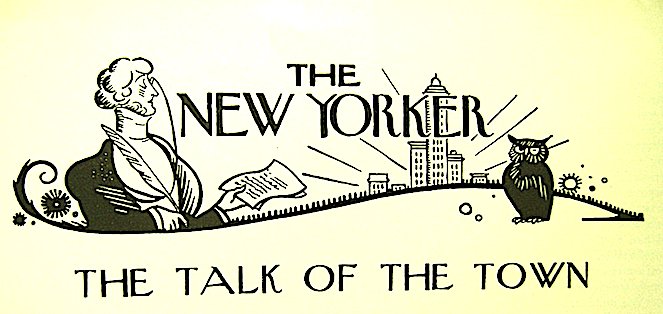
Once again, Rea Irvin’s perfect Talk design (shown here) has not returned to the magazine. Every Monday morning, since May of 2017, when a redrawn(!) version by a contemporary illustrator replaced Mr. Irvin’s work, I’ve opened up the newest issue hoping to see the original, but alas…

Read more here.

___________________________________

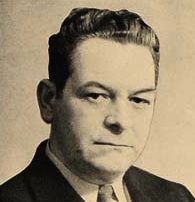
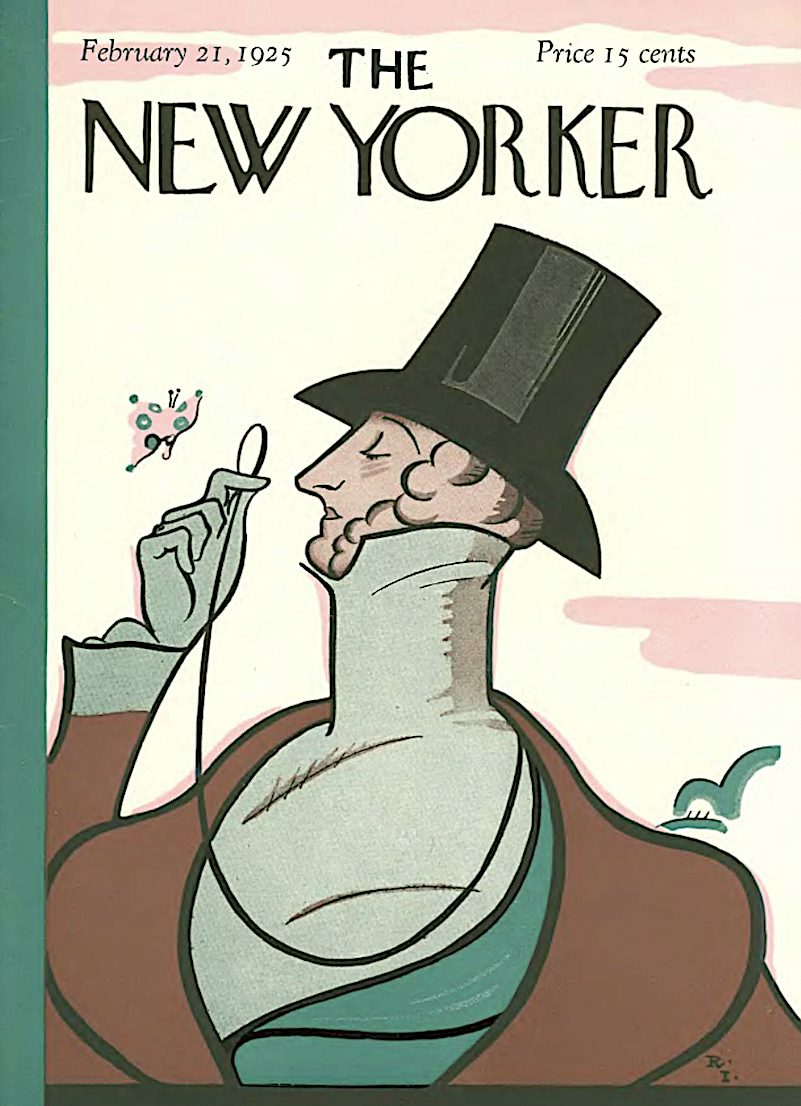
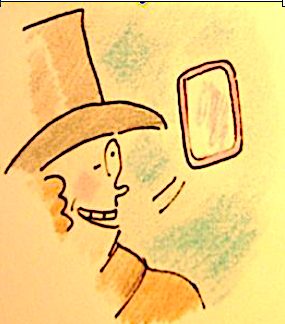
Rea Irvin (pictured above. Self portrait above from Meet the Artist) Born, San Francisco, 1881; died in the Virgin Islands,1972. Irvin was the cover artist for the New Yorker’s first issue, February 21, 1925. He was the magazine’s first art and only art supervisor (some refer to him as its first art editor) holding the position from 1925 until 1939 when James Geraghty assumed the title of art editor. Irvin then became art director and remained in that position until William Shawn officially succeeded Harold Ross in early 1952. Irvin’s last original work for the magazine was the magazine’s cover of July 12, 1958. The February 21, 1925 Eustace Tilley cover had been reproduced every year on the magazine’s anniversary until 1994, when R. Crumb’s Tilley-inspired cover appeared. Tilley has since reappeared, with other artists substituting from time-to-time. Number of New Yorker covers (not including the repeat appearances of the first cover every anniversary up to 1991): 179. Number of cartoons contributed: 261.


The post Monday Tilley Watch, The New Yorker Issue Of June 8, 2026 first appeared on Inkspill.
  •  

Review of “Famous Studios Champion Collection”

I recently encountered Jerry Beck at Film Forum here in New York City; on the day we met, he was presenting a program of Fleischer studio oddities, a program that was a good deal of fun, and had a few pleasant surprises in it.

In the course of our pre-show conversation, he invited me to watch and review a recent Blu-Ray release, “Famous Studios Champion Collection,” put out by Cartoon Logic.

This was of great interest to me, since I grew up in coastal Connecticut, in an area where picking up the Boston and New York televisions station that habitually broadcast Classic-era cartoons was tricky, especially in those pre-CATV days. My limited experience with Famous Studios’ cartoons thus came largely from public domain VHS tapes and DVDs, and those familiar with those kinds of collections can only imagine the visual quality of what was on offer.

So as not to bury the lede too much, I will come out and say this: the “Champion Collection” is warmly recommended as something animation buffs should have, either to fill in gaps in cartoons not previously seen, or to re-watch cartoons in a fashion much closer to how they would have been presented in theaters, originally.

At Left: A mangled title card for “Sheep Shape,” showing the kind of thing one sees on public domain collections.
At Right: The title card beautifully restored on this set.

Counting bonus cartoons (on which more, later), there are 20 cartoons on one disc in the collection, together with commentary tracks for all of the cartoons, as well as some miscellaneous audio and graphic production items. The cartoons themselves cover a roughly seven-year period, with cartoons bearing release dates from late 1943 to early 1950.

The collection thus covers the formative years of Famous Studios, the successor to the Fleischer studio, which had been based in Miami at the time Paramount Pictures assumed control over the Fleischer studio in early 1942. Barrier notes that by the first quarter of 1943, Famous was in the process of moving back to New York City, where the Fleischer studio had been founded, and where it had operated until moving to Florida in the late 1930s. Thus, the first cartoon in the collection, No Mutton Fer Nuttin’, represents some of the first work completed at the studio in its changed location.

This was a time period when the studio not only had to meet the challenge of the Walt Disney studio, but had to meet the challenge of the cartoon studio at MGM and that at Schlesinger/Warner Bros., both of which had emerged as trend-setters in animation, and in story-writing, from the early 1940s on. In particular, Famous had to meet the challenge thrown down by other studios with the creation of continuing characters, such as Tom and Jerry, Bugs Bunny, Daffy Duck, and so forth.

Famous’ attempt to meet these challenges forms the heart of the Champion Collection. We get a mix of the different sub-series that Famous offered, mostly under the “Noveltoons” rubric, which comprise:

• Blackie the lamb and Wolfie, in No Mutton Fer Nuttin’, A Lamb in a Jam, Sheep Shape and Much Ado About Mutton
• Casper the Friendly Ghost, in The Friendly Ghost, There’s Good Boos To-Night, and A Haunting We Will Go
• Herman the Mouse and Henry, in The Henpecked Rooster and Sudden Fried Chicken
• Little Lulu, in Bargain Counter Attack and A Bout With a Trout
• Little Audrey, in Butterscotch and Soda
• Baby Huey, in Quack-a-Doodle Doo
• The revived Screen Songs sub-series, with Readin’, ‘Ritin’ and Rhythmetic and Our Funny Finny Friends
• Raggedy Ann, in Suddenly, It’s Spring!
• Herman the Mouse alone in Campus Capers
• Buzzy the Funny Crow in Cat O’ Nine Ails (in a print without a soundtrack, but with storyboard and script material interpolated)
• A miscellaneous cartoon in Hep Cat Symphony, and lastly
Spree for All, in the only known (black and white) print of a Snuffy Smith cartoon Famous produced

As you can see, there’s quite a mix of sub-series on offer, and the collection was evidently put together with an eye toward presenting a good-cross section of the non-Popeye, Noveltoons shorts made by Famous in this time period.

The value in this collection lies primarily in the quality of the prints presented. Original negative materials have been used where possible, though in a few cases, such materials were not available, and sources such as a 35mm nitrate print had to be used. The end result is eye-opening, especially for those familiar with the discolored, washed-out or butchered prints of these cartoons that had been available in public domain collections.

In particular, as can be seen in a number of segments in Suddenly, It’s Spring! or in the credits sequence to The Friendly Ghost, the beauty of the background artwork comes out, with some very appealing and soft colors. In addition, using the original negative materials, or otherwise high-quality materials, allows the animation to be seen clearly, and much better appreciated. A Lamb in a Jam, in my view, is a cartoon that benefits greatly from this treatment. Cartoons that heavily rely on characters being cute and appealing, such as There’s Good Boos To-Night or A Haunting We Will Go now can show these cute characters to full effect, most notably with Ferdie the Fox in the first-named cartoon. The dream sequence in Butterscotch and Soda, where Little Audrey is stuck in a nightmarish candy-land, pops now that one can see it as originally intended.

A good example of attractive backgrounds now being readily visible. From “The Friendly Ghost.”

For comparison purposes, an Ansco print of the same scene, owned by Steve Stanchfield.

The fact that original materials were used also helps with certain of the cartoons that use music heavily, such as A Bout With a Trout or, again, Suddenly, It’s Spring! One thing that did strike me, in listening to the music on this collection, is the surprising fact that even though Famous had access to a significant musical library, musical underlying of gags, in the Carl Stalling/Scott Bradley sense, was rarely if ever used. The only instance that struck me (and which was not mentioned in the commentary) was the use of “Dream Lover,” which had originally been written for the 1929 Paramount musical The Love Parade, and which does work in Stalling fashion – if you happen to recognize the song.

The secondary value to this collection comprises the commentary tracks; there’s one for each short, and in general, I thought the comments were intelligent and fair. It does help that the son of animator Myron Waldman is one of the commenters, bringing a personal angle to the exercise. Mike Kazeleh, Will Friedwald, Jerry Beck, Bob Jaques and Thad Komorowski all provide worthwhile background information regarding the operation of the studio, inclusive of the fact that the death of executive Sam Buchwald in the early 1950s may have had a negative effect on the quality of the cartoons.

Is there a negative to the set? Well, the commenters don’t shy away from the fact that Famous did have a tendency to re-use plot ideas (as all of the Hollywood cartoon studios did). There’s also the fact that in some cases, the timing of the gags means they don’t land with the same force as a similar idea might have in the units of Avery, Jones or Freleng. Hep Cat Symphony has some interesting animation, and in a few spots some quite appealing jazzy music (a feature also of Much Ado About Mutton), but the same script in the hands of an Avery, Jones or Freleng could have had much sharper impact.

The two Screen Songs cartoons do look attractive, but are somewhat forgettable in the gags, which is a flaw the entire sub-series had. In particular, it struck me that Our Funny Finny Friends was nearly a decade behind Tex Avery’s Fresh Fish, done during his Warner Bros. days. Campus Capers is also something of a weak entry. The Blackie/Wolfie cartoons do attempt, at various times, to capture the same sort of energy as the Bugs Bunny cartoons at Warner Bros., as well as the Wolf/Red cartoons at MGM (especially in Sheep Shape), and while they are pretty good cartoons, and certainly far ahead of the product that, say, Screen Gems was putting out for Columbia at this time, nevertheless, there is a derivative air that’s noticeable.

I’ve known a few cartoon fans to grind their teeth (metaphorically, and possibly literally) when confronted by Casper the Friendly Ghost cartoons, but There’s Good Boos To-Night, with its well-known and simultaneously macabre and heart-tugging ending, is probably rescued by the fact that it can now be seen in pristine condition, the quality of the animation being that good. You need to see a cute character to appreciate it. Frank Gallop’s narration is also pleasant to hear.

Spree for All, the Snuffy Smith cartoon, is probably the biggest misfire on the set. As the commentary notes with commendable honesty, a large chunk of the gags are simply generic hillbilly gags (again, a decade behind Avery, who had done A Feud There Was years before), and outside of the usage of a few of Snuffy’s stock phrases, Billy DeBeck’s creation really doesn’t come through.

But by no means let any of these story or gag failings deter you. One now has a chance to encounter these cartoons on a much fairer level than before, and (as noted with other historical cartoon sets), welcoming these cartoons encourages the future release of even more cartoon sets like this one.

The producers (and Paramount) should be commended for giving these cartoons fresh life.

  •  

Tuesday Spill: Two New Yorker Artists Named Pulitzer Finalists; Article Of Interest…Alan Dunn’s Architectural Drawings


Two New Yorker Artists Are Pulitzer Finalists


We learned yesterday that Peter Kuper (above, left) and Ivan Ehlers (on the right) were named finalists in the Pulitzer Prize category of Illustrated Reporting and Commentary. The Spill congratulates both of these fine folks.

Mr. Kuper began contributing to The New Yorker in 2011; Mr. Ehlers in 2021.

Peter Kuper’s website

Ivan Ehlers’ website

See the full list of 2026 winners and finalists here.

________________________________________________________________

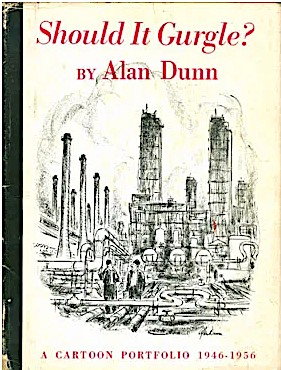
Article Of Interest: Alan Dunn’s Architectural Drawings


From Apollo Magazine, April 27, 2026, “The Cartoonist with A Fine Line In Architectural Criticism” 

— this piece by Will Wiles comes just weeks before the publication of Gabriele Neri’s Alan Dunn: The Cartoonist As Architectural Critic (May 25, 2026. MIT Press).

Mr. Dunn was, for many years, the most published New Yorker artist.

(My thanks to Mike Rhode for the link) 

______________________________________________________

Alan Dunn’s A-Z Entry:

Alan Dunn (self portrait above from Meet the Artist) Born in Belmar, New Jersey, August 11, 1900, died in New York City, May 20, 1974. New Yorker work: 1926 -1974 Key collections: Rejections (Knopf, 1931), Who’s Paying For This Cab? (Simon & Schuster, 1945), A Portfolio of Social Cartoons ( Simon & Schuster, 1968). One of the most published New Yorker cartoonists (1,906 cartoons) , Mr. Dunn was married to Mary Petty — together they lived and worked at 12 East 88th Street, where, according to the NYTs, Alan worked “seated in a small chair at a card table, drawing in charcoal and grease pencil.”

____________________________________________________________________

More Dunn…Rejections (Knopf, 1931), and Who’s Paying for This Cab? A Book of Cartoons from the New Yorker (Simon and Schuster, 1945).


__________________________________________________________


The post Tuesday Spill: Two New Yorker Artists Named Pulitzer Finalists; Article Of Interest…Alan Dunn’s Architectural Drawings first appeared on Inkspill.
  •  

Tuesday Spill: Award Of Interest…Bruce Eric Kaplan; Hilary Campbell Has A Sketchbook Club; Liana Finck Speaks

Award Of Interest…Bruce Eric Kaplan

From New Jersey Stage, May 15, 2026, “Bruce Eric Kaplan To Receive The Maplewood Literary Award On May 21st” 

Mr. Kaplan (who signs his work “BEK”) began contributing to The New Yorker in 1991. His most recent book is They Went Another Way: A Hollywood Memoir (Henry Holt & co., 2024)

Below: his first cartoon collection (1999), and his memoir (2015):

______________________________________________________

Hilary Campbell Has A Sketchbook Club

Hilary Campbell began contributing to The New Yorker in 2017. All the details about her Sketchbook Club can be found here on Instagram.Her most recent book is The Joy Of Snacking (Andrews McMeel, 2025).

Visit her website here.


____________________________________________________

Liana Finck Speaks

From Dorotusa, “An Afternoon With Cartoonist Liana Finck” — notice of an online appearance on May 27th where, according to the organization’s  website:

“Cartoonist and graphic novelist Liana Finck talks about her New Yorker cartoons and her books, which include an adaptation of Yiddish advice column A Bintel Brief and Let There Be Light, an adaptation of the Book of Genesis.” All the info here.

Liana Finck began contributing to The New Yorker in 2013. Visit her website here.


The post Tuesday Spill: Award Of Interest…Bruce Eric Kaplan; Hilary Campbell Has A Sketchbook Club; Liana Finck Speaks first appeared on Inkspill.
  •  

Saturday Spill: My Own “I Like The Kitty” Moment; The Tilley Watch Online, June 1-5, 2026

My Own “I Like The Kitty” Moment

Many of us recall the famous Seinfeld episode, “The Cartoon” (written by my New Yorker colleague, Bruce Eric Kaplan) that includes the scene where Elaine Benes goes into “The New Yorker” to confront the editor (“Mr. Elinoff”) about a cartoon she doesn’t understand.

Here’s the dialogue:

  • Mr. Elinoff: Miss Benes, cartoons are like gossamer, and one doesn’t dissect gossamer.
  • Elaine Benes: Well, you don’t have to dissect it if you could just tell me why this is supposed to be funny.
  • Mr. Elinoff: Oh, it’s merely a commentary on contemporary mores.
  • Elaine Benes: But what is the comment?
  • Mr. Elinoff: It’s a slice of life.
  • Elaine Benes: No, it isn’t.
  • Mr. Elinoff: A pun?
  • Elaine Benes: I don’t think so.
  • Mr. Elinoff: Vorshtein?
  • Elaine Benes: That’s not a word. You have no idea what this means.
  • Mr. Elinoff: No.
  • Elaine Benes: Then why did you print it?
  • Mr. Elinoff: I like the kitty.

I had my own “I like the kitty” moment yesterday when a Mr. Cooper from Victoria, Canada wrote in asking me to explain a drawing of mine that appears in the 1987 collection (edited by Sam Gross), Cats! Cats! Cats!. 

Here’s the drawing:

My immediate reaction was to write Mr. Cooper back saying, “Vorshtein.” But instead, I admitted I had no idea what the cartoon meant. This morning I showed the cartoon to my wife (who is also a long time New Yorker cartoonist). She immediately furrowed — not a good sign.

If any cartoonist out there has had a similar experience (that is: not “getting” one of your own drawings) I’d love to hear about it.

___________________________________________________________

The Tilley Watch Online, June 1-5, 2026

An end of the week listing of New Yorker artists whose work has appeared on newyorker.com features

Daily Cartoon: Matt Reuter(twice), Elisabeth McNair, this cartoonist, Jorge Penne.

A Cartoon Soccer Selection: “Kicking It” 

A Cartoon Basketball Selection: “Full-Court Press”

Barry Blitt’s Kvetchbook: “Data Centers Bring The Buzz”

______________________________________________________________________________


The post Saturday Spill: My Own “I Like The Kitty” Moment; The Tilley Watch Online, June 1-5, 2026 first appeared on Inkspill.
  •  

Thurber Thursday: The Debut Of The Thurber Dog

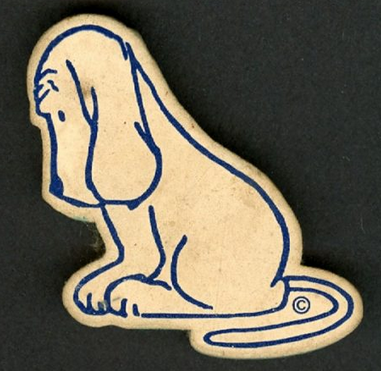
Looking at James Thurber’s first New Yorker cartoons this morning, it came as quite a surprise that the famous “Thurber dog” did not make an appearance in the magazine until 29 Thurber cartoons had been published in the magazine (I’m not including the ones that showed up in his “Our Pet Department” series. While I love those dogs, they’re not the dog you see above, shown here in eraser form). In fact, not a one of those first 29 Thurber drawings had a dog anywhere in sight. When the classic Thurber dog did show up, in the issue of February 6, 1932, it was not an incidental dog in a cartoon featuring humans. The dog was the star of the show — the main attraction, and it made its debut in a 16 part(!) spread that traveled across the magazine’s gutter. I’ll show you the first part here:

The entire piece can be found in his collections, The Seal In The Bedroom, The Thurber Carnival, and Thurber’s Dogs (to mention just a few). If you have a subscription to The New Yorker you can, of course, find it in the archive, on pages 22-23 of the February 6, 1932 issue. It’s online here as well.

_______________________________________________________________________

James Thurber’s A-Z:

James Thurber Born, Columbus, Ohio, December 8, 1894. Died 1961, New York City. New Yorker work: 1927 -1961, with several pieces run posthumously. According to the New Yorker’s legendary editor, William Shawn, “In the early days, a small company of writers, artists, and editors — E.B. White, James Thurber, Peter Arno, and Katharine White among them — did more to make the magazine what it is than can be measured.”

Key cartoon collection: The Seal in the Bedroom and Other Predicaments (Harper & Bros., 1932). Key anthology (writings & drawings): The Thurber Carnival (Harper & Row, 1945). There have been a number of Thurber biographies. Burton Bernstein’s Thurber (Dodd, Mead, 1975) and Harrison Kinney’s James Thurber: His Life and Times (Henry Holt & Co., 1995) are essential. Website


The post Thurber Thursday: The Debut Of The Thurber Dog first appeared on Inkspill.
  •  

A Few Updates

With Frank Stack, David Oskow, Peter Kuper, Jeff Koterba, Adam Zyglis, Rick McKee, and Daryl Cagle. Frank Stack, NY Times Obituary Apparently The New York Times didn’t have an obituary for Frank Stack “in the can.” A month after Stack’s passing we finally get a notice of death from the paper of record by Michael […]

  •  

Flying Monkeys! Terrytoons gives us some “Raspberries” (1931)

Before I give everyone here the “Raspberry”, here’s some quick Thunderbean updating:

Summer is my time to really catch things up, and I go between being incredibly motivated and hiding until certain things are finished and being completely burned out from doing so! This summer, I’m working on one thing at a time as much as I can, then having the other Thunderbean folks also work on one thing at a time to see if we can get through as many of the close to finished projects as possible. Cartoons for Victory is heavily on the plate for me right now along with helping with Tommy Stathes’ beautiful Dinky Doodle project, along with colleague David Gerstein.


And now — onto getting “Razzberried”!!!

I really love the idea of bringing back the entire Terrytoons staff from 95 years ago and have them watch some of their cartoons with a contemporary audience.

Razzberries (1931), like many of the Terrytoons of this period, is working hard to have you laugh at every shot of the film, either with action or, sometimes, just the bizarre or funny drawing. And it *is* funny, and must have been entertaining to the audience at least. The primitiveness of the animation is one of its greatest assets in this case, and pretty enjoyable if you’re not expecting more.

In this nearly plotless cartoon, we’re treated to a series of animals doing funny things for no reason at all, starting with some lions that are dancing in some sort of tribal fashion. It’s animation synced to music for only that reason. The flying monkeys that show up for one shot may be my own favorites. An astute monkey on a high-wheeler uses a small horn to give the lion-tribe the ‘“raspberry”, scaling them off- hence the title of the film. A little more than halfway through the picture, Farmer Alfalfa, game hunter and now the star, shows up in a mechanical elephant rather than riding on a real one. After chasing around a bunch of bear cubs (and eventually being confronted by their angry mom) he gives up that chase, offers our hero a few furs, then. Or monkey on the bike shows up and sells some furs to our hero, but then gives him the “raspberry” to scare him and get them back.

I have to note that the designs of the various animals look barely different than then did in 1925 silent Aesop’s Fables from Terry/Van Beuren. All the said, I sort of don’t mind in this case. It’s animation for enjoyment, not brilliance.

So, that said, enjoy! This cartoon lives again when we watch it, and that’s the best thing we could possibly do for the legacy of these artists.

Have a good week all!

  •  

Saturday Spill: Tilley Watch Online, The Week Of April 27 – May 1, 2026, With A Gallery Of Graduation Cartoons

Tilley Watch Online, The Week of April 27–May 1, 2026

An end of the week listing of New Yorker artists whose work has appeared on newyorker.com features

Daily Cartoon: Lynn Hsu, Enrico Pinto, (the duo of) Sophie Lucido Johnson and Sammi Skolmoski, Sarah Kempa, Hilary Campbell. See them here (in a slideshow).

Barry Blitt’s Kvetchbook: “Charles And Donald See Eye To Eye”


_________________________

Pomp And Circumstance: A slideshow of graduation cartoons (the below, from the great Warren Miller,* is just one of many in this online special feature.

____________________________________________________________________________

*Warren Miller’s A-Z Entry:

Warren Miller (photo by Liza Donnelly, NYC, Sept. 1997) Born 1936, Chicago, Ill. The following biographical information comes from The Phoenix Gallery site which hosted a group exhibit of NYer cartoonists work (Lorenz, Harris, Modell, and Miller) in 2007: “Warren Miller studied commercial and fine art at the American Academy of Art, Chicago. He started selling cartoons to Playboy and The New Yorker in 1961 and moved to New York City later that year. Miller’s work has also appeared in Esquire, Punch, Rolling Stone, Audubon, Harvard Business Review, Barrons, Time, Newsweek, The New York Times, and the London Sunday Times. Mr. Miller is a painter and a sculptor as well. He has exhibited his work in a number of shows in the New York area and in the Midwest.” Key collections: All Thumbs (Bobbs-Merrill,1967); Prince and Mrs. Charming (Bobbs-Merril, 1970). New Yorker work: 1959 -.


The post Saturday Spill: Tilley Watch Online, The Week Of April 27 – May 1, 2026, With A Gallery Of Graduation Cartoons first appeared on Inkspill.
  •  
❌