Need dry skin relief ASAP? Sephora's Major Summer Deals are kicking off with 20% off face moisturizers for all skin types.
But if you need something that will dew it all for your dry skin, we've...
The ocean floor is covered with dead whales–but it is everything but a biohazard. When a whale dies, its body sinks to the ocean floor in a process called whale fall. The carcass then becomes its own complex ecosystem, nourishing and housing all types of marine life. Whale bones can then fossilize over time, leaving behind traces of what life looked like millions of years ago.
Now, scientists in the Indian Ocean have discovered an enormous whale graveyard. The collection of bones and communities supported by these whale falls stretches 745 miles across the seafloor 13,779 to 22,965 feet deep. The oldest whale fossil is roughly 5.3 million years old and the graveyard even includes a new species of extinct whale. The findings are detailed in a study published today in the journal Nature.
“The deep sea is far from barren—it’s dynamic, full of life and history,” Dr. Xiaotong Peng, a study co-author and engineer at the Chinese Academy of Sciences (CAS), tells Popular Science. “When a whale dies and sinks, it becomes an oasis, supporting unique communities for decades or centuries.”
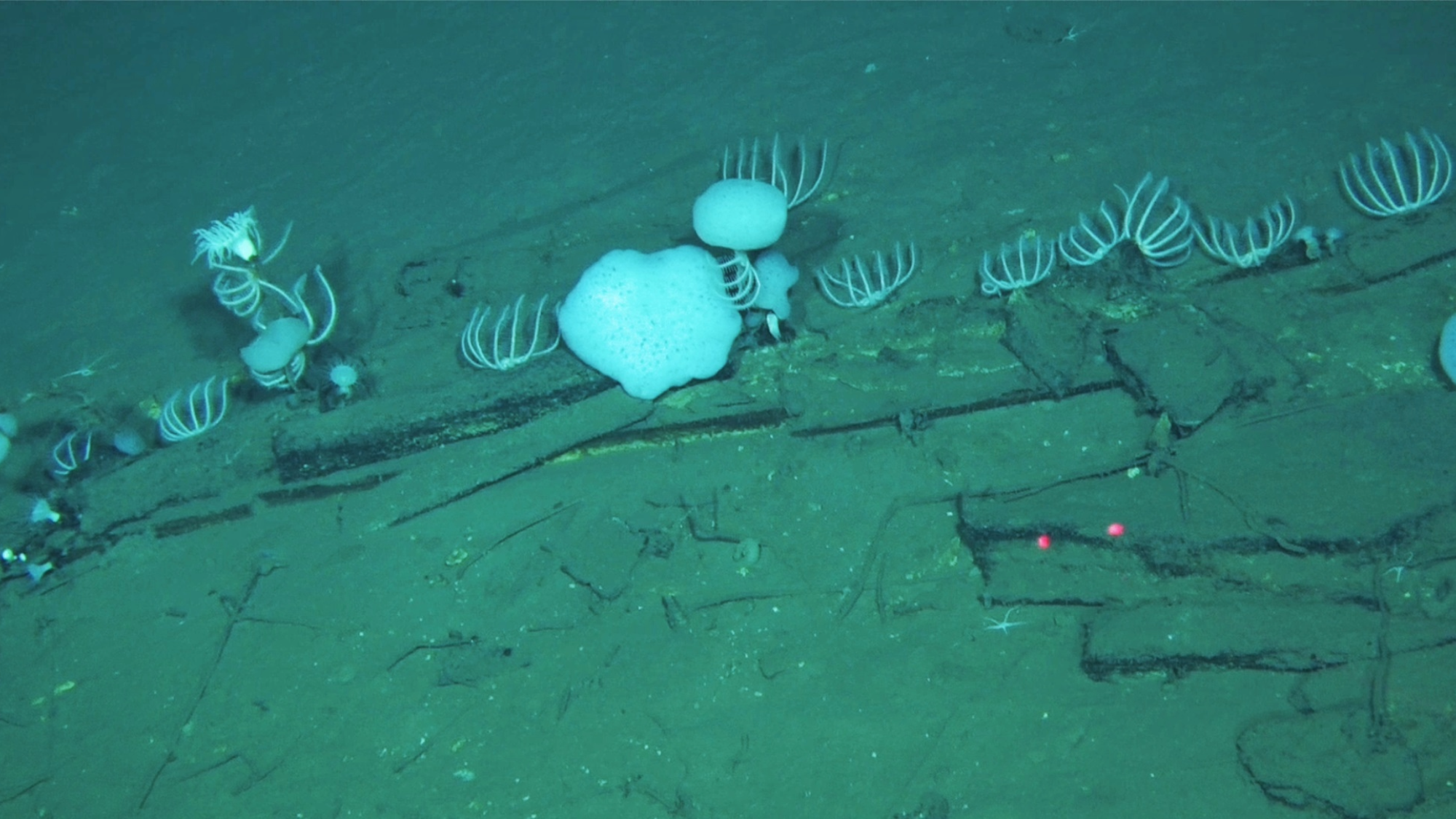
In 2023, CAS team was studying the geology and biology of the southeast Indian Ocean’s hadal zone—the ocean’s deepest zone, extending from 19,680 to 36,000 feet-deep. While inside of a submersible, the divers spotted the first whale fossil 22,972 feet below the surface.
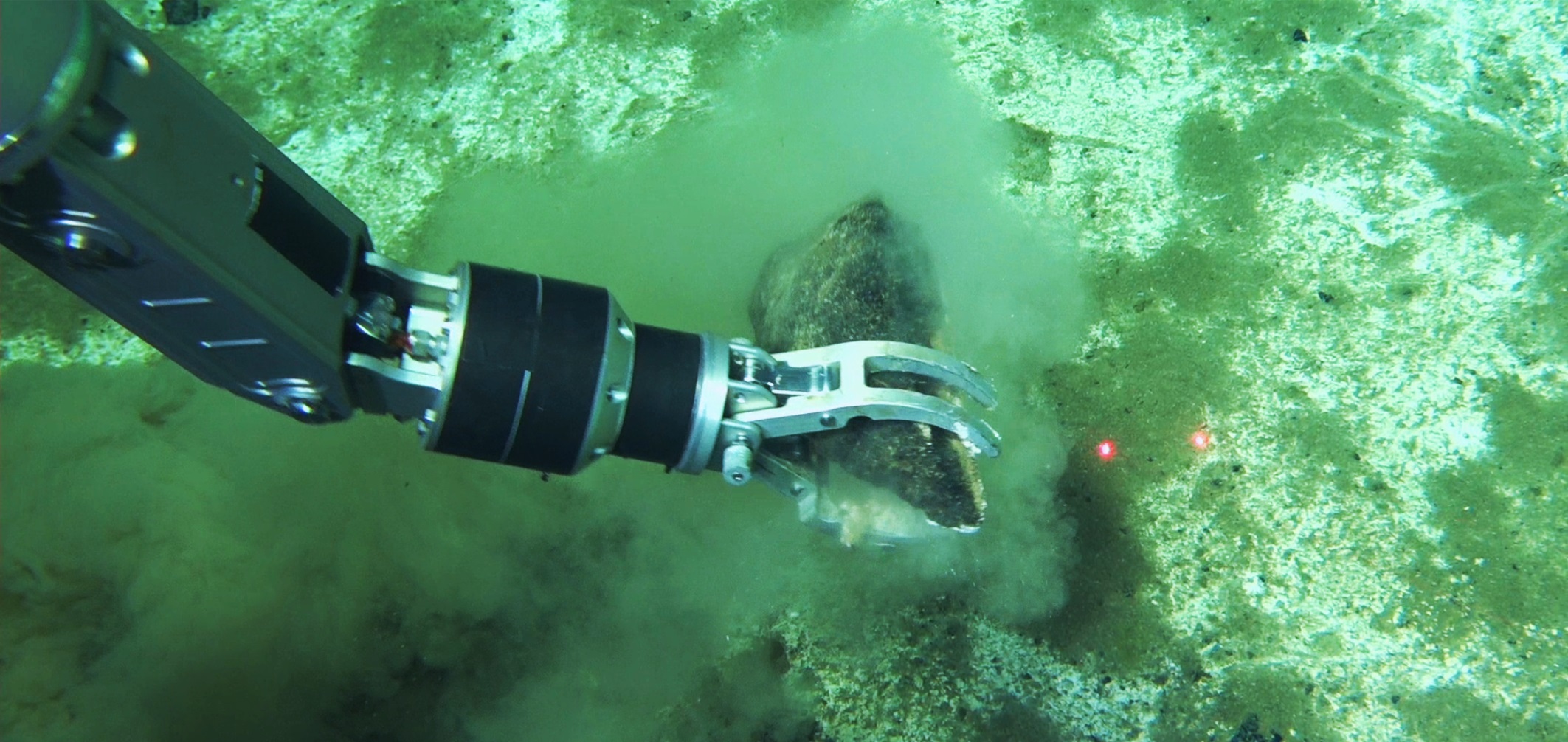
Recovery of whale fossil bones using the manipulator arm of the Chinese submersible Fendouzhe on the deep seafloor of the Diamantina Zone, a deep-sea rift in the Indian Ocean. Image: Global TREnD, IDSSE.
According to study co-author and geologist Dr. Peng Zhou, the remains were actually “quite easy to find” once the team began to search. “They looked unusual, so when the dive scientists first encountered them, they wanted to figure out what they were,” Zhou tells Popular Science.
Peng adds, “We immediately pivoted our objectives to systematically map, document, and sample these whale remains. So it really came down to curiosity meeting the technological capability to explore depths that had been largely inaccessible.”
They documented 485 whale fossil sites from five active whale falls. The whale carcasses are home to a large community of jellyfish, brittle stars, bone-boring worms, and bivalves. Some of these species living in the carcasses may even be new to science, but that has not been confirmed. The oldest have been in the area for about 5.3 million years ago (the Pliocene era).
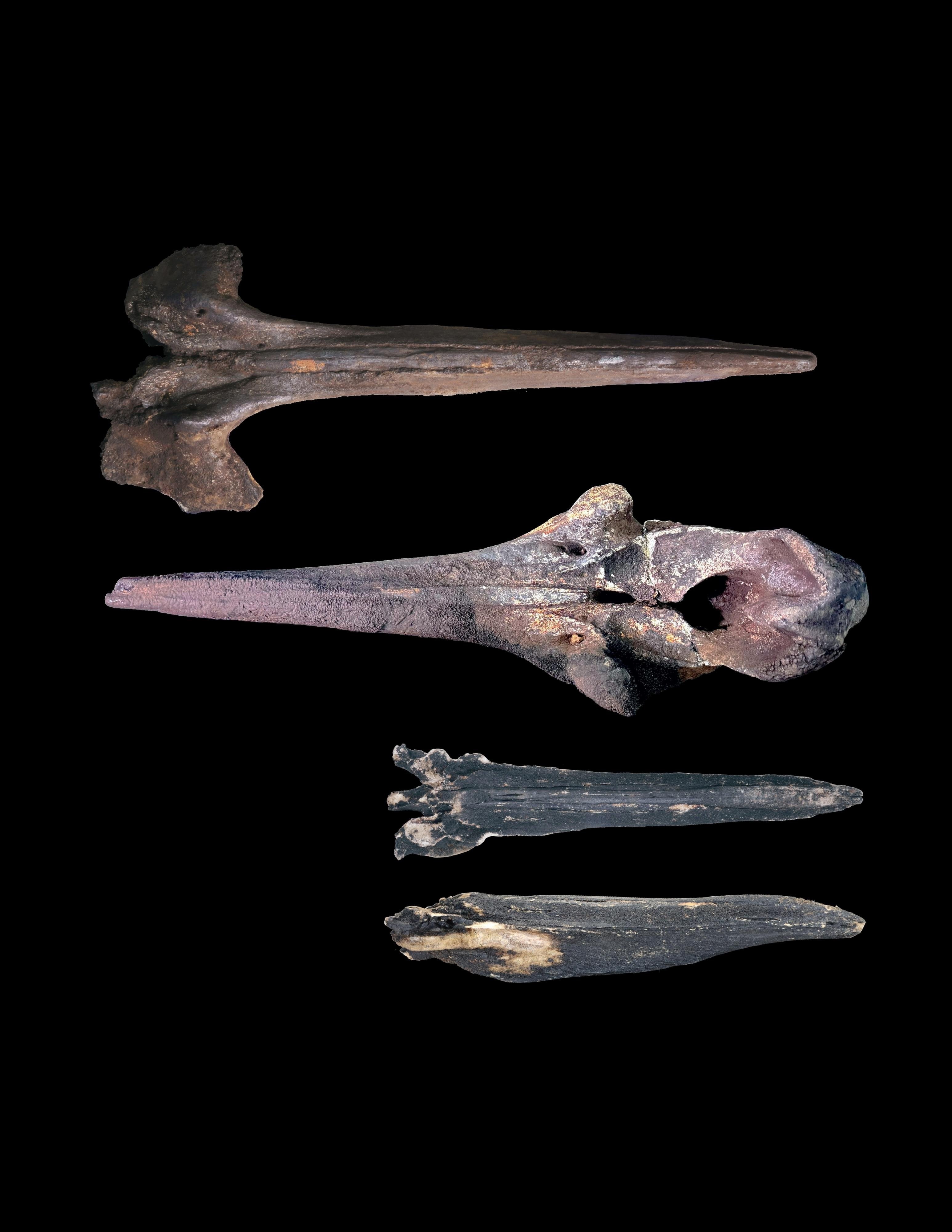
Fossil skulls of three beaked whales recovered from the seafloor at hadal depth of the Diamantina Zone, 6,584–-6,878 meters. The image shows two extinct beaked whale species, Pterocetus diamantinae sp. nov. (new species to science, on the top) and Izikoziphius rossi (the second skull), as well as an extant Andrews’ beaked whale, Mesoplodon bowdoini (two skulls on the bottom). Image: Global TREnD, IDSSE
Most of the whale fossils come from several species of deep-diving beaked whales. Some of the bones belong to beaked whales that still exist today. Others are from extinct whales, including a species new to science named Pterocetus diamantinae.
“Finding both extinct genera like Pterocetus and living species like Mesoplodon bowdoini preserved together in the same region, across 1,200 kilometres [745 miles] of seafloor at such extreme depths—that was truly unexpected,” says Zhou.
This fossil record is also continuous, so the team can track the population dynamics and evolution of deep-diving whales over time.
“These fossils give us a direct window into the Pliocene, about 5.3 million years ago,” study co-author and biologist Dr. Xikun Song tells Popular Science. “They show that beaked whales were already specialized deep‑divers in the Indian Ocean by that time. Beyond the whales themselves, the associated fossil fauna also tells us about the structure of ancient deep‑sea whale‑fall communities and broader deep‑sea biodiversity back then.”
This whale graveyard could reshape our understanding of both living and extinct beaked-whales. There are roughly 24 species of beaked-whale living today. However, their deep-sea habitat, likely low population numbers, and reclusive behavior make them difficult to study. Having such a large fossil deposit like this could help explain more about their reclusive lives.
The fossils are also shedding more light on the mysterious ecosystems living at the ocean’s deepest depths.
“Discoveries like this are possible because of curiosity, collaboration, and technology,” Peng concludes. “We’ve barely scratched the surface of the deep ocean, and there’s so much more waiting to be found.”
Sweet breads are one of the most comforting parts of Easter baking. This collection of 15 Easter Sweet Bread Recipes brings together some of my favorite recipes from my kitchen – recipes I love making for family and sharing during the spring season.
Inside this collection you’ll find a mix of traditional European Easter breads and soft, bakery-style treats that fill the house with the smell of warm dough, butter, and spices. There are classics like Romanian Pasca, rich and festive, perfect for the Easter table. You’ll also find beautifully spiced Chocolate Hot Cross Buns, Easy Panettone, soft and fluffy Wool Roll Bread, elegant Estonian Kringle, and Poppy Seed Babka that feels like a true celebration bake.
I also included several sweet rolls that are simple to make but special enough for a holiday breakfast or brunch. Some recipes are traditional, others are modern favorites, but all of them are recipes I’ve tested, baked, and shared with my readers over the years.
These breads are meant to be enjoyed slowly, served warm, shared with family, or baked ahead for Easter morning. If you love enriched doughs, braided breads, or soft cinnamon-style rolls, this collection offers something cozy and festive to bake during the Easter season.
Pasca is a traditional Romanian Easter bread that is typically made during Holy Week and served on Easter Sunday. It is a rich, sweet bread with a mixture of cheese, eggs, and raisin filling. The bread is usually round and is often decorated with a cross.
Panettone is the ultimate Italian holiday treat, soft, fluffy, and bursting with sweet, citrusy flavor. With this Easy Panettone recipe, you can make your own panettone at home without any stress. It is perfect for breakfast, dessert, or gifting to loved ones.
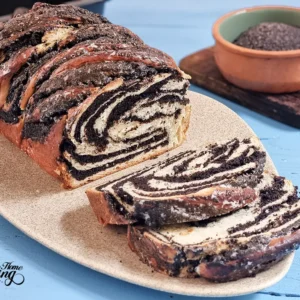
This delightful Poppy Seed Babka is a beloved pastry enjoyed in various countries around the world. It features a fluffy dough filled with a generous amount of poppy seed meringue filling. It is a perfect addition to your holiday table or for pairing with your morning cup of coffee or afternoon tea.
This Cinnamon Wool Roll Bread is a delightful treat perfect for holidays or for whenever craving something sweet. It combines the comforting flavors of cinnamon with the soft, fluffy texture of freshly baked sweet bread.
Chocolate Chunk Hot Cross Buns – with raisins, spices and lots and lots of chocolate inside. These buns are soft, light, very flavorful and chocolaty, some of the chocolate chunks get melted while baking which is awesome.
These Lemon Custard Rose Sweet Rolls are a mouthwatering pastry treat that combines the flavor of lemon with the sweet creaminess of custard, all wrapped up in a soft, fluffy, rose-shaped bun. These sweet rolls are perfect for breakfast, brunch, or any time you're craving something sweet and indulgent.
This Orange Nutella Babka is a really delicious version of traditional Babka, rich, nutty and chocolaty, abounding in citrus flavor. It is by far one of the best Babka you can ever prepare.
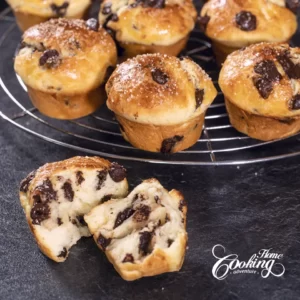
These Chocolate Brioches with their crispy exterior and buttery, soft, chocolatey interior are a fantastic treat either for breakfast alongside a cup of coffee or milk or simply as a snack all day round.
If you like bread recipes these knots are a must-try for you. Making these beautiful dough knots is much easier than it looks. Easy rich yeast dough, filled with your favorite filling, cut into strips and tied into knots. There’s no room for mistakes, every knot is perfect in its way. Soft and fluffy dough bursting with flavor perfectly served warm right after taking them out of the oven.
Treat yourself to a heavenly delight with these twisted cinnamon rolls. Picture warm, fluffy rolls, each swirled with fragrant cinnamon and kissed with a touch of buttery goodness. They're twisted into beautiful, small knots and baked in a muffin tin, adding an extra touch of elegance and charm.
These Blueberry Cream Cheese Buns are a delightful treat that combines soft, fluffy dough with sweet blueberries and creamy cheese filling. They are perfect for breakfast, a snack, or even dessert. They pair wonderfully with a cup of coffee or tea, making them an ideal choice for a cozy morning or a special afternoon treat.
Who could resist homemade cinnamon rolls? Rich and fluffy, with their soft, buttery interior they are irresistible. You can hardly stop to only one roll.
If you love strawberry and lemon combinations you are at the right place. These No Yeast Eggless Strawberry Rolls with Lemon Cream Cheese Icing are a great summer treat that everybody will adore. They look simply amazing and totally irresistible.
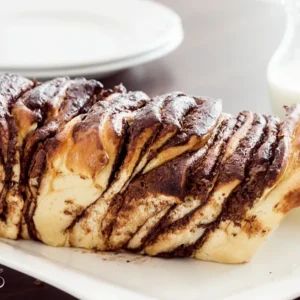
The recipe for Nutella Pull Apart Bread is very easy. The bread is irresistible with its soft interior which becomes even more tempting when filled with Nutella. Serve it warm, right after taking it out of the oven, alongside some cold milk. Will be for sure a memorable treat for everybody.
I hope this collection inspires you to bake something special for your Easter table. Sweet breads have a beautiful way of bringing people together.
If you try one of these recipes, I would truly love to see it! Feel free to share your bakes and tag me on Instagram so I can admire your creations. Seeing your breads come to life in your kitchens is always the most rewarding part of sharing these recipes. Happy Easter baking!
Kanye "Ye" West and Bianca Censori have their love locked down.
And in celebration of the rapper's 49th birthday on June 8, his wife shared a rare glimpse into their marriage.
Posting a picture of...
With the countdown for the FIFA World Cup's kickoff drawing closer and closer, here is a guideline of new rules and breakdowns of how certain plays work.
Adrien Brody couldn't have asked for a grander romance.
As the actor navigates his Broadway debut in The Fear of 13, he shared a glimpse into how his relationship with longtime love Georgina...
Camila Cabello is no longer Henry Junior Chalhoub’s señorita.
The “Havana” singer and the billionaire heir have called it quits after over a year together, according to multiple outlets.
Camila,...
Justice secretary’s plans likely to increase black people’s suspicion of court system, committee suggests
David Lammy’s planned changes to the criminal courts in England and Wales could have a “far-reaching” impact on race relations, a cross-party committee of MPs has concluded.
The deputy prime minister’s plan to remove the right to elect for a crown court trial “has the potential to increase mistrust in the criminal justice system among the black community”, the justice select committee said, because black defendants are more likely to elect for trial.
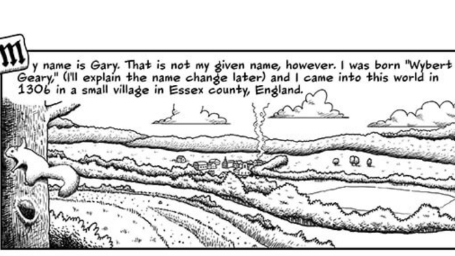
Early last year Mark Buford put an ash stake in his Scary Gary comic strip. Now Julie Lineback for the University of West Georgia brings us up-to-date with Mark. “A Major in Minds, a Minor in Mischief.” As the U.S. recognizes National Cartoonist Day on May 5, University of West Georgia alumnus Mark Buford ’86 […]
In 1953, Donn Fichter, a graduate student at Northwestern University in Chicago, had a simple transportation idea: What if you tipped an elevator on its side, enabling it to run horizontally, and set it loose in a city? Unlike conventional urban mass transit, elevators are responsive to individuals, callable with the push of a button, and not subject to schedules.
After completing his dissertation in 1958, “Automated Urban Circulation,” Fichter spent years turning that idea into a complete transit system design he called Veyar. At its core, Veyar would offer small automated cars running on lightweight guideways. The electric cars would be available at any hour and travel directly from origin to destination without stops, schedules, or drivers. “Personalized transit,” he called it, in which each car “is a self-operating vehicle which can go unattended.” To keep infrastructure construction costs low, he explained, “they have to utilize existing public right of way: the streets.” Fichter self-published the design in 1964, calling it “Individualized Automatic Transit and the City.”
For 60 years, personalized transit systems like Veyar gained support from generation after generation of transportation engineers, but none were ever built. That’s because personal rapid transit systems demanded infrastructure cities couldn’t afford and automation technology that didn’t yet exist. What finally solved both problems wasn’t a transit agency or a federal program, but rather the autonomous vehicle industry. Companies like Zoox and Waymo built Fichter’s system more practically, starting with the automation and letting existing streets serve as the guideways.
The origins of personal rapid transit
Donn Fichter was born in Minneapolis in 1926. After serving in the Army during World War II, he earned engineering degrees from Brown and Northwestern. He was the first serious advocate of what urban planners would eventually call personal rapid transit, or PRT—a vision of on-demand, automated, point-to-point city travel.
Fichter conceived Veyar at a time when traffic choked American cities. Cars gave riders individual freedom at the expense of gridlock. Buses, subways, and elevated rails offered more efficiency but subjected riders to fixed schedules and routes.
What no one had yet built, Fichter argued, was a third system that combined the automobile’s spontaneity and the subway’s separation from traffic, available to anyone at any hour without a driver, a schedule, or a transfer. Gridlock notwithstanding, the environmental stakes, he believed, made the solution urgent.
Even before the first Earth Day was celebrated in 1970, Fichter foresaw the “ecological imperative” to reduce our dependence on private automobiles. He made this case explicitly in a 1968 PRT planning paper, “Small Car Automatic Transit.” Fichter claimed that small, electrically-propelled, autonomous cars running on guideways would mean cleaner air, quieter streets, and cities less congested with the machinery of driving and parking.
Personal rapid transit systems catch on in the 1970s
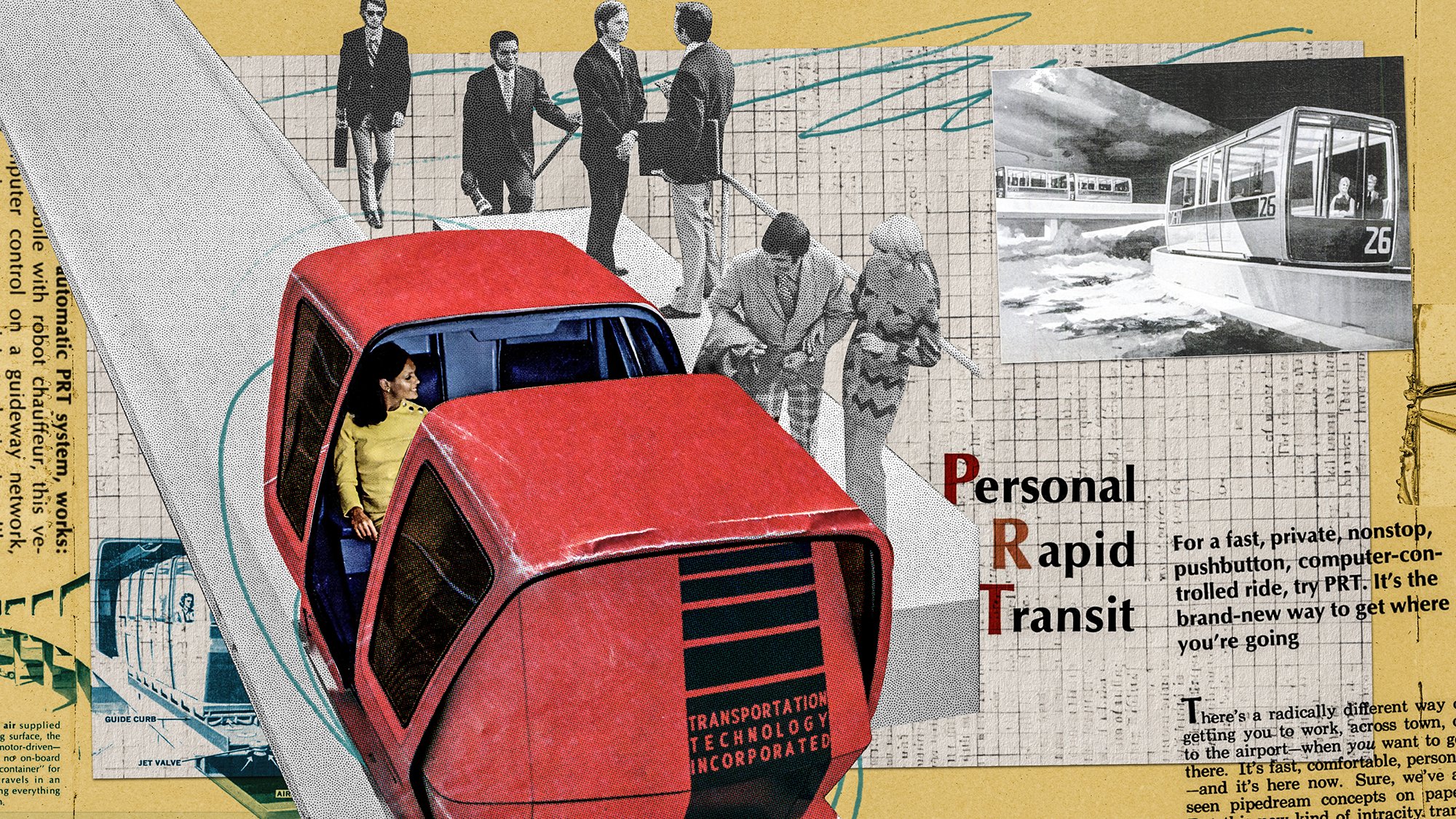
“Your car is waiting,” wrote journalist Paul Wahl in a 1971 Popular Science feature on personal rapid transit systems. “On entering the car, you push a button to select your destination, then take a seat. The cabin is roomy, automobile-like in accommodations.”
Wahl went on to describe how a PRT trip might unfold: “The automatic vehicle moves away on the station spur, accelerating until it enters the stream of traffic on the guideway.” The car would then switch off the guideway at its destination spur, “with a central computer doing the driving.”
The experience Wahl described was precisely what Fichter’s Veyar system proposed. Small electric cars—sized for just a few riders—would run on slender elevated tramways threaded along existing streets. Stations every few blocks would keep cars queued and ready. Just like an elevator, a rider would board, close the door, press a button, and go. The car would merge into mainline traffic automatically, travel nonstop to the destination, and pull itself into the arrival station without further instruction. Then it would wait, callable for whoever needed it next. A computer would control the entire network. What the elevator had done for the skyscraper, Veyar would do for the city.
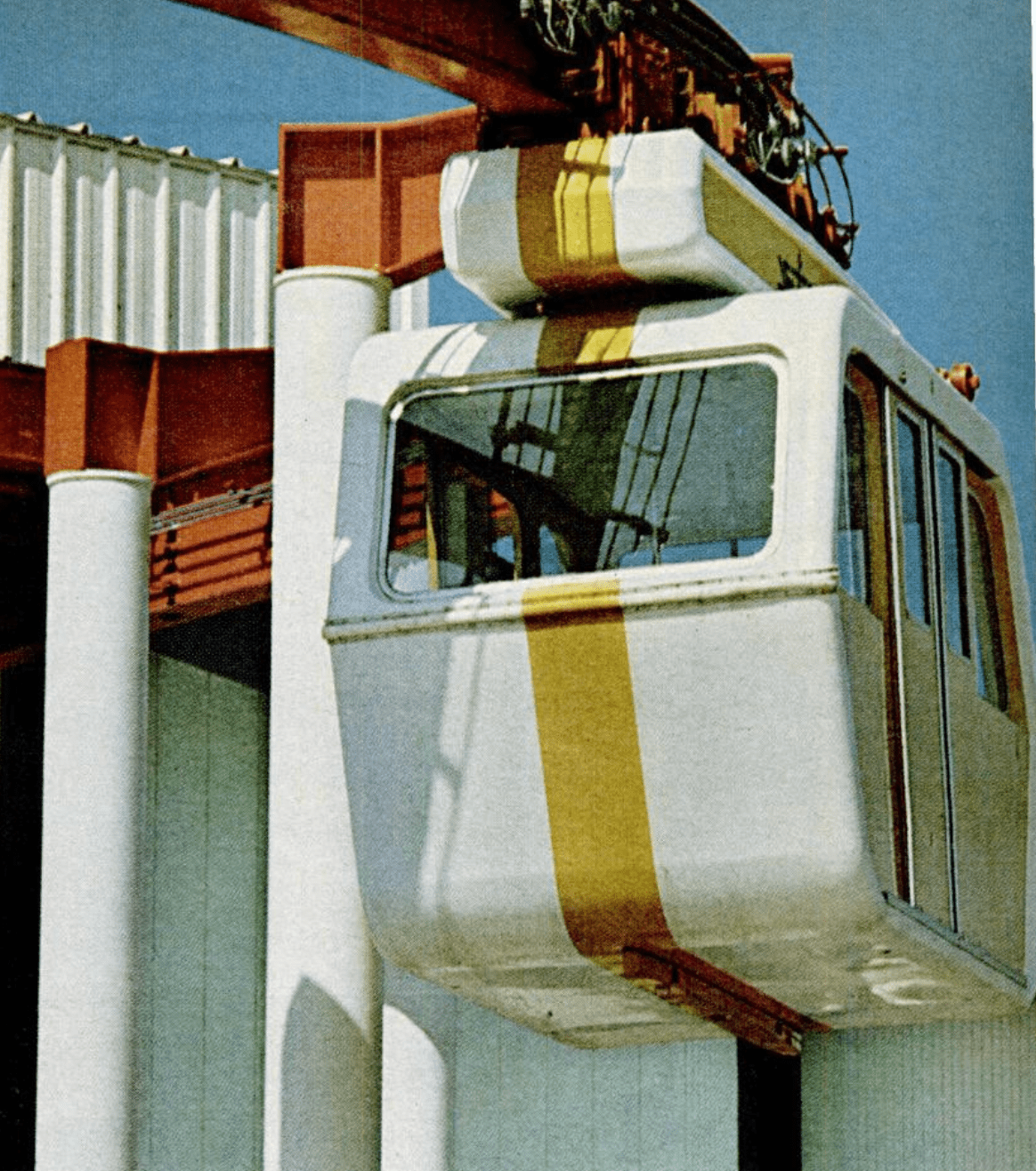
The Jetrail at Dallas Love Field was the world’s first airport car-to-plane monorail system. Suspended 17 feet above the ground, its 10 electrically powered 10- passenger cars, traveling at 15 mph, cover the three quarter mile distance between the satellite parking lot and the Braniff boarding area in under four minutes. Image: Popular Science, November 1971 issue
The federal bet on personal rapid transit begins with the Nixon administration
By the early 1970s, the idea attracted serious attention. As Wahl wrote, experts were “banking on it to relieve our metropolitan areas from the twin stranglehold of pollution and congestion.” The federal government committed $6 million to build and demonstrate four competing PRT systems at Transpo72, an international transportation exposition held at Washington, D.C.’s Dulles International Airport in 1972. One of those prototypes was destined for a small college town in West Virginia, where West Virginia University needed a better way to move students between its multiple campuses and downtown Morgantown, West Virginia.
At the same time, planners in Minnesota began drawing up blueprints for a city to be built from scratch on 50,000 acres of rural land—a place called the Minnesota Experimental City, or MXC. The new city was the brainchild of Athelstan Spilhaus, a polymath University of Minnesota dean who had already helped design the 1962 Seattle World’s Fair and co-invented submarine warfare instruments. Spilhaus wanted MXC to be a living laboratory, not a utopia, and personal rapid transit was to be its arteries.
The federal commitment to PRT in the early 1970s produced a brief but remarkable flurry of competing designs. Engineers at aerospace firms, university labs, and automotive companies developed more than two dozen distinct guideway systems—Monocab, TTI, Dashaveyor, Cabinentaxi, Aramis, staRRcar, and others—each with its own switching designs, propulsion method, and structural approach. No two were compatible. The proliferation reflected a significant engineering problem—no one had cracked the code on the automated control systems required to make PRT work. Wahl called this control system the “super-robot trainmaster.”
“The heart of any personal rapid transit system,” Wahl wrote, “is the central computer facility that runs things efficiently and economically, making it practical.” He described a fully autonomous system that not only controls all the cars, “but also handles vehicle distribution and scheduling.” In fact, the central computer would manage just about everything, he explained, leaving little to human operators who are prone to make mistakes. Unfortunately, at the time, such sophisticated automation technology did not exist.
Besides lacking the necessary automation, PRT systems demanded infrastructure cities couldn’t afford to build at scale, even with available federal funding. A network of lightweight guideways would need to be built above city streets, with stations every few blocks, for PRT to deliver on its promise. By the mid-1970s, federal funding had dried up, Transpo72 had come and gone without producing a single municipal contract, the Minnesota Experimental City project had been canceled, and PRT’s moment of official enthusiasm had passed—with one notable exception.
America’s first and only personal rapid transit system
The West Virginia University Personal Rapid Transit system, which opened in Morgantown in 1975, became the closest thing to a guideway-based automated transit system ever built for regular urban use in the United States. It connects the university’s three campuses and the downtown central business district via 8.7 miles of dedicated guideway and five stations, carrying riders in small electric vehicles on demand, without stops between origin and destination. And most importantly: The system works.
The West Virginia University Personal Rapid Transit system debuted in 1975. Video: WVU celebrates 50 years of its PRT system WBOY 12 News, WBOY 12 News
More fundamentally, Morgantown succeeded because it was built for a specific, constrained geography: a university town with four fixed nodes and a captive ridership. That configuration bears almost no resemblance to the open-city, go-anywhere network with stops every few blocks that Fichter had imagined, and it offers no blueprint for replication in a traditional urban setting. For a major city to build what Fichter described, it would have had to retrofit onto automobile-centric city streets dozens or even hundreds of miles of elevated guideway. It’s something no city has ever tried.
Driverless cars: PRT without the tracks?
And yet, six decades after Donn Fichter sketched his first Veyar pods, you can summon one of their descendants with your phone. Today, Waymo operates driverless electric vehicles across six major American cities, completing nearly half a million rides per week in 2025.
Amazon’s Zoox has deployed a uniquely designed robotaxi—no steering wheel, no pedals, carriage seating for four, bidirectional so it never needs to turn around—on the streets of San Francisco and Las Vegas. Between them and a growing field of competitors, the age of individualized automated transit has arrived—just not as anyone planned.
But do robotaxis really fit Fichter’s vision? A car can be summoned with the push of a button. It travels straight from origin to destination without stops. It is “a self-operating vehicle which can go unattended” as Fichter described Veyar in 1964.
Fichter would recognize robotaxis instantly as personalized transit. What’s missing is the “rapid” promise of a PRT system. Driverless taxis are subject to the same traffic-choked congestion that has plagued American cities for nearly a century.
Waymo has faced recalls for vehicles driving into flooded roadways, investigations into repeated failures to yield to school buses, incidents where robotaxis blocked emergency responders at active crime scenes, and acted as getaway cars. A citywide power outage in San Francisco in 2025 triggered a wave of vehicles simultaneously requesting remote confirmation checks, snarling traffic for hours. The riding experience remains geofenced to specific neighborhoods in specific cities.
When issues arise, the system relies on remote human operators—Waymo employs about 70, half of them based in the Philippines—to step in. But these are engineering problems being worked through, not evidence the concept is broken. Arguably, city streets become the guideways when they are filled almost exclusively with robocars, which would complete Fichter’s vision in spirit, if not in intent.
But robotaxis were built as a for-profit product, not as civic infrastructure. They are privately owned, unevenly distributed in cities, expensive on a per-ride basis, and poorly regulated across most of the United States.
What Fichter envisioned was a public system woven into the city—the way elevators are woven into buildings—affordable to everyone, and available at the push of a button. Waymo, Zoox, and their competitors have built something remarkable. But whether it someday resembles the civic infrastructure Fichter had in mind, or remains just another profit-based enterprise siphoning riders and revenue from transit agencies, is ultimately a policy question—one that cities and regulators have so far shown little urgency to answer.
In A Century in Motion, Popular Science revisits fascinating transportation stories from our archives, from hybrid cars to moving sidewalks, and explores how these inventions are re-emerging today in surprising ways.
Lexus officially unveils its 3-row all-electric SUV - the 2027 Lexus TZ; Subaru's newest U.S. lease deals make its EVs cheaper than a comparable ICE model; and a Chinese plug-in hybrid that does what the Tesla Cybertruck couldn't: turn into a boat and cross a river without a bridge!
⏱️ Episode Timeline:
00:00 - Introduction and Sponsor Shoutouts
00:33 - Welcome to the show
00:45 - Rivian hints at R2 pickup and R2X variants; VW becomes Rivian's largest shareholder; Georgia plant expansion
01:41 - Mercedes-Benz prices the electric C-Class in Europe
02:52 - Porsche to discontinue the ICE Macan
04:02 - Lexus debuts its 3-row electric SUV
05:09 - Lucid withdraws year-end guidance, blames supplier issues
06:11 - Honda cancels its Canadian EV factory plans
07:07 - Nissan cancels U.S. EV production and closes a Sunderland line
08:06 - Massachusetts signs with Vineyard Wind; 165 wind projects blocked by the Trump Administration
09:10 - Ford teases its secret EV lab to select journalists
10:33 - Cheaper to lease a Subaru EV than an ICE Subaru!
11:38 - Sponsor Segment - CCAN Action Fund
12:55 - Tesla Cybertruck recalled for wheel stud issue
13:11 - Stellantis recalls Dodge and Jeep EVs for instrument panel fault
13:25 - California cops can now ticket autonomous vehicles
13:44 - EU and India launch joint EV battery recycling initiative
13:55 - Bloomberg NEF: EVs displaced 2.3M barrels of oil per day in 2025
14:07 - Mercedes-Benz ramps up electric GLC production
14:17 - Nissan tweaks the Ariya where it's still sold
14:29 - Spain announces €100M EV charging funding
14:39 - The Mobility House launches ChargePilot as a standalone product
14:51 - Kia cuts prices on the EV6 range
15:03 - Electra Battery Materials signs deal with the Canadian Government
15:15 - Australia extends its EV incentive scheme
15:28 - Tovion unveils its powered eTrailer
15:38 - eBusCo explores a partial sale to survive
15:48 - Two million EVs now on UK roads
15:59 - Zeekr X updated with faster charging
16:13 - Volkswagen denies BYD acquisition rumours
16:25 - BYD's latest sales figures
16:40 - ABB unveils its OM X-Series megawatt charger
16:53 - Geely rumoured to acquire part of Ford's Valencia plant
17:06 - Workhorse secures a 100-vehicle order
17:18 - Bosch updates its e-bike drive units
17:29 - BYD sells its most expensive EV ever
17:42 - Automobilwoche: VW working on new 'Gamechanger' production system
17:55 - Germany commits €1B to heavy-duty EV charging infrastructure
18:07 - Porsche Taycan sets new Nürburgring record
18:20 - Norway's first fully driverless autonomous bus is now in service
18:34 - Norway hits 98.6% EV sales in April
18:46 - Juiced Bikes is back from the dead
18:55 - BYD Flash charging coming to Australia and Aotearoa New Zealand
19:06 - Ford reinstates employee pricing for EVs
19:17 - Nivalis Energy acquires SolarEdge e-Mobility
19:29 - BYD Datang claims 100,000 orders since launch
19:42 - It's Electric bringing 1,000 charging stations to Philadelphia
19:52 - Greenlane expands electric truck charging into Texas
20:02 - Fraunhofer ISI: German auto industry further into EV transition than thought
20:15 - Rocsys unveils its S2 autonomous heavy-duty charging robot
20:27 - Global EV battery market hits 244.6 GWh in Q1
20:43 - DAF starts production of XG Electric and XG+ Electric trucks
20:54 - Segway launches a 60 mph electric dirt bike
21:15 - Sponsor Segment - You
21:54 - And EnergySage!
22:29 - Honda patents a simulated clutch for electric motorcycles
23:39 - Chery's Jetour G700 plug-in hybrid crosses a river. As a boat.
24:52 - Closing Sponsor Acknowledgements
25:58 - Closing messages
On this week's TEN — Transport Evolved News! Lexus officially unveils its 3-row all-electric SUV - the 2027 Lexus TZ; Subaru's newest U.S. lease deals make its EVs cheaper than a comparable ICE model; and a Chinese plug-in hybrid that does what...
On this week's TEN — Transport Evolved News! Lexus officially unveils its 3-row all-electric SUV - the 2027 Lexus TZ; Subaru's newest U.S. lease deals make its EVs cheaper than a comparable ICE model; and a Chinese plug-in hybrid that does what...
On this week's TEN — Transport Evolved News! Lexus officially unveils its 3-row all-electric SUV - the 2027 Lexus TZ; Subaru's newest U.S. lease deals make its EVs cheaper than a comparable ICE model; and a Chinese plug-in hybrid that does what...
On this week's TEN — Transport Evolved News! Lexus officially unveils its 3-row all-electric SUV - the 2027 Lexus TZ; Subaru's newest U.S. lease deals make its EVs cheaper than a comparable ICE model; and a Chinese plug-in hybrid that does what...
On this week's TEN — Transport Evolved News! Lexus officially unveils its 3-row all-electric SUV - the 2027 Lexus TZ; Subaru's newest U.S. lease deals make its EVs cheaper than a comparable ICE model; and a Chinese plug-in hybrid that does what...
On this week's TEN — Transport Evolved News! Lexus officially unveils its 3-row all-electric SUV - the 2027 Lexus TZ; Subaru's newest U.S. lease deals make its EVs cheaper than a comparable ICE model; and a Chinese plug-in hybrid that does what...
On this week's TEN — Transport Evolved News! Lexus officially unveils its 3-row all-electric SUV - the 2027 Lexus TZ; Subaru's newest U.S. lease deals make its EVs cheaper than a comparable ICE model; and a Chinese plug-in hybrid that does what...

 Login
Login
 Need dry skin relief ASAP? Sephora's Major Summer Deals are kicking off with 20% off face moisturizers for all skin types.
But if you need something that will dew it all for your dry skin, we've...
Need dry skin relief ASAP? Sephora's Major Summer Deals are kicking off with 20% off face moisturizers for all skin types.
But if you need something that will dew it all for your dry skin, we've...












 Kanye "Ye" West and Bianca Censori have their love locked down.
And in celebration of the rapper's 49th birthday on June 8, his wife shared a rare glimpse into their marriage.
Posting a picture of...
Kanye "Ye" West and Bianca Censori have their love locked down.
And in celebration of the rapper's 49th birthday on June 8, his wife shared a rare glimpse into their marriage.
Posting a picture of...


 Adrien Brody couldn't have asked for a grander romance.
As the actor navigates his Broadway debut in The Fear of 13, he shared a glimpse into how his relationship with longtime love Georgina...
Adrien Brody couldn't have asked for a grander romance.
As the actor navigates his Broadway debut in The Fear of 13, he shared a glimpse into how his relationship with longtime love Georgina...
 Camila Cabello is no longer Henry Junior Chalhoub’s señorita.
The “Havana” singer and the billionaire heir have called it quits after over a year together, according to multiple outlets.
Camila,...
Camila Cabello is no longer Henry Junior Chalhoub’s señorita.
The “Havana” singer and the billionaire heir have called it quits after over a year together, according to multiple outlets.
Camila,...