Vintage British postcard, 1910s. Hepworth Picture Player. P.C., 3. NB IMDb does not list a Chrissie White film with the title The Winning Smile, so it may just be a tagline accentuating what we see.
British actress Chrissie White (1895-1989) was one of the most famous and popular stars of British silent cinema.
Blue-eyed and light-haired beauty Chrissie White was born Ada Constance White in Chiswick, London, on 23rd May 1895 – the year film was introduced by the Lumière brothers. She started her film career when joining the Hepworth company in 1907 as a 12-year-old girl. Under the name of ‘ Chrissie’ she became one of the first stars in British cinema, often performing in shorts by director Lewin Fitzhamon, in particular the Tilly comedies. When White was teamed with Alma Taylor, they became a popular comic duo as the naughty schoolgirls Tilly and Sally, who create havoc everywhere. The Tilly comedies were a popular series in the years 1910 and 1911. NB White supposedly rode to the studios on a bicycle in her early years as a star.
One by one, White moved from comedy to drama and romance. By 1912 Chrissie White had become Hepworth’s leading lady and the most popular British star of her time. In the same year she married Claude Witten, who also worked for Hepworth. One of her earliest features was a crime film set in the horse racing milieu: The Kissing Cup (1913); it still survives in the Dutch Desmet Collection, as well as the Tilly comedy Tilly in a Boarding House (1911). Other memorable titles were The Vicar of Wakefield (1913), and At the Foot of the Scaffold (1913). Chrissie White’s male partners in her films were mostly Lionelle Howard (from 1914 on); Stewart Rome (between 1914-1917), a.o. in Coward! (1915) and Her Boy (1915); and Henry Edwards (from 1918 on).
Edwards also directed most of their films together, such as Possession (1919), The City of Beautiful Nonsense (1919), The Kinsman (1919), The Bargain (1921) and Lily of the Alley (1923). All in all they did some 22 films together. They were also a couple in real life, as White married Edwards in 1922, and they had a daughter Henrietta, who also became an actress. Edwards and White became real celebrities in Britain, the equivalent of Douglas Fairbanks and Mary Pickford. White's last silent film with Edwards was the romance The World of Wonderful Reality (1924).
When Hepworth collapsed in 1924, Chrissie White - who had worked only for Hepworth - retired from the screen, to the regret of her fans. She returned in the sound era to play in only two films more, with Edwards as her male partner: The Call of the Sea (Leslie Hiscott 1930) and the comedy General John Regan (Edwards 1933), filmed in Northern Ireland. After that White definitively retired from the screen, and after the death of Edwards in 1952 she withdrew from publicity at all. Estimates are that Chrissie White worked in between 100 and 180 films, shorts and features. Chrissie White died 18/8/1989 in Hollywood, California, and was buried at the Westwood Memorial Park.
Clips of Chrissie White's films can be traced in the BBC/BFI documentary Silent Britain (2006). See also on YouTube Tilly, the Tomboy, Gives to the Poor www.youtube.com/watch?v=Ac1dVYaPN8I
Acting Staff Sgt. Cory Der said the mid-afternoon shooting at Connaught Park was a 'brazen act of public violence' that left a man with life-altering injuries.
PARIS, June 7 — Faced with a painful slowdown in recent years, the luxury sector is seeking to recover its mojo by juggling a back-to-basics approach with finding new ways to connect to clients.
The financial performances of the heavyweights – profits amputated last year at LVMH and Kering, while Burberry posted a loss for its 2024-2025 financial year – testify to the fact the market has undergone a change.
The causes are multiple, including the slowing Chinese market, aspirational customers becoming more cost-conscious, and concerns about quality.
“Following the Covid pandemic the luxury market was boosted by binge buying,” said Eric Briones, a cofounder of the Paris School of Luxury who recently published a book about the transformation of the sector.
“And when the luxury sector was confronted with that strong demand, the artisanal model came under pressure,” he said, pointing to recent outsourcing scandals in Italy.
Luxury overexposed
A major part of the luxury cachet is that products are made with superior materials by skilled artisans using traditional methods, which naturally limits production.
Italian police have been investigating major luxury brands for two years over work allegedly outsourced to poorly paid Chinese workers and grim labour conditions.
The post-Covid boom in demand was accompanied by price hikes of up to 50 percent for some labels, “without improvements in quality, and sometimes a drop in quality”, Briones said.
Not only prices increased. Volumes did too.
“It is a fundamental question,” said Christophe Cais, chief executive at CXG, a consultancy that works with premium and luxury brands about customer experiences.
“How many bags can you sell globally without becoming overexposed? Exclusivity is desirable and at the same time you want sales volume, so at what point does volume undermine exclusivity?” he said.
According to the consultancy Bain & Company, the luxury market lost 20 million clients between 2024 and 2025, after having lost 50 million over the previous two years.
Consolidation
Following years of economic and geographic growth for the big luxury groups, analysts say the time has come to prune.
“A phase of recentring and bringing some coherence to portfolios is underway,” said Lea Hubsch at Kearney.
“That may include stepping back or finding another partner for certain brands that aren’t so much part of the DNA” of a group, she added.
LVMH, the world’s largest luxury conglomerate, recently sold off US label Marc Jacobs after holding it for three decades.
In January, it sold the DFS duty free shops’ activities in China.
Kering, another luxury group based in France that is undergoing a major shakeup, sold off its beauty division to L’Oreal for €4 billion (US$4.7 billion; RM18.57 billion).
“This consolidation trend is sure to continue as conglomerates clean out underperforming or strategically less important divisions, focusing on core operations,” CXG said in a recent report.
That will provide opportunities for other companies to snap brands and create new combinations.
Italy’s Versace bought its home turf rival Prada last year for €1.25 billion (RM5.8 billion).
Other deals are expected: Giorgio Armani indicated in his will that he wanted his fashion house to eventually join a luxury group like LVMH or L’Oreal.
Desirability, quality, experiences
Kering’s new CEO Luca de Meo was quite clear in his presentation of the group’s turnaround strategy last month that consolidation was coming, but he also signalled a back-to-basics approach.
He called for an upgrade in quality and efforts to restore the desirability of its leading brand Gucci, which fell victim to overexposure thanks to streetwear.
“Our priority is to make Gucci unmissable again,” de Meo said.
“In one second, you must know it’s Gucci – and it doesn’t mean covering the world with GG.”
Analysts say that in addition to returning to an emphasis on craftmanship and quality, the industry is tuning into demand for experiences and tap into the wellness trend with customer service that rivals that of luxury hotels.
“Desire has shifted to ‘experiences’: beauty, hospitality, transformative luxury,” Briones said. — AFP
The Hong Kong government has allocated an additional HK$5 billion to a national security special fund, bringing the total amount to HK$18 billion.
The funding is the third allocation for national security since Beijing imposed the national security law in Hong Kong in June 2020.
Hong Kong’s Security Bureau organises a flag-raising ceremony on June 22, 2025, to mark the fifth anniversary of the national security law. Photo: GovHK.
The government unveiled the funding on Friday, when it gazetted the government accounts for the fiscal year 2025-26.
It showed a HK$5 billion allocation for non-recurrent expenditure as special funding for safeguarding national security.
Hong Kong established the special fund in 2020 to finance expenses related to safeguarding national security after the national security law took effect in June that year.
The latest allocation thus brought the total amount to HK$18 billion.
In response to Ming Pao’s enquiry, the Financial Secretary’s Office said authorities will not disclose details of the funding, citing Article 14 of the national security law. It did not respond to whether the previous HK$13 billion funding had been depleted.
According to Article 14 of the national security law, no institution, organisation, nor individual in Hong Kong shall interfere with the work of the Committee for Safeguarding National Security, and information relating to its work shall not be subject to disclosure.
The Hong Kong government’s 2025-26 accounts show HK$5 billion is allocated to a special fund for safeguarding national security. Photo: HKFP screenshot.
The government said in July that it would not disclose any details of the special fund in a report to the legislature on the control and management of the special fund, citing the same article of the national security law.
It said authorities had established “a dedicated accounting and financial unit” in the secretariat of the Committee for Safeguarding National Security.
“The unit, which reports directly to the [financial secretary], is responsible for the revenue and expenditure arrangements and financial matters relating to such work,” the government said.
An AI agent doesn't just respond to customers; it resolves their problems independently, without human involvement.
About one-third of service calls are already handled by AI, according to Salesforce's November 2025 State of Service report, and that number will hit 50% by 2027. But what percentage of those calls are–or could be–resolved by AI without human intervention? That is an entirely different question.
AI agents are no longer just for enterprise. SMBs are adopting them to reduce costs, handle volume, and compete with larger players on service quality.
This guide is for the SMB owner or operator evaluating these tools for the first time.
What Is an Agentic AI Agent for Customer Service?
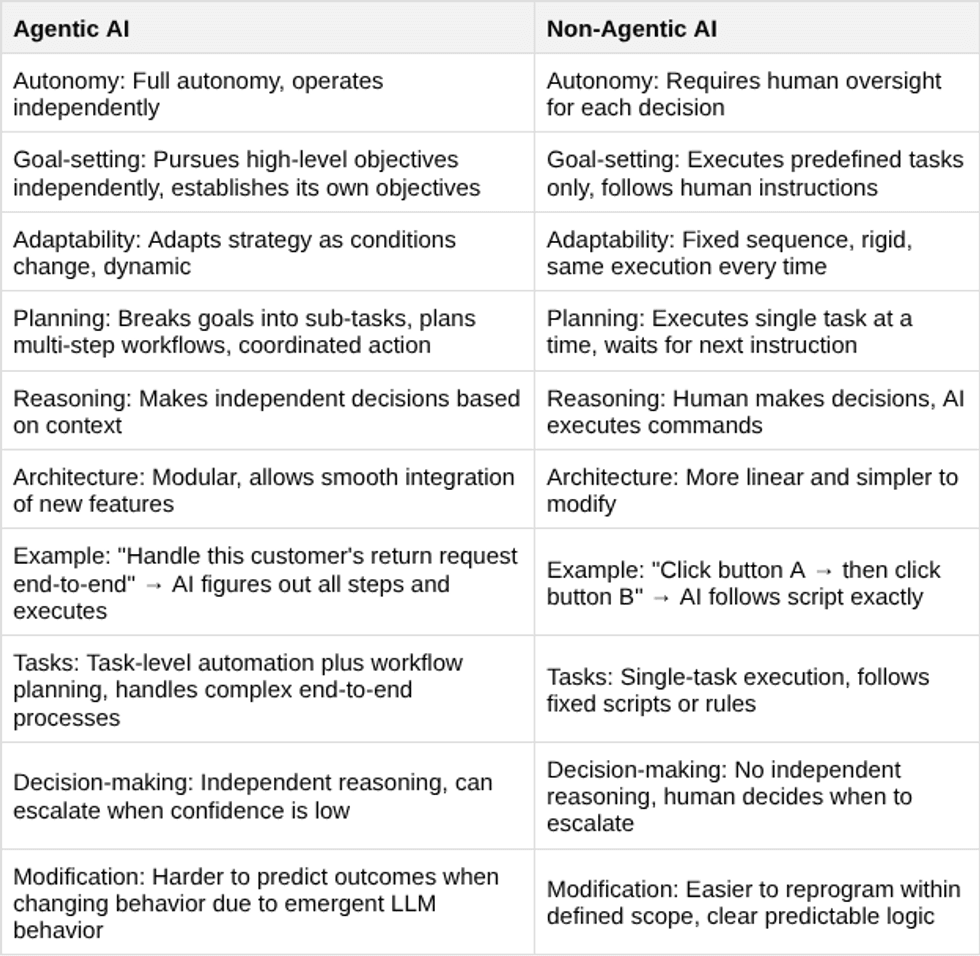
Originally, AI agents were non-agentic, similar to chatbots and AI-powered support platforms. But the term gets used loosely, and the differences matter when you're deciding what to buy:
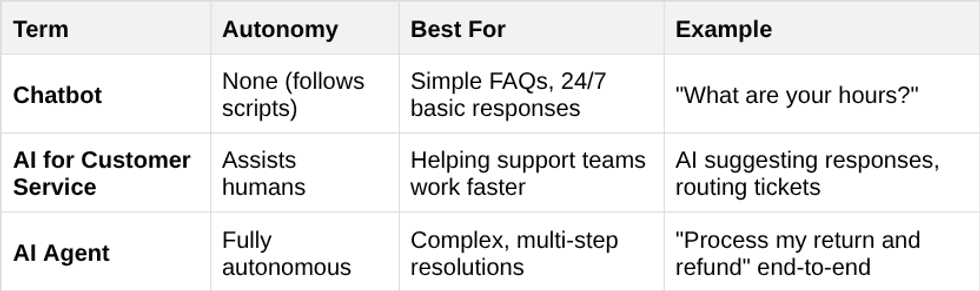
Differences Between Chatbots, AI-powered Support Platforms, and AI Agents
The term “AI agent” has a precise meaning in the industry, but you would not know it from browsing the market. True AI agents can reason through problems, take independent action, and complete multi-step tasks without a human directing each move.
Most of what gets sold under that label cannot do any of that. Instead, it is AI-powered customer service software, which can be genuinely useful, but it is not the same thing.
The distinction matters because if you search for "AI agent" and buy the first thing that comes up, there is a good chance you are buying something far less capable than the name implies.
This table explains the differences:
True AI agents typically cost 2-3x more than a chatbot, but a chatbot that can't resolve the issue just moves the cost to your support team.
Why SMBs Are Adopting AI Agents Now
Two-thirds of businesses that have already adopted AI agents report measurable productivity gains, according to PwC's AI Agent Survey. More than half say they're seeing real cost savings and faster decision-making. And 54% credit AI agents with improving the customer experience.
Customers today expect fast answers wherever they reach out, whether that's chat, email, or social. Hiring enough staff to cover all those channels around the clock isn't realistic for most small businesses. Basic chatbots are affordable, but anyone who's used one knows how quickly they hit a wall. AI agents are a different thing entirely. They can handle complex, multi-step conversations across channels without the overhead of a full support team.
Nearly three-quarters of executives surveyed expect their AI agent strategy to be a significant competitive advantage within the next 12 months, and 46% are already worried they're falling behind. That's not just enterprises competing with other enterprises. SMBs are going to feel this too, competing with other SMBs who move faster.
What to Look for When Choosing an AI Agent Platform
Knowing AI agents deliver results is one thing. Choosing the right platform is where most SMBs get stuck. Not all AI agent platforms are built the same, and the wrong choice can mean paying for capability you can't use or getting locked into something you'll outgrow. These six factors are worth evaluating before you commit to any platform:
1. Resolution Capability
The most important question to ask any vendor is whether their agent actually resolves issues or just routes them. Triaging a customer inquiry and handing it off to a human likely isn't much of an upgrade over what you already have.
Look for platforms with documented resolution rates across real customer interactions, not just demo scenarios. That track record is the clearest signal of whether the AI is actually doing the work.
2. Omnichannel Support
Your customers aren't reaching out through one channel, and your AI agent shouldn't be limited to one either. A platform that handles chat but not email, or email but not voice, creates gaps that fall on your team to cover.
The goal is a single platform managing every channel consistently, so customers get the same quality of response whether they text, call, email, or open a chat window.
3. Ease of Use for Non-Technical Teams
If your support team needs to file a ticket with engineering every time they want to update the agent, the platform is going to create friction fast. The best platforms let support leaders configure, adjust, and retrain the agent themselves. That independence matters, especially for SMBs, where engineering resources are limited and support needs change quickly.
4. Integration with Existing Tools
An AI agent that can't talk to your CRM, helpdesk, or knowledge base is working blind. It needs access to customer history, open tickets, and your existing documentation to give accurate, useful responses. Before committing to any platform, map out which tools it needs to connect to and verify those integrations exist and actually work, not just that they're listed on a features page.
5. Responsible AI and Governance
This one gets skipped more than it should, especially by SMBs. If your agent is handling customer data, billing questions, or anything sensitive, you need to know how it makes decisions and where humans provide oversight. Look for platforms with clear oversight controls, visibility into the agent's reasoning, and relevant compliance certifications. A governance failure isn't just a technical problem, it's a customer trust problem.
6. Scalability
The platform that fits your business today needs to fit even when you've doubled your support volume or expanded into new channels. Switching platforms mid-growth is expensive and disruptive. Ask vendors directly how their pricing and architecture scale, and look for case studies from businesses that started where you are now.
Platforms Worth Considering
These platforms specifically describe their offerings as agentic, meaning they can act autonomously rather than just assist humans. Here's what to know about each:
Zendesk
Zendesk AI for customer service deploys AI agents that handle customer requests end-to-end across every channel while giving human agents real-time access to relevant knowledge for the conversations they do handle. It's one of the more established platforms on this list, which shows in its governance approach. Zendesk holds ISO 42001 certification for AI management systems with clear transparency and human oversight controls, making it a good fit for SMBs that need enterprise-grade reliability without the infrastructure to match.
Tidio Lyro
Lyro Conversational AI Agent sits in a useful middle ground, more capable than basic automation, less complex than enterprise platforms. It handles customer conversations across chat, email, and social media while taking real action in your business systems, checking order statuses, updating customer records, scheduling appointments, and escalating to a human when needed. Every response is grounded in your verified support content to keep answers accurate. Lyro is designed for SMBs that want true agentic capability without enterprise-level complexity or cost.
Fin (formerly Intercom)
Fin AI Customer Agent handles more than half of all customer questions without human intervention, pulling answers from your internal content, websites, PDFs, and databases across 45 languages. What sets it apart is how deeply it connects to existing business systems. It can retrieve and update customer data, process account changes, and take action directly within Salesforce, HubSpot, and Freshdesk. For SMBs already running those tools, that level of integration means the agent isn't just answering questions, it's actually taking action.
Gorgias
AI Agent Gorgias is built specifically for ecommerce brands, which makes it a different kind of tool than the others on this list. It handles the full range of ecommerce support, including order status, returns, and shipping updates, while also functioning as a shopping assistant that can recommend products during the conversation. It resolves around 60% of inquiries autonomously, supports 80+ languages, and integrates directly with Shopify and other ecommerce platforms to access real-time order and inventory data. If your business sells online, it's worth a close look.
Freshdesk
Freddy AI Agent is Freshworks' autonomous customer support and IT service agent, handling questions across Freshdesk, Freshservice, and Freshchat from a single platform. It manages the full support process without human intervention, working across email, chat, voice, and messaging. The flexibility to build custom agents for specific use cases makes it a practical fit for mid-sized SMBs that have outgrown basic automation but aren't ready for enterprise complexity. If your business is already in the Freshworks ecosystem, the integration is seamless.
Questions to Ask Before You Buy
Here are some questions an SMB decision-maker should ask any vendor before signing:
What is the average resolution rate?
How are agents updated when your products or policies change?
What governance controls are in place?
How long does it take to set up and train the AI on my business?
What happens when the AI can't answer a question or gets stuck?
How much does it cost per conversation or per resolved ticket?
Can I see real customer data from companies similar to mine?
What integrations do you have with my existing tools?
How do you handle customer data privacy and security?
Getting Started: A Simple Path to First AI Agent Deployment
Choosing the right AI agent isn't about picking the most advanced technology. It's about finding a platform that resolves customer issues reliably, scales with your business, and operates with the transparency and accountability your customers expect.
Start With Low-Stakes Interactions
The smartest way to start is narrow. Pick one high-volume, low-complexity use case, like order status questions, password resets, or basic account inquiries. These are interactions your team handles dozens or hundreds of times a week, the answers don't change much, and a failed response doesn't put a customer relationship at serious risk.
Set Your Baseline Measurements First
Before you go live, define what success looks like in concrete terms: resolution rate, average handle time, customer satisfaction score, escalation rate. Pick one or two metrics that matter to your business and measure them before and after.
From there, adding a channel or a more complex use case is a much easier internal sell than asking leadership to approve an unproven investment. The businesses that get AI agents right aren't the ones who launched with the most sophisticated setup. They're the ones who started somewhere specific.
Customers Notice When Problems Actually Get Resolved
By 2027, AI will handle half of all service calls. What matters for your business is whether those interactions actually resolve your customers' problems. That's what agentic AI agents are built to do.
In uncertain, often overwhelming times, I’ve found solace in my houseplants. There’s a joy in tending to them—the ritual of watering, the slow unfurl of a new leaf, and the way a room softens in their presence. Over time, my home has filled with them.
But somewhere along the way, I realized: more plants didn’t necessarily mean a more beautiful space. Too many, placed without intention, and suddenly a living room starts to feel less like a sanctuary and more like a roadside nursery. What I was craving wasn’t more greenery—it was a sense of cohesion. A way to make my plants feel like part of the design, not an afterthought.
So I set out to understand how designers actually style plants at home. What I found, through conversations with San Francisco-based Little Trees owner Kathy Ho and Lindsay Pangborn, formerly a gardening expert at Bloomscape, is that the difference comes down to perspective. Plants aren’t just décor—they’re a design layer. And when you start to think about them that way, everything shifts: where you place them, how you group them, and how they shape the feeling of a room.
How to Design With Plants (By Thinking Like a Designer)
When you start to see plants as a design element—not just something to care for—the way you use them begins to change. It’s easy to slip into collecting mode. You find a plant you love, then another, then another—and before long, they’re scattered throughout your home with little thought for how they relate to one another.
Designers approach plants differently. Instead of asking Where can I fit this? they ask, What does this room need?
That shift—from accumulation to intention—creates a space that feels considered.
“Plants should complement your space and your lifestyle, not compete with it,” Pangborn says. In practice, that means thinking about plants the same way you would any other design element: in terms of scale, balance, and placement.
A single, well-placed plant can anchor a corner. A small grouping can create a focal point on a surface. Even negative space—what you choose not to fill—plays a role in how your plants are experienced.
1. Create Visual Moments (Not Plant Clutter)
Once you start thinking like a designer, the next step is editing—then arranging with intention. Instead of dispersing plants evenly throughout a room, focus on creating a few defined moments. Designers often group plants in twos or threes, treating them less like standalone objects and more like part of a vignette. The result feels grounded and cohesive, rather than scattered.
“Grouping plants can make a space feel more calm and considered,” says Ho. “It also makes care easier when plants with similar needs are placed together.”
Think of a cluster on a coffee table, a styled corner of a console, or a small trio anchoring a shelf. What matters isn’t the number of plants—it’s how they relate to one another and to the space around them.
Just as important: what you leave out. Giving each grouping room to breathe allows the eye to land, rather than constantly move.
One of the simplest ways to elevate your plant styling is to think vertically. When every plant sits at the same level—lined up on a windowsill or clustered at eye height—the effect can feel flat. Designers, instead, use plants to create movement throughout a space, guiding the eye up, down, and across the room.
Trailing plants are especially effective here. Placed on a high shelf, bookshelf, or cabinet, they soften hard lines and draw the eye upward as they grow. Hanging planters offer a similar effect, making use of often-overlooked ceiling space while adding a sense of lightness.
“Using vertical space is key, especially in smaller homes,” Pangborn notes. “It allows you to incorporate more greenery without sacrificing surface area.”
The goal isn’t to fill every level, but to create a sense of rhythm—something that feels layered and lived-in, rather than static. A taller plant on the floor, a cluster at mid-level, and something trailing above can be enough to shift the entire energy of a room.
3. Let Plants Fill the Space—Not Overwhelm It
One of the most common mistakes when decorating with plants is treating every empty spot as an opportunity to add one. But designers tend to approach it the opposite way. Instead of filling space, they use plants to resolve it.
That might look like placing a taller plant in an empty corner to soften a hard edge, or using a single, sculptural plant to anchor a blank wall. On the floor, especially, plants can create a sense of weight and presence—grounding the room in a way smaller accents can’t.
“Larger plants can make an immediate impact,” Pangborn says. “They help define a space and can bring balance to areas that feel unfinished.”
Just as important is what surrounds them. Giving a plant enough space—away from furniture, walls, or artwork—allows it to stand on its own without competing for attention.
A room doesn’t feel lush when every inch is filled. It feels lush when there’s contrast—between fullness and openness, presence and pause.
4. Balance Scale, Shape, and Texture
If you’re drawn to a home filled with plants, the key is to create contrast. A room full of greenery can feel rich and layered, but only when there’s variation. When every plant is similar in size, shape, or tone, the effect flattens. What designers do instead is mix elements deliberately: pairing something tall with something low, something structured with something soft, something bold with something more delicate.
“Combining plants with different leaf shapes and sizes keeps a space visually interesting,” Pangborn says. “It creates depth rather than repetition.”
Think of a broad-leaf plant set against something more airy, or a sculptural silhouette next to a trailing vine. These contrasts give the eye somewhere to move and a reason to linger.
The effect is what people often describe as a “lush” space, but what it really comes down to is composition. Not more plants, but better balance.
Design for Real Life, Not Just Aesthetics
Even the most beautifully styled plants should support the way you actually live in your space. It’s easy to get caught up in how something looks—especially when it comes to plants, which can instantly transform a room. But if they’re difficult to care for, constantly in the way, or require more attention than you can realistically give, that sense of ease starts to disappear.
“Plants should complement your space and your lifestyle,” Pangborn notes. “They should never feel like a burden.”
That might mean grouping plants with similar care needs so your routine feels intuitive. Or choosing fewer, more impactful pieces that you can tend to consistently. It might even mean moving things around as your space (or your energy) shifts.
When you start to see plants as part of your home’s design, the entire approach softens. You edit more. You place with intention, and you let the space breathe.
In turn, your home begins to feel the way you wanted it to all along: lush, yes—but also calm, cohesive, and entirely your own.
This post was last updated on April 17, 2026, to include new insights.
Editor’s note, May 31, 8 am ET: We’re bringing you some of our best-loved Your Mileage May Vary columns while Sigal Samuel is on parental leave. The one below originally published on October 6, 2024. This unconventional advice column offers you a unique framework for thinking through moral dilemmas. It’s based on value pluralism — the idea that each of us has multiple values that are equally valid but that often conflict with each other. Stay tuned for more original Your Mileage May Vary columns coming in June.
My grandmother had a teenage pregnancy she hid from her family before giving birth in secret and immediately giving the child up for adoption after birth. I accidentally discovered this after I received a message on an ancestry DNA website from someone closely related genetically to me. She told me she knew barely anything about her birth parents and was desperate to just have an answer. I accidentally exposed this secret to my mother and grandmother by asking if anyone knew who this person who messaged me was.
My grandmother was horrified, and wants nothing to do with her. How do I respect the choice my grandmother felt she had to make at that time in her life and protect her peace, while also acknowledging that this person should be able to at least know who the people who created her are and prominent family medical history? I feel guilty for exposing this secret accidentally but now I feel like I have an obligation to protect my grandmother and offer this person some peace of mind.
Dear Caught-in-the-Middle,
Your question reminded me of an idea from Bernard Williams, one of my favorite modern philosophers. He said that someone facing a moral trade-off can make what is, all things considered, the best decision, and — even though it was the right call — find that it still results in some cost that deserves acknowledgment or feels regrettable. Williams called that cost “the moral remainder.”
Regret is a trickster of an emotion. We’re used to viewing it as an indication that we’ve done something wrong. But as Williams explains, sometimes all it means is that reality has forced upon us an incredibly hard choice between two options, with no cost-free option available.
Your grandmother is not in the wrong for giving up her child all those years ago — or for wanting to keep her distance now. As you said, it’s the choice she “felt she had to make at that time in her life.” Pregnancy outside of marriage, especially in her generation, often came with a massive serving of shame, and the fact that she felt the need to hide it from her family and give birth in secret suggests this was a pretty traumatic experience.
It’s understandable if she’s scared to reopen that trauma now. She has a right to decide if and how to process it — a right to self-determination.
Have a question you want me to answer in the next Your Mileage May Vary column?
At the same time, her grown child is not wrong for wanting answers today. The desperation felt by this newfound relative of yours is the “moral remainder” of your grandmother’s decision.
As technology shifts over the generations, moral norms shift along with it. When your grandmother gave up the baby for adoption, she had no idea DNA testing would become commonplace — but it has. And as cheap testing kits like 23andMe have exposed all kinds of family secrets, more and more kids who’d been kept in the dark are making their experiences known.
Some were never bothered by their obscured origins, but discover an extra measure of joy and connection once they meet long-lost relatives. Others say they always suffered from an uneasy sense that they’re different from their siblings. Still others say it’s important to know your biological family’s medical history, especially with the advent of precision medicine.
All this has led to an increasing belief that children have a right to know where they came from — a right to self-knowledge.
Take it from Dani Shapiro, author of Inheritance, who found out as an adult that her beloved father was not her biological father. She writes:
The secret that was kept from me for 54 years had practical effects that were both staggering and dangerous: I gave incorrect medical history to doctors all my life. It’s one matter to have an awareness of a lack of knowledge — as many adoptees do — but another altogether not to know that you don’t know. When my son was an infant, he was stricken with a rare and often fatal seizure disorder. There was a possibility it was genetic. I confidently told his pediatric neurologist that there was no family history of seizures.
Some bioethicists, like Duke University’s Nita Farahany, are also building this case. Following the famous proclamation from Ancient Greece — “Know thyself!” — Farahany argues that people have a right to self-knowledge, including when it comes to medical information. She writes that “access to that essential information about ourselves is central to the self-reflection and self-knowledge we need to develop our own personalities.” It helps us shape our own lives and empowers us to make choices about our future.
That means that self-knowledge is actually a subset of self-determination — the exact same value that your grandmother is asserting. And it seems only fair for us to acknowledge that if your grandmother is entitled to that, then so is her child.
If both people have a right to self-determination, and their rights are in conflict with each other, then … well … what do you do?
Even John Stuart Mill, the 19th-century English philosopher who literally wrote the book on liberty, didn’t think that anyone’s right to liberty or self-determination is an absolute right. Instead, it’s a qualified right — the kind that we generally honor but that can be restricted to protect the interests of others.
So it feels appropriate here to strike a balance between your grandmother’s wishes and her child’s. There are a few different ways to do that, but here’s one: You could assure your grandmother that you won’t pressure her to talk to the child or hear any more about her, but you will give the child family medical information and a general understanding of her birth story, including the aspect that might feel most important to her: why she was given up for adoption.
Without mentioning your grandmother’s name or any details that would make it easy for the grown child to track her down, you could say something like, “Your birth mom is one of my relatives. She got pregnant as a teenager and didn’t have the means or support to take care of you. She made the hard choice to give you up for adoption in hopes that you’d have a better life than she could provide. She doesn’t feel comfortable being in contact now, and I feel that I need to respect her wishes and her privacy, but I hope this message brings you at least a little bit of peace.”
Ultimately, you won’t have total control over what your relative does with this information, because internet sleuthing is a force to be reckoned with. And you won’t be able to control whether she feels fully satisfied with what you tell her. That’s a feature of this kind of moral dilemma: You can’t please everyone 100 percent, but you’re doing what you can to honor the values at stake.
If you want, you might choose to meet with the grown child without involving your grandmother. Or you might decide that your notion of kinship isn’t rooted in biology and you don’t feel any particular need to bond with someone new to you.
Either way, what I love about Williams’s idea of the “moral remainder” is that it encourages you to view everyone in this tricky situation (including yourself!) compassionately. Regardless of which specific step you take next, you can move forward from that place of compassion.
Bonus: What I’m reading
23andMe is floundering, to the point that the company’s CEO is now considering selling it. As Kristen V. Brown notes in The Atlantic, that would mean “the DNA of 23andMe’s 15 million customers would be up for sale, too.” It’s one of the many reasons why I’ll never spit into one of those test tubes.
I recently reread the philosopher Susan Wolf’s 1982 essay “Moral Saints,” and it feels more on point than ever. Wolf argues that you shouldn’t actually strive to be “a person whose every action is as morally good as possible” — and not just because those people are incredibly boring!
David Brooks is not my usual cup of tea, but I appreciated him writing in the New York Times about how, contrary to popular opinion, “emotion is central to being an effective rational person in the world.”
Nick Sadler and his wife had different ideas of what a chill Saturday looked like. He considered the weekend a blank slate — no set plans, the family’s moment to reset and chill. She was under the impression that time was up for grabs and put a short hangout on their calendar, which Sadler saw as his wife not taking his schedule into account. To settle the argument, he opened up ChatGPT, specifically the group chat function, which allows more than one human to interact with the technology. Sadler prompted the chatbot to act as a neutral mediator and to instruct them on their next moves. Sadler tells Vox that ChatGPT acted as a trusted friend, or even a therapist, suggesting both of them consider different perspectives. It attempted to pinpoint where the conversation broke down (“Both of you then behaved logically according to your own understanding. That means this is not primarily a respect problem. It’s a classification problem.”) and offered guidelines for future scheduling (“A simple question can prevent most of these arguments: ‘Is this an idea, or are we locking this in?’”)
“It was like, ‘Well, next time just consider this’ and ‘maybe try saying this’ and ‘maybe try doing that,’” Sadler, a film producer, says. “We got some sort of advice to follow, but ultimately we’ve still got to do the work and we’ve still got to actually take the actions.”
Sadler, a 48-year-old self-proclaimed AI enthusiast, is no stranger to utilizing ChatGPT in his marriage. He’s used it to uncover the weaknesses in his arguments and to craft apology texts to his wife. “I put in purpose mistakes so she wouldn’t think I was just using ChatGPT,” he says.
But the pressures of parenting two young kids was kindling for their periodic annoying marital spats. Sadler and his wife considered couples counseling, but once he discovered ChatGPT could guide them through difficult conversations, they no longer felt they needed the help of a professional. One night, while sitting on the couch with his wife, Sadler launched ChatGPT and told his wife to talk to it as if it was a therapist. “In a way, it’s having a therapist on tap,” he says.
That people are turning to large language models to navigate their love lives isn’t entirely surprising. Relationships have peaks and valleys and, many times, exist in an emotional gray area. Chatbots, on the other hand, are authoritative in tone and confident, even when they’re wrong.
Some people are going a step beyond asking Claude to draft an apology text, and inviting AI into the most intimate moments of their lives: fights with their significant others. In other words, they are treating technology like an on-demand couples therapist. The tech, which could be ambiently listening or addressed directly via voice or text, might suggest someone use more “I” statements or prompt couples to ask questions like “Where did you feel unsupported?”
The desire for an authoritative, always-available guide in the midst of conflict is certainly seductive, but emotional matters are best reserved for human-to-human conversation. “The answer is typically not that you need some type of content strategy on how you should approach your next steps,” Amelia Miller, a fellow at the Berkman Klein Center for Internet and Society at Harvard University, tells Vox. “But it’s much more that you need emotional support, which comes from asking other people that you care about what you should do in the situation, not asking a machine.”
Drawing from a shared reality
In her Bay Area therapy practice, Courtney Quattrini has seen her fair share of couples who leverage AI chatbots in their relationships, including using it as a practice conversation partner and to ghostwrite texts to their significant other. While none of her clients have let ChatGPT or Claude mediate a fight, some do bring in AI summaries of arguments from one person’s perspective to their sessions with her. “They’re ruminating or they’re thinking about their side of the fight: What am I going to come back and say, how am I going to prove that I’m right or wrong?” Quattrini tells Vox. “They’re summarizing the fight from their perspective, and then they’ll bring in the summary and present it almost like it’s objective, but of course it’s not objective.”
But much of the work in couples therapy centers on the idea that two things can be true at once, and is about getting both individuals to understand that their partner’s emotional reality is important. “When you’re coming in and you want to summarize who won a fight, that really doesn’t align with the work that we’re actually doing,” Quattrini says. Feeding AI your narrative doesn’t help you see the things you could have done differently.
But when both people in a relationship invite AI into the discussion, leveling the playing field, the technology draws from a version of the story that may be more closely aligned with reality. A few months into dating, Khalid Tawohid and his partner discovered they’d both been discussing their relationship with their respective AI chatbots. “How can we get our AIs to just talk to each other?” Tawohid tells Vox.
Earlier this year, the 25-year-old software engineer designed a workaround where both his and his partner’s Claude agents — drawing from each individual’s full chat history — could facilitate difficult conversations. The app, called Bridge, claims to provide scaffolding for the discussions and package disorderly thoughts in a more coherent manner. Instead of looking to a machine to validate your point of view, the machine, ideally, would hold your hand as you attempt that same conversation with a human. “This helps your AI have a real sense of identity of who this [other] person is because it’s two different AIs, one knows one person, one knows the other person, and they’re both vehemently going to defend their own person,” Tawohid says. “But together it gets you to a more shared sense of truth.”
Still, Tawohid isn’t convinced his AI chatbot mediation tool, Bridge, is even a good idea. He has shared Bridge with about 10 couples, all of whom have given him the feedback that they’d use it again, he says, but it isn’t widely available for use. Perhaps, he says, it could be a supplement to traditional couples counseling, a way to practice communication outside of the therapy room.
Ironically, though, Tawohid has come down on the side of mild AI skepticism. “It’s a combination of a journal and a therapist and a friend, but it is also not real. It’s also just a computer code,” he says. When he discovered he’d lost his ability to craft a sentence without help, he stopped writing with AI. Now he fears people could lose their relationships to chatbots, too.
Gateway to introspection or outsourcing sincerity?
After a few months of using Bridge, Tawohid says he and his partner spend much less time talking to AI. They’ve had enough machine-facilitated conversations that they better understand each other’s thought patterns and triggers. Sadler, the AI-curious film producer, and his wife have similarly come to rely on AI less frequently because, he says, ChatGPT has taught them to be better communicators. “It just taught me to understand that she’s got a different perspective on things. If I’m not understanding where [she’s] coming from, just asking questions to say, well, what do you mean? And not jumping to conclusions,” he says.
Using AI as a therapeutic outlet can be instructive for people who aren’t in the habit of introspection, says Miller, the Harvard fellow. These chatbots can, in theory, be a tool for reflecting on an argument and for rehearsing what to say next. But sometimes the language the chatbot suggests is so far out of the realm of what your partner would actually say that its assistance is counterproductive.
For Josh Elledge and his wife, the stupid fight began over a haircut — or lack thereof. Elledge, a 54-year-old podcast consultant, was refusing to clean up his look (“I didn’t like something my barber said, and so I stopped going to him,” Elledge says) and his wife was not pleased. So she turned to an AI chatbot for assistance on how to break it to him. What she ended up saying to Elledge didn’t land. “It just made her opinion stronger in a way that wasn’t really helpful,” he says. “She’s conveying this stuff and I’m like, wow, you really think that? And she’s like, well, no, not really.” He says they “thankfully had the good sense” to distinguish between what she believed and what was the AI.
Once you relinquish enough of your critical thinking to AI, you run the risk of undermining the relationship you sought to fix. Therapists are trained to identify when a fight needs to be slowed, rerouted, or ditched altogether. But because chatbots never tire of hearing about your problems, you can get caught in a loop of rumination, perpetually mulling over the same frustrations and workshopping language on how to tell your husband you hate his haircut. At that point, who are you in a relationship with — a large language model, or a human? “That was an instance where maybe this isn’t a miracle process. You still have to just be really careful about not showing up as someone who you are not just simply because you defaulted to this AI being this authority in all things,” Elledge says.
AI chatbots are programmed to keep you engaged, but endless mediation and reflection isn’t exactly helpful. If you feel compelled to use one to navigate a squabble, give the technology guardrails. For example, Miller has created custom prompts that don’t exceed 10 or so exchanges with the AI and are meant to illuminate your own biases and shortcomings. But, ultimately, Quattrini, the therapist, says it’s important to remember that true counsel comes from a human who possesses the ability to read nonverbal cues, affect, and changes in body language. “Right now I think AI is a pretty dangerous mediator because it doesn’t have a nervous system,” she says.
The joy of being a person in a relationship with another person is getting through the hard parts together, even imperfectly. “We’re complicated people and no one really knows everything going on in everyone’s mind,” Tawohid says. “But humans are awesome, truly.”
A retired Hong Kong policeman and a former UK Border Force official were convicted by a London jury Thursday of conducting “shadow policing” on British soil on behalf of China.
Ex-police superintendent Bill Yuen, 65, and Peter Wai, 38 — both dual Chinese-British nationals — were found guilty of assisting a foreign intelligence service under Britain’s national security laws following a weeks-long trial.
From left: Hong Kong Economic Trade Office (HKETO) official Bill Yuen and former UK Border Force officer Peter Wai. Photos: Metropolitan Police.
Wai, who worked for the UK’s Border Force immigration and customs enforcement agency after previously serving in the British police and the Royal Navy, was also convicted of misconduct in a public office.
He had searched the interior ministry’s computer system for people of interest to Hong Kong authorities.
The jury at London’s Old Bailey court, which deliberated for nearly 24 hours, was discharged after failing to reach verdicts on a further foreign interference charge against each defendant.
Prosecutors promptly announced they would not seek a retrial and the duo were remanded into custody ahead of sentencing on a date to be set on May 15.
The court had heard how Wai had gathered intelligence on the orders of Yuen, who was a senior manager at the Hong Kong Economic Trade Office (HKETO), which represents Hong Kong’s government in London.
Politicians, campaigners
The pair targeted Hong Kong dissidents and pro-democracy protesters living in Britain, with “special attention” also paid to politicians, including senior Conservative Iain Duncan Smith.
They undertook information gathering, surveillance and acts of deception, with one operation capturing photographs of prominent campaigner Nathan Law.
Pro-democracy activist Nathan Law. Photo: Nathan Law, via Facebook.
Their activities coincided with Hong Kong authorities publishing bounties of around £100,000 (US$136,000) for information helping to identify several UK-based activists, including Law, jurors heard.
Another protester told the jury of how Wai had threatened him with arrest for confronting a Hong Kong diplomat in London.
Messages on Yuen’s phone showed surveillance of Law began as early as 2021, the prosecution said as it gave evidence.
The defendants’ activities were exposed in May 2024 when police foiled an alleged bid to snatch a former Hong Kong resident from her flat in the northern county of Yorkshire, the court heard.
Wai, of Staines-upon-Thames, southwest of the capital — who was known to associates as Fatboy — and Yuen, of Hackney in east London, had both denied wrongdoing.
The case comes in the wake of tens of thousands of people, including democracy activists wanted by Chinese authorities, moving to Britain since Hong Kong enacted a draconian National Security Law in mid-2020.
Adam Castillo's book criticised Myanmar military and US sanctions policy
US State Department aware of reports of detention
BANGKOK, June 13 — An American businessman who wrote a book about living through a military coup in Myanmar was detained on his return to the South-east Asian nation on Thursday, according to two people briefed on the matter.
Adam Castillo, a former head of the American Chamber of Commerce in Myanmar who is based in Yangon where he runs a security firm, was stopped at an airport after travelling to the country, one of the people said.
A US State Department spokesperson said it was aware of reports of the detention of an American in Myanmar but had no further comment due to privacy concerns.
A spokesperson for the military-backed government told Reuters they had not received any information about the matter and had no comment.
Castillo had been abroad promoting his book, Finding Our Voice, about staying in Myanmar following the 2021 coup that threw the country into turmoil, according to social media posts.
The military’s power grab ended a brief experiment in democratic rule under Nobel laureate Aung San Suu Kyi, and sparked a civil war between the army and a coalition of pro-democracy armed resistance forces allied to long-established ethnic minority groups.
In early April, former junta chief Min Aung Hlaing was sworn in as the country’s president, following a widely criticised, military-engineered election that excluded the main opposition groups, including Suu Kyi’s political party, and was conducted in the throes of conflict.
Castillo, a former US Marine, last year visited the White House and suggested to officials that the United States play a peace-broker role with a view to accessing rare earth minerals, Reuters reported.
His book chronicles the military’s bloody crackdown on pro-democracy protesters but also criticises Washington’s policy, including sanctions, as ineffective and advocates for more business engagement. — Reuters
Vintage British postcard. Lubin, 1910s, No. 45. Photo by Gilbert & Bacon, Philadelphia, 1916.
Eleanor Caines (1870 or 1880-1913) was an American silent film actress. She spent most of her film career at the Lubin Film Company. According to IMDb, Eleanor Caines was born in 1870 in Philadelphia, Pennsylvania, USA. In 1909, she began her film career at Lubin in the short comedy Blissville the Beautiful (1909) with George Reehm and Harry Myers. In the following years, she appeared in some 30 Lubin productions. Eleanor Caines died in 1913 in her hometown Philadelphia at the age of 43. The cause of her death was surgery after an accident. She was married to William Robson with whom she had a child, and till her death to Jack Le Faint.

 Login
Login















![Olympus μ[mju:]-II](https://live.staticflickr.com/65535/55296240466_09d0f81404_m.jpg)