Reading view

Cuban government pledges to release 51 prisoners after talks with Vatican

In an unexpected move, the Cuban Foreign Ministry announced on Thursday night that the Cuban government would release 51 prisoners in the coming days “in the spirit of goodwill”. 

According to the Cuban government the decision, described as “sovereign” in the statement, was taken as a result of its “close relationship” with the Vatican, suggesting that the Holy See had a significant part to play in the prisoner release.

The prisoner release comes amidst severe tensions between Cuba and the U.S. as Washington continues its campaign of economic pressure to try to force regime change on the island. 

Although the Cuban government denies that its decisions are influenced by U.S. economic pressure, the release could be a sign of its willingness to make concessions in order to de-escalate tensions with Washington, which often criticizes its arbitrary detention of political prisoners.  

The Cuban government did not specify who it would release, but said that the prisoners selected “have all served a significant part of their sentence and have maintained good conduct in prison”. 

This is not the first time that Havana has released prisoners to soften relations with Washington. In early 2025 the Cuban government granted over 500 prisoners early release in accordance with the terms of a deal between the Miguel Díaz-Canel and Joe Biden administrations.

In return, Biden removed Cuba from the U.S. list of state sponsors of terrorism just days before his term ended. Cuba was, however, redesignated a state sponsor of terrorism immediately after Donald Trump came to power; the prisoners were released regardless. 

The 2025 deal was also brokered by the Vatican, highlighting the traditional importance of the papal state as a mediator between the two nations. 

The Vatican appears to have adopted this role of interlocutor again, as Vatican Secretary of State Cardinal Parolin stated earlier this week that the “necessary steps” had been taken to ensure a “negotiated solution” between the two adversaries. 

In the context of current tensions, Pope Leo XIV called for Cuba and the U.S. to engage in “sincere dialogue” to “avoid violence” in early February and recently held talks with Cuban Foreign Minister Bruno Rodríguez Parrilla. 

The top U.S. diplomat in Cuba – Chief of Mission Mike Hammer – also met with a representative of the Holy See to discuss the “deteriorating situation in Cuba”. 

Read more: Cuba, U.S. reportedly “talking” as Pope calls for de-escalation of tensions

“Historically, [the Vatican’s role] has been important because in Cuba the Catholic Church has remained a presence more than in most other communist countries, certainly more than in [Soviet] Russia,” Professor Massimo Faggioli, a professor of ecclesiology at Trinity College Dublin and a Vatican specialist, told Latin America Reports 

Although that “history of coexistence” has been “difficult” – religious celebrations were once banned on the island and the Cuban Communist Party seized Church property after coming to power – the Church’s continued existence in Cuba has meant that “all popes since John Paul II have had some kind of relationship with the Cuban leadership, to the dismay of the Americans”.

That relationship has become more important as the Vatican now, according to the Professor, perceives “a clearer threat” on the part of the United States “to do something about Cuba” and its communist regime in the wake of the Venezuelan and Iranian operations.

The Vatican’s “traditional approach to international relations … based on multilateralism, on the role of international organizations, on the rule of law” means that the Holy See finds itself “at odds” with the current American policy of potentially destabilizing unilateral regime change operations. This, in turn, has led it to push “to prevent the escalation” of the U.S.-Cuba tensions into a military conflict, Faggioli argued.  

The Vatican has historically been successful in mediating difficult negotiations between adversaries, the ecclesiologist pointed out, because their representatives engage in diplomacy as a “service to the Church” borne from faith and therefore tend to be less career-oriented.

Furthermore, the Vatican’s experience in mediating conflicts worldwide meansthere is a treasure of knowledge and of relationships and of connections”  within the papal diplomatic corps, which operates “in every part of the world”.  

Although Faggioli suggested that some senior figures in the American administration – such as the Catholic Marco Rubio and Trump himself – may not be the most amenable to the Vatican’s overtures, he also recognized that “there are some voices in the U.S. Department of State that are more cautious than … [those] in the cabinet of Donald Trump” and might represent “different views when they talk with the Vatican”. 

With today’s official confirmation of ongoing Cuba-U.S. negotiations by Cuban President Miguel Díaz-Canel, perhaps the Vatican will be called upon to act as intermediary between the two adversaries once again. 

Featured Image: The current Pope Leo XIV. He is the first American-born Pope and has called for de-escalation between his country of birth and Cuba. 

Image Credit: Edgar Beltrán via Wikimedia Commons

License: Creative Commons Licenses

The post Cuban government pledges to release 51 prisoners after talks with Vatican appeared first on Latin America Reports.
  •  

Cuban government confirms talks with Washington

Cuban President Díaz-Canel confirmed earlier today that the Cuban and American governments are engaged in official negotiations with the aim of halting the recent escalation of tensions between Washington and Havana.

“Cuban functionaries recently had conversations with representatives of the Government of the United States to find, by way of dialogue, the potential solution to the bilateral differences that exist between our two nations,” Díaz-Canel told journalists in a televised address.

His comments come amidst months of speculation about clandestine negotiations between Washington and Havana as the U.S. enforces a total oil blockade on Cuba in the hopes of forcing political regime change. 

The Cuban state had, before this morning, refused to acknowledge the existence of official dialogue with the U.S. government; Díaz-Canel cited the revolutionary government’s aversion to giving into “speculation” about a particularly “sensitive” diplomatic process.

Washington, however, has previously referred to talks with Havana but has made no guarantee regarding a diplomatic solution to the tensions between the two countries. U.S. President Donald Trump has suggested that both “friendly” and “unfriendly” options for a Cuba settlement remain on the table. 

Although the U.S. leader has not specified what these options may entail, the “friendly” deal likely refers to some kind of economic arrangement that sees the Cuban government liberalize the economy in exchange for an end to American sanctions. The “unfriendly” deal could involve regime change by military force, a method used by the Trump administration  in Venezuela and Iran

Although the breadth and full agenda of the talks remains unknown, Díaz-Canel mentioned that he had agreed to the inclusion of the Cuban diaspora, which is mainly concentrated in the United States, in economic life in Cuba proper. 

Díaz-Canel’s acknowledgement of talks follows an announcement of a prisoner release by the Cuban government late on Thursday. Although the Cuban government implied that this release had been a result of dialogue with the Vatican, its proximity to today’s statements could suggest Havana is willing to make political concessions to reach a diplomatic solution with the U.S.

The United States has reportedly proposed a deal with Cuba that would allow the Cuban leadership a peaceful political exit strategy, but Díaz-Canel has given no indication that a fundamental political change on the island is imminent.

Instead, he said that the current negotiations were being conducted with the express consent and at the direction of the “General of the Army” and “historic leader of our Revolution” Raúl Castro. Díaz-Canel also added that the negotiations would base themselves upon a mutual respect for “equality”, “the political systems of both countries, sovereignty and self-determination”.

Responding to the announcement, a functionary of the Cuban Foreign Ministry, who asked to remain anonymous, told Latin America Reports: “Our willingness to converse with the United States has always been there”. 

However, reiterating the Cuban President’s statements, they added, “we must resolve our differences through respectful dialogue between equals with respect for our sovereignty”. 

But as negotiations take place, the U.S. continues its campaign of maximum pressure.

Díaz-Canel also revealed in his address today that not a single oil tanker had reached Cuba in three months as he named the U.S.-sanctioned “energy blockade” as the biggest crisis currently facing the country. 

A Russian tanker carrying 200,000 barrels of oil was recently diverted away from the island under suspected U.S. pressure. Venezuela, Cuba’s erstwhile closest regional ally and chief oil supplier, has also been blocked by Washington from providing the island with energy supplies.

As the U.S. blockade pushes Cuba’s economic and humanitarian infrastructure towards collapse, hope for some form of peaceful negotiated settlement remains. 

Featured Image: Cuban President Miguel Díaz-Canel

Image Credit: Russian Duma via Wikimedia Commons

License: Creative Commons Licenses 

The post Cuban government confirms talks with Washington appeared first on Latin America Reports.

  •  

On anniversary of military coup, Argentina’s ‘Nuremberg Trial’ prosecutor reflects on current global conflicts (Interview)

Buenos Aires, Argentina — On the 50th anniversary of Argentina’s military coup, which led to one of the bloodiest dictatorships in South American history, the former prosecutor of Argentina’s so-called “Nuremberg Trial,” Luis Moreno Ocampo, argues that the country offers a key lesson for today’s global conflicts: violence should be confronted with justice, not war — otherwise, “it multiplies.”

In the 1970s, Argentina was battered by extreme political violence, with guerrilla groups and escalating state repression that intensified after the 1976 military coup led by General Jorge Rafael Videla. His military dictatorship carried out an illegal, nationwide campaign that included forced disappearances, torture, and the systematic theft of newborns. An estimated 30,000 people were disappeared, and around 500 babies were taken from detained parents, according to the human rights organization Grandmothers of Plaza de Mayo.

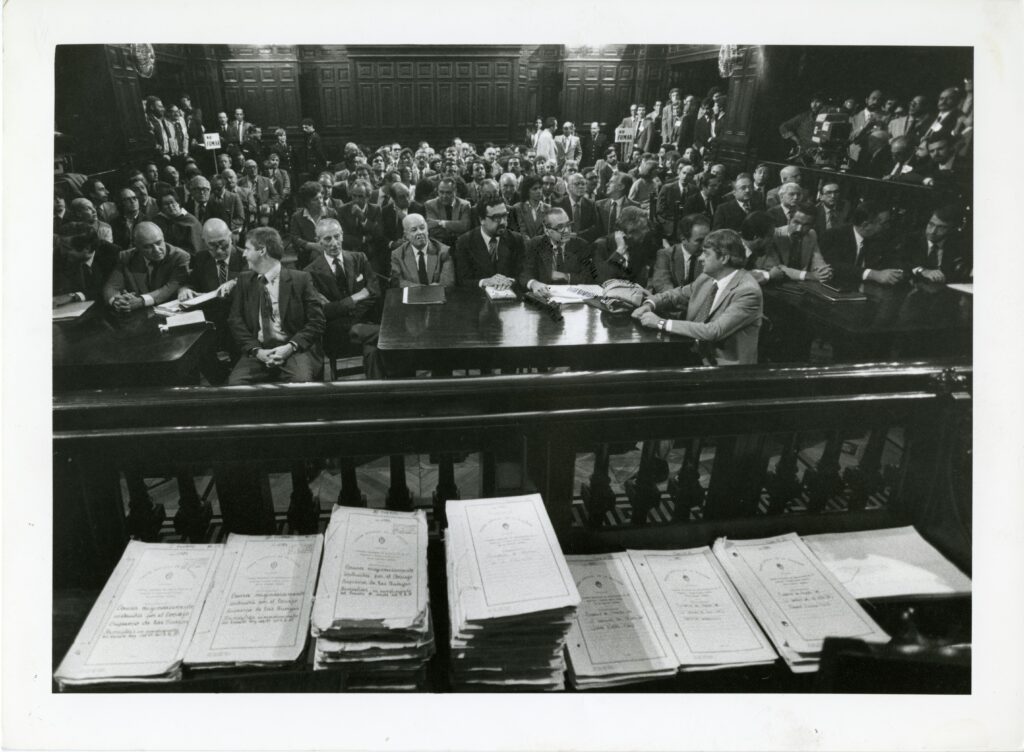
In 1985, after the fall of the dictatorship, Moreno Ocampo served as a deputy prosecutor in the Trial of the Juntas, in which Argentina’s newfound democratic government prosecuted the leaders of the military junta for crimes against humanity. 

The landmark trial set a precedent for the development of international criminal justice, later reflected in the creation of the International Criminal Court (ICC) in 2002, where Moreno Ocampo went on to serve as chief prosecutor.

In a conversation with Argentina Reports, Moreno Ocampo argues that Argentina’s experience stands as an exceptional case: a country that managed to confront violations to human rights without resorting to the logic of the “enemy” — which implies elimination without guarantees — but instead through a political consensus that led to a new method.

“Argentina showed that it is possible to confront the past with justice, not revenge,” Moreno Ocampo said.

Luis Moreno Ocampo and Chief Prosecutor of the Trial of the Juntas, Julio Strassera (1985). Image credit: FCJS UNIVERSIDAD NACIONAL DEL LITORAL

Justice, not war, protects societies from violence

The creation of the ICC, in part, was meant to provide a mechanism in which countries could avoid the political limitations of the United Nations Security Council, upon which permanent members have veto power that often leads to gridlock on pressing conflicts. 

Despite this body existing, many major global powers, including the United States, Russia and China, are not members, and increasingly, the former prosecutor laments, the world seems to be moving in the opposite direction.  

“The ICC is like a global Wi-Fi. Some countries are connected, others are not,” he said. 

In that context —marked by the fragmentation of the international order, large-scale wars such as those in Iran and Ukraine, and growing nuclear risk— war has once again become a tool to resolve conflicts.

From Afghanistan and Iraq to Ukraine, Gaza and now Iran, Moreno Ocampo argues that war is the “mother crime” that enables all others. Faced with violence that has once again become a response to terrorism and disputes between global actors, major powers are repeating a model that does not work.

“The way to protect a country against terrorist groups is not war —which generates more violence— but justice. And that is the lesson from Argentina,” he said.

For Moreno Ocampo, the problem is one of method. There are two ways to confront violence: to treat the violent actor as an enemy and eliminate them, or to investigate and judge them while respecting their rights. In 1985, Argentina chose the second path.

“It gave the military what they had not given their victims: a fair trial,” he said. 

Untitled photo. Trial of the Juntas in April, 1985.
Image credit: Eduardo Longoni via FCJS UNIVERSIDAD NACIONAL DEL LITORAL

The return of war

Moreno Ocampo traces the return of war as a tool for resolving conflicts to the aftermath of the September 11 attacks, when the United States decided to treat Al Qaeda leader Osama bin Laden not as a criminal to be prosecuted, but as a military target to be eliminated. 

The result, he argues, was counterproductive. Bin Laden remained at large for years, and the war in Afghanistan ultimately failed. 

Similar dynamics, he says, can be seen in Iraq and other conflicts.

“Every time the United States enters these wars, it loses. And yet, for different reasons, it cannot learn from that experience,” he said. 

This logic, he adds, is also visible in current conflicts in the Middle East, where opposing projects seek to eliminate each other rather than coexist.

“When projects appear that aim to exclude or eliminate the other, that inevitably leads to war.”

The persistence of war, according to Moreno Ocampo, is also linked to the limits of the current international system —and is visible in today’s conflicts.

In the Middle East, he argues, opposing sides are trapped in mutually exclusive projects that leave no room for coexistence. “When actors seek to exclude or eliminate the other, that inevitably leads to war,” he said, pointing to the dynamics between Israel and Hamas. 

After the October 7 attacks, he noted, there was broad international consensus in condemning Hamas — but the subsequent military response did not resolve the conflict and instead deepened the humanitarian crisis, while Hamas remains in power. 

For Moreno Ocampo, this reflects a broader failure of method: war continues to be used where justice mechanisms exist but are not applied.

A warning from Argentina

In a world shaped by nuclear weapons, advanced technology and growing geopolitical tensions, Moreno Ocampo warns that continuing down this path could lead to a global catastrophe.

“War is a model that humanity has used for thousands of years. But in a world with atomic bombs and cyberattacks, it is no longer viable,” he said.

Echoing Albert Einstein, he added: “I don’t know how the Third World War will be fought, but the Fourth will be fought with sticks and stones.”

For Moreno Ocampo, Argentina’s experience remains relevant not only as a historical process, but as a possible model for the future.

“The world is returning to the logic of war to resolve conflicts, and that can lead us to a catastrophe.”

Featured image: Luis Moreno Ocampo

Image credit: luismorenoocampo.com

The post On anniversary of military coup, Argentina’s ‘Nuremberg Trial’ prosecutor reflects on current global conflicts (Interview) appeared first on Argentina Reports.

The post On anniversary of military coup, Argentina’s ‘Nuremberg Trial’ prosecutor reflects on current global conflicts (Interview) appeared first on Latin America Reports.

  •  

Russian oil tanker arrives in Cuba in first non-private fuel shipment since January

The Russian tanker Anatoly Kolodkin has entered Cuban waters, according to the Russian news agency Interfax. 

The vessel, which is sanctioned by the European Union, United States and United Kingdom due to the ongoing Russia-Ukraine war, appears to be en route to the Cuban port of Matanzas, according to Marine Traffic. 

The ship’s arrival comes after U.S. President Donald Trump told reporters late on Sunday night that he had “no problem” with Russia supplying the island with oil, having previously threatened to impose tariffs on any foreign oil supplier of the communist-run nation. 

If delivered, the 100,000 tonnes of crude oil aboard the vessel would represent the first non-private foreign shipment of oil to reach Cuba since January, when the Trump administration’s oil blockade of the island began. 

The U.S. has allowed private companies to import fuel to the island, though these supplies have been negligible for the island’s needs as a whole.

Tensions between Havana and Washington have defined bilateral relations since the Cuban Revolution of 1959 and the subsequent nationalization of U.S. assets in the Caribbean nation. But in recent months, the long-running dispute escalated after the White House forcibly removed Venezuelan President Nicolás Maduro from power and took him into U.S. custody. 

Maduro was a staunch ally of the current Cuban regime and Venezuela was its primary oil supplier. 

While the U.S. and Cuban governments are engaged in diplomatic talks, this has not stopped high-ranking officials in Washington from repeatedly threatening the Cuban communist leadership with regime change

On Friday U.S. Secretary of State Marco Rubio told reporters that, in order for Cuba’s problems to be solved, “you need to change the people in charge, you need to change the system that runs the country.” 

Rubio also blamed the Cuban government, rather than U.S. sanctions, for the island’s oil shortages, accusing the state of wanting foreign nations to supply them with oil for free; this had supposedly been the case with Maduro and the former Soviet Union. 

Though both nations provided the island with heavily subsidized oil shipments at below-market prices, Cuba supplied the Soviet Union with sugar and sent its medical professionals to Venezuela in exchange for oil. 

The Cuban government blames U.S. sanctions for the current crisis. 

Their cause notwithstanding, the shortages of fuel on the island have provoked a grave humanitarian crisis; United Nations Secretary General Antonio Guterres warned last month of impending “collapse” if no oil reached the island. 

Cuban hospitals have had to cancel emergency surgeries due to a lack of power and Cubans have resorted to burning wood to cook food. 

Featured Image: Current Russian President Vladimir Putin and former Cuban President Raúl Castro in 2015. 

Image Credit: The Presidential Press and Information Office via Wikimedia Commons 

License: Creative Commons Licenses

The post Russian oil tanker arrives in Cuba in first non-private fuel shipment since January appeared first on Latin America Reports.

  •  

Pentagon reportedly preparing for action against Cuba

The United States is preparing options for a possible military operation against Cuba, according to a report today by daily newspaper USA Today

Two sources reportedly familiar with the matter told the paper that the Pentagon is increasing its preparedness in case U.S. President Donald Trump orders the military to intervene on the island, a possibility which Trump and various other high-ranking figures in his administration have mooted. 

In response, the Cuban government said that while it did not want Washington to attack, it was prepared for any possible intervention.

This year, relations between the two ideological adversaries have become more tense than at any other point since the end of the Cold War, with the U.S. removing Cuba’s closest political ally Nicolás Maduro from power in Venezuela and imposing a complete blockade on non-private fuel imports during the first three months of 2026. 

However, the commencement of high-level diplomatic talks between the two nations and the recent arrival of a Russian oil tanker in Cuba – which Trump said he had “no problem” with – suggested that mutual desire for a peaceful resolution to tensions was growing. 

But earlier this week, Trump said that the U.S. “may stop by Cuba” after the conflict with Iran reaches a resolution, which may be an indication that ongoing diplomatic talks between Cuba and the U.S. that seek to de-escalate tensions are progressing poorly.  

Nevertheless, Cuban President Díaz-Canel repeatedly expressed his desire for peace with the United States in his first interview with U.S. media last Sunday, though he warned that he and the Cuban population would be willing to fight to defend the island from any aggression by Washington. 

In January, Havana ordered its forces to prepare for war and has hosted countrywide defensive drills to prepare for a potential invasion from the north, yet its ability to defend against a Pentagon-led operation is unknown. 

Jennifer Kavanagh, a senior fellow and director of military analysis at foreign policy think tank Defense Priorities, spoke to Latin America Reports about the likelihood of a U.S. military operation in Cuba. 

She speculated that, although the leak to USA Today was likely a negotiating tactic intended to pressure the Cuban government into making greater concessions in negotiations, “there is planning going on for such a [military] operation … Rubio has made his support for regime change in Cuba clear. Trump, too, would likely welcome a distraction from Iran that he can sell as a success”. 

The expert also explained what a potential intervention might look like: “I doubt they would use exiles, as this has failed in the past. A Maduro-style approach is possible. A more complete takeover of the island which is small and weak is an alternative”.

Kavanagh also weighed in on the chances of such an operation’s success. “[Although] 

defenders always have an advantage, I imagine the United States could overpower Cuba’s defenses. Holding the island for a sustained period might be more challenging”.

The U.S. has intervened several times in Cuba, which is situated approximately 90 miles off the coast of Cuba. In the early 1900s, the U.S. invaded the island on three occasions to protect American economic interests.

In 1961, after the triumph of the Cuban Revolution, Washington also backed a failed invasion attempt of the island by anti-communist Cuban exiles, which came to be known as the Bay of Pigs. 

In a rally today, Díaz-Canel drew parallels between the latest threats and the infamous Cold War operation.

“The moment is extremely challenging and calls upon us once again, as on April 16, 1961, to be ready to confront serious threats, including military aggression. We do not want it, but it is our duty to prepare to avoid it and, if it becomes inevitable, to defeat it.”

Featured Image: The celebration of the 50th anniversary of the creation of the United States Southern Command (USSOUTHCOM) in Miami. USSOUTHCOM is the command of the U.S. military that would likely be responsible for overseeing any military operation against Cuba.  

Image Credit: Department of Defense via Wikimedia Commons License: Creative Commons Licenses

The post Pentagon reportedly preparing for action against Cuba appeared first on Latin America Reports.

  •  

International calls for US-Cuba de-escalation grow amid latest threats

The leaders of Mexico, Spain and Brazil called for Cuba’s sovereignty to be respected as it continues to face threats by Washington.

The joint statement came during a meeting of left-wing leaders in Spain and also vowed to send humanitarian aid to the crisis-ridden island.

The plea comes as the President Donald Trump administration ratchets up punitive measures on the communist-run island in the hopes of forcing political regime change. 

“We express our deep concern regarding the serious humanitarian crisis the Cuban people faces … [and] we reiterate the need to respect at all times international law and the principles of territorial integrity, sovereign equality and the peaceful settlement of disputes”, said Mexican President Claudia Sheinbaum, Spanish Prime Minister Pedro Sánchez and Brazilian President Luiz Inácio Lula Da Silva in a joint statement on Saturday. 

Although the U.S. was not directly mentioned, the plea appears to be aimed at the White House as tensions rise between the two neighbors. Since news broke on Wednesday that the Pentagon is ramping up preparations for an operation against Cuba, a U.S. Navy surveillance drone has been observed flying over Cuba’s coast for several hours and Trump has promised that “a new dawn for Cuba” is imminent. 

Hope for a peaceful solution, however, remains. Havana and Washington are currently engaged in official diplomatic negotiations; a U.S. government delegation visited Havana earlier in April, marking the first visit of an official U.S. government plane since former President Barack Obama’s trip in 2016.

The U.S. delegation reportedly informed their Cuban counterparts that they saw an end to political repression, the liberation of high-profile political prisoners and economic liberalization as prerequisites for easing the longstanding economic and commercial embargo on the island. 

These sanctions, which have historically been condemned by the vast majority of the international community at the United Nations General Assembly, have caused far-reaching material shortages on the island and hindered the island’s ability to engage in international trade and commerce, according to UN experts. 

Recently, the U.S. intensified sanctions, declaring Cuba a national security threat and blockading the vast majority of oil destined for the island, which is now facing an acute humanitarian and economic crisis as a result of the intensified measures.

Sheinbaum, Lula and Sánchez’s promise of support represents the latest in a series of international offers and shipments of aid. Sheinbaum’s own government has already sent humanitarian shipments to the island, and the Chinese, Chilean and Canadian administrations have also sent or pledged to send aid to the island. 

Furthermore, a civilian humanitarian aid mission to Cuba, which brought food, medicine and solar equipment to the island, was organized in March. 

Featured Image: Spanish Prime Minister Pedro Sánchez and Brazilian President Luiz Inácio Lula Da Silva during the former’s visit to Brazil in 2024.

Image Credit: Ricardo Stuckert via Flickr

License: Creative Commons Licenses

The post International calls for US-Cuba de-escalation grow amid latest threats appeared first on Latin America Reports.

  •  

United Nations negotiates with US to allow fuel into Cuba

The United Nations (UN) has entered into formal negotiations with the United States regarding the entry of fuel supplies to Cuba amid acute fuel shortages caused by a U.S. oil blockade, said Francisco Pichón, the permanent representative of the UN to Cuba.

Members of the UN Office for the Coordination of Humanitarian Affairs and the Trump administration are discussing ways “to ensure that fuel can be accessed for humanitarian purposes,” according to Pichón.

The UN representative clarified that those fuel supplies would be used for “emergency response operations” and to protect the access of “vulnerable people and groups” to “vital services”. 

The recent U.S. oil blockade on oil has led to a growing nationwide humanitarian crisis: many regions are facing prolonged power outages, hospitals are facing increasing pressure as life-saving treatments are disrupted, and the economy is crumbling as schools and workplaces reduce their operational hours. 

The U.S. campaign of economic pressure is widely seen as an attempt to force the Cuban regime into collapse or make its leader grant political concessions to Washington. Senior Republicans in the U.S. have repeatedly suggested that some form of regime change in Cuba is imminent.

During the Shield of the Americas Summit on Saturday, President Trump promised that “great change” was coming to Cuba and its “bad regime that has been bad for a long time.” 

On Monday, President Trump reiterated his warning, claiming that Cuba may soon face either a “friendly” or “unfriendly” takeover by the U.S. 

Republican U.S. Senator Lindsey Graham also told Fox News on Sunday that “the liberation of Cuba is upon us. It’s just a matter of time now.” 

Although there are reports that an economic deal between Washington and Havana could soon be announced, the “unfriendly” option remains a possibility. The U.S. administration’s strikes on Iran or its operation to capture Venezuelan President Nicolás Maduro could serve as templates for a potential military operation against Cuba.

Read more: U.S. Reportedly Closing In On Economic Deal With Cuba

Ricardo Torres, a Cuban economist and research fellow at the Center for Latin American and Latino Studies at American University, spoke to Latin America Reports about the current Cuban crisis and the various iterations of regime change that could occur as a result.

“Whatever emotional and material reserves [Cuban] people once had are now largely exhausted … if the United States strictly enforces the oil embargo, a negotiated solution will likely become inevitable, given the limited support Cuba is receiving from its allies,” the economist said. 

Venezuela, Cuba’s erstwhile closest regional ally, has stopped supplying the island with oil since the capture of President Nicolás Maduro by U.S. forces and in early March an oil tanker bound for the island from Russia – a traditional ally – reversed route under suspected U.S. pressure. 

Commenting on recent revelations about UN-U.S. negotiations, Torres pointed out that the discussions between the White House and the UN will likely be limited to “aid delivery” as opposed to opening an avenue for de-escalation. 

The U.S., he argued, “would [probably] favor a full [political] transition in Cuba” and an end to Communist party rule. Failing that, “they may be prepared to support a phased agreement that starts with building a more stable economic base and proceed from there,” the research fellow concluded. 

Featured Image: A horse-drawn cart in Cuba during the Cuban ‘Período Especial’, the term used to describe the Cuban economic struggles in the 1990s after the Soviet collapse. The scale of current fuel shortages in Cuba has not been seen since the ‘Período Especial’ 

Image Credit: Nick via Wikimedia Commons 

License: Creative Commons Licenses

The post United Nations negotiates with US to allow fuel into Cuba appeared first on Latin America Reports.

  •  

A polarized election may not matter for one of Peru’s biggest concerns: corruption

In yet another polarized Latin American election, Peru’s June 7 runoff pits two ideological opposites against each other. 

Keiko Fujimori, the conservative daughter of former dictator Alberto Fujimori, and Roberto Sanchez, a left-wing congressman backed by jailed former President Pedro Castillo, won the first round of voting on April 12 with 17% and 12% of the vote, respectively. 

The race comes as Peruvians have become all but fed up with their elected officials. A 2025 OECD study found that trust in government is lower in Peru than in any other Latin American or Caribbean country. With eight presidents in office in just 10 years, political instability has become a hallmark of Peruvian politics. 

Scandals and accusations during this campaign haven’t done much to restore voter confidence.

As the final vote counts in April confirmed he would advance to the runoff, prosecutors charged Sanchez with financial crimes, accusing him and his brother of failing to disclose 280,000 soles ($81,720) in party contributions. His critics are calling for his disqualification. 

“One cannot help but see this as a politically motivated move designed to remove him as a viable candidate,” Jo-Marie Burt, a senior fellow at the Washington Office on Latin America (WOLA) focused on Peru, told Latin America Reports in May. 

In addition, delayed ballot deliveries and quick count releases during the first round prompted the resignation of the head of Peru’s elections agency. 

Rafael Lopez Aliaga, a conservative candidate and Trump acolyte who didn’t make it to the second round, alleged electoral fraud and threatened to call for mass protests. He now faces a criminal complaint for inciting civil disorder. 

Despite political differences, corruption extends beyond party lines 

Despite an Ipsos poll from last year which found that crime, corruption, and political instability were at the top of Peruvians’ concerns, the electorate may be forced to choose between divergent political and economic ideologies that hold similar patterns of corruption. 

“On economic issues, [the candidates] are substantially different. On rule of law, unclear,” Will Freeman, Latin America Fellow at the Council on Foreign Relations who studies corruption and organized crime in the region, told Latin America Reports

On one hand, Fujimori’s Fuerza Popular party has sat at the center of Peru’s institutional decay for a decade. After winning a congressional majority in 2016, the party fought the anti-corruption investigations that grew out of the region-wide Odebrecht kickback scandal — probes that, Freeman acknowledged, “could fairly be argued to have gone too far at times.” 

“But the response has been the dismantling of the justice system and rule of law in Peru,” he added. The Fujimori name is now “doubly associated” with authoritarianism. 

In the shadow of her father’s dictatorship, marred by corruption and human rights abuses, Keiko is now plagued by “not only what her dad did, but what she herself has done,” he argued. 

Opposition to the Fujimori family, or “anti-Fujimorismo”, has long been a pillar of Peruvian politics, and likely can be credited with snubbing Keiko’s three previous presidential bids. 

However, her strength in the polls suggests that her opposition is weakening. 

Pedro Castillo and Alberto Fujimori.

Freeman attributes Keiko’s current success less to her own appeal, and more to the collapse of the political coalition opposed to her family. 

Sanchez-ally and leftist President Pedro Castillo, elected in 2021 with anti-Fujimorista backing, would go on to embrace his own form of abuse of power, attempting to dissolve Congress “like Alberto Fujimori himself, almost copying him exactly,” said Freeman. Last year, Castillo was sentenced to over 11 years in prison.

While the elections are often being framed as “left versus right”, corruption and dismantling of institutional power extends beyond party lines in Peru. 

In congress, Castillo’s lawmakers and the Fujimoristas often voted together when it was in their interests, Freeman said. “Particularily in weakening the justice system and shielding themselves from investigation.” 

China and the U.S. in Peru

Governments abroad, especially the U.S. and China, are paying attention to what happens in Peru on Sunday. 

As Trump has set his sights on shoring up U.S. influence in Latin America during his second term, China, who has made significant investment inroads in LatAm countries over decades – most notably in Peru – also has its interests at stake. 

“It’s sometimes not really stressed enough just how important Peru is to China,” Freeman said. 

Beijing controls about half of Lima’s electricity supply and the new deepwater megaport at Chancay, with plans for an interoceanic corridor linking Brazil to the port as an export route for South American commodities. 

Washington, by contrast, has largely written Peru off. Even under former President Joe Biden, Freeman said, there was a “tacit acceptance that the battle was already lost.” 

It’s unclear whether the Trump administration’s more interventionist turn in Latin America will extend to Peru. A Fujimori win, and her ideological alignment with Washington, “may open space for a more direct U.S. military presence,” Freeman suggested, whether against coca production or in the ports, “similar to what Ecuador has done.”

It is unlikely Sánchez would allow the same. His progressivism and close ties to Castillo’s leftist movement could invite Trump’s ire, as has been the case in Cuba, Colombia and Venezuela. 

Freeman also cautions against reading a Fujimori win as Peru joining the U.S.-allied right wing tide across the region. 

“This is more of the culmination of that process than the start of some sudden authoritarian wave,” he said. Peru’s government has been effectively right-wing since Castillo’s removal in 2022, with a conservative Congress setting the agenda.

Featured image: Keiko Fujimori and Roberto Sanchez via their respective X accounts.

The post A polarized election may not matter for one of Peru’s biggest concerns: corruption appeared first on Perú Reports.

The post A polarized election may not matter for one of Peru’s biggest concerns: corruption appeared first on Latin America Reports.

  •  
❌