Reading view

What’s fueling AI companies’ IPO rush

Elon Musk speaks virtually from a large video screen above a stage.
Elon Musk speaks during a video interview in Tel Aviv, Israel, on May 18, 2026. | Kobi Wolf/Bloomberg via Getty Images

Welcome to the era of the big three.

We’re not talking rappers here — although according to Kendrick Lamar, it’s “just big me” — we’re talking AI companies: Anthropic, SpaceX, and OpenAI. 

These three leading artificial intelligence companies are all expected to go public this year. Elon Musk’s SpaceX, which recently acquired another Musk company, xAi, is on track to open up to investors later this month. Anthropic, the company behind the chatbot Claude, just filed confidentially with the States Securities and Exchange Commission for its own initial public offering. Reports say OpenAI could also go public as soon as September. (Disclosure: Vox Media is one of several publishers that have signed partnership agreements with OpenAI. Our reporting remains editorially independent.)

SpaceX’s IPO, when it happens, could be the largest in history and mint Musk as the world’s first trillionaire. With Anthropic and OpenAI, the combined value of AI IPOs could total over $3 trillion.

But it’s not as simple as going public and raking in cash. “There’s this race that’s been going on between SpaceX, OpenAI, and Anthropic,” Liz Lopatto, a senior writer at The Verge said. “There’s this fear that if you don’t go public at the right time or you don’t go public first, investors aren’t going to wait for you.”

To understand why some of the world’s richest men, at the helm of some of the world’s richest companies, are now courting the public’s money, Today, Explained co-host Sean Rameswaram spoke with Lopatto. 

She’s been deep in SpaceX’s public filings and has been covering the court drama between Musk and OpenAI’s Sam Altman. Her latest piece for the Verge is titled “The SpaceX IPO is great for Elon Musk and terrible for you.” 

Sean and Lopatto chat about what each of the companies hope to gain from the public, why this moment could be like internet 1.0’s dot-com bubble, and whether these companies chasing shareholder profits will be good for us.

Below is an excerpt of their conversation, edited for length and clarity. There’s much more in the full podcast, so listen to Today, Explained wherever you get podcasts, including Apple Podcasts, Pandora, and Spotify.

Why do [these companies] need to go public right now?

Whoever goes public first is going to scoop up better investors or have an easier time convincing investors. That is fueling this rush toward the market. So that’s thing one. 

But thing two is that AI is extremely expensive. And I think that’s something that people often forget about because right now we’re sort of in, like, the early days of Uber, where you’re using this very expensive tool for free and then they’re going to try to get you hooked on it so that you’ll pay real prices later on. 

In order to get the money that you need for compute, to build all of these data centers, to do all of the things that you need to do in order to have these frontier models, that’s just an incredibly capital-intensive business. One way to get capital is to go public.

Anthropic has had some better discipline than the other companies in terms of behaving like actual adults. They might actually tell us a little bit less before it happens than we’ve heard from, for instance, SpaceX.

Tell me more about behaving like adults when it comes to IPOs, which feels like a very adult thing to do.

There are sort of a lot of things that come into play with an IPO. And basically what you’re doing is you are setting out what your company is, what the company’s vision is, how you plan to make money, and what you’re going to do with all the money that you’re raising in the IPO. And for SpaceX, there’s a bunch of nonsense about Mars in there that doesn’t really feel real to me. There’s nothing about the biological risks of going to Mars, for instance, and the risk factors, which, if that were a real thing, you’d see it. 

One of the things that’s been notable is that both Anthropic and OpenAI seem to have better businesses, based on what we know. Anthropic is actually about to make a profit. Anthropic in particular didn’t make any images with its AI. It stuck to text and it focused specifically on programming. It’s not a sexy business, it’s enterprise software. But you don’t have to be sexy to make money.

Just looking at the difference between like the flash we’re seeing about, like, spreading the light of human consciousness among the stars and actually making money, which is the point of a company. I would say that Anthropic seems like it’s run by adults by comparison. And then I would put OpenAI somewhere in the middle.

Why? What is Open AI doing that isn’t very adult-like behavior?

OpenAI as a business is really scattered. They created and shut down Sora, which was AI-generated videos. They have these AI image generators that have created a whole new level of headaches for them. They’re embroiled in a number of lawsuits.

Sam Altman, the CEO, was running it effectively as a startup composed of little startups within it and was like, “Well, we’ll just see which one of them wins.” And that’s maybe not the best way to run a company. It’s a fine way to run a portfolio, but a company is not a portfolio.

Liz, you’re very tapped into this world out there in Silicon Valley and you were at the trial between Altman and Musk. It sounds like these companies are all being talked about in the same breath even though two of them are very specifically AI companies and one of them wants to colonize Mars. Why is that? Is it just because they all may IPO soon?

I think that’s part of it. I also think there’s been this investment thesis that frontier AI models are effectively going to be a boom on the scale of internet 1.0, if you remember 1999.

This is sort of the moment where we’re going to find out who’s Google and who’s Amazon and who’s Pets.com, right? And so I think that’s why people are talking about them in this way, because it’s not just these three companies that are AI companies. Obviously Google has an AI arm that is very good. But then you have companies like Databricks, which you maybe haven’t heard of. 

Can’t say I know her.

Yeah. This is a perfectly fine company. It’s got a business. But it’s not in that conversation because I don’t think people expect it to be one of the behemoths in the way that they’re looking at these three as the potential behemoths of this generation of technology.

This reminds me that when social media companies went public, they started prioritizing things like shareholder profit rather than safety. I think Facebook — Meta — is probably the most prominent example of this. 

Do we want the still mostly dudes holding our future in their hands to be beholden to market forces and profits above all else?

Arguably they already are. 

This is one of the arguments that has been made about OpenAI: that the reason they’ve had some of these issues around safety has been because they are motivated by chasing the market and trying to raise money. Because unlike social media, this is a very capital-intensive business.

You need to be showing investors something. You need to be proving yourself out in a way that you didn’t necessarily have to with social media right off the bat. So I think that’s part of it. But I think that going public potentially makes that worse. The chatbot will try to keep you engaged. It will give you an answer and then it will ask a tag question. And that’s an engagement tool that keeps you engaged with the AI. 

You see that also with some of the sycophantic behavior you see with these AI where they’re like, “Wow, that’s such a smart question. Gee, you’re so bright.”

And is that really good for us? I don’t think it is. But it does keep people involved, and it does keep people engaged with the AI, and if you need to be showing user numbers or otherwise showing metrics to investors, those are the ones you show.

It seems almost silly to ask if being a publicly traded company could make these companies more accountable or even safer. But then again, if you think about Anthropic and their whole dustup with the Pentagon, without being publicly traded, they said, you know, you guys are crossing the red line and we have to reassess our relationship.

Do you think something about being publicly traded post-IPO could make a company like Anthropic or OpenAI a little bit more conservative in their developments and their technology?

To the degree that you can say, “Hey, like I was misled by this company as a shareholder because they told me there were these safety practices that actually were not in play and then take them to court” — that is something that can be done, sure. Unless you’re talking about SpaceX, which has a governance structure that effectively bars shareholder suits, unless you have a specific percentage of holding.

So not SpaceX, but maybe Anthropic, maybe OpenAI have this additional measure of accountability where shareholder lawsuits can potentially move the needle.

But most likely of all we just start to see a lot more ads.

I think that’s right. I think you also see prices go up for the enterprise products — and maybe for all of the other products as well.

  •  

When Loving Your Job Is Not Enough

The quiet tension shaping today’s workforce

There is a strange contradiction unfolding at work right now. People say they are happy. They like their teams, they enjoy what they do, they feel engaged. And yet, beneath that surface, there is a growing sense of unease that is hard to ignore.

It shows up in small ways. A hesitation before asking a question. A quiet urgency to learn something new late at night. A subtle fear that the ground is shifting, even if everything looks stable.

This week, conversations around artificial intelligence have felt louder and more personal. Not just about what AI can do, but about what it might take away. There is a noticeable shift from curiosity to concern. From excitement to quiet anxiety.

And that tension is important to understand.

Happiness does not equal security anymore

For a long time, we treated job satisfaction as the ultimate goal. If people were happy, we assumed everything else would follow. Retention, performance, loyalty. It felt like a simple equation.

But that equation is breaking down.

Today, someone can love their job and still feel deeply uncertain about their future. That is because happiness is rooted in the present, while anxiety lives in what might happen next. And right now, the future feels less predictable than it used to.

“Anxiety often reflects fear of what ‘might’ happen, or a worst-case scenario, not the current state. When there is a looming threat… the human mind reacts to this potential danger by anticipating loss or harm. It remains on alert,” Explains Wendy Lynch, PhD,, CEO of Analytic Translator.

AI is a big part of that feeling. Not necessarily because people believe they will lose their jobs tomorrow, but because they do not know how their roles will change. The lack of clarity is what creates stress.

It is one thing to face a known challenge. It is something very different to face an undefined one.

When people hear that AI could reshape entire industries, the question becomes personal very quickly. Where do I fit into that change? Will I still be relevant? Am I already falling behind?

Even those who feel confident today can still feel vulnerable about tomorrow.

The rise of invisible stress

What makes this moment more complex is that much of this anxiety is not openly discussed. It is not always visible in surveys or performance reviews. People continue to show up, do their work, and even report that they are satisfied.

But internally, something else is happening, Dr. Lynch have notice: “An anxious brain is not an optimally functioning one. Thoughts and ruminations about a threat reduce bandwidth for higher-level thinking, such as problem solving, creativity, and concentration.”

This is where the idea of hidden data becomes important. Not data in a technical sense, but the subtle signals that people send through behavior. Changes in communication patterns. Shifts in engagement. Small drops in confidence.

These are not dramatic red flags. They are quiet indicators that something is changing beneath the surface.

Dr. Wendy Lynch, PhD, CEO of Analytic Translator, has pointed to this kind of hidden data as a way for leaders to better understand what employees are really experiencing. Not just what they say, but what their actions suggest.

Her perspective feels especially relevant right now. If anxiety around AI continues to grow quietly, organizations may not notice it until it becomes a bigger problem. And by then, it may show up in ways that are harder to manage, like sudden waves of resignations or disengagement. The challenge is that traditional ways of listening are not always enough. If you only rely on direct feedback, you might miss what people are hesitant to say out loud.

Why uncertainty hits harder than change

It is tempting to frame this moment as simply another wave of technological change. After all, industries have adapted before. New tools have always created new opportunities.

But this moment feels different for many people.

Not because AI is inherently more threatening, but because the pace and visibility of change are higher. People are seeing examples of automation and transformation in real time. They are hearing about it constantly. It feels immediate, even if the actual impact is still unfolding.

And uncertainty amplifies everything. When people do not know what skills will matter most, they try to prepare for everything. That can lead to exhaustion. When they are unsure how decisions will be made, they may hesitate to take risks. That can slow innovation.

In some ways, the fear is not about AI itself. It is about losing a sense of control.

A different kind of leadership moment

This creates a new kind of responsibility for leaders.

It is no longer enough to keep people engaged in their current roles. There is a growing need to help them feel secure in their future. Not by promising certainty, which is impossible, but by creating clarity where it can exist.

That might mean being more transparent about how AI is being used. It might mean investing in learning in a way that feels accessible rather than overwhelming. It might also mean paying closer attention to those subtle behavioral signals that suggest rising anxiety.


“If we looked at the combined medical, pharmacy, disability, absence, and injury costs for those 59% of people who have a mental health challenge, it represented 72% of total costs. Suddenly, we realize that our original, narrow definition of treatment cost vastly underrepresents the full size of the issue,” adds Wendy Lynch. 

Based on those numbers, the idea of hidden data becomes less about analytics and more about awareness. About noticing patterns early. About understanding that what is not being said can be just as important as what is. Leaders who can do this well are likely to build stronger trust. Not because they eliminate uncertainty, but because they acknowledge it.

Looking ahead without losing the present

There is also an important balance to maintain.

If the conversation becomes only about future risks, it can overshadow the real value people find in their work today. That would be a mistake. The fact that many employees still report high satisfaction is not meaningless. It shows that work can still be fulfilling and engaging.

The goal is not to replace that sense of satisfaction, but to support it with a clearer path forward.

People want to feel that their efforts today still matter tomorrow. That what they are building, learning, and contributing will not suddenly lose relevance.This is where thoughtful perspective matters more than perfect answers.

The companies that navigate this moment well may not be the ones with the most advanced technology, but the ones that understand the human side of change. The ones that recognize that anxiety and satisfaction can exist at the same time, and that both need attention.

A quiet turning point

It is easy to overlook moments like this because nothing dramatic has happened yet. There is no single event that marks a turning point. Instead, it is a gradual shift in how people feel about their place in the world of work.

But these quiet shifts often matter the most. They shape decisions over time. Whether someone chooses to stay, to leave, to speak up, or to stay silent. Whether they feel confident investing in their future or hesitant to take the next step. Loving your job used to feel like enough. Now, it feels like just one piece of a bigger picture. And understanding that difference may be one of the most important challenges leaders face right now.

The post When Loving Your Job Is Not Enough appeared first on Social Lifestyle Magazine.

  •  

Altman, OpenAI get bogged down in political spending fight

OpenAI, the artificial intelligence firm that birthed ChatGPT, is struggling to distance itself from pro-AI super PAC Leading the Future and its Silicon Valley backers as the industry faces backlash over its midterm election donations. OpenAI CEO Sam Altman is facing new questions over the company’s affiliation with Leading the Future, which is backed by...

  •  

The couples using ChatGPT as their therapist

An illustration of a robot handing a confused man a bouquet of flowers and a heart full of chocolate.

Nick Sadler and his wife had different ideas of what a chill Saturday looked like. He considered the weekend a blank slate — no set plans, the family’s moment to reset and chill. She was under the impression that time was up for grabs and put a short hangout on their calendar, which Sadler saw as his wife not taking his schedule into account. To settle the argument, he opened up ChatGPT, specifically the group chat function, which allows more than one human to interact with the technology. Sadler prompted the chatbot to act as a neutral mediator and to instruct them on their next moves. Sadler tells Vox that ChatGPT acted as a trusted friend, or even a therapist, suggesting both of them consider different perspectives. It attempted to pinpoint where the conversation broke down (“Both of you then behaved logically according to your own understanding. That means this is not primarily a respect problem. It’s a classification problem.”) and offered guidelines for future scheduling (“A simple question can prevent most of these arguments: ‘Is this an idea, or are we locking this in?’”)

“It was like, ‘Well, next time just consider this’ and ‘maybe try saying this’ and ‘maybe try doing that,’” Sadler, a film producer, says. “We got some sort of advice to follow, but ultimately we’ve still got to do the work and we’ve still got to actually take the actions.”

Sadler, a 48-year-old self-proclaimed AI enthusiast, is no stranger to utilizing ChatGPT in his marriage. He’s used it to uncover the weaknesses in his arguments and to craft apology texts to his wife. “I put in purpose mistakes so she wouldn’t think I was just using ChatGPT,” he says.

But the pressures of parenting two young kids was kindling for their periodic annoying marital spats. Sadler and his wife considered couples counseling, but once he discovered ChatGPT could guide them through difficult conversations, they no longer felt they needed the help of a professional. One night, while sitting on the couch with his wife, Sadler launched ChatGPT and told his wife to talk to it as if it was a therapist. “In a way, it’s having a therapist on tap,” he says.

That people are turning to large language models to navigate their love lives isn’t entirely surprising. Relationships have peaks and valleys and, many times, exist in an emotional gray area. Chatbots, on the other hand, are authoritative in tone and confident, even when they’re wrong

Some people are going a step beyond asking Claude to draft an apology text, and inviting AI into the most intimate moments of their lives: fights with their significant others. In other words, they are treating technology like an on-demand couples therapist. The tech, which could be ambiently listening or addressed directly via voice or text, might suggest someone use more “I” statements or prompt couples to ask questions like “Where did you feel unsupported?” 

Research has suggested publicly available AI, like ChatGPT, is an effective intermediary in a dispute, with human subjects feeling less divided when AI was mediating. But AI platforms lack the emotional intelligence to adequately read a couple’s body language and tone, understand cultural context and power dynamics, and incorporate a couple’s past into the fight at hand.

The desire for an authoritative, always-available guide in the midst of conflict is certainly seductive, but emotional matters are best reserved for human-to-human conversation. “The answer is typically not that you need some type of content strategy on how you should approach your next steps,” Amelia Miller, a fellow at the Berkman Klein Center for Internet and Society at Harvard University, tells Vox. “But it’s much more that you need emotional support, which comes from asking other people that you care about what you should do in the situation, not asking a machine.”

Drawing from a shared reality

In her Bay Area therapy practice, Courtney Quattrini has seen her fair share of couples who leverage AI chatbots in their relationships, including using it as a practice conversation partner and to ghostwrite texts to their significant other. While none of her clients have let ChatGPT or Claude mediate a fight, some do bring in AI summaries of arguments from one person’s perspective to their sessions with her. “They’re ruminating or they’re thinking about their side of the fight: What am I going to come back and say, how am I going to prove that I’m right or wrong?” Quattrini tells Vox. “They’re summarizing the fight from their perspective, and then they’ll bring in the summary and present it almost like it’s objective, but of course it’s not objective.”

But much of the work in couples therapy centers on the idea that two things can be true at once, and is about getting both individuals to understand that their partner’s emotional reality is important. “When you’re coming in and you want to summarize who won a fight, that really doesn’t align with the work that we’re actually doing,” Quattrini says. Feeding AI your narrative doesn’t help you see the things you could have done differently. 

But when both people in a relationship invite AI into the discussion, leveling the playing field, the technology draws from a version of the story that may be more closely aligned with reality. A few months into dating, Khalid Tawohid and his partner discovered they’d both been discussing their relationship with their respective AI chatbots. “How can we get our AIs to just talk to each other?” Tawohid tells Vox.

Earlier this year, the 25-year-old software engineer designed a workaround where both his and his partner’s Claude agents — drawing from each individual’s full chat history — could facilitate difficult conversations. The app, called Bridge, claims to provide scaffolding for the discussions and package disorderly thoughts in a more coherent manner. Instead of looking to a machine to validate your point of view, the machine, ideally, would hold your hand as you attempt that same conversation with a human. “This helps your AI have a real sense of identity of who this [other] person is because it’s two different AIs, one knows one person, one knows the other person, and they’re both vehemently going to defend their own person,” Tawohid says. “But together it gets you to a more shared sense of truth.”

Still, Tawohid isn’t convinced his AI chatbot mediation tool, Bridge, is even a good idea. He has shared Bridge with about 10 couples, all of whom have given him the feedback that they’d use it again, he says, but it isn’t widely available for use. Perhaps, he says, it could be a supplement to traditional couples counseling, a way to practice communication outside of the therapy room.

Ironically, though, Tawohid has come down on the side of mild AI skepticism. “It’s a combination of a journal and a therapist and a friend, but it is also not real. It’s also just a computer code,” he says. When he discovered he’d lost his ability to craft a sentence without help, he stopped writing with AI. Now he fears people could lose their relationships to chatbots, too. 

Gateway to introspection or outsourcing sincerity?

After a few months of using Bridge, Tawohid says he and his partner spend much less time talking to AI. They’ve had enough machine-facilitated conversations that they better understand each other’s thought patterns and triggers. Sadler, the AI-curious film producer, and his wife have similarly come to rely on AI less frequently because, he says, ChatGPT has taught them to be better communicators. “It just taught me to understand that she’s got a different perspective on things. If I’m not understanding where [she’s] coming from, just asking questions to say, well, what do you mean? And not jumping to conclusions,” he says.

Using AI as a therapeutic outlet can be instructive for people who aren’t in the habit of introspection, says Miller, the Harvard fellow. These chatbots can, in theory, be a tool for reflecting on an argument and for rehearsing what to say next. But sometimes the language the chatbot suggests is so far out of the realm of what your partner would actually say that its assistance is counterproductive. 

For Josh Elledge and his wife, the stupid fight began over a haircut — or lack thereof. Elledge, a 54-year-old podcast consultant, was refusing to clean up his look (“I didn’t like something my barber said, and so I stopped going to him,” Elledge says) and his wife was not pleased. So she turned to an AI chatbot for assistance on how to break it to him. What she ended up saying to Elledge didn’t land. “It just made her opinion stronger in a way that wasn’t really helpful,” he says. “She’s conveying this stuff and I’m like, wow, you really think that? And she’s like, well, no, not really.” He says they “thankfully had the good sense” to distinguish between what she believed and what was the AI. 

Once you relinquish enough of your critical thinking to AI, you run the risk of undermining the relationship you sought to fix. Therapists are trained to identify when a fight needs to be slowed, rerouted, or ditched altogether. But because chatbots never tire of hearing about your problems, you can get caught in a loop of rumination, perpetually mulling over the same frustrations and workshopping language on how to tell your husband you hate his haircut. At that point, who are you in a relationship with — a large language model, or a human? “That was an instance where maybe this isn’t a miracle process. You still have to just be really careful about not showing up as someone who you are not just simply because you defaulted to this AI being this authority in all things,” Elledge says.

AI chatbots are programmed to keep you engaged, but endless mediation and reflection isn’t exactly helpful. If you feel compelled to use one to navigate a squabble, give the technology guardrails. For example, Miller has created custom prompts that don’t exceed 10 or so exchanges with the AI and are meant to illuminate your own biases and shortcomings. But, ultimately, Quattrini, the therapist, says it’s important to remember that true counsel comes from a human who possesses the ability to read nonverbal cues, affect, and changes in body language. “Right now I think AI is a pretty dangerous mediator because it doesn’t have a nervous system,” she says. 

The joy of being a person in a relationship with another person is getting through the hard parts together, even imperfectly. “We’re complicated people and no one really knows everything going on in everyone’s mind,” Tawohid says. “But humans are awesome, truly.”

  •  

Storytelling and AI

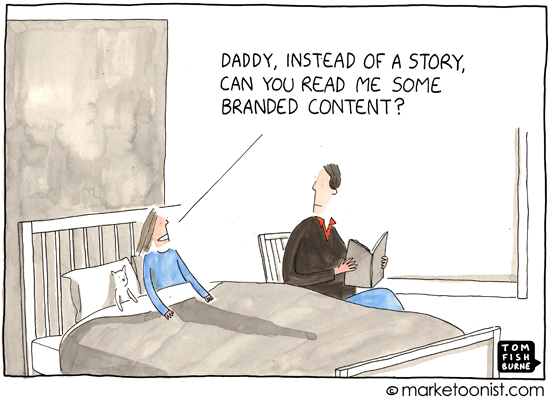
Storytelling and AI Marketoonist cartoon

LinkedIn reported that the percentage of US job postings that include the term “storyteller” doubled last year from the year before.

Katie Deighton recently wrote about this in the WSJ:

“Marketing and technology companies have often repurposed grandiose descriptions from other arenas to lend corporate office roles additional sparkle. While the heyday of technology gurus, developer ninjas, SEO rockstars and at least one digital prophet have long since passed, calling salaried communications professionals “storytellers” and the practice of storytelling appears to only have picked up in popularity.”

Of course this isn’t totally new. Storytelling in business practice goes through periods of being in vogue.

In 2014, Austrian designer Stefan Sagmeister famously pilloried the whole idea of creatives calling themselves storytellers, showing up to a conference on storytelling to tell everyone they weren’t really storytellers.

“People who actually tell stories, meaning people who write novels and make feature films don’t see themselves as storytellers. It’s all the people who are not storytellers, who kind of for strange reasons because it’s in the air suddenly now want to be storytellers.”

I find it funny that Stefan Sagmeister’s own wikipedia entry now describes him as a “graphic designer, storyteller, and typographer.”

AI is impacting storytelling in interesting ways. In some ways, AI is democratizing storytelling. It’s helping amplify and extend stories that might not otherwise get told. Yet, the path of least resistance is to use these tools to generate more of the same.

Here are a few related cartoons I’ve drawn over the years:

marketing storytelling - July 2016

Share
  • Share this Marketoon
| Read Post

branded content - September 2013

Share
  • Share this Marketoon
| Read Post

AI Slop Fatigue and Analog Intelligence - September 2025

AI Slop Fatigue cartoon
Share
  • Share this Marketoon
| Read Post

The post Storytelling and AI first appeared on Marketoonist | Tom Fishburne.

  •  

Faker, fried chicken and AI: Jensen Huang enters his K-Variety era on ‘You Quiz on the Block’

Malay Mail

SEOUL, June 12 — Nvidia chief executive Jensen Huang used his first-ever appearance on a variety talk show to deliver what amounted to a love letter to South Korea, crediting the country’s gamers, companies and decades-long partnerships with helping transform Nvidia into a global powerhouse.

“Our lives, our history are very close, and Korea has always been a very close part of my heart,” Huang said on tvN’s You Quiz on the Block, which aired on Wednesday night.

Filmed during his recent visit to Seoul, the appearance marked the first time the Nvidia founder had sat down for a variety programme anywhere in the world. 

Huang traced Nvidia’s ties with South Korea back some 25 years, arguing that the country’s gaming culture played a critical role in the company’s rise.

“Without all of the amazing gamers here, like Faker and so many others, Nvidia’s technology would not be a global phenomenon,” he said.

He was equally enthusiastic about Nvidia’s Korean partners.

“When I’m here in Korea, I want my partners to succeed. I want SK to succeed, I want Samsung to succeed, I want LG, I want Hyundai, I want Naver to succeed, and they know that,” Huang said. 

“I will do my best work I can and I will give you 100 per cent.”

The television appearance capped a whirlwind visit that had turned Huang into an unlikely celebrity. 

During his five-day stay in South Korea, the Nvidia chief drew crowds wherever he went, from a stop at a Hongdae internet cafe to meetings with leaders of some of the country’s biggest technology groups.

Even host Yu Jae-seok could not resist revisiting last year’s so-called “Kkanbu summit” — the fried chicken gathering involving Samsung Electronics chairman Lee Jae-yong, Hyundai Motor Group executive chair Chung Euisun and SK Group chairman Chey Tae-won.

Asked which of the three executives he was closest to, Huang diplomatically sidestepped the question.

“They’re all incredible, world-class leaders,” he said. “All three companies are very fortunate to have them.”

Beyond the corporate diplomacy, Huang reflected on the experiences that shaped him. 

He recalled immigrating to the United States from Taiwan at the age of nine and taking on restaurant jobs that included washing dishes and cleaning bathrooms.

“The job didn’t matter,” he said. “When you finished, it represented you.”

Resilience emerged as a recurring theme. Huang revisited the mid-1990s period when Nvidia came within weeks of collapse.

“When you have nothing, you also have nothing left to lose, and that’s a very powerful person,” he said.

The conversation eventually turned to artificial intelligence and its potential impact on everyday life.

“AI is easy, computer is hard,” Huang said.

He argued that AI could lower barriers that have traditionally kept many people at arm’s length from technology, allowing users to communicate with computers in plain language rather than code.

To illustrate the point, Huang recalled meeting the owners of a barbecue restaurant he had visited the previous evening.

“They were so nice, they could be programmers,” he said. 

“If they would like to create a new website, if they would like to create a new application, it’s easy — tell the AI to help you do that.”

The episode ended on a lighter note. One of the programme’s trademark “balance games” forced Huang to choose between a lifetime of samgyeopsal (grilled pork belly) or Korean fried chicken.

“Until last night, it was easy to decide,” he said, referring to a recent pork belly meal in Seoul. 

“This is a choice I cannot make.”

  •  

In an AI workplace, the human edge is becoming analogue —Elman Mustafa El Bakri 

Malay Mail

JUNE 2 — We are living through one of the most rapid waves of digital transformation in modern history. Artificial intelligence drafts our emails, generates our presentations and increasingly supports decision-making processes that once required teams of analysts. The dominant instinct in many organisations is to adopt more tools, automate more workflows and accelerate everything that can be accelerated.

Yet amid this surge toward optimisation, an interesting counter current has begun to emerge. A recent Fast Company article argues that in order to think clearly, learn deeply and remain cognitively sharp, professionals may need significantly less technology in certain aspects of their work. The idea may sound nostalgic at first. In practice, it is strategic.

The more we automate cognitive effort, the more we must be intentional about preserving it.

One of the simplest examples is the habit of writing by hand. Research cited in the article suggests that handwriting engages deeper cognitive processing than typing. When we write by hand during meetings or while thinking through a problem, we cannot capture everything verbatim. We are forced to prioritise, to interpret and to synthesise in real time. That mental filtering process strengthens understanding.

In many leadership discussions, I have observed that digital note-taking often encourages volume over insight. Screens allow us to record extensively, but not necessarily to reflect. Handwriting, by contrast, slows the pace just enough to deepen thought. In an environment where AI can instantly summarise a transcript, the true advantage lies not in how quickly we capture information, but in how well we internalise it.

For Gen Z professionals who have grown up in fully digital environments, this may feel unfamiliar. Yet I have noticed a growing number of younger employees experimenting with analogue tools precisely because they sense the cognitive fatigue that constant screen exposure creates. This is not a rejection of technology. It is a recalibration.

When we write by hand during meetings or while thinking through a problem, we cannot capture everything verbatim. We are forced to prioritise, to interpret and to synthesise in real time. — Pexels pic

The same principle applies to collaboration.

Remote meetings and digital whiteboards have expanded flexibility and reduced logistical friction. However, the Fast Company piece highlights research indicating that physical co-presence generates more spontaneous and diverse creative exchanges. When individuals share a physical space, subtle cues, interruptions and informal contributions often produce ideas that would not surface in a structured video call.

In sectors such as healthcare or biomedical innovation, where interdisciplinary collaboration is essential, these nuances matter. A prototype may begin as a half-articulated thought sketched on a physical whiteboard. A regulatory concern may emerge from a casual remark during a live discussion. Creativity rarely follows a neat agenda.

As organisations integrate AI tools into daily workflows, the temptation is to make collaboration increasingly efficient and structured. Yet over-structuring can narrow the range of perspectives considered. Real brainstorming, without screens and without slide decks, creates space for exploration before refinement. It signals that ideas are allowed to evolve before they are judged.

The third habit that deserves renewed attention is the simple act of sharing time face to face, often over something as ordinary as coffee. Casual exchanges are frequently dismissed as unproductive. However, research referenced in the article points to the strong connection between in-person social interaction and cognitive performance. Beyond individual well-being, these interactions build trust and belonging.

In hybrid workplaces, loneliness is an emerging risk, particularly for younger professionals who are still forming their professional identity. Early-career employees learn not only through formal training but through observation and informal conversation. A brief discussion about how a senior colleague approaches a problem can transmit more tacit knowledge than a formal document ever could.

For leaders, the lesson is not to retreat from technology. AI will continue to shape the workplace, and rightly so. The lesson is to recognise that as digital systems become more capable, human capabilities must be cultivated deliberately rather than assumed.

Handwriting reinforces disciplined thinking. In-person brainstorming strengthens collective creativity. Informal conversations deepen trust and cultural cohesion. These practices may appear modest in comparison to sophisticated AI systems, yet they sustain the cognitive and relational infrastructure on which those systems ultimately depend.

Gen Z will enter workplaces defined by digital fluency. Their advantage, however, will not come from mastering the most applications. It will come from balancing fluency with depth. The organisations that understand this balance will be better positioned to navigate technological acceleration without eroding the human judgment that gives technology its value.

As we invest in more advanced tools, we would do well to invest equally in habits that preserve attention, reflection and genuine connection. In doing so, we are not stepping backward. We are ensuring that progress remains anchored in the very qualities that make work meaningful and sustainable.

* Ts. Elman Mustafa El Bakri is CEO and Founder of HESA Healthcare Recruitment Agency and serves on the Industrial Advisory Panel for the Department of Biomedical Engineering, Universiti Malaya. 

** This is the personal opinion of the writer or publication and does not necessarily represent the views of Malay Mail.

  •  

‘It just creates more work’: Singaporean employee says AI is ‘nowhere near as good as bosses think it is’

SINGAPORE: There has been no shortage of headlines, LinkedIn posts, and workplace presentations warning that artificial intelligence is coming for everyone’s jobs. From tech workers and administrators to customer service staff, employees are constantly being told that AI will soon be capable of doing what humans do, only faster and cheaper.

However, one Singaporean employee is not buying into the hype.

Posting on the r/asksg forum on Wednesday (Jun 3), the worker said they are becoming increasingly frustrated with the endless claims that AI is on the verge of replacing large numbers of employees. In their view, the reality inside many workplaces looks very different from the glossy promises being made by executives and consultants.

“Maybe this is an unpopular opinion, but I’m getting tired of hearing ‘AI will replace jobs’ every other week,” they wrote. “AI is nowhere near as good as bosses think it is.”

They then shared, “My company has been pushing AI quite heavily. Every meeting somehow comes back to AI. All departments are expected to use AI. We’re all expected to ‘embrace AI.’”

The problem, however, is that the technology itself does not appear nearly as revolutionary as management makes it out to be.

The employee said the AI tools being rolled out across the company still make far too many mistakes to be trusted on their own.

“Half the time we’re still manually checking its work,” they said, adding that there are occasions when the system produces completely wrong answers.

“It misses obvious details and creates more work because we have to fix its mistakes. And whenever we point this out, management’s response is basically: ‘It’s still improving.’Okay, but then why are employees being told they can be replaced by something that’s still being developed?”

“Maybe AI will eventually get there, I don’t know, but right now, it feels like companies are treating AI as both the future that will replace workers and a work-in-progress that still needs workers to constantly babysit it. Am I the only one seeing this contradiction?”

“Your way of thinking is totally wrong.”

In the discussion thread that followed, quite a few users said they could relate to the original poster’s frustrations.

One user argued that many managers are simply following the trend without fully understanding the technology themselves.

“That’s the problem.  A lot of bosses only ‘think’ AI is great because their fellow bosses tell them it is. I, for one, work in a company where the bosses have no idea how AI works. They are all cluelessly telling staff to use/implement AI without knowing what it really is.”

“It’s a recipe for disaster that has already happened twice before in two previous dot.com booms, but now even worse due to the haemorrhage of real human talent thanks to AI so competently taking over our jobs.”

Another user said, “Those who are retrenching workers already know that; they’re merely using it as a legitimate excuse to get rid of the people they’ve always wanted to get rid of. Ground staff think management are fools, but they’re just shrewd.”

However, others in the thread pushed back on that view.

One told him, “Your way of thinking is totally wrong. AI doesn’t replace ‘a person.’ It can replace maybe 10-50% of the work a person does, depending on what job you’re talking about. So this means one employee can now do things faster or increase output/productivity by 30%, maybe.”

Another remarked, “AI definitely improves efficiency and output of skilled workers. Companies might be able to cut a few jobs due to the increased output of a few workers.”

A third added, “No contradiction. AI will replace fresh graduates because it’s still better than having to deal with some hormonal 20-year-old. It will still need experienced hires to shepherd it along until it improves enough to do better than the experienced. Over time, it will do better than the 5-year employee than the 10-year one.”

In other news, a man has shared online that his sister and brother-in-law have been keeping their distance from his parents after they allegedly demanded an “extravagant Guo Da Li package”, complete with large angbaos, during the couple’s wedding preparations.

In a post published on the r/askSingapore subreddit on Monday (May 11), the man explained that his family used to get along very well with his sister’s husband before wedding planning began.

Read more: Man says his parents demanded ‘extravagant Guo Da Li’ from brother-in-law, now he refuses to let them see his sister: ‘You sold your daughter off’

This article (‘It just creates more work’: Singaporean employee says AI is ‘nowhere near as good as bosses think it is’) first appeared on The Independent Singapore News.

  •  

It’s a Whatnot World

A roundup of stories tangentially connected to comic strips. A history of the Jeep that brings to mind Mort Walker’s army, a non-cartoonist barber creating comic strip promo with a.i., a real cartoonist who has moved on to using skin as his canvas, a comic stripish font for official documents, and a 1960s Saturday Morning […]

  •  

The next AI safety fight may actually be about DNA

A robotic arm grasps a glass test beaker containing a blue liquid, in an advanced lab.

AI company CEOs Sam Altman (OpenAI), Demis Hassabis (Google DeepMind), and Dario Amodei (Anthropic) disagree on a lot, like how fast the technology should develop, the best way to regulate it, and how to prepare society for smarter-than-human AI, among other things. 

That makes it all the more remarkable that they — along with 85 other experts in tech, biology, and national security policy — recently signed on to an open letter calling for more robust regulations around gene synthesis. They’re all concerned that AI systems might be used to help develop and even deploy dangerous biological weapons designed through gene synthesis, which is used to chemically build custom DNA sequences in a lab, rather than relying solely on existing natural DNA templates.

The simple fact of multiple CEOs of fiercely competitive AI companies aligning on anything is remarkable. But to understand how they came to this agreement, we have to take a step back to understand what gene synthesis is, how it works, and why the possibility of AI-assisted misuse of the technology generates so much fear.  

Modern microbiology owes a lot to gene synthesis. Researchers can order synthetic genes from commercial DNA providers to develop new vaccines, drugs, and gene therapies for inherited diseases like hemophilia; produce human insulin, boost agricultural output, and more. Gene synthesis is a foundational technology for successful CAR-T cell therapies for cancer and many diagnostic tools. The demand for synthetic DNA is growing globally, and it’s never been cheaper or simpler to write genetic code.  

But for all its power, gene synthesis also carries substantial risk. The same technology that can enable life-saving new gene therapies can also assist in the creation of deadly pathogens by assembling some of the same nucleotides — the genetic building blocks that create the code for all of life — in a different order. 

Most US companies that provide gene synthesis services screen orders for genetic sequences of concern, such as those that can make a pathogen more dangerous or transmissible, and to verify that customers are legitimate. They do so voluntarily, well aware of the potential dangers. 

But not every provider does so. “As long as screening remains voluntary, some companies will not do it,” Becky Mackelprang, the director for security programs at the Engineering Biology Research Consortium, told me over email. There’s a real risk that bad actors could find a gene synthesis company with more lax standards, and that might mean disaster.

We’ve been fortunate so far. “This technology has been commercially deployed for more than 20 years and has never been misused to cause harm,” James Diggans, the vice president of policy and biosecurity at gene synthesis company Twist Bioscience, told me over email.

But AI threatens to complicate matters, opening up new frontiers of risk.

For good or for ill

Both large language models (LLMs) and AI biodesign tools enable scientists to design entirely novel genetic sequences. This is a boon for industrial and medical applications — and a challenge for current screening systems, which use similarity to known pathogenic or toxic sequences in order to detect risk. A screening system should catch someone trying to order sequences of a known dangerous virus like Ebola, for example, but it might miss a new sequence that could still be risky. Last year, a study published in Science demonstrated that our screening systems have kept pace with AI capabilities so far. “But the industry clearly understands this will not be the case forever,” Diggans said.   

Mackelprang is worried that AI could reduce the knowledge barriers that have historically prevented bad actors from developing bioweapons. Frontier AI systems, for example, seem to already outperform expert virologists on questions about performing complex laboratory procedures. 

But there is knowing and there is doing, and biological lab work is still hard. “Researchers spend years trying to make a protocol work even after consulting directly with others who have perfected that exact same protocol. I think AI can help someone ‘level up’ their laboratory skills, but I do not think AI can enable someone without any biological training to create a serious hazard,” Mackelprang told me.

That means that gene synthesis companies are still a primary chokepoint for anyone trying to produce a novel genetic sequence. Mackelprang’s main concern is that aspiring bioterrorists might use AI to generate harmful genetic sequences that can evade current or future screening systems. “In the near term, I think the likelihood of these types of misuse are quite low. But when the potential consequences are severe and technologies continue to develop rapidly, we have a responsibility…to develop reasonable prevention and mitigation options,” she said.

Maximizing the benefits of gene synthesis while minimizing the risks is difficult, but not impossible. That’s why Diggans and Mackelprang — along with Altman, Hassabis, and Amodei, as well as other gene synthesis providers, tech entrepreneurs, life science executives, and national security experts — signed the open letter calling for mandatory gene synthesis screening and recordkeeping of orders. 

Co-organized by the think tanks Institute for Progress and the Foundation for American Innovation, the open letter also calls for providers to record synthesis orders and sequence data to support biosecurity investigations “so that any threat that might evade initial screening can be traced back to its source…Awareness of traceability itself deters misuse.” This would, ideally, address Mackelprang’s concern that AI might eventually help bad actors evade existing screening protocols.

“Screening every DNA synthesis order before it’s manufactured is the kind of unglamorous, common-sense step that prevents a much bigger problem later,” DJ Kleinbaum, the co-founder of the biotech startup Emerald Cloud Lab, an automated lab scientists can access remotely, and one of the signatories, said. 

But Altman, Hassabis, and Amodei’s shared signatures may be the most meaningful evidence that the letter matters. For all their disagreements, they are well aware that their tools can be used for tremendous — even catastrophic — harm. 

AIxBio risk: A thing on which we can all agree

While it’s far from the first time frontier AI companies have spoken to AI-enabled biological risk, the open letter is the first place they’ve come together to do so in a single voice. “Support for screening does not depend on any particular view of AI,” the letter reads. “This is a rare moment of agreement across stakeholders that are often at odds.”

The letter calls for Congress to act now. “We applaud the legislative efforts currently underway,” the letter says, alluding to the bipartisan Biosecurity Modernization and Innovation Act, a bill that gives the Department of Commerce a year to develop new gene synthesis screening rules. The letter also suggests that US states should implement screening requirements based on federal and industry guidelines to create a unified national standard rather than an inconsistent set of laws.

The letter isn’t about applying biosecurity regulations to the AI companies themselves, which likely would have limited the number of tech signatories. (Though major companies do actively try to prevent their models from giving away dangerous biological knowledge, albeit not always successfully.) Focusing on screening is tractable, has the buy-in of several gene synthesis providers, and provides a concrete example of how AI can lower the barrier to doing both great and terrible things. And of course, it’s ultimately something a human being has to do at this point. 

The AI companies are actively thinking about the catastrophic risks that their technologies might enable. Anthropic is hiring a technical chemical, biological, radiological, and nuclear threat investigator for its threat intelligence team. In May, after launching GPT-Rosalind, a frontier model to accelerate life sciences research and drug discovery, OpenAI introduced Rosalind Biodefense, a program that allows trusted developers to use GPT-Rosalind to build biodefense tools. On June 4, the day after the open letter went live, security specialists at OpenAI and Anthropic served as panelists at the Bipartisan Commission for Biodefense’s meeting on AI and biological threats.

But according to Twist Biosciences’s Diggans, the best way to defend against misuse of AI models to design harmful pathogens is to use AI models as defense. These defensive models can be used to detect attempted misuse before anything happens. DNA synthesis companies can employ these models to ensure orders for highly-engineered sequences are given the same scrutiny and evaluation as orders for naturally occurring sequences.

“[Gene synthesis] companies have to agree to have their order screened not just against a list of sequences but by an AI that people agree is smart enough to recognize and thwart an adversary who’s trying to build a deadly pathogen,” David Haussler, the scientific director of the UC Santa Cruz Genomics Institute and a signatory of the open letter, told me.

Using AI to protect against AI

The good news is that this work is already underway. Last year, I reported that OpenAI provided $30 million in seed funding to biodefense startup Valthos, which develops frontier AI systems to detect biological threats and create medical countermeasures. Valthos’s co-founder Kathleen McMahon signed the open letter.

In September 2025, the Coalition for Epidemic Preparedness Innovations (CEPI) and philanthropic nonprofit Sentinel Bio created the Pandemic Preparedness Engine AI platform (sometimes referred to simply as “the Engine”). They’re taking a biosecurity-by-design approach, considering biosecurity risks from the outset. “This includes a multi-layered approach to biosecurity: from protecting biosecurity-sensitive data needed to train the AI to carefully managing who has access to the Engine and monitoring how they use it,” Sarah Carter, a biosecurity consultant at CEPI, told me over email. 

Users of the Pandemic Preparedness Engine would use AI prompts to interact with the system, similar to how people use consumer platforms. User prompts could be monitored in real time by a specialized AI agent built to assess the risk of misuse potential or attempts to “jailbreak” an LLM to get it to generate prohibited content, such as the “recipe” for assembling a deadly virus. 

Still, even commercially available technologies may present problems of their own. This week, Anthropic launched Claude Fable 5, a version of its highly powerful and restricted Mythos model that the company has aimed to make safe for public use. Claude automatically stops use of Fable if it detects requests involving cybersecurity, biology, chemistry, or distillation (attempting to extract Claude’s capabilities to train competing AI models), shunting those requests to a less powerful model. Users have complained that trying to discuss biology for legitimate purposes with Fable 5 results in the model refusing to engage or defaulting to less capable models instead. The Fable example shows that it’s possible to overcorrect, limiting the potential upside of using AI for the life sciences.

“The major providers of LLMs are doing their best to prevent the models from answering questions that would enable somebody to do something dangerous,” Haussler told me. “[But] the end product of jailbreaking an LLM that’s capable of teaching you how to build a deadly virus is that you now have an LLM that’s capable of teaching anybody how to build a very dangerous virus. And we don’t want that to happen.”

It’s here that the letter’s signatories hope they can stop a still-simmering problem before it comes to a full boil. “Mandatory synthesis screening is that rare case where a threat is clearly visible and substantial prevention clearly achievable before any crisis has occurred,” said Richard Danzig, a natural security expert who served as the 71st Secretary of the Navy under former President Bill Clinton. “Opportunities to act in advance are unusual in this field. I think we should take this one.”

  •  

Shopee cuts Singapore jobs as AI takes over their work; even local software engineers among hundreds of global developer roles are also affected

SINGAPORE: Shopee has cut jobs in Singapore, with software engineers among those affected, as the e-commerce giant continues a major dive into artificial intelligence (AI).

The company confirmed the workforce adjustment on June 10, saying it regularly reviews staffing needs and may make changes based on business and operational priorities. The decision was made as Shopee’s parent company, Sea Limited, accelerates investment in AI projects across its businesses.

Employees at Shopee’s Singapore headquarters were informed of the layoffs on Monday. The company was also cutting hundreds of developer roles globally, representing about 8 per cent of its developer workforce, Channel NewsAsia (CNA) reported, citing Bloomberg.

Software engineers among those affected

Two Shopee software engineers, on condition of anonymity, said they were among those retrenched. One of them said he first received a message through the company’s internal communication platform before being called into a meeting with human resources.

Affected staff were reportedly offered an “N+2” package, which provides one month’s salary for every year of service, plus an additional two months of pay. The total number of affected employees in Singapore is still unknown.

Another employee, whose role wasn’t impacted, said there was no company-wide town hall or email announcing the exercise. He was aware of at least 10 colleagues who lost their jobs, mostly from product and engineering teams.

The retrenchments are concerning because they involve software developers, a profession viewed as one of the safer bets in the digital economy.

Read related: ‘Complete nonsense’ — Jensen Huang rejects the need for global workers to fear AI-driven job losses, says more software engineers will be needed

As AI tools become more capable of writing code, testing software and automating routine development work, technology firms are increasingly reassessing how many engineers they need.

Union and task force step in

Sea Limited isn’t unionised in Singapore, but the company informed the Creative Media and Publishing Union (CMPU) before the retrenchment exercise.

The union said the advance notice allowed it to work with management to support affected employees and ensure compensation packages met expectations. Union representatives were also present during the exercise to assist.

The Taskforce for Responsible Retrenchment and Employment Facilitation said Sea was working with CMPU to support affected employees whose final working days fall between late June and late August.

The task force added that Sea had committed to providing retrenchment benefits that align with Singapore’s tripartite guidelines on responsible retrenchment.

Read related: NTUC: Singapore is looking into ways to better support workers before job losses

AI becomes a bigger priority for the business

The layoffs come against the backdrop of Sea’s growing AI ambitions. Sea’s chief executive officer (CEO), Forrest Li, has previously described AI as a major growth opportunity for the company.

Mr Li told employees in 2025 that Sea could potentially reach a trillion-dollar market valuation if it made the right decisions around AI and doubled down on the technology.

Last month, Bloomberg reported that Sea had committed fresh funding to both internal and external AI initiatives as it looked for new growth opportunities beyond e-commerce.

In April, the company launched an Artificial Intelligence Centre of Excellence in Singapore with support from Digital Industry Singapore. At the launch, Mr Li described AI as a core capability that would strengthen product development, operations and long-term value creation.

Read related: ‘Singaporeans will definitely get retrenched at least once’ — HR consultant and author of ‘Still Relevant in the Age of AI?’ says, ‘It’s only a matter of when’

Workforce cut even when business profits rise despite higher spending

For the first quarter of 2026, the company reported net income of US$438.2 million (S$564.31 million), up 6.7 per cent from a year earlier. Adjusted earnings before interest, taxes, depreciation and amortisation (EBITDA) rose 9.3 per cent to US$1 billion (S$1.28 billion).

At the same time, Sea’s spending climbed sharply. Operating expenses rose 43.4 per cent year-on-year to nearly US$2.6 billion (S$3.34 billion), while cost of revenue increased 51.7 per cent to US$4 billion (S$5.15 billion).

Read related: Singapore retrenchments 2026: Amazon, Tiger Beer, Yeo’s, and more firms cut jobs amid rising energy costs and weak demand

AI is taking over jobs at every level of the workforce

The latest cuts again show a change taking place across the technology sector. Companies are pouring money into AI while seeking ways to streamline teams and automate work previously handled by humans.

The development is another reminder that AI is taking over jobs at every level of the workforce. The subject is no longer whether AI will affect knowledge workers; it is increasingly about which tasks are still uniquely human and how workers can adapt as technology takes on a larger role.

Job cuts are never easy for those affected. Companies pursuing AI-driven growth should continue investing in retraining and skills development, helping employees move into new roles instead of leaving them behind.

Read related: Meta terminates 8,000 jobs globally, while Singapore staff receive their termination e-mails at 4 AM, as the company moves on with its new AI-focused teams

This article (Shopee cuts Singapore jobs as AI takes over their work; even local software engineers among hundreds of global developer roles are also affected) first appeared on The Independent Singapore News.

  •  
❌