Featuring George Gant, Gerald Vreden and Hakim Rafai, Mason Mastroianni, Howie Noel, Kieran Castaño, Paul Noth, and Bill Schorr.The Glyph AwardsThe East Coast Black Age of Comics Convention (ECBACC) has announced the winners of their Glyph Awards, honoring “outstanding achievements in comics made by, for, and about people of color.” George Gant, the Beware of […]
Kickstarter has updated its rules on the types of mature content that comic creators (or anyone) can post to fundraise using the social platform. The new update is causing worry and anger for some comic creators who rely on the platform to fund their comics.Prior to this update the only rule regarding prohibited fundraising for […]
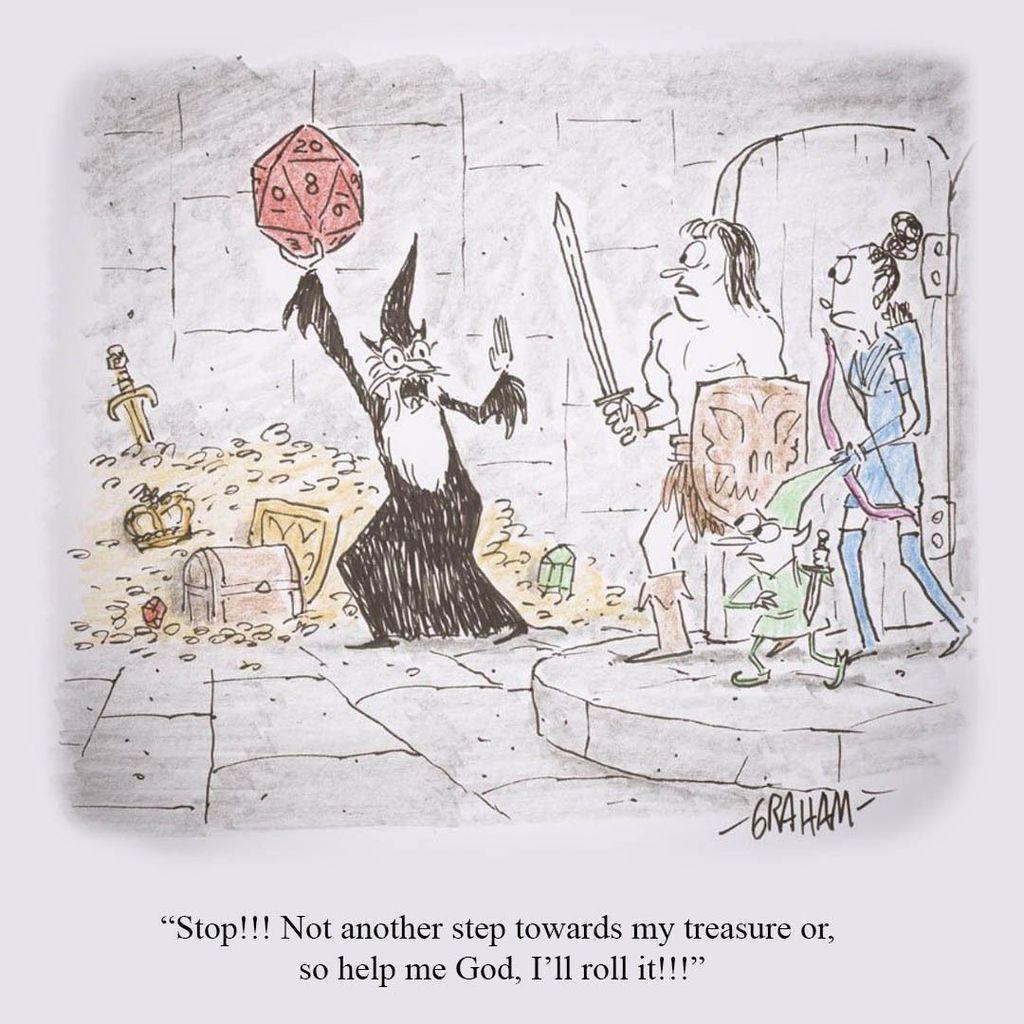
A cartoon illustration of a wizard in front of a stash of treasure holding a large 20-sided die and yelling at a band of a barbarian, archer, and elf. Caption reads "Stop!!! Not another step towards my treasure or, so help me God, I'll roll it!!!"
I’m not nearly as worried about mice and rats as I am of the looney in charge of Health and Human Services.Hantaviruses are spread in rodent droppings, which is why they’re a greater threat out West where desert climates suit rodent life and their droppings don’t return to the earth quickly. And how better could […]
The Spill sends birthday greetings to long-time New Yorker contributor, Liza Donnelly, seen above attempting to take it easy for a few minutes in Maine a few years ago.
Born in Washington, D.C., then high-tailing it asap to New York City, she has been contributing to The New Yorker since 1979. Among the many hats she wears, the most recent is filmmaker. Her documentary on The New Yorker‘s women cartoonists, Woman Laughing, co-directed with Kathleen Hughes, is making the rounds, festival-wise this year.
It is one thing that we comic strip fans are aware of the situation, but when newspaper editors, who are on the whole no more knowledgeable than the general newspaper reading public about comic strips, are taking notice it is a warning sign to the short form sequential art. Last week The Gloucester Daily Times […]
This entry continues my well-deserved punishment for offering to detail two of the worst animated cat films ever inflicted upon audiences. Last time out, it was Felix the Cat: The Movie. This time, I’ll take the blame for detailing the R-rated 1974 abomination called The Nine Lives of Fritz the Cat.
The 1972 film Fritz the Cat, directed by Ralph Bakshi, made dubious history by earning the first X rating for a wide-release animated film. While the movie had many flaws and was obviously the work of a first-time director (Bakshi began with shorts for Terrytoons), it is a masterwork compared to its sequel.
There are only so many ways The Nine Lives of Fritz the Cat can be worse than its predecessor, and the movie manages to hit them all. Ralph Bakshi and Steve Krantz, the producer of Fritz, had a falling-out, and Bakshi had nothing to do with the sequel. Robert Crumb, who created the character of Fritz, ignored the film completely and was so disdainful of the first film that he had Fritz murdered in his final comic appearance in 1972.
Krantz hired Robert Taylor (an assistant animator on the first Fritz film and collaborator with Bakshi on The Mighty Heroes TV show) to helm the project. Fred Halliday and Eric Monte assisted on the disjointed screenplay. There is a loose theme of Fritz, a stoned, unemployed, and heckled husband, imagining himself in different life scenarios, each one ending badly for the titular cat.
Before addressing that, the differences between the Bakshi and Taylor films merit some discussion. First, Bakshi’s film is linear, whereas Taylor’s film is hallucinatory and less concerned with narrative cohesion. Bakshi tended to treat racism and class warfare with sharp, sometimes nasty satiric humor. Taylor treats these issues gratuitously and with a clumsy hand, edging close to and often erupting into actual racism.
One example is when Fritz imagines he is sent to deliver a message into “New Africa” (formerly New Jersey), run by stereotypical blacks (again depicted as crows), all of whom seem to embody the worst stereotypes of blacks as violent, switchblade-wielding thugs and prostitutes incapable of governing themselves save through acts of violence and assassinations.
Bakshi’s Fritz film is far more sophisticated in its approach to social commentary, depicting urban life as a decaying corpse of a lost American Dream. Taylor’s film is a copy of Bakshi’s, even using the dirty watercolors, canted angles, and extreme down shots evident in the first film. Taylor’s environment, however, does not convey the same utter hopelessness as Bakshi’s, possibly because the scenarios change too often. Taylor’s landscape is dirty and gritty enough, but Bakshi’s (he did grow up in a gang-ridden slum) is more authentic.
Bakshi’s Fritz is much more economical than Taylor’s. Bakshi’s Fritz the Cat runs for 77 (or 78 minutes, depending on the source), and so does the sequel. However, considerable filler mars the sequel’s narrative: Fritz’s fantasy of high life in the 1930’s consists largely of photographic montages and an endless repeating pattern of lights. A scene representing a mutually destructive war between blacks and whites (a crow and a pig, respectively) is one of the few scenes that makes its point, but the exchange of fire goes on for far too long.
Some other differences: Bakshi and Taylor both depict blacks as crows, but while Bakshi depicted Jews as lions, Taylor uses a Jewish lizard. Adolph Hitler appears to be a scrawny lion (he rather looks like Itchy Brother in the Linus the Lionhearted cartoon, disguised as Hitler). There’s a twist!
Oh, the movie: As we open, Fritz (voiced again by Skip Hinnant) is unemployed, perpetually stoned, married to nagging harridan Gabrielle (shout out to Reva Rose), and is burdened with a masturbating, chain-smoking toddler named Ralphie (a dig from Steve Krantz?). Fritz escapes by sending his incorporeal self out into the street while Gabrille rants on.
From here, we follow Fritz into nine imagined lives (the transitions are not always clear, or whether imagined or not). In Life One, Fritz seduces the sister of his Puerto Rican pal Chita (a camel?) with pot; her hallucinatory high is one of the better scenes in the film. Chita’s father shoots Fritz to death.
Life Two sees Fritz encounter a drunken bum who says he is God. This scene is exceedingly gross and unpleasant, but that’s where Taylor shows his weaknesses. Life Three finds Fritz in Nazi Germany as Hitler’s horny orderly and psychotherapist. Hitler attempts to rape Fritz before having his sole testicle (the major joke in the segment) blown off. American tanks kill Fritz.
Life Four has Fritz trying to sell a used condom to a bartender, whose wife caught gonorrhea from Fritz. Bakshi would never have used this gratuitous scene. Life Five, the flashback to the 1930s referred to above, is nothing but filler. It ends with Fritz broke and despondent.
Are we up to life Six? Fritz trades a toilet to the stereotypical Jewish pawnshop owner, Morris, for a space helmet after the lizard refuses to cash Fritz’s welfare check. We go into Life Seven, where astronaut Fritz bangs a black female reporter in space until the rocket explodes.
In Life Eight, the ghost of Fritz’s buddy from the first film, Duke, leads the cat into the future, where President Kissinger (depicted as a rat) has him deliver a message to President Jackson of New Africa (formerly New Jersey). The dark racism of this segment, discussed above, is barely even satirical. It ends with Fritz framed for Jackson’s assassination and executed.
Now relaxing in the underground sewers of New York, Fritz encounters the characters of his final life, an incomprehensible Indian guru, and an effeminate Lucifer (Lucifer is a faggot!) before we see Fritz at home once more, shortly before Gabriella throws him out into the street. Fritz declares that this current life is the worst of all of them before strutting down the street into the coda.
The Nine Lives of Fritz the Cat is, overall, a tasteless and unimaginative follow-up to Ralph Bakshi’s take on the character. The movie was universally panned, and Fritz was never seen again. Was anything about this woebegone sequel worthwhile?
Well, there was a great cast of notable animators toiling in vain. Cosmo Anzilloti, Milton Gray, Jim Davis (no, not THAT Jim Davis), John Gentilella, Volus Jones, Martin Taras, and Manny Perez returned from the first Fritz movie and worked with newcomers to approximate the feel of the first film.
Complete voice credits are hard to come by: Certain roles, such as Fritz (Skip Hinnant) and Gabrielle (Reva Rosa), are credited, but only a few of the listed voice artists correspond to characters in the movie. In fairness, this episodic film has many secondary and one-shot characters. We do know that Robert Ridgely, Pat Harrington Jr., and other notables appear (Side note: Skip Hinnant voiced the Easter Bunny for Rankin-Bass and was also a fixture on the kids’ show The Electric Company. He was also the star of the first X-rated AND R-rated animated films produced! It has been said that The Nine Lives of Fritz the Cat has now become a “cult classic.” I suppose that’s a matter of taste.
Last week, on May 4, 2026, The Gloucester Daily Times informed their readers why they could no longer find the newspaper’s comics page. From the unsigned editorial (or here): In today’s paper, you’ll notice that while all your favorite puzzles are available, we’ve decided to eliminate the comics in our weekday print editions. This is […]
The nominees for the 2026 Doug Wright Awards and Canadian Cartooning Hall of Fame inductees have been announced.The nominees are:Best Book The Nipper (Emerging Talent)The Pigskin Peters Best Small or Micro-Press BookThe Egghead (Best Kids’ Book)Additionally Emily Hearn (1925–2015) and Mark Thurman, the co-creators of The Mighty Mites, which appeared for many years in Owl magazine; and Arch Dale (1882–1962), an editorial cartoonist […]

 Login
Login