Read a transcript of this episode. Subscribe to receive transcripts.
What we call waste is really just misallocated feedstock—raw materials waiting to be cycled back into the next generation of products and packaging. According to research by the World Economic Forum and United Nations Development Programme, the circular economy could unlock $4.5 trillion in new global value by 2030, and investors are racing to capture part of that opportunity. Meet Elizabeth Blankenship-Singh, Director of Inn
What we call waste is really just misallocated feedstock—raw materials waiting to be cycled back into the next generation of products and packaging. According to research by the World Economic Forum and United Nations Development Programme, the circular economy could unlock $4.5 trillion in new global value by 2030, and investors are racing to capture part of that opportunity. Meet Elizabeth Blankenship-Singh, Director of Innovation at Overlay Capital, an Atlanta-based alternative investment firm whose Waste and Materials Fund is backing both early-stage materials innovators and later-stage recycling operations with established infrastructure. Overlay’s strategy involves investing in innovation and implementation simultaneously—in both startups and established companies—to accelerate progress across multiple layers of the circular economy. It offers a window into where smart money sees the materials transition heading.
Elizabeth Blankenship-Singh, Director of Innovation at Overlay Capital, is our guest on Sustainability In Your Ear.
Elizabeth explains that sortation is the biggest bottleneck at the materials recycling facilities (MRFs) your garbage and recycling are sent to after curbside collection. The U.S. is simultaneously the world’s leading exporter of scrap aluminum and the number one importer of finished aluminum, because we’ve lacked domestic sorting capacity. Overlay has invested in companies like AMP Robotics, which recently closed a 20-year contract with SPSA, a southeastern Virginia municipal authority, to sort all recyclables from four to five cities using AI-driven systems. When you fix sortation, she says, you trigger a domino effect: recycling rates climb, landfill life extends, and margins improve as higher-purity materials command premium prices.
Overlay’s portfolio also includes next-generation materials companies united by a common thesis: they must be better, faster, cheaper, and more sustainable than what they replace. Cruz Foam converts chitin from shrimp shells into compostable packaging foam. Simplifyber uses cellulose to create biodegradable soft goods through 3D molding, bypassing traditional textile manufacturing entirely. Terra CO2 just closed a $124 million Series B to scale low-carbon cement technology that could cut into concrete’s 8% share of annual global CO2 emissions. Each uses abundant, waste-derived feedstocks and has achieved or is on a clear path to price parity with incumbents.
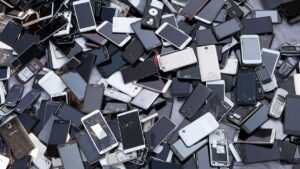
24. That is the average number of electronic devices sitting in a typical American home right now. Phones in drawers, tablets behind the TV, chargers without their devices, and devices without their chargers. Most of those products are headed for a landfill or a shipping container, not a recycler.
Electronics are the fastest-growing solid waste stream on the planet, and U.S. households are an outsize engine. The UN’s Global E-waste Monitor 2024 found that global e-waste reached a record 62 milli
24. That is the average number of electronic devices sitting in a typical American home right now. Phones in drawers, tablets behind the TV, chargers without their devices, and devices without their chargers. Most of those products are headed for a landfill or a shipping container, not a recycler.
Electronics are the fastest-growing solid waste stream on the planet, and U.S. households are an outsize engine. The UN’s Global E-waste Monitor 2024 found that global e-waste reached a record 62 million tons in 2022, which is up 82 percent since 2010, and is rising five times faster than electronics recycling capacity. Americans produce roughly 46 to 48 pounds of it per person per year. Most of those discarded devices contain materials worth real money and environmental harms worth understanding.
The 2022 e-waste pile contained an estimated $91 billion in recoverable metals, according to the United Nations, including roughly $19 billion in copper, $16 billion in iron, and $15 billion in gold. About $62 billion of that value was lost to landfills, incinerators, or unregulated dumping.
The materials don’t disappear; they just stop circulating. Mining companies extract more virgin gold and copper from the ground while millions of pounds of the same metals sit on shelves in junk rooms and lie fallow in landfills.
What’s Driving the Growth
The average U.S. smartphone replacement cycle has stretched to 3.64 years in 2024, according to Assurant; that’s up from under 3 years a decade ago, yet the underlying hardware can typically last 5 to 7 years with software support. That gap between when consumers upgrade and when the device actually fails is where most e-waste is born.
Behind the phones, a longer parade of devices is generating serious volume. Wearables, smart speakers, e-cigarettes, lithium-powered toys, and cheap rechargeable accessories now show up in municipal waste streams in quantities that did not exist a decade ago. The WHO documented more than 1,000 hazardous substances associated with informal e-waste recycling, including lead, mercury, and brominated flame retardants, all of which can leach from devices that are crushed or burned rather than processed properly.
What the U.S. Actually Recycles
The picture here is genuinely confusing, and reporting that pretends otherwise is wrong. The most-cited EPA estimate of consumer electronics recycling puts the U.S. rate at 38.5 percent, but that figure dates from 2018. More recent independent estimates put the actual U.S. rate closer to 15 percent, with global formal recycling at 22.3 percent in 2022. The gap between the two numbers reflects the difference between what enters a recycling program and what actually gets recovered as usable material.
The remainder follows three main paths. Some heads to U.S. landfills, where heavy metals contribute to leachate problems. Some is incinerated, releasing dioxins from PVC and other plastics. And roughly 90 percent of exported e-waste is processed in low- and middle-income countries, where informal recyclers — often including children — strip devices by hand or by burning. A systematic review in PubMed Central links e-waste exposure in children to reduced lung function, altered thyroid function, ADHD, and lower cognitive scores. None of that shows up on the product box when you buy it.
The Household Financial Picture
Households absorb the cost from two directions at once. They pay for new devices that replace working products, and they leave material value on the table when they discard what they own.
A reasonable estimate, using the per-capita value of unrecovered e-waste metals from the UN report and U.S. generation rates, puts the recoverable value sitting in the average American household’s old electronics in the range of several hundred dollars over a few years. That is metal the household paid for, embedded in devices the household paid for, and the household will not recover unless the device reaches a refiner that can extract it.
The cost on the other side — replacement spending — is easier to size at the industry level than the household level. The Consumer Technology Association puts U.S. consumer technology retail revenue at roughly $505 billion in 2024, which works out to nearly $3,900 per household when spread across the 131 million U.S. households tracked by the BLS Consumer Expenditure Survey. Even allowing for wide variation across income tiers, much of that spending replaces devices that were repairable or still functional.
Right to Repair Is Starting to Bite
The most consequential policy shift on e-waste in the past two years has been the spread of right-to-repair legislation. As of mid-2025, eight states have passed right-to-repair laws covering consumer electronics: New York, California, Minnesota, Oregon, Colorado, Maine, Washington, and Massachusetts. Oregon’s law, which took effect January 1, 2025, became the first in the country to explicitly ban “parts pairing,” the practice of using software to disable replacement components installed by independent shops.
These laws do not immediately reduce e-waste, but they change the economics. When manufacturers must supply parts, tools, and documentation to independent repairers, the cost of fixing a phone or laptop drops. When repair is cheaper than replacement, more devices stay in service. The Repair Association tracks more than 40 active bills across at least 20 states in 2025.
Extended Producer Responsibility (EPR) for electronics covers 24 states, but there is substantial variation in how well-funded and enforced those programs are. A patchwork is still better than nothing, but the absence of a federal framework means a device thrown away in one state may be treated as toxic and a device thrown away in another may end up in a regular dumpster.
What You Can Do
The interventions here are tiered, with very different impacts depending on where you can act.
At home:
Before replacing a device, check whether repair is feasible — battery swaps and screen replacements are the two most common smartphone failures and both are repairable.
Sell or donate working electronics rather than storing them. The Earth911 recycling search tool provides local options by ZIP code.
For batteries, including the lithium cells in earbuds, e-bikes, vapes, and power tools, use The Battery Network (formerly Call2Recycle), the North American battery stewardship program, which operates collection sites at most major retailers.
For phones specifically, manufacturer trade-in programs (Apple, Samsung, Google) and carrier programs typically capture more material than dropping a phone in a generic recycling bin, because the devices are tested for reuse first.
Buy refurbished when you can. Certified refurbished phones and laptops are typically 30 to 50 percent cheaper than new and have the same useful life.
In your community:
If your state hasn’t passed a right-to-repair law, ask your legislators why. The model bill from the PIRG Right to Repair coalition is a good starting reference.
Support EPR legislation that puts the cost of end-of-life management on manufacturers, not municipalities.
Push back on devices that are designed against repair — glued-in batteries, paired parts, and service-only components — by buying brands that score well on iFixit’s repairability index.
Individual household action on e-waste matters, but it is not where the leverage lives. Changing product designs and recycling policy, both of which are moving slowly in the right direction, is the path to a more sustainable electronics industry. Your household choices buy time and recover value while the larger system catches up.
Recycling in Ontario is changing in a big way. As of January 1, 2026, the province has fully transitioned to a new Blue Box system that changes who is responsible for recycling and is intended to make the process more consistent across Ontario.
Under the new rules, recycling is now managed and funded by the companies that produce packaging and paper products, rather than municipalities. This shift is known as Extended Producer Responsibility (EPR). The idea is that companies should take more r
Recycling in Ontario is changing in a big way. As of January 1, 2026, the province has fully transitioned to a new Blue Box system that changes who is responsible for recycling and is intended to make the process more consistent across Ontario.
Under the new rules, recycling is now managed and funded by the companies that produce packaging and paper products, rather than municipalities. This shift is known as Extended Producer Responsibility (EPR). The idea is that companies should take more responsibility for the waste they create, while making recycling systems easier for residents to navigate.
The goal is to recycle more, send less waste to landfills, and move toward a more circular economy. But for many Ontarians, the new rules also raise a lot of questions. Here are some of the most common ones.
Frequently Asked Questions
1. What changed in Ontario’s recycling system in 2026?
Ontario’s Blue Box program is now fully run by producers – the companies that create packaging and paper products. That means they are responsible for collecting, sorting, and recycling those materials.
An organization called Circular Materials now helps operate the Blue Box program across Ontario.
For most residents, the day-to-day experience may still look similar. The province will continue using the same blue boxes, the same curbside pickup and will continue to accept many of the same items. But behind the scenes the system has changed significantly, with the goal of creating more consistent recycling rules across the province.
2. Why is Ontario changing its recycling system?
Before this transition, municipalities shared the cost and responsibility of recycling programs, and each city or region often had its own rules. That meant something recyclable in one community might not be accepted in another.
The new system is meant to reduce that confusion. By making producers responsible for the materials they put into the marketplace, the Blue Box program should, in theory, put more pressure on companies to reduce unnecessary packaging and design products that are easier to recycle. However, advocates have raised concerns about the true efficacy of this program, including looser reporting requirements, lack of transparency in operations, increased incineration of recyclable materials, and the exclusion of many groups like multi-residential buildings, public spaces and schools.
3. Will recycling rules still differ depending on where I live?
Historically, yes. What you could recycle in Toronto might not have been accepted in London, Kingston, or another municipality.
The new Blue Box system is designed to make accepted materials more consistent across Ontario. However, some local differences may still exist in how recycling is collected. For example, some municipalities may use blue boxes, while others use large recycling carts. Pickup schedules and collection contractors may also vary by region.
So while the rules about what can be recycled are becoming more standardized, the way recycling is collected may still look different from place to place.
4. Can I recycle…?
If you’ve ever stood over your recycling bin wondering, “can I recycle this?” You’re not alone.
Some cities across Ontario have helpful tools. For example, if you live in Toronto, one of the easiest ways to check is by using the Waste Wizard, an online tool that lets you search specific items and find out whether they belong in recycling, garbage, organics, or special drop-off.
Although Toronto’s Waste Wizard is one of the best-known examples, other municipalities across Ontario offer similar search tools or waste apps. They can be especially helpful for sorting items like black plastic, coffee pods, takeout containers, or mixed-material packaging.
The updated Blue Box program expands the list of accepted materials. In many cases, you can now recycle more types of packaging than before, including items like foam containers, black plastic, and certain flexible plastics. But contamination — such as food waste, liquids, or hazardous materials — can still create major problems in the recycling stream.
5. If the province has one system, why do municipalities still matter?
Even though the recycling rules are now set at the provincial level, municipalities still play a major role in waste management.
They are often responsible for services like garbage collection, green bins or organics, household hazardous waste depots and local public education. Municipalities also help residents understand changes to collection schedules, bin types and local disposal options.
In other words, the province may be standardizing the recycling system, but municipalities are still an important part of how that system works in practice.
This is one of the most important questions and one of the hardest to answer simply.
Recycling can help reduce landfill waste and recover useful materials, but it is far from a perfect solution. In Canada, recycling rates remain low. Currently, only 7% of Ontario’s waste is recycled through the Blue Box. This is due to a combination of factors, including contamination, complex materials, and limited recycling markets.
Ontario’s new recycling system is intended to improve outcomes by making producers more accountable and expanding what can be collected. But recycling alone will not solve the waste crisis.
Reducing waste in the first place and reusing materials whenever possible remains essential.
7. What should I do with electronics or hazardous waste?
Electronics and hazardous materials should never go in your Blue Box.
Items like batteries, old phones, chargers, paint, propane tanks, light bulbs, and cleaning chemicals require special handling. If they are placed in recycling, they can contaminate other materials, damage equipment, or create safety risks for workers.
Instead, these items should be taken to a designated drop-off depot, household hazardous waste site, or e-waste collection program in your municipality. Many communities in Ontario offer permanent depots or seasonal collection events for these materials.
If you are unsure, your municipality’s waste lookup tool is the best place to check.
The Bottom Line
Ontario’s new recycling rules are a major shift. By making producers responsible for the packaging they create the province is trying to improve recycling and reduce confusion for residents.
But even the best recycling system depends on public understanding and participation. Knowing what belongs in your Blue Box and taking the extra moment to check when you’re unsure can make a real difference.
At the same time, recycling is only one part of the solution. If Ontario is serious about reducing waste and protecting the environment, we also need to focus on addressing the systemic root of continuous waste generation in the first place.
Americans threw away 12.1 million tons of furniture in 2018, the most recent year the U.S. Environmental Protection Agency (EPA) measured the category. About 9.7 million tons went straight to a landfill. Less than half of one percent was recycled.
The jobs that support the fastest, cheapest way to keep that sofa or dresser out of the dump — paying someone to fix it — have been disappearing for a generation. The Bureau of Labor Statistics counts roughly 22,500 upholsterers still working in the Un
Americans threw away 12.1 million tons of furniture in 2018, the most recent year the U.S. Environmental Protection Agency (EPA) measured the category. About 9.7 million tons went straight to a landfill. Less than half of one percent was recycled.
The jobs that support the fastest, cheapest way to keep that sofa or dresser out of the dump — paying someone to fix it — have been disappearing for a generation. The Bureau of Labor Statistics counts roughly 22,500 upholsterers still working in the United States and projects the occupation will shrink more through 2034. Refinishers, frame menders, and the small repair shops they anchored are vanishing alongside them.
Furniture’s waste problem and the collapse of the repair trades are the same story told from two ends.
What is in the 12.1 million tons
The EPA’s 2018 Advancing Sustainable Materials Management report tracked the fate of furniture and furnishings, including sofas, tables, chairs, dressers, and mattresses, at end of life. In 1960, Americans discarded 2.2 million tons of these items per year. By 2018, the figure had grown 5.5 times, to 12.1 million tons, even as recycling rates for paper, metals, and yard trimmings climbed.
The results are discouraging:
80.1% landfilled (about 9.7 million tons)
19.5% combusted for energy recovery
only 0.3% is recycled
Paper and paperboard, by contrast, are recycled roughly 68% of the time, and about 50% of aluminum cans are turned into new packaging. Furniture barely registers. The category was not designed for recovery: composite wood, polyurethane foam, polyester batting, springs, staples, and flame-retardant fabrics arrive at end of life as a tangled bundle that no current system can economically separate.
The household cost of fast furniture
A 2024 Level Frames analysis of EPA waste data and consumer survey responses found Americans spend roughly $2,750 a year combined on furniture, decor, and trend-driven replacement, with more than a third of those purchases prompted by social media.
The replacement cycle has accelerated. The RE Store, a Bellingham, Washington, reuse retailer that has tracked the category for years, reports that flat-pack pieces from major retailers are typically engineered to last about five years, and design trends now turn over every 10 months or so.
A $150 particleboard dresser tossed when it is three years old costs the household $50 per year of use, before delivery, assembly time, or hauling fees on the back end. Then, they have to pay to have it hauled away or to drop it at a landfill.
The repair trade collapse
For most of the 20th century, furniture was assumed to be repairable. Upholsterers, cane weavers, frame menders, and refinishers anchored a network of independent shops in nearly every American city. That network has thinned to a trickle.
BLS data from 2023 counts 22,519 upholsterers nationwide, with employment in the industry projected to decline through 2034 even as the overall workforce grows. Furniture refinishers and woodworking craftspeople are following the same downward arc. The culprit is particleboard, which can be used to make a side table that costs less than the labor to repair a comparable solid-wood piece; consumer expectations shifted accordingly and people got used to tossing, not repairing, their furniture.
The result is a market failure. EPA’s 0.3% recycling figure reflects a recycling system that cannot disassemble furniture profitably. Curbside programs cannot accept bulky composite goods, like a couch or end table. Few municipalities run dedicated furniture diversion programs. And the repair sector, which once extended product life, has been priced out of business.
Fast furniture is the engine
Two retailers shape the modern category. IKEA accounts for about 7.5% of the global furniture market and recorded roughly 915 million store visits in 2025. Wayfair generated $11.8 billion in revenue in 2024, much of it from drop-shipped flat-pack goods. The category they popularized — engineered wood, foam, and laminate furniture, sold cheaply and shipped flat — has reshaped consumer expectations and what ends up in the landfill.
Particleboard and medium-density fiberboard (MDF) bind wood chips with urea-formaldehyde resins. Oklahoma State University Extension reports these boards continue off-gassing formaldehyde for months to years after manufacture, adding to indoor air pollution alongside volatile organic compounds in polyurethane foam and finishes. The same chemistry that makes the boards cheap to produce makes them impossible to recycle: no mill will accept resin-saturated chips as feedstock.
Upstream impacts are substantial as well. The World Wildlife Fund estimates illegal logging accounts for 15% to 30% of globally traded wood, with furniture among the largest demand categories. A figure circulating in industry blogs suggests that furniture accounts for “12% of global greenhouse gas emissions” is not supported by primary IPCC or peer-reviewed sources and is omitted here; the more defensible claim is that the sector is a meaningful, though not dominant, contributor to forest loss and embodied carbon emissions.
The aggregate numbers
Globally, the European Union generates about 10.78 million tons of furniture waste a year, roughly matching the U.S. figure. The UK alone discards 670,000 tons — about 22 million individual pieces — and recycles only 17% of it. In both, most discarded furniture is judged to be reusable or repairable at the point of disposal.
Even in environmentally progressive Europe, policy responses are uneven. France runs a mature furniture-specific Extended Producer Responsibility (EPR) program in which manufacturers fund repair, reuse, and recycling networks.
No U.S. state has followed the EPR path for general furniture. The closest equivalent is the Mattress Recycling Council, which operates in California, Connecticut, Oregon, and Rhode Island under producer-funded laws that recover about 80% of a mattress’s components. California’s mattress fee were increased to $18 per unit in April 2026.
What you can do
Furniture is one of the few household waste categories where individual action significantly outperforms recycling infrastructure, because the most consequential step happens before purchase.
Before you buy
Choose solid wood over particleboard for high-use pieces. Solid wood can be sanded, refinished, and re-glued; composite cannot.
Look for verified certifications: CertiPUR-US for foam, GREENGUARD Gold for low emissions, FSC for responsibly sourced wood. None are perfect, but each rules out the worst offenders.
Buy used. Estate sales, consignment stores, Habitat for Humanity ReStores, and online resale platforms move millions of pieces a year that would otherwise enter the waste stream.
Before you toss
Search for local upholsterers and refinishers before disposal. Many small cities still have a practitioner or two who are not visible online.
Donate functional furniture to Goodwill, Salvation Army, ReStores, women’s shelters, or refugee resettlement organizations.
Recycle mattresses through Bye Bye Mattress if you live in California, Connecticut, Oregon, or Rhode Island. Other states offer limited drop-off only.
Furniture EPR legislation has been proposed in several U.S. states and could move the financial burden of disposal upstream, where it influences product design. France’s model is the working precedent.
12.1 million tons of furniture waste need not be a fixed feature of American life. It is a downstream consequence of design decisions, retail incentives, and the slow disappearance of a trade. Each of those is reversible, but only if the household, the manufacturer, and the policymaker each carry their share.
On March 20, 2026, the Environmental Protection Agency proposed a rule change that could fundamentally shift how the federal government regulates a controversial type of plastic recycling called pyrolysis, also known as “advanced recycling.” Currently, the EPA treats pyrolysis plants as incinerators, restricting the release of toxic chemicals. The proposed rule would redefine them as factories, altering longstanding pollution controls.
Though it may seem minor, this rule change would weaken key
On March 20, 2026, the Environmental Protection Agency proposed a rule change that could fundamentally shift how the federal government regulates a controversial type of plastic recycling called pyrolysis, also known as “advanced recycling.” Currently, the EPA treats pyrolysis plants as incinerators, restricting the release of toxic chemicals. The proposed rule would redefine them as factories, altering longstanding pollution controls.
Though it may seem minor, this rule change would weaken key pollution protections for pyrolysis plants. The result could be increased toxic emissions, with the burden falling on nearby communities—often low-income or predominantly Black, Latino, or Indigenous neighborhoods.
What is pyrolysis?
Pyrolysis involves heating plastic to very high temperatures in a container with little or no oxygen, preventing it from burning as it melts. The plastic breaks down into an oily liquid that can be used to make fuel, or it can be mixed back into the process that creates new plastic. The plastics industry calls this “advanced recycling” or “chemical recycling.” Environmental groups, such as the Ocean Conservancy, have called the process “the latest plastics industry deception.”
There are six pyrolysis plants running in the United States today, in Ohio, Texas, North Carolina, Indiana, and Georgia. More are being built in Arizona and West Virginia. The industry wants to build many more, but says strict EPA rules make it hard to get permits.
Why the rule change matters
The Clean Air Act is the federal law that limits air pollution. One part of it — Section 129 — sets strict rules for incinerators. It requires them to limit nine kinds of pollutants, including dioxins, heavy metals, and tiny particles that lodge deep in human lungs. Pyrolysis plants have been covered by these rules since 2005. The EPA’s new proposal would move them from Section 129 to Section 111, which covers fewer pollutants.
John Walke, a clean air expert at the Natural Resources Defense Council, told the Associated Press that the timing is the real problem. Removing the old rule would happen quickly. Writing a new one takes years. In between, he said, a plant could legally turn off its pollution controls.
“You could have a facility that was controlled on a Monday, preventing those hazardous air pollutants from being emitted into the atmosphere, and on Tuesday, the facility would have legal permission to turn off installed pollution controls,” Walke said. The reason a company would do that, he added, is simple: running pollution control equipment costs money.
James Pew of Earthjustice, a group that takes environmental cases to court, put it more bluntly to Inside Climate News: “As a practical matter, this definition change would mean EPA is completely deregulating a whole class of incinerators, these so-called pyrolysis units. And their pollution is really toxic.”
What the plastics industry says
The American Chemistry Council, which represents plastic companies, has lobbied for this change for years. Ross Eisenberg, who leads its plastics group, told the Associated Press that pyrolysis is not the same as burning. “The definition of incineration is to destroy it, right? You’re literally trying to make it go away,” he said. “That’s not what they’re doing here. They are trying to preserve it and recover the materials, which is recycling, which is manufacturing.”
Eisenberg argues that chemical recycling plants are already heavily regulated, citing other parts of the Clean Air Act that would still cover them, as well as requirements associated with state-level permits.
What scientists have actually found
The science on pyrolysis is at best mixed and can be partisan. A 2023 study by the Department of Energy’s Argonne National Laboratory, published in the Journal of Cleaner Production, found that mixing even a small amount of pyrolysis oil into new plastic production cuts greenhouse gas emissions by 18% to 23% compared to making plastic from scratch. The researchers used real operating data from eight U.S. pyrolysis facilities between 2017 and 2021.
But a 2025 paper in ACS Sustainable Chemistry & Engineering concludes that, depending on the size of the plant and how its emissions are measured, the same process can produce anywhere from 28% less to 30% more greenhouse gas emissions than ordinary fossil-fuel-based plastic production. The paper also notes that pyrolysis facilities release volatile organic compounds, fine particles, and a group of cancer-linked chemicals called polycyclic aromatic hydrocarbons. Those emissions, the authors wrote, fall hardest on communities that are mostly low-income or marginalized.
A 2023 report by Beyond Plastics found that of 11 chemical recycling plants then operating in the U.S., seven were sited in environmental justice communities. Six of those seven were pyrolysis plants.
Pyrolysis can reduce some forms of pollution while creating others, and the people who breathe those other emissions are usually not the ones making decisions about where plants are built.
How the public weighed in
The EPA gave the public 45 days to submit comments, from March 20 to May 4, 2026. Environmental groups organized quickly. A group including the Public Interest Research Group, Environment America, and Environmental Action collected and submitted more than 27,000 comments asking the agency to keep treating pyrolysis as incineration. The groups argue that pyrolysis can release up to 96 different toxic chemicals, including some linked to cancer and harm to developing children.
At a public hearing, a dozen speakers from Moms Clean Air Force testified against the change. Kiya Stanford, the group’s Georgia organizer, said the proposed rule “feels like a move to prioritize polluters over people.”
Judith Enck, a former EPA regional administrator who now runs Beyond Plastics, told Inside Climate News she was puzzled by how the change was announced. “I thought, could it be a mistake, or are they quietly trying to push this through?” she asked. The pyrolysis paragraph was buried inside a 17-page rule about wood waste burning.
Where to follow what happens next
The official record for this rule lives on the federal website regulations.gov, in docket EPA-HQ-OAR-2025-0068. Every public comment, every supporting document, and the EPA’s eventual decision will appear there.
The first comment window closed on May 4. The EPA can still accept late comments, but it doesn’t have to count them. The bigger opportunity for public input is still ahead: the EPA said the comments collected on this docket will help it draft a new, separate rule focused entirely on advanced recycling. That second rule has not yet been published. When it is, the public will get another comment period of at least 30 days, often 45 to 60.
What You Can Do
Follow the rules’ progress. Go to regulations.gov and search for EPA-HQ-OAR-2025-0068. You can subscribe to email alerts to receive updates when the EPA posts.
Be ready to comment on the next rule. When the EPA publishes its dedicated pyrolysis rule — likely later this year or next — you will have a chance to submit a public comment. Even a short, clear comment becomes part of the official record.
Find out if a plant is near you. Pyrolysis plants are operating or under construction in Ohio, Texas, North Carolina, Indiana, Georgia, Arizona, and West Virginia. If you live in one of those areas, state-level air quality rules will matter more than ever.
Ask brands what “recycled” really means. Some products labeled as containing recycled plastic don’t actually contain recycled molecules. They use a paper accounting system called mass balance. Asking companies to explain their labels is a fair question.
Use less plastic. The whole debate is about what to do with plastic after it exists. Choosing durable goods, refilling instead of replacing, and skipping single-use packaging keeps plastic out of the system entirely.
When the decision is likely
The current rule has two parts that move on different schedules. The disaster-recovery section involving wood waste is on a fast track. The EPA said it wants to finish that before the 2026 hurricane and wildfire season, which means a final decision is likely between late spring and early summer 2026.
The pyrolysis part will take until next year. The EPA has not announced a target date for its dedicated pyrolysis rule. Based on how quickly the agency is moving and what industry groups have told reporters, a reasonable guess is that a new proposed rule will appear in late 2026 or the first half of 2027, with a final version possibly in 2027 or 2028.
The National Resources Defense Council has announced plans to sue if the rule is finalized, a step that could delay implementation further. The EPA’s upcoming publication of its dedicated pyrolysis rule is the next key moment, as it will determine whether the government continues to uphold or dismantle existing pollution protections. This decision will shape the future of advanced plastic recycling in the U.S.
Old glass trash container hand traced from a photo of mine of a glass recycling dumpster in the area. Black outlines, white surfaces. Optimized in SVGOMG.
For emptying, a top loader truck with a crane arm raises the glass recycling container above the truck bed container and opens the dumpster into two, kind of like an upside-down scallop sea shell. The two halves don't have a snug fit, which explains the dirty-seeming vertical lines in the middle of the the right side. I suppose the bottom base
Old glass trash container hand traced from a photo of mine of a glass recycling dumpster in the area. Black outlines, white surfaces. Optimized in SVGOMG.
For emptying, a top loader truck with a crane arm raises the glass recycling container above the truck bed container and opens the dumpster into two, kind of like an upside-down scallop sea shell. The two halves don't have a snug fit, which explains the dirty-seeming vertical lines in the middle of the the right side. I suppose the bottom base is connected and should also be split and uneven at the split line.
The average American household uses about 150 pounds of glass containers each year, but more than two-thirds of that glass never gets recycled into new bottles. This isn’t because people aren’t trying. Glass is now the only common packaging material that costs recycling facilities more to process than they make from selling it, and the U.S. recycling system has been adapting to this problem for the past twenty years.
According to the EPA, the U.S. has recycled about 31 percent of its glass conta
The average American household uses about 150 pounds of glass containers each year, but more than two-thirds of that glass never gets recycled into new bottles. This isn’t because people aren’t trying. Glass is now the only common packaging material that costs recycling facilities more to process than they make from selling it, and the U.S. recycling system has been adapting to this problem for the past twenty years.
According to the EPA, the U.S. has recycled about 31 percent of its glass containers for the past ten years. In contrast, the European Union collected 80.8 percent of its glass containers in 2023. This gap isn’t because of how people act, but because of differences in infrastructure, policies, and the fact that glass is heavy, breakable, and not very profitable. As a result, glass no longer fits well in the single-stream recycling system most Americans use.
The math that broke glass recycling
Cullet, which is the industry term for crushed and sorted recycled glass, is a permanent material. It can be melted and reused over and over without losing quality. Adding 10 percent more cullet to a furnace reduces energy use by 2.5 to 3 percent and lowers CO₂ emissions by about 5 percent. If a furnace uses only cullet, it produces about 58 percent fewer emissions than making glass from raw materials like sand, soda ash, and limestone.
These numbers show that glass should be valuable to bottle makers. However, manufacturers want cullet that is color-sorted, clean, and ready for the furnace, which is rarely what comes out of single-stream recycling facilities.
A 2017 analysis by the Closed Loop Foundation found that single-stream glass costs U.S. recycling facilities $150 million each year in equipment damage, transportation, and disposal. On average, a facility loses about $35 for every ton of glass it handles. For example, a transfer station in Washington, D.C. spends about tens of thousands of dollars a year replacing screen baskets damaged by glass shards. When trucks unload, glass shards also get stuck in paper and cardboard, making those materials less valuable.
This is known as the negative-value problem. The glass itself isn’t worthless, because high-quality cullet can be sold. But the way glass is collected usually produces a dirty, color-mixed load, so it often ends up being used as road base, landfill cover when ground into sand-like consistency and laid over the day’s waste, or just thrown away.
How we built a system that loses money
The current U.S. glass recycling shortfall is largely the story of two infrastructure decisions made decades apart.
The first decision was moving to single-stream collection in the 1990s and 2000s. This change increased overall recycling rates but mixed glass with other materials. As a result, glass often arrived at recycling facilities already broken, contaminating other recyclables and damaging equipment designed for paper and plastic.
The second decision was to close glass-only drop-off programs as city budgets tightened. Without dedicated collection routes, like the ones used in Italy, Belgium, and Germany to recycle 90 percent of glass containers, American glass no longer had a clean way to be collected.
The exception is the 10 states with container deposit laws. These states, known for their bottle bills, recycle about 70 percent of beverage containers, which is more than twice the national average of 33 percent. Oregon’s deposit system achieved an 87 percent redemption rate in 2024, the highest in the country. Glass returned through deposit programs is typically clean, sorted, and unbroken — exactly what manufacturers want.
What does glass costs your household?
Consumers end up paying for glass twice. First, the cost of the bottle is included in the price of products like wine, beer, sauce, or seltzer. Second, people pay municipal recycling fees through property taxes, garbage bills, or both. These fees cover the average $ 62-per-ton landfill tipping fee in 2024, plus the extra cost of glass contamination that affects other recyclables.
The exact dollar figure varies wildly by region. New York City’s Department of Sanitation has estimated curbside recycling collection at $686 per ton, a number that includes labor, fuel, and equipment that reaches beyond what households see on their utility bills, but shows up in tax rates.
In states with bottle bills, the economics are different for households. A 5- or 10-cent deposit can be fully recovered, and if the home doesn’t recycle, others can generate income picking it up.
Glass that would have cost the city money instead becomes a small refund for the household and a clean material for manufacturers. This system covers the cost directly through fees for using glass, rather than spreading it across all taxpayers.
Glass emissions matter
Glass furnaces use a lot of energy compared to other packaging processes. Making 1 ton of container glass produces between 0.5 and 1.6 tons of CO₂, depending on the furnace’s efficiency and the amount of cullet used. Each ton of cullet used instead of raw materials saves about 0.67 tons of CO₂ and 1.2 tons of mined sand, soda ash, and limestone. soda ash, and limestone.
If you apply these numbers to the 6 million tons of glass containers that were landfilled in the U.S. in 2018—the most recent year for which the EPA provides data—the country misses out on about 4 million tons of avoided CO₂ emissions each year, plus more than 7 million tons of raw materials that could have been saved. This is a climate cost that the recycling rate alone cannot capture.
The Glass Packaging Institute and Boston Consulting Group have created a plan to raise the U.S. glass recycling rate to 50 percent by 2030. It focuses on expanding deposit programs, building dedicated glass processing facilities, and moving away from single-stream collection where possible. Reaching this goal would nearly double the current recycling rate without requiring people to change what they drink or how often they recycle.
What’s changing, and what isn’t
Seven states, including California, Colorado, Maine, Maryland, Minnesota, Oregon, and Washington, have passed extended producer responsibility (EPR) laws for packaging. These laws shift the cost of recycling from cities to the companies that sell the bottles. Oregon started enforcing its program in July 2025, and Colorado, Minnesota, and Maryland will phase in their programs by 2028.
EPR is the policy most likely to change the economics of glass recycling in the next decade. When producers pay recycling costs directly, they have to deal with contamination from single-stream recycling, not the recycling facility. This makes dedicated glass collection much more appealing. The European experience shows that this approach works, but it has not yet been tried on a large scale in the U.S.
What you can do
Check if your state has a bottle bill. If it does, redeem your deposit for a clean recycling stream and a small refund. If not, look up your local recycling options using the Earth911 recycling search before putting glass in your curbside bin.
If your area has glass-only drop-off sites, use them. Many cities offer free drop-off locations at transfer stations or grocery store parking lots. The glass collected from these sites is the type manufacturers prefer.
Rinse your bottles instead of crushing them. Whole bottles are easier to sort than broken pieces. Take off metal lids and recycle them separately.
Buy refillable bottles when possible. A refilled bottle does not use any cullet, raw materials, or the recycling system. Programs for returnable beer, milk, and water bottles are slowly becoming more common in the U.S.
Support extended producer responsibility and bottle-bill laws in your state. Most glass that gets recycled in the U.S. today comes from the 10 states with deposit programs. Expanding these programs is the most effective policy change available.
Forty thousand miles of plastic waste wash through the global ocean every year, enough to wrap the Earth at the equator. But walk into the right store, and you can personally shorten that pipeline by a few feet, returning a pair of worn sneakers, a dead laptop, or a piece of furniture destined for the dumpster.
Some retailers have built genuine end-of-life infrastructure for the products they sell — not just a PR line, but real systems with documented results. The seven below have the numbers to
Forty thousand miles of plastic waste wash through the global ocean every year, enough to wrap the Earth at the equator. But walk into the right store, and you can personally shorten that pipeline by a few feet, returning a pair of worn sneakers, a dead laptop, or a piece of furniture destined for the dumpster.
Some retailers have built genuine end-of-life infrastructure for the products they sell — not just a PR line, but real systems with documented results. The seven below have the numbers to back it up, updated for 2026.
Patagonia
Patagonia’s Worn Wear program remains one of the most comprehensive take-back systems in retail apparel. In 2025, customers made more than 137,000 trade-ins — almost 71,000 of them from return and warranty claims — and the online Shop Used feature launched in September 2024 has expanded the secondhand market significantly. Items deemed wearable are cleaned, repaired, and resold through Worn Wear; those beyond repair enter a recycling pipeline.
On the material innovation side, Patagonia partnered with Eastman in 2024 to process 8,000 pounds of pre- and post-consumer clothing waste through molecular recycling — breaking apparel down to chemical building blocks for reuse as new fiber. The brand has also moved aggressively on materials: by fall 2025, over 90 percent of Patagonia’s fabrics were recycled, organic, or traceable. Its 2025 Work in Progress Report disclosed that reducing hang tags by over 40 million pieces has avoided 170,000 pounds of packaging waste. The structural challenge — mechanically recycling blended fabrics — remains unsolved at industrial scale, and Patagonia acknowledges it openly.
Apple
Apple’s trade-in and recycling program sent 15.9 million devices to new owners through refurbishment schemes in 2024 alone. Devices that cannot be refurbished are processed by Daisy, Apple’s disassembly robot, which can now break down 36 models of iPhone into discrete components to recover aluminum, copper, rare earth elements, and other materials. A second robot, Dave, disassembles Taptic Engines to recover rare earth magnets, tungsten, and steel.
The material-recovery numbers are striking. In 2024, 24 percent of all materials shipped in Apple products came from recycled or renewable sources, up from 10 percent in 2019. Recycled aluminum accounted for 71 percent of the aluminum Apple purchased. The company avoided 6.2 million metric tons of greenhouse gas emissions by using recycled and low-carbon materials in 2024, according to its 2025 Environmental Progress Report. Apple has also surpassed 99 percent on its 2025 goal to use 100 percent recycled rare earth elements in all magnets and 100 percent recycled cobalt in all Apple-designed batteries. Customers can drop devices off at any Apple Store or ship for free.
Best Buy
Best Buy has collected 2.7 billion pounds of electronics and appliances since launching its recycling program in 2009, making it the nation’s largest retail collector of e-waste. The program accepts most consumer electronics at more than 1,000 stores regardless of where items were purchased, collecting more than 400 pounds of product every minute stores are open.
The program has expanded: a mail-in recycling service now lets customers without easy store access ship old tech in purpose-built boxes. A home haul-away service launched for customers who cannot transport large items. Best Buy requires all recycling partners to comply with rigorous environmental management standards and holds them to regulatory compliance and responsible workforce practices. TVs and monitors carry a $25 fee; most other electronics — phones, laptops, tablets, cables — are accepted free.
Nike
Nike’s original Reuse-a-Shoe program launched in 1995 to recycle worn athletic footwear into Nike Grind material for surfaces and new products has evolved into the Recycling + Donation (RAD) service, now available globally.
The program accepts athletic footwear and apparel from any brand and inspects each item to determine donation or recycling eligibility. Wearable items go to nonprofit partners including Soles4Souls for redistribution to communities in need; worn-out footwear is ground down into Nike Grind, which goes into playground surfaces, running tracks, and new Nike products.
Part of Nike’s Move to Zero initiative, targeting zero carbon and zero waste across the supply chain, the Participating stores accept shoes of any brand — athletic footwear only; no cleats, boots, or sandals. Nike also runs Nike Refurbished, which cleans and resells gently worn or slightly imperfect footwear and apparel at select factory and community stores, extending product life before material recovery.
Staples
Staples pioneered national retail recycling in 2007 as the first U.S. retailer to offer a universal e-waste takeback program. Today the program accepts over 50 types of materials including computers, printers, phones, cables, batteries, crayons, and coffee machines from any brand. Since 2021, Staples has recycled 7,000 tons of e-waste and 19 million ink and toner cartridges, helping HP reach a milestone of 1 billion cartridges recycled.
Staples’ Easy Rewards program currently gives members 500 points (equivalent to $5 back) per month for tech recycling. Ink and toner cartridge recycling earns $2 per cartridge for members spending at least $30 on ink over the previous 180 days, up to a monthly limit. Staples uses certified recyclers whenever possible, and recycled toner material gets routed into road construction aggregate. The company accepts electronics in-store at customer service desks at all U.S. Staples locations.
IKEA
Furniture is the United States’ largest category of discarded household goods, with Americans throwing away approximately 12 million tons of it each year. IKEA’s Buyback & Resell program addresses the problem at the point of sale: customers fill out an online form, receive a value estimate, and bring gently used IKEA furniture to any participating store in exchange for store credit. Items that pass inspection enter the As-Is section for resale; those that cannot be resold are recycled under IKEA’s zero-waste-to-landfill policy.
The U.S. program now runs in 33 stores and, as of 2025, accepts more than 5,000 product types, including tables, chairs, storage units, lamps, and kids’ furniture among many. Globally, IKEA’s circular initiatives contributed to a 24.3 percent reduction in the company’s climate footprint while revenue grew 30.9 percent. Sofas, mattresses, and modified products are not accepted. IKEA Family members currently receive 50 percent more in store credit through May 2026.
REI
REI’s Re/Supply program sold nearly 1.4 million items of used outdoor gear in 2024, double the volume from 2019. The program accepts trade-ins of gently used REI-brand and name-brand gear including backpacks, sleeping bags, tents, and apparel. Members receive store credit; items are inspected, cleaned, and resold at a discount. Selling a used item through Re/Supply emits at least 50 percent less carbon than selling a new equivalent, even accounting for shipping, cleaning, and remerchandising.
REI also became the first major U.S. retailer to reach 90 percent operational waste diversion, achieving zero-waste certification in 2024 that audited and independently verified — ahead of Walmart and Target. Three of its distribution centers hold TRUE Zero Waste certification. In 2024, about 52 percent of the polyester and 45 percent of the nylon in REI Co-op products came from recycled sources. REI also charges brand partners a recycling fee to discourage individual plastic poly bags, and the majority of brands it carries have eliminated them as standard practice.
That foam coffee cup, takeout box, or packing block likely won’t be recycled. It’s not your fault; most Americans lack access to recycling systems for these materials. The plastics industry says it’s improving, and that’s true in some ways. But there’s still a gap between industry claims and what people can actually do when taking out the trash.
Before we talk about why foam is hard to recycle, it’s helpful to know what it really is. “Polystyrene” is the material, though it is often referred to
That foam coffee cup, takeout box, or packing block likely won’t be recycled. It’s not your fault; most Americans lack access to recycling systems for these materials. The plastics industry says it’s improving, and that’s true in some ways. But there’s still a gap between industry claims and what people can actually do when taking out the trash.
Before we talk about why foam is hard to recycle, it’s helpful to know what it really is. “Polystyrene” is the material, though it is often referred to by the brand name “Styrofoam,” and it comes in different forms. EPS is the foam used in coffee cups, takeout boxes, and packing blocks. The hard kind, found in utensils and appliance parts, is GPPS or HIPS. Both are polystyrene but need different recycling methods.
The #6 symbol on the foam container only tells you what kind of plastic it is, not if it can be recycled. If you put it in the bin just because you see a number and the recycling arrows, it can actually contaminate your other recyclables, like paper, cardboard, and aluminum, and might cause the whole batch to be rejected.
The Recycling That Happens Without You
The plastics industry recently launched the Polystyrene Recycling Alliance (PSRA), which commissioned a detailed study of where polystyrene foam is actually recycled in the US. Its headline stat: about 105 million Americans — roughly one in three — have access to recycling services that handle at least one type of polystyrene.
That sounds promising. But one must read the fine print to see the whole picture.
The PSRA–RRS Polystyrene End Markets Study, published in February 2026, is the most detailed inventory of US and Canadian polystyrene recycling infrastructure to date. It identified 81 companies handling recovered EPS and XPS foam, with 119 facilities spread across 30 US states and four Canadian provinces. About 52% of those companies are manufacturing end markets, businesses that actually turn recovered foam into new products like transport packaging and insulation.
Most of this recycling happens through business-to-business systems that regular people don’t use. Big retailers, warehouses, and appliance stores create large amounts of packing foam. They have private deals with haulers who collect the foam, compress it into dense bricks called “densified foam,” and send it to manufacturers, mainly to make new packaging and insulation. Some European and Asian companies also import compressed EPS from North America for manufacturing. There are also more than 700 drop-off locations for foam across the country.
Environmental groups note that EPS drop-off access, in stark contrast to industry claims, currently reaches only about 3% of the US population.
Between 2019 and 2023, Foam Recycling Coalition-funded programs nearly doubled the amount collected, according to Waste Dive‘s reporting. The Alliance reported 168.6 million pounds of EPS foam were diverted from disposal in North America in 2022. But it’s largely invisible to consumers, and almost none of it involves your curbside bin.
For the rigid forms of polystyrene, the stuff in your fridge’s vegetable drawer or your blender housing, the recycling picture is much less encouraging. The same PSRA–RRS study found just 45 companies handling recovered GPPS and HIPS in the US and Canada, and only 13% of those actually turning it into new products. Those 45 companies operate just 50 facility sites across 22 US states and four Canadian provinces, compared to 119 facilities in 30 states for foam. Most post-consumer rigid polystyrene that does get recycled comes from medical equipment and e-waste programs, not household recycling.
Foam is a recycler’s nightmare, and the reason is simple: it’s mostly air.
EPS is about 95% air by volume. A regular collection truck can fill up with foam that weighs almost nothing, so the hauler spends the same amount of money to collect much less valuable material. Also, foam breaks apart easily, and small pieces can mix with paper and cardboard in the same bin, making everything else less valuable.
A 2024 study in the journal ChemSusChem found that processing polystyrene costs about $1,456 per metric ton, more than for most other plastics. This rate works only when there are grants, subsidies, or a guaranteed supply chain in place, but none of those exist at the scale needed to handle all the foam Americans throw away.
What “Chemical Recycling” Can and Can’t Do
You may have heard that polystyrene can be “chemically recycled,” meaning it is broken down by heat into its original building blocks to make new plastic. While that’s technically possible, it’s not happening on a large scale.
The only US facility dedicated to this polystyrene process, run by a company called Regenyx in Oregon, shut down in early 2024. A National Resources Defense Council report from March 2025 found only eight chemical recycling facilities of any kind operating in the entire US. Most of what these plants produce isn’t new plastic; it’s fuel oil, which means the material isn’t really being recycled so much as burned in a different way. The Regenyx plant generated approximately one ton of hazardous waste for every ton of usable output, a serious problem the industry doesn’t advertise.
The 79% Nobody Talks About
Here’s a number worth sitting with: only 21% of all residential recyclables in the US actually get recycled, according to The Recycling Partnership’s 2024 State of Recycling Report — one of the most comprehensive independent analyses of the US system.
What about the other 79%? Most of it is lost at home before it ever reaches a recycling facility. People might not have access to a recycling program, might not know what their local program accepts, or just don’t take part. The report, along with EPA plastics data, shows that the overall US plastic recycling rate is only about 5–6%. For foam, which most curbside programs don’t accept, this gap at the household level is even harder to close. The industry’s solution is drop-off programs, but these require people to know where to go, make a special trip, and bring clean, uncontaminated foam. That’s asking a lot.
The Recycling Partnership says the biggest problem in the US recycling system isn’t technology or end markets. It’s getting people involved, and the main way to do that is through funding for education and outreach, which most municipalities lack. The EPA’s 2024 Recycling Infrastructure Assessment estimated it would take $36–$43 billion to upgrade the US system by 2030. A Resource Recycling summary found that nearly half of US states don’t even track how many curbside programs they have. You can’t fix a system if you aren’t measuring it.
How The U.S. EPS Recycling Rate Compares
The US lags well behind other wealthy countries when it comes to foam recycling.
Market data compiled through 2023 indicate that EPS recycling rates for comparable packaging are approximately 88% in South Korea, 83% in Taiwan, and 68% in Japan. Europe averages around 40%, though that figure masks wide variations. Some countries, including Portugal and Norway, approach 90% recovery rates, largely driven by fish box collection programs, while thers sit well below the average. North America comes in at roughly 31%, and that figure is almost entirely commercial collection programs, not household recycling.
It’s worth noting that all of these figures come primarily from GESA (the Global EPS Sustainability Alliance) and affiliated national industry groups, organizations with a direct stake in presenting favorable data. Independent verification is limited.
Japan’s foam recycling program has been running since 1978, and the country’s EPS industry group reports an effective utilization rate of 94.2% in 2024. That “effective utilization” figure includes incineration with energy recovery, not just mechanical recycling. South Korea made packaging producers legally responsible for recycling costs as early as 2000, a policy approach called Extended Producer Responsibility (EPR). The US has no federal EPR law for packaging and only seven states that have passed one so far.
Overall, the US ranked 30th in the world on the 2024 Environmental Performance Index’s waste recovery score. Germany, Japan, South Korea, and most of Western Europe all rank higher.
The Biggest Companies Are Giving Up on Foam
One of the clearest signs about foam’s future isn’t coming from regulators. It’s coming from the brands that use it.
The Ellen MacArthur Foundation (EMF), which tracks voluntary sustainability commitments from over 1,000 companies representing about 20% of global plastic packaging production, released its final progress report in late 2025. Since 2018, signatory companies have removed over 775,000 metric tons of the most problematic plastics, including polystyrene and PVC, from their packaging entirely.
The EMF classifies certain polystyrene formats, especially foam foodservice containers, as plastics that should be eliminated rather than recycled. In its framework for problematic plastics, it consistently identifies these materials as candidates for phase-out, not circularity. That’s the stated view of an organization whose members include Nestlé, Unilever, Coca-Cola, and L’Oréal.
Meanwhile, those same companies are falling short of their overall recycled-content targets for plastics. The share of recycled plastic in the broader global packaging market barely moved — from 3.4% to 4.2% — even as committed companies tripled their own use of recycled content. As Chemical & Engineering Newsreported in November 2025, plastics recycling is struggling across the industry.
Voluntary commitments move the leaders, but they don’t move the system.
States Are Banning Expanded Polystyrene
Twelve states and three US territories have chosen not to wait for the recycling system to improve. They’ve banned foam food containers completely, and Earth911 tracks these changes. Oregon, California, Delaware, Rhode Island, and Hawaii all joined the ban list as of January 1, 2025.
California’s law included a recycling test: foam producers had to show a 25% recycling rate by January 2025 to keep selling EPS foodware in the state. When CalRecycle reported to the legislature that the industry had fallen far short—the rate was about 6% when the law passed—foam containers were effectively banned.
Not every ban effort has succeeded. Montana’s legislature passed a phase-out bill in spring 2025 — only to have the governor veto it. And while a federal “Farewell to Foam Act” has been introduced in Congress, it hasn’t passed.
Globally, the bans are further along. The EU banned foam food containers in 2021. Canada followed with federal legislation in 2022. Over 97% of Australians now live somewhere with an EPS ban in place, according to Wikipedia’s phase-out tracker.
What Would Actually Fix Polystyrene Recycling
The most honest answer is that recycling alone won’t solve the foam problem. But better policy can.
The Recycling Partnership’s EPR analysis finds that states with Extended Producer Responsibility laws have recycling rates up to 3 times higher than those without them. EPR generates funds for consumer education, access, and infrastructure that cash-strapped municipalities can’t provide on their own.
The PSRA’s end markets study is candid about what’s missing for rigid polystyrene. For GPPS and HIPS to be recycled at scale, the industry needs to solve a chicken-and-egg problem. Sorting facilities won’t invest in the equipment without a guaranteed buyer for the output, and buyers won’t commit without a reliable supply. The study’s concrete suggestion is to offer subsidies per pound to sorting facilities that would need to separate polystyrene from mixed plastic streams. Without that financial nudge, the economics don’t work.
The broader lesson is that without policy structures that change the economics, including embracing EPR, mandatory recycled content standards, or bans, voluntary action produces incremental progress against a systemic problem. As Chemical & Engineering News reported, even companies with strong sustainability commitments are falling short.
What You Can Do At Home
Find a drop-off:
Search Earth911 for EPS foam drop-off locations near you. These are separate from your curbside bin — call ahead to confirm they accept your specific type of foam.
For foam meat trays, most facilities won’t take food-soiled containers, so they must be clean and dry.
Retailers like The UPS Store accept clean packing peanuts for reuse.
Cut foam out of your routine:
Bring your own insulated mug to the coffee shop instead of accepting a foam cup.
When ordering takeout, ask for paper or compostable containers.
When shipping things, use crumpled newspaper, shredded paper, or molded pulp instead of foam peanuts.
Push for better policy:
Find out whether your state has a packaging EPR bill pending. If it does, contact your representative in support. The trend is moving in that direction.
Turn back the clock to our first conversation with David Katz, founder of Plastic Bank. He shares his vision for a regenerative society built on grassroots recycling programs that help low-income regions build resilient communities. The Vancover, B.C., startup compensates more than 30,000 plastic recyclers in the Philippines, Indonesia, Brazil, and Egypt. To date, Plastic Bank has stopped over 99 million pounds of plastic waste — the equivalent of more than 2 billion plastic bottles — from ente
Turn back the clock to our first conversation with David Katz, founder of Plastic Bank. He shares his vision for a regenerative society built on grassroots recycling programs that help low-income regions build resilient communities. The Vancover, B.C., startup compensates more than 30,000 plastic recyclers in the Philippines, Indonesia, Brazil, and Egypt. To date, Plastic Bank has stopped over 99 million pounds of plastic waste — the equivalent of more than 2 billion plastic bottles — from entering the world’s oceans, and the pace of its collections is accelerating. The people who collect plastic are paid for the material they deposit at more than 511 Plastic Bank branches. Katz’s team has partnered with more than 200 companies, including Procter & Gamble, HelloFresh, L’Oreal, and Coca-Cola, to create circular economies in plastic packaging.
David Katz, founder and CEO of Plastic Bank, is our guest on Earth911’s Sustainability in Your Ear.
Their next goal is to capture 10 billion bottles, which still represents only 1.7% of the 583 billion produced in 2021, according to Euromonitor. David explains that a shift in mindset from extractive ownership to regenerative stewardship can break the economic mold and bring prosperity in regions where so much valuable material currently is treated as waste. Plastic Bank uses a blockchain-based data collection and reporting system that helps collectors track their earnings and which provides transparency and traceability for the plastic captured. Plastic Bank works with plastic recyclers to convert the collected bottles into SocialPlastic, a raw material for making new products. They sell plastic #1, #2, and #4 to industry to recover their costs. You can learn more about Plastic Bank at plasticbank.com.
In a converted 18th-century chapel on the grounds of Yorkshire Sculpture Park, a strange form creeps through openings in the architecture. One can imagine its clipper- and knife-footed tendrils scurrying across the floor as it spills from an upper aperture and even slithers around part of the building’s exterior. Its otherworldly genesis is at the hands of Nicola Turner, known for her monumental, contorted textile installations that often surge from structures and public spaces.
Turner’s s
In a converted 18th-century chapel on the grounds of Yorkshire Sculpture Park, a strange form creeps through openings in the architecture. One can imagine its clipper- and knife-footed tendrils scurrying across the floor as it spills from an upper aperture and even slithers around part of the building’s exterior. Its otherworldly genesis is at the hands of Nicola Turner, known for her monumental, contorted textile installations that often surge from structures and public spaces.
Turner’s solo exhibition, Time’s Scythe, comprises forms made of recycled wool and horsehair, which she hand-stitches inside of mesh to create the bulging, knotted forms. “This is Turner’s first large-scale installation to use pale wool and creates a different energy to her dark sculptures, moving away from their more melancholic character,” the gallery says.
Time’s Scythe continues through September 27 in Wakefield. If you go, check out LR Vandy’s provocative exhibition, Rise, which also continues into September. See more on Turner’s Instagram, and for more twisting, creature-like forms, might also enjoy the work of Kate MccGwire.
Every kilogram of medical X-ray film holds 5 to 15 grams of silver — enough to make tossing those old films in the trash not just an environmental problem, but an outright waste of a recoverable precious metal. Add the fact that it’s also illegal to throw X-rays in the garbage in most jurisdictions, and the case for recycling them becomes urgent.
Millions of Americans still have film X-rays sitting in file folders, shoe boxes, or back-of-drawer oblivion. These relics from a pre-digital era of me
Every kilogram of medical X-ray film holds 5 to 15 grams of silver — enough to make tossing those old films in the trash not just an environmental problem, but an outright waste of a recoverable precious metal. Add the fact that it’s also illegal to throw X-rays in the garbage in most jurisdictions, and the case for recycling them becomes urgent.
Millions of Americans still have film X-rays sitting in file folders, shoe boxes, or back-of-drawer oblivion. These relics from a pre-digital era of medical imaging need to be handled safely. Whether you’re a patient trying to clear out a closet or a smaller clinic still managing physical archives, understanding how X-ray film recycling works, why it matters, and who accepts it can help you make a responsible choice that’s good for the environment and, in some cases, your wallet.
What’s Inside an X-Ray Film
X-ray films are made of polyethylene terephthalate (PET) plastic, the same material used in many beverage bottles, coated with an emulsion layer containing silver halide crystals. When the film is exposed to X-ray radiation, those silver halide crystals capture the image by converting to metallic silver to produce the dark-and-light diagnostic image your doctor reads.
That silver content is why X-ray film is worth recycling. A research paper in the Journal of Environmental Chemical Engineering reports that medical X-ray films typically contain between 5 and 15 grams of silver per kilogram of film. That’s the highest silver concentration of any common photographic material and a meaningful quantity: at 2025 silver spot prices hovering around $30 to $35 per troy ounce, a 50-pound box of old hospital films can yield real financial value through silver recovery.
The plastic substrate, once the silver has been stripped out, is recyclable PET. Nothing in a properly recycled X-ray film needs to go to a landfill.
Why You Can’t Just Throw X-Rays Away
Federal and state regulations prohibit tossing X-ray films in the ordinary waste stream for two separate reasons.
First, silver is classified as a hazardous material in landfill environments. When films degrade in landfills, silver leaches into soil and groundwater, where it can harm aquatic ecosystems and contaminate drinking water supplies. The EPA’s Resource Conservation and Recovery Act governs how silver-bearing waste must be handled. X-ray films older than 50 years may be made from nitrocellulose, a highly flammable material that requires special EPA-regulated transport and disposal handling.
Second, X-ray films are protected health information (PHI) under HIPAA and its successor, the HITECH Act. That means they cannot simply be thrown out, shredded in a standard office shredder, or otherwise disposed of without ensuring the images and any associated patient data are rendered permanently unreadable. The responsibility for proper disposal falls on whoever has the films, the originating medical facility, or, in some states, the patient themselves.
How X-Ray Film Is Recycled
The modern silver recovery process is efficient and well-established. According to Radiopaedia, the current standard method — called the “wash” process — recovers more than 99.9% of the silver in the film.
The process typically unfolds in four stages:
Collection and sorting. Films are collected, weighed, and assessed. Films received in paper patient jackets have those jackets separated first. The paper goes to standard recycling centers, and the film is handled separately.
Shredding and chemical wash. The film is shredded and immersed in a chemical bath of cyanide solution, though some facilities now use alternative reagents to dissolve the silver emulsion from the plastic base.
Electrolytic silver recovery. Silver is separated from the solution by electrolysis, producing refined silver that can be cast into bars or coins and returned to the industrial silver market.
PET plastic recycling. The now-clear plastic substrate is baled and sent to PET recyclers for reuse in manufacturing.
HIPAA-compliant recyclers also provide a Certificate of Destruction documenting that all protected health information on the films has been permanently and irrecoverably destroyed, which is essential for any medical facility’s compliance records.
Most New X-Rays Are Already Digital But Film Persists
The vast majority of U.S. hospitals and large imaging centers have completed the transition to digital radiography, which eliminates film entirely. Digital systems transmit images directly to secure electronic health records, reducing cost, storage burden, and chemical waste.
However, film-based imaging persists in several settings, such as some smaller clinics, rural practices, dental offices, veterinary practices, and industrial non-destructive testing (NDT) applications, which continue to use conventional film. If you’re receiving imaging at a smaller or independent practice, it’s worth asking directly: “Do you use digital imaging, or do you still produce physical film?” If the answer is film, follow up with: “What is your policy for recycling X-rays when they’re no longer needed for my care?”
A responsible provider should have a documented recycling process in place. Many do so because the silver recovery value incentivizes facilities to partner with certified recyclers rather than pay for disposal.
Recycling Programs: Who Accepts X-Ray Film
The X-ray recycling landscape is largely served by specialized national companies rather than municipal programs. Most curbside and drop-off programs do not accept X-ray film. Here are reputable options for both medical facilities and individuals.
Free nationwide pickup; pays by weight; HIPAA-compliant; Certificate of Destruction; serves hospitals, clinics, dental offices, vets. Individuals should contact for small-quantity options.
Free pickup nationwide (minimum weights vary by state; typically 50 lbs out of jackets). Pays by weight based on silver market. HIPAA-compliant; EPA-registered. Serves facilities; individuals may ship.
Based in Homewood, Alabama; accepts shipments nationwide; one-time purges or recurring service; issues Certificate of Destruction. Focuses on medical and industrial film.
NAID AAA-certified chemical film wash; offers “Metal on Account” option (sell silver at a future date); accepts medical, industrial, litho, and microfilm.
First NAID-certified silver refiner in the world. Pays “spot” silver price; nationwide pickup available for large quantities (truckload); ships accepted. Medical focus.
Serves all 50 states; accepts medical, dental, veterinary, and industrial film; free pickup for qualifying volumes; Certificate of Destruction provided.
If you’re a patient with a few old X-rays at home from a broken bone, a dental procedure, or years of routine imaging, the options are more limited than for medical facilities, but they exist.
Most of the major X-ray recycling companies set minimum weight thresholds for free pickup (often 30 to 50 pounds without paper jackets). A typical individual patient’s collection of personal X-rays won’t meet that threshold, so your options include:
Mail-in services. Many recyclers, including B.W. Recycling/XRayFilmsDisposal.com and X-Ray Films Recycling, accept small-quantity mail-in shipments. You’ll typically pay postage; the recycler may pay you a small amount or simply provide free recycling in return. Contact the provider first to confirm their current individual consumer process.
Check local hazardous waste events. Some municipal household hazardous waste (HHW) events accept medical imaging film. Check with your county or city’s waste management program. Call ahead to confirm, as not all HHW programs accept X-ray film, and policies vary.
Return to your provider. Some medical facilities will accept old films for recycling as a patient service. Ask your clinic, hospital, or specialist’s office directly.
Contact your original imaging center. Many imaging centers retain legal ownership of films they produce, and some will accept returned films for recycling at no cost to the patient. Policies vary, and a call is often worth the time.
Watch for a common source of confusion: HIPAA’s destruction requirements apply to covered entities, such as healthcare providers and insurers, and their business associates, but not typically to individual patients who receive copies of their own records. As a patient, you are not obligated to follow HIPAA disposal procedures for your own X-rays. That said, ensuring the secure destruction of your imaging records remains sound personal data hygiene.
What You Can Do
Don’t throw X-rays in the trash or recycling bin. They are not accepted in municipal recycling programs and may be illegal to landfill in your state.
Ask about digital imaging before your next appointment. Confirm whether your provider uses digital or film-based imaging, and ask about their film recycling policy if film is still in use.
Search for a recycler using Earth911. earth911.com/recycling-search can help locate the few local options for X-ray film in the United States.
If you’re a patient with personal X-rays, contact a national recycler directly. Most will advise on mail-in options for small quantities. Don’t let confusion leave films sitting in a drawer indefinitely.
If your facility still uses film, set up a certified recycling program. The silver recovery value offsets the cost of a certified pickup, and a HIPAA-compliant Certificate of Destruction protects your organization from liability.

 Login
Login