“We live with so many hard things,” says Sheila Hicks, “that we’re crying for softness.” The pleasure, simplicity, and tactile qualities of textiles ground a new film from Louisiana Channel, which explores the ways in which fiber art remains both evocative and relevant in this increasingly digital era.
“7 Artists on Soft Sculptures” weaves together a variety of distinct approaches to textiles. Nick Cave describes incorporating found plastics, toys, metals, fringe, and more into elaborate s
“We live with so many hard things,” says Sheila Hicks, “that we’re crying for softness.” The pleasure, simplicity, and tactile qualities of textiles ground a new film from Louisiana Channel, which explores the ways in which fiber art remains both evocative and relevant in this increasingly digital era.
“7 Artists on Soft Sculptures” weaves together a variety of distinct approaches to textiles. Nick Cave describes incorporating found plastics, toys, metals, fringe, and more into elaborate suits that mask the wearer’s identity, while Icelandic artist Shoplifter shares her obsessions with brightly dyed synthetic hair, which she transforms into immersive installations.
And Kaarina Kaikkonen offers her deeply personal reason for incorporating used clothing into her large-scale installations: “When I was 14, after my father’s death, I wanted to wear his clothes,” she says. “I felt very strongly that my father is near me if I wear his clothes.” This invisible presence continues to inform her work, offering a connection to people and times passed.
Louisiana Channel hosts a trove of videos featuring artists, writers, and designers, including earlier studio visits with Shiota and Shoplifter, on Vimeo.
Over the course of two decades, Queens resident Joe Macken meticulously built an entire city from the ground up. In fact, he built New York City—the whole thing—one building, house, and bridge at a time. Now, his expansive scale construction is on view in He Built This City: Joe Macken’s Model at the Museum of the City of New York.
Macken began working on the 50-by-27-foot model in 2004, first in Middle Village, Queens, before moving to Clifton Park, New York. It comprises 340 individual s
Over the course of two decades, Queens resident Joe Macken meticulously built an entire city from the ground up. In fact, he built New York City—the whole thing—one building, house, and bridge at a time. Now, his expansive scale construction is on view in He Built This City: Joe Macken’s Model at the Museum of the City of New York.
Macken began working on the 50-by-27-foot model in 2004, first in Middle Village, Queens, before moving to Clifton Park, New York. It comprises 340 individual sections, each built from everyday materials like cardboard and glue, with many of the buildings constructed of balsa wood and detailed with pencil and paint. He completed the structure in 2025, and it’s now on long-term view at the museum, where visitors can walk around it and are encouraged to use binoculars to find familiar buildings and neighborhoods.
Photo by David Lurvey. All images courtesy of the artist and the Museum of the City of New York, shared with permission
You may also enjoy the “Panorama of the City of New York” at the Queens Museum, which was completed in 1964 and took a team of more than 100 people about three years to complete.
Photo by Filip WolakPhoto by David LurveyPhoto by David LurveyPhoto by Filip WolakPhoto by David LurveyPhoto by David LurveyPhoto by David LurveyPhoto by David Lurvey
A visit to Lincoln Park or the Garfield Park Conservatory is one of the outings Chicagoans rarely pass up, particularly when we need some reprieve from all the concrete and steel. Two beloved green spaces in the city, these spots boast oases blanketed in verdant foliage even in the depths of winter and house an array of specimens not native to the Midwest.
For artists Merryn Omotayo Alaka and Sam Frésquez, the immersive nature of a conservancy, with plants above and below and all around,
A visit to Lincoln Park or the Garfield Park Conservatory is one of the outings Chicagoans rarely pass up, particularly when we need some reprieve from all the concrete and steel. Two beloved green spaces in the city, these spots boast oases blanketed in verdant foliage even in the depths of winter and house an array of specimens not native to the Midwest.
For artists Merryn Omotayo Alaka and Sam Frésquez, the immersive nature of a conservancy, with plants above and below and all around, became a central point for a collaborative project. Your Birth is My Birth presents the duo’s synthetic hair sculptures, which suspend from the ceiling of Jane Lombard Gallery and splay across the wooden floor like organic growths. Alaka and Frésquez describe the exhibition as a sort of “Kanekalon forest,” referring to the brand behind the luscious material.
Installation view of ‘Your Birth is My Birth.’ Photo by Adam Reich
Five different “species” emerge in the space, including Listening Roots, Hearing Bells, Mother & Child, Stacking Pearls, and Umbra Pods. Dark, dyed locks and domed shapes are throughlines, although each takes on a distinctive form. The series are influenced by epiphytes, non-parasitic plants that make their homes on a host specimen. Think orchids, cacti, moss, and kelp.
Surging upward from lily pad-shaped discs suctioned to the floorboards, the largest sculpture is part of Listening Roots, which tethers singular shoots to a central form. This connection between smaller pieces—like the feather-duster-shaped Stacking Pearls—and more comprehensive structures recurs throughout the exhibition, gesturing toward an intimate and intentional symbiosis.
Several works also reference genetics and what’s passed down through generations, as mirrored forms emerge within the same vertical tendril. “Similar to an epiphyte and its host tree, these sculptural works have their own life cycles evoking systems of dependence and exchange, where one form sustains from another,” says a statement.
Your Birth is My Birth is on view through June 13. Explore more from Alaka and Frésquez on Instagram.
“Stacking Pearl (Adolescent) I” (2026), Kanekalon hair and steel support, 24 x 24 inchesInstallation view of ‘Your Birth is My Birth.’ Photo by Adam ReichDetail of “Umbra Pods I” (2026), Kanekalon hair and steel support, 45 x 27 inchesInstallation view of ‘Your Birth is My Birth.’ Photo by Adam ReichDetail of “Umbra Pods III” (2026), Kanekalon hair and steel support, 45 x 27 inchesInstallation view of ‘Your Birth is My Birth.’ Photo by Adam Reich
Let Us Gather in a Flourishing Way explores contemporary Latinx artists’ innovations and interventions within established traditions of painting, inviting discussion on a variety of themes and revealing the diversity and expansiveness present within the field. The fifty-eight artists in the exhibition—and those in the Latinx field more broadly—encourage us to interrogate the continued relevance of boundaries, from political borders to disciplinary confines. This exhibition therefore celebrates a
Let Us Gather in a Flourishing Way explores contemporary Latinx artists’ innovations and interventions within established traditions of painting, inviting discussion on a variety of themes and revealing the diversity and expansiveness present within the field. The fifty-eight artists in the exhibition—and those in the Latinx field more broadly—encourage us to interrogate the continued relevance of boundaries, from political borders to disciplinary confines. This exhibition therefore celebrates artists whose expressions are first and foremost personal and subjective, but whose heterogeneous and culturally specific interventions enrich one another and the history of American and contemporary art, two fields from which such artists have been historically excluded. Inspired by former U.S. Poet Laureate Juan Felipe Herrera’s poem “[Let Us Gather in a Flourishing Way],” the…
Like a miniature chapel with enough space for one person to stand comfortably, Judith Schaechter’s glowing installation, “Super/Natural,” invites viewers to reflect on nature. An exhibition of the same name just opened at Claire Oliver Gallery and pays homage to biophilia, a theory positing that humans seek connections with nature through an innate attraction. Schaechter celebrates this propensity with a cornucopia of florals, insects, birds, and other imaginative organic forms.
“The verna
Like a miniature chapel with enough space for one person to stand comfortably, Judith Schaechter’s glowing installation, “Super/Natural,” invites viewers to reflect on nature. An exhibition of the same name just opened at Claire Oliver Gallery and pays homage to biophilia, a theory positing that humans seek connections with nature through an innate attraction. Schaechter celebrates this propensity with a cornucopia of florals, insects, birds, and other imaginative organic forms.
“The vernacular of stained glass is one of worship and mythology,” Schaechter says. “Super/Natural turns this a bit on its head, creating a secular sanctuary for contemplating beauty, nature, and our relationship to it.” The sculpture, which comprises 65 panes and took nearly two years to complete, is topped with a small geodesic dome and stands about eight feet tall.
“Super/Natural” came about partly as a result of Schaechter’s residency at the Penn Center for Neuroaesthetics, which focuses on a sub-discipline of cognitive neuroscience concerned with how the brain processes aesthetic experiences. The artist attended lab meetings with researchers and scientists and was influenced by explorations into the “relationships between art, beauty, morality, and the brain,” the gallery says.
“My goal is to invite viewers into a deeply personal, immersive experience that explores the connections between self, nature, and imagination,” Schaechter adds in a statement. “We are ultimately connected to—not just observing—nature.”
Super/Natural continues through May 23 in Harlem. Find more on the artist’s Instagram, along with insights into her research and process on her blog.
Incorporating nearly two tons of porcelain fragments, a monumental pair of vessels spills out into a pool of lustrous green. Shards of broken cups and saucers, pots, and other voluptuous forms blanket the gallery of the Green-House at Green-Wood for a new installation by Jean Shin.
Celadon Landscape is one of the latest projects in which the artist transforms a singular material into a sprawling sculpture. Found objects that bear traces of their former purposes and users are prized possess
Incorporating nearly two tons of porcelain fragments, a monumental pair of vessels spills out into a pool of lustrous green. Shards of broken cups and saucers, pots, and other voluptuous forms blanket the gallery of the Green-House at Green-Wood for a new installation by Jean Shin.
Celadon Landscape is one of the latest projects in which the artist transforms a singular material into a sprawling sculpture. Found objects that bear traces of their former purposes and users are prized possessions in Shin’s New York studio, as these often-discarded items are nested into dynamic works that consider the relationship between consumption, environmental care, and community.
Green-Wood presents the second iteration of Celadon Landscape, which originated during the artist’s visits with ceramicists and makers in South Korea. Celadon production has a lengthy history in the region and dates back to at least the 10th century. As Shin encountered the heaps of imperfect pieces these artisans had cast aside, she found the pale green-blue material an apt metaphor for belonging, repair, and the diaspora.
“Celadon vases occupy a prized place in Korean cultural history—objects of reverence, painstakingly made and carefully preserved,” the artist says. “In Celadon Landscape, I shift the gaze to what is usually discarded: thousands of broken ceramic shards. I see in their imperfection not loss, but beauty—fragments that still pulse with the memory of Korea’s enduring legacy.”
With materials donated by studios in and near the city of Icheon, Shin conceived of two bulbous vessels cloaked in patterned, painted, stamped, and textured bits of pottery. Resting on their sides, the mosaic forms appear to emerge from the earth below, as if they’ve been uncovered in an archaeological dig. None of the vessels—the original pieces or the large-scale reconstructions—is presented whole and unblemished, suggesting a fragmentation that doesn’t disappear but rather is made anew.
Fabricated by Miotto Mosaics Art Studios, Inc., Celadon Landscape is on view through January 17 in New York, where Shin is based. Keep up with her projects on Instagram.
Until just the past few decades, textiles were generally created with only practical applications in mind. Although fiber and cloth in its myriad forms had been produced for millennia around the globe, fabrics were woven for either domestic or industrial use, and crafts such as knitting, weaving, basket- and net-making, and more were considered purely functional. Think clothing or decor. Even ornate medieval tapestries were conceived as utilitarian objects, used in stone buildings like church
Until just the past few decades, textiles were generally created with only practical applications in mind. Although fiber and cloth in its myriad forms had been produced for millennia around the globe, fabrics were woven for either domestic or industrial use, and crafts such as knitting, weaving, basket- and net-making, and more were considered purely functional. Think clothing or decor. Even ornate medieval tapestries were conceived as utilitarian objects, used in stone buildings like churches and large homes to soften sounds and insulate against the cold.
Within the canon of Western art history, in particular, the hierarchy of fine art has long been quite definite: painting and sculpture were chief among mediums. Anything else fell under categories of preparatory processes, craft, or ornament. But in the mid-20th century, that delineation began to shift. Anni Albers, who taught at the Bauhaus and later Black Mountain College, was one of the first artists to approach weaving as both a craft and an art. She laid the foundations for later artists like Sheila Hicks, Magdalena Abakanowicz, Cecelia Vicuña, Faith Ringgold, and many more. Today, artists like Bisa Butler, Do Ho Suh, Nick Cave, and countless others continue to challenge boundaries and redefine the role of textiles in art.
Chiachio & Giannone. “Conversación sobre arte” (2022), hand-embroidered quilt with cotton threads on toile de Jouy, 164 x 200 centimeters. Photo by Nacho Iasparra. Courtesy of Bendana | Pinel Art Contemporain, Paris
A new exhibition at Saatchi Gallery takes a fresh look at how fiber has become a celebrated facet of contemporary art. Textile Art Redefined is curated by Helen Adams, founder of the platform Textile Curator. Vibrant colors and patterns infuse the show with a sense of joy and optimism, while the selection highlights the broad range of approaches to different materials, such as Ian Berry’s large-scale installation titled “Secret Garden,” which mimics Delft tiles and yet is made entirely of recycled denim. And Kenny Nguyen’s large-scale wall piece, made of thousands of colorful strips of silk, appears to undulate and swirl.
For some of these artists, like Argentinian duo Chiachio & Giannone and knit designer Kaffe Fassett—who continues to work alongside his long-term partner, designer Brandon Mably—the union of art and craft lends itself to a entire lifestyle built around fiber as a form of expression, brimming with color and patterns. Colossal readers may also recognize work by Anne von Freyburg, Signe Emdal,Deniz Kurdak, and Benjamin Shine, in addition to Caroline Burgess, Sara Impey, Simone Pheulpin, Jakkai Siributr, Magda Sayeg, and Jenni Dutton. “In an increasingly digital world, creating by hand has taken on a new appreciation,” says a statement.
Textile Art Redefined continues through May 10 in London. Adams is also the author of the new book Textile Fine Art, published by Laurence King.
Anne von Freyburg, “In Flight Mode (After Fragonard, The Swing)” (2026), textile wall installation painting: acrylic ink, synthetic fabrics, PVC fabric, tapestry-fabric, sequin fabrics, hand-embroidery, polyester wadding and hand-dyed tassel fringes on canvas, 350 x 260 centimeters. Courtesy of K Contemporary Denver + Santa Fe. Photo by Pasquale ViglioneInstallation view of ‘Textile Art Redefined,’ Saatchi Gallery, London. Photo by Pasquale ViglioneIan Berry, “The Secret Garden” (2026), denim on denim, dimensions variable. Photo by Debbie BraggIan Berry, “The Secret Garden” (detail). Photo by Debbie BraggKenny Nguyen, “Echo Series No. 6” (2025), hand-cut silk fabric, acrylic paint, canvas, mounted on wall, 289.56 x 332.74 x 12.70 centimetersKaffe Fassett, “Geometric Sampler” (2019), cotton and wool, 150 x 188 centimeters. Photo by Brandon MablyInstallation view of ‘Textile Art Redefined,’ Saatchi Gallery, London. Photo by Pasquale ViglioneTop to bottom: Magda Sayeg, “The Machine Gun” (2017), replica of Bushmaster XM15-E2S: acrylic mix triple worsted yarn, vintage children’s sweaters, 200 x 68 centimeters. Magda Sayeg, “Yoga Balls” (2025), acrylic yarn and inflated PVC ball, approx. 55 x 75 centimeters. Photo by Pasquale ViglioneSigne Emdal, “Dreams of Gaia” (2024), Italian mohair, Shetland wool, Swedish cotton warp, gold-plated artist’s signature, 195 x 60 x 18 centimeters. Created with funding support from the Danish Beckett Foundation. Installation view of ‘Textile Art Redefined,’ Saatchi Gallery, London. Photo by Pasquale Viglione
Tensely contorted or standing pin straight, Ben Zank’s signature faceless subjects evoke ineffable yet familiar emotions.
The New York City-based photographer has a knack for turning ordinary settings and unaccompanied figures into strangely perplexing sights. Mismatched socks, bold garments, and awkward poses go a long way in evoking a visceral response through his lens, tapping into a sort of uncanny realism.
Zank’s work traveled to Festival Cargo Les Photographiques—a.k.a. The C
Tensely contorted or standing pin straight, Ben Zank’s signature faceless subjects evoke ineffable yet familiar emotions.
The New York City-based photographer has a knack for turning ordinary settings and unaccompanied figures into strangely perplexing sights. Mismatched socks, bold garments, and awkward poses go a long way in evoking a visceral response through his lens, tapping into a sort of uncanny realism.
Zank’s work traveled to Festival Cargo Les Photographiques—a.k.a. The Cargo Festival—in Saint-Nazaire, France last summer. Since its debut in 2022, the annual event typically features several outdoor exhibition areas, highlighting contemporary photographers.
The artist’s plein air installation for the festival included large reproductions of images affixed to leaning wooden pallets and covering brick walls. The minimalist, Earth-toned portraits complemented their surroundings, scattered across sparse grounds.
Zank is currently working on a series that is focused on capturing strangers in their own homes, rather than the constructed settings he typically employs. Find more from the artist on Instagram.
The Colombian artist Delcy Morelos describes her hometown of Tierralta as “a paradise full of butterflies and unpaved streets.” In the late 1960s and early ’70s, Morelos spent her days in her grandmother’s garden, running barefoot and gleaning what it meant to live in connection with the land. When paramilitary and guerrilla troops moved in, though, the region was plunged into a chaotic state of grief and fear.
In her earliest works, Morelos translated the death and destruction plaguing he
The Colombian artist Delcy Morelos describes her hometown of Tierralta as “a paradise full of butterflies and unpaved streets.” In the late 1960s and early ’70s, Morelos spent her days in her grandmother’s garden, running barefoot and gleaning what it meant to live in connection with the land. When paramilitary and guerrilla troops moved in, though, the region was plunged into a chaotic state of grief and fear.
In her earliest works, Morelos translated the death and destruction plaguing her home into two-dimensional compositions. As she details in a new segment for Art21, acrylic painting was not long her primary mode of working, and quickly, she returned to the earth, incorporating soil, straw, and grass into large-scale installations. The film follows the artist as she installs a sepulchral mound in Seville’s Centro Andaluz de Arte Contemporáneo, a former Carthusian monastery turned art museum that once housed Christopher Columbus’ remains.
Throughout the film, we witness Morelos grab gobs of straw-laden soil and affix the chunky material to a standing structure, which eventually grows a range of produce native to both sides of the Atlantic. In contrast to the space’s colonial ties, the artist’s work presents a way of creating and living that’s entwined in natural rhythms. Visitors are greeted by notes of cinnamon, cloves, and fecund soil before being enveloped by towering walls of growth. Within the vaulted monastery, Morelos’ indomitable forms offer a direct tie to the sacred and divine right beneath our feet.
“Many people believe they are in a bubble, and that is why they can do things that harm nature, harm others, and also harm themselves,” she says, demonstrating a profound sense of care for and connection to all that gives life.
This segment is part of Art21’s Human Nature episode and is available to watch on its site. Find additional films on YouTube.
In the late 12th century, a nobleman named Count Gerard van Loon commissioned an abbey to serve as his final resting place. Over the next few decades, amid plenty of political tumult, Herkenrode Abbey in Hasselt, Belgium, was converted to the first Cistercian convent for women. It was a site of pilgrimage from the 13th to the 15th centuries, and despite regional wars and economic uncertainty, it stayed the course. During the 16th century, it experienced its heyday thanks to the patronage of a
In the late 12th century, a nobleman named Count Gerard van Loon commissioned an abbey to serve as his final resting place. Over the next few decades, amid plenty of political tumult, Herkenrode Abbey in Hasselt, Belgium, was converted to the first Cistercian convent for women. It was a site of pilgrimage from the 13th to the 15th centuries, and despite regional wars and economic uncertainty, it stayed the course. During the 16th century, it experienced its heyday thanks to the patronage of a figure named Prince Bishop Evrard van der Marck, seeing the addition of a Gothic church that brimmed with beautiful stained glass windows, textiles, paintings, and more.
The Eighty Years’ War paused Herkenrode’s prosperity, and once things stabilized again politically, the abbey experienced several decades of good fortune, although much of this wealth was spent on the abbesses’ own acquisitions of property and art in a show of their prestige. But the paradigm-shifting Liège Revolution, which coincided with the French Revolution, brought all of this crashing to a halt by 1796. The abbey complex was promptly sold and dismantled.
Throughout the 19th and 20th centuries, Heckenrode went through many other uses, including factories and even a series of private homes, before it was again acquired by a religious organization in the 1970s. While the original 16th-century abbey church no longer exists due to a devastating fire in 1826, the site remains one of the region’s most culturally significant. And Herita has been working to restore it. As part of a phased regeneration of the landmark and its park, an ethereal, life-size sculpture of the abbey titled CLAUSURA by Gijs Van Vaerenbergh has risen from the building’s original footprint.
The studio, founded by Belgian designers Pieterjan Gijs and Arnout Van Vaerenbergh, conceived of CLAUSURA as “an artistic vision for the vanished heart of Herkenrode.” True to scale, the structure is made of slender steel rods that rise from the ground in an airy framework. The installation revolves around the idea of memory and sensation: rather than rebuilding the abbey to try to mirror what it may have looked like hundreds of years ago, the work nods to its past with an airy elegance.
“The new volumes are transparent, allowing their silhouettes to blend seamlessly with the landscape in the background,” says a statement. “The intervention balances between reconstruction and abstraction, as the original structures are evoked through a refined play of suggestion. Iconic details such as windows, vaults, and towers enhance the sense of recognisability, although at times, these elements dissolve back into a chaos of lines.”
Gijs Van Vaerenbergh is known for its architectural interventions, often utilizing steel, stone, wood, and a wide range of other building materials to re-envision spaces as structural sculptures. “What unites their diverse output is a sustained focus on how space is experienced—visually, bodily and temporally,” a statement says.
CLAUSURA is being constructed in three phases. The first, which is also the most ambitious, is slated to open to the public on June 18. Visitors will be able to walk and reflect amid the installation. See more on Gijs Van Vaerenbergh’s Instagram, and learn about the restoration progress and how to visit on Herita’s website.
Tavares Strachan is an artist whose interests, references, and approaches to making stretch so broadly, it’s not surprising that one of his more well-known works is an encyclopedia. Created in 2018, the 2,400-page volume contains 15,000 entries on individuals, events, places, and more that are critical to understanding our shared history, and yet were omitted from the Encyclopedia Britannica. This inverse book-cum-sculpture is one of many pieces within Strachan’s oeuvre that question the narr
Tavares Strachan is an artist whose interests, references, and approaches to making stretch so broadly, it’s not surprising that one of his more well-known works is an encyclopedia. Created in 2018, the 2,400-page volume contains 15,000 entries on individuals, events, places, and more that are critical to understanding our shared history, and yet were omitted from the Encyclopedia Britannica. This inverse book-cum-sculpture is one of many pieces within Strachan’s oeuvre that question the narratives we collectively disseminate.
Born in Nassau, the Bahamian artist is one of the leading conceptual artists working today, and his first monograph, out in July from Phaidon, peers into decades of his expansive practice.
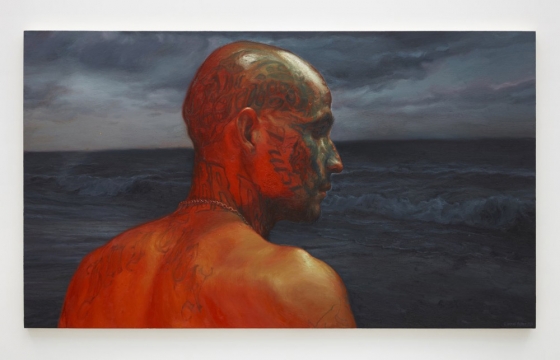
“Every Tongue Shall Confess” (2023), oil, enamel, pigment, and acrylic on two panels, 213 x 213 centimeters
While much of Strachan’s work considers colonialism and historical erasure, the artist is deeply rooted in the present and future. Our changing climate and the push for space exploration figure prominently and even sparked the scientific research platform, Bahamas Aerospace and Sea Exploration Center (BASEC), which Strachan founded in 2018. That project launched a 3U satellite into space for a three-year orbit around the sun that same year, which shared the story of Robert Henry Lawrence Jr., the first African-American astronaut within any national space program.
The book’s release coincides with Strachan’s exhibition The Day Tomorrow Began at The Pizzuti, part of the Columbus Museum of Art in Ohio, which runs through January 3. In true Strachan fashion, creating the monograph goes beyond simply gathering the various projects and shows within his practice. “When you make a book, you are participating in this very long historic lineage of bookmaking and sharing information,” he says, adding that there’s a strong spiritual connection between presenting work in person and on the page.
“In Praise of Midnight (Christophe × Napoleon)” (2025), resin and steel, 485 x 345 x 155 centimeters“The Barber Shop” (2025), performance, installation, dimensions variable. Installation view at the Los Angeles County Museum of Art“Black Star” (2024), aluminum, fiberglass, steel, painted wood, 543 x 1210 x 200 centimeters. Installation view at Hayward Gallery, LondonTavares Strachan, Isolated Labs, New York, 2025. Photo by Jason Schmidt
Toronto-based Kurdish artist Roda Medhat pushes the boundaries of fabric into the realm of sculpture, exploring the ways in which traditional West Asian textiles can be translated into various media. As digital fabrication and 3D scanning cross paths with memory and material, Medhat’s practice asks “how we carry our stories, and what happens when those stories are translated into new, synthetic languages?”
The artist’s new solo exhibition, titled From the Loom, fills Toronto’s Abbozzo Gall
Toronto-based Kurdish artist Roda Medhat pushes the boundaries of fabric into the realm of sculpture, exploring the ways in which traditional West Asian textiles can be translated into various media. As digital fabrication and 3D scanning cross paths with memory and material, Medhat’s practice asks “how we carry our stories, and what happens when those stories are translated into new, synthetic languages?”
The artist’s new solo exhibition, titled From the Loom, fills Toronto’s Abbozzo Gallery with large-scale sculptures in conversation with a new series of textile works. Known in part for his neon installations, the artist also presents several glowing light-based works encased within glass or acrylic, redolent of patterned Kurdish rugs.
“Def” (2026). Photo by Fraser Carr Moore
Several of Medhat’s images and symbols—most prominently young boys riding horses and interacting with nature—are sourced from Kurdish children’s books. These icons are woven directly into the surface of each textile by way of an electronic Jacquard machine, further accentuating the contrast between preserved cultural objects and contemporary reconstruction. In the exhibition’s statement, Medhat shares that his work “functions as a distillation of a wider body of research,” including the contemporary subversion of archival materials.
“The Sheep and the Chevrolet,” an anchoring work within the exhibition, reimagines François Balsan’s problematic 1947 ethnographic work of the same title. Pitting bucolic Kurdish life with Western modernism, Balsan’s off-key travelogue presented a stereotypical, highly subjective view of Kurdish culture. Medhat’s bold sculpture invokes 3D printing to construct a monumental sheep composedly sitting atop a small Chevrolet vehicle, offering a playful point of reconceptualization.
From the Loom is on view through May 26. You can find more from the artist on Instagram.
“The Sheep and the Chevrolet” (2026). Photo by Darren RigoPhoto by Darren Rigo“A Rug Falls in Four Frames” (2025). Photo by Fraser Carr MoorePhoto by Darren Rigo“Boy, Cat, Bike, Mother” (2026). Photo by Fraser Carr Moore“Jajim 1” (2026). Photo by Fraser Carr MooreDetail of “Jajim 2” (2026). Photo by Fraser Carr MoorePhoto by Darren RigoPhoto by Darren RigoDetail of “Def” (2026). Photo by Fraser Carr Moore

 Login
Login