Normal view

  • ✇rabble.ca
  • Court ruling makes factory farms harder for the public to investigate Linda McQuaig
    There’s a lot going on at factory farms that the owners don’t want us to see — and they’ve just won the right to keep it all secret. That’s the sad result of a ruling last week by the Ontario Court of Appeal, which no doubt has executives in the pork and poultry industry celebrating. They can rest assured that the public won’t get even a glimpse of what they’re doing to the hundreds of millions of animals in their captivity. The ruling will have the effect of preventing clandestine investig
     

Court ruling makes factory farms harder for the public to investigate

12 June 2026 at 18:56
Pigs living in factory farm conditions.

There’s a lot going on at factory farms that the owners don’t want us to see — and they’ve just won the right to keep it all secret.

That’s the sad result of a ruling last week by the Ontario Court of Appeal, which no doubt has executives in the pork and poultry industry celebrating. They can rest assured that the public won’t get even a glimpse of what they’re doing to the hundreds of millions of animals in their captivity.

The ruling will have the effect of preventing clandestine investigators — including journalists and animal advocates — from making false statements in order to go undercover on factory farms. It overturns a lower-court ruling that found a provincial law preventing such exposés violated free speech guarantees in the Charter.

So, as a result of the upper court ruling, there will likely be no more undercover exposés. Secrecy will prevail.

That secrecy is crucial to maintaining the gap between two conflicting realities that exist today — on one hand, there is a growing sensitivity toward animals, as humans increasingly understand them to be sentient beings capable of experiencing pain, sadness, joy and grief.

On the other hand, dramatic changes in the farming business have created a horrific world for animals on modern industrial farms — or what New York Times columnist Nicholas Kristoff recently dubbed the “livestock gulag.”

No longer grazing in outdoor fields, most farm animals now live their lives in indoor facilities where they’re confined in cramped, crowded sunless spaces and subjected to painful cutting procedures beyond the public’s view.

Exposés of these conditions by undercover activists alarmed the public and led to calls for government intervention. But governments have tended to be more responsive to demands from the powerful agriculture industry to shut down the exposés.

In 2020, Ontario Premier Doug Ford brought in an “ag-gag” law that effectively made such exposés illegal.

Without exposés, however, there’s little to protect animals locked up in these facilities.

The only regulations governing their welfare are “codes of practice,” but these codes are drawn up by an industry-controlled organization, known as the National Farm Animal Care Council. 

In other words, the industry is regulating itself. And, not surprisingly, it’s not very hard on itself.

Provinces have animal protection laws that prohibit causing “distress” to animals. But procedures that are generally accepted in the industry are exempt. 

So, while it would be illegal to confine a cat or a dog to small cage for its entire life, the same sort of confinement is perfectly legal — and widely used on factory farms — for pigs and hens.

“To insulate a painful practice from legal scrutiny, the only thing the farm industry has to do is ensure that the practice is widely adopted,” according to a report prepared by Animal Justice and other advocacy groups. “Our animal welfare framework enables systemic cruelty.”

Canada received a “D” on the World Animal Protection Index for allowing practices — such as the use of confining crates for long time periods and painful procedures — that are banned in some comparable jurisdictions, including some U.S. states.

Although polls show Canadians strongly support protections for farmed animals, the issue attracts almost no mainstream media attention.

That can change abruptly however with the release of a graphic undercover video. For instance, there was huge media attention and public outrage in 2014 when an undercover video captured frightening scenes inside a large dairy farm in Chilliwack, B.C.

The video showed cows being repeatedly beaten, kicked, punched and whipped with chains and canes, and a cow being lifted by a tractor with a chain around her neck.

Industry executives and their allies in the Ford government want to make sure there’s no such disturbing videos disseminated in the future, so they’re clamping down hard — not on potential abusers but on those brave enough to try to capture the abuse on film.

This article originally appeared in the Toronto Star.

The post Court ruling makes factory farms harder for the public to investigate appeared first on rabble.ca.
Doug Ford has opened the door to privatizing our water, history show how that can put public health at risk

15 May 2026 at 20:42
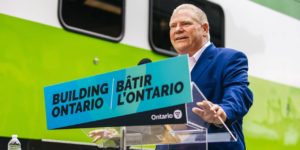
A photo of Ontario Premier Doug Ford.

Although he reinvented himself as a kingpin in the nursing home business, former Ontario premier Mike Harris used to be best known for the water contamination fiasco that killed seven people and sickened thousands more in Walkerton, ON.

That tragedy led to a dramatic decline in support for his government and was considered a key reason Harris resigned as premier in 2002.

Not surprisingly, the premiers who’ve followed Harris have steered clear of anything that smacks of weakening government surveillance of Ontario’s water systems.

Until now, that is.

Shaking off the Walkerton bogeyman, current Ontario Premier Doug Ford is embarking on a plan that will effectively privatize aspects of the province’s water systems, with potential risks to our drinking water.

Ford is well aware of the political danger of being associated with any weakening of public management of water. This explains why he’s going out of his way to deny the label “privatization” applies to the changes in new legislation, which the government insists will keep our water “publicly owned.”

But, as law professor Joel Bakan and economist Jim Stanford noted in a piece in the Star yesterday, the new legislation creates a regime for water and wastewater services in Ontario that is effectively privatized — despite the Ford government’s attempt to deny what it’s doing amounts to privatization.

The Ford government’s keenness to put in place this new water regime — while disguising the fact that it involves privatization — raises the question: whose interests is the government serving in doing this?

Clearly, there’s no public pressure for our water systems to be redesigned to include profit-making. That’s because there would be no benefit for the public.

However, there is one group that would benefit significantly — private investors.

Indeed, private investors — particularly large global institutional investment firms that represent (among others) pension funds, insurance companies and very wealthy families — have trillions of dollars in capital and are keen to invest it in low-risk projects where they can earn returns as high as seven to nine per cent a year. And public infrastructure, including Ontario’s water system, fits that bill.

Under Ford’s legislation, water and sewage systems can be removed from the control of local governments — the plan is to start with Peel Region — and transferred to specially-created, profit-making corporations.

“Key decisions — including finances, contracts and water rates — would be made by corporate boards,” observes Meera Karunananthan, a geography professor at Carleton University.

She also says that the public would continue to be responsible for the debt from constructing the water infrastructure, while the profits would go to investors. “Simply put, the public bears the burden while shareholders capture the reward.”

The public is also potentially endangered. A 2002 public inquiry found that among the factors contributing to the Walkerton tragedy was the Harris government’s failed provincial oversight after it privatized water testing.

Harris was an unusually gung-ho privatizer, and his legacy of privatization — with all the associated risks — lives on in areas beyond water management.

He also encouraged privatization in Ontario’s long-term-care homes and then went on to benefit handsomely from the privatized nursing home industry he helped create. Shortly after retiring as premier, he became a significant shareholder and chairman of Chartwell Retirement Residences, a major private chain operating publicly-funded nursing homes.

Chartwell was among the for-profit nursing homes that were found to have higher death rates during the COVID pandemic than not-for-profit homes, according to a 2020 investigation by a team of Toronto Star reporters as well as a CBC probe. Harris retired as Chartwell chairman two years later, in 2022.

While public services and infrastructure offer lucrative opportunities for moneyed investors, there’s a reason not to hand over aspects of these vital provincial responsibilities to private interests which are, above all, focused on making profits.

Ontarians died needlessly in nursing homes and in Walkerton. Doug Ford should take note.

This article was originally published in the Toronto Star.

The post Doug Ford has opened the door to privatizing our water, history show how that can put public health at risk appeared first on rabble.ca.

  • ✇rabble.ca
  • Big Oil nurtured ‘petro-populists;’ now they’re driving separatist cause Linda McQuaig
    How many times do Liberal prime ministers have to learn that coddling Alberta gets them nowhere? Justin Trudeau learned that bitter lesson when he tried to woo Alberta by putting up federal money to expand the Trans Mountain pipeline — after private builders refused to — ultimately leaving Canadian taxpayers on the hook for $34 billion. The memory of that wildly expensive pipeline — and the fact that it won Trudeau no favour in Alberta — should have been enough to make his successor, Prime
     

Big Oil nurtured ‘petro-populists;’ now they’re driving separatist cause

28 May 2026 at 19:37
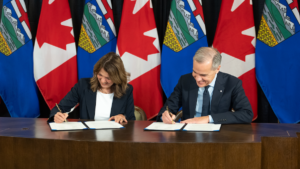
Alberta Premier Danielle Smith and Prime Minister Mark Carney signed the memorandum of understanding last fall that set the stage for Friday’s carbon pricing, carbon capture and bitumen pipeline deal.

How many times do Liberal prime ministers have to learn that coddling Alberta gets them nowhere?

Justin Trudeau learned that bitter lesson when he tried to woo Alberta by putting up federal money to expand the Trans Mountain pipeline — after private builders refused to — ultimately leaving Canadian taxpayers on the hook for $34 billion.

The memory of that wildly expensive pipeline — and the fact that it won Trudeau no favour in Alberta — should have been enough to make his successor, Prime Minister Mark Carney, wary.

But no. Once elected, Carney abandoned his pre-election climate talk, cancelling a number of Trudeau-era climate measures and signing a deal with Alberta committing to support a whole new pipeline.

Last week, Alberta premier Danielle Smith demonstrated that all this appeasement had won Carney nothing when she announced that Alberta will hold a referendum that opens the door to a future referendum on Alberta separation.

Carney has gone too far

There’s no reasonable way to satisfy the separatist cause in Alberta and Carney has already gone dangerously far in attempting to do so, sacrificing the minimal progress we’ve made in the climate battle — all in the interests of pleasing Big Oil, which is the real driving force in Alberta politics.

The role of Big Oil has remained largely hidden in the current drama, as the media focuses on Smith’s self-serving behaviour.

But it’s important to note that the Alberta separatist movement isn’t just a natural, homegrown development. It was instigated, financed and encouraged by the fossil fuel industry, which has used it as a cudgel to resist climate action.

This began over a decade ago when the oil industry, frustrated that environmentalists were alarming the public about climate-related wildfires, decided to move beyond traditional lobbying and launch a campaign to mobilize grassroots support for the industry.

The campaign by the Canadian Association of Petroleum Producers (CAPP) was modelled on a campaign by the American Petroleum Institute. It has fostered a movement of right-wing activists — dubbed “petro-populists” or “extractive populists” — who trumpet the benefits of the fossil fuel industry and fiercely oppose climate action, writes Simon Enoch in “Briarpatch” magazine.

These petro-populists were influential in the “Freedom Convoy” that occupied Ottawa in winter 2022; convoy leader Tamara Lich highlighted her petro loyalties when she appeared in court wearing a sweatshirt that read “I love Oil and Gas.”

Central to the separatist cause — and more broadly to “Western alienation” — is the belief that Eastern elites have consistently sabotaged Alberta by undermining the fossil fuel industry.

Always ignored (along with Ottawa’s Trans Mountain financing) is the fact that Ottawa appeased Alberta in the mid-1980s by adopting the world oil price, thereby depriving Canadians of a lower, domestic price. (Some other oil-producing nations still provide a reduced price for domestic consumers.)

Costly for Canadians

This decision has been costly for Canadians, particularly when the world oil price soars — like now, due to the closing of the Strait of Hormuz.

Economist Jim Stanford notes: “The vast majority of Canadians (including those living in oil-producing provinces) will be significantly harmed by this price shock. The only clear winner is the petroleum industry.”

Indeed, the Canadian petroleum industry is collecting tens of billions of dollars in windfall profits and will continue to do so as long as the strait remains closed.

The industry pays royalties and taxes in Canada, but the bulk of its gigantic windfall will end up outside Canada — since the Canadian industry is mostly foreign-owned, as political economist Gordon Laxer has documented.

Although a Canadian windfall profits tax on the oil industry would make sense, no such idea will even be considered as the national debate focuses on how to keep Alberta happy.

But let’s be clear about what we’re appeasing. Unlike the Quebec sovereigntist movement, with its deep linguistic and cultural roots, the Alberta separatist movement has been shaped and nurtured by corporate interests — and foreign corporate interests, at that.

This article was originally posted in the Toronto Star.

The post Big Oil nurtured ‘petro-populists;’ now they’re driving separatist cause appeared first on rabble.ca.

❌
rabble.ca