Normal view

  • ✇rabble.ca
  • Mark Carney favours the wealthy and privileged over working-class Canadians Karl Nerenberg
    Canada’s Prime Minister Mark Carney continues to achieve high scores in public opinion polls.  Environmentalists believe he has betrayed them.  Indigenous leaders wonder what happened to the PM who appointed three Indigenous women to his cabinet. British Columbia premier David Eby openly chides his erstwhile political friend for rewarding Alberta’s separatists and separatist fellow travellers with the promise of a new bitumen pipeline that would slice through B.C. to the Pacific. Ca
     

Mark Carney favours the wealthy and privileged over working-class Canadians

26 May 2026 at 20:19
Mark Carney announcing a new graphite mine in Quebec in May of 2026.

Canada’s Prime Minister Mark Carney continues to achieve high scores in public opinion polls. 

Environmentalists believe he has betrayed them. 

Indigenous leaders wonder what happened to the PM who appointed three Indigenous women to his cabinet.

British Columbia premier David Eby openly chides his erstwhile political friend for rewarding Alberta’s separatists and separatist fellow travellers with the promise of a new bitumen pipeline that would slice through B.C. to the Pacific.

Canadians who believe defending our sovereignty must include an adequately-resourced CBC wonder what happened to the Carney government’s oft-delayed plans for the public broadcaster.

The international development community, here and abroad, worry Carney is cutting Canadian support at the worst time possible, just as U.S. president Trump has pulled his country out of the foreign aid business entirely.

Canadians concerned with poverty, inequality, and social services, including child care and health, are dismayed to see the Carney government freeze in place the not-yet-fully-realized gains of Justin Trudeau’s government. 

Fourteen Liberal MPs have written to Carney to warn him against weakening this country’s hard-earned environmental protections, as the PM pursues Canada becoming an “energy super-power”.

Three former Liberal environment ministers have expressed similar alarms. 

One of them, Catherine McKenna, writes “we now live in a petrostate, where rich oil and gas companies have convinced politicians that fossil fuels are better than renewable.” She characterises that as “bonkers”. 

Some mainstream media folk, notably the Toronto Star’s Althia Raj, are taking Carney to task for environmental policies that are worse than Conservative Stephen Harper’s. 

There is growing disappointment and alarm in the land, from east to west, with Carney’s continued dance to the Right. 

But little of it seems to have any impact on public opinion, not yet in any case.

Pay the rich more; the poor, less

Right now, Carney can do no wrong. 

Even many of those who are critical of him say, given what they call “the alternatives”, they would probably vote for Carney and his Liberals again. 

The majority of Canadians appear to believe everything Carney is doing (or failing to do) is necessary and unavoidable because of the still very real and very frightening threat of Donald Trump’s nakedly aggressive imperialism.

Natural Resources Minister Tim Hodgson has used that argument when justifying an accelerated process for approving mega-projects.

And Health Minister Marjorie Michel invoked it when explaining why the government had lost interest in pursuing pharmacare or any other expansion of universal healthcare. 

Unprecedented threats, the Carney folks say, mean the government must make tough choices.

We cannot afford to favour the environment, Indigenous rights, or the expansion of the social safety net as we thought we could in the Justin Trudeau era.

We have to focus on hard stuff – mines, mills, transport infrastructure.

And to build a more resilient economy we have to not only work with (and, at times, get out of the way of) the private, corporate sector, we have to facilitate it with generous subsidies and tax benefits.

We also must build up our military capacity – and fast.

All of that means sacrifices must be made.

But those sacrifices will not fall evenly on all Canadians. 

In his government’s reaction to the Trump challenge, Carney has yet again proven economist John Kenneth Galbraith had it right when he wrote:

“When we want the rich to work harder, we pay them more. When we want the poor work harder, we pay them less.”

Carney signalled his intentions even before he became Prime Minister. 

During the Liberal Party leadership campaign, he casually pledged to scrap what had been one of the Trudeau Liberals’ signature measures to, ever so slightly, tilt the inequality board from those who have to those who have not.

In the spring of 2024, the Justin Trudeau government had increased what is called the inclusion rate for taxing capital gains from 50 per cent to two thirds, for all gains over $250,000.

Most people earn their income by working for wages and salaries. Some earn commissions or tips. All of that is earned income. 

After basic, minimal deductions, the vast majority of Canadians pay tax on all of their earned income.

A capital gain is not earned income. It is the profit people and corporations make when they sell assets.

Those assets could include equipment or machinery or a whole business. They could include property other than a person’s principal residence (which is not taxable), and that includes vacation property.

The vast majority of capital gains in Canada come from the sale of financial assets, such as shares in publicly traded corporations. 

Canadians with money invested for their retirement usually have some stocks and bonds. When they sell any of those, at any sort of profit, half of that income is taxable.

Very few of those folks would be touched by the 2024 changes. That’s because the Trudeau government only planned to increase the taxable amount from 50 per cent to two thirds for capital gains over $250,000. Such gains are far beyond the wildest dreams of the average Canadian investor.

In 2024 then-Finance Minister Chrystia Freeland pointed out that the increased inclusion rate would only affect 0.13 per cent of taxpayers – that’s about one in a thousand. 

Most of those folks’ capital gains resulted from stock speculation, not from high-risk, job-creating economic activity. 

In the 1980s, the Conservative government of Brian Mulroney had instituted an inclusion rate of three quarters, 75 per cent, for all capital gains. At the time, the business community considered Mulroney to be a friend and ally, and did not object.

Nobody, in the 1980s, complained about capital gains taxes acting as a disincentive to investment.

But when Mark Carney promised he would kill Trudeau’s modest inclusion rate increase he said he did not want to penalize “risk takers”. 

Chrystia Freeland was one of Carney’s rivals in that leadership race, and she quickly shifted her position and said she too would kill the capital gains increase.

Major groups in the business community, such as the Canadian Chamber of Commerce and the Canadian Council of Chief Executives, had earlier vigorously opposed the Trudeau government capital gains changes. 

Those critics did not focus on stock speculators. 

Rather, they cited the example of the money some Canadians who are not wealthy earn by selling vacation cottages (some of which have been in the family for generations). 

The business groups did not mention that those family-cottage-profits form only a tiny proportion of total capital gains in Canada.

Neither the business community, nor politicians such as Carney and Freeland, ever propose any alternatives to the capital gains increase, such as a wealth tax, which could give the government increased revenue at a time of great need.

Nor did they suggest any carve-outs to the proposed inclusion rate changes, to avoid potentially harmful and unintended consequences for genuine risk-taking Canadian entrepreneurs, for instance. 

As John Kenneth Galbraith famously wrote ….

An eloquent Liberal defence of tax fairness

Mere months before the Liberal leadership race in the spring of 2025, Chrystia Freeland had given an eloquent defence of the capital gains inclusion rate increase. 

Her words in 2024 are still relevant today, even if talk about social justice, fairness and equality has largely gone out of fashion in this country. 

Have a look:

When someone sells an investment that has appreciated in value—like a portfolio of stocks or a rental property—they accrue a capital gain.

In Canada, these gains are taxed below the rate that we all pay on regular income.

Today, in fact, only half of the capital gain is taxed at all.

So, if someone makes a $2 million profit on a stock sale, they pay tax on only $1 million of that gain.

That’s a big advantage.

And there are consequences to this preferential treatment of capital gains:

Many of the wealthiest Canadians make most of their money through investments—not income.

But because of how investment gains are taxed, well-off Canadians can wind up paying a lower marginal tax rate than a nurse or a carpenter.

That’s not fairness; that’s favouritism.

In the end—and this is key—we estimate that only 0.13 per cent of Canadians—with an average annual income of $1.4 million—will be affected by this change in any given year. But millions more, especially younger Canadians, will benefit from it.

Taxing capital gains is not an inherently partisan idea. It’s an idea that everyone who cares about fairness should support.

In fact, the idea of taxing capital gains in Canada was first broached by the government of Prime Minister John Diefenbaker and his Royal Commission on Taxation, chaired by Kenneth Carter.

In the Royal Commission’s report, Carter said that fairness should be the foremost objective of the tax system, and he memorably insisted, “a buck is a buck is a buck”.

I would also like to ask Canada’s one per cent—in fact, Canada’s 0.13 per cent—to consider this: What kind of a Canada do you want to live in?

Do you want to live in a country where kids go to school hungry?

Do you want to live in a country where a teenage girl gets pregnant just because she doesn’t have the money to buy birth control?

Do you want to live in a country where the only young Canadians who can buy their own homes are those with parents who can help with the down payment?

Do you want to live in a country where we make the investments we need—in health care, in housing, in old age pensions—but we lack the political will to pay for them, and choose instead to pass a ballooning debt onto our children?

Do you want to live in a country where those at the very top live lives of luxury, but must do so in gated communities behind ever higher fences, using private health care and airplanes, because the public sphere is so degraded, and the wrath of the vast majority of their less privileged compatriots burns so hot?

Every Canadian across our great country needs to ask themselves these same questions.

Because the stakes could not be higher.

Democracy is not inevitable. It has succeeded and succeeds because it has delivered a good life for the middle class. When democracy fails to deliver on that most fundamental social contract, we should not be surprised if the middle class loses faith in democracy itself.

And this writer says: I could not have put it better myself.

The post Mark Carney favours the wealthy and privileged over working-class Canadians appeared first on rabble.ca.

  • ✇rabble.ca
  • Danielle Smith vows to do everything humanly possible to keep Alberta in Canada David J. Climenhaga
    In addition to blaming everyone but herself for the national unity crisis she’s been trying for months to foment, Alberta Premier Danielle Smith used a news conference in Calgary Thursday to insist repeatedly that no one’s more loyal to Canada than she is and for sure she’ll be doing everything she can to get everyone to vote to remain in Canada when the referendum almost nobody else wants to happen is held next October. That is to say, not an actual referendum on separation – which would be
     

Danielle Smith vows to do everything humanly possible to keep Alberta in Canada

25 May 2026 at 20:50
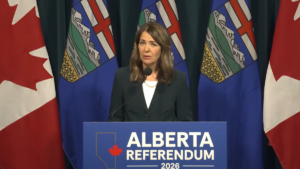
Alberta Premier Danielle Smith.

In addition to blaming everyone but herself for the national unity crisis she’s been trying for months to foment, Alberta Premier Danielle Smith used a news conference in Calgary Thursday to insist repeatedly that no one’s more loyal to Canada than she is and for sure she’ll be doing everything she can to get everyone to vote to remain in Canada when the referendum almost nobody else wants to happen is held next October.

That is to say, not an actual referendum on separation – which would be OK with the United Conservative Party’s separatist base, if no one else – but the confusing vote on whether or not to have a referendum on separation that Smith wants to hold to keep the issue alive in the face of court rulings that have blocked the Alberta Prosperity Project-approved wording she really wanted to see on the ballot. 

“I’m fiercely loyal to both Alberta and Canada,” the premier asserted in the first seconds of the newser, the motivation for which appeared simply to be to crossly roll out all the same talking points she made yesterday in her 15-minute prime-time televised message to us Albertans. 

Over the next 34 minutes according to my count, Smith repeated at least 13 times that she supported Alberta remaining in Canada and would be campaigning hard to ensure that happens. 

  • “My position is to stay”
  • “I believe Albertans should remain in Canada”
  • “I would ask that all Albertans join me in voting to remain a province of Canada”
  • “I will do everything I can to convince Albertans that the choice should be to remain”
  • “Once again, I’ll be doing everything I can to convince my fellow Albertans that the choice should be to remain”
  • “I’ll be doing town halls and meetings and telling people about why it is I think we should vote to remain”
  • “If you want to remain in Canada, as I do, vote to remain”
  • “I hope it goes the other way as well, that the remain side wins”
  • “I’ll be very clear about the position of my caucus and my government and why does it think we should vote to remain”
  • “I’ll be trying to do everything I can to convince our fellow citizens to vote to remain”
  • “I’ll be campaigning hard to try to convince my fellow Albertans of my position, which is to remain”
  • “I’ve said what side I’m on, that I want to convince my fellow Albertans to stay”
  • “I will be focusing my efforts on remain”

Of course, I may have missed a few. A lot of words were spoken during that half hour, and my note-taking’s not what it used to be. 

In addition, at least two more times Smith insisted that she’s always been working to save Canada. “Everything I have done from the moment I got elected, with the Alberta Sovereignty Within a United Canada Act, has been to work to find the issues that were causing division and resolve them,” she said at one point. “I have been actively campaigning to save our country and to resolve these issues from the moment I got elected,” she said at another. 

All of which begs the question, if this is true, why the hell is she doing everything she can to make it easy for a bunch of separatists with ties to a foreign country to break up the country? 

Look, not to be mean, but if she really sincerely believes what she’s saying, even if she only believes it when she’s saying it, then that’s a prima facie case right there for a 30-day psychiatric remand!

Or maybe she’s just gaslighting us and being obvious about it because she’s starting to realize that almost everybody in Alberta is infuriated by her antics right now. I’ll let you be the judge. 

True to form, as widely reported, Smith blamed everybody but herself for the present state of affairs. Justin Trudeau got special mention, of course, and his father probably deserved some too, although to be fair she didn’t think to mention old Pierre. 

Jagmeet Singh also populates the list of the usual Suspects, as seen by Danielle Smith. She whinged about uppity judges, of course, and the poor abused law-abiding gun owners of Wild Rose Country. 

The premier also singled out: 

  • “The 14 cowards who signed a letter to the prime minister trying to derail our MoU,” a reference to the group of Liberal MPs who wrote Mark Carney before the memorandum of understanding was signed to complain about environmental rollbacks;
  • “People like Avi Lewis, who continues to campaign to keep all of our fossil fuels in the ground;”
  • And “leadership in British Columbia who continues to try to put barriers in the way of getting our product to market” …

… “That is the reason we having this crisis right now,” she averred. “… That’s what’s created the situation we find ourselves in today!”

Smith stuck to her talking point that 700,000 Albertans who signed petitions want to hold a vote on separation, notwithstanding the fact that most of the more than 400,000 verified signatories to the pro-Canada Forever Canadian petition wanted no such thing and as far as we know none of the 300,000 signatures on the separatist petition have been verified. She said nothing about the personal information of three million Albertans now in the hands of a Trump affiliated campaign company south of the world’s longest undefended border or what role the huge data breach may have played in getting signatures on the Stay Free Alberta petition.

If you were looking for actual news from this news conference, there wasn’t much, and it wasn’t particularly good.

Will the premier step down, one reporter asked, if the vote doesn’t go her way? Forget about it. “As I’ve said, I will accept the outcome of these referendum questions,” she said. If the separatists win, “then we will commence the legal processes to get to the point of a binding referendum on it.”

Asked another: Why not just call an election and settle the matter that way? “Well, because I had until October 2027 in my mandate.” She went on to suggest that the questions she wants answers to are so important that the government needs to get direction on them – which an election would provide, but never mind that. At least not until the UCP’s province-wide gerrymander is complete. 

And how big a vote would be enough to proceed to a full separation referendum? “Fifty per cent plus one. That’s what a majority looks like. Yes.”

Judged on her actions, not her words, Smith is a separatist. Ergo, this problem isn’t going away any time soon. Leastways, not until she summons up the courage to kick the separatists out of her party like almost all Conservative Alberta premiers have done from time to time. 

The post Danielle Smith vows to do everything humanly possible to keep Alberta in Canada appeared first on rabble.ca.

In less than a year, 1 in 5 minors in Colombia suffered online sexual violence, UNICEF, ECPAT, and INTERPOL warn

14 May 2026 at 17:52

Bogotá, Colombia – Around 21% of Colombian minors aged between 12 and 17 have been victims of online sexual abuse in the past year, according to a report published last week by UNICEF-Innocenti, ECPAT International, and INTERPOL. 

The report, “Disrupting Harm,” covered 25 countries including Colombia and examines how technology use, including new tools like artificial intelligence (AI) are helping to facilitate online abuse. 

The investigation was made between 2023 and 2025, and the results are alarming: around 860,000 Colombian adolescents experienced some type of digital sexual abuse or exploitation in just one year (2024) . 

Data also pointed to gender and economic disparities. A quarter of young women surveyed said they’d been victims of this type of abuse or exploitation while 17% of young men said the same. In poorer, rural areas of the country, 29% of minor respondents said they’d been victimized while 17% living in urban areas said they had been. 

In addition to social dynamics in Colombia, including deep-rooted “machismo”, prevalent domestic and gender based violence, and extreme wealth inequality, technology is increasingly becoming a factor in the abuse of children. 

According to a 2025 study by the Communications Regulation Commission (CRC), during the past year, 81% of teenagers between 14 and 17, and 55% of pre-adolescents aged 10 to 13, reported having their own cell phones. 

Experts say that since the pandemic, interactions among children and adolescents have increased significantly. Cell phones have become a ‘fundamental’ tool for maintaining social status and escaping reality, especially for those facing family problems.

“It is essential that children do not fear being punished or having their phones taken away for responding to a message. We saw in the study that this is one of their biggest fears: losing their connection to the rest of the world,” Camila Perera, a specialist at the Office of Research and Data for UNICEF Innocenti, told Latin America Reports.

Nearly half of the reported cases of abuse happened on social media platforms such as Facebook (80%), WhatsApp (30%), and Instagram (17%), while 14% were linked to online gaming networks.

In addition, 2% of victims reported that artificial intelligence was used to create fake explicit content using their faces – highlighting a newer phenomenon that became widely discussed last year after Elon Musk’s AI chatbot Grok began creating millions of sexualized images of people online. 

With the introduction of such technologies, regulators and parents are struggling to keep up. 

“Minors, with their superior digital skills, moved much faster than any safety measures could. While they advance, protection protocols simply cannot keep up,” Fabio González Florez, Project Leader at ECPAT International, told Latin America Reports.

“There is a serious obligation to stay informed, and that doesn’t require a postgraduate degree. Tutorials are everywhere, and every platform offers parental controls that we must learn to use,” he added.

A stranger behind a screen? The ‘real’ danger

Contrary to popular belief, the threat is not always an anonymous hacker hiding in the dark; in fact, only 30% of victims met their aggressor online.

In half of the documented cases, children were abused by someone they already knew, including family members, neighbors, and classmates. Due to this approach, some of the minors can’t recognize the abuse or feel safe enough to ask for help.

“There’s a common expression: ‘stranger danger’, the idea that we must only be looking for outsiders. However, the majority of the abusers are actually the ones close to the family,” stated González.

The findings are also exposing another difficult situation: one in five cases of online sexual abuse against a minor was made by another minor. It was found that some victims will look to target or recruit their peers to re-victimize in exchange for incentives or “freedom.”

The report also highlights that victims often suffer from severe mental health issues, including anxiety, depression and propensity to self harm. 

Even if many minors prefer to remain silent, when they decide to speak out, they usually look for their mothers, siblings, or a friend. This is a message about the importance of creating trust-based relationships with children.

“Beyond digital parenting, we must ensure the kids see their parents as sources of protection. They need to be someone they can talk to about sexuality, consent, and limits without being judged,” Perera recommended. “It is about being a source of trust so they can come to us with their doubts and curiosities.”

Despite existing channels in Colombia, such as the ICBF’s 141 line or the National Police’s “¡A Denunciar!” portal, the study found that formal reporting is almost non-existent between minor victims.

Protection measures: Are they enough?

With increased connectivity via the internet, the threat landscape for online abusers of Colombian children expands immensely. 

“Our obligation is to work with our 196 member countries; also, we have specific resolutions focused on child protection,” a member of INTERPOL, who requested anonymity because of the sensitivity of their work, told Latin America Reports. “Another critical measure is urging countries to adopt protocols to detect and block URLs containing sexual abuse and exploitation material to prevent the commercialization of such content.”

However, risks remain in an increasingly interconnected world: “A single image of a Colombian child can be reproduced globally across time and geography; therefore, the response to protect them must be a national priority”, the INTERPOL member said. 

Finally, the investigation calls on digital companies to contribute to risk reduction by incorporating prevention into platform design and improving safety measures. The research is also looking for new prevention tools for transforming both physical and digital spaces and eliminating the conditions that facilitate violence.

This issue requires concrete actions from all sectors: the protection system, families, and technology companies.

Featured image credit: UNICEF

The post In less than a year, 1 in 5 minors in Colombia suffered online sexual violence, UNICEF, ECPAT, and INTERPOL warn appeared first on Latin America Reports.

  • ✇Latin America Reports
  • Mexico open to hosting Iran’s World Cup games amid war with US Aztec Reports
    The Mexican government, led by President Claudia Sheinbaum, said on March 17 that it is open to hosting Iran’s matches at the upcoming 2026 World Cup if FIFA agrees to the proposal – despite the recent U.S. intervention in the country.  The U.S. is a co-host of this year’s emblematic football tournament alongside Mexico and Canada.  Earlier, Iran’s football federation urged FIFA to consider relocating its World Cup matches from the U.S., citing safety concerns after recent U.S. airstrikes orde
     

Mexico open to hosting Iran’s World Cup games amid war with US

19 March 2026 at 21:17

The Mexican government, led by President Claudia Sheinbaum, said on March 17 that it is open to hosting Iran’s matches at the upcoming 2026 World Cup if FIFA agrees to the proposal – despite the recent U.S. intervention in the country. 

The U.S. is a co-host of this year’s emblematic football tournament alongside Mexico and Canada. 

Earlier, Iran’s football federation urged FIFA to consider relocating its World Cup matches from the U.S., citing safety concerns after recent U.S. airstrikes ordered by the administration of President Donald Trump.

U.S. officials have not yet responded to the matter. However, they had stated security preparations are ongoing for hosting matches at MetLife Stadium in New Jersey, one of the venues for the 2026 World Cup. 

President Trump commented on Iran’s participation, noting that it might not be appropriate for the team to play in the United States “for their own life and safety.” 

Meanwhile, Iran has insisted that if the U.S. cannot guarantee the security of its national team, it will not travel to the country. FIFA has not confirmed any specifics.

Mehdi Tak, President of the Iranian Football Federation, said he is “negotiating with FIFA to hold Iran’s World Cup matches in Mexico,” in a post on the Iranian Embassy in Mexico’s X account. 

As the decision ultimately rests with FIFA, rejecting Iran’s request to transfer its matches — a move that would pose a major logistical challenge — could risk the country’s participation. Despite this, FIFA said it is looking forward to all teams competing according to the schedule announced on December 6, 2025.

Meanwhile, Mexico is carrying out extensive security preparations for the World Cup matches it will host.

Mexico’s security preparations ahead of 2026 World Cup

As the 2026 World Cup approaches, the Mexican government reported enhancements to its security strategy, originally initiated and launched in 2024 under President Sheinbaum. 

Plan Kukulkán was initially developed to address broader security challenges including cartel-related violence, and has now been adapted to ensure the safety of soccer fans visiting Mexico’s major host cities — Mexico City, Guadalajara, and Monterrey — for the 2026 World Cup. 

Amid fears that recent cartel violence could flare again following the assassination of cartel leader “El Mencho”,  Plan Kukulkán deployed 100,000 personnel, including 20,000 armed forces and 55,000 public security agents, with additional support from civilian and private security teams.

“There is no risk for fans,” said Sheinbaum in late February. 

In addition to armed forces’ deployment, technological support includes 24 tactical aircraft for rapid response and 33 drones for aerial monitoring of stadiums, fan zones, and transport hubs. 
FIFA is also expected to conduct further reviews of Mexico’s security and mobility plans in the run-up to the event.

Featured image: Estadio Azteca in Mexico City.

Image credit: Alejan98 via Wikimedia Commons.

The post Mexico open to hosting Iran’s World Cup games amid war with US appeared first on Aztec Reports.

The post Mexico open to hosting Iran’s World Cup games amid war with US appeared first on Latin America Reports.

  • ✇Latin America Reports
  • Mounting irregularities cloud Peru’s 2026 general election as runoff remains unclear Peru Reports
    Lima, Peru — Peru’s general election, held Sunday, April 12, has been thrown into uncertainty following a series of logistical failures, contested tally sheets, and newly reported irregularities that have raised doubts about the integrity of the process—even as authorities insist there is no evidence of fraud. With partial results still being processed several days later, no clear contender has emerged to face Keiko Fujimori in the runoff, despite her leading the vote with around 17%. The tight
     

Mounting irregularities cloud Peru’s 2026 general election as runoff remains unclear

18 April 2026 at 18:40

Lima, Peru — Peru’s general election, held Sunday, April 12, has been thrown into uncertainty following a series of logistical failures, contested tally sheets, and newly reported irregularities that have raised doubts about the integrity of the process—even as authorities insist there is no evidence of fraud.

With partial results still being processed several days later, no clear contender has emerged to face Keiko Fujimori in the runoff, despite her leading the vote with around 17%. The tight race for second place—separated by a razor-thin margin—between right-wing candidate Rafael López Aliaga and leftist Roberto Sánchez could ultimately be decided by thousands of challenged votes.

Delays, missing materials, and ballots found in the trash

Election day was marked by widespread delays in the delivery of voting materials, especially in Lima, forcing authorities to extend voting into Monday in several districts.

Officials are now facing scrutiny over more troubling incidents. In one of the most widely reported cases, sealed boxes containing 1,200 ballots—distributed across four tamper-evident containers—were found discarded in the trash in the Lima district of Surco.

The National Office of Electoral Processes (ONPE) attributed the incident to negligence during the transport of ballot boxes and tally sheets to its central headquarters. It maintained, however, that the chain of custody was not compromised, noting that a coordinator, a police officer, and an electoral observer from the National Jury of Elections were present in the vehicle.

However, Roberto Burneo, president of the National Jury of Elections (JNE), told a congressional oversight committee on Friday that the ONPE’s statement was “false.”

“It is important to clarify that, regarding those boxes, contrary to what ONPE indicated, there was no observer accompanying them nor a police officer. They were transported in unregistered private vehicles, and the JNE was not present,” he said.

Burneo added that evidence has already been submitted to prosecutors.

“Serious irregularities,” but no fraud, observers say

Despite the growing list of incidents, international observers from the Organization of American States and electoral experts have drawn a distinction between administrative failures and deliberate manipulation.

“There have been serious irregularities that must be investigated and sanctioned, but this is not a fraudulent situation,” former Justice Minister Aldo Vásquez told CNN. “At least up to now, there is no evidence supporting that claim.”

Observers from international organizations echoed that assessment, noting that while “egregious irregularities” were documented, they do not amount to systemic fraud.

Still, the scale and variety of problems—from late poll openings to missing materials—have eroded public confidence.

Thousands of disputed votes could decide the runoff

At the center of the uncertainty are more than 5,000 tally sheets marked as “disputed”—representing just over one million votes—due to inconsistencies such as missing signatures, illegible figures, or arithmetic errors.

These votes are now under review by electoral authorities and, in such a close race, could determine who advances to the runoff.

“Of course they can change the outcome,” said electoral lawyer Silvia Guevara. “The difference between candidates is so small that these votes could tip the balance.”

“This is a situation that won’t be resolved tomorrow or in two or three days. Citizens will need to be patient,” she added to Canal N.

Institutional crisis and ongoing investigations

The fallout has triggered multiple investigations. The Public Ministry and the Comptroller General have launched inquiries, while the National Board of Justice—the body responsible for overseeing judicial appointments—has opened a preliminary investigation against Piero Corvetto Salinas, head of the ONPE.

According to Vásquez, the process could lead to disciplinary sanctions or even suspension, noting that “it is highly likely that a formal proceeding will be opened.”

Meanwhile, electoral authorities have confirmed that at least 85 requests to annul the election have been filed, further complicating the timeline.

With the runoff scheduled for June, the coming days will be decisive not only in determining who advances, but also in whether Peru’s electoral institutions can restore public trust after one of the most controversial elections in recent years.

The post Mounting irregularities cloud Peru’s 2026 general election as runoff remains unclear appeared first on Perú Reports.

The post Mounting irregularities cloud Peru’s 2026 general election as runoff remains unclear appeared first on Latin America Reports.

Marking 180 Years: The Oregon Treaty, DRIPA, and the future of Indigenous-settler relations

First Nations Leadership Council representatives hold up printed copies of the UN Declaration bill tabled in B.C. on Oct 24, 2019.

One hundred eighty years ago, on June 15, 1846, representatives of the U.K. and the U.S. signed the Treaty of Oregon.

What is this treaty, and why is it important?

The B.C. and Canadian governments assert that their right to govern, to assert sovereignty over the lands now called “British Columbia,” began in 1846 with the signing of the Treaty between Her Majesty and the United States of America for the Settlement of the Oregon Boundary.

The treaty did define today’s border with the U.S. west of the Rockies but most importantly it asserted that the British and U.S. were to exercise sovereignty over the Oregon territory – present day Washington, Oregon and British Columbia. The U.K. was to have sovereignty over the territory north of the 49th parallel, and the U.S. was to control the lands south of the border.

The text of the Oregon Treaty offers no justification for this colonial assertion of sovereignty. However, publicly available minutes of the negotiations in 1845-46 starkly reveal that the U.K. believed that visits to the region by James Cook, George Vancouver, and others gave them the right to take the land.

The treaty fails to mention that First Nations lived, governed, and worked across these territories for thousands of years. At the time, the settler population was at most a few hundred. Estimates vary, but as many as 300,000 or more Indigenous peoples lived north of the border. They were never consulted and the treaty rendered the land into a fictional terra nullius.

In effect, the Treaty of Oregon, and the Crown’s right to govern, is based upon the thoroughly discredited Doctrine of Discovery that even the Vatican has repudiated.

The bitter irony is that those who effectively stole the lands in 1846, are now accusing those whose lands they took of threatening private property. Nothing could be further from the truth.

History matters

Initially First Nations often supported newcomers to their territories. But settler governments, backed by British canons, asserted control by pushing First Nations off the land and onto reserves, refusing to sign treaties, and encouraging white settlers to exploit native lands. First Nations have been organizing and fighting the dispossession and genocide that ensued ever since. Our colleagues introduced a concise account of that history a few years ago – a history that made B.C. a province like no other.

One of the recent landmarks in this ongoing fight was the 1981 Constitution Express that saw First Nations mobilize across the country and Europe to demand Indigenous title and rights be recognized in the Canadian constitution then under consideration. This led to the adoption of Section 35 of the Constitution affirming Aboriginal title and rights for the first time.

Indigenous led movements, including Idle No More, the Truth and Reconciliation Commission, and Every Child Matters continued that fight and had an impact on the consciousness of many people in the province – Indigenous and non-Indigenous alike.

Consequently, the provincial legislature unanimously passed the Declaration on the Rights of Indigenous Peoples Act (DRIPA). It affirmed the application of the United Nations Declaration on the Rights of Indigenous Peoples to the laws of B.C. It declared that “in consultation and cooperation with the Indigenous peoples in British Columbia, the government must take all measures necessary to ensure the laws of British Columbia are consistent with the Declaration.”

DRIPA was a further step in decolonization and reflected the long struggle of First Nations for recognition of Indigenous title and rights. These hard-won gains set the stage for recent court decisions, Cowichan Tribes v. Canada and Gitxaala v. British Columbia that reinforced Indigenous title and rights, emphasizing the legal imperative for the government to fully implement DRIPA.

Backlash

In the Cowichan Tribes v. Canada case last year, the BC Supreme Court declared that the Quw’utsun (Cowichan) Nation had title to Tl’uqtinus, a parcel of land on the southern arm of the Fraser River in Richmond. The NDP government reacted immediately, declaring it would appeal the ruling: “This ruling could have significant unintended consequences for fee simple private property rights in B.C. that must be reconsidered by a higher court,” stated NDP attorney-general Niki Sharma.

A few months later, the B.C. Court of Appeal decision in Gitxaala v. British Columbia reinforced the legal obligations of the B.C. government to implement DRIPA to the laws of the province. It ruled that the mineral claims system was inconsistent with DRIPA. Again, the provincial government contested the decision, announcing it would appeal the decision in the Supreme Court of Canada.

In a major speech to the B.C. Chamber of Commerce this spring, the premier criticized both decisions, saying they invite “further and endless litigation,” and were “the exact opposite of the direction we need to go.” David Eby then promised to amend or suspend DRIPA, provoking a crisis.

Over 100 First Nations publicly objected to the Eby government’s move to amend DRIPA, as did the Law Society of BC and the BC branch of the Canadian Bar Association. Over 130 civil society organizations, including the B.C. Federation of Labour and the B.C. Civil Liberties Association, publicly called on the government to stop their attempts to amend DRIPA, warning: “We are deeply troubled by the recent rise in anti-Indigenous rhetoric and fearmongering in this province that has framed the realization of the fundamental human rights of Indigenous peoples as detrimental to economic growth, security, and the interests of others. We stand united in opposition to these divisive narratives.”

Under pressure from within his caucus, David Eby was forced to shelve his plan to amend or suspend DRIPA and instead committed to engage in consultations with First Nations. Meanwhile, the Conservative Party and right-wing think tanks such as the Fraser Institute have been outspoken in their criticism of DRIPA.

Understanding the crisis

First Nations have made it clear that their title and rights are not out to dispossess property owners. The landmark Gaayhllxid • Gíhlagalgang “Rising Tide” Haida Title Lands Agreement, calls for “a staged transition to Haida jurisdiction, while protecting and maintaining private property rights and existing government services and infrastructure on Haida Gwaii.” The Cowichan Nation publicly promised that they were not seeking “to invalidate any privately held fee simple titles.”

Furthermore, many legal experts argue that Indigenous title can overlay and co-exist with fee simple private property, as does Crown title. So, what is really at stake?

Political polarization is occurring in many places in the world. In B.C., Indigenous title and rights has become the flashpoint, reflecting this province’s unique history.

Conservative forces are pushing to roll back hard-won social gains, whether it be Indigenous rights and title, women’s rights, LGBTQ rights, labour rights, or environmental regulations. 

Kerry-Lynn Findlay, recently elected as leader of the B.C. Conservatives, has a track record of anti-Indigenous activism and has reiterated the Party’s commitment to repeal DRIPA. Her election night clarion call for “family, faith, and freedom” eerily echoes the conservative right, south of the border.

However, the current crisis resonates with deep cultural differences that transcend partisan politics. The colonial world conceives of the land as being owned, and ownership translates into economic terms, monetary – the land is monetized. For the Indigenous world, it’s not about who owns the land, it’s about who is looking after that land and all life upon it.

Another layer is economic. The NDP government’s agenda focuses on fast-tracking the exploitation of LNG and critical minerals – continuing the long tradition of colonial extractive projects. Some in the government feel that Indigenous title and rights, and the courts’ recent decisions, go too far and that “free, prior, and informed consent” may impede the fast-tracking of resource projects.

Governing with a slim majority, the Eby government seems to be listening to the BC Business Council who recently released a recent survey in which 98 percent of its members were “very concerned” about the Declaration on the Rights of Indigenous People’s Act (DRIPA) applying to all laws in the province. 

The threat to the land, regardless of ownership, comes not from Indigenous peoples but from forest fires, flooding, and pollution – an ever-deepening environmental catastrophe that has arisen from unfettered growth. This has often altered the land to the point that it is unable to heal.

First Nations face huge hurdles as they struggle to re-establish relationships, among themselves and with settler society. Still, they lead in the search for renewable energy as illustrated in the series Generating Futures. Indigenous knowledge systems point to a good way to relate to the land, to overcome colonial concepts of competitiveness and hierarchy. Reinforcing Indigenous title and rights will open pathways to cooperation in which Indigenous and non-Indigenous people can work together to solve the pressing problems of our time.

The post Marking 180 Years: The Oregon Treaty, DRIPA, and the future of Indigenous-settler relations appeared first on rabble.ca.

  • ✇Latin America Reports
  • Wave of raids target migrants in Mexico City ahead of World Cup Aztec Reports
    Medellín, Colombia – Since early May, Mexico’s National Institute of Migration (INM) has carried out a wave of raids targeting migrants, mainly of Venezuelan and Central American origin, in Mexico City. NGOs across the city have denounced the intensified anti-migrant operations, with reports that those submitting to legal processes seeking asylum or residency in Mexico are being detained despite having the correct documentation. The recent tactics used by the INM, such as raiding houses, taking
     

Wave of raids target migrants in Mexico City ahead of World Cup

19 May 2026 at 02:56

Medellín, Colombia – Since early May, Mexico’s National Institute of Migration (INM) has carried out a wave of raids targeting migrants, mainly of Venezuelan and Central American origin, in Mexico City.

NGOs across the city have denounced the intensified anti-migrant operations, with reports that those submitting to legal processes seeking asylum or residency in Mexico are being detained despite having the correct documentation.

The recent tactics used by the INM, such as raiding houses, taking away migrants’ cellphones and documents, and targeting online delivery drivers, have been compared to the tactics used by the United States Immigration and Customs Enforcement (ICE).

Rights groups have in recent weeks denounced the immigration raids, with Lorena Cano, the juridical coordinator for the Institute for Women in Migration (IMUMI), calling them “totally irregular.”

A group of NGOs – including Support to Venezuelan Migrants, IMUMI, and the Juridical Clinic Alaíde Foppa of the Iberoamerican University – made a formal complaint before the National Commission for Human Rights earlier this month denouncing the targeting of online delivery drivers in a shopping center in the upmarket neighborhood of Polanco. 

They also criticized that many people who were already undergoing the processes for refugee status were transported to a migrant station in Itzapalapa before being sent to Villahermosa and Tapachula, cities in the south of the country, despite Mexico City describing itself as a “sanctuary city” for migrants.

A spokesperson for Casa Tochan, a migrant shelter in Mexico City, told Latin America Reports that “not only is this a flagrant violation of human rights, it’s also a violation of the rule of law. We don’t know what’s happening with those who’ve been detained because they’re unreachable – they haven’t been given the right to the phone call that they’re entitled to in the event of a legal arrest.”

The Supreme Court has also described the recent raids as unconstitutional.

Despite reports and testimonies shared on national and international news media, the INM has publicly rejected the notion that they are carrying out “raids”, instead stating that their actions come following a “request for cooperation from the competent authorities of Mexico City, with the intention of preventing any criminal acts.” 

Some speculate the operations are part of a beautification drive ahead of the World Cup games, of which Mexico is a co-host.
Meanwhile, the Mexican Commission for Refugee Assistance (COMAR) has been facing severe delays since the COVID-19 pandemic, with southern states like Chiapas being hit the hardest. Since Claudia Sheinbaum took office in October 2024, there have been 18 migrant caravans leaving from Tapachula, Chiapas. Members of the David Caravan, which set off at the end of April, cited the extreme delays in COMAR’s asylum processing as a key reason for their movement.

Featured image description: Government building in Mexico City

Featured image credits: ProtoplasmaKid via Wikimedia Commons

The post Wave of raids target migrants in Mexico City ahead of World Cup appeared first on Aztec Reports.

The post Wave of raids target migrants in Mexico City ahead of World Cup appeared first on Latin America Reports.

❌
Americas