So, what kind of mischief “wood” our beaver friends be up to today? Plenty. Their roles range from devilish troublemaker to street-wise con man to patriotic American hero! Every studio of the day seems to get into the act as we continue our way through the 1940’s. Some place the creature center stage, while others leave him a notable guest or walk-on. One film even tries to develop a beaver as an identifiable recurring character – though his cinema career would only span a grand total of two episodes.
Song of Victory (Screen Gems/Columbia, Color Rhapsody, 9/4/42 – Frank Tashlin, supervision/Bob Wickersham, dir.), presents another instance of beavers being thrown in with other forest creatures for a “give them the works” finale. A typical wartime scenario has the peaceful forest taken over by the terrible trio of Hitler, Mussolini, and Hirohito look-alikes, cast in the respective species of a vulture, gorilla, and hyena. (Only the hyena seems an original concept, the other species having been used by other studios.) An intertitle announces that any similarities between these three and certain dictators, “either living or dead (we hope) is purely intentional.” Beavers appear briefly in an opening panorama shot, as usual constructing a dam. The forest axis move in from the dark recesses of the woods, survey the situation, then set-up a public speaking engagement for the vulture atop a high rock, with the gorilla and hyena slapping around various animals to herd them into the public square, the gorilla parting branches of foliage above the vulture to allow a beam of sunlight to shine down upon him as if a divine sign that he is the animals’ salvation, and the gorilla and hyena again slapping around anyone who does not applaud and heil. Soon, the animals find themselves paying tribute to the new regime, marching in long lines to provide food offerings to the trio’s fast-growing personal stockpile. A chipmunk relinquishes a bag of nuts, but notices one nut fall to the ground. Kicking the nut quickly behind his back with one toe, he reaches backwards, and grabs the nut, stuffing it in his cheek to avoid detection. But his act of treason is spotted by the vulture, who tries to squeeze the nut out of his mouth, but instead causes the chipmunk to swallow it. Infuriated, the vulture leads his pack in a shadow-show of violence to make an example of the traitor, seen as silhouettes on the wall as the chipmunk is slapped, pounded and stomped upon, then thrown out into the snow unconscious, while the trio laughs savagely. The animals pick up the prone figure of the chipmunk, and exchange looks as if to register the unanimous message, “We have had enough.”
While most Axis spoofs treat the subject in broad humor and satiric ridicule, this cartoon does have the distinction of treating its material, despite a few moments of comic silliness, with more somber, serious overtones – not to the level of heaviness of Disney’s “Education For Death”, but at least approaching some of the darker moments of the later Halas and Bachelor’s “Animal Farm”. It emphasizes deep blues and blacks in its color selection and background work, artistically setting the appropriate mood for tyranny and revenge. (It would be nice to see the full impact of the visuals in a properly-restored print; however, due to its dated period storyline, it was bypassed for inclusion in Columbia’s “Totally Tooned In” television package, and to my knowledge has also not yet shown up on MeTV.) In its climactic finale, the film also finds inventive and psychological means of incorporating again and again visual “V” formations and the opening note pattern of Beethoven’s 5th Symphony into animal calls and sound effects, setting up a mysterious and foreboding mood for the cowering dictators as if the world is closing in upon them in their solitary fortress – a mood of perhaps more disabling impact upon them than what could be accomplished by the animals’ mere actions alone. The reveling of the trio within their hollow-tree headquarters, as they feast on their ill-gotten gains, is rudely interrupted by pecking upon the front door, following the four-note pattern of Beethoven. When the vulture opens the door to look around, he finds no one, but rears back at a huge V pecked into the wood of the front door. From the trunks of the evening-darkened trees and crests of nearby snow-covered hills and knolls rises an increasing upswell of calls in the repeated pattern of the “dot dot dot dash” of the Beethoven composition, including deep hoots of an owl, chirps from an isolated songbird, croaks of frogs in a pond, and slaps of beavers’ tails sounding upon a large hollow log aimed as if a megaphone projecting toward the fortress. The vulture’s mind begins to play tricks upon him, as he steps backwards, then realizes his own talons seem to be creating a trail of V’s facing him in the snow. He retreats back into the tree and shuts out the interior light, allowing himself and his cronies to gaze out a window into the mysterious night, as a formation of fireflies approaches the window, lighting up the trio’s entire view with a luminous V, and causing them to cringe backwards in apprehension. Crickets chirp the four note strain again, while a V formation of rabbits’ heads pops out of a snowbank, their ears also giving the appearance of another series of V’s.
The animals now break from the psychological games, and get seriously busy, taking up strategic positions, while sending forward an advance guard of skunks, who infiltrate the tree fortress through small holes in the trunk above the dictators. Screams are heard from within, and the animal axis emerges from the fortress as if driven out by a gas bomb. Another V appears in silhouette upon the snow before them, formed by the shadows of a flock of geese flying overhead. The dictators turn about face, only to come up against a V of glowing pairs of eyeballs perched in the limbs of a tree – a flock of owls, who attack, swiping their claws at the villains’ faces. The dictators attempt to flee across the river, using the beaver dam as a bridge. But the beavers are a step ahead of them, swimming in the river to float away the center section of the dam, dumping the nefarious trio into the drink. Artillery is broken out, as bees are launched from a beehive pressed into a hollow log as an improvised machine gun, and porcupine quills are fired from such critter’s back. The geese bombard with eggs, while smaller birds in similar V formation swoop to peck at the vulture’s head. The beavers act again, now chopping down trees along the path of the villains’ retreat, narrowly missing direct hits upon their craniums. The trio finally reach the edge of a cliff and a suicide drop-off into a canyon. Their return from the edge is blocked off by the animals, who, although on the surface appearing to be their usual, fuzzy selves, are now enough of a intimidation to the trio to send yellow streaks up their backs. Who should advance upon them out of the crowd but the now-recovered chipmunk, who strikes a steadfast pose, and squeaks loudly with tongue protruding at them in defiance. The psyched-out triumvirate is so spooked by this time, that this harmless act sends them rearing back in panic, stepping right off the cliff. We see them fall, but never see on camera their fate. All we are greeted with is the peace of a new morning dawning before the animals eyes, as the sky lights up in sunbeams formed between gaps in the dissipating clouds – the beams, of course, taking the shape of a heavenly “V”.
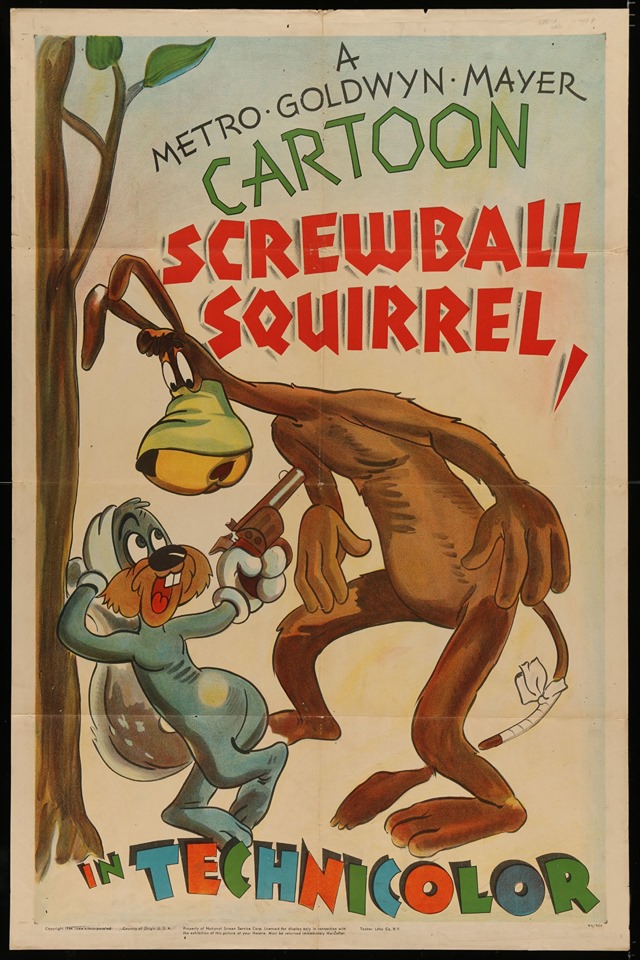
Screwball Squirrel (MGM, 4/1/44 – Tex Avery, dir.) may mark the first instance in which a beaver participates in a cartoon by name-reference only, making no actual appearance on camera. An ultra-cute and realistically-proportioned gray squirrel, intentionally designed to mimic the Disney-inspired animation style of the Harman-Ising eras of MGM production, if not recent Disney productions such as Bambi, skips merrily through the woods, picking up stray nuts he finds on the ground to deposit in a little basket. His foraging is abruptly halted by a furry red foot stepping upon the next nut in line and covering it. The gray squirrel looks up and delivers a friendly “Hello” to the red stranger – a bulb-nosed, buck-toothed, oversize red squirrel at least a head taller than the gray one, with big feet, an oversized tail, and Bugs Bunny gloves on his hands. “Hello”, responds the stranger with a snorting sniffle punctuating his sentence. Our red friend, soon to be known as “Screwy” instead of “Screwball” by the time of his next appearance, asks with only minimal interest what kind of a cartoon this is going to be anyway. Little gray replies, in a falsetto voice so sickly sweet the very hearing of it can give you cavities, that he plays the lead in the picture – Sammy Squirrel – and the cartoon is all about him and his furry friends of the forest (emphasizing the cuddliness of the situation by wrapping himself up in his own fuzzy tail as he describes the scenario). Screwy, a street-smart wise guy crossing Bugs Bunny’s bravado and fearlessness with Daffy Duck’s insanity and penchant for troublemaking, responds as any sophisticate of the cinema would. “Oh, brother! Not that, not THAT!!” These words may have echoed the sentiments of Avery himself at being recently initiated to a studio mired at the time in films of classy but definitely derivative Disney-esque style – and perhaps those of many veteran animators around him, who craved a new direction for displaying their talents in comedy. Avery had never aspired in his many years of production to fit the Disney mold, and, though artistically experienced through long gradual development to be capable of turning out drawings of Disney quality in character, smoothness and expression (perhaps his most Disney-like project being Warner’s “I’d Love To Take Orders From You”, a script which he may have had unloaded upon him just to fill production quota), far preferred to pack his films with rapid-fire and surprising humor, manic expression and tempo, and was determined to break MGM out of a rut to compete on an equal pairing with his old bosses at Warner Brothers.
Thus, his use of realistic and ornate forest animation in the opening shots of this film is convincing and clearly evokes the old styles – but appears purely for the purpose of satire, allowing his new character to have shock value and hit the audience right between the eyes. Certainly the recent efforts of William Hanna and Joseph Barbera had blazed the way before Tex for a parting with the old and an improvement of personality and timing, but Tom and Jerry were still developing their comedy chops when Avery blew into the lot, and Avery’s new style had definite influence upon the cat and mouse’s direction from the time of Avery’s arrival. What is surprising is that by the time of Screwy’s debut, the MGM executives were willing to let go public the sentiment of dissent with the old regime expressed by the squirrel in this cartoon – an unusual degree of self-awareness and letting the audience in on a not-so-private joke that what had been considered by management to be top-of-the-line entertainment in the late 1930’s was no longer viable for the hep, up to date audiences of the wartime 40’s looking for laughs of the quick and belly-variety for instant gratification and escapism. Perhaps this concept would not have worked out had Hugh Harman and Rudolf Ising still at this time maintained a role of control over studio productions, as it might have been viewed as a personal affront to their tastes. But their last productions had screened the previous season, leaving the field wide open for Avery’s commentary, as long as the likes of Fred Quimby and/or other executives followed their normal policy of looking the other way, so long as the cartoons made money. Thus, Avery got away with declaring an absolute schism between the new MGM and almost a decade of past filmmaking, allowing Screwy to be the standard-bearer in declaring the new direction in which the animation units would now be headed.
While Screwy is remarking to the audience in his first-ever breaking of the fourth wall, the gray squirrel is rambling in vivid description about the cast of his cartoon, naming names of all the other equally-adorable but devoid of personality characters who will be his co-stars. Names include Freddy Frog, Wallace Woodchuck, Buster Badger, Horace Hedgehog, Scott Skunk (any intentional relation to Scott Bradley?), Dorothy Duck, and a surprise reference to Barney Bear (who, being a real character of the studio, seems a bit shocking for inclusion. However, Barney had just lost his principal director, Rudolf Ising, and perhaps Avery was unaware that his series was soon to be revived, under the new direction of George Gordon, so thought it fair to pronounce him as washed-up too). Two additional names are included in the gray squirrel’s cast, but their first names are almost obliterated by the speaking of Screwy over the top of them – perhaps a “Benny” Beaver, and a Monkey of inaudible first name. Screwy settles this abominable situation by leading the little blabbing ball of furry boredom behind a tree, then launching an unseen attack upon him, with all the flashing stars, resounding thumps, and sound effects of crashing glassware characteristic of a cartoon fight emitting from each side of the tree trunk. Only Screwy emerges back into camera view, dusting off his gloved hands while the soft sounds are heard of a lone bugler playing taps for the one he left behind the tree. “You wouldn’t have liked the story anyway”, says Screwy matter-of-factly to the theater audience. Over 80 years after its initial presentation, the candor of this sequence and its message to the industry is still jaw-dropping and truly ground-breaking, sure to have the same impact on any new viewer as it must have had upon the theater audience those many years ago.
Old Sequoia (Disney/RKO, Donald Duck, 12/21/45 – Jack King, dir.) – Chip and Dale were not yet a part of the Donald Duck universe, though they had already appeared in the Pluto short, “Private Pluto”. Thinking along similar lines, Jack King’s unit decided to create a pair of mischievous beavers as one-shot foils for Donald – even using some leftover sped-up voice tracks from the chipmunks’ previous appearance as part of the beavers’ dialogue. To set up their meeting, Donald is cast as a forest ranger, stationed in a high tower looking out over the forest. The beavers are forest residents, with no sign of a dam or den under construction, but simply seeming to have a personal hobby of cutting down every tree they encounter – just for kicks. They are currently laying waste to a row of trees extending back as far as the camera can see – and at the forward end of their line of progress stands the monarch of the forest, a giant redwood named Old Sequoia – so old, a brass plaque affixed to the trunk can’t even state the tree’s age, leaving it as a question mark. A chief ranger (voiced by Billy (Black Pete) Bletcher) telephones Donald’s station, first reprimanding him for not answering the phone immediately when called (he had been asleep, his chair resting against a loose railing that almost pitched him into a mile-high fall into a canyon), then informing him that too many trees have been lost in his district. “If Old Sequoia goes,…YOU GO!!!” Donald scopes out the forest action through an extra-long telescope, and spots the beavers just one tree away from beginning their dirty work upon Old Sequoia. Grabbing a double-barreled shotgun, Donald soon arrives in a zip to the scene. He steps on one of the beaver’s tails, stopping his forward progress. The beaver flips him off of his tail, into the trunk of the present tree he has been gnawing at. “Timber!”, he shouts. Donald knocks the first tree down, collapsing upon its trunk. His shotgun goes flying, discharging a shot as it hits a rock, which blasts backwards to fell another tree – right on Donald’s head. Donald’s face turns the usual beet red, and a like-colored head lump emerges through the opposite side of the tree trunk atop him.
The two beavers now take note of what is next in line, and marvel at Old Sequoia’s towering height. “Well, what are we waiting for?”, says one to the other. They begin gnawing. Donald, however, trains both shotgun barrels upon them. But before he can fire a shot, the phone rings at the ranger station high up on the hill. Remembering the chief ranger’s orders to answer immediately, Donald drops everything, and zips at supersonic speed to answer the call. The ranger asks if Donald’s is watching Old Sequoia, and Donald responds, “Yes, sir.” “Well, what are you doing at this phone?!!!” snarls the ranger, contradicting his own order, and sending him back to do his duty guarding the tree.
Donald returns to the woods, to find the tree seemingly in one piece, with no further sign of the intruders. He begins pacing a patrol in front of the tree with his shotgun, only to have his marching interrupted by somewhat distant sounds resembling those of a buzzsaw in a cavern. Listening closely to one of the roots of the tree, Donald discovers the sounds to be coming from within, and guesses who is causing it. “Looks like an inside job”, he squawks. From knotholes everywhere in the trunk, streams of sawdust begin to emerge. Donald, like the beaver in Disney’s 1931 Silly Symphony, begins to play the role of the boy at the dike, hopelessly trying to plug each of the points of sawdust exit. He even tries to scoop sawdust back into the tree, but one of the beavers inside flips it out again with his tail, covering Donald in wood dust, making him resemble a child’s yellow rubber duckie. Donald zips out of frame and returns with a unique piece of heavy-duty construction equipment, vacuuming up sawdust into a giant tube, then spraying it back into the tree through one of the knotholes. Though the dust should match the tree’s original volume, it somehow distributes unevenly, causing two large chunks of the trunk to explode off the tree. Inside, the beavers are revealed, having hollowed out everything of the tree’s middle save a stick in the center, its diameter no wider than a pencil, on which the weight of the entire tree balances. Donald rushes in to add himself as an extra brace, attempting to keep the tree standing. The beavers make Donald’s life more difficult by simultaneously thumping their tails on the ground to create a shock wave. The central stick begins to bend to near snapping point, and the beavers, sensing victory, curl the tail of one beaver into a megaphone shape, allowing the other beaver to holler through it, “TIMBER!” This is actually the last we see of the beavers in the film – though Donald’s troubles are not over. As the tree tips more and more precariously, Donald takes a chance, zips out of the spot he is standing, and returns with about a dozen or more sticks, which he jams into the gap between the upper and lower tree portions in a circular perimeter, attempting to evenly distribute bracing for the tree. He then carries back the two exploded sections of the tree bark, replacing them into position on both sides (although the section with the plaque is at first inserted upside down).
“You’re okay now, Old Sequoia”, says Donald, patting the tree. Yeah, sure. That meager bracing isn’t going to hold all that weight for long, and the two sections of bark become compressed and bulge, ready to pop again. Donald tries to hold them back, when the ranger station phone rings again. The sound waves from the ringing seem the only thing holding the bark walls of the tree in place as they reverberate off the wood, and Donald again risks following orders to answer the call. When he arrives at the station, the ranger asks “How’s Old Sequoia coming?” Now, no phone ringing is providing support for the bark, and Donald stares from his station platform at the upper branches of the giant tree falling straight toward the station. “She’s coming fine”, reports Donald, referring to the tree’s traveling progress. As the trunk of the arbor passes the station in a near miss, a protruding branch reaches out as if a giant hand, making sure that the station also comes along, and yanking the structure right off of its support poles. The tree, and the station house, wind up at the bottom of the river. The phone rings again, and a water-soaked voice howls from the receiver, “YOU’RE FIRED!!!!!!” Donald breaks into his usual squawks of temper, though sounding a bit blubbery underwater, as the bubbles from his breath escape through the closing iris out.
• “Old Sequoia” is on Dailymotion.
The Poet and Peasant (Lantz/Universal, Andy Panda, 3/18/46 – Dick Lundy, dir.), while not yet billed as a “Musical Miniature”, set the template for that soon-to-be Lantz series of episodes scored to classical music. It was in essence a return to the setting of Mickey Mouse’s “The Band Concert”, or perhaps could be paralleled to “Rhapsody in Rivets”, “Concerto In B Flat Minor”, or take your pick of classically-scored concert cartoons of the past. The maestro is Andy Panda, in what is billed as his “farewell performance (we hope).” Andy uncharacteristically appears in a flowing red wig to appear “longhair” like Stokowski, and wears a “dickey” across his chest to also give a cultured appearance. The setting for his performance (an open barnyard) unfortunately gives the event an appearance of anything but polish – as the maestro makes his entrance from a subterranean stage elevator built into a farmyard water pump. Musical spot gags run rampant, including such ideas as Andy’s dickey getting stuck on a nail, and his tugs to snap it loose changing the rhythm of the performance to mild Dixieland. A horse uses a bouncing pumpkin atop an inverted washpail as a tympani, until the pumpkin bounces too hard, spewing its innards all over him. A dancing bird lands on Andy’s baton, then, as Andy shakes the baton to try to get the bird off, transforms into two birds, three birds, four birds, and five birds. A repeat of the shaking reverses the process, back to four birds, three, two,…and then a single cat, who has eaten the bird. The cartoon receives mention here for a stray gag including a flute-tooting beaver, positioned in front of a seated fat pig. The beaver performs double-duty, also serving as a percussionist, by rhythmically whacking the belly of the pig with his tail to produce bass drum sounds. Two ballerina ducks provide a chase finish to the short, as one is summarily devoured behind a haystack by a fox, who takes her place in dancing line to get at the other ballerina. Once the chasing is through, Andy has been bowled over on the podium several times, and the duck has somehow turned the tables, now wearing a fox hunting outfit and blowing a small curved fox-horn, riding the fox off ino the sunset as her trusty steed. Andy receives a final bash in the head from the cat seen earlier on his baton, and ends the concert unconscious against the podium. Nominated for an Academy Award.
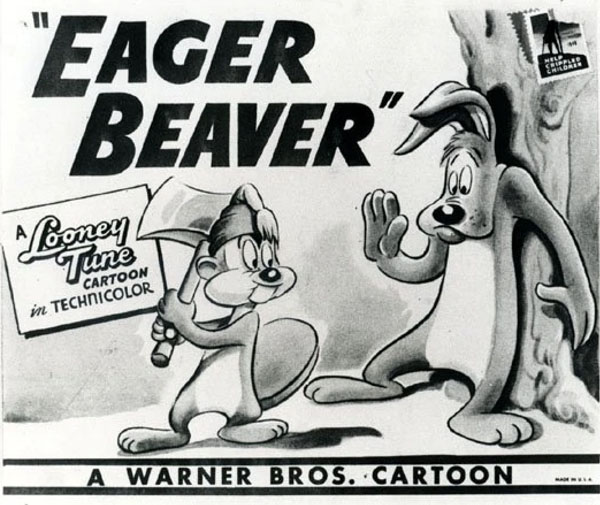
The Eager Beaver (Warner, 7/13/46 – Charles M. (Chuck) Jones, dir.) – Here’s one that has to rank as one of the top beaver stories of all time. It definitely owes its inspiration to Disney’s “The Busy Beavers”, and could almost be considered a modernization of the same tale. While this could easily have resulted, in the wrong hands, in an ultra-cutesy cartoon of the type Avery sought to bury, Jones by this time was fine-tuning his timing, pacing, and choice of gag material, plus mastering his artistic abilities at expressive posing and facial nuances – thus allowing the film to display an up-to-date newness and a sense of that cutting edge house style that became the mark of the mid-1940’s and on.
We open upon a clan of busy beavers (busy, that is, when the camera is looking, although they at first are caught fast asleep by the narrator, who has to verbally nudge them awake to save their reputation). The narrator talks of the beavers’ primary occupation to “dam the river”. The beavers misunderstand the narration, and begin casting unheard but literally visualized “Blankety Blank”s at the water, then are overcome with embarrassment when the narrator reprimands them, “Not that way!”. They begin the actual task at hand, with a string of fast-timed gags. One beaver seats another upon a block of ice, until his teeth start to chatter. When his jaws are good and active, he is carried to a tree to devour a troth in the trunk like a power-saw. “TIMBER!” yells the first beaver, as a trio of eggs is toppled out of a nest in the tree branches above. The eggs hatch, each bird well prepared for the situation, wearing a parachute. However, the third of the youngsters has the same stuttering problem (and voice) as Porky Pig, and can’t utter the word “Geronimo” preliminary to pulling the ripcord. Amidst an endless verbal stream of “G-g-g-g-g-”s, he crash lands on the ground, then disgustedly gets out “Geronimo!”, to have the parachute open on delayed basis, and drag him out of the shot. A log is cleaned of foliage for use in construction by merely inserted a corkscrew in the center of the diameter of the fallen tree, and pulling out the central wood from the bark as if extracting a cork from a champagne bottle. Another beaver solves the problem of an axe which has become dull by popping open a spring-loaded pivoting panel in the side of the axe head, and replacing within a compartment therein a new “double-edged safety blade” – a product even then well-known to the owners of Gillette razors for shaving. We are also introduced to the running gag of the film – and a key plot point – a beaver foreman who suffers from chronic indecision in directing the placement of a key log into the dam from a crane, endlessly giving the crane operator directions that contradict themselves, left, right, up, down, merely shifting the log back and forth in position.
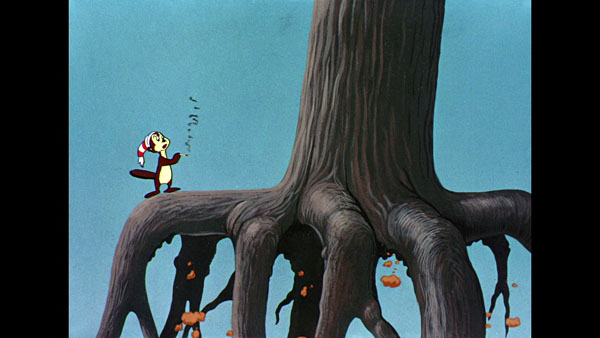
Among this clan lives Eager Beaver, a young newbie anxious to get in on the wood-cutting action, but overlooked by his peers as meddlesome and too puny. Eager still attempts to join the activity. He aims his axe at a first tree, but is blocked from swinging by a prototype Charlie Dog, who at first seems determined to “save that tree”, but really only wants to rescue a bone he has buried under it. Now the path is clear for an axe swing, but Eager is beaten to it by several swings of other beavers’ axes, barely escaping the scene with his own head still on his shoulders. It is the same story wherever he goes – excepting for one “trunk” he successfully chops, only to find it is really a telephone pole, with an irritated lineman seated on top. One of the larger beavers, to get him out of the way of the real work, directs his attention to a humongous tree on a mountain peak, which none of the other beavers seem to be paying attention to, and shouts “WHY DON’T YOU CHOP THAT TREE DOWN??” This is with good reason, for the tree seems unchoppable. Eager’s small axe gets nowhere, not even making a dent. He goes for some heavy ammunition, raiding a dynamite shack and setting off the explosives around the tree trunk. All the blast does is expose an ultra-long root system embedded in the mountain peak – but the tree doesn’t budge an inch.
Back at the dam worksite, the foreman continues to be confused as ever, but a warning is received from a messenger bird, who squawks unintelligibly with vigor. On the screen appears a subtitle – “English Translation: There’s a flood coming. Get moving, stupid!!!!” The beavers shift to double speed, placing logs into the dam from both riverbanks – all except the key log the foreman has been fussing over, which remains hovering above on the crane, while all wait for the foreman to finish his directions. Above on the mountain peak, Eager scratches his head, pondering what to do about his own designated task. A cutaway view of his skull shows motors and gears spinning around in his brain, until a light bulb lights on which appears the word “Idea”. Reaching into his pocket, Eager handily produces a small matchbox, on which is written the words “One termite.” He slides the box open, revealing a ravenous bug that is all teeth. In a split second, the bug has chewed through the massive tree trunk, then yells in a tiny voice “Timber!” The tree topples onto one side of the peak, and is briefly motionless. Eager jumps onto one end of the fallen log, trying to start it sliding down the hill. It suddenly gives way, taking Eager with it for the ride as it plunges off a cliff, toward a deep canyon below. With superhuman effort, Eager takes hold of the trunk, and gives the massive tree a mighty flip in direction, so that he appears to be holding it as one would an umbrella by the pole, and the tree’s limbs extend outward like an umbrella canopy, forming a huge parachute by which Eager is able to gently sail down to safety into the canyon below. Eager’s safety does not last long – as immediately behind him, filling the canyon’s walls, comes the onrush of a solid wall of flood water, towering about 20 stories above his head.
Still carrying the tree, Eager engages in a winding foot race, staying only mere steps ahead of the raging waters behind him. The scene returns to the dam, where the whole beaver community nervously awaits the completion of the foreman’s signals – a wait that it seems will go on interminably. Panning back upstream, the camera picks up Eager, the tree, and the flood waters, as they approach the drop-off point of a high cliff above the beavers’ valley. Eager leaps off the cliff with the tree, with the water close behind. Sailing through the air, Eager again gives the tree a flip in reverse direction, pointing its upmost branches downwards. Now the branches neatly fold like an umbrella closing, and with precision aim, the giant tree falls into the hole intended for the foreman’s key log in the dam. Eager lands atop the inverted trunk, the impact of his landing and additional bounces hammering the tree firmly into place to complete the installation, just as the flood waters hit the dam wall from behind. The structure holds, and the flood waters are halted and corralled. To Eager’s utter surprise, he finds himself carried upon the shoulders of the beavers of the community, hailed as a hero. The only ones not joining the festivities are the foreman and the crane operator, as the foreman offers a few final directions, then at last is satisfied with the log’s position. “Okay, Mac. Let her go!” shouts the foreman – only to have the log dropped directly upon himself, burying him completely in the ground, for the iris out.
• “The Eager Beaver” can be viewed on Dailymotion.
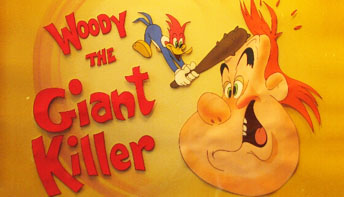
Woody the Giant Killer (Lantz/Universal, Woody Woodpecker, 12/15/47 – Dick Lundy, dir.) – Dick Lundy seems to have been the only golden-age animation director who attempted to launch a beaver as a recurring character in theatrical cartoons. The character (who may possibly have pre-dated this film as a creation from Lantz character comic books) is actually not at all beaver-like in behavior or demeanor, but was more of a W.C. Fields-inspired fast-talking sharpie and con man, named Buck Beaver. The name “Buck” appears not to refer to his front teeth, but his ever-present quest to make a fast “buck”. It is unclear what Woody’s occupation or particular reason for being in the location he finds himself is when the cartoon opens, but he refers to himself as a “floater”, suggesting he is a traveling day-laborer. The town he has landed in, however, is completely booked up when it comes to living space, with signs everywhere declaring “No vacancy”, and one that simply says, “No, no no!” As Woody grumbles about the housing shortage while seated on a staircase front step, Buck Beaver arrives and sets up shop with a collapsible peddler’s wagon packed in his traveling suitcase. He calls for Woody’s attention, and, having no idea why Woody is moping, nevertheless claims to have the answer to all his problems. “Okay, wise guy. What’s the answer?”, responds Woody sarcastically. The beaver begins a spiel about his fabulous magic beans, imported directly from the Carri-bean. “I don’t want beans! I want a room!”, bellows Woody, bringing down his fist upon the sales counter of Buck’s wagon, and dislodging a loose board, which smacks Woody in the face, his beak protruding right through it. Undaunted, Buck continues his sales pitch, and provides a demonstration of how, with just a few magic words, these beans produce a beanstalk right before your eyes. He sets up a small pot on the counter, drops in a bean, then utters standard stage-magician incantations. A thin but tall beanstalk emerges almost immediately. What Woody doesn’t see is that the stalk is ready-made, wound around a large wooden spool hidden in the base of the wagon, and being forced up through the pot by means of a foot pedal Buck is operating for the spool. Woody is fascinated enough to forget his room troubles, and shell out a buck for the beans.
Buck disappears from the film after that. Apparently, however, he is more reputable that he appears – or merely didn’t know the source of what he is selling – because when Woody plants the beans, they at first make no response to the magic words, but in delayed reaction produce a stalk worthy of Jack from the storybooks. The beanstalk lifts a riff from Bugs Bunny’s “Jack-Wabbit and the Beanstalk”, equipped with an internal elevator (what Bugs called “modern design”), and zooms Woody up through the tendrils to the cloud world of Giantland – where there is still no vacancy. Woody nevertheless headstrongly barges in to a castle, demanding service. I won’t cover all the details as off-point for this series, but needless to say, Woody baffles and befuddles the giant, finally causing him and the entire castle to fall to Earth, where its stones restructure themselves into the Castle Apartments – with plenty of vacancies. Woody becomes manager, and the giant labors for him as bellboy!
Buck was a licensed property for sporadic appearances in Walter Lantz comic books and coloring books, but would appear in only one further cartoon – to be discussed next week.
Lazy Little Beaver (Terrytoons/Fox, Mighty Mouse, 12/26/47 – Eddie Donnelly, dir.) – Narrator/writer Tom Morrison just can’t resist referring to beavers as “the best dam builders in the country.” Random gags open the film, with one beaver impossibly balancing a lengthy log atop his head, as the camera tracks back to a point where we expect to see another beaver carrying the rear – but instead find only a red flag tied to the end of the log to signal an overhanging load. A small beaver appears to have gnawed the wide trunk of a tree down to a center-point of a mere inch in diameter, and still stands within the hole, looking as if the tree will imminently smash down upon him with crushing weight. “I hope this little fellow knows what he’s doing”, remarks Morrison. But indeed he does, as the beaver merely snaps away the center stub, lifting the entirety of what is above him onto his shoulders. As he jumps down to the ground, it is revealed that there is no towering tree above him at all, as the tree had already been previously cut, and what the beaver is carrying is only a flat wheel of wood about two inches thick! But off to one side of an assembly line cutting and floating logs to the dam, we are introduced to another small beaver – the laziest in the forest, who slowly bounces a rubber ball off his tail in paddleball fashion (borrowing the gag from Fleischer’s “Little Lamby”), and remarks, “Ho hum, lack a day.” His papa, foreman of the project, cautions him that unless he remains busy and alert, he may wind up in a fur coat – and he won’t be wearing it. His lecture has little effect on Junior, who takes a rest on the end of a two-handled saw, leaving Papa to do all the pushing and pulling on his end. Papa gives him a spanking, administered by Papa’s own tail. Junior decides to run away, but pulls the old Hansel and Gretel trick in case he changes his mind, leaving behind him a trail of bread crumbs to lead back home. The birds eat it all, swallowing the last morsels while hitching a ride on the beaver’s tail. A wicked wolf (voiced by Dayton Allen), hears him crying at being lost, and sets up a portable information booth, playing the part of a guide. He informs the beaver that he saw some bread crumbs just down the road. To his surprise, the beaver finds a trail of crumbs yet uneaten, and begins to follow them. Of course, it is the wolf who is laying them out ahead, creating a path which leads right into his forest furrier shop!
The door of the shop slams and locks immediately upon the beaver’s entering, and the wolf tests the beaver for size, placing down around him a partially-finished fur coat from which one pelt is yet missing. “Perfect fit”, remarks the wolf. Junior runs, making a dive toward a window. The wolf gets there ahead of him, pulling a Heckle and Jeckle move by tugging the window frame to one side of the wall, leaving the beaver to smack his head into solid wood. The wolf places the unconscious youth upon a conveyor belt, leading to robotic arms wielding scissors and a sewing needle, ready to render him into the coat his father talked about. Who should chance to be sailing over the woods in a blimp, with neon lights on the side displaying his name, but Mighty Mouse. (Yes, buy the way, the Goodyear blimp was already in existence even then.) Spotting the trouble through binoculars, Mighty is off to the rescue. The wolf gets a typical pummeling, highlights including socking the wolf while his arms hold a mallet behind his head in the middle of an intended backswing, causing the wolf’s head to repeatedly rebound between the mallet head and Mighty’s fist; a blow that knocks off the wolf’s nose in Tex Avery fashion, sending it independently yipping around on the ground like a wounded dog; a loss of the wolf’s own fur coat that reduces him to his underwear; and a playful sock from Mighty which is more like a flick of a finger, slamming the wolf into a tree trunk and bringing down a bee’s nest upon his head. The beaver is rescued in nick of time from the machinery, and is so happy at being rescued, he becomes the most industrious beaver in the forest, zooming through tree trunks as if Mighty Mouse in flight, seeming to be set on chopping down the entire forest single-handed.
The Little Cut Up (Famous/Paramount, Noveltoon, 1/21/49 – I. Sparber, dir.). We open on a tree in the forest, populated by a variety of creatures, including a wise owl, three squirrels who take turns whacking each other on the head to crack nuts to eat, a mama bluebird and her three fledglings, and a Mr. and Mrs. Bunny, the latter of whom is knitting little things – quite a few of them – for an expectant family. Nearby, a community of beavers busies themselves on a nearly-completed dam. Along comes a little boy dressed in clothes suggesting colonial times, and wearing a small white-powdered wig. He is carrying a hatchet, and sings an original number probably penned by Winston Sharples, “Chop Chop Chop”, describing the fun he has chopping down trees at random. Of course, the animal community tree turns out to be in the line of fire, and with a few well-places blows, the child fells it, causing it to land squarely on the beaver dam. (Damn!) The beavers are launched into the air from the impact, and cluster together, attempting to use their combined spinning tails as the blades of a helicopter, but getting their appendages tangled up, landing them back on land with a crash, and resulting in them appearing in bandages and on crutches. The other animals aren’t in much better physical shape, and everyone’s homes and property are a wreck. Wise owl emerges from the stream covered in mud, and shames the boy for the destruction he’s caused. Learning that everyone’s homeless, the child decides to make amends by taking them to his home and building them all new domiciles. At a sumptuous plantation, the boy builds wise owl a colonial-style treetop structure, complete with a rocking chair on the veranda. Mrs. Bluebird gets an equally ornate birdhouse on a pole, with a small fountain alongside for her brood to use as a birdbath. The squirrel’s home has made life easier by the addition of a nut bowl and nutcracker. A larger house serves as a hutch for the rabbits – and they can use the space, as they now have a stroller built for over a dozen babies, with a descending bar over the top that lowers a row of milk bottles when it’s feeding time. As for the beavers, the child puts his hatchet to more constructive use, chopping a sturdy cherry tree to give the beavers a strong lumber supply for their new dam. A colonial gentleman armed with a musket – the boy’s father – hears the tree fall, rushes to the scene, and places blame on the beavers for felling the best cherry tree in Virginia. The boy stands in front of the raised musket barrel to block the shot, and states – – well, you should know the rest, as the boy is of course, the young George Washington.
NEXT: A move into the furry 50’s.

 Login
Login