US Extends Russian Oil Waiver As Bessent Urges Tougher Iran Sanctions


![]()
WASHINGTON, June 10 — US forces carried out strikes against Iran yesterday in what President Donald Trump said was retaliation for the downing of an American helicopter by the Islamic Republic a day earlier.
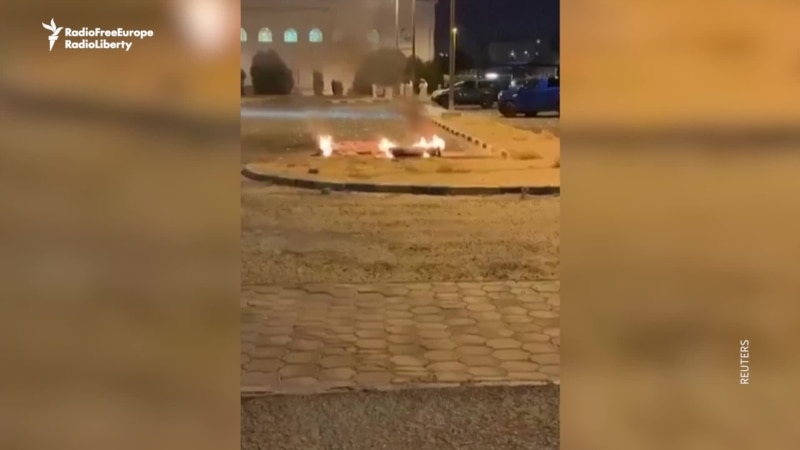
Iranian media said that following a series of explosions along Iran’s southern coast near the Strait of Hormuz, the situation was “now reported to be calm.”
Digital news outlet Axios reported that US forces had attacked several Iranian air defense systems and radar systems around the strait.
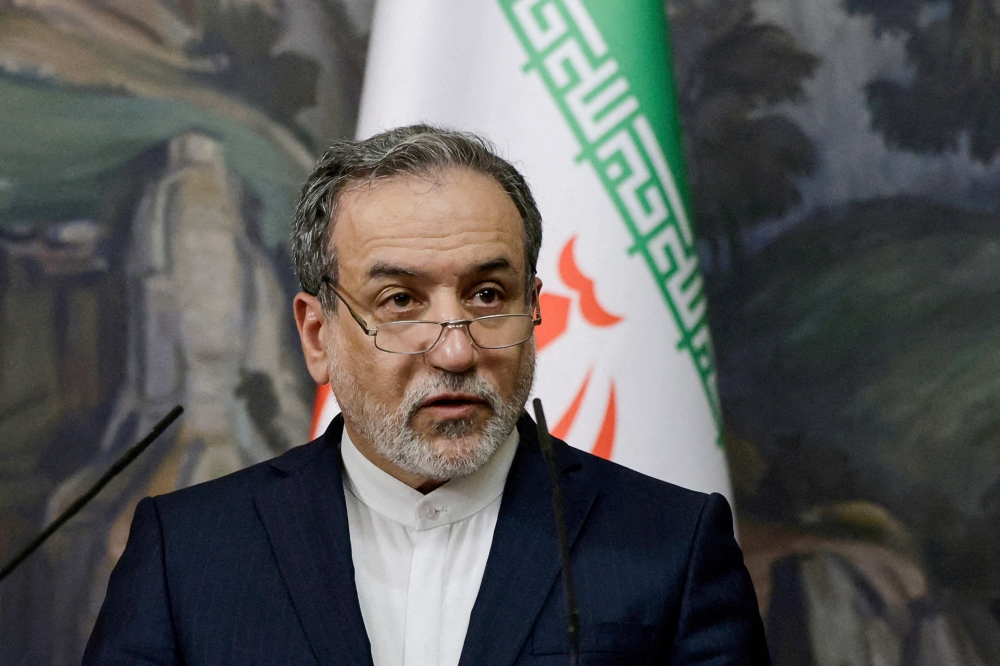
Following the strikes, Iran’s Foreign Minister Abbas Araghchi threatened to retaliate.
“Despite its defeats on the battlefield, the U.S. opted to test our determination. Our Powerful Armed Forces will leave no attack or threat unanswered. Leave our region if you want to be safe,” Araghchi posted on X.
The US strikes came just hours after Trump had said negotiations to end the Middle East war were in their final stages—a claim he has made repeatedly in the past few weeks.
But after the downing of a US Army Apache helicopter on Monday, Trump said the United States was responding “in a strong manner” after “what they did with our helicopter last night,” in a telephone interview with ABC News.
“And I believe the response should be very strong, very powerful, and that’s what this one is,” he said.
US Central Command (CENTCOM) said American forces “began launching self-defense strikes against Iran, at 5 pm yesterday at the Commander in Chief’s direction” and “the mission is a proportional response to unjustified Iranian aggression.”
A shaky ceasefire between the warring parties has been in place since April 8, but it faced a major test when Iran and Israel renewed attacks over the weekend, before each side announced a halt.
Israeli attacks on Lebanon continued, however, and Lebanese officials said 11 people were killed in airstrikes on Tuesday on the historic city of Tyre in the south of the country.
The Israeli military also warned the entire city to evacuate.
An AFP correspondent saw residents of Tyre, including from the Christian quarter, fleeing and heavy traffic heading north after the Israeli warning.
Another correspondent in the coastal city of Sidon, further north, saw displaced people arriving from Tyre, some with belongings hastily strapped to the roofs of their cars.
Tehran has insisted a halt to the war must include a truce in Lebanon, which was drawn into the conflict when Iran-backed Hezbollah militants fired rockets at Israel on March 2.
Israel responded with an extensive campaign of airstrikes and a ground invasion that has killed more than 3,600 people. Exchanges of fire with Hezbollah have not stopped despite an ongoing truce.
Constant risk
Iran’s Foreign Minister Abbas Araghchi urged foreign forces meanwhile to leave the Strait of Hormuz and surrounding areas, warning that they faced a risk of being caught in the crossfire if they remained.
“The Strait of Hormuz is NOT international waters but shared between Iran and Oman,” Araghchi said. “Foreign forces in proximity to our territory are at constant risk on account of their own human errors, plain accidents, or potentially being caught in crossfire.
“To reduce risk, best solution is for them to leave. We prefer language of diplomacy but speak other languages too,” he said.
The US Army Apache helicopter is the second crewed aircraft that Washington has confirmed was shot down by Iran during the war, following the loss of an F-15 fighter plane in April.
CENTCOM said the two crew members were rescued after their helicopter went down near the coast of Oman.
“The Soldiers were safely rescued within approximately two hours and are in stable condition,” CENTCOM said in a post on X.
A spokesperson said a naval surface drone helped rescue the crew members.
The US-Iran conflict has severely disrupted shipping via the Strait of Hormuz, through which about a fifth of global oil usually passes, while Washington has imposed a blockade on Iranian ports.
The price of the main US oil benchmark—West Texas Intermediate—jumped 1.4 percent shortly before Asian markets opened Wednesday, reaching $89.40 per barrel following the news of renewed US strikes.
Oil prices had retreated previously after Trump hinted at a deal with Iran in the coming days. — AFP


![]()
WASHINGTON, June 9 — From handcuffed extra-terrestrials to an orbital missile command centre — US President Donald Trump is unleashing a relentless stream of AI-generated imagery that analysts view as an effort to dominate the attention economy ahead of perilous midterm elections.
Artificial intelligence has transformed Trump’s Truth Social feed into a cascade of memes skewering his political rivals and glorifying himself, with the communications style echoed across his administration.
The attention-grabbing posts come as Trump’s approval ratings slide to new lows ahead of elections in November, in which his Republican Party is seeking to maintain its narrow control of Congress.
Trump is “facing many problems that he has failed to solve,” including an unpopular war with Iran and inflation, Todd Belt, director of the political management program at George Washington University, told AFP.
“So, he’s flooding the information environment with positive images of himself, particularly images that make him look large and in charge.”
For a president facing multiple challenges, Trump has averaged about 20 posts a day on Truth Social this year, researchers say, with many of those posts — sometimes part of late-night tirades — featuring AI-generated imagery.
During one particularly active stretch last weekend, one post showed Trump riding horseback beside George Washington, next to a race car, with the White House in the background.
Another depicted an enlarged image of Trump towering over Greenland beneath the words “Hello, Greenland!”
Trump has raised alarm by repeatedly threatening to take over Denmark’s autonomous territory, saying it is vital for national security.
‘Diverting attention’
Another image showed Trump looming over warships, dressed as a military commander clad in gold armor, as fighter jets flew overhead.
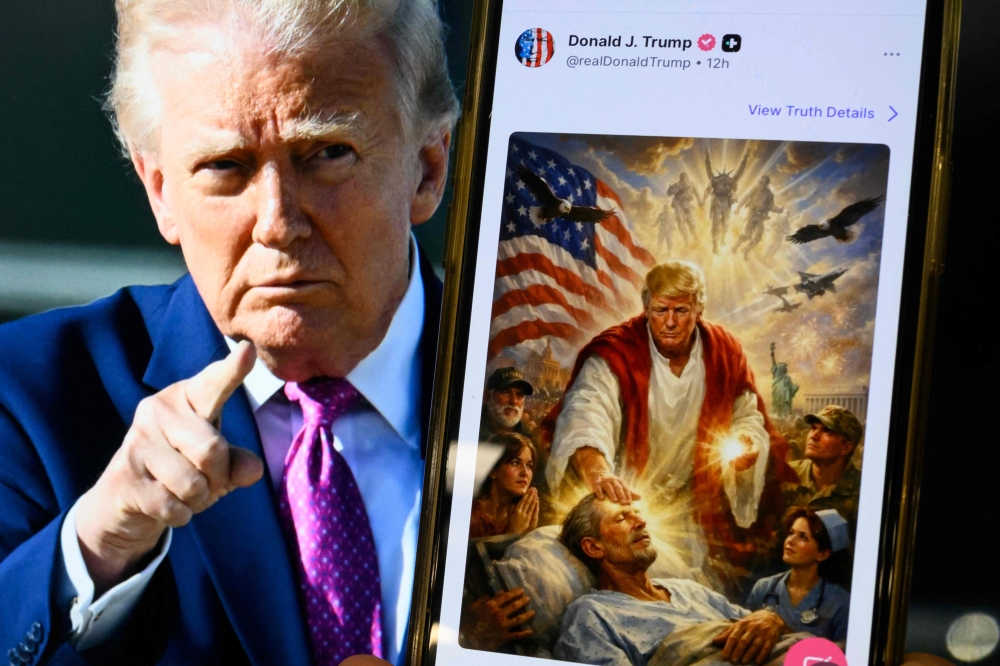
Trump may be attempting to control the narrative with such AI-generated imagery, some observers say, even as he triggers backlash — such as with his now-deleted post depicting himself as Jesus Christ.
“Trump’s AI trial balloons are yet another strategic distraction, reducing public dialogue to the most banal issues in hopes of diverting attention from more important topics of the day,” Nora Benavidez, senior counsel at the advocacy group Free Press, told AFP.
“If we are busy debating his likeness to Christ or some other AI-generated savior image, Trump hopes we might not have the time or energy or solidarity to challenge his latest war or rising unaffordability and gas prices.”
Other analysts say the AI messaging could seek to rally his support base and campaign through trolling.
‘Illusion is powerful’
“Trump is posting these to generate emotion,” Cory Alpert, a researcher at the University of Melbourne, wrote in a report.
“His followers are not seeing actual truth, but a version of reality that they want to believe is true. The illusion is powerful.”
Underscoring the strategy’s potential appeal to younger voters, similar AI-driven messaging has also been adopted by other arms of the Trump administration as well as by some of the president’s political rivals.
It is unclear how much of the Truth Social feed is posted by Trump himself, by his White House team or a combination of both. The White House did not respond to AFP’s request for comment.
“The White House is certainly aware of the stakes of the midterm elections, and the president’s sensational AI renderings reflect the need to attract attention to initiatives he believes are successful,” Walter Scheirer of the University of Notre Dame told AFP.
“Whether these AI fantasies and the less than spectacular circumstances they’re based on resonate with voters will be determined in November.” — AFP


![]()
GENEVA, June 13 — Switzerland has offered to host the possible signing of a peace agreement between the United States and Iran, the Swiss foreign ministry told AFP on Friday.
“Switzerland is fully engaged. We are in close contact with the United States and Iran,” the ministry said in a brief message sent to AFP.
A senior official in President Donald Trump’s administration said Friday that the United States was “80 to 85 per cent” confident of inking an accord with Tehran to end the war in the coming days.
The Swiss foreign ministry said it was playing an active role “to support efforts toward a Memorandum of Understanding intended to consolidate the truce and pave the way for de-escalation in the context of the conflict between Iran and the USA”.
In addition, the ministry said it “has proposed Switzerland as the venue for a possible signing, should the parties agree to it”.
Prime Minister Shehbaz Sharif of Pakistan – which has acted as mediator in efforts to end the war – said on Friday that an agreement on the text of a peace deal had been reached. — AFP