Andy Burnham Headlining New UK Film & TV Event In Manchester Alongside ‘Adolescence’ EP & BBC iPlayer Boss


![]()
KUANTAN, June 7 — An American tourist who was reported missing while hiking on Pulau Tioman was found safe last night after he shared his real-time location via mobile phone with rescue teams.
Rompin district police chief Supt Sharif Shai Sharif Mondoi said police received information about the missing man at about 5.30pm yesterday after he failed to return to his resort accommodation following an activity along the old Kampung Tekek-Kampung Juara trail.
“The victim was found at 8.33pm in the Bukit Parang forest area, Kampung Tekek, in a safe condition and without any injuries. He was taken out of the forest area for further checks,” he said in a statement today, without naming the victim.
He said the trail has many junctions and side paths and is no longer used as a main route by locals.
“At present, the trail is often used by tourists as a hiking and recreational route. Investigations found that the victim got lost after taking the wrong branch of the path, which caused him to be unable to exit the hilly forest area,” he said.
Sharif Shai said the search operation was carried out by the Tioman police station with assistance from the Wildlife and National Parks Department team on Pulau Tioman.
He advised tourists engaging in hiking or recreational activities in forested areas to make adequate preparations, inform relevant parties of their movements, and ensure communication devices are in good working order to avoid untoward incidents. — Bernama

Sometimes, it feels like there aren't any new ideas under the sun. Although there's some truth in that assertion, given how the ever-churning IP machine tends to dominate film and television, franchise name recognition has always factored into which projects do and don't see the light of day. The "there's nothing new under the sun" adage has always been true, and that's not always a bad thing. Tropes exist because we can only tell so many variations of a story; innovation often boils down to re-envisioning genres from the ground up.


Sure, Peppermint Patty went into a swivet when Charlie Brown’s Thanksgiving dinner consisted of popcorn, pretzels, jellybeans and toast (and Linus had seen him make toast). But she wouldn’t complain about what Abrams and Lee Mendelson Film Productions have served up in book and recorded form, respectively.
The Essential Peanuts by Charles M. Schulz: The Greatest Comic Strip of All Time by Mark Evanier (Abrams Comic Arts) is a lavish coffee-table book packaged with collectible bonus materials. It is stunning visually from cover to cover, from the iconic “warm puppy” image on the slipcase and “cloud dreams” scene from the Sunday strip (and later in the first feature, 1969’s A Boy Named Charlie Brown) on the book cover itself.
Mark Evanier, a person whom everyone reading this should already know about (and if not, visit his venerable daily blog, newsfromme.com), wrote the detailed text. Mark is quick to point out his discomfort having sole author credit, as so many people were involved, even before he was brought into the project.
“Up front here,” he said, “This book was really a team effort, and I don’t say that to sound humble.” By calculated coincidence, a new interview with Mark can be heard in an episode of POP Culture Classics Podcast with Greg Ehrbar called “A Celebration of Charles M. Schulz and Peanuts” (Please subscribe and “like” it on your favorite streaming service.)
The book is organized by era, providing a chronological context of Schulz’s life, art, and characters, as well as the world around him. To newer Peanuts fans or those interested in comics, animation, art, and all things that connect it, it is a valuable series of revelations. To those of us who see Peanuts as an organic part of their lives, it is both reaffirming and fascinating.
Several people adroitly offer their perceptions of Charlie Brown and the gang within their own lives and careers, but again, Mark Evanier eloquently express the scope and attachment we enthusiasts have for Schulz’s one-of-a-kind accomplishments. Of course, the genuine author is really Schulz himself, still astonishing us with his gift for combining character-driven writing that is infinitely quotable with an ability to convey humor and emotion in a manner so extraordinary, he is the real-life superhero of all comicdom.
IT’S ARBOR DAY, CHARLIE BROWN / CHARLIE BROWN’S ALL-STARS
Original Television Soundtracks
50th Anniversary Extended Edition
Music by Vince Guaraldi
Lee Mendelson Film Productions LM26ADAS01 (stereo/mono) 12” LP (also download and CD).
Released in 2026. Producers: Sean Mendelson, Jason Mendelson. Musicians: Vince Guaraldi, Frank Snow, John Coppola, Eugene “Fuzzy” Firth, Eddie Duran. Liner Notes: Derrick Bang, Sean Mendelson, Jason Mendelson. Mastering: Vinson Hudson. Mixer; Clark Germain. Running Time: 33 minutes.
“It’s Arbor Day, Charlie Brown” Music: “Rerun’s Lament,” “Rerun’s Lament (Reprise),” “Ships Sail Into Arbor,” “Laughter In The Library,” “Flatten Patten (Baseball Theme),” “Young Man’s Fancy,” “Jay Sterling Morton Jazz,” “We’re The Visiting Team,” “Seeds For Thought (Joe Cool),” “Don’t Forget The Shovel,” “Sprinkle Your Bird,” “Snoopy At Bat,” “Lucy’s Home Run,” “Rain, Rain, Go Away (Rain, Gentle Rain),” “Happy Arbor Day, Charlie Brown,” “Jay Sterling Morton Jazz (Bonus Alternate Take),” “Happy Arbor Day, Charlie Brown (Bonus Alternate Take),” by Vince Guaraldi.
By the time It’s Arbor Day, Charlie Brown aired on CBS in 1976, there were those who said, “Charlie Brown has officially run out of holidays.” How wrong they were. Happy New Year, Charlie Brown was still to come (that was in 1986), as well as shows related to events like It’s the Super Bowl, Charlie Brown (1994) and even some that revisited holidays, like 1992’s It’s Christmas Time Again, Charlie Brown (the original VHS of which was sold at Shell gas stations).“Charlie Brown’s All-Stars” Music: “Charlie’s Run,” “Charlie Brown’s All Stars!” “Baseball Theme (Medley),” “Oh, Good Grief!” “Surfin’ Snoopy,” “Pebble Beach,” “Rain, Rain, Go Away,” by Vince Guaraldi.
Arbor Day, which occurs on the last Friday of April has been around for well over a hundred years, observed by planting trees to make the earth a better place, certainly an accessible way for people, especially kids, to do something positive. Admittedly, it’s not as “big” as some other holiday, especially in retail terms, but it’s to the credit of Schulz, Mendelson, Melendez, and CBS that it was given due attention on a Peanuts TV special.
Now Lee Mendelson Film Productions, in their ongoing effort to release these treasured soundtracks on vinyl, CD, and streaming, have combined Vince Guaraldi’s superb music for Arbor Day with the soundtrack from the 1966 special, Charlie Brown’s All-Stars (which is explored by our colleague Mike Lyons in this fine Animation Cel-abration feature on Cartoon Research.
Charlie Brown’s All-Stars was only the second Peanuts animated special, and one of the more forgotten ones among the early classics. One reason is that it isn’t connected to a holiday, and another might be that it did not “score” as highly in the ratings over the years.
It’s also uniquely dated for a Peanuts special, because an offer to put Charlie Brown’s team in a real league with uniforms is withdrawn because of females on the team (in addition to a very highly unique dog).
Peppermint Patty, who had not made her indomitable debut in a special, would have surely confronted Mr. Hennessy himself. A remake of sorts was produced for video in 1996. It’s Spring Training, Charlie Brown, in which the team again loses its chance for uniforms but for a different (and amusing) reason.
Because Charlie Brown’s All-Stars contains less than ten minutes of music, and the special has become less evergreen (sorry) than It’s Arbor Day, Charlie Brown, the latter soundtrack is featured on the front cover with All-Stars on the back. They complement each other perfectly, both in story and music, with baseball being the main connector.
Like planting trees for a better tomorrow, get a copy of this new soundtrack, as sales dictate the reoccurrence of the kind of media we really want.
“Charlie Brown’s All-Stars” on Charlie Brown Records
Covered in an earlier Animation Spin, Disneyland/Vista’s Charlie Brown label offered the story with dialogue as well as music, but not the music on its own. Here is the read-along seven-inch LLP/cassette, which is an edited version of the full album with page turning signals.


![]()
PARIS, June 3 — French authorities said today that they had imposed two fines on Shein totalling more than €22 million (RM101 million), citing problems with product traceability, environmental labelling and delivery times.
The new penalties bring the total fines imposed by France against the Asian fashion giant to more than €210 million.
Shein said it was contesting the “disproportionate” penalties, arguing that no consumer harm had been established.
The Singapore-based company has been under fire since it established operations in France. Last year, the discovery of childlike sex dolls on the Shein platform caused outrage in France and prompted greater scrutiny.
Trade Minister Serge Papin said e-commerce platforms “avoid complying with our rules”.
“This is unfair competition, and I am fighting against it,” he said on X.
“Since the discovery of child pornography dolls on Shein, we have decided not to let these platforms get away with it, and we will continue until they completely change their practices — or abandon our market.”
The government’s consumer protection agency DGCCRF imposed the penalties following an investigation targeting several e-commerce platforms, primarily based outside Europe, including Shein.
The first fine of €5.77 million targets Infinite Style Ecommerce Co Ltd (ISEL), which handles sales for Shein.
The DGCCRF accuses Shein of failing to comply with a 14-day period required for consumers to be able to reconsider certain purchases and return them free of charge.
The watchdog also accuses the company of omitting mandatory traceability information, such as the countries where its clothing is woven, dyed and manufactured, and of failing to disclose the presence of microplastics in its fabrics.
Microplastics, primarily found in polyester, are released into the water with every machine wash, posing a serious environmental threat.
The agency also slapped a fine of €16.73 million on Shein’s subsidiary Infinite Styles Services Limited (ISSL), accusing it of violations of consumer law.
“We dispute these findings and consider the fines manifestly disproportionate,” Shein said.
“There has never been any doubt about the fairness of transactions on our platform, or the quality and safety of the products and services offered,” it said.
Following the uproar over the sex dolls, Shein said it immediately removed the products from its marketplace—the section of its website selling third-party products—and banned sex dolls from its site globally.
Campaign groups and politicians accuse Shein of generating environmental pollution, practising unfair competition, selling goods that fail to comply with basic regulations and imposing poor working conditions in its Chinese factories.
In July, France slapped Shein with a €40 million fine, saying it misled customers on price deals and on its environmental impact. — AFP


The creation of Hanna-Barbera is certainly the result of a perfect storm of talent, circumstances, and miracles. An extraordinary team of people, veterans and newcomers, gave even the most budget, time, and scrutiny-challenged entertainment a special spark. Most of the time, when they had the chance to make something good, it was better than good, it was great.
Ted Nichols at Hanna Barbera. Photo Credit – Ryan Williams:WGCN
One of those people is the often-overlooked composer/arranger/conductor Ted Nichols. Hoyt Curtin is considered TV animation’s musical genius, and rightly so. In 1963, when the studio started bursting at the seams from massive production demands and unparalleled success, Nichols began his H-B career. Along with Jack de Mello, whom we remembered in this Animation Spin, Nichols was among the additional music staff needed to get the scoring done at its highest level.
The Dapper Dans: John Borneman (tenor), Roger Axworthy (lead), T.J. Marker (bass), and Ted Nichols (baritone).
Walt Disney was among the guests enjoying the quartet during his countless park visits. Nichols told Marissa Freireich of the Williams-Grand Canyon Review in a rare interview. “The funny thing was, Uncle Walt as we called him, used to come there to Disneyland, and he’d sneak in and go over to the coffee place and sneak in the back,” Nichols told Freireich. “I’d just go over, sit with him, and have coffee.”
During his years as Minister of Music at Church of the Open Door in Glendora, California, he met an animator who was also a choir singer. “He liked what I did. And I kidded him one time, I said, ‘well why don’t you introduce me to your boss?’ The next week, I get a call from Bill Hanna,” Nichols said. Hanna, also a musician and lyricist, was an avid barbershop quartet singer (“Zuckerman’s Famous Pig” in Charlotte’s Web was a tribute to Hanna’s avocation).
Nichols’ earliest success for H-B was creating action/adventure cues for Jonny Quest. According to TV music historian Jon Burlingame, the composers did not collaborate. The orchestra sessions were separate. Nichols’ extensive experience as a musical director was evident, as was his ability to work within the general framework that Curtin created for Hanna-Barbera. This was a specialized technique requiring the ability to write cues for sequences in the works, as well as anticipating the need for additional cues that might necessary later in production.
Nichols proved astute in adapting his music to that of Curtin’s previous H-B cues. All of Hanna-Barbera’s TV cues were not the same. While the Loopy DeLoop and Yogi Bear Show cues had a similar tone, those for The Flintstones, The Jetsons, and Top Cat were distinct enough for sharp listeners to distinguish in most cases. These cues were heard in virtually all H-B cartoons of the early sixties. Nichols managed to blend his music with the other cues for Jonny Quest so it all functioned as a cohesive score.
Hoyt Curtin, who worked often for Hanna-Barbera from Ruff and Reddy to Jonny Quest, went out on his own during sometime during Quest. As discussed on an earlier Animation Spin, he recorded a unique album of songs for a limited album released called Hollywood Directory. He continued to contribute theme songs here and there until 1972, when he returned to scoring cues.
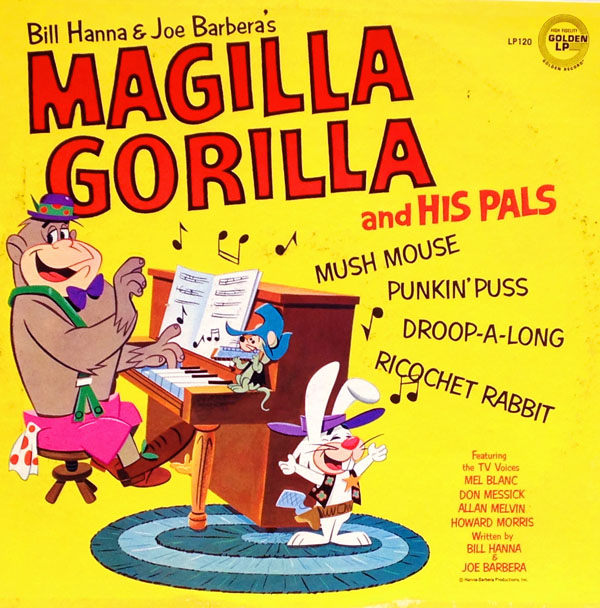
In the meantime, Ted Nichols was the H-B equivalent of Milt Franklyn at Warner Bros., composing music that continued the flippant, spot-on comedy of Carl Stalling. Nichols (along with de Mello) created cues for The Magilla Gorilla Show that became staples of H-B cartoons, as well as record albums, along with earlier Curtin music. In 1966, Curtin’s score for Alice in Wonderland, or What’s a Nice Kid Like You Doing in a Place Like This? and Nichols’ music for The Man Called Flintstone each yielded dozens of new cues, promptly added to the studio library (Alice cues can be heard as early as 1964.)
Ted Nichols’ music dominated such series as The Atom Ant Show, The Secret Squirrel Show, Space Ghost and Dino Boy, Frankenstein Jr. and The Impossibles, Herculoids, Shazzan, The Fantastic Four, Cattanooga Cats, Wacky Races and its spinoffs, Dastardly and Muttley in Their Flying Machines and The Perils of Penelope Pitstop.
Nichols occasionally post-scored Hanna-Barbera films and records. The assignment for The Man Called Flintstone was certainly a vote of confidence, as his experience, while considerable, was not as high profile in the industry as that of Marty Paich, a veteran of superstar recordings and television. Paich composed the background music for H-B’s first feature, Hey There It’s Yogi Bear (1964). However, his work for Alice and The Man Called Flintstone was limited to the songs, and those songs were not contracted for commercial records. Al Capps created simpler arrangements for Alice’s Hanna-Barbera record album based on the Paich charts.
For The Man Called Flintstone, Nichols was asked to do what Henry Mancini did for RCA Victor. Instead of using the soundtrack music, Nichols adapted his background scoring for individual album tracks. For the songs, Nichols created completely different arrangements for a small orchestra, although most of the vocal tracks came from the film. The album was released in mono, but the stereo version was also completed before HBR folded. The masters still exist.
When its own label ended, H-B partnered with Liberty Records to produce additional albums on their Sunset label (all remaining HBR’s were also re-labeled as Sunset). Two outstanding productions resulted, both featuring complete scores and songs created for the LPs. The albums were the authentic-to-the-series Shazzan and the Evil Jester of Masira and a spectacular musical extravaganza called The Flintstones Meet the Orchestra Family (click links for previous Animation Spins. The songs for both were written by John McCarthy, who also contributed songs to the Flintstone feature and the series’ first Christmas episode.
The New Adventures of Huckleberry Finn (NBC, 1968) was the first weekly series combining live-action and animation. It was one of the most expensive TV series up to its date (along with its competition on ABC, Land of the Giants). The higher budget allowed for more ambitious musical scoring. In addition to its memorable theme song and numerous cues, several episodes were post-scored. This was something Hanna-Barbera and Hoyt Curtin seldom, if ever, were able to do for television. For more about this extraordinary series, please enjoy this deep dive with author/historian Jim Fanning and me on The Funtastic World of Hanna and Barbera podcast (and please listen to other episodes, as well as the POP Culture Favorites Podcast).
Before he departed Hanna-Barbera for other musical endeavors, including an opera based on the John Bunyan novel, Pilgrim’s Progress, his grand finale with Hanna-Barbera were the iconic music cues for 1969’s Scooby-Doo, Where Are You? Before the groovy theme was added to the titles, one of Nichols’ most familiar Scooby cues was heard over the main titles. Like the cues from Huck Finn, the first season of Scooby was a treasure trove of background music, used in countless subsequent cartoons.
The premiere Scooby episode, “What a Night for a Knight,” was another of those rare post-scored films. It is fascinating to see the visuals match the action exactly.
We lost Ted this year, due to a long illness. Surely when St. Peter saw him at the gate, he said, “The composer for Scooby-Doo, Space Ghost, and Wacky Races? Come on in.”