JUNE 7 — Malaysia today presents a curious paradox.
On the one hand, it remains one of the most peaceful and liveable countries in Asia.
The streets are calm. The economy continues to function. The country’s multicultural fabric remains largely intact despite periodic political disagreements.
Families continue to gather in shopping malls, restaurants, mosques, churches, temples, and community centres. Students fill universities.
Tourists arrive in increasing numbers. Businesses continue to trade with the world.
On the other hand, the international environment surrounding Malaysia has rarely been more dangerous since the end of the Cold War.
Wars rage in Ukraine and West Asia. Supply chains remain vulnerable. Energy markets are increasingly unstable.
Great-power competition between the United States and China is accelerating across technology, finance, artificial intelligence, semiconductors, and military affairs.
Economic nationalism is spreading. The world economy is becoming more fragmented. Yet Malaysia appears remarkably relaxed.
This is both a strength and a potential weakness.
The country’s resilience is not accidental. For decades, Malaysia has benefited from a strategic culture that prizes moderation, pragmatism, and balance.
Successive governments have avoided ideological extremes and sought constructive engagement with all major powers.
As a medium-sized trading state, Malaysia has long understood that prosperity depends on openness rather than confrontation.
This approach has served the country well.
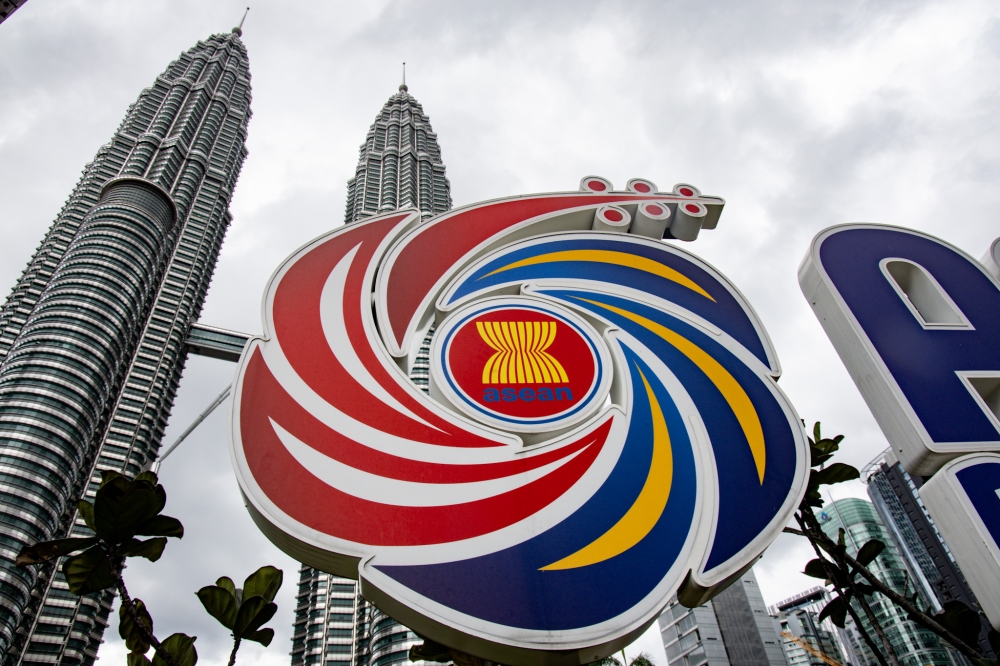
The Association of Southeast Asian Nations (Asean) logo stands in front of the Petronas Twin Towers in Kuala Lumpur ahead of the 47th Asean Summit on October 24, 2025. — Firdaus Latif pic
Malaysia survived the Cold War, the Asian Financial Crisis, the September 11 attacks, the Global Financial Crisis, the Covid-19 pandemic, and multiple episodes of regional instability. Each crisis reinforced the value of flexibility, moderation, and diplomacy.
Today, Prime Minister Anwar Ibrahim finds himself leading Malaysia through another period of global turbulence.
While Malaysia is not directly involved in any military conflict, the Prime Minister is compelled to govern amid a world increasingly shaped by war. The consequences are unavoidable.
The conflict in West Asia demonstrates how distant events can affect Malaysian livelihoods. Any disruption in the Strait of Hormuz threatens global energy supplies. Oil prices rise.
Transportation costs increase. Inflationary pressures spread. Investment decisions become more cautious.
Likewise, the war in Ukraine continues to affect commodity markets, shipping routes, food prices, and broader economic confidence.
Malaysia’s economy is particularly exposed because it is deeply integrated into global trade networks.
What happens thousands of kilometres away can eventually affect households in Johor Bahru, Kota Bharu, Kuching, Kota Kinabalu, and Kuala Lumpur.
Yet despite these mounting risks, Malaysians remain comparatively calm.
Part of this reflects confidence in the country’s institutions. Another part reflects the laid-back nature of Malaysian society itself.
There is much to admire in this national temperament.
Malaysia has generally avoided the extremes of hyper-nationalism, ideological polarization, and social fragmentation that plague many countries. Malaysians are accustomed to diversity and compromise. The country’s political culture, while often noisy, tends to favour accommodation over confrontation.
However, every strength can become a weakness when carried too far.
A relaxed society can become complacent.
A comfortable society can become vulnerable.
And a peaceful society can underestimate emerging dangers.
This is where Malaysia’s paradox becomes most apparent.
The country increasingly resembles a paradise surrounded by gathering storms.
The economic indicators may appear stable. The diplomatic environment may remain manageable. But beneath the surface, significant vulnerabilities persist.
Perhaps the most revealing indicator comes from the Employees Provident Fund (EPF).
According to EPF data, approximately 61 per cent of Malaysians are unable to immediately raise RM1,000 in the event of an emergency.
This statistic should concern policymakers, businesses, and society alike.
A household unable to mobilize RM1,000 quickly is not financially resilient. It is financially exposed.
The figure suggests that millions of Malaysians continue to live with limited savings and little margin for unexpected shocks.
This matters because the modern world is becoming increasingly unpredictable.
A sudden rise in food prices. An energy shock. A global recession, potentially, a stagflation.
A disruption in trade routes. A major health emergency. A technological displacement caused by artificial intelligence.
Any one of these developments could place immense pressure on households already operating close to their financial limits.
The challenge facing Malaysia therefore extends beyond foreign policy.
The country must strengthen domestic resilience with the same determination that it applies to international diplomacy.
Malaysia has been exceptionally successful in maintaining balanced relations with major powers. It continues to engage the United States, China, Japan, South Korea, Europe, the Gulf states, and the broader Global South.
Within Asean, Malaysia has consistently supported mechanisms that preserve regional stability.
Through Asean Plus Three, the Asean Regional Forum, the Asean Defence Ministers’ Meeting-Plus, and the East Asia Summit, Malaysia contributes to creating diplomatic space for dialogue amid intensifying geopolitical rivalry.
These achievements should not be underestimated.
Yet diplomacy alone cannot protect households from economic vulnerability.
The next stage of Malaysia’s development must focus on building deeper reserves of national resilience to become a high income nation, worthy of being a member of the Organization of Economic Cooperation and Development (OECD) and G20.
This means encouraging greater savings, improving wages, strengthening social protection systems, expanding skills training, enhancing digital literacy, and preparing citizens for technological disruption.
It also means fostering a culture of preparedness.
For too long, many societies have assumed that globalization would continue to generate prosperity indefinitely. The events of recent years have demonstrated otherwise.
Globalization is not disappearing, but it is becoming more fragmented, more contested, and more uncertain.
Countries that prepare will adapt.
Countries that remain complacent will struggle.
Malaysia’s future therefore depends on recognising a simple reality.
The country’s peace and prosperity are real. They should be celebrated.
But they should not be taken for granted.
The paradox of modern Malaysia is that it remains a paradise in many respects while confronting increasing perils beyond its shores and growing vulnerabilities within.
The task of leadership is not merely to preserve today’s stability.
It is to prepare society for tomorrow’s uncertainties.
Prime Minister Anwar Ibrahim must therefore continue navigating an increasingly dangerous international environment with or without the General Election at the background.
At the same time, Malaysia itself must become less cavalier about its own economic fragilities.
For while the country remains at ease, the world is not.
And in an era defined by shocks, resilience belongs not to those who are most comfortable, but to those who are most prepared.
Malaysia’s greatest challenge is therefore not avoiding danger altogether.
It is ensuring that paradise does not become complacent in the face of increasing peril.
* Phar Kim Beng is a professor of Asean Studies, International Islamic University Malaysia and a director, Institute of International and Asean Studies.
** This is the personal opinion of the writer or publication and does not necessarily represent the views of Malay Mail.

 Login
Login