With the countdown for the FIFA World Cup's kickoff drawing closer and closer, here is a guideline of new rules and breakdowns of how certain plays work.
SINGAPORE: A domestic helper has turned to social media for advice after alleging that her employer makes her clean three different properties every month, including a house in Malaysia that she is reportedly sent to twice a month.
In an anonymous post shared in the Facebook group SINGAPORE TRANSFER (No Fees/SD), DIRECT HIRE & NEW HELPER on Monday (May 25), the helper said she has been struggling to cope with the exhausting workload and constant travelling.
According to her, she spends long hours cleaning her employer’s home in Singapore, is also tasked with cleaning their office, and has to travel to Malaysia twice a month to clean another property there.
“I’m already exhausted here because I work in the house until late at night,” she wrote. “Then I also have to go to the office to clean there. I clean three places in one month.”
The helper also claimed that she “can’t complain” to the agency because they are allegedly friends with her employer.
She said that when she previously tried to complain, the agency allegedly cursed at her and said hurtful things instead of helping her resolve the issue.
Desperate to find a way out, she asked other members of the community, “Will another employer still accept me if I leave this job? I’ve only been here for one year. Thank you for your answers. I hope someone can help me find a good employer.”
“That’s strictly not allowed.”
Many commenters expressed alarm over the claims, with several fellow domestic helpers pointing out that workers are generally not allowed to clean other houses or workplaces outside the residential address stated on their work permit.
One commenter advised the helper to gather evidence. They said, “Write down all the dates when you went to Malaysia to clean. Screenshot all the cursed and hurtful words that the agency told you. Take videos and photos as proof that you cleaned there, so that you know all the details. So that when you report this to MOM, you know what to answer.”
Another commented, “Report such employer! Must! Not! Clean! Another! House!”
A third wrote, “That’s strictly not allowed. Take pictures as evidence, especially of their house in Malaysia and their office.”
A fourth added, “Oh my goodness, that is absolutely not allowed. Whatever is written in the contract is what should be followed.”
As per the Ministry of Manpower (MOM), migrant domestic workers are only allowed to work for their employer at the residential address declared to the ministry.
MOM states that employers who illegally deploy helpers to work at another residential address or carry out non-domestic duties may face serious penalties. Those found in breach of the rules can be fined up to S$10,000 and may also be barred from hiring domestic helpers in future.
Plus some surprising extra requirements, like having to say “thank you” at least 10 times a day.
Every school in Japan has its own set of rules, and while many of these guidelines are perfectly understandable, there are some that are baffling, to say the least.
This topic of nonsensical school rules was recently explored by Jukusen, one of Japan’s largest online directory and comparison platforms for cram schools, in a survey that targeted 104 high school students nationwide.
More than half (56.7 percent) of the respondents said there were rules at their school that they did not agree with, and out of these, about 70 percent said they hadn’t been given an explanation as to why those rules are necessary.
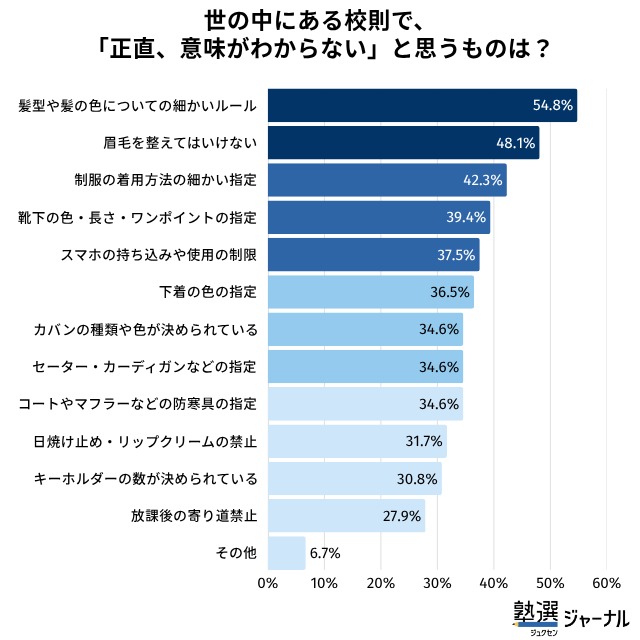
So what were the rules that made no sense to students? Let’s take a look at the top 12 responses below – totals exceed 100 percent as students were allowed to give multiple responses – starting with a brief rundown from 12 to six.
12. No stopping anywhere on the way home after school (27.9 percent)
11. Limits on the number of keychains students can carry (30.8 percent)
10. Ban on sunscreen and lip balm (31.7 percent)
9. Restrictions on winter clothing such as coats and scarves (34.6 percent)
8. Restrictions on sweaters and cardigans (34.6 percent)
7. Rules specifying the type and colour of school bags (34.6 percent)
6. Restrictions on underwear colour (36.5 percent)
▼ The question put to students for the survey was: “Which school rules honestly make no sense to you?“
Taking a closer look at the top five revealed the following results:
5. Restrictions on smartphones (36.5 percent)
Many respondents accepted bans during class but thought prohibitions during breaks or school events were unreasonable as students want to communicate and take photos at those times.
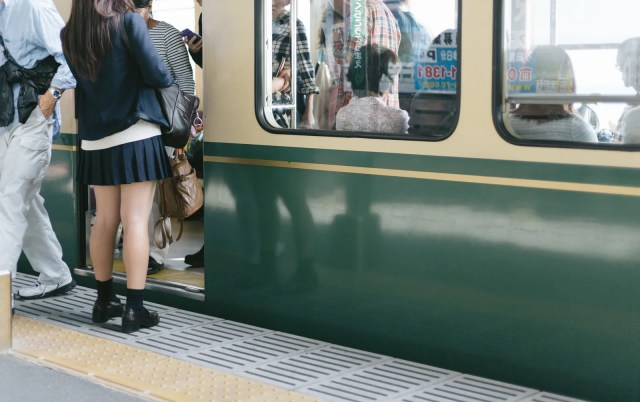
4. Restrictions on the colour, length, and design of socks (39.4 percent)
Students questioned why schools sought to regulate such a minor detail, saying it felt pointless to regulate tiny fashion issues.
3. Restrictions on how to wear the uniform (42.3 percent)
Students complained that uniform rules were excessively detailed and inconsistently enforced, with one student saying she was pulled up by teachers for folding up the waist of her skirt, even though she was only doing it as it was uncomfortably loose.
▼ Low socks and a high skirt is a no-no at schools.
2. Ban on eyebrow grooming (48.1 percent)
Students argued that not being allowed to care for your eyebrows actually makes people look less presentable. They also expressed concern for people who feel insecure about their brows, as they’re not allowed to tend to them.
1. Restrictions on hairstyles and hair colour (54.8 percent)
Students strongly questioned why schools regulate hair at all, with many saying they felt these rules weren’t in line with the times as they prioritise conformity over individuality.
The survey also revealed some unusual rules that exist at some schools:
On graduation day, girls must wear tights of 80 denier or higher
Students are required to say “thank you” at least 10 times a day within the school
Bans on establishing a light music club
While “light music” originally referred to lighter orchestral pieces, it now involves popular music like punk, rock and J-Pop, and some schools fear these clubs might “increase the number of delinquent and misbehaving students”.
Though students are quick to complain about these “incomprehensible” school rules, saying they have little to do with academic performance, in the end, they mostly put up with them, with approximately 70 percent of current respondents indicating that they abide by the rules despite their dissatisfaction.
The remaining 30 percent are likely plucking an eyebrow hair every now and then, and holding out hope for their school to rethink some of its requirements. With some schools now easing up on black-only hair rules and abolishing underwear checks, change may very well be on the horizon.
Source: Press release
Featured image: Press release
Insert images: Press release, Pakutaso (1, 2, 3) ● Want to hear about SoraNews24’s latest articles as soon as they’re published? Follow us on Facebook and Twitter!
James Kennedy is going to be a dad.
The Vanderpump Rules alum shared that his girlfriend Jordan Meyers is pregnant with their first baby.
“We are thrilled to share that Jordan and I are expecting...
Bust out the pumptinis because Dayna Kathan is celebrating Pride month.
The Vanderpump Rules alum came out as a lesbian, posting a picture of herself with friends and sporting a cropped tank top...
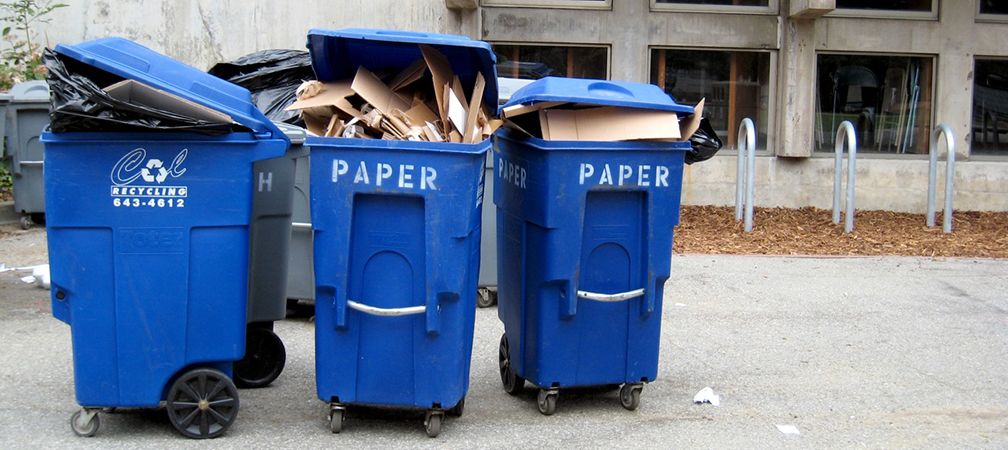
Recycling in Ontario is changing in a big way. As of January 1, 2026, the province has fully transitioned to a new Blue Box system that changes who is responsible for recycling and is intended to make the process more consistent across Ontario.
Under the new rules, recycling is now managed and funded by the companies that produce packaging and paper products, rather than municipalities. This shift is known as Extended Producer Responsibility (EPR). The idea is that companies should take more responsibility for the waste they create, while making recycling systems easier for residents to navigate.
The goal is to recycle more, send less waste to landfills, and move toward a more circular economy. But for many Ontarians, the new rules also raise a lot of questions. Here are some of the most common ones.
Frequently Asked Questions
1. What changed in Ontario’s recycling system in 2026?
Ontario’s Blue Box program is now fully run by producers – the companies that create packaging and paper products. That means they are responsible for collecting, sorting, and recycling those materials.
An organization called Circular Materials now helps operate the Blue Box program across Ontario.
For most residents, the day-to-day experience may still look similar. The province will continue using the same blue boxes, the same curbside pickup and will continue to accept many of the same items. But behind the scenes the system has changed significantly, with the goal of creating more consistent recycling rules across the province.
2. Why is Ontario changing its recycling system?
Before this transition, municipalities shared the cost and responsibility of recycling programs, and each city or region often had its own rules. That meant something recyclable in one community might not be accepted in another.
The new system is meant to reduce that confusion. By making producers responsible for the materials they put into the marketplace, the Blue Box program should, in theory, put more pressure on companies to reduce unnecessary packaging and design products that are easier to recycle. However, advocates have raised concerns about the true efficacy of this program, including looser reporting requirements, lack of transparency in operations, increased incineration of recyclable materials, and the exclusion of many groups like multi-residential buildings, public spaces and schools.
3. Will recycling rules still differ depending on where I live?
Historically, yes. What you could recycle in Toronto might not have been accepted in London, Kingston, or another municipality.
The new Blue Box system is designed to make accepted materials more consistent across Ontario. However, some local differences may still exist in how recycling is collected. For example, some municipalities may use blue boxes, while others use large recycling carts. Pickup schedules and collection contractors may also vary by region.
So while the rules about what can be recycled are becoming more standardized, the way recycling is collected may still look different from place to place.
4. Can I recycle…?
If you’ve ever stood over your recycling bin wondering, “can I recycle this?” You’re not alone.
Some cities across Ontario have helpful tools. For example, if you live in Toronto, one of the easiest ways to check is by using the Waste Wizard, an online tool that lets you search specific items and find out whether they belong in recycling, garbage, organics, or special drop-off.
Although Toronto’s Waste Wizard is one of the best-known examples, other municipalities across Ontario offer similar search tools or waste apps. They can be especially helpful for sorting items like black plastic, coffee pods, takeout containers, or mixed-material packaging.
The updated Blue Box program expands the list of accepted materials. In many cases, you can now recycle more types of packaging than before, including items like foam containers, black plastic, and certain flexible plastics. But contamination — such as food waste, liquids, or hazardous materials — can still create major problems in the recycling stream.
5. If the province has one system, why do municipalities still matter?
Even though the recycling rules are now set at the provincial level, municipalities still play a major role in waste management.
They are often responsible for services like garbage collection, green bins or organics, household hazardous waste depots and local public education. Municipalities also help residents understand changes to collection schedules, bin types and local disposal options.
In other words, the province may be standardizing the recycling system, but municipalities are still an important part of how that system works in practice.
This is one of the most important questions and one of the hardest to answer simply.
Recycling can help reduce landfill waste and recover useful materials, but it is far from a perfect solution. In Canada, recycling rates remain low. Currently, only 7% of Ontario’s waste is recycled through the Blue Box. This is due to a combination of factors, including contamination, complex materials, and limited recycling markets.
Ontario’s new recycling system is intended to improve outcomes by making producers more accountable and expanding what can be collected. But recycling alone will not solve the waste crisis.
Reducing waste in the first place and reusing materials whenever possible remains essential.
7. What should I do with electronics or hazardous waste?
Electronics and hazardous materials should never go in your Blue Box.
Items like batteries, old phones, chargers, paint, propane tanks, light bulbs, and cleaning chemicals require special handling. If they are placed in recycling, they can contaminate other materials, damage equipment, or create safety risks for workers.
Instead, these items should be taken to a designated drop-off depot, household hazardous waste site, or e-waste collection program in your municipality. Many communities in Ontario offer permanent depots or seasonal collection events for these materials.
If you are unsure, your municipality’s waste lookup tool is the best place to check.
The Bottom Line
Ontario’s new recycling rules are a major shift. By making producers responsible for the packaging they create the province is trying to improve recycling and reduce confusion for residents.
But even the best recycling system depends on public understanding and participation. Knowing what belongs in your Blue Box and taking the extra moment to check when you’re unsure can make a real difference.
At the same time, recycling is only one part of the solution. If Ontario is serious about reducing waste and protecting the environment, we also need to focus on addressing the systemic root of continuous waste generation in the first place.
 Login
Login







 James Kennedy is going to be a dad.
The Vanderpump Rules alum shared that his girlfriend Jordan Meyers is pregnant with their first baby.
“We are thrilled to share that Jordan and I are expecting...
James Kennedy is going to be a dad.
The Vanderpump Rules alum shared that his girlfriend Jordan Meyers is pregnant with their first baby.
“We are thrilled to share that Jordan and I are expecting...
 Bust out the pumptinis because Dayna Kathan is celebrating Pride month.
The Vanderpump Rules alum came out as a lesbian, posting a picture of herself with friends and sporting a cropped tank top...
Bust out the pumptinis because Dayna Kathan is celebrating Pride month.
The Vanderpump Rules alum came out as a lesbian, posting a picture of herself with friends and sporting a cropped tank top...