It was a who’s who on the sidelines of Madison Square Garden as the New York Knicks fronted a miraculous comeback against the San Antonio Spurs in Game 4 of the NBA Finals. NYC staples like Spike Lee, Larry David, Adam Sandler, Jerry Seinfeld, David Zaslav, Timothée Chalamet, Mariska Hargitay, Ben Stiller, Chris Rock, John […]
History, it is said, does not repeat itself, but sometimes it rhymes. This may explain the sense of déjà vu that crept over me when I read about the case of Mr Raymond Wong – a 55-year-old construction worker, not the former newsman of the same name – who appeared at the West Kowloon Magistrates Court a couple of weeks ago.
File photo: Canva.
The charge against Mr Wong was that he had on two occasions thrown home-produced leaflets, or in legal language “paper sheets written with statements,” from the vicinity of his 12th-floor public housing flat into the public area of the estate.
The first time, many of them were picked up by an irate district councillor, on the second by a staff member of the estate’s management. Quite how this led to Mr Wong was not explained in court but police eventually discovered his fingerprints on two of the offending items.
Mr Wong was then charged with violating the local national security law, on the grounds that the words on the leaflets were seditious. The first batch called for action against corrupt police people, which I suppose is automatically seditious because it implies that there are corrupt police people, which – of course – is not true.
The second batch of leaflets included the phrase “liberate Hong Kong; do not vote.” Curiously Mr Wong was not charged with discouraging voters, though that is an offence. Worse, we may suppose, was the fatal phrase “liberate Hong Kong,” when – as we all know – the law presumes that Hong Kong is already as liberated as it wishes to be.
Mr Wong sensibly pleaded guilty and will be sentenced later next week.
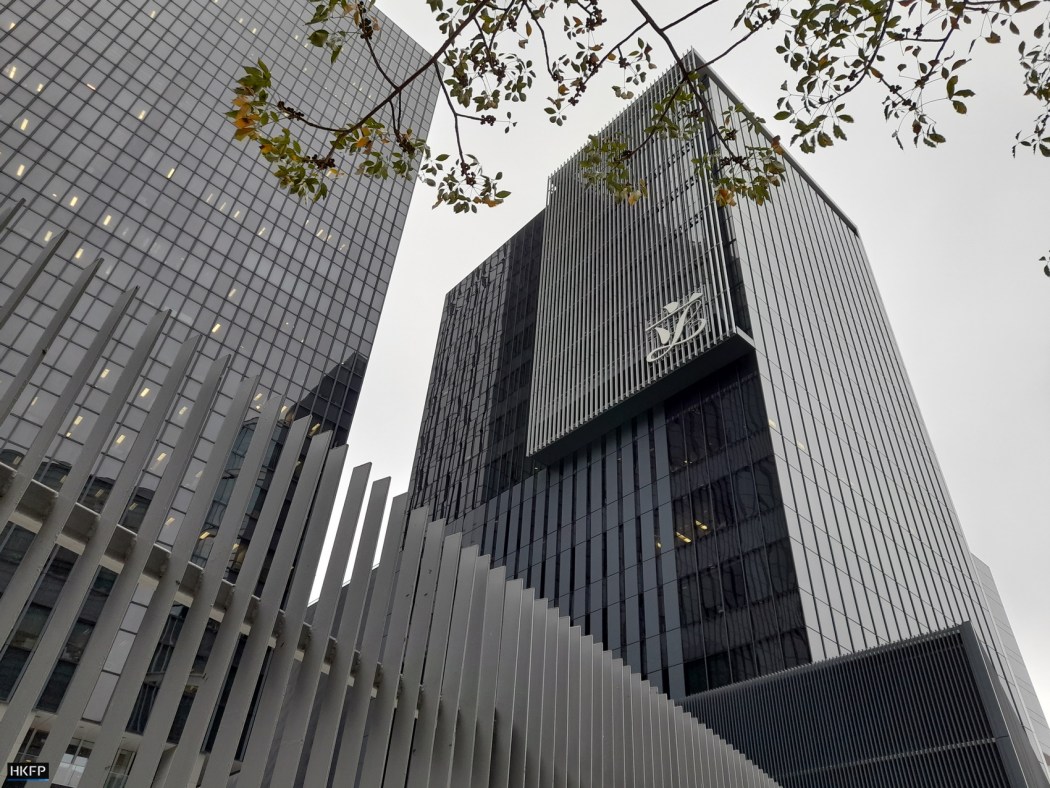
West Kowloon Law Courts Building. File Photo: GovHK.
Meanwhile, I was haunted by the thought that scattering subversive leaflets into public places had come up somewhere before. And after some searching I found it in Geert Mak’s book, “In Europe.” Mr Mak was assigned by the Dutch newspaper he worked for to spend a year touring Europe while also touring the continent’s 20th century history. The resulting pieces were published as they were written in the newspaper, and assembled into the book, which is excellent though now a bit dated, afterwards.
So, in due course, Mr Mak reached Munich, a city with a complete set of capital city kit because it used to be the home of the Kings of Bavaria. One of them lent his name to the local university, the Ludwig-Maximilian Universität. Apparently this is a rather bombastic piece of architecture.
Let me now hand the microphone to Mr Mak:
“Here at the university is where it all converges: the pompous stairways, the pseudo-Roman statues beside them (in reality, two Bavarian kings in costume), the stupendous dome covering the hall, but also the wispy innocent desperate little pamphlets that the students Hans and Sophie Scholl let flutter down from the galleries here on 18 February 1943 ‘In the name of Germany’s young people we demand restitution by Adolf Hitler’s state of our personal freedom …’. They had spread tracts and left behind graffiti on earlier occasions as well: ‘Freedom’, ‘Down with Hitler.’ That was all the White Rose did. This time, though, they were caught by the caretaker and turned over to the Gestapo. Four days later they were beheaded.”
Now, nothing like that could happen here. We do not conclude national security cases in four days. We take four years, which may or may not be an improvement but is certainly different. We do not do capital punishment.
Still, it should not be a matter of rejoicing that we have joined the club of countries where the channels of public communication have been so choked by fear and restrictions that citizens who wish to express their views are reduced to scattering anonymous leaflets.
Our government seems to have inherited the thin skin of our notoriously sensitive police force. Now even legislators – carefully vetted patriots to a man or woman – are complaining that any comment on government policy which falls short of a rousing endorsement is branded as dishonesty or worse by official spokespersons.
LegCo president Starry Lee at the 8th Legislative Council’s first meeting on January 14, 2025. Photo: Kyle Lam/HKFP.
No doubt government policies are usually well chosen and efficiently implemented. Still, our leaders should perhaps take a word of advice from Oliver Cromwell, who famously wrote to one set of obstinate opponents: “I beseech you, in the bowels of Christ, think it possible you may be mistaken.”
HKFP is an impartial platform & does not necessarily share the views of opinion writers or advertisers. HKFP presents a diversity of views & regularly invites figures across the political spectrum to write for us. Press freedom is guaranteed under the Basic Law, security law, Bill of Rights and Chinese constitution. Opinion pieces aim to constructively point out errors or defects in the government, law or policies, or aim to suggest ideas or alterations via legal means without an intention of hatred, discontent or hostility against the authorities or other communities.
No two movie franchises have had a bigger impact on film than Star Wars and The Lord of the Rings. It's impossible to measure what the original Star Wars trilogy has meant to pop culture. There have been a plethora of movies and TV series since, and a half-century after the first movie debuted, the franchise remains as popular as ever. The same can be said for The Lord of the Rings. Peter Jackson's original trilogy is Oscar-winning perfection, and it too has had several spinoffs.
What role the Legislative Council (LegCo) should play in our executive-led system continues to spark controversy. Lawmakers themselves are discussing the issue, which is a healthy sign.
The eighth Legislative Council’s first meeting on January 14, 2025. Photo: Kyle Lam/HKFP.
Central authorities have also spoken indirectly on LegCo’s role.
On January 26, the Hong Kong and Macau Affairs Office head Xia Baolong pointed out that executive-led government in Hong Kong means that each branch – executive, legislative, and judicial – performs its “own role and cooperates and coordinates with each other.”
According to Article 64 of the Basic Law, LegCo’s role includes holding the government to account. This means asking questions, asking for justification of government action, investigating government actions and inactions, and, when necessary, sanctioning government officials for policy failures.
According to the Powers and Privileges Ordinance (Cap 382), enacted in 1985, with the select and investigation committee system, as well as the system of policy panels, LegCo has the capacity to fulfil its “own role.”
It is precisely how to understand LegCo’s “own role” that has sparked controversy.
First, may LegCo use the tools it has to hold the government to account? The central authorities have condemned the way the opposition in LegCo used these tools after 2010. They call it abuse, citing filibustering and other tactics that delayed legislation.
Moreover, both the central and the city’s authorities accuse the opposition of abusing LegCo’s powers to investigate, and to summon and inquire – precisely those powers legislators still have and need to hold the government to account.
The Legislative Council. Photo: Peter Lee/HKFP.
In this view, the abuse dates from after 2010 when the opposition and representatives of the central government negotiated a deal over political reform in Hong Kong. It has been downhill ever since, according to Beijing.
From 1985 to 2010, LegCo convened six select or investigation committees, which focused on issues of public concern: the Independent Commission Against Corruption (ICAC) operations and staff loyalty, the chaotic Chek Lap Kok airport opening, short piling in public housing, SARS, misselling Lehman-Brothers minibonds, and conflicts of interest in the post-retirement employment of civil servants.
The result: the government changed course and made improvements in public policy.
For example, authorities introduced the Principal Officials Accountability System (POAS) in 2002, which is still with us today. LegCo’s work and the results of an expert committee investigation on the SARS outbreak in 2003-04 better prepared us for the Covid-19 pandemic in 2020. These positive results are undeniable.
Even in the post-2010 period, pressure from LegCo to investigate sometimes had positive results. In 2015, for example, responding to public concern expressed in the legislature, the government established a commission of inquiry into lead in drinking water in some public housing estates. Again, the government changed course.
Second, authorities tell us that executive-led government means that LegCo and the executive should “cooperate” and “coordinate.” Does this mean that legislators may not criticise government policy? Reporting indicates that many LegCo members perceive this to be the case.
Remember Chief Executive John Lee’s harsh rebuke of LegCo member Paul Tse’s criticism of government policy in the first “patriots-only” seventh-term LegCo? The chief executive deemed such criticism “dangerous,” similar to the “soft resistance” of the much-criticised opposition and must be “stamped out.”
The few government critics in the seventh-term LegCo all left the body in 2025.
More recently, consider the Hospital Authority’s (HA) rebuke after LegCo members Gary Chan, Rebecca Chan, and David Lam expressedconcerns that residents might not have collected their HA-provided medication because of increased charges. (A sidenote: Rebecca Chan served as a political assistant in the Food and Health Bureau from 2012 to 2017.)
The Hospital Authority logo. Photo: Tom Grundy/HKFP.
The legislators drew attention to the very figure disclosed by the Health Bureau: that 26,000 public hospital prescriptions were uncollected after the new fee regime was introduced in January. However, rather than listening and investigating, the HA said the remarks were “untruthful.”
The government apparently prefers to send legislators “warm reminders” on many issues of public concern, in effect telling them to shut up. Precisely because no lawmaker spoke up when LegCo deliberated the bus seatbelt issue in September 2025, the policy resulted in a fiasco.
The public needs a legislature that is engaged, open, and responsibly critical of government action – this is the minimum required to perform its “own role.”
Of course, LegCo should cooperate and coordinate with the government, but to do so should not compromise the legislature’s “own role.”
Hong Kong needs a middle way for LegCo – somewhere between the dysfunction seen from the 2014 Umbrella Movement through the 2019 protests and a rubber stamp.
We have experienced a middle way, for example, from 1985 to at least 2010.
At the time, as noted above, LegCo investigations played an important role in improving public policy. Hong Kong people value this kind of LegCo role. It benefits the government and the community, building trust and legitimacy.
Authorities should trust their own gatekeeping in selecting patriotic LegCo members. Many LegCo members seem to understand that they should play a more active role.
The government should realise that it cannot do everything alone. Effective governance is co-produced.
Authorities need to recognise the legitimacy of a middle way, a more authentic role for LegCo. We will all benefit.
HKFP is an impartial platform & does not necessarily share the views of opinion writers or advertisers. HKFP presents a diversity of views & regularly invites figures across the political spectrum to write for us. Press freedom is guaranteed under the Basic Law, security law, Bill of Rights and Chinese constitution. Opinion pieces aim to constructively point out errors or defects in the government, law or policies, or aim to suggest ideas or alterations via legal means without an intention of hatred, discontent or hostility against the authorities or other communities.
Two Hong Kong officials have condemned “groundless accusations” against a recent update to the city’s homegrown national security law, which empowers the chief executive to certify any criminal case as a national security offence.
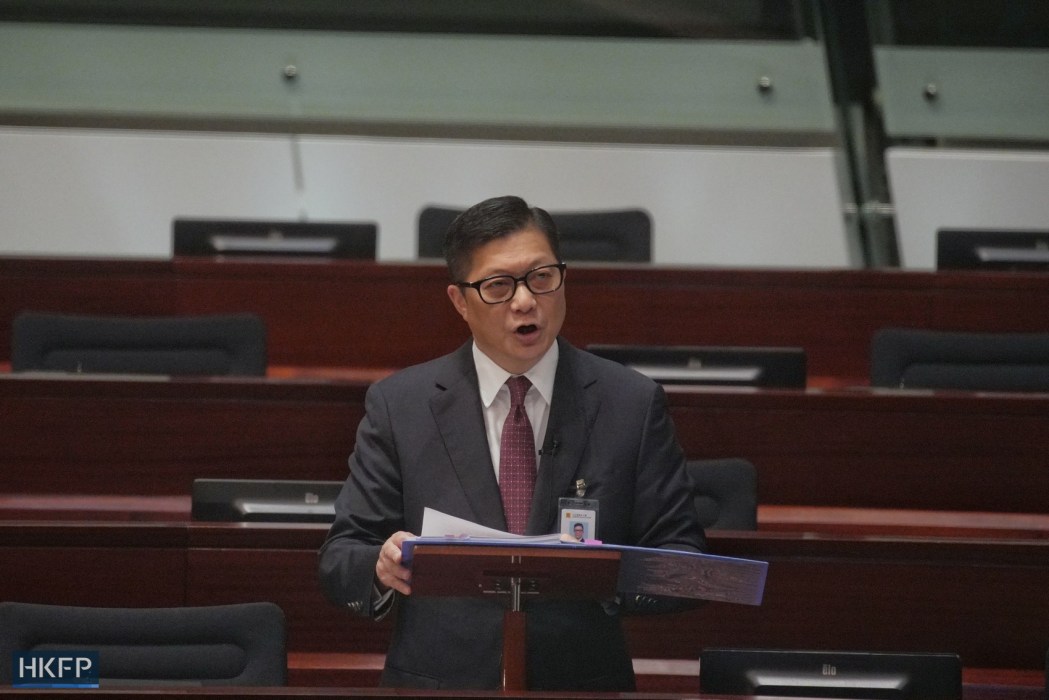
Secretary for Security Chris Tang speaks at LegCo. File photo: Kyle Lam/HKFP.
Secretary for Security Chris Tang told the Legislative Council (LegCo) on Thursday afternoon that he noticed some people had misunderstood or “deliberately misinterpreted” the subsidiary legislation.
They tried to intimidate the public by claiming that the subsidiary law would widen the scope of national security offences, turning minor offences into national security crimes, he said.
The security chief called the accusations “false, misleading, deceptive, and scaremongering” and said some people were attempting to incite hatred towards the government.
“Some people delivered alarmist remarks, saying that the government can randomly certify any acts of the public as national security offences. Those people may have ulterior motives or are cruel-hearted, hoping to incite others’ hatred of the HKSAR,” Tang said in Cantonese.
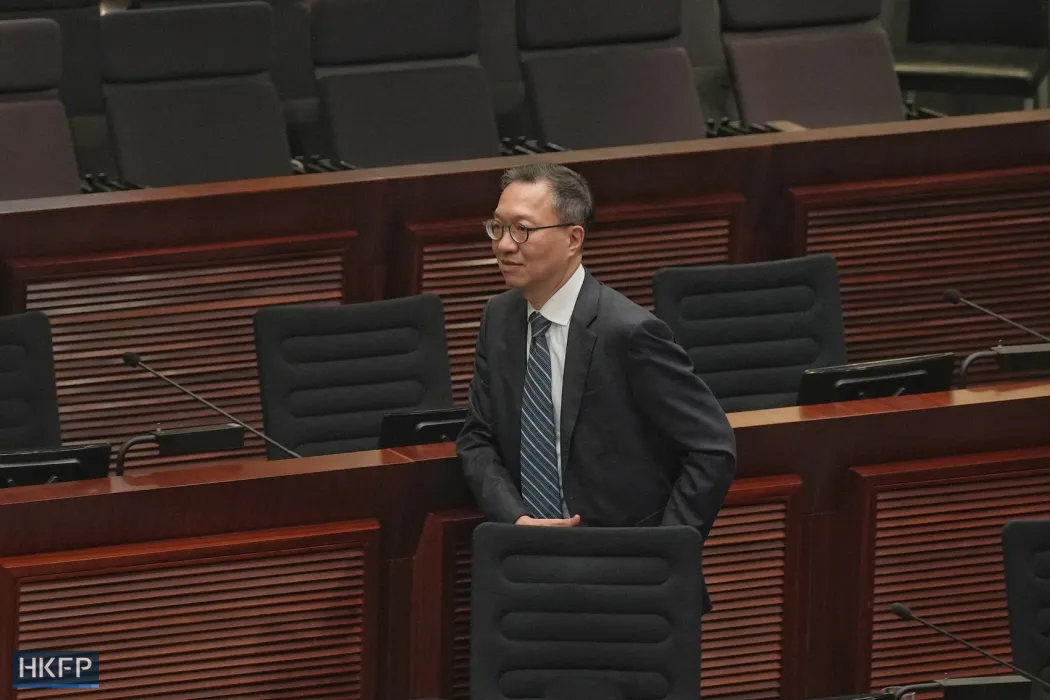
Also speaking at LegCo, Secretary for Justice Paul Lam said he noticed “some media outlets with ulterior motives, foreign forces, and fugitives” had made “groundless accusations” against the national security law.
The two ministers delivered their remarks during LegCo’s first meeting to review the Safeguarding National Security (Procedural Matters) Regulation, a subsidiary legislation of the homegrown national security law, commonly known as Article 23.
Authorities enacted the subsidiary law through the “negative vetting” mechanism, which allows the law to be gazetted and to take effect before legislative scrutiny.
Secretary for Justice Paul Lam at LegCo. File photo: Kyle Lam/HKFP.
Lam, the justice chief, said that the subsidiary legislation was necessary to further explain articles in the Beijing-imposed national security law and Article 23, which stipulate that the chief executive should have the power to determine whether a criminal case involves national security.
In its proposal, the government cited the “legislative intent” of the Beijing-imposed national security law, saying that offences endangering national security include not only the four types of offences under the national security law, but also “other offences endangering national security under the law of the HKSAR.”
Lam said the recent legislative update was intended to further define “other offences endangering national security under the law of the HKSAR,” and it did not introduce any new power or new offences.
Earlier on Tuesday, Chief Executive John Lee said the new subsidiary legislation “is purely to make the law even clearer.”
Hong Kong restaurants with an area larger than 20 square metres can start applying for licences to allow dogs in their premises from May 18, the government has announced.
The Food and Environmental Hygiene Department said in a statement on Thursday that it would accept applications from May 18 to June 8.
Pixel, the HKFP news hound, welcomes the move. File photo: Tom Grundy/HKFP.
The department is set to approve the first batch of applications in mid-June, with dogs to be allowed in restaurants in July.
The statement said that “the FEHD will specify a date in July from which dogs will be allowed to enter permitted food premises.”
While the Food Business (Amendment) Regulation 2026 came into effect on Friday, the FEHD reminded the public that “restaurants must first submit an application and obtain approval before allowing dogs to enter.”
Hotpot and barbecue restaurants are not eligible to apply for the permits, the government said, citing safety concerns.
The FEHD will hold briefing sessions for restaurant operators from Monday to Wednesday next week, as well as on May 28.
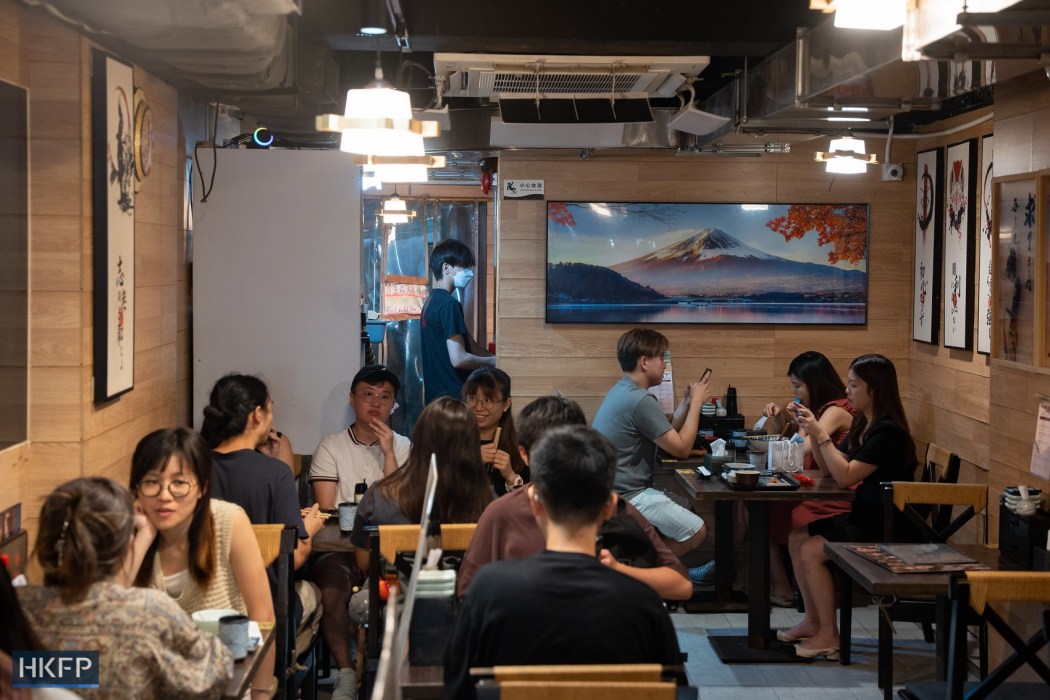
A Hong Kong restaurant. File photo: Kyle Lam/HKFP.
The department said it would publish a list of dog-friendly restaurants once the first batch of permits is approved.
The announcement to update the decades-old Food Business Regulation came after a pet-friendly restaurant in Tai Po had to suspend operations for seven days in January last year for allowing dogs inside.
Marvel Comics has long resurrected iconic characters for second acts. Now ElevenLabs is doing the same for Marvel’s most famous creator, Stan Lee — in a sense. The AI audio company on Wednesday said it struck an expansive deal with Stan Lee Universe, the joint venture between Genius Brands International and POW! Entertainment, to add the […]
Chief Executive John Lee has announced that Hong Kong’s links to Central Asia will be strengthened with expanded visa-free arrangements and direct flights to Kazakhstan.
Chief Executive John Lee (centre) in Astana, Kazakhstan on June 2, 2026. Photo: GovHK.
Lee was speaking to reporters in the Kazakh capital of Astana on Tuesday during an official visit with business leaders.
Hong Kong already has visa-free arrangements with Kazakhstan, Uzbekistan and Kyrgyzstan, which allow stays of between 10 and 30 days, but Lee said he hoped to extend the period to 30 days for all three countries this year.
“We and the Kazakh government both agree that this is definitely one of our goals. We have already exchanged some further information with the two governments, and everyone is working hard to work toward this target,” he said, according to RTHK.
He later told officials at a business dinner that he looked forward to a “long-term partnership and enduring friendship” between Astana and Hong Kong.
“Rich in oil and mineral resources, and rapidly developing and diversifying, Kazakhstan is a regional economic powerhouse. Hong Kong, a pivotal player in the Belt and Road Initiative, looks forward to working with Kazakhstan – with you – in creating mutual opportunities,” he said, according to a government press release.
Cathay direct flights
Meanwhile, flagship carrier Cathay Pacific announced direct flights to Almaty, the country’s largest city and former capital, on Tuesday.
The airline said flights are set to begin in the first quarter of next year.
Cathay Pacific. File Photo: GovHK.
“Central Asia is a strategically important Belt and Road region that offers ample business opportunities. As Hong Kong’s home hub carrier, Cathay has aligned interests with the HKSAR Government in strengthening our connectivity with this emerging market,” Cathay Chief Customer and Commercial Officer Lavinia Lau – who is among the visiting delegation – said, according to a Cathay press release.
Business deals
On Monday, Lee oversaw several memoranda of understanding signed at the capital’s Astana Hub – an innovation and tech hub.
Agreements were inked between Hong Kong’s Belt and Road Office and Kazakhstan’s Ministry of Artificial Intelligence and Digital Development, as well as deals between the Astana Hub and Cyberport, Hong Kong Science and Technology Parks and the Hong Kong-Shenzhen Innovation and Technology Park.
An agreement between InvestHK and the Astana International Financial Centre was also signed, RTHK reported.
Lee will visit Astana’s Nazarbayev University on Wednesday to strengthen collaboration with Hong Kong universities. He will then travel on to Uzbekistan.
Chief Executive John Lee (third left) meets Prime Minister of Kazakhstan Olzhas Bektenov (third right) on June 2, 2026. Photo: GovHK.
Kazakhstan is Hong Kong’s largest trading partner in Central Asia.
It has seen strong GDP growth in recent years and a stable unemployment rate in recent years, with minerals, agriculture and hydrocarbons being key exports.
However, it has struggled with double-digit inflation, currency stability and severe social inequality, according to the US International Trade Administration. It is ranked 96th out of 182 countries evaluated in Transparency International’s latest Corruption Perceptions Index. Hong Kong sits at 12, whilst China sits at 76.
According to the Astana Times, Kazakhstan’s top trade partner is China, with trade reaching US$13.2 billion (HK$103.4 billion). Beijing imports huge quantities of minerals from the Central Asian country and has developed a trade corridor across the region.
The Belt and Road Initiative is a hallmark economic strategy proposed by Chinese President Xi Jinping, seeking to link China to Europe and Africa through a land “belt” and a maritime “Silk Road.” Since its announcement in 2013, China has spent billions of dollars developing trade links and building infrastructure in countries across central and southern Asia.
A Hong Kong court has convicted a former law student of rioting during the 2019 protests and unrest after the government successfully appealed against her acquittal, leading to a retrial.
The protest in Wan Chai on August 31, 2019. File photo: May James/HKFP.
Alice Tong, 26, was found guilty of rioting on Tuesday, nearly seven years after she was arrested in Wan Chai on August 31, 2019, according to local media. District Judge Edmond Lee remanded Tong in custody pending sentencing on July 15.
Lee initially acquitted Tong of rioting and possession of an offensive weapon in a public place in August 2021, saying at that time prosecutors had failed to prove she committed violence or abetted the riot.
Authorities appealed against her acquittal, and the Court of Appeal overturned Lee’s decision in June 2024.
The three appellate judges said at that time that the circumstantial evidence of Tong’s participation in the riot was “overwhelming,” according to media outlet The Witness.
The Court of Appeal judges ordered the case to be reconsidered by the trial judge. In July last year, they rejected Tong’s application to take her case to the Court of Final Appeal.
Judge Lee said on Tuesday that the circumstantial evidence was “overwhelming” in showing that Tong was part of the riot and had encouraged others through her presence.
District Court in Wan Chai. File photo: Hans Tse/HKFP.
At the time of her arrest, Tong was dressed in black, carrying a gas mask and a black scarf, and holding an umbrella and a walking stick, Lee said.
Officers also seized a helmet, goggles, gloves, and a laser pen from her backpack, Lee said.
The defendant’s clothing and the equipment she carried were “extremely unusual and suspicious,” Lee said, pointing out that her outfit on that day was clearly similar to that of other protesters.
Lee also said that, in the minutes before the defendant was stopped by police, many black-clad protesters were retreating along the same route on Wan Chai Road towards the east.
The judge dismissed the defence’s argument that Tong was merely caught in the riot and was not leaving the scene alongside other protesters.
Tong was seen weeping after the judge delivered his verdict, while her supporters yelled, “We all love you,” as she was led away by guards, The Witness reported.
Following the success of the softcover editions of The Amazing Spider-Man Newspaper Comics 1977-1980 Clover Press is planning to release the next four years in four softcover volumes.The Amazing Spider-Man Newspaper Comics 1980-1984 will be in the same format as the previous slipcased issues.From Clover Press: Between killer robots, Doctor Doom’s flying saucer, the rise […]
Hong Kong media outlets should “make contributions” to national development by telling “good stories” of the city and China amid geopolitical uncertainties, Chief Executive John Lee has said.
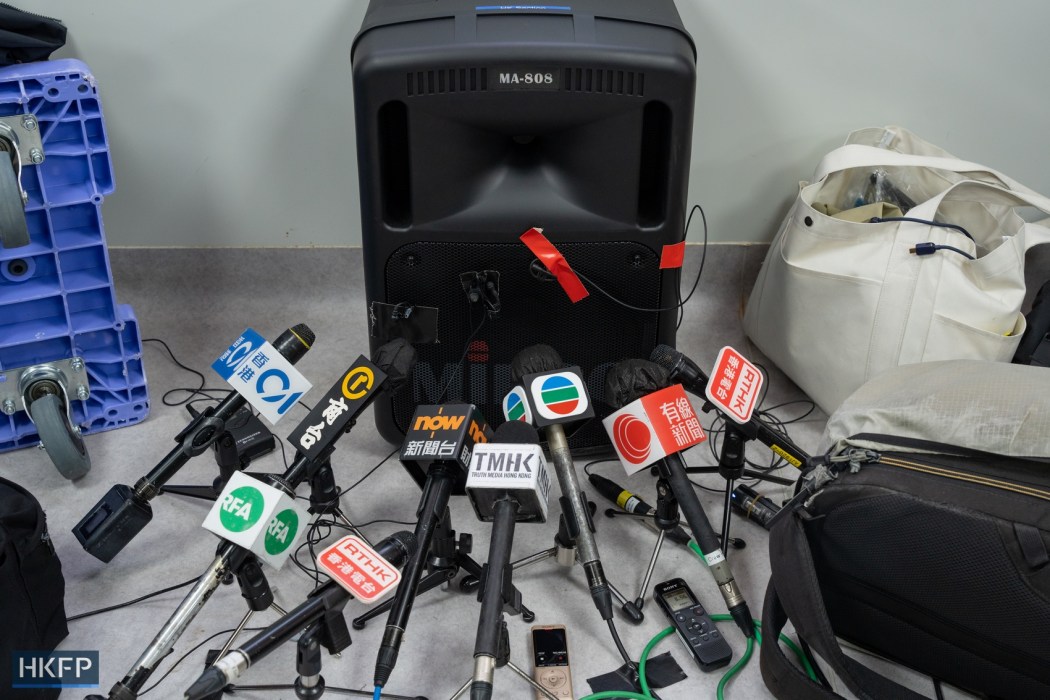
Microphones from media outlets at a press conference. File photo: Kyle Lam/HKFP.
Speaking at the annual Hong Kong News Awards ceremony on Friday, Lee said media practitioners in Hong Kong should aspire to contribute not just to the city’s progress, but also to China’s national development.
He made reference to the “Three Deeds to Immortality,” an ancient Chinese philosophy, and urged media workers to establish “virtue,” “contribution,” and “teaching.”
He said promoting national and city interests should be the core values of those in the media industry, especially amid uncertainties in global politics.
“Journalism has great influence and therefore comes with great responsibilities,” Lee said in Cantonese. “Such responsibilities include being impartial, not using news for personal gain, and reporting on accurate and high-quality information for residents.”
Lee said the government is working on Hong Kong’s first five-year blueprint in tandem with China’s 15th Five-Year Plan, a set of policy initiatives outlined by the Chinese Communist Party that has set the stage for the country’s social and economic development since the 1950s.
Hong Kong Chief Executive John Lee speaks at the 2025 Hong Kong News Awards ceremony on May 15, 2026. Photo: GovHK.
The 15th Five-Year Plan, announced in March, proposes expediting the development of a “Chinese narrative system,” and enhancing the country’s image on the global stage, Lee said.
“Excellent media workers… should assist Hong Kong in serving the country, connecting to the world, and contributing the power of the news to society and people’s wellbeing,” he said.
Lee has called on Hong Kong’s media sector to tell good stories of the city since he became Chief Executive in 2022. He has made similar remarks during past speeches at the Hong Kong News Awards ceremony, thought this was the first time he directly urged media workers to contribute to China’s development.
The Peaky Blinders sequel series has unveiled a fresh wave of cast including stars from Game of Thrones and All Her Fault. Conleth Hill joins as Clemmy Keeler, the fierce patriarch of the Keeler gangster family who rival the Peaky Blinders’ ambition to rebuild Birmingham. Meanwhile, Daniel Monks, who starred opposite Sarah Snook in Peacock […]

 Login
Login