Reading view

2 UK-Chinese dual nationals convicted of spying on Hong Kong dissidents

Bill Yuen Peter Wai featured image

A retired Hong Kong policeman and a former UK Border Force official were convicted by a London jury Thursday of conducting “shadow policing” on British soil on behalf of China.

Ex-police superintendent Bill Yuen, 65, and Peter Wai, 38 — both dual Chinese-British nationals — were found guilty of assisting a foreign intelligence service under Britain’s national security laws following a weeks-long trial.

From left: Hong Kong Economic Trade Office (HKETO) official Bill Yuen and former UK Border Force official Peter Wai. Photos: Metropolitan Police.
From left: Hong Kong Economic Trade Office (HKETO) official Bill Yuen and former UK Border Force officer Peter Wai. Photos: Metropolitan Police.

Wai, who worked for the UK’s Border Force immigration and customs enforcement agency after previously serving in the British police and the Royal Navy, was also convicted of misconduct in a public office.

He had searched the interior ministry’s computer system for people of interest to Hong Kong authorities.

The jury at London’s Old Bailey court, which deliberated for nearly 24 hours, was discharged after failing to reach verdicts on a further foreign interference charge against each defendant.

Prosecutors promptly announced they would not seek a retrial and the duo were remanded into custody ahead of sentencing on a date to be set on May 15.

The court had heard how Wai had gathered intelligence on the orders of Yuen, who was a senior manager at the Hong Kong Economic Trade Office (HKETO), which represents Hong Kong’s government in London.

Politicians, campaigners

The pair targeted Hong Kong dissidents and pro-democracy protesters living in Britain, with “special attention” also paid to politicians, including senior Conservative Iain Duncan Smith.

They undertook information gathering, surveillance and acts of deception, with one operation capturing photographs of prominent campaigner Nathan Law.

Pro-democracy activist Nathan Law. Photo: Nathan Law, via Facebook.

Their activities coincided with Hong Kong authorities publishing bounties of around £100,000 (US$136,000) for information helping to identify several UK-based activists, including Law, jurors heard.

Another protester told the jury of how Wai had threatened him with arrest for confronting a Hong Kong diplomat in London.

Messages on Yuen’s phone showed surveillance of Law began as early as 2021, the prosecution said as it gave evidence.

See also: ‘Your inner self is red’: UK border officer accused of ‘infiltrating’ Hong Kong pro-democracy group

The defendants’ activities were exposed in May 2024 when police foiled an alleged bid to snatch a former Hong Kong resident from her flat in the northern county of Yorkshire, the court heard.

Wai, of Staines-upon-Thames, southwest of the capital — who was known to associates as Fatboy — and Yuen, of Hackney in east London, had both denied wrongdoing.

The case comes in the wake of tens of thousands of people, including democracy activists wanted by Chinese authorities, moving to Britain since Hong Kong enacted a draconian National Security Law in mid-2020.

  •  

Myanmar’s ex-junta chief makes first China trip as civilian president

Min Aung Hlaing Xi Jinping featured image

Myanmar’s coup-commander turned President Min Aung Hlaing touched down in China on Monday for talks with Xi Jinping, his first visit since taking over as civilian leader after Beijing-backed elections rejected by democracy monitors.

Myanmar’s President Min Aung Hlaing (left) shakes hands with Chinese President Xi Jinping on May 9, 2025, on the sidelines of Russia's 80th Victory Day Parade in Moscow. Photo: MyanmarGov.
Myanmar’s President Min Aung Hlaing (left) shakes hands with Chinese President Xi Jinping on May 9, 2025, on the sidelines of Russia’s 80th Victory Day Parade in Moscow. Photo: MyanmarGov.

Min Aung Hlaing is hoping to expand trade and security ties with China, a rare enduring partner for Myanmar after his 2021 coup ousted the elected government of Aung San Suu Kyi and diplomatically isolated the country on the world stage.

Relations have frayed in recent years over mushrooming internet scam centres along the countries’ shared border areas which both enlist and target Chinese citizens in lucrative cryptocurrency fraud, analysts say.

China has emerged as a key power-broker in the civil war sparked by the coup — variously backing the military, rebels and truces between them according to its security and economic interests, analysts say.

The one-party state also vocally backed recent polls excluding Suu Kyi’s party, punishing dissent with prison time and returning a walk-over win for pro-military MPs — who elected Min Aung Hlaing as president.

Democracy watchdogs described the transition as a charade to launder the reputation of the leadership, campaigning to recover from the pariah status many nations branded it with since the putsch.

Min Aung Hlaing landed in China to a red carpet welcome, according to images shared by his office, and spent the first hours of his five-day trip touring Beijing Aerospace City — the centre of China’s space programme.

Supply and demand

During his half-decade ruling Myanmar as military chief, Min Aung Hlaing made trips to China only for regional summits — meeting Beijing officials on the sidelines.

China hopes his first visit as civilian president will deepen “comprehensive strategic cooperation”, foreign ministry spokesman Lin Jian told reporters on Friday.

In addition to Xi, Min Aung Hlaing is also set to meet Chinese Premier Li Qiang and top legislator Zhao Leji.

Chinese PM Li Qiang
Chinese Premier Li Qiang at the Annual Meeting of the New Champions 2023 in Tianjin, China, on June 27, 2023. Photo: World Economic Forum, via Flickr.

Beijing is a key provider of materiel to the Myanmar military and has also brokered a pair of landmark truces with two of the most powerful rebel factions that once challenged it in the borderlands with China.

While Myanmar has been massively impoverished by the civil war, it has also emerged as a major global supplier of mined rare earth minerals — vital for China’s production of renewable energy technology.

The first bill announced by Myanmar’s new crop of lawmakers proposes the death penalty for those who detain or violently coerce victims into working in scam centres, signalling the country’s intention to crack down.

Attention has also been drawn to the bilateral relationship between Myanmar and China by Beijing’s detention of a US scholar who studies Myanmar and stands accused of spying.

Min Zin, founder of the Institute for Strategy and Policy Myanmar (ISP-M), “has been subjected to criminal compulsory measures”, foreign ministry spokesman Lin told reporters on Friday.

Authorities are holding him “on suspicion of engaging in espionage activities that endanger China’s national security”, Lin said.

Min Zin was detained in the capital of China’s border province of Yunnan, a person with professional ties to the ISP-M told AFP anonymously because of the case’s sensitivity.

  •  

‘Make law clear’: John Lee defends plan to give Hong Kong leader power to certify criminal acts as nat. sec offences

Hong Kong Chief Executive John Lee.

A Hong Kong government proposal that will allow the city’s leader to certify criminal acts as national security offences is intended to “make the law clear,” Chief Executive John Lee has said.

Chief Executive John Lee at a press conference on January 27, 2026. Photo: Kyle Lam/HKFP.

Speaking at a press conference on Tuesday, Lee said the new subsidiary legislation for Hong Kong’s homegrown national security law, the Safeguarding National Security Ordinance, commonly known as Article 23, “is purely to make the law even clearer.”

Shortly after, Lee approved the subsidiary legislation during a meeting with the Executive Council, the city’s top decision-making body.

Under the new law, which was gazetted and came into effect the same day, the chief executive will be able to certify “other offences endangering national security.”

Criminal cases classified as endangering national security will have tougher court procedures, such as a higher bar for bail and trial before designated judges.

“The purpose of introducing the subsidiary legislation is to make it clear, make it much, much clearer, how offences… endangering national security under the law of Hong Kong will be so classified,” Lee told reporters on Tuesday.

“It is not intended and will not expand the definition of the offences, and it’s not adding any new offences or any new powers or punishments. It also does not expand the scope of the application of the law,” he added.

‘Sensitive’ information

Lee said the new piece of legislation would reduce “controversy or debate in court” about what constitutes national security offences.

Asked whether he was concerned about giving an impression of further centralising power into his hands, Lee said the city’s chief executive must shoulder the “important responsibility” of safeguarding national security.

Lee said he would exercise the new power with “prudence and seriousness,” but added that, as city leader, he has access to exclusive information regarding threats to national security.

A lot of activities endangering national security “are committed by state players of another place. They are professional, sophisticated, and the series of information that may be available to indicate the seriousness of the matters [is] privy to the chief executive,” he said.

“A lot of this information is sensitive and not suitable for public disclosure,” he added.

Under the government proposal, the certificate issued by the chief executive will be binding on the city’s courts and cannot be challenged.

China's national flags and Hong Kong flags are displayed in the city on September 30, 2025, a day before the 76th anniversary of the People's Republic of China. Photo: Kyle Lam/HKFP.
China’s national flags and Hong Kong flags are displayed in the city on September 30, 2025, a day before the 76th anniversary of the People’s Republic of China. Photo: Kyle Lam/HKFP.

Speaking to reporters on Monday, Secretary for Justice Paul Lam said the designation of national security offences involves “highly confidential” information that would not be available to the courts.

“The judiciary would not be capable of making such a decision,” Lam said.

Asked whether the chief executive’s certificates will be announced, Lam only said “people will know” as court proceedings are open to the public.

“If you see designated judges or other special arrangements in a trial, you will know” that the case has been designated as relating to national security, he said.

  •  

Man jailed for 10 months after throwing ‘seditious’ leaflets from public housing flat

Man jailed 10 months over banned political slogan thrown from gov’t housing

A Hong Kong man who threw anti-government leaflets from his public housing flat has been sentenced to 10 months in prison after pleading guilty to committing seditious acts.

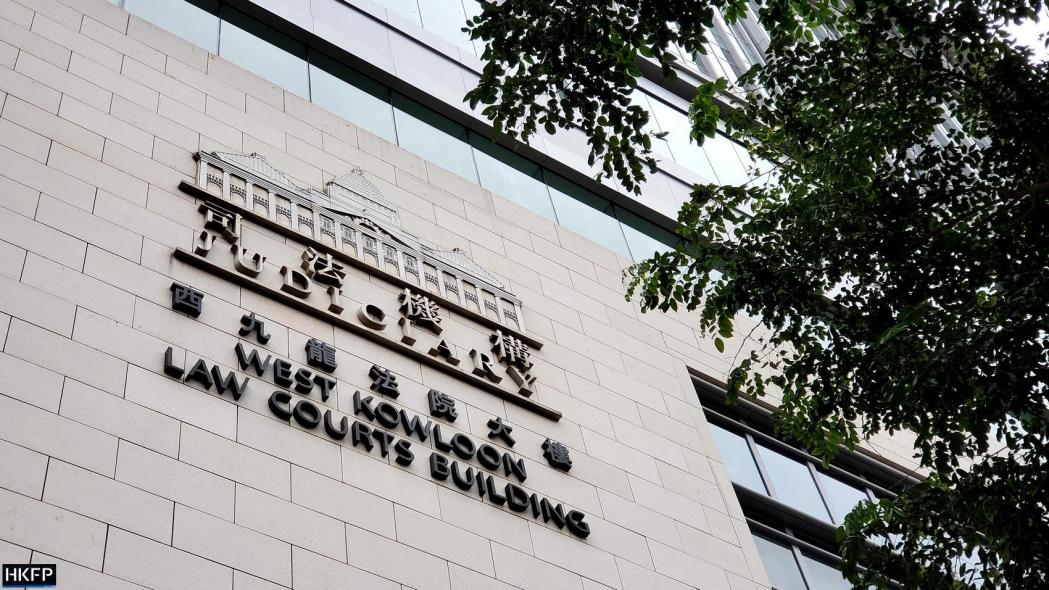
West Kowloon Law Courts
West Kowloon Law Courts Building. File photo: Kelly Ho/HKFP.

Raymond Wong appeared at the West Kowloon Magistrates’ Court on Tuesday to receive a 10-month jail sentence handed down by Chief Magistrate Victor So for two counts of “doing with a seditious intention an act or acts that had a seditious intention,” local media reported.

Wong, a 55-year-old construction worker, admitted to throwing the leaflets from his unit in On Tat Estate, Kwun Tong, on two occasions in October 2024 and December 2025.

He was arrested in April, and the following month, he pleaded guilty to the charges –  an offence under Hong Kong’s homegrown national security law, also known as Article 23.

In mitigation, he apologised to his girlfriend and his daughter, as their public housing unit would be reclaimed by the government due to his offence.

Citing a psychological report, Wong’s lawyers said that the defendant did not know how to control the resentment that had built up from losing his full-time job after the 2019 protests and the Covid-19 pandemic.

‘Premeditated and planned’

Noting that the leaflets were thrown after National Day two years ago and before last year’s Legislative Council (LegCo) elections, Magistrate So said that Wong’s actions were “premeditated and planned to some degree.”

On October 2, 2024, Kwun Tong district councillor Hsu Yau-wai reported 41 sheets of paper to the police after finding them on the podium of Lai Tat House at the estate. The papers had slogans on them saying “kill police” and derogatory remarks about mainland Chinese people.

On December 5 last year, two days ahead of the “patriots only” LegCo polls, a property manager found papers scattered near that same area, with written slogans such as “Liberate Hong Kong, do not vote.”

Police officers at a Tai Po polling station for the 2025 LegCo elections, on December 7, 2025. Photo: Kyle Lam/HKFP.

Wong’s lawyers said on Tuesday that his methods were “primitive” and had limited impact compared with online posts.

So said he accepted the defence’s argument but pointed out that Wong explicitly incited people to kill police officers, mainland Chinese, and government officials.

Wong incited enmity towards the police and referred to mainland residents with “derogatory” and “dehumanising” language, and his use of the slogan “Liberate Hong Kong,” considered secessionist under Beijing’s national security law in Hong Kong, also challenged national sovereignty, the magistrate added.

Calls to boycott the LegCo polls also amounted to an effort to undermine public confidence in the city’s electoral system, So said.

The turnout for last year’s polls was the second-lowest on record, at 31.9 per cent. Beijing overhauled the city’s electoral system in 2021 to ensure that only those deemed patriotic enough can run.

The move reduced democratic representation in the legislature, tightened control of elections and introduced requirements for candidates to obtain nominations from a small circle of political elites.

  •  

2-month suspended jail term for elderly man who reposted social media call to boycott legislative elections

ICAC. File photo: Kyle Lam/HKFP.

A 67-year-old man has been handed a two-month jail term, suspended for 24 months, after he pleaded guilty to resharing a social media post urging a boycott of the 2025 “patriots only” legislative elections.

The Independent Commission Against Corruption (ICAC). File photo: Kyle Lam/HKFP.

According to a press release from the Independent Commission Against Corruption (ICAC), Lam Kin-sik admitted on Monday to inciting another person not to vote, in violation of the Elections (Corrupt and Illegal Conduct) Ordinance.

Whilst it is legal to cast a blank ballot or boycott an election in Hong Kong, it is unlawful to encourage another person to do so during an election period.

Tong Wai-hung, who is accused of inciting a boycott of the 2025 Legislative Council elections. Photo: ICAC.

Magistrate Shirley Cornelia Hung said a custodial sentence was inevitable as it was a serious offence, but it was suspended considering Lam’s guilty plea and mitigating factors such as his health condition.

Lam was among three people prosecuted by the ICAC in November after they shared social media posts by two overseas activists – Alan Keung and Tong Wai-hung – who called for a boycott of what they described as a “fake election.”

In the Monday statement, the anti-corruption watchdog said that the defendant shared a post published by Tong.

“A warrant for Tong’s arrest, who has since left Hong Kong, was earlier issued by a Magistrate upon the ICAC’s application,” the ICAC said.

See also: Hong Kong woman given suspended jail term for reposting calls to boycott legislative polls

Those found guilty of inciting another person not to vote, or to cast an invalid ballot, face up to three years’ imprisonment and a fine of HK$200,000.

In March 2021, Beijing passed legislation to ensure “patriots” govern Hong Kong. The move reduced democratic representation in the legislature, tightened control of elections and introduced a pro-Beijing vetting panel to select candidates. Authorities say the overhaul ensures the city’s stability and prosperity. But the changes also prompted international condemnation, as much of the traditional opposition remains behind bars, in self-exile or has quit politics.

  •  

Taiwan opposition leader seeks to maintain US defence cooperation

Cheng Li-wun featured image

The leader of Taiwan’s main opposition party said Friday she hopes to maintain engagement with the United States on the island’s defense capabilities, speaking on a two-week US visit aimed at growing trust with Washington.

Taiwanese opposition leader and Kuomintang chairperson Cheng Li-wun participates in a press conference at the Jefferson Hotel in Washington, DC, on June 12, 2026.
Taiwanese opposition leader and Kuomintang chairperson Cheng Li-wun participates in a press conference at the Jefferson Hotel in Washington, DC, on June 12, 2026. Photo: Alex Wrobleski/AFP.

Addressing reporters in the US capital, Kuomintang chairwoman Cheng Li-wun said the party has expressed support for Taiwan’s defense capabilities and hopes “to continue maintaining and deepening our cooperation with the US in this regard.”

She did not comment specifically about a US$14 billion US arms sale to Taiwan that remains under review. Such sales are a thorny issue between Washington and Beijing.

Cheng in April became the first KMT leader in a decade to visit Beijing and meet Chinese President Xi Jinping, and her US trip comes just weeks after President Donald Trump himself held a summit with Xi.

The KMT, which has long advocated for closer ties with China, recently thwarted the Taiwanese government’s plan to spend nearly US$40 billion on critical weapons such as US arms and domestically produced drones.

In Washington, the KMT comes up against concerns over its more pro-engagement position, compared with President Lai Ching-te’s Democratic Progressive Party.

Cheng has rocked Taiwanese politics since her unexpected rise to the top of the party last year and drawn criticism for being too pro-China.

Beijing claims Taiwan is part of its territory and has threatened to use force to seize it.

On Friday, Cheng hit back at critics, saying that “seeking peaceful dialogue across the Taiwan Strait does not mean abandoning Taiwan’s defense capabilities.”

She added that she met nine members of Congress during her visit, alongside academics and others, touting the trip as a success.

She said Trump’s recent warning to the island against making a declaration of independence was also aligned with the KMT’s positions.

After wrapping up his state visit to Beijing last month, Trump said in an interview that “I’m not looking to have somebody go independent. And, you know, we’re supposed to travel 9,500 miles to fight a war. I’m not looking for that.”

Cheng’s itinerary also included stops in San Francisco, Los Angeles, Boston and New York.

  •  

Japan asks China to ensure citizens’ safety after Shanghai stabbing

Shanghai stabbing

Tokyo has asked Beijing to ensure its citizens’ safety after a stabbing in a Shanghai restaurant in which two Japanese were injured, Japan’s consulate in Shanghai told AFP Wednesday.

Shanghai skyline
Shanghai skyline. Photo: Pexels.

It is the latest diplomatic point of friction as the two countries are embroiled in a stand-off triggered by Prime Minister Sanae Takaichi’s suggestion Tokyo might intervene militarily if Beijing were to invade Taiwan.

On Tuesday, Pudong district police said on social media they had received a report that a man “was injuring people with a fruit knife in a restaurant”.

Police said the suspect, a 59-year-old surnamed Yang who was detained at the scene, had a history of mental illness.

Three people were taken to hospital, the statement said, with Japanese media later reporting two were Japanese.

Asked about the reports, the Japanese consulate in Shanghai confirmed two citizens had been hurt, adding they were receiving medical treatment.

From left: Chinese and Japanese flags.
Chinese and Japanese flags. Photos: Aboodi Vesakaran, Wikimedia Commons.

“The Government of Japan has requested the Chinese government to… clarify the facts and provide a clear explanation… (and) ensure the safety and security of Japanese nationals,” a spokesperson said in a statement.

Top government spokesperson Minoru Kihara later confirmed Tokyo had requested an explanation, adding that a consular alert had been sent out to all Japanese residents in China.

“The government will continue, while maintaining contact with the parties concerned, to provide all possible support from the standpoint of protecting Japanese nationals,” he said.

The restaurant reported to be the site of the attack, matching the police statement’s rough address, appeared calm on Wednesday.

An AFP reporter saw multiple people in grey suits, who appeared to be security, standing guard in the mall it was located in.

Police said that when Yang was detained, he had been “speaking incoherently and behaving erratically”.

AFP has contacted the Chinese ministry of foreign affairs for comment.

  •  

US President Donald Trump heads for Xi summit overshadowed by Iran war

Trump Xi visit

US President Donald Trump heads for a superpower summit with Chinese counterpart Xi Jinping next week hoping the Iran war will not spoil the mood in Beijing.

US President Donald Trump (left) and Secretary of Defence Pete Hegsesth (right) at a White House press briefing on April 6, 2026. Photo: The White House/Flickr.

Trump will be expecting a lavish welcome at the high-stakes meeting, which he delayed in March because of the Middle East conflict.

But the war will still loom large over his first visit to China since 2017, which is supposed to focus on easing tensions over trade and Taiwan between the world’s largest economies.

Trump said the two leaders would discuss the issue and that Xi had been “very respectful” over Iran.

Yet with Trump desperately seeking a deal to end the war before he lands in Beijing, China may seek to use his weakened position to extract concessions on key issues.

“The reality is that right now, Iran is critical for the US and the Chinese know that,” said Edgard Kagan of the Center for Strategic and International Studies (CSIS).

‘Big, fat hug’

The world will be closely watching the Trump-Xi summit, but uncertainty over the timing and a lack of preparation mean deliverables are likely to be limited.

For a US president obsessed with the idea of Great Power diplomacy, the main priority during the May 14-15 visit will be visuals of him being feted by a strongman fellow leader.

Chinese President Xi Jinping attends a China-US bilateral meeting at the Gimhae International Airport terminal, in Busan, South Korea, on October 30, 2025.
Chinese President Xi Jinping attends a China-US bilateral meeting at the Gimhae International Airport terminal, in Busan, South Korea, on October 30, 2025. Photo: The White House, via Flickr.

Trump, 79, has repeatedly talked up his “very good relationship” with Xi, 72, whom he met in South Korea last October, even saying the Chinese leader will give him a “big, fat hug” over Iran.

He will also hope to come away from the summit with big business deals as he looks to midterm elections in which Republicans face a hammering over high oil prices from the Iran war.

While some industry leaders say invitations have still not formally gone out, Trump’s administration plans to invite CEOs from companies including Apple, Exxon, Nvidia and Boeing, Semafor reported, with talk of a big Boeing deal in the offing.

Trump will also be hoping to bring back deals on AI, critical minerals and fentanyl.

One solid result that China in particular hopes for could be an extension of the fragile year-long trade truce that Trump and Xi agreed on in South Korea in October.

White House
The White House. Photo: White House, via Flickr.

China has however shown that it is still ready to respond to Washington, saying on May 2 that it would not comply with US sanctions against firms targeted over Iranian oil transactions.

“It appears that the truce is not as strong as we were hoping,” Sean Stein, president of the US-China Business Council, told AFP.

‘A lot of leverage’

Communist-run China will meanwhile be looking for stability in a Trump-roiled world, and to play for time in the knowledge that the volatile US leader is on his second and final term in office.

Beijing is also likely to use Trump’s weakened position to its advantage where it can.

“There’s actually a lot of leverage there that Beijing could use,” said Patricia Kim, a senior foreign policy fellow at the Brookings Institution in Washington.

“Trump is looking for a win, right? I mean, he hasn’t had much wins in recent weeks with the war in Iran going on.”

US and China flags
US and China flags. File photo: U.S. Army.

Taiwan could be one area in particular where Xi may try to extract concessions, analysts say — for example on arms sales to the self-governing island that Beijing claims as its own.

Trump has been known to go off-script on the thorny topic before and allies in the region who fear an assertive China will be closely watching for signs of US wavering.

At the same time Beijing is likely to play up to Trump’s love of pomp and flattery, knowing that a slighted and angry Trump would cause trouble.

But the Chinese will try to wash their hands of any involvement in the war on its ally Iran and deflect pressure from Trump during the meeting with Xi.

Beijing’s hosting of Iran’s foreign minister this week was “a sign that they realize this is coming down the pike,” said Kagan from CSIS.

  •  

Trial of Hong Kong Tiananmen activists looms over crackdown anniversary

Tiananmen vigil AFP featured image

By Catherine Lai

Activists Lee Cheuk-yan and Chow Hang-tung once led thousands of Hong Kongers in candlelight vigils every June 4 to remember China’s 1989 Tiananmen crackdown.

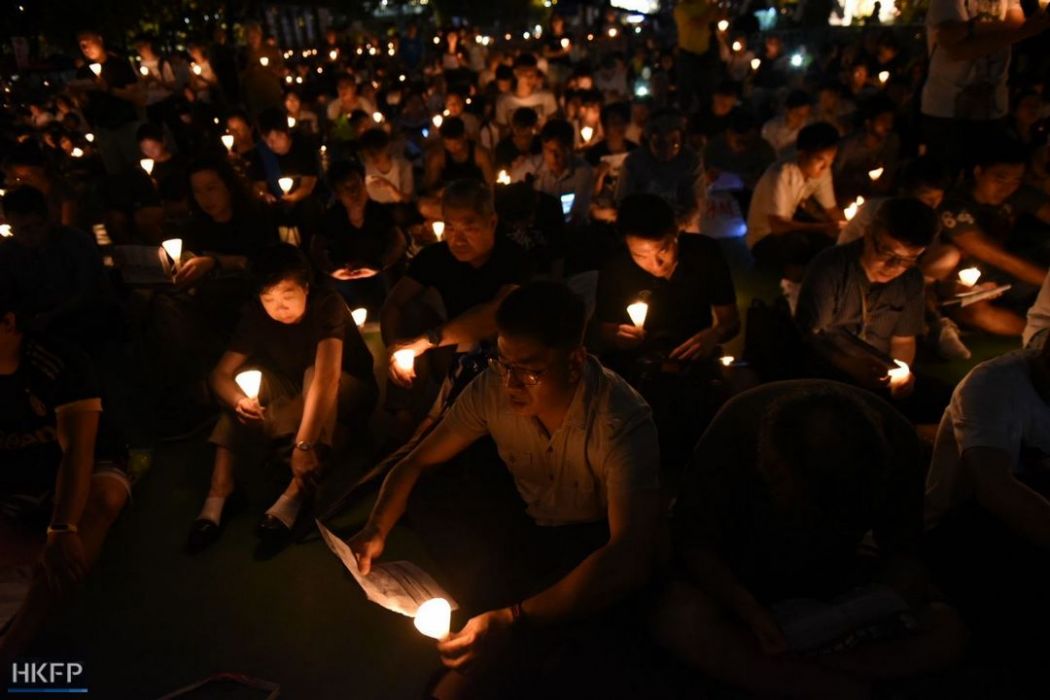
A group of veteran pro-democracy activists hold candles during a candlelight vigil at Victoria Park in Hong Kong on June 4, 2019, to mark the 30th anniversary of the 1989 Tiananmen crackdown in Beijing. Photo: Philip Fong/AFP.
A group of pro-democracy activists, including Lee Cheuk-yan, Chow Hang-tung, and Albert Ho, hold candles during a candlelight vigil at Victoria Park in Hong Kong on June 4, 2019, to mark the 30th anniversary of the 1989 Tiananmen crackdown in Beijing. It was the last official memorial event organised by the Hong Kong Alliance in Support of Patriotic Democratic Movements of China. Photo: Philip Fong/AFP.

This year, the pair are facing up to 10 years in jail after their trial under a Beijing-imposed national security law, during which they sought to defend the slogans they had chanted openly for decades.

Hong Kong and Macau used to be the only places on Chinese soil that permitted large-scale vigils to mourn those who died on June 4, 1989, when the government sent troops and tanks to crush protests calling for political reform.

But public commemoration has been effectively banned since the national security law’s introduction in 2020, following huge and sometimes violent pro-democracy protests the year before in Hong Kong.

See also: Explainer: What to know about Hong Kong’s past Tiananmen commemorations and nat. security trial of vigil leaders

Lee and Chow’s fate is a “gesture by the government to tell everyone where the boundary is, what is no longer allowed to be discussed”, Dennis, a 29-year-old Hongkonger who used to attend the vigils, told AFP.

“The space for public discussion is much smaller, if it even exists,” he said, using a pseudonym for fear of retaliation.

Lee and Chow, who organised the vigils as leaders of the now-defunct Hong Kong Alliance, are expected to receive their verdict in July on charges of “incitement to subversion”.

‘Space for discussion’

At the time, the Chinese government officially defined the Tiananmen protests as a “counter-revolutionary riot” driven by a “very small number of people”, justifying the use of force on June 4 as necessary to restore order.

It said around 200 protestors were killed, as well as several dozen soldiers.

The precise toll is unknown, but most other estimates range from 400 to over 1,000.

The Hong Kong Alliance, formed in May 1989 to support the demonstrators, began campaigning for redress after the crackdown.

For decades, its annual vigils were attended by tens of thousands, turning the city’s Victoria Park into a sea of candlelight.

tiananmen massacre vigil 2018 hong kong
The Tiananmen vigil in 2018. File photo: Catherine Lai/HKFP.

Calls to “end one-party rule” and “build a democratic China” were commonplace — a fact prosecutors in Lee and Chow’s trial now argue amounted to incitement to subvert the state.

Dennis remembers watching livestreams of the gatherings as a child, and debating their relevance as a university student when they came to be considered old-fashioned by some.

“At least before… whether you considered (the vigil) cheesy or not, there was still space for discussion,” he told AFP.

‘Everything has changed’

Former legislator Emily Lau said she no longer recognises her own city.

“Everything has changed, there are many things that you are not allowed to say, do not dare to say, won’t say… many media outlets have shut, much of civil society has vanished,” she told AFP.

In recent years, police have detained mourners around Hong Kong’s central Victoria Park and arrested multiple people for Tiananmen-related online posts.

On Wednesday, performance artist Sanmu Chan was stopped by police near the park as he unrolled a 6.4-metre (21-foot) long red string — a reference to the date and “red lines”.

Hong Kong artist Sanmu Chan is stopped and searched in Causeway Bay on June 3, 2026. Photo: Kyle Lam/HKFP.

Others will mark the day more subtly.

Dennis said he plans to listen to songs that were played at the vigils while walking around the area.

University student Laurie told AFP she didn’t “feel free speaking my mind… publicly” and would commemorate the day through prayers or a moment of silence.

“The issue is the lack of clear information on what is or is not allowed to (be talked) about, so people end up not saying anything altogether,” the 22-year-old said, using a pseudonym.

Hong Kong’s government told AFP it was committed to safeguarding the freedoms of citizens “that are protected by law”, but added that these were “not absolute”.

It warned that anyone using “the commemoration of a special day… to incite hatred” of China could be in violation of the city’s national security laws.

Zhou Fengsuo
Zhou Fengsuo. File photo: Tom Grundy/HKFP.

Zhou Fengsuo, a student leader during the 1989 demonstrations, said it was a “great loss” that the gatherings could no longer influence a young generation of Hong Kong activists.

“Every year on June 4th this (vigil) became a topic of international concern,” he said.

“That’s a crucial factor why the legacy of June 4th, 1989, is still known to the world today despite the Communist Party’s attempts to smear and obliterate it.”

  •  

Hong Kong justice chief urges staff to report sources of claims against top prosecutor

Hong Kong justice chief urges staffers to give up information on 'unsubstantiated' allegations against top prosecutor

A Hong Kong official has confirmed that the justice minister sent an internal memo urging department staff to provide information on the sources of allegations of a top government prosecutor’s misconduct.

Department of Justice
Department of Justice. Photo: GovHK.

Deputy Secretary for Justice Horace Cheung confirmed on Wednesday the existence of the internal memo sent by Secretary for Justice Paul Lam on Tuesday.

Cheung also warned the media against asking about unsubstantiated claims, lest such questions fuel those accusations. Continuing to ask about the “unsubstantiated allegations… would only fuel those accusations,” he said, Ming Pao reported.

Cheung appeared to be referring to overseas activist Frances Hui’s allegations that Director of Public Prosecutions Anthony Chau used public funds to pursue a romance with a female subordinate.

Hong Kong authorities have since slammed the viral claims, saying the allegations amounted to “malicious smearing.”

‘Unsubstantiated’

In the English-language memo, which circulated on social media, Lam told Department of Justice (DoJ) staff that he knew messages containing “unsubstantiated allegations against the colleagues involved had been widely circulated both within and outside DoJ.”

Secretary for Justice Paul Lam delivers opening remarks at the National Security Legal Forum, held by the Department of Justice, on April 15, 2026. Photo: GovHK.

“I am most alarmed that those allegations were allegedly based on information provided by ‘insiders’. I have to say that I will be very upset and disappointed if this was true,” he wrote.

Echoing an earlier DoJ statement on Saturday, the justice chief said the matter had been reported to the police and that actions would be taken “if necessary depending on the result of the investigations.”

He also requested that DoJ staff not republish “any message containing those allegations” against Chau, reaffirm the department’s stance if asked about the matter, and disclose any “useful information concerning the source of the allegations” to the department.

Lam also said that the DoJ “always requires its staff to uphold utmost integrity” and that the department has procedures for colleagues to raise concerns and make complaints against suspected misconduct, adding that anonymous complaints would be “unhelpful.”

Director of Public Prosecutions Anthony Chau. Photo: GovHK.

Neither Lam nor Cheung said whether the department would look into the misconduct allegations against Chau.

Cheung also told journalists on Wednesday that he would not comment further on the incident to avoid “encouraging unhealthy trends.”

In an e-mail response to HKFP’s enquiry, the DoJ confirmed the existence of the memo but said it “has no further comment to make on the matter.”

Chau was the prosecutor in high-profile national security cases, such as those involving the 47 democrats and pro-democracy media tycoon Jimmy Lai.

The DoJ also said on Saturday that the allegations against Chau “are completely without factual basis, entirely fabricated, and constitute malicious smearing.”

“It is ill-intentioned for someone to maliciously spread rumours online… and to deliberately smear dedicated prosecutors who perform duties in safeguarding national security,” the statement read.

  •  

Former Hong Kong law student convicted after gov’t appeal against 2019 riot acquittal

The protest in Wan Chai on August 31, 2019. File photo: May James/HKFP.

A Hong Kong court has convicted a former law student of rioting during the 2019 protests and unrest after the government successfully appealed against her acquittal, leading to a retrial.

august 31 china extradition admiralty
The protest in Wan Chai on August 31, 2019. File photo: May James/HKFP.

Alice Tong, 26, was found guilty of rioting on Tuesday, nearly seven years after she was arrested in Wan Chai on August 31, 2019, according to local media. District Judge Edmond Lee remanded Tong in custody pending sentencing on July 15.

Lee initially acquitted Tong of rioting and possession of an offensive weapon in a public place in August 2021, saying at that time prosecutors had failed to prove she committed violence or abetted the riot.

Authorities appealed against her acquittal, and the Court of Appeal overturned Lee’s decision in June 2024.

The three appellate judges said at that time that the circumstantial evidence of Tong’s participation in the riot was “overwhelming,” according to media outlet The Witness.

See also: ‘It has been so long’: Hongkongers acquitted in 2019 protest cases face lengthy legal battle after gov’t appeals

The Court of Appeal judges ordered the case to be reconsidered by the trial judge. In July last year, they rejected Tong’s application to take her case to the Court of Final Appeal.

Judge Lee said on Tuesday that the circumstantial evidence was “overwhelming” in showing that Tong was part of the riot and had encouraged others through her presence.

The District Court in Wan Chai, Hong Kong, on November 2, 2023. Photo: Hans Tse/HKFP.
District Court in Wan Chai. File photo: Hans Tse/HKFP.

At the time of her arrest, Tong was dressed in black, carrying a gas mask and a black scarf, and holding an umbrella and a walking stick, Lee said.

Officers also seized a helmet, goggles, gloves, and a laser pen from her backpack, Lee said.

The defendant’s clothing and the equipment she carried were “extremely unusual and suspicious,” Lee said, pointing out that her outfit on that day was clearly similar to that of other protesters.

Lee also said that, in the minutes before the defendant was stopped by police, many black-clad protesters were retreating along the same route on Wan Chai Road towards the east.

The judge dismissed the defence’s argument that Tong was merely caught in the riot and was not leaving the scene alongside other protesters.

Tong was seen weeping after the judge delivered his verdict, while her supporters yelled, “We all love you,” as she was led away by guards, The Witness reported.

Protests erupted in June 2019 over a since-axed extradition bill. They escalated into sometimes violent displays of dissent against police behaviour, amid calls for democracy and anger over Beijing’s encroachment. Demonstrators demanded an independent probe into police conduct, amnesty for those arrested and a halt to the characterisation of protests as “riots.” 

  •  

Re-elected Tibet-in-exile government leader sworn in

Penpa Tsering featured image

Buddhist spiritual leader the Dalai Lama prayed as the leader of the elected goverment of Tibetans in exile was sworn in for a second term on Wednesday.

Tibetan Buddhist leader the Dalai Lama (centre) looks on as Penpa Tsering (right) is sworn in as the Tibetan government's "sikyong," or leader, at the Main Tibetan Temple courtyard in Dharamsala, India, on May 27, 2026. Photo: Central Tibetan Administration.
Tibetan Buddhist leader the Dalai Lama (centre) looks on as Penpa Tsering (right) is sworn in as the Tibetan government’s “sikyong,” or leader, at the Main Tibetan Temple courtyard in Dharamsala, India, on May 27, 2026. Photo: Central Tibetan Administration.

The India-based Central Tibetan Administration (CTA) — condemned by China as “nothing but a separatist political group” — is a key institution for the exiles, especially after the Dalai Lama handed over political power in 2011.

Elections took place in February and April in 27 countries — but not China.

The government’s “sikyong”, or leader, Penpa Tsering, was elected for a second term, after taking 61 percent in the preliminary round — a high enough threshold to win outright.

Tsering said Wednesday that he did not seek full independence for Tibet, but rather backed the Dalai Lama’s long-standing “Middle Way” policy seeking autonomy and a “resolution to the Sino-Tibet conflict through non-violence, dialogue and mutual benefit”.

Re-elected Tibetan "sikyong," or leader, Penpa Tsering gives a speech during the swearing-in ceremony at the Main Tibetan Temple courtyard in Dharamsala, India, on May 27, 2026. Photo: Central Tibetan Administration.
Re-elected Tibetan “sikyong,” or leader, Penpa Tsering gives a speech during the swearing-in ceremony at the Main Tibetan Temple courtyard in Dharamsala, India, on May 27, 2026. Photo: Central Tibetan Administration.

Groups of traditional dancers performed, as crowds including red robed monks and nuns watched the ceremony in India’s northern hilltown of Dharamshala.

‘Enduring bond’

“We … urge all Tibetans to remember our shared identity as political exiles, set aside differences, foster unity, and fulfil our individual responsibilities towards the common cause of Tibet,” Tsering said after took the oath of office in front of justice officials, and watched by the Dalai Lama.

“Despite the Chinese government’s systematic efforts to undermine Tibetan national identity, China cannot weaken the Tibetan people’s enduring bond with their homeland.”

The Tibetan government's "sikyong," or leader, Penpa Tsering gives a speech during the swearing-in ceremony at the Main Tibetan Temple courtyard in Dharamsala, India, on May 27, 2026. Photo: Dalai Lama video screenshot.
The Tibetan government’s “sikyong,” or leader, Penpa Tsering gives a speech during the swearing-in ceremony at the Main Tibetan Temple courtyard in Dharamsala, India, on May 27, 2026. Photo: Dalai Lama video screenshot.

The 91,000 registered voters include Buddhist monks in the high Himalayas, political exiles in South Asia’s megacities and refugees in Australia, Europe and North America.

The five-year parliament, which sits twice a year, has 45 members from across the world: 30 representing three traditional provinces, 10 representing five religious traditions and five representing the diaspora.

It functions as a representative body for an estimated 150,000 Tibetans living in exile worldwide.

‘Struggle for truth’

Tsering thanked host India, as well as the United States, for support.

“I also take this opportunity to express my sincere gratitude to the government and people of India, the United States and all our supporters,” he said. “Your support remains key to the effective continuation of our struggle for truth.”

Exiled voters represent only a fraction of ethnic Tibetans — whom the CTA estimates at six million worldwide, compared with more than seven million China counted in its 2020 census.

Beijing, which in 1950 sent troops to the vast high-altitude plateau it describes as an integral part of China, calls the exiled government an “illegal organisation that completely violates the Chinese constitution and laws”.

The 90-year-old Dalai Lama, based in India since fleeing the Tibetan capital Lhasa after Chinese troops crushed an uprising in 1959, insists he has many more years to live.

The Tibetan government's "sikyong," or leader, Penpa Tsering (right) gives a speech during the swearing-in ceremony as Tibetan Buddhist leader the Dalai Lama looks on at the Main Tibetan Temple courtyard in Dharamsala, India, on May 27, 2026. Photo: Dalai Lama video screenshot.
The Tibetan government’s “sikyong,” or leader, Penpa Tsering (right) gives a speech during the swearing-in ceremony as Tibetan Buddhist leader the Dalai Lama looks on at the Main Tibetan Temple courtyard in Dharamsala, India, on May 27, 2026. Photo: Dalai Lama video screenshot.

He smiled and waved as the ceremony progressed.

But supporters of the Nobel Peace Prize laureate are acutely aware that self-declared atheist and Communist China said last year that it must approve the Buddhist leader’s eventual successor.

The Dalai Lama says only his India-based office has that right.

Tibetan Buddhists believe he is the 14th reincarnation of a spiritual leader first born in 1391.

“We remain committed to countering disinformation and misleading narratives propagated by the Chinese government regarding His Holiness the Dalai Lama’s reincarnation,” Tsering added.

  •  
❌