Bogotá, Colombia – A challenge to a public debate, accusations about football shirts used as political symbols, and increasingly sharp exchanges on social media — campaigning for Colombia’s run-off in its presidential election is already underway just a day after Abelardo de la Espriella emerged as the surprise first-round winner.
While Senator Iván Cepeda had been widely expected to come out on top and enter the second round in a stronger position, his camp was left disappointed after falling short of those expectations.
Although he still claimed nearly 41% of the tally, de la Espriella surpassed him by almost three points, coming out with 44%.
Analysts say the run off is wide open. An important factor is supporters of other candidates whose votes are up for grabs. But a decisive factor is also likely to be those who didn’t participate at all in the first round.
“Whoever manages to somehow win over the undecided voters who didn’t vote in the first round but will vote in the second, I think that’s already enough to be president,” political analyst Oscar Chala said.
With three weeks to go until the June 21 elections, the race is on to sweep up those votes, and the candidates haven’t wasted any time in trying to position themselves.
Shortly after the results, Cepeda’s camp alleged irregularities in the vote, although the candidate backtracked the next day, saying they were not significant.
He also criticised the wearing of Colombian football shirts as part of political campaigns, linking it to de la Espriella’s far right movement — and also challenged him to a public debate, something he had not previously participated in.
“Cepeda is now inviting and wanting to hold a debate when he had always avoided it. That is a sign of desperation,” Rubén Erazo, political consultant, told Latin America Reports.
Although de la Espriella accepted the debate — which will be held on Tuesday June 9 — he also called his rival a “coward” and accused his campaign of hiding behind Petro.
Despite the disappointing result for Cepeda, he gained roughly what polls had been predicting — even marginally higher. Yet analysts say he struggled to win over undecided and abstentionist voters and lacked a solid and coherent campaign.
“The failures of Cepeda’s campaign are that Cepeda is not himself the candidate. The candidate is the current president Petro,” political consultant Rubén Erazo said, referring to this election being more like a referendum on Petro’s legacy.
He said this incorporates “the good, the bad, and the ugly” of his presidency. While he expanded social programmes, other policies, such as opening ambitious negotiations with armed groups, were highly controversial. Those dissatisfied with what Petro stands for are likely to be against Cepeda.
Despite knockbacks, Erazo says this doesn’t mean it is game over for the senator and Petro ally.
“Cepeda could win as long as his team reorients his strategy, acknowledges mistakes, thinks calmly and does not focus solely on claiming fraud,” he said.
The race is still very much open — and analysts say anything could happen, and that a lot will depend on where they target their political energy.
“Cepeda is likely to move closer to the centre and Abelardo could become more radical. The strategy Abelardo will use to try to win is to radicalize his discourse because he knows that Iván Cepeda will start seeking centrist votes,” Chala said.
He believes Espriella will also target an abstentionist segment on the right, even further right than traditional right-wing establishment figures such as Paloma Valencia, who once polled above 20% but ultimately secured just under 7%.
This part of the electorate is conservative, often macho, and wants hardline security strategies and more investment in the country.
De la Espriella was the main candidate able to capitalize on this as well as anti-Petro sentiment, and is expected to continue drawing support from parts of Valencia’s former base.
“However, his discourse is very anti-establishment and he’s not seeking the support of political parties,” Chala explained.
Nevertheless, Paloma Valencia — and her mentor, former president Álvaro Uribe — have come out in support of de la Espriella. Her relevance is not yet completely diminished if she can convince those who supported her to shift to this camp.
Moreover, while Cepeda took a backseat in his own campaign and drew heavily on traditional strategies such as mass gatherings and marches, Espriella, as well as doing this, drew heavily on crafting his own image — calling himself “The Tiger”.
“Everything is exaggerated and trying to inspire: the planes, the Italian suits from when he was a lawyer, and even his image of advising controversial figures,” he said. “Even the beard, for example, is copied from Nayib Bukele. It’s the same style.”
De la Espriella is plainly anti-establishment and aligns himself with Nayib Bukele, Javier Milei and Donald Trump. That appeals to some of the electorate, and repels another part.
At this stage, both candidates are still very much in this race, with everything to play for.
Featured image description: Iván Cepeda (Left) and Abelardo de la Espriella (Right).
Medellín, Colombia – José Antonio Kast was sworn in today as the new president of Chile, inaugurating the country’s first far-right government since the fall of Augusto Pinochet’s military dictatorship in 1990.
Kast beat Jeanette Jara from the Communist Party last December, winning 58% in second-round polls following a campaign focused on law and order and tackling illegal immigration through mass deportations.
He succeeds left-wing president Gabriel Boric, forming part of a broader right-wing wave across the Americas.
Chile’s new president resembles U.S President Donald Trump in his approach to certain policy matters, such as his promises to curb illegal immigration, increase mass deportations and even build border walls.
Kast is a controversial figure: his father was a member of the Nazi party, and he was raised deeply conservative.
While studying law at the Universidad Católica, he was mentored by Jaime Guzmán, who was a trusted advisor of Pinochet.
Kast is now the first president to defend the legacy of Pinochet, and he has suggested that the dictator would have supported his candidacy. He has also appointed two ex-Pinochet lawyers, Fernando Barros and Fernando Rabat, to his cabinet as Minister of Defence and Minister of Justice and Human Rights, respectively. This move has drawn criticism from human rights groups.
Kast previously failed in a 2022 bid for the presidency, losing to Boric. Boric, however, was a deeply unpopular president, with polling from July 2025 highlighting a 66% disapproval rating.
Kast recently withdrew from transition talks with his predecessor, claiming that he had not been informed about the construction of an underwater sea cable connecting Chile and China. The spat raised concerns regarding democratic transfer of power.
Kast is part of a growing right-wing coalition across the Americas, supported by Trump, who has announced a return of the Monroe Doctrine, which maintains Washington’s dominance across the Western Hemisphere.
Before assuming office, Kast attended Trump’s “Shield of the Americas” summit on Saturday alongside other Latin American leaders, signalling his eagerness to cooperate with Washington in its invigorated counter-narcotics strategy.
His swearing-in ceremony, held in the coastal city of Valparaíso, was attended by many prominent political figures from the Americas, including conservative leaders like Ecuador’s Daniel Noboa and Argentina’s Javier Milei.
The left-wing president of Brazil, Lula Inácio da Silva, canceled at the last minute after finding out that his potential rival in the next elections, Flávio Bolsonaro – the son of jailed former president Jair Bolsonaro – would be attending.
Venezuelan opposition figure, María Corina Machado, also attended the inauguration, posting on X that she was excited to meet with Venezuelans in Chile during her visit.
Kast has singled out Venezuelan immigrants, having centered his campaign on fighting irregular migration through mass deportation with his “Border Shield” plan; it references “hundreds of thousands of illegals, bringing with them crime, narcotrafficking, human trafficking and gun smuggling, and labor exploitation”. Migrants represent almost 10% of the population in Chile, the largest group being Venezuelans – 17% of which entered irregularly, according to El País. Despite this, figures shared by the Minister of Defense, Adriano Delpiano, indicate that the number of irregular entries to Chile decreased by 54% between 2021 and 2025.
Despite Kast’s promises to restore public order amid rising crime, Chile remains one of the safest countries in Latin America.
Featured image description: José Antonio Kast in European Parliament
A 67-year-old man has been handed a two-month jail term, suspended for 24 months, after he pleaded guilty to resharing a social media post urging a boycott of the 2025 “patriots only” legislative elections.
The Independent Commission Against Corruption (ICAC). File photo: Kyle Lam/HKFP.
According to a press release from the Independent Commission Against Corruption (ICAC), Lam Kin-sik admitted on Monday to inciting another person not to vote, in violation of the Elections (Corrupt and Illegal Conduct) Ordinance.
Whilst it is legal to cast a blank ballot or boycott an election in Hong Kong, it is unlawful to encourage another person to do so during an election period.
Tong Wai-hung, who is accused of inciting a boycott of the 2025 Legislative Council elections. Photo: ICAC.
Magistrate Shirley Cornelia Hung said a custodial sentence was inevitable as it was a serious offence, but it was suspended considering Lam’s guilty plea and mitigating factors such as his health condition.
Lam was among three people prosecuted by the ICAC in November after they shared social media posts by two overseas activists – Alan Keung and Tong Wai-hung – who called for a boycott of what they described as a “fake election.”
In the Monday statement, the anti-corruption watchdog said that the defendant shared a post published by Tong.
“A warrant for Tong’s arrest, who has since left Hong Kong, was earlier issued by a Magistrate upon the ICAC’s application,” the ICAC said.
Those found guilty of inciting another person not to vote, or to cast an invalid ballot, face up to three years’ imprisonment and a fine of HK$200,000.
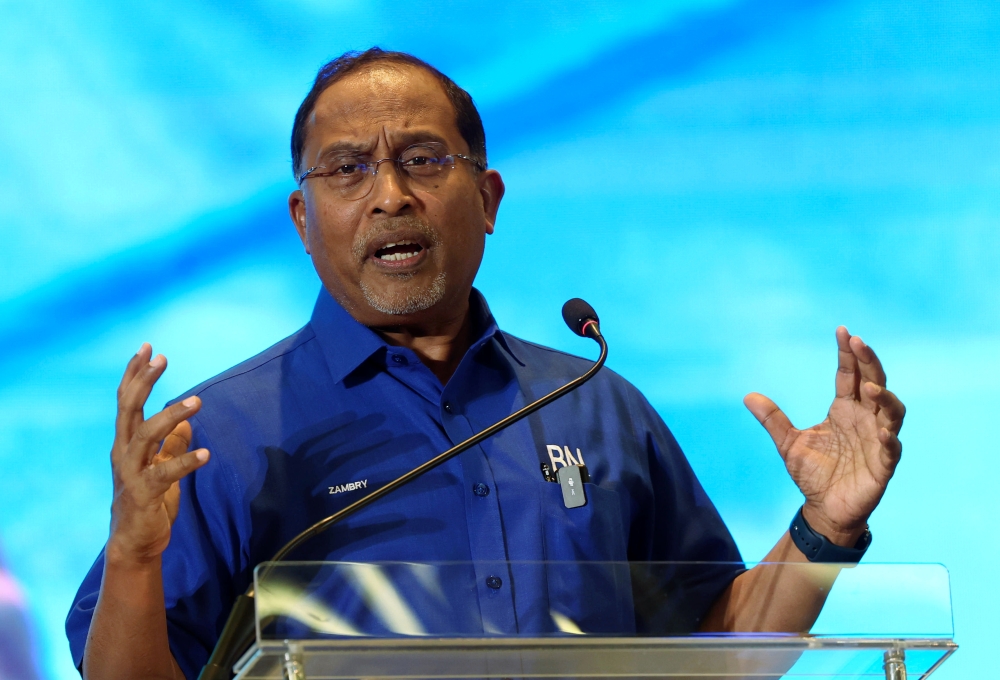
TANJUNG MALIM, June 16 — The formation of new political parties in the country will not affect Barisan Nasional's (BN) prospects in the upcoming Johor and Negeri Sembilan state elections, said BN secretary-general Datuk Seri Dr Zambry Abd Kadir.
He said the coalition was well-prepared for the two state polls and remained fully focused on efforts in the areas where it will field candidates.
He said that while anyone is free to establish a new political party in a democracy, BN will continue to adhere to its strategies and preparations.
“Johor Umno and BN have prepared extensively, and I believe the formation of a new party will have no impact on BN, based on the efforts and preparations that have already been set in motion,” he said.
He said this when asked whether the emergence of Parti Wawasan Negara and Parti Bersama Malaysia (Bersama) would pose a challenge to BN in the Johor and Negeri Sembilan state elections.
Earlier, Zambry launched the pilot programme for the National Service Training Programme (PLKN) 3.0 at public universities before attending the launch of the book Nahas Gerik: UPSI Berduka at Universiti Pendidikan Sultan Idris (UPSI) here today.
The Johor state poll is slated for July 11, while voters in Negeri Sembilan will cast their ballots on August 1. — Bernama
Federal agents showed up at the Cleveland office of the Ohio Organizing Collaborative on Thursday and spent hours questioning staff, said Prentiss Haney, a board member of the grassroots organization.
As more artists drop out of the White House’s Freedom 250 event, Bruce Springsteen and Tom Morello are leading a protest music festival. While performing together on Wednesday at Nationals Park in Washington DC, they announced the one-day Power to the People festival will take place Oct. 3 at Merriweather Post Pavilion in Columbia, Maryland, […]
Legislators passed a law two years ago barring the use of the QR code printed on ballots that the state relies on to tally votes beyond July 1 of this year, but no replacement method was ever implemented.
Bogotá, Colombia – Peru’s presidential election has been upturned by news that the country’s public prosecutor is seeking a jail term for Roberto Sánchez, one of two candidates set to compete in next month’s run-off.
The public prosecutor announced on Tuesday it is seeking a five year and four month jail term for alleged irregularities in campaign donations to the Together for Peru (Juntos por el Perú) party between 2020 and 2021.
The announcement has fuelled existing concerns about the integrity of the elections and the state of Peru’s democracy, which has faced a spate of crises in recent years.
If successfully prosecuted, Sánchez would be unable to stand in the election set for June 7.
The candidate denies the accusations, saying, “I proved that I never made personal use of the party’s financial resources, and that is why the alleged fraud as a serious crime was dismissed by the Judiciary through a court ruling.”
The timing of the release of the documents, leaked to the press on May 12 and formally unsealed the next day, has raised suspicions in some quarters of attempted electoral manipulation. The documents show that the prosecutor’s resolution was issued on January 15 but was only made public this week, as Sánchez closes in on advancing to run-off elections following a lengthy vote count.
Jo-Marie Burt, from the Washington Office on Latin America (WOLA), says the charges may signal that an elite coalition in congress is seeking to subvert the election process to avoid the chance of Sánchez coming to power.
“One cannot help but see this as a politically motivated move designed to remove him as a viable candidate,” she told Latin America Reports.
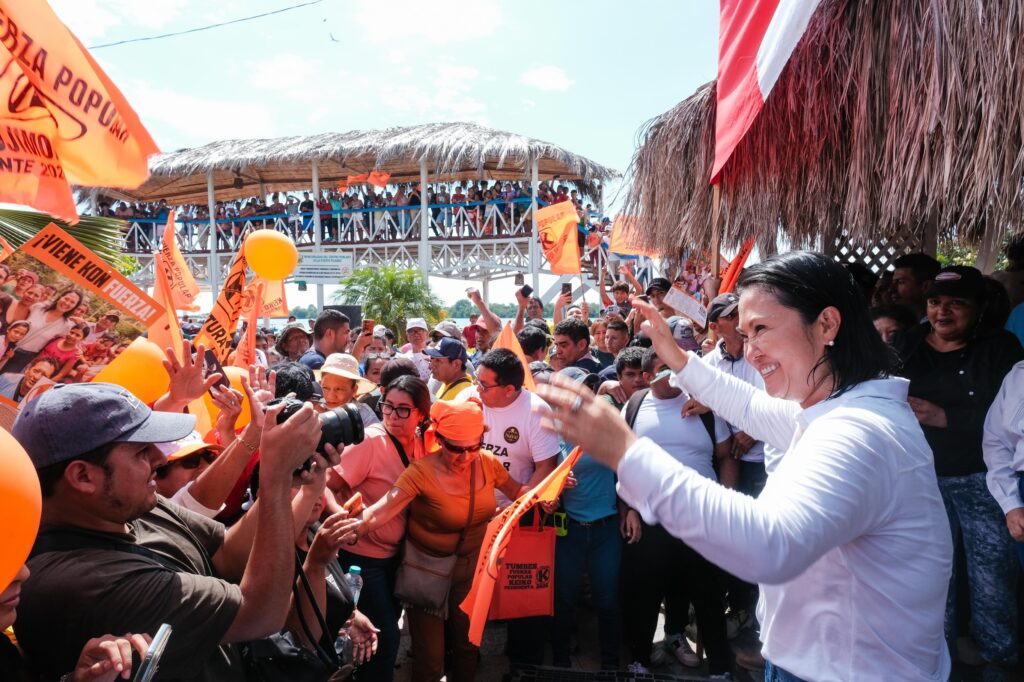
Sánchez, a leftist former trade minister, is set to face off with Keiko Fujimori, the right-wing politician who has dominated the political scene in Peru for a decade but has been defeated in each of the last three presidential run-offs.
Keiko Fujimori greets supporters. Image credit: Keiko Fujimori via Facebook.
WOLA’s Burt sees the hand of Keiko Fujimori behind this intervention: “The [prosecutor’s office] is now run by people who are closely allied with Keiko Fujimori and her allies. Hence the concern that this action against Sánchez is politically motivated.”
The public prosecutor’s decision to seek a jail term for Sánchez is just the latest in a series of moves which have fuelled concerns about the integrity of Peru’s judiciary.
While the prosecutor’s office is technically independent from the executive and legislative branches, it has been clouded by accusations of politicization since the accession of Attorney General Tomás Gálvez, considered an ally of Fujimori.
In November last year the UN Special Rapporteur on the independence of judiciary and lawyers, Margaret Satterthwaite, raised concerns about the ousting of Attorney General Delia Espinoza, who had been actively pursuing investigations into links between organized crime and legislators.
“Judicial independence is not optional. It is the foundation of democracy,” she said, after congress voted to bar Espinoza from office for ten years.
Espinoza’s replacement by Gálvez – who has been under investigation for links to organized crime in the Cuellos Blancos del Puerto influence peddling scandal – deepened fears for the integrity of the judiciary in Peru. In January this year, he announced that three major corruption investigation units, including the one investigating the Cuellos Blancos case, were being closed down.
Peru’s National Human Rights Coordinator claimed at the time this “constitutes an institutional breakdown that seriously weakens the fight against impunity by jeopardizing ongoing investigations.”
Featured image description: Roberto Sánchez at a campaign rally.
Featured image credit: Roberto Sánchez via Facebook.
Less than three weeks before Colombians head to the polls in presidential elections, centrist candidate Claudia Lopez’s odds at victory are slim, to say the least.
Since winning the primary contest to lead the Consultation of Solutions (Consulta de las Soluciones) bloc in March, the silver-haired former mayor of Bogotá has been criss-crossing the country to win over moderate voters.
But the latest polls report the 56-year-old’s share of the vote as being in the low single digits.
Dressed in her signature gilet and sipping from a mug of coffee, the former Harvard University guest lecturer says in flawless English that she wants to do the interview in Spanish – “I need to get people to vote for me,” she jokes.
With little to lose, López speaks candidly about her time in office, her views on other politicians, and her experience on the campaign trail.
Watch the full interview here
Reflections on her mayorship
López, who steered Bogotá through the Covid-19 pandemic and a mass wave of anti-government protests, speaks proudly of her stint as mayor from 2020 to 2024.
The presidential hopeful rattles off a list of her achievements in office: her management of the Covid-19 pandemic, lifting 600,000 women out of poverty, and rolling out Bogotá’s public bicycle network.
López also speaks candidly about the problems during her mayorship, which spanned the administrations of presidents Iván Duque and Gustavo Petro.
“Interestingly, I ended up having an easier relationship with President Duque, a right-winger, than with my left-wing president, whom I voted for,” says López.
López, who publicly backed Petro’s candidacy, describes friction between the national government and the mayor’s office.
“President Petro is an effusive leader, but he is too effusive, very machista, and I, well, I don’t agree with that; if there’s one thing I can’t stand in my life, it’s the abuse of power.”
On the campaign trail
Today, the former senator finds herself trying to carve out a place in a noisy election cycle marked by political extremes and polarization.
Her coalition’s platform is based on three pillars: security and territorial governance; equality and social justice; and regional development without corruption.
López’s shift to the center has drawn some criticism, including from voters who note the former Green Alliance member’s u-turn on key environmental issues like fracking.
Last year, she declared: “If god gave us oil, coal, and gas, that is what we will use.”
“I maintain this stance,” insists López, adding she opposes the Petro administration’s pause on all oil and gas exploration. “Stopping gas exploration means halting Colombia’s energy transition – it’s a mistake.”
López argues the policy has damaged the economy and reduced funds for investment and development.
Instead, she backs a gradual transition: “I estimate that the transition in Colombia from fossil fuels to cleaner energy sources will take us about 25 years, give or take.”
The candidate believes in preserving biodiversity, saying she would not authorize mineral exploration in the country’s forests or protected areas, marking a softer stance than some of her opponents.
Among her rivals, López is especially critical of right-wing criminal defense attorney Abelardo de la Espriella.
“He is the only candidate – let’s put it this way – whom I would absolutely never vote for. He is a defender of mobsters. He is a shadowy character,” says López.
De la Espriella notoriously represented figures linked to paramilitary death squads, the head of the worst pyramid scheme in Colombian history, and Alex Saab, considered the frontman for corruption schemes by former Venezuelan dictator Nicolas Maduro.
López argues that he is an Uribista – a supporter of the politics of right-wing ex-president Álvaro Uribe – but is on a different “side of the coin” to Uribe’s chosen candidate, Paloma Valencia.
“Paloma is definitely a supporter of Uribe, but she’s never exactly been a defender of mobsters,” explains López.
The ex-mayor refused to rule out voting for Valencia or for leftist candidate Ivan Cepeda, the two frontrunners alongside de la Espriella.
But López, a lesbian woman, is staunchly critical of Valencia’s stance on LGBTQ+ rights. The candidate for Uribe’s Democratic Center (Centro Democrático) party opposes adoption by same-sex couples while her party has blocked bans on conversion therapy.
She is particularly critical of Juan Daniel Oviedo, a gay politician, for agreeing to be Valencia’s running mate in March.
“I regret that Juan Daniel Oviedo feels compelled to play along with that anti-rights agenda. In fact, I believe he is the only person who has been told to his face that he is not considered an equal human being, that he is not considered a citizen with the same rights, and that they do not trust him to raise a child,” says López.
Despite her objections to Valencia, López says she still will not rule out voting for her in the second round, citing the improbable possibility that Paloma faces de la Espriella in a run-off.
But the former mayor maintains she would not endorse Valencia and Oviedo in any eventuality: “I wouldn’t campaign for them, ask anyone to vote for them, or endorse them.”
Looking to the future
Finally, faced with nearly impossible odds in May’s elections, López projects a springy optimism about her political future.
“I’m very happy with the campaign I’ve run, and I’m very grateful to the Colombian people,” says the candidate, stressing that it is just her first stab at the presidency.
“Ours is a new grassroots movement; we only just collected the signatures last year, so I feel grateful, happy, and very excited, and I’m going to continue in politics and continue working to build Colombian social democracy.”
This article originally appeared on The Bogotá Post and was republished with permission.
A Hong Kong man who threw anti-government leaflets from his public housing flat has been sentenced to 10 months in prison after pleading guilty to committing seditious acts.
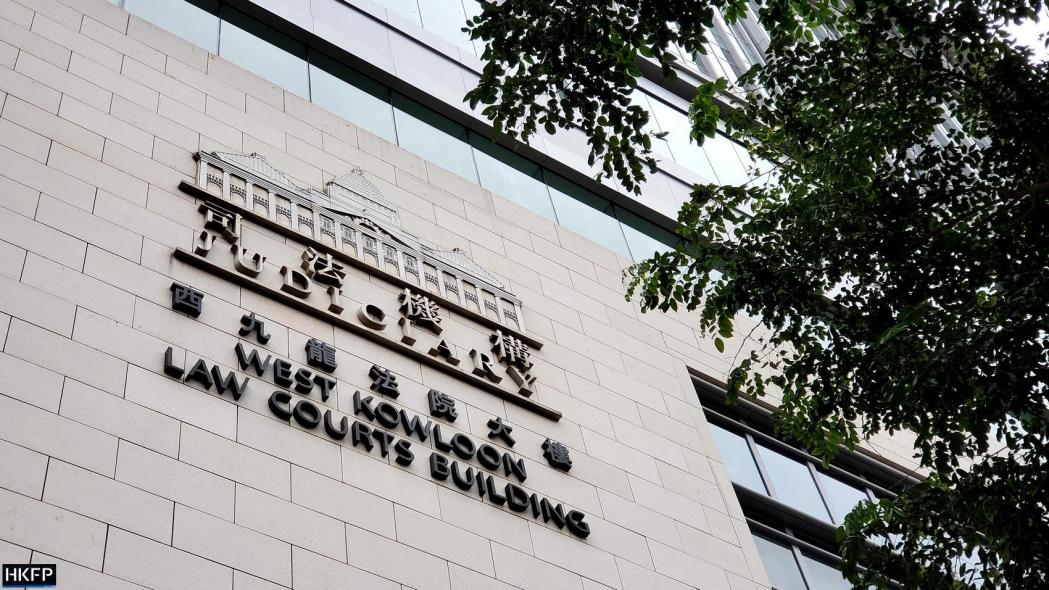
West Kowloon Law Courts Building. File photo: Kelly Ho/HKFP.
Raymond Wong appeared at the West Kowloon Magistrates’ Court on Tuesday to receive a 10-month jail sentence handed down by Chief Magistrate Victor So for two counts of “doing with a seditious intention an act or acts that had a seditious intention,” local media reported.
Wong, a 55-year-old construction worker, admitted to throwing the leaflets from his unit in On Tat Estate, Kwun Tong, on two occasions in October 2024 and December 2025.
He was arrested in April, and the following month, he pleaded guilty to the charges – an offence under Hong Kong’s homegrown national security law, also known as Article 23.
In mitigation, he apologised to his girlfriend and his daughter, as their public housing unit would be reclaimed by the government due to his offence.
Citing a psychological report, Wong’s lawyers said that the defendant did not know how to control the resentment that had built up from losing his full-time job after the 2019 protests and the Covid-19 pandemic.
‘Premeditated and planned’
Noting that the leaflets were thrown after National Day two years ago and before last year’s Legislative Council (LegCo) elections, Magistrate So said that Wong’s actions were “premeditated and planned to some degree.”
On October 2, 2024, Kwun Tong district councillor Hsu Yau-wai reported 41 sheets of paper to the police after finding them on the podium of Lai Tat House at the estate. The papers had slogans on them saying “kill police” and derogatory remarks about mainland Chinese people.
On December 5 last year, two days ahead of the “patriots only” LegCo polls, a property manager found papers scattered near that same area, with written slogans such as “Liberate Hong Kong, do not vote.”
Police officers at a Tai Po polling station for the 2025 LegCo elections, on December 7, 2025. Photo: Kyle Lam/HKFP.
Wong’s lawyers said on Tuesday that his methods were “primitive” and had limited impact compared with online posts.
So said he accepted the defence’s argument but pointed out that Wong explicitly incited people to kill police officers, mainland Chinese, and government officials.
Wong incited enmity towards the police and referred to mainland residents with “derogatory” and “dehumanising” language, and his use of the slogan “Liberate Hong Kong,” considered secessionist under Beijing’s national security law in Hong Kong, also challenged national sovereignty, the magistrate added.
Calls to boycott the LegCo polls also amounted to an effort to undermine public confidence in the city’s electoral system, So said.
The turnout for last year’s polls was the second-lowest on record, at 31.9 per cent. Beijing overhauled the city’s electoral system in 2021 to ensure that only those deemed patriotic enough can run.
The move reduced democratic representation in the legislature, tightened control of elections and introduced requirements for candidates to obtain nominations from a small circle of political elites.
Bogotá, Colombia – President Gustavo Petro rejected the results of first-round presidential elections on Sunday, alleging irregularities.
Hard-right populist Abelardo de la Espriella defied pollsters’ predictions to beat the candidate representing Petro’s leftist Historic Pact party, Iván Cepeda, although neither surpassed the 50% required to win outright.
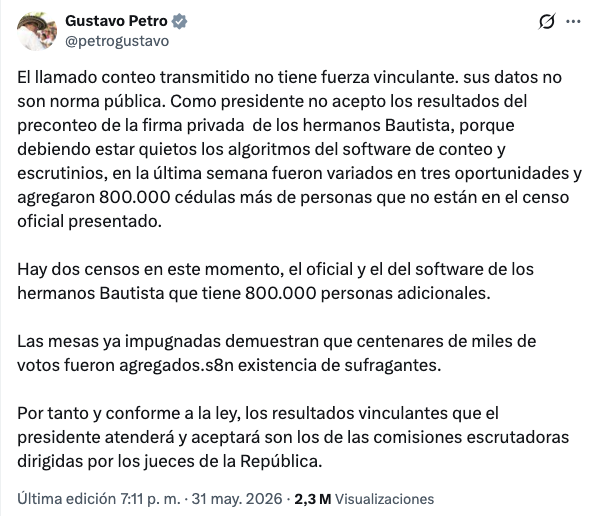
“The so-called count being transmitted is not legally binding. Its data is not considered official. As president, I do not accept the results of the preliminary count,” wrote Petro on X shortly after the election was called.
In Colombia, the “pre-conteo”, or preliminary count, is based on officials tallying the ballot sheets and entering them into an online software. But the “escrutinio”, or scrutinized results, usually take several days to be announced and are ratified by judges.
According to the Registrar’s Office, which is responsible for overseeing the voting process, the pre-count is “for informational purposes only” and has “no legal standing.”
But de la Espriella received nearly 700,000 more votes than Cepeda, a gap which is very unlikely to be closed after the scrutiny.
Delivering a speech after the results were released, Cepeda said he would not address the elections until the scrutinized count came out.
A post from President Gustavo Petro on May 31 saying he would not accept the pre-count results of Sunday’s elections.
“Only once the vote-counting committees have fully, clearly, and thoroughly clarified this matter will we comment on tonight’s results,” the senator told a crowd of supporters at the Hotel Tequendama in central Bogotá.
He also referred to historic efforts by Colombia’s traditional parties and institutions to repress the leftist movement embodied by the Historic Pact: “Our life has been a constant struggle.”
A crowd of Cepeda voters gathered nearby to watch the speech on a large screen, with some chanting the Spanish anti-fascist slogan “No Pasarán”. One pair held a sign reading “Fraud!”.
Petro has repeatedly warned that the elections may be stolen, part of a long-running dispute with Thomas Greg & Sons, a multinational company responsible for electoral logistics.
In 2022, the Historic Pact gained some 500,000 votes in legislative elections following the scrutiny.
Regardless of the final results of the election, Cepeda and de la Espriella are set to face off in a second round on June 21.
Featured image description: President Gustavo Petro at a cabinet meeting, October 22, 2025.

 Login
Login
:max_bytes(150000):strip_icc():format(jpeg)/Spencer-Pratt-Karen-Bass-and-Nithya-Raman-052826-bc525f42f6d24c57960726b62bc26e0d.jpg "<p>Roy Rochlin/Getty; Axelle/Bauer-Griffin/Getty; Vivien Killilea/Getty</p>")