Investors see SpaceX as a bet on broadband, AI infrastructure and even space-based energy. But if they become reality, the biggest change may be visible every night.
Investors see SpaceX as a bet on broadband, AI infrastructure and even space-based energy. But if they become reality, the biggest change may be visible every night.
Demonstrators protest a data center in Tucson, Arizona, in May 2026. | Mamta Popat/Arizona Daily Star via Getty Images
On its surface, the national revolt against data centers seems simple: They are a nuisance, and people do not want them in their proverbial backyards. But I haven’t been able to let go of the idea that there must be something much deeper driving the backlash against them, and few other subjects have confounded me more than trying to figure out what to think about it.
T
Demonstrators protest a data center in Tucson, Arizona, in May 2026. | Mamta Popat/Arizona Daily Star via Getty Images
On its surface, the national revolt against data centers seems simple: They are a nuisance, and people do not want them in their proverbial backyards. But I haven’t been able to let go of the idea that there must be something much deeper driving the backlash against them, and few other subjects have confounded me more than trying to figure out what to think about it.
These facilities — the massive suburban and exurban warehouses that power AI, along with much of what we do on the modern internet — spew noise, have been accused of guzzling electricity and water, and have a halo of generalugliness around them. And over the past year-and-a-half or so, many Americans have gone from barely knowing what a data center is to having fiercely held opinions about them. Seventy percent of Americans, according to a recent Gallup poll, now say they would oppose one being built in their area. The environment tops their list of concerns. They’re also disquietedby the idea of high-tech facilities buying up land from America’s farmers and ranchers. Anti-data center campaigns have swept communities across the country, producing dozens of local moratoria on their construction.
Inside this story
Data centers have rapidly become a flashpoint in communities across the US, with many Americans opposing their construction over concerns about noise, water use, energy use, and other nuisances.
But the backlash is probably about much more than data centers themselves — they’ve become a proxy for the public’s dread of AI and an uncertain future.
Instead of fighting data centers one by one, the US needs a broader debate and policy agenda on how AI should be regulated and how to ensure it expands rather than diminishes human agency.
These objections sound public-spirited enough. But as Vox’s Eric Levitz and many othershavewritten, many of the rationales for stopping the buildout of data centers, particularly the environmental case against them, have been overstated (more on that in a moment).
Yet grassroots anti-data center activists are hardly wrong to be worried about artificial intelligence — it is one of the most formidable policy problems we face today. AI’s ultra-wealthy makers promise a world of unprecedented progressand prosperity, but also say they might also eliminate everyone’s job and possibly annihilate humanity in the process.
If you are terrified that AI is ushering in a future that will be miserable to live in, I fully share in that feeling (and would personally prefer to go back to a world before ChatGPT). And I think this sentiment, rather than any ecological anxiety, explains much of why Americans are suddenly fighting to ban the physical infrastructure on which AI and tech more generally depends, why they’re so pessimistic about AI in general, and why college seniors graduating this spring have been booing the mere mention of AI off the commencement stage.
But it’s a problem that stopping a data center locally feels like the only policy lever that an ordinary person can pull right now to try to slow down AI, because it’s a blunt instrument that can’t give us the outcomes we really want. Canceling data center projects town by town is unlikely to meaningfully slow AI adoption, and it certainly doesn’t regulate AI use or protect us from its worst possible outcomes.
Instead, this approach traps us in a debate about relative trivialities rather than about one of our society’s most important questions: how we will manage a technological and economic transformation that’s already happening. And that dysfunction in turn prevents us from seeing any upside to AI and thinking about how we might broadly share it. It is, at bottom, a symptom of the same obstructionism that blocks us from addressing many of the biggest problems of our time, from green energy to housing and so much else, under similarly confused pretexts.
Could that ever change?
Where the data center revolt is coming from
The great US data center buildout is colliding with a national economic mood that appears to be historically, singularly bad. Americans are angry about the cost of living, afraid for their futures, increasingly mistrustful of each other, and don’t trust our institutions to solve the problems we face. They despise (it probably goes without saying) Big Tech. Majorities of the public say that AI will do more harm than good in daily life, that it will take away their economic opportunities, that government is not doing enough to regulate it. Young people are particularly fixated on the impacts of AI, and they seem positively miserable about it.
It’s little surprise Americans feel such a dread of AI; Congress has introduced dozens of bills to govern the technology but has failed to pass any comprehensive legislation. With no federal regulation apparently forthcoming that would, say, provide a measure of economic security to the tens of millions of workers who could be replaced by AI in the coming years, it’s perhaps no wonder that there’s been such vigorous backlash against the physical manifestations of the tech.
Surely, then, at least some of the reasons that data centers are being pigeonholed as an ecological issue is that people are searching for legitimate-feeling reasons to try to stop this runaway train. The tendency to fall back on reasons that can be metabolized by the policymaking processes that ordinary Americans can actually influence, like environmental review, has been inherited from the environmentalprotection laws embraced across the country beginning in the 1970s, when pollution had become a visible public crisis. But just as when environmentalism is weaponized to block new housing or high-speed rail or in support of whatever other garden-variety NIMBY cause, the ecological argument for shutting down AI mostly withers under scrutiny.
Like all economically important industries, data centers and AI certainly have real environmental impacts. These facilities use a lot of electricity, and much of it comes from fossil fuels because most US electricity is still derived from fossil fuels. Their electricity use will grow quickly as demand for AI tools increases.
But years of covering one of the world’s most underrated environmental menaces — agriculture, especiallyanimal agriculture — have taught me to be skeptical of contextless claims about how much water or energy any particular industry uses. The planetary harms of data centers aren’t radically out of proportion to what we would expect from an industry that is increasingly important to daily life and the economy; computing is far less intensive in energy and physical resources than many other things we do and many of the activities it stands to replace, AI researcher Andy Masley haspointed out repeatedly. Data centers’ water use, meanwhile, amounts to a tiny fraction of all US water use, and there is not much evidence that they’re going to cause water scarcity issues even in arid parts of the country. In cases where a data center replaces, say, farmland growing water-intensive cattle feed crops in dry regions of the US, it mighteven benefit the environment.
I never want to sound glib about the future of our planet, nor do I want to take too far a detour into the political philosophy of how we decide whether an industry’s resource use is “worth it.” But I think it’s fair to say that campaigning against data centers on ecological objections is a dead end, if we are serious about finding a policy response to this technology that addresses the true concerns around it. An environmental frame may even be a gift to the AI industry, because the industry can defend itself on that ground pretty straightforwardly. Even data centers’ dependence on fossil fuels, one could argue not entirely unreasonably, is a problem for policymakers to solve by accelerating the buildout of renewable energy.
The AI debate we’re not having
So what, then, are we to with AI concerns if not taking them, converted into gigawatts and gallons, to the local planning commission meeting?
I wrestled with that question as I read Techno-Negative: A Long History of Refusing the Machine, Thomas Dekeyser’s recent book on the long human lineage of attempting to destroy the technologies that reshape the way we live, from the ancient Greeks, who, much like contemporary dread of AI, worried that machines could eclipse human agency, to computer arsonists in the 1980s. Dekeyser, who is a lecturer on human geography at the University of Southampton, writes that technological progress has always been a “political battlefield” where the purpose of human life is contested.
How can technology be used to make our society freer and more equal, and to augment human agency, rather than diminish it?
The fight to choke off data centers represents the latest expression of that struggle to define what it means to be human in the face of technological change, of what Dekeyser calls the “tenacious, fierce urge to negate life’s technologization.” What is AI, the technology that promises to replace the human mind itself, if not the apotheosis of our fears of being made obsolete? To the median American, data centers might feel like a manifestation of the forces that want to take all their power and relevance away from them.
Yet widespread cynicism about AI, I think, doesn’t stem from any inherent property of the technology itself, but rather from our politics. The public has not been offered any credible political vision of a future where AI could be deployed to support human flourishing, nothing that can offer a satisfying answer to the most important questions about our relationship with technology. As Dekeyser writes: “Do they constitute and expand, or undermine, human subjectivity?”
In this way, political possibilities shape the way we feel about technology: Imagine if, for example, instead of the prospect of widespread economic disenfranchisement, the productivity gains from AI could be harnessed to pass a four-day (or, hell, even three-day) work week, or to finance a generous universal paid leave policy. The US, as the richest country in the world and an undisputed leader in AI, certainly has the leverage to enact such policies. We could also give workers power over how AI is deployed in their workplaces, or incentivize AI development in a direction that expands, rather than replaces, human creativity. Or, as Sen. Bernie Sanders proposed this week, give the public a direct ownership stake in the technology itself, created by a tax on AI companies.
Whatever you think of these ideas, we’d be better off debating their merits and thinking through the particulars of how they might be implemented than fixating on individual data centers. But because an ambitious national AI policy feels unimaginable right now, and so of course people see AI as all downside and no upside. But simply channeling popular sentiment into local bans on physical infrastructure forecloses debate over the most important aspects of AI before we can even have them, as Holly Buck, an associate professor of environment and sustainability at the University of Buffalo, recently argued.
The politics of local veto has produced many of America’s other major governing failures, too: We can’t decarbonize the economy, solve a structural housing shortage, or absorb a technology as big as AI when local zoning hearings are the only places where the fight is happening and actionable decisions are being made. The essential difference with AI, though, is that on housing or climate change, we already mostly know the policy solutions we need. On AI, that terrain is still much less certain. We don’t yet know what we want from a potentially existentially transformative technology. That calls for real national confrontations with the most important questions: How can technology be used to make our society freer and more equal, and to augment human agency rather than diminish it?
Maybe that future still requires more data centers, many more of them (or maybe we should build fewer of them). Whichever outcome we choose, it should be downstream of a rational and deliberative policy process, rather than a poor simulacrum of the debate we all deserve.
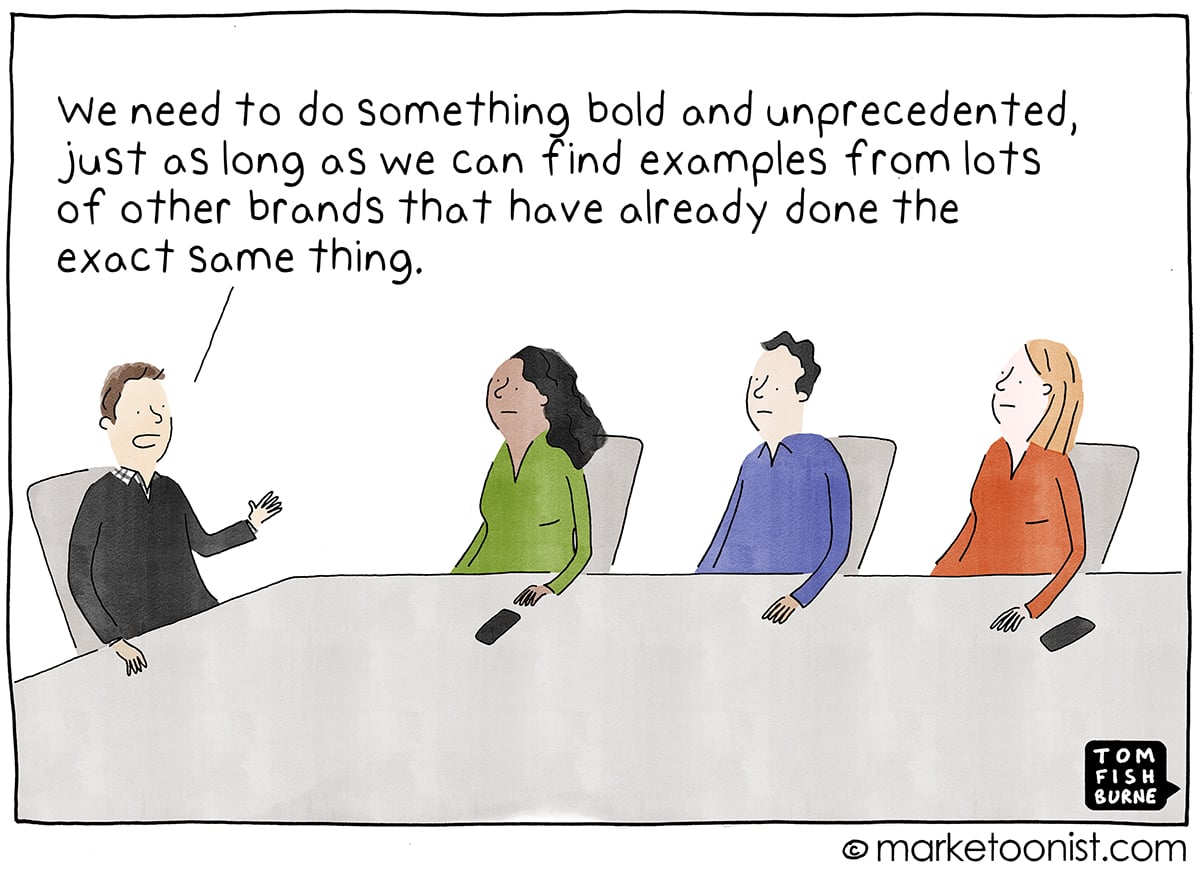
I drew this week’s cartoon on a paradox I keep seeing in innovation.
Henry Ford famously said:
“I invented nothing new. I simply assembled the discoveries of other men behind whom were centuries of work.”
Ford’s original motor company cribbed ideas and inspiration everywhere from Singer sewing machines to P&G to Chicago slaughterhouses. Those borrowed innovations set the stage for a whole new approach to manufacturing.
Stanford GSB professor Stefanos Zenios and Ken Favaro explore
I drew this week’s cartoon on a paradox I keep seeing in innovation.
Henry Ford famously said:
“I invented nothing new. I simply assembled the discoveries of other men behind whom were centuries of work.”
Ford’s original motor company cribbed ideas and inspiration everywhere from Singer sewing machines to P&G to Chicago slaughterhouses. Those borrowed innovations set the stage for a whole new approach to manufacturing.
Stanford GSB professor Stefanos Zenios and Ken Favaro explored Ford’s approach as a case study in what they called “Precedents Thinking” in an HBR article last year.
Their key thesis is that past innovation is raw material for new innovation. Precedents show what’s possible, reduce risk, and give leaders the confidence to act.
And yet, in practice, precedents often get used less to inspire what’s possible, than as a permission slip to do anything at all. This creates a kind of innovation theater.
Relying only on precedents can lead brands to doing the same thing over and over again.
That tension to be “unprecedented with precedents” is at the heart of innovation. The best innovation borrows selectively and builds on what it finds. The worst just borrows.
Here are a few related cartoons I’ve drawn over the years:
How do we know when the world has changed?
On June 1, a team of scientists published a preprint scientific paper claiming they had edited human embryonic DNA with more precision than any previous attempt. As a technical achievement, the work is undoubtedly impressive, largely avoiding the errors that had accompanied earlier efforts to gene edit embryos. With further development, such embryonic editing could free future children from fatal or debilitating genetic diseases, but as the ve
On June 1, a team of scientists published a preprint scientific paper claiming they had edited human embryonic DNA with more precision than any previous attempt. As a technical achievement, the work is undoubtedly impressive, largely avoiding the errors that had accompanied earlier efforts to gene edit embryos. With further development, such embryonic editing could free future children from fatal or debilitating genetic diseases, but as the veteran science writer Carl Zimmer reported in the New York Times later that week, the real headline news was that the work “could open the way to babies engineered with particular characteristics” — designer children, in other words.
The same day the Times piece published, the AI company Anthropic published a post asserting that AI was already accelerating AI development, which the authors argue may represent an early step toward recursive self-improvement (RSI) — AI systems that design and build their own successors, faster and faster. Already most of the code that runs Anthropic’s Claude was written by Claude itself, which has helped the company’s engineers ship eight times as much code as they did two years ago. While more is not automatically better, and Claude is still far from being able to guide itself, the possibility of self-improving AI is on the horizon — and “it could come sooner than most institutions are prepared for,” as Anthropic co-founder Jack Clark and Anthropic Institute head Marina Favaro wrote.
These two writings were published by academic biologists and the employees of an AI company, in two wildly disparate disciplines, but they nonetheless point to a possible near future that is fundamentally different from the world we live in now.
Both events are potential key steps toward unprecedented powers — not all of which we would have firm control over: newly designed intelligences and newly designed humans. What the two share is not just consequence, but bivalence — the possibility of both the miraculous and the catastrophic. The biological precision that could eradicate an inherited disease like Huntington’s could also pave the way to a genetic caste system. The AI capability that could accelerate decades of scientific progress could also utterly disempower its makers — us.
The world may have walked through a historic door with both of these advances last week. But we can’t yet know which kind.
Designing ourselves
Take the biology step first. Strip away the headlines — which come from the media, not from the scientists themselves — and the experiment is fairly narrow.
Using so-called base editors, which make a small nick in a gene strand rather than chopping out an entire segment, as CRISPR does, Columbia University geneticist Dieter Egli and his team edited two genes: PCSK9 and HBG. You might have heard of the first one; PCSK9 produces a protein that affects the body’s ability to clear cholesterol from the blood, and certain mutations in the gene can drive LDL cholesterol levels dangerously high. HBG encodes a form of hemoglobin that the body relies on before birth and normally switches off afterward. Being able to control these genes could prevent the mutations that increase heart disease risk (PCSK9) and reactivate that fetal hemoglobin in adulthood, easing — though not curing — sickle cell disease and beta-thalassemia (HBG).
The researchers delivered their base editors into fertilized eggs and into two-cell human embryos, and in some cases they managed to make the edits without the chromosomal damage that had been associated with earlier attempts to edit using CRISPR.
The paper — which has yet to be peer-reviewed — is an impressive step forward in the effort to use gene editing technology on human embryo genes with greater precision. But impressive is still far from perfect, or even safe — some edits landed at the wrong spot in the genome, and relatively few of the embryos went on to develop normally. (The embryos, which had been donated by IVF patients, were developed no further than very early stages, and none were implanted.) Egli and his colleagues were clear in the paper that any notion of using the base editing technique as it is now for treatment is “premature.” But the paper does show such editing can now apparently be done without shredding chromosomes.
When the Chinese scientist He Jiankui used conventional CRISPR to edit human embryos in 2018, producing three children, his work was widely rejected not just for moral reasons, but technical ones, as his clumsy gene editing did real genetic damage. Should the new paper’s results bear out, the technical obstacles to embryo engineering begin to vanish.
No one knows what comes next. Certain genetic disorders like sickle-cell anemia can be fixed with a single gene edit, but preventing more complex health problems — or engineering the traits some people might dream about, like height or intelligence — would require editing hundreds or even thousands of genes in combinations we don’t fully understand yet. But if the technical barriers keep falling, that will only leave the moral ones — and the moral ones have rarely held back a technology for long.
Designing intelligence
As revolutionary as the ability to truly engineer human beings would be, biology still moves slowly. The same can’t be said for the subject of the other document released last week.
Anthropic’s post uses over 5,000 words and plenty of (I’m guessing) Claude-produced graphics to make a single point: The proportion of human work that goes into building AI is shrinking at every stage. Engineers who once wrote the code now mostly review what Claude itself writes. Experiments once designed manually are now increasingly proposed and run by the model. While humans still make the judgment call about what is worth building, Anthropic argues that even that has started to change, as employees increasingly defer to what the model proposes to do next.
A research loop that is increasingly dominated by AI itself is one that could move ever faster. Technology has always changed at the rate of human beings — how fast they can think, plan, and act. An AI capable of improving itself eliminates that speed limit, allowing for the very real possibility of it moving faster than any human or any human-run institution charged with governing it can follow. Intelligence itself goes critical — each smarter model building a smarter one, the reaction sustaining itself.
That might seem like a lot to put on a few months of internal coding data from an AI company that has a vested interest in making its models look as strong and as smart as possible. (Especially if that AI company happens to have a potentially record-breaking IPO on the horizon.) In the post, Anthropic itself concedes that simply counting lines of code only goes so far, and that speed is only at best a partial metric of success. But independent research has shown that AI models are able to spend longer and longer on a single task, which allows them to work not just quicker but deeper. We can quibble over the speed, but not on the idea that AI is moving forward, and fast.
Powerful and blindingly quick AI could lead to rapid economic, scientific, and medical progress — all the dreams Anthropic CEO Dario Amodei has laid out in his own writing.
But it also threatens to be existentially dangerous as well as profoundly disempowering for most of us, not unlike genetic human enhancement could be for those left out. And the potential speed of such change is so great that Anthropic makes the unusual proposal of calling for AI companies to consider collectively slowing down or even temporarily pausing frontier AI development, to enable societal structures and AI alignment research to keep up. The authors of the Anthropic post specifically cite the international regimes built to control past dangerous technology like nuclear weapons, which, for all their problems, have so far kept the world from annihilating itself. But those institutions, like the International Atomic Energy Agency, took decades of white-knuckling to build, and as the Anthropic leaders note, when it comes to self-improving AI: “We don’t have that long.”
History’s hinge
How do we know when the world has changed?
Sometimes it’s immediate. When Otto Hahn and Fritz Strassmann achieved nuclear fission in December 1938, experts understood the implications almost immediately: A nuclear bomb would be possible. Sometimes the scientists see it, and the rest of the world doesn’t. When Jennifer Doudna and Emmanuelle Charpentier published the seminal paper detailing CRISPR in 2012, initial press attention was all but nonexistent, and the institutions that would eventually need to govern it had no idea what had just happened.
The hardest cases of all are the ones where even the experts can only see half of it. Fission pointed one way, toward a weapon, and the people who understood it could do little to stop it. Each of the two advances of last week points in two ways at once. The same editing technology that could spare a child from a fatal disease is one that could eventually sort children into genetic castes. The same intelligence that could give us “a country of geniuses in a data center,” as Amodei once put it, could also leave us as little more than spectators in the world.
So we are left where we began, at a threshold we cannot see past. The danger is not just that we may have walked through the wrong door. It is that we’ve walked through without noticing there was one.
While SpaceX is a world superpower in crafting reusable rockets, its high-priced takeover of the AI start-up xAI should be factored into calculating its IPO share price.
While SpaceX is a world superpower in crafting reusable rockets, its high-priced takeover of the AI start-up xAI should be factored into calculating its IPO share price.
Looking for help with today's New York Times Wordle? Here are some expert hints, clues and commentary to help you solve today's Wordle and sharpen your guessing game.
Looking for help with today's New York Times Wordle? Here are some expert hints, clues and commentary to help you solve today's Wordle and sharpen your guessing game.
Ilia Topuria's UFC record stands at a perfect 17-0 with 15 finishes. Ahead of his defense vs. Justin Gaethje at the White House, here's his best wins and highlights.
Ilia Topuria's UFC record stands at a perfect 17-0 with 15 finishes. Ahead of his defense vs. Justin Gaethje at the White House, here's his best wins and highlights.
A jury ruled against Elon Musk in his lawsuit against OpenAI on Monday. | Benjamin Fanjoy/Getty Images
Friendship breakups are never easy, but few are as messy and expensive as the collapse of Elon Musk and Sam Altman’s once thriving tech bromance, which has — for now — reached a legal end.
On Monday, a jury ruled against Musk in his lawsuit against OpenAI, which contended that Altman and other executives “stole a charity” (as one of Musk’s lawyers put it) by turning much of what was on
A jury ruled against Elon Musk in his lawsuit against OpenAI on Monday. | Benjamin Fanjoy/Getty Images
Friendship breakups are never easy, but few are as messy and expensive as the collapse of Elon Musk and Sam Altman’s once thriving tech bromance, which has — for now — reached a legal end.
On Monday, a jury ruled against Musk in his lawsuit against OpenAI, which contended that Altman and other executives “stole a charity” (as one of Musk’s lawyers put it) by turning much of what was once a nonprofit research lab into a corporate behemoth. (Disclosure: Vox Media is one of several publishers that have signed partnership agreements with OpenAI. Our reporting remains editorially independent.) For three weeks, lawyers on both sides deployedan increasingly unhinged body of evidence in an attempt to discredit both men and prove they’re untrustworthy and power-hungry.
Musk claimed he was duped into donating roughly $38 million to OpenAI under false pretenses, and was suing for $150 billion in financial restitution alongside major changes to OpenAI’s leadership and governance structure. Judge Yvonne Gonzalez Rogers accepted the jury’s decision that Musk failed to bring his lawsuit within the three-year statute of limitations, given that OpenAI first added its for-profit arm in 2018. However, it’s possible that the evidence put forth at trial will still beenough to convince state regulators to revisit the agreements that allowed OpenAI to restructure into a for-profit enterprise to begin with.
Lawyers tell me that Musk will likely choose to appeal the ruling, meaning the catfight might not be over yet. But even beyond the outcome, the trial shone an often uncomfortable spotlight on the inner workings of Silicon Valley and the AI industry.Here are five major revelations from the trial.
OpenAI’s board members questioned Sam Altman’s honesty
Musk’s legal team sought to paint Altman as a deeply untrustworthy person, prone to lying to his co-founders, employees, and board members if it meant advancing his interests.
Multiple former OpenAI employees and board members testified as much in the courtroom. Altman’s “pattern of behavior related to his honesty and candor” led directly to his temporary ouster as CEO in 2023, said Helen Toner, a former board member, in a video deposition. He had a tendency of “saying one thing to one person and completely the opposite to another person,” Mira Murati, OpenAI’s former chief technology officer, testified. In one instance, she said, Altman explicitly lied to her about the safety review required to vet a new AI model.
Greg Brockman kept a diary — and he probably wishes he hadn’t
Some of the more salacious evidence entered into trial came from a personal diary kept by OpenAI president Greg Brockman, who chronicled his “stream of consciousness” as he weighed whether it would be “morally bankrupt” to pivot OpenAI into a for-profit enterprise.
“Can’t see us turning this into a for-profit without a very nasty fight,” he wrote in one 2017 entry. “It’d be wrong to steal the nonprofit from him,” meaning Musk, who co-founded OpenAI and provided most of its start-up funding. “He’s really not an idiot,” Brockman later wrote. “His story will correctly be that we weren’t honest with him in the end.”
Brockman was also candid about his personal ambitions; “It would be nice to be making the billions,” he wrote. He later received a stake in OpenAI now estimated to be worth about $30 billion.
Surprise, surprise: Elon Musk is difficult to collaborate with
OpenAI built a bot in 2017 that was so advanced, it could beat top professional players at strategic multiplayer battle game Dota 2, a major milestone for the budding lab. “Time to make the next step for OpenAI. This is the triggering event,” Musk emailed Brockman.
Musk gave Brockman and cofounder Ilya Sutskever new Tesla Model 3 cars, presumably to “butter us up,” Brockman testified. The Tesla CEO then summoned them to his self-described “haunted mansion” for discussions of a possible OpenAI for-profit arm, where whiskey was served by Musk’s then-girlfriend Amber Heard.
At one point, Musk became so irate at his guests’ insistence that they share control of OpenAI — rather than cede absolute control to Musk — that “I actually thought he was going to hit me, physically attack me,” Brockman testified. In the following months, Musk repeatedly pitched having Tesla absorb OpenAI, Altman testified. And, in one “particularly hair-raising moment,” he mused that OpenAI should pass on to his children.
Musk ultimately left OpenAI in 2018 to begin building his own competitor. During an all-hands meeting, Musk got into another tense verbal tussle with Josh Achiam, now OpenAI’s chief futurist, over the race to develop artificial general intelligence. “He snapped and called me a jackass,” Achiam testified. For Achiam’s valor, two OpenAI employees — including Dario Amodei, who later departed to form Anthropic — awarded him a small golden statue of a donkey’s rear end, inscribed with the message, “Never stop being a jackass for safety.”
Microsoft cozied up to OpenAI to avoid being left behind in the AI race
Musk first funded OpenAI because of another friendship breakup, this one with Google cofounder Larry Page, who Musk says mocked him at his own birthday party for preferring humans over computers. Microsoft — which is named in Musk’s lawsuit for aiding and abetting OpenAI’s abandonment of its nonprofit mission — later became OpenAI’s first major corporate investor in 2019, because it, too, wanted to compete with Google as the AI race heated up.
“I don’t want to be IBM,” Microsoft CEO Satya Nadella wrote to executives, referring to that company’s decline in the personal computing race, according to emails revealed at trial. “It was becoming even more core and important that we had real agency at every layer of the stack,” Nadella testified.
That meant ingratiating itself in every corner of OpenAI’s world. Microsoft played a crucial role in bringing Altman back to power after the failed board coup in 2023, which Nadella referred to as “amateur city, as far as I was concerned.” In a text thread revealed at trial, Altman asked Microsoft executives to vet various members of OpenAI’s reconstituted board of directors, who now control both the for-profit company and the original nonprofit.
By this summer, Microsoft will have invested over $100 billion in OpenAI, one of the company’s executives testified. The company was awarded a 27 percent stake in OpenAI last fall.
Everybody wants to rule the world (of artificial general intelligence)
Microsoft. Musk. Altman. Brockman. Almost everyone who testified at trial pointed fingers at a different boogeyman whose motives were too impure and whose character was too corruptible, to be trusted with control of what all agreed would be an extremely consequential technology. By contrast, their own introspection mostly took a back seat to ambition.
“We don’t want to have a Terminator outcome,” Musk testified, to apparent eyerolls from Judge Gonzalez Rogers, who tried and sometimes failed to steer the trial away from discussions of AI’s existential risks. “If you have someone who is not trustworthy in charge of AI,” Musk said, “I think that’s a very big danger for the whole world.”
Over a decade ago, Musk came together with OpenAI’s cofounders to build a charity equipped to take on a different threat then poised to lead the AI race: Google, which had recently acquired Demis Hassabis’ DeepMind. Now, like Altman and Brockman, who testified that they resisted Musk’s dictatorial attempts to secure absolute control of artificial general intelligence, Musk portrayed himself as someone selfless and transparent enough to be put in charge.
“It is ironic that your client, despite these risks, is creating a company that is in the exact space,” Gonzalez Rogers at one point told Musk’s lawyer, in reference to xAI, which has come under fire this year for facilitating the mass creation of nonconsensual deepfakes. “I suspect there are plenty of people who wouldn’t like to put the future of humanity in Mr. Musk’s hands.”
Update, May 18, 2026, 2 pm ET: This story has been updated to reflect the conclusion of the trial.

 Login
Login