
Normal view

Received — 15 April 2026 Cartoon Research
  • ✇Cartoon Research
  • Get With The Times (Part 12) Charles Gardner
    A final installment of cartoons looking toward the new ways of present times, or bringing backwards characters of the past up to speed. We’ll deal with a couple of features, a Garfield special, a recent Mickey Mouse, and a lot of up-to-date action from the Looney Tunes gang. Garfield Gets a Life (Film Roman, 5/8/91), a half-hour prime-time special, could more appropriately be called “Jon Gets a Life”, dealing with the boredom that is Jon’s existence, and its contagious effect upon Garfield a
     

Get With The Times (Part 12)

15 April 2026 at 07:01

A final installment of cartoons looking toward the new ways of present times, or bringing backwards characters of the past up to speed. We’ll deal with a couple of features, a Garfield special, a recent Mickey Mouse, and a lot of up-to-date action from the Looney Tunes gang.

Garfield Gets a Life (Film Roman, 5/8/91), a half-hour prime-time special, could more appropriately be called “Jon Gets a Life”, dealing with the boredom that is Jon’s existence, and its contagious effect upon Garfield as well. The most exciting thing Jon seems to do is organize his sock drawer – two of them – by size, color, materials, blends, and all neatly tucked-in. When not occupied with socks, Jon counts ceiling tiles while flat on his back – and Garfield takes to doing the same thing, as they compare counts between the ceilings in the bedroom and living room. Garfield (perhaps for lack of anything better to do) tries to break Jon out of his rut, remembering an old copy on Jon’s bookshelf of “How To Make Friends and Fool the Rest”. Jon spots a chapter on getting dates, and attempts to follow it to the letter. Efforts to pick up girls in the park, at the beach, in the laundromat and at the video store fail miserably. Jon almost has accidental luck at a singles club (Club Ticky Tacky), as, while badly reading aloud from his book just for practice the line, “Hey there, would you like to dance with me?”, an equally-bored girl at the bar overhears him, and half-heartedly responds, “Sure, why not?” “YES!!”, shouts Jon, escorting her onto the floor. But Jon quickly loses her, by throwing her into a couple of forceful spins that spiral her right off the dance floor, then breaking into his own solo elaborate disco number (predicting Goofy’s in An Extremely Goofy Movie). Patrons of the club momentarily stare at the display, but, as the number reaches its close, the house lights go up, and Jon stands alone in an empty club, with total silence except for Jon’s last footfalls. Nevertheless, Jon strikes a closing Jon Travolta-style pose, only to hear from the rafters the voice of the D.J, yelling, “Hey, jerk. Disco is DEAD!” “What?? When??”, reacts Jon, and trudges away with Garfield, complaining how you learn a new dance, and 14 years later, they change it. “Go figure” responds Garfield in characteristic underplay.

A television ad by a dweebish-looking guy for his school, Lorenzo’s School For the Personality Impaired, intrigues Garfield and Jon – especially when mentioning such characteristics of the average students he helps as counting ceiling tiles and thinking disco is still in. Jon and Garfield arrive at Lorenzo’s meager institution (a run-down building complete with broken and partially-boarded windows and cracking plaster). They know they’re in the right place when they find every student in attendance looking up to count the ceiling tiles. Lorenzo dispenses rather meaningless advice, such as extend a hand to the one next to you and say, “Hi, my name is so-and-so”. Most of the students quote him verbatim, never including in the sentence their own name. Another suggestion is to make people believe you can speak a foreign language, by only sounding like you do. He thus utters French-sounding gibberish meaning nothing, then teaches Canadian by merely adding the syllable, “eh?” every few sentences.

Jon’s handshake extension during the class causes him to make the acquaintance of a moderately pretty girl, who is as unsure of herself as Jon is, and certain that she is blowing making a good first impression. Jon and the girl find themselves equally matched in awkwardness and shyness, and begin to open up to each other about it, being themselves – and really hit things off. Garfield is both amazed and puzzled that this is possible, having never thought Jon to have the potential for striking up any serious relationship. The two decide they’ve had enough education for one day, and step out for a bite to eat, then spend the entire evening on Jon’s porch, getting to know each other – and all the time being themselves, without following any of their professor’s advice. Things get personal for Garfield when he overhears Jon, carried away in conversation with the girl, refer to him merely as “his cat”. “Yesterday, I had a name”, Garfield complains to himself, seeing his best buddy and confidant relationship with Jon slipping away. Garfield lapses into a dream of what will happen if Jon marries, a toddler arrives, and the abuse he will endure as the toddler grabs at him and chomps upon his tail. He marches outside, seizing Jon by the collar and trying to shake some sense into him. The girl, taking her first notice of Garfield, reaches out to pet him behind the ear. “She’s trying to get to you by getting to me”. Garfield warns in thought and pantomime – but a few scratches in just the right places, and even Garfield finds himself being won over, resting in her lap as she scratches his back above his tail. However, the girl has pushed her luck, and an old nemesis of hers arises – an allergic sneezing fit when she is around cats. The two humans are heartbroken at this development, but Jon stays faithful to Garfield, giving his pet a hug. Garfield remarks at the value of having seniority. The two humans realize they can’t be a serious part of each other’s lives, but promise to see each other from time to time. Garfield still wants to ensure that things will stay this way, by promising to himself that their meetings will be chaperoned – riding along with the couple as Jon drives her home, not inside the car, but stuck to the rear window by suction cups on his feet and hands, just like so many plush Garfield ornaments decorated real-life car windows of the period.

• “Garfield Gets a Life” is on Dailymotion


My Generation G…G…Gap (Looney Tunes (unreleased, direct to video), Porky Pig, 3/31/04 – Dan Povenmire, dir.) – Hard to say if this one should have ever been produced. It was scrapped for theatrical release when box office on Looney Tunes: Back in Action failed to reach expectations (undeservedly). And it is definitely a departure for Porky, perhaps more jarring than Goofy’s 1950’s transformation to the “everyman”. Somehow, Porky is married? With a hip teenage daughter? (Where did Petunia fit into all of this, as she is never seen nor mentioned in the film.) Porky drives his daughter to her first rock concert, waiting outside the arena at a local coffee shop – where he sees a news story on TV about how out-of-control the concert tour has gotten at its previous venues, and sees a live shot from inside the area of his daughter wildly riding on the shoulders of a burly hunk. Porky spit-takes, and races for the arena, convinced that the performance is unsuitable for the likes of his young girl. A bulky gate attendant with a build reminiscent of construction worker Hercules from Bugs Bunny’s “Homeless Hare” refuses Porky entrance without a ticket, and even the influence of a talking Abe Lincoln on a five-dollar bill Porky offers the guard fails to impress him. Porky scolds Lincoln: “Y-y-you didn’t even try.” Yet, a couple of shapely girls get past the guard just on their good looks without any pass. Porky tries the same thing in drag, but just gets socked in the mush. Porky resorts to hiring a helicopter to lower him to the arena roof – however, the pilot is still giving him instructions when Porky jumps – and has not yet attached Porky’s safety cable. Porky falls through some high-tension wires, then crashes through the arena roof – in three dissected sections.

Inside, Porky lands inside an open guitar case next to the stage. The performance in progress has a rocker using guitars to smash everything on the stage – and Porky is the next “instrument” wielded. Bruised and battered, he is discovered by the guard. Running backstage, Porky ducks into wardrobe, and emerges wearing rocker’s garb, a mohawk wig, eye makeup resembling a member of Kiss, and two-foot tall platform shoes. Thinking he has spotted his daughter waiting around a dressing room backstage, Porky mistakenly demands that the young lady come home with him. She turns to reveal that she is a total stranger – and the other girls in the line would like to be taken home as well. Porky finds himself in the traditional predicament of all rockers – pursuit by an over-stimulated mob of women. He runs right into the guard, who fails to recognize him, and informs him that he should be on stage. Porky is deposited in the spotlight, while an almost stone-quiet audience tries to guess who he is. Porky tries to back away, but jostles a tall speaker, upon which someone has carelessly left a paper cup full of water. The water lands on a transformer, producing a short circuit, which makes its way up the cord of the microphone next to which Porky is standing. ZAP!! SIZZLE!! Porky engages in the most electrifying series of screams ever presented on stage, while a drummer in the back-up group behind him provides accompanying rhythmic beats. The whole stage blows up, and Porky is revealed next-to-naked. His daughter wails from the audience, “Daddy, how could you…” But the incident provides Porky with a new career, depicted in a mock TV commercial for a mail-away record album featuring 22 or so rock hits of other artists performed by a stuttering pig. As the list of hyphenated song titles scrolls across the screen, we fade out on Porky singing “B-b-b-bad to the bone.”


Rabid Rider (Warner, Road Runner (CGI), 12/17/10 – Matthew O’Callaghan, dir.) – A late theatrical short, produced in CGI. Wile E. Coyote is rarely one to be intimidated by new advances in technology. But for once, a new innovation has him perplexed – mostly, as to what to do with it. Wile E. eagerly unpacks the crate of the Acme Hyper-Sonic Transport, and dons his protective safety crash helmet before mounting up. As Road Runner passes the boulder behind which he hides, Wile E. rolls into view – at a relative snail pace and in jerking and tenuous motion and direction, atop a self-balancing platform! The device makes sudden stops causing the coyote’s belly to jam into the handlebars, topples forward to smash his face into the ground and then rights itself again, rolls him face-first into a boulder, then shifts into reverse uncontrollably, taking Wile E. Past the camera, only to be knocked back into view as he is hit from behind by an oncoming truck. As Wile E. lies prone upon the pavement, his fingers nervously drumming, the conveyance rights itself and wheels its way up to his side, letting out a beeping signal to indicate that it is ready to go again.

Wile E. knows this thing needs more speed. Standing atop it, he attempts to lasso the Road Runner passing around the neck, hoping to be towed like a chariot. His toss misses, but catches the next best thing – the air-fin of a passing sports car. Wile E. is off to the races, but has to do some fancy pulling of the “reins” to swerve and avoid being hit by oncoming traffic in the other direction. He finds himself rolling faster than the car he is tethered to, and facing the reflective rear of the back of a tanker truck between himself and the bird. Wile E. manages to fight the balancing instincts of his conveyance, leaning backwards to do a “limbo” pass under the truck’s axles. Now in front of the truck and still proceeding at a good clip, he lets go of the rope, and extends his arms in attempt to reach the Road Runner’s neck. But, the road reaches one of those inevitable T-intersections at the edge of a cliff, and Wile E. and the platform fall into the canyon below. They do not hit the ground, but come to rest straddling a pair of power wires, with the platform mid-way between two poles. Wile E. shimmies over to join his platform, but their combined weight bends the poles together at the top until their transformers touch. ZOWIE! A well-fried coyote and his platform shoot up into the air, striking into the bottom of a rock ledge overhanging above, then roll down the cliff face, Wile E. giving us a look as if to say, “Not again.” He and the platform roll past the Road Runner below, and come to rest in an intersection between a road and a train track. The platform’s wheels are sandwiched in the track bed between the rails and the cross-ties, and the machine rocks back and forth in its confined space helplessly, as Wile E. sees the approach of a train’s headlight. The coyote wisely hops off the track and his vehicle to avoid the train, only to get hit by a crossing truck. As the shadow of the train passes the flattened Wile E. in the roadway, the platform somehow emerges from the incident unscathed, and beeps again to signal that it is charged and ready for more.

Wile E. has had enough of this troublesome contraption. Swinging it around himself several times, he hurls it off a cliff. The vehicle lands on a rock ledge, balanced on a fulcrum like a teeter-totter, with a massive boulder positioned on the other end. The boulder is propelled into the air, and lands mere feet behind the sulking coyote walking on a road. Wile E. is barely phased in his bad mood by the near-miss, but his bad luck isn’t over. A large delivery truck swerves to avoid collision with the boulder, and its trailer payload is thrown over the rock, landing again mere inches behind the fleeing coyote, and covering him in a cloud of dust as he falls to the ground. As the dust clears, a chorus of electronic beeps announces the rise from the ground, one by one, of an armada of self-balancing platforms carried by the truck, who line up on each side of the roadway like an advance guard for a royal procession. Who speeds down the middle of the rows, plowing over Wile E. in the process, but the Road Runner, aboard one of the platforms himself, uttering his “Beep beep” and riding off into the sunset, passing a canyon wall on which the words ‘That’s all, folks!” appear.


Arthur Christmas (Aardman/Columbia/Sony, 11/23/11) attempts to bring the magical realm of Santa Claus into the modern hi-tech era. It also debunks a myth as to the everlasting nature of the man with the red suit and the white beard, who seems to have lived a good many lifetimes past the average human. There really wasn’t just one Santa, but several. In fact, the title has been passed down in the family for generations, the role of successor handed off twenty times since St. Nicholas to the most eligible of the clan, whenever one of those in charge reaches a stage of being past his prime.

The current Santa has already flown 70 missions. However, there’s been a lot of change to keep up with the demands of supplying toys to the entire world’s children in one night. No longer is the mission approached in the likes of a wooden sleigh. Instead, Santa’s vessel looks more like something out of Star Trek – the S-1, a giant, hovering behemoth of a space platform, complete with an underside of camouflaging cloaking panels to make it indistinguishable from the night sky as it moves into position to cover entire major cities. On a signal, an armada of elves drop on lines from the ship onto every rooftop, secure the area, and mass-unload the toys from panels in the bottom of the ship. Finding every which-way to enter into premises (one team is shown delivering presents to the president’s children in the White House by power-sawing a hole around a ceiling decoration of the Presidential seal), the elves scan sleeping children with a digital scanner that determines their percentage rating of naughty vs. nice before okaying the release of gifts from a supply chute. (One elf takes pity on a child who receives a borderline rating on the scanner, turning the device upon himself to register a more favorable rating and release the gifts.)

All is going well, and is monitored at a massive mission control base carved into the ice below the North Pole, until a child almost awakens to see the current Santa (who, more or less as a figurehead, delivers a few select toys personally). An emergency protocol is initiated to get Santa out of the touchy situation, and in the melee, a bicycle intended for a little girl falls from the ship and rests somewhere below undelivered. At mission control, two offspring of the current Santa become aware of the situation: one Steve, the elder brother and presumed next-in-line for the Santa title, currently in charge of mission control, and the younger Arthur, who has no dreams or realistic hopes of ever becoming Santa, and is a soft-spoken, sentimental type in charge of answering the letters to Santa. Arthur is distraught at the thought of the little girl who wrote for the bicycle facing complete disappointment on Christmas day when her bike doesn’t arrive, while Steve, more concerned for his own self-image and obtaining the family’s prestigious title of Santa the 21st, is not about to have it laid upon himself as being the first to allow the family’s perfect record of gift-giving to be spoiled. Steve talks his befuddled and confused Dad into classifying a one-in-a billion misdelivery as an acceptable margin of error, and Dad and Steve refuse Arthur’s request to send the S-1 out again to make the botched delivery. But Arthur will not rest until he sees that bike delivered – even if no one else will help him.

Arthur finds an unlikely source of assistance in the form of his cantankerous, headstrong, and a bit off-his-rocker Granddaddy, who was Santa before Arthur’s dad. Granddaddy claims he has a way to get Arthur to his destination to deliver the gift, and reveals out of hiding away in an ice cave something he’s been saving that no one else seems to know about – the original wooden sleigh previously used in his own heyday and by generations of Santas before him. Powered by magic dust distributed upon a team of reindeer, the “relic” can still make a top speed of 45,000 miles per hour, and maneuver under the hands of one trained in the reins to spin on a dime, streak through the skies like a comet, and fly to the moon and back if necessary (Granddaddy does so for Arthur, just for show). He remembers the good old days when the Clauses were the only humans who knew how to fly, and thinks of the present Santa (his own son) as a wimp who’d barely be able to control one of these babies. The Sleigh, in honor of the holiday, has been affectionately named “Evie”. Arthur experiences a white-knuckling but fascinating ride without the benefit of seat belts, and grows to have an equal admiration with Gramps for the ways of old, as Gramps shows him tricks like making a snowman out of cloud formations. But, a storyline we must have to support a feature-length CGI film, and a mishap places Gramps out of the driver’s seat and Arthur left holding the reins. Arthur does a good deal of globetrotting, arriving at the wrong destinations, losing the reindeer, and ultimately having the sleigh destroyed, while back at mission control, Dad and Steve finally get wind of Arthur’s secret mission, and embark on their own mission to rescue Arthur. Ultimately, all four surviving males of the Santa clan converge on the same location to try to right the wrong at the crack of dawn, but it is Arthur who, with his large heart (Steve in the course of the action discovering that he just doesn’t have a natural knack for getting along with children), receives the honor of placing the present under the tree. At Arthur’s suggestion, all of them hide behind a door, to witness the glee of the little girl when her present is opened. Dad remarks that in his 70 years, he’s always been too busy to see such an event firsthand – and realizes he should have made the time for it all this while. Even Steve is touched, and, with his blessing, allows Dad to pass the honor of the Santa title to – Arthur. By the next year, Arthur is at the helm of the S-1, but with a few changes. Its name has been changed to “Evie” in honor of the magic sleigh. And its power source is now the hooves of five thousand reindeer!


Tokyo Go (Disney, Mickey Mouse Cartoons (TV), 7/12/13 – Paul Rudish, dir.) – Another of Mickey’s frequent international episodes from this series, this time set in Japan, providing plenty of opportunity for imaginative and colorful background art. Mickey plays a typical Japanese commuter, facing the day-to-day hustle and bustle of trying to get to work from the congested urban setting of a busy railway station, and facing the current rage of commuter technology, the bullet train. He purchases a ticket for the blue line, then attempts to follow the colored lines on the station floor to his train’s departure zone. Unfortunately, the blue line on the floor intersects at right angles to a red line, and a mob of pedestrian cross-traffic sweeps up Mickey, pressing him onward toward the red train instead of the blue one. As bad or worse than New York subways, Mickey is tightly crammed into the train doorway by a station guard, so that when the doors closed, Mickey is plastered between the door’s glass windows and someone’s butt. Mickey pops out of the collar of the passenger’s coat to get a breath of the meager air supply inside the car as the train takes off, with enough inertia around a curve to send shock waves to the street below, piling four cars one on top of the other. Mickey looks around, seeing the blue train out the windows running at equal speed on another track – then also sees a sign at the end of his car reading in both English and Japanese, “Exit”. Mickey slips his way through people’s pantlegs, briefcases, and collars, attempting to make his way to the exit door through the sardine-can of humanity. His pants are punctured by the spiked heels of a gang of punk teens, but he manages to pass over them by swinging from the hand-holder handles in the ceiling of the car like Tarzan. But one passenger is unavoidable – a Sumo, whose girth blocks the whole car. Mickey has to peel off his trousers, revealing a Sumo’s pant-bandana underneath. The Sumo meets his challenge, also peeling down to the same bandana, and the two circle one another for combat. They both charge one another – but Mickey ducks at the last second between the Sumo’s legs. The behemoth crashes into the remaining passengers at the end of the car, both knocking himself out and clearing a path so that Mickey can escape through the exit.

Now, how to reach the proper train? The blue line is still speeding on a parallel track, but the speed of the trains makes any attempt to cross to the other seem impossible. Mickey is nearly blown away merely climbing onto the roof of the red train, and plays a dangerous game of dodging oncoming low signs and signals which protrude over the train roof as it passes them. Mickey shimmies every which way to miss being hit, and at one point even has to temporarily detach his ears to avoid disaster. More barriers in the form of poles or walls pass between him and the blue train to prevent a safe crossing. Finally, the blue track veers away, descending at an angle to a lower level, where its track passes under a bridge of the red line to cross at a right angle. Mickey’s last chance. In slow motion like a Japanese anime film, Mickey takes a daring leap from the bridge, passing a flock of ducks on the way down, and miraculously lands successfully upon the blue train’s roof. (How could he not be swept off or bounce given the blue train’s equal speed? But this is, after all, a cartoon.) In a matter of moments, the blue train screeches to a halt at its destination, and Mickey hurries from the local rail platform to a small park with a miniature red barn, entering the structure and flipping over a door sign in the window to read “Open”, then punching a time clock which finds him right on time. His job? The engineer of a Tokyo Disney duplicate of the “Casey Jr.” circus train ride known from Fantasyland in the States. Mickey displays a contented preference for the leisurely pace of this mode of travel, breathing a relaxed sigh as he circles the course with a load of happy children in tow.


World Wide Wabbit (Warner, Wabbit (Bugs Bunny), 9/22/15) – Yosemite Sam’s been in prison for 20 years, but finally tunnels his way out into the big city and freedom. “I’m free, I’m free…I’m broke”, he observes from his empty pants pockets. Conveniently, he has come up just outside the doors of a bank – the easy answer to his cash problems. He observes he has no firepower, but, setting up a running gag for the film, realizes that his pointing fingers pack as much ability to shoot up his surroundings as a pair of pistols. Thus, he marches into the bank, telling everyone to reach for the skies. The modern bank, however, is something absolutely new to him – no tellers, vault, or long lines, just Bugs at an ATM machine. So how do you hold the place up? Bugs tries to explain to him that everything’s gone digital – lots of ones and zeroes. Sam states he wants lots of bills with ones on them – followed by a lot of zeroes. Bugs continues that there’s nothing here to give, as its all on the Internet. “Okay – Hand over the Internet!!”, screams Sam. “Oh, boy”, mutters Bugs, realizing he’s dealing with a hopeless boob. Bugs again begins by informing Sam that the Internet isn’t something you just had over, and is hard to explain. He asks Sam to imagine a big delivery tube. “A big tube – got it!”. jumps Sam to conclusions, then checks outside for a kid’s drinking straw, an inner tube floating at a pool party, and even a girl’s tube top. “Eh, no”, cautions Bugs before he can touch it. Sam finally spots the biggest tube he’s ever seen, and runs into a subway tunnel, to be quickly run down by a train.

Bugs explains again that “tube” was merely a metaphor, and that digital information is in the cloud. Of course, Sam commandeers a hot air balloon to reach it, and Bugs makes sure he promptly falls out of its basket. Sam orders Bugs at trigger-finger point to take him to the Internet. Bugs leads him through a dark ventilation shaft, into a room where a game of turning on and off a pull-string light switch results in an unexplained change of locale and/or costumes with every pull of the switch (including lion’s dens, train tunnels, and even a gold room to which Sam just can’t return by turning the switch on and off again). Enough shenanigans, declares Sam, shooting away the pull string with a shot from his finger. Bugs finally tells him that the Internet is directly above them. Sam climbs a stepladder and saws a hole in the ceiling, then climbs up. “I’m on the Internet”, he shouts with jubilation – until he looks at his surroundings, and discovers he’s made his way right back into his jail cell, with a mob of police standing ready to capture him. As the sounds of police brutality echo from the hole above Bugs, Bugs climbs the stepladder himself, sticking a cell phone with camera up through the hole, and declaring “You’re on the Internet now, Doc.” As the live video records, the groggy voice of Sam is heard to say from the beating, “I’m up to a million hits already.”


Hareplane Mode (Warner, Wabbit (Bugs Bunny), 10/15/15) – Bugs is crossing the street, when Yosemite Sam careens down the road, texting while driving. The result is inevitable, with Sam’s car a wreck, and Bugs thrown onto the sidewalk. Sam has no concern for the victim he just collided with – only for his Smart phone, which bounced out of his convertible onto the pavement. Sam blames the rabbit for carelessly walking into the road when he could see Sam was texting, and threatens to sue when he notices a hairline crack in the screen of the phone. “I’m gonna sue the pants off ya”, he shouts, until Bugs points out he’s not wearing any pants – and also points to a billboard, advertising a new model phone available today. “Ya done me a favor”, Sam acknowledges in making him need a new phone, and Sam approaches the line in front of the “Phone Home” store, shoving all others to one side to be first in line. Who should be behind the counter in the store but Bugs, disguised as a typical teenage sales clerk, ready to seek revenge on this menace to society. “Gimme, gimme, gimme”, insists Sam, while Bugs deluges him in paperwork to sign and other red tape. Bugs demonstrates new security features, like a self-defense mode available at the push of a button, causing a gorilla fist to emerge from the phone screen and sock Sam in the jaw. Bugs sets a ringtone to a setting marked “Lion attack”. It goes off, emitting the sounds of a purring kitten. “That don’t sound like no lion attack”, complains Sam – until it signals a real lion to maul him. Bugs suggests switching to vibrator mode, but Sam insists it be nice and strong so he doesn’t miss any calls. Bugs sets the vibrator to “Apocalypse”. At a board meeting, an incoming call vibrates Sam right out of a skyscraper window to a 40-story drop. His mere leaning against a tree and a building when on the ground during phone rings brings down on his head a bee hive and a grand piano.

Sam returns to the store, demanding to return the phone. Bugs states be can’t understand why Sam is having issues – “That never happens with modern technology.” Bugs convinces Sam to keep the phone or be faced with the shame of using an older model, and resets Sam’s vibration lower. But Bugs isn’t through. That evening, he calls Sam, impersonating someone informing Sam that he’s won a grand sweepstakes prize, but interrupting the conversation with voice impressions of static, as if the signal is breaking up. Sam tries desperately to keep the connection going, first moving the phone all around the room for a stronger signal, then outside, then into the desert, and next the mountains. He finally re-establishes the call, shouting “Hello, hello…”, and brings down upon himself an avalanche. Then, the previous ring tone gets reactivated, and Sam is mauled by lions again. A bedraggled Sam returns to the store, again demanding a refund. Bugs pretends to be willing, but holds up the phone, dripping from melted snow from the avalanche, and states that he can’t take the phone back due to water damage. Sam insists that there’s no damage and he can prove the thing is working right, but everything he presses activates the gorilla punch, until he finally knocks himself out. Removing his disguise, Bugs remarks that this new model still had a few “Bugs” in it, then turns to the audience as if another customer, closing as he did in “Rabbit of Seville”: “Next!”
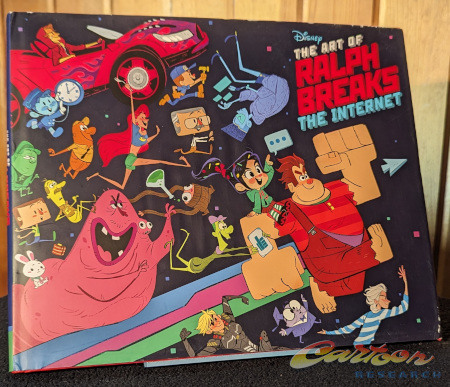

More than I can write about comfortably with my DVD temporarily mislaid and out of reach is Disney’s Ralph Breaks the Internet (11/21/18). A complicated tale finds Wreck-It Ralph and child racer Vanellope von Schweetz, two characters from old arcade games, in a dilemma when Vanellope’s video game, “Sugar Rush”, is rendered on the blink by Ralph’s helpful meddling in attempting to liven up the game for Vanellope by building her a new digital road. The steering wheel of the game becomes broken, and is only available as a vintage part at high cost in the resale market on the Internet. To keep the game from being scrapped by the arcade owner, Ralph and Vanellope travel through a Wi-Fi router to the world of the internet, structured like a magical city, in search of the replacement wheel and enough digital bucks to buy it. The mission, however, becomes rather unnecessary, as Vanellope discovers the existence of an online urban street racing game where everything is wild and unpredictable instead of the repetitive and tame race courses she has been used to, and decides she’d like to stay. Ralph feels his trust and friendship have been betrayed, and his own insecurity is built upon by a villainous character who creates clone duplicates of Ralph, merging into a colossal mega-monster. Ralph ultimately conquers the monster by conquering his own insecurities, realizing Vanellope is wise enough to make her own decisions, and he and the little girl part company as friends, staying in touch long-distance via video/email.

The film is also remembered for a memorable, if self-promoting, incident where Vanellope, who is considered a princess in her Sugar Rush game, encounters a Disney website, and meets all the famous princesses of past Disney classics, rendered in CGI. There are some funny bits, like Cinderella defending herself from the intruder by breaking one of her glass slippers and wielding the broken half like a bottle in a barroom. There is even a crossover from Pixar’s “Brave” of Princess Merida, who speaks in a heavy Scottish dialect which the others admit no one can understand, as one princess adds, “She’s from the other studio.” By the end of the sequence, Vanellope has all the princesses thinking like her, and each wearing similar knit casual shirts like Vanellope instead of their usual gowns. I remember seeing a complete set of dolls from the sequence in the special shirts for sale at a Disney store for a high but not exorbitant price based upon the sheer number of dolls in the set. It was tempting but out of my reach, and I wonder how many people managed to acquire it (the only copy I have noticed intact on line selling for $179 bucks – not a bad rate of investment return).


Virtual Mortality (Warner, Looney Tunes Cartoons (Bugs Bunny), 11/25/21 – David Gemmill, dir.) – After all these years, Elmer is determined as ever to know the feeling of victory – of finally catching that wascally wabbit. His latest efforts have him axe-swinging over Bugs’ rabbit hole (his latest cartons don’t allow him to use a shotgun – but is axe-swinging any less violent?). Between swings, Bugs asks if he’ll ever give up. Not until he’s felt victory – just once. An idea hatches in Bugs’ head, appearing in the form of a light bulb – but a swing of the axe fractures the bulb’s glass. Nevertheless, the idea remains in Bugs’s noggin, and he runs with it. He and Elmer could go on like this all day, with Elmer accomplishing nothing. Or, Elmer could achieve the feeling of victory – right now. “I’m wistening…”, says a skeptical Elmer. Bugs reminds Elmer that they are now living a modern era of technological marvels, and demonstrates what he means by disappearing into his rabbit hole to tinker loudly with some tools within. Bugs emerges from the hole carrying an old football helmet, fastened to which are a set of yellow safety goggles, and a snorkel. Elmer asks what it is, and Bugs displays it as a virtual reality helmet. With this, Elmer can experience the virtual reality of capturing him – something that in all likelihood will never occur in the real world. Still not sure what to believe, Elmer is at least willing to try the device on. Bugs “activates the simulation function”, by clunking Elmer a resounding blow on the back of the helmet with a hammer. As Elmer’s blurred vision comes into focus through the goggles, he can’t believe the clarity and detail he sees – of course, of the real forest before him. But Bugs reminds him he is viewing a virtual world that “ain’t real”. To prove the point, he hands Elmer a lit “virtual bomb”. “Wow! It wooks so dangewous!” marvels Elmer. Elmer asides to the audience that if this was real, he’d be freaking out about now. But since it’s virtual, he can be fearless. KA-BOOM! Now Elmer marvels at how real the virtual pain feels.

Bugs giggles to himself at how good a setup that was, and too bad its over so soon. But the rabbit hasn’t counted on Elmer’s recuperative powers, and in a few moments, Elmer has him tied up in rope, thinking he has “virtually caught” the wabbit, and now gets to virtually cook him and find out how good he virtually tastes. As Bugs is twirled on a spit over an open fire, he realizes things are being carried a bit too far. So, in his usual manner, he bluffs, convincing Elmer to not settle for such a small prey in this virtual world, but to go for an even bigger “virtual rabbit” – like the one over there. Slipping out of his bonds, he points out a grizzly bear eating honey from a hive, with his back facing Elmer. Zipping around behind the honey tree, Bugs extends one hand out to simulate, with two fingers, long ears protruding from the bear’s head. Elmer takes the bait, and approaches the bear, grabbing his fur and ordering him to come along quietly. When the beast doesn’t respond, Elmer kicks him. “I’m talking to you”, Elmer shouts, then reminds the beast that this is virtual reality, and Elmer’s in charge. The bear comes face to face with Elmer and snarls. Elmer again marvels at how vicious-looking these virtual wabbits are. Soon, he is experiencing that remarkable virtual pain again.

Elmer walks wobbly over to Bugs, stating that he thinks he’s had enough of the virtual world. But Bugs convinces him not to be a quitter, and to experience what it would be like to virtually conquer his biggest fears. What are the things that frighten Elmer most in the world. He answers, fear of heights, and his mother. Bugs hands Elmer a “virtual” cel phone, calling up Mom, and Elmer, again reminded that this “ain’t real”, tells off his Mom in no uncertain terms, that he’s through having her pick out clothes for him at the store, and also through eating his vegetables – so gets “virtually” cut out of Mama’s will. “Congratulations” says Bugs, shaking Elmer’s hand in close-up, for conquering both his fears. Elmer is confused, as he hasn’t conquered his fear of heights. “Ya could’a fooled me, Doc”, says Bugs, noting how well Elmer has taken to virtual sky diving. The camera pulls back, showing both of them somehow in the middle of a free-fall. But only Bugs is wearing a parachute. Elmer slams into the ground, while Bugs uses his chute to make a graceful landing. Bugs finally asks for an opinion whether Elmer enjoys better virtual reality, or hunting in genuine reality. “Neither”, responds Elmer matter-of-factly. “I prefer metaphysical reality.” Elmer assumes a lotus position, floats upwards a few feet off the ground, and makes a departure from the cartoon through a worm hole. A puzzled Bugs looks at the audience, and closes with the observation, “Huh, I’m more existential myself, but different strokes for different folks.”

This series of articles will no doubt need supplementation as time goes on, and new trends, fads, music styles, or other changes roll around worthy of satire and comedy. Any ideas as to something worthy and modern that hasn’t made the medium of animation yet? You could have the inspiration for the LOL classic of tomorrow. Share your suggestions – – or better yet, get cracking on your own animated productions!

Received — 14 April 2026 Cartoon Research
  • ✇Cartoon Research
  • The Last Five “Screen Gems” Cartoons Jerry Beck
    The 1948-49 Season of cartoon short subjects from Columbia Pictures consisted of just eight new cartoons. Among them some of the worst the Screen Gems studio ever produced. But also among the eight were a few real gems, the first offerings from the game changing UPA studio. This was the transitional year. Columbia had closed their Screen Gems studio (formerly Charles Mintz’s studio) in November 1946, after years of operating in the red. Luckily, Columbia had over two years of cartoons in the b
     

The Last Five “Screen Gems” Cartoons

14 April 2026 at 07:01

The 1948-49 Season of cartoon short subjects from Columbia Pictures consisted of just eight new cartoons. Among them some of the worst the Screen Gems studio ever produced. But also among the eight were a few real gems, the first offerings from the game changing UPA studio. This was the transitional year. Columbia had closed their Screen Gems studio (formerly Charles Mintz’s studio) in November 1946, after years of operating in the red.

Luckily, Columbia had over two years of cartoons in the backlog – enabling the studio to release a steady stream through their 1946-47 and 1947-48 season. Color cartoons were still in high demand in movie theaters throughout the 1940s and 1950s – especially as television invaded the media landscape – and the movie studios and exhibitors teamed up to fight off the new technology. Columbia still needed cartoons – but perhaps produced at a lower cost. Enter UPA.

Columbia made a deal with UPA for four cartoons to test the waters – three Fox & Crow and one “whatever they wanted”, a miscellaneous cartoon for a new series to be called “Jolly Frolics”. Combined with the last five Screen Gems shorts, those first three from UPA gave Columbia a respectable eight subjects. (If you think that was a small release slate – just check Walter Lantz’ output for United Artists that same season (48-49): a measly five Woody Woodpecker/Andy Panda subjects).

For Columbia, this season became a win-win. Three Fox and Crow – including one of the best ever, an Oscar nominee, The Magic Fluke – and another that was a real hit with the public: Ragtime Bear, featuring the first appearance of Mr. Magoo.

What a mixed bag. Those last Screen Gems films – despite the crew of cast-off Warner Bros/Lantz/Disney personnel, including an uncredited Bob Clampett – were poor by any measure. Let’s take a look at that season – in the order of their release – the year that introduced UPA to the general public and changed animation forever.

PICKLED PUSS (September)

What’s funnier than a drunken cat? Nothing – certainly nothing in this cartoon – not even a drunken cat (or a “pickled puss”). The final Columbia cartoon from ex-Disney animator Howard Swift – who went on to create an independent shop that did everything from animating Superman (in the Columbia serials) to pioneering TV commercials. I’m sure this looked hilarious in the story boards; the animation is sufficient – it has the “look” of an average Hollywood cartoon of the era – but it’s just plain unfunny.


LO, THE POOR BUFFAL (November)

Buffalo Billingsly (cross Yosemite Sam with Foghorn Leghorn) hunts a forlorn Buffalo and a Native American. Alex Lovy was a capable director – but it takes team to make a cartoon, and the team at Columbia just didn’t have the incentive – or sense of humor. Sometimes I watch these late Columbia cartoons, squint my eyes, and try to figure out what they thought was going to get laughs here… They don’t have a vocal talent like Mel Blanc, they don’t have the music of Carl Stalling or Scott Bradley (or Winston Sharples, for that matter). Weak.


ROBIN HOODLUM (December)

The first UPA entertainment theatrical short… and what a beauty it is. They threw out the Fox & Crow playbook (if there ever was one) and just have them play Robin Hood. There’s a story that animators from Chuck Jones unit did scenes when the production fell behind. All and all a vast improvement over Screen Gems shorts.


COO-COO BIRD DOG (February)

Have I mentioned how much I do not like the voice work of Cal Howard and Jack Mather in these later Screen Gems cartoons? Here’s a cartoon that has “should be directed by Art Davis” written all over it… but it was directed by his old partner Sid Marcus. This may be the best of the Screen Gems bunch here today… but that’s not saying much.


All of these cartoons are now telecast regularly on MeTV Toons – please watch the channel and spread the word.

Here’s the first Magoo… and by now there was no turning back. Columbia would have the hottest cartoons of the decade – and with this, the rest is history.

RAGTIME BEAR (September)


These last five Screen Gems cartoons do not portend or predict what could have been if the Screen Gems studio were to continue. It was somewhat a lost cause. Their ending allowed UPA to flourish and animation became a better place.

CAT-TASTROPHY (June)


…and this might be one of the worst Fox & Crow shorts ever. I can’t get past the Fox’s stupid voice.

GRAPE NUTTY (April)


MAGIC FLUKE (March)

Back to UPA and this one is quite perfect. Might be my second most favorite John Hubley UPA short (after Rooty Toot Toot).


Received — 13 April 2026 Cartoon Research
  • ✇Cartoon Research
  • “The Man From Button Willow” 61 Years Later Martin Goodman
    On April 3, 1965, a low point in American animated films hit the theaters. Advertised on its poster was the tagline, “The Most Delightful Animated Adventure Since Snow White.” This audacious claim would have been more truthful if it had been a comparison between a third-grader’s crayon art and a Picasso, but hey, it did have one honest word: it was animated. The Man From Buttton Willow, produced by film and TV cowboy star Dale Robertson, left itself wide open with that tagline, and it gets ev
     

“The Man From Button Willow” 61 Years Later

13 April 2026 at 07:01

On April 3, 1965, a low point in American animated films hit the theaters. Advertised on its poster was the tagline, “The Most Delightful Animated Adventure Since Snow White.” This audacious claim would have been more truthful if it had been a comparison between a third-grader’s crayon art and a Picasso, but hey, it did have one honest word: it was animated.

The Man From Buttton Willow, produced by film and TV cowboy star Dale Robertson, left itself wide open with that tagline, and it gets everything it deserves. Neither delightful nor adventurous, this disaster takes its place beside Foodfight, Arctic Dogs, and that great animated epic, Happily Ever After, which spelled the end for Filmation. Button Willow is 81 minutes of boring, poorly produced animation that might have an actual running time of 45 minutes if one were to edit out all the folderol involving humanized animals, the terrible “musical numbers,” and the reused animation cycles.

Let’s get down to business. The story involves Justin Eagle, (Dale Robertson) purportedly the very first “U.S. Agent”, investigating the machinations of the evil Montgomery Blaine and his accomplice, The Whip. These two, readily identifiable by their Scooby Doo – type evil visages, have been buying up the route for the transcontinental railroad and overcharging the government for the land. Oh yeah, they have been driving settlers off and burning their homes, a terrible thing to do since the inhabitants of Button Willow do nothing except walk down an idealized Western street and attend church. We know that Blaine is a scoundrel because he blows smoke rings from his cigar into our faces.

Aha! The good Senator Freeman has evidence of Blaine’s misdeeds! Before he can warn the Senate, the bad dudes kidnap Freeman in San Francisco, which is on the other side of the country from Washington, where the Senate is, but hey. They dump him onto a ship, although nobody knows which one, planning to permanently silence him eventually.

It’s Justin Eagle to the rescue, or at least after a stultifying, absolutely deadly period of doing farm chores and relating to his ranch animals and being attentive to his Japanese adopted little girl Stormy, who speaks in malformed English and attaches the suffix – “san” to everyone’s name. We learn in an awful song whose lyrics consist mostly of “Pardon Me, Ma’am” why Justin’s loyal ranch hand, Jeremiah “Sorry” Baker, never married, which is irrelevant to anything in the plot.

Jeremiah and Justin are both incredibly stupid; when one of their mares, Savannah, is about to foal, they believe she is sick, panic, call the vet, and wait worriedly outside the stall until they get the good news and celebrate! You dunderheads! You own a freakin’ ranch, and you couldn’t figure out that one of your mares was preggers? Anyway, this segues into a lengthy scene of the cutie foal. The dreadful soundtrack launches into the praiseful song, “Savannah,” which consists of that single name repeated endlessly.

Of course, the foal runs away into the mountains, pursued by Savannah’s stud Rebel, Justin’s dog Shady, and pet skunk Alfie. A cougar attacks, and Shady is knocked off a cliff in a fall that Wile E. Coyote might have envied, but of course the kindly vet resurrects him as Stormy prays. We are now at least 100,000 miles off the alleged plot of this tale.

Oh, yeah, Justin is in San Francisco, where he gets shanghaied and ends up on the same boat as Senator Freeman (remember him?) With the help of fellow prisoner Andy (Ross Martin), who boasts the worst Swedish accent since Pat Harrington Jr. voiced Lars in the Filmation series Journey to the Center of the Earth, Justin defeats the entire crew in the only noticeable “action/adventure” sequence in the film. They sail back to San Francisco. Justin goes home. Blaine and the Whip go to jail. Das Ende.

We’ve been over the music. Henry Mancini was allegedly a contributor to George Stoll and Robert Van Epps score, perhaps on a day when Mancini was cleaning out his trash bucket. The animation is abominable. Justin does resemble Dale Robertson when his features aren’t drifting over his face. The characters are stiff and rigid, and I spotted several scenes in which body movements are oddly out of synch. The animation crew seems to be a mixture of the unemployed and the third-stringers left after the death of theatrical shorts. Among the more recognizable are John Dunn, Don Lusk, John Sparey (who did some good work for Ralph Bakshi), Ben Washam, Les Clark, and Marc Davis (uncredited).

There is a horrid animated sequence in which Justin is pitched woo by the local spinster, Ms. Pomeroy; her entire face appears to be a repeating animation cycle, with several of her facial expressions physically and emotionally inappropriate for her dialogue. It’s scary. The only passable animation is that of the ranch hand, Sorry, who looks as if he belongs in a different movie. Since he seems to be a thinly disguised version of Johnny Appleseed’s guardian angel from Melody Time, perhaps he does.

I remain amazed at the vocal cast that Button Willow mustered. Cliff Edwards, Clarence Nash, and Verna Felton, late of Disney. Add Pinto Colvig, Herschel Bernardi, Shep Menken, and Thurl Ravenscroft, most of them playing multiple parts. Give ‘em all credit.

Poor Dale Robertson! This handsome cowboy star founded United Screen Arts in 1964, with Button Willow being its first feature. The now-defunct company produced seven films, the last one in 1968. The only legacy truly remaining is giving Raquel Welch her first film role and producing an animated feature that made Filmation look like Disney.

Lest we forget, Button Willow had David Detiege as director. His most notable prior credits were The New 3 Stooges and the abysmal Syncro-Vox cartoon Captain Fathom. After Button Willow, Detiege went on to a passable career at various studios until he died in 1984.

Received — 10 April 2026 Cartoon Research
  • ✇Cartoon Research
  • The 30th Anniversary of “James and the Giant Peach” Michael Lyons
    One sheet poster designed by Lane SmithWhen James and the Giant Peach came out, Henry Selick was already an animation veteran. Not only had he directed Tim Burton’s The Nightmare Before Christmas, which was released just three years prior, but he had been working in the industry since the late 70s. Selick had been part of Disney’s staff, animating on films such as The Fox and the Hound, but it was stop-motion animation that he eventually fell in love with. Selick’s dedication to stop-motion ext
     

The 30th Anniversary of “James and the Giant Peach”

10 April 2026 at 07:01

One sheet poster designed by Lane Smith

When James and the Giant Peach came out, Henry Selick was already an animation veteran. Not only had he directed Tim Burton’s The Nightmare Before Christmas, which was released just three years prior, but he had been working in the industry since the late 70s. Selick had been part of Disney’s staff, animating on films such as The Fox and the Hound, but it was stop-motion animation that he eventually fell in love with.

Selick’s dedication to stop-motion extended well beyond James and the Giant Peach. After the film, he went on to direct the live-action/animated Monkeybone in 2001, the Oscar-nominated Coraline in 2006, and 2022’s Wendell and Wild, continuing his journey in this unique animation style.

“It’s something I grew into. I always enjoyed the stop motion [Ray] Harryhausen films,” said Selick in a 1996 interview, reflecting on his career. “When I was a kid, I saw a lot of European puppet films, cut-out films. When I got into animation, I was going to art school already. So, I was experimenting with cut-out photos, and I even did these sorts of life-size figures that were hinged before I got into animation. I made new ones, animated them, and had them moving and talking. I went from 2D animation into 3D, and it’s sort of hard to go back.”

This dedication is evident in James and the Giant Peach, a film celebrating its 30th anniversary this spring, where Selick’s passion for the arduous and beautiful art of stop-motion truly shines.

When it was released on April 12, 1996, filmmakers were looking toward the ever-emerging technology of computer-generated imagery—Toy Story had just been released five months earlier. Despite this industry’s focus on computer graphics, Selick remained very comfortable in his stop-motion lane.

“Even in this day of super-impressive computer effects, which are only going to get more impressive over time, stop-motion still has this hold on my imagination,” said Selick in ‘96, adding, “I feel like I’m further and further out on a limb in the land of stop-motion, but the last thing I’m going to do is throw in the towel and try to compete, head-to-head, with everyone else in computers.”

Based on a book by author Roald Dahl, most famous for Charlie and the Chocolate Factory, the tale features the author’s trademark macabre story elements. “I come from this really strong visual background, so I was in love with the visual possibilities,” said Selick in 1996. “I really like the sort of flavor of Roald Dahl‘s books. There’s some pretty twisted, dark things set off against imaginative, heroic children.”

The film James and the Giant Peach opens in live-action, telling the story of young James Henry Trotter (Paul Terry), a lonely orphan living with his wicked aunts, Spiker and Sponge (Joanna Lumley and Miriam Margolyes, respectively).

A mysterious man (Pete Postlethwaite) gives James a bag of glowing green seeds, which he drops near an old peach tree outside his aunts’ house. The next day, a peach appears on the tree and keeps growing. The aunts begin charging the public admission to see it while forbidding James from going near the peach.

James sneaks away one night and enters a tunnel in the giant peach (the film then transitions to stop-motion animation). Once inside, James meets a group of large insects, who soon set the peach rolling out to sea, and he joins them on a magical journey to New York City, a place he has always dreamed of seeing.

The insect characters feature an impressive all-star voice cast. Susan Sarandon is Miss Spider, Richard Dreyfuss is the gruff Centipede, Simon Callow (Four Weddings and a Funeral) is Grasshopper, Jane Leeves (Daphne on TV’s Frasier) is Lady Bug, Margolyes as Mrs. Glowworm, and David Thewlis, is the voice of the Earthworm. “He did a remarkable job of this basic coward who’s blind and always imagines things being worse than they really are,” said the director of Thewlis, adding, “He did this amped-up performance, a quivering voice that really fueled the animation.”

There’s another character in James and the Giant Peach that audiences will immediately recognize. In one sequence, James and the insects run across an army of skeletal pirates. Look closely at the pirates, and you’ll notice a cameo that Lane Smith, the film’s character designer, snuck into the movie. “Lane kept putting in this tall, skinny guy against these other shapes,” remembered Selick in ‘96. “I finally said, ‘Well, he keeps looking like Jack Skellington, let’s just put him in the movie.”

Jack Skellington’s tale of The Nightmare Before Christmas is a film that, although not a success during its initial run, has generated a following that few films have. Sadly, this was originally not the case with James and the Giant Peach.

Despite not achieving box-office success initially, the film has since gained a following, helped by home video and its availability on Disney+.

Thirty years later, what audiences appreciate about James and the Giant Peach is reflected in the original review of The New York Times’ film critic Janet Maslin, who wrote: “Together, this prodigiously clever group has come up with expert animated effects and some boldly beautiful sights unlike anything else on screen…”

Received — 9 April 2026 Cartoon Research
  • ✇Cartoon Research
  • UPA’s “Christopher Crumpet’s Playmate” (1956) Steve Stanchfield
    First, some quick Thunderbean news: We’re cranking on sending out special sets this week – 8 in total! We’re trying hard to catch up on all of these and have this be the most productive year at Thunderbean. I’m particularly happy with this group of the special sets, and thanks to everyone who has contributed to these since it’s made so many of the real sets move forward. We also have two new ones (and all Lantz and all Columbia set) at the Thunderbean Shop, and will be working to get Rainbow P
     

UPA’s “Christopher Crumpet’s Playmate” (1956)

9 April 2026 at 07:01

First, some quick Thunderbean news:

We’re cranking on sending out special sets this week – 8 in total! We’re trying hard to catch up on all of these and have this be the most productive year at Thunderbean. I’m particularly happy with this group of the special sets, and thanks to everyone who has contributed to these since it’s made so many of the real sets move forward. We also have two new ones (and all Lantz and all Columbia set) at the Thunderbean Shop, and will be working to get Rainbow Parades volume 2 out the door soon as well as several other official sets. I’m really enjoying seeing many longer-term projects finally out the door, and I know many of you are super happy about that too!


Now- today’s film!

The loveliest thing about this period in time is that we have good quality versions of so many things that used to be only available in both less-than-great versions and standard def. It still makes you wish that *everything* was already available, but that’s of course asking for too much!

For the things that are still not available in HD, having access to a good 35mm scan often suits the bill.

Christopher Crumpet’s Playmate (1956) is a feast for the eyes in its simplicity and ‘modern’ aesthetic. Directed by brilliant animator Robert Cannon, it’s full of both the design sensibility and beautiful animation you would expect. T. Hee takes credit for story (along with Cannon) as well as design, with the great Jules Engel simply getting a credit for color. It’s nice to see a credit for voice actors Marvin Miller and Marian Richman, who provided voices for the first Christopher Crumpet film as well.

The film starts out with Christopher Crumpet’s father making Christopher return a very blue dog, suggesting Christopher play with an imaginary friend instead. From there, it’s a fun little story featuring incredibly supportive parents, something I think a lot of us would have loved. I was lucky in that my own parents really tried to help me with artistic pursuits the best they could. If you did have supportive parents and they’re still around, show them this little film!

Seeing this 35mm print projected recently was a feast for the eyes, and I’m glad to be able to share that print here. Seeing a high definition version on these really make a difference- you see the textures of the paint, the self ink lines on the cels, the detail of grids and phone cords in one scene- and the beautiful quality of motion.

While I don’t see this as a top cartoon from the studio, I find it pretty enjoyable as a little piece of entertainment- and I applaud UPA for making films like this one for families that could work like an animated storybook.

Have a good week all!


EDITOR’S NOTE: I’ve been waiting for one of my contributors to mention Christopher Crumpet’s Playmate – like the “secret word” on Groucho’s You Bet Your Life TV show – I descend within a special prize for this post. Over 20 years ago I helped organize and catalog Pete Burness’ archive (for his son) and among the material there were several pencil tests for various UPA shorts… among them, THIS.

The first one below is the raw scan of the film, which was negative. That’s how most pencil tests were screened, in negative form. No need to create a print – the pencil test was going to be thrown away after viewing. I took the liberty if inverting the neg and created a video with the image positive – easier to see the pencil lines. Enjoy them both.
– Jerry Beck

Received — 8 April 2026 Cartoon Research
  • ✇Cartoon Research
  • Get With the Times (Part 11) Charles Gardner
    Now, where were we? Ah, yes…… After a six-week hiatus into the world of bullfighting, we return to the universe of cartoons attempting to keep up with popular trends, fads and crazes, or update its characters from their past antiquated ways or personalities unbefitting popular activities into conforming members of society. We re-commence with a few last items from the 60’s, then move into more modern territory from Disney’s move into daytime television-animation and theatrical work post-Rog
     

Get With the Times (Part 11)

8 April 2026 at 07:01

Now, where were we? Ah, yes……

After a six-week hiatus into the world of bullfighting, we return to the universe of cartoons attempting to keep up with popular trends, fads and crazes, or update its characters from their past antiquated ways or personalities unbefitting popular activities into conforming members of society. We re-commence with a few last items from the 60’s, then move into more modern territory from Disney’s move into daytime television-animation and theatrical work post-Roger Rabbit.

Beatnik Boom/Call Out the Kids (Total Television, King Leonardo and His Short Subjects, circa 1960-61) is a typical two-part tale from the “King and Odie” segments of the show. All seems peaceful in Bongo Congo, with the king’s subjects happy, and industrious in the kingdom’s sole manufacturing enterprise of mass-producing bongo drums, with factory operations humming. This is bad news to resident villain Biggy Rat, who currently finds no ideas for fast moneymaking or promoting his own and his partner Itchy Brother’s rise to power. Itchy, the king’s disreputable sibling, is by nature a confirmed beatnik, and Biggy’s announcement that the two of them are out of money, and may actually have to go to work to eat, receives the same shock-wave of response as if you mentioned the word “work” to Maynard G. Krebbs. Itchy points out that he’s just not the working type, and prefers to spend his day sitting around playing the bongos and spouting beat poetry. In fact, Itchy calls himself the pied piper of poetry. A light goes on (not visualized on screen) inside Biggy’s brain. If the people of the kingdom could be convinced to see life in Itchy’s way, they’d have no use for that lunkhead Leonardo as their ruler, and Itchy could rise to power. So, a speechmaking campaign is set into motion. Itchy pours on the poetry, while Biggy promotes a lifestyle of all play and no work. The idea proves attractive to the Congo’s working class, and soon Itchy is indeed a pied piper to his followers, who abandon factory life and royal occupations in droves to take up bongo playing and poetry writing.

Leonardo becomes painfully aware of the problem when he finds no palace guards within the castle, forcing him to awkwardly open his own throne room doors, and almost wrench his wrist in the process. Royal aide Odie O-Cologne informs him of the bad news of Itchy’s beatnik campaign, and the mass walkout or workers from all occupations. Leonardo calls it the most unheard of thing he’s ever heard of, and ponders the unthinkable thoughts of the financial ruin of the kingdom, and a future of having no one to open doors for him. He and Odie attempt to keep the bongo factory running by trying to operate its assembly-line themselves, but the effort is an utter failure, resulting in both of them being stuffed inside the framework of a newly-minted set of bongos.

Now Biggy rallies the population for the final step – a march on the palace to demand an election, allowing them to cast their votes for Itchy as king. Leonardo observes democratic principles, and agrees to hold the election, nervously waving to his subjects in the belief that they would of course vote for him. But Odie can see where opinion polls are headed, and, despite talking Leonardo into running his own speech-making campaign in attempt to convince the public that work is necessary to the kingdom’s survival, Leonardo is booed resoundingly by the masses of nuevo-beatniks, and final poll results seem to indicate that no one will vote for Leonardo save himself and true-blue Odie.

However, there is one group of subjects left who retain a soft-spot for Leonardo – even though they are disenfranchised from the right to vote themselves. The kids of the kingdom remain loyal, button-wearing members of the King Leonardo fan club. They alone have the wisdom to realize that, if their parents don’t work, no one will be bringing in any money. And if there’s no money, then no toys! This is a lifestyle that cannot be stood for, and the kids resolve to commence their own emergency campaign to keep Leonardo on the throne. But how to convince their lazy parents to vote for him? The solution becomes an exercise in “monkey see, monkey do” logic. Hiding their fan club buttons to conceal their true allegiances, the kids present a unified transformation within the households of their parents – each doing their best impression of following in the footsteps of the example of their parents, and becoming beatniks too! Little girls won’t pick up their toys, because, like, Daddy-o, that would mean work. Boys won’t deliver to their fathers his favorite pipe. The kids start reciting hip poetry ansd banging out beats on bongos all day, giving their parents no aural peace. So, when election day rolls round, every disgruntled parent in the kingdom votes unanimously for Leonardo. The king wins by a landslide, while Biggy and Itchy’s campaign racks up only two favorable votes – their own. The kids reveal their efforts to Leonardo, who praises them publicly for their loyal support. The factory and palace return to normal industrious operation, while Biggy and Itchy trudge home in disgrace, carrying a few leftovers of their campaign banners and signs. We are left to wonder what will be their next nefarious scheme – until next time.


Alice In Wonderland, or What’s a Nice Kid Like You Doing In a Place Like This? (Hanna-Barbera, 5/30/66 – Alex Lovy, dir.), also deserves honorable mention for riding upon the beatnik craze. Although its portrayal of the Cheshire Cat as a goateed, beret-wearing hipster (voiced by Sammy Davis Jr.) is not quite as blatant as several other depictions of beatniks, the cat’s cool lingo comes very close to dialog suitable for Bob Clampett’s Wild Man of Wildsville. As the cat’s smile first appears, Alice remarks that she can’t “see” him. He responds, “Well, I ain’t that sure I flip over you, either.” Alice informs him that she’s not sure she understands him. “That’s all right, little square baby. Not many people dig what I put down.” The cat is not quite up on his Lewis Carroll, surprised when Alice calls him a Cheshire Cat. When Alice informs him that in the book, Carroll’s Alice met a Cheshire Cat”, he rearks “Well, bully for her. I bet that gave her an ‘A’ with the in-crowd.” The Cat declares that he’s really from Jersey City, four generations. Davis then goes on to perform the catchy title number, which was the hit of the hour-long special, and received release as a 45 RPM single on HBR records by Scatman Crothers, and also inclusion in a storyteller album. The film’s script was provided by Bill Dana (Jose Jimenez), and music composed by Charles Strouse and Lee Adams (“Bye Bye Birdie”), which score earned the special an Emmy nomination.


The title Scrooge’s Last Adventure (Disney, Ducktales, 11/17/90) may suggest that this episode was intended to be the wrap-up finale to the original series (although ultimately, a two-part episode, “The Golden Goose”, intended as something of a sequel to the theatrical “Treasure of the Lost Lamp”, aired last). It all starts when a round of Frisbee playing inside the mansion by the nephews wrecks Scrooge’s grandfather’s clock. The nephews take the broken pieces to a clockmaker known as Dr. Quackenshpiel. The clockmaker sees the repair job as hopeless, and at first refuses to even try. Desperate, the boys resort to their standard “Plan B” – throw a mass tantrum on the floor. The clockmaker relents, and promises to try his best. Meanwhile, Scrooge has been out for the day, taking his annual physical checkup – at a free clinic. “A penny scrounged is a penny earned” is Scrooge’s motto when it comes to medical care. Speaking of scrounging, Scrooge thinks he is having a happy day, thanks to a new attachment Gyro Gearloose has installed upon Scrooge’s walking cane – a magnetized tip that allows him to pick up any stray coin found on the street without bending. (A good trick, considering that no U.S. currency is currently made of metal attracted by magnetism – of course, if Scrooge is collecting only wartime steel pennies…) But a telephone call comes in from the “doctor”, informing Scrooge that the “old ticker” has given out, and at most can only run for a few more days. Of course, it is the clockmaker – but Scrooge thinks it is the results of his physical. “What can I do?”, asks a distraught Scrooge. “You could sell me the spare parts”, responds the clockmaker.

Scrooge visits his money bin, accompanied by his “bean counter” Fenton Crackshell (aka Gizmoduck, though he has no opportunity in this episode to revert to his heroic alter-ego). Scrooge worries, knowing that his fortune will be left to the kids, but plagued by the thought of how it can be effectively guarded from the Beagle Boys when he is no longer around. Fenton talks Scrooge into the world of computerized on-line banking to manage his financial affairs and monetary transactions. This is something new and foreign to Scrooge’s way of thinking. (Indeed, one could imagine Scrooge as feeling more comfortable having his accounting performed by scriveners with quill pens.) But, for the sake of the security of his nephews, he agrees to have the money bin drained and deposited in an online account – after one last swim through it for old times sake. The operation takes every truck in the county, but is accomplished. Fenton takes Scrooge to his computer console, and opens up a site where he begins to demonstrate how Scrooge’s money can be shifted from account to account and from investment to investment. Suddenly, upon another push of a button, the screen turns to static, and Fenton begins to perspire profusely – more that Mrs. Beakly at a disco. A one-in-a billion glitch has occurred, and all record of Scrooge’s money has disappeared. Fenton jiggles the keys, slams the monitor, but nothing changes. Scrooge refuses to be wiped out by technology and die a pauper. He and Fenton consult Gyro for a solution. In a bend of scientific possibility closely mirroring Disney’s “Tron” series, Gyro proposes the radical and risky idea of going into the computer to find the source of the problem – converted into electronic impulses and uploaded from a floppy disc. (Boy, Gyro’s floppies must have a lot more memory capacity than the ones I used to use on old systems.) Fenton begs to go along to make up for his disastrous ideas, but Scrooge refuses to subject him to the risks – until Fenton resorts to the nephews’ “Plan B”, and also throws a crying tantrum on the floor. Thus begins a trek into the electronic universe, as Gyro drops both of them into a digital world, propelled by a strange conveyance he refers to as a “hard drive”, a device steered by Fenton juggling cutouts of geometric shapes upon a magnetic dashboard like Colorforms. Gyro tells them to look for the glitch hiding out in a bad sector, and a black area of computer space punctuated by synthetic lightning flashes looks about as bad as Scrooge has ever seen.

While they are steering a course toward the sector, they are unaware that Gyro has taken a quick break from the screen to grab himself a sandwich, and the nephews have entered Scrooge’s office in his absence, carrying a video game cartridge which Scrooge has previously allowed them to play on his computer. Upon inserting the game, the scenery around Scrooge and Fenton changes abruptly – to a point-of-view inside the pill-filled maze of an ersatz Pac-Man game. However, Pac is nowhere to be found. Instead, Fenton and Scrooge are the targets, and the ghosts are replaced by one huge creature that somewhat resembles a monstrous whale – whom, upon sighting it, Fenton dubs “Moby Glitch”. The chase is on, and Gyro returns to find what the boys have done, the boys not understanding why images of Scrooge and Fenton are appearing in their game. Gyro informs the boys that the images are real, but the boys can see that Fenton and Scrooge have become cornered at one end of the maze. Having no way to steer them into a route of escape, one of the nephews does what he always does when about to lose a video game – pull the plug. The screen goes blank, and Gyro panics that the two voyagers may be lost forever. But inside the system, Fenton and Scrooge somehow re-materialize on board the hard drive, with the maze and all boundaries to their travel disintegrated. As Gyro reconnects the computer’s power and frantically searches the system for them, he somehow determines that the voyagers and the glitch have found a means of escaping the system through the phone modem, and into the telephone wires leading to the mansion. Gyro describes it as trying to “reach out and touch someone” – an old telephone company slogan.

A return to the viewpoint of our digital heroes finds them pursuing the glitch within a telephone cable, which looks more like a never-ending canal tunnel on the inside. The hard drive has taken substantial damage, and Fenton’s geometrical maneuvering isn’t accomplishing much with all gears dropping off except reverse. The conveyance finally falls apart, and the glitch turns to battle them. Fenton, upon Scrooge’s orders, puts up a fight against the beast, but is swallowed whole by it. Scrooge sees to be next – but the voice of Gyro reverberates through the cable, as he attempts to contact them through the telephone in Scrooge’s office. Gyro informs Scrooge that something magnetic might disrupt the glitch – and Scrooge remembers the new tip of his walking cane. Scrooge thus allows the beast to swallow him, then points the tip of his cane at him from the inside. BLAMMO! The beast disintegrates, and Fenton and Scrooge are saved. Not only that, but a sea of dollar signs emits from where the glitch had been – the digital dollars the beast had swallowed. Gyro reverses his electrical impulse program, re-routing the end result to a monitor within Scrooge’s money bin. In a miracle which could only happen in a cartoon, Scrooge, Fenton, and the entire former contents of the money bin burst out of the monitor to full 3-dimensional life, and everything is restored to what it was before. All except Scrooge, who reveals to the boys that he isn’t back for long, and relates to them the bad news he was given from the “doctor”. The boys quickly realize what “doctor” he is talking about, and a confession is made about their busting the clock. Scrooge is not so much mad about the clock, but at having risked his life and his fortune all for no good reason – and breaks into a Donald Duck-like quacking tantrum on the floor. One of the nephews remarks to the others that he didn’t know their uncle knew about “Plan B”.


It might also be said that Pixar’s Toy Story (11/22/95) constitutes a tale of getting with the times. Classic TV Western cowboy doll Woody comes face-to-face with the future, when Christmas brings the household of his boy, Andy, the top-flight superstar toy of Buzz Lightyear of Star Command. Buzz is not aware of the true meaning for his existence – to be a child’s plaything – and has the notion in his head that he is the real deal – a genuine Space Ranger, even equipped with the power to fly. His winged space-suit does not display genuine aerodynamics, and despite Buzz’s impressive demonstration of diving into the air and bouncing gracefully off various objects in the playroom, Woody calls his bluff by insisting that Buzz can’t fly – he is only “falling, with style.” Woody further repeatedly confronts Buzz with the reality check, “You are a toy!”, merely leaving Buzz with the prevailing impression that Woody isn’t well. When Buzz becomes Andy’s new favorite, even receiving a marker-pen inscription of Andy’s name that used to be reserved for the sole of Woody’s boot, Woody seems to secretly want nothing more than the ouster of the psycho space ranger from the playroom. An accidental mishap causes Buzz to fall out the window – and circumstances make it appear to the rest of the toys in the playroom that Woody pushed him. The toys gang up upon the innocent, if not entirely unpleased, Woody, and Woody is forced to exit the house also, determined to embark on a mission to rescue Buzz and clear his own name. The now-iconic tale thus weaves its way through many exciting misadventures, including a visit to the ever-popular “Pizza Planet” outer-space themed kiddie restaurant (a not-so-subtle send-up of Chuck-E-Cheese’s), and the chamber of horrors that is the room of next-door-neighbor boy, Sid the Toy Destroyer. In the course of it, Buzz learns from an on-the-air TV advertisement that he is one of thousands of dolls of his type, and that a disclaimer in the ad notes that he cannot really fly. Woody softens toward him, and reassures him that the role of a toy is equally important to any old space ranger, boosting Buzz’s shattered morale, and making him determined to get home to their boy, Andy, to serve their proper purpose. Of course, Sid is defeated (Buzz even leaning how to use his “falling with style” to the mutual advantage of himself and Sid’s other captive toys), and Buzz and Woody return to the playroom triumphantly, with a new-found respect and comradery toward one another. Maybe past and present heroes can co-exist, after all.


An Extremely Goofy Movie (2/29/00, direct to video), noted by one of our bloggers, receives honorable mention, though perhaps not precisely fitting the theme of this article series in its primarily-remembered content, as Goofy’s extended musical performance as a surprise whiz at disco dancing is not a transformation aimed at getting with the times, but a throwback to Goofy being himself, to impress a college librarian who is from his era and hooked on the same fads from the past as Goofy is. Perhaps the film’s main plotline more closely matches-up with our theme. Max is off to college with P.J., leaving Goofy with the feeling of an empty nest. Goofy’s mind wanders thinking of Max while doing his work at a toy factory, resulting in an assembly-line disaster that loses him his job. Finding no new jobs of sufficient stature available without a college degree, and Goof being one year short of education to obtain same, Goofy enrolls in the same college as Max and P.J., and tries to fit in with student society and hijinks. Of course, Goofy gets mixed up in the boys’ Extreme Sports competition against a rival fraternity, and has to deal with the realization that his son thinks he is ruining everything, but an ultimate reconciliation results when the chips are down. Meanwhile, Goofy finds new love in the form of the librarian, also mired in love of the past era that Goofy finds his comfort zone. Goofy and Max bring home the gold in the competition, and Goof receives his diploma – only to perplex Max as to what next year will bring, when Goof’s new sheepskin qualifies him for a good job right on campus next year. Another sidelight of the film, unexplained as to how she happens to exist unchanged by modern times, is the setting of a coffee house which is a favorite campus haunt, operated by a black-outfitted and bereted female proprietor who is 100% beatnik and a dean of cool poetry. P.J. finds budding romance with her, and begins to expound verse of a similar nature that even the girl can dig the most. Go fig, ya dig?


Disney’s Mickey Mouse Works marked the studio’s first full-scale revival of its cast of classic theatrical characters from the golden age of short subjects. While many episodes presented the characters in classic-style story situations which could have as easily fit into the time periods of the 40’s and ‘50’s, some would pit the characters against new and more modern settings and predicaments which did not yet exist in their glory days, attempting to keep the characters fresh and up-to-date. Of course, this didn’t mean that their personalities naturally meshed with their contemporary challenges, and culture shock could often contribute to the comedy of their attempts to face uncharted waters.

Computer.don (Disney, Mickey Mouse Works, 4/15/00) – Donald Duck is a dweeb. Don’t take my word for it – it’s everybody’s opinion – except for Donald himself. His houseboat is full of antiquated and obsolete objects that serve the functions of everyday necessities. His lighting is provided by a kerosene lamp. His wall clock is a sundial. His refrigerator is a 1930’s ice box. (Even iceman Goofy, who seems to have Donald as the last customer left on his list, remarks that Donald must be the only one on Earth to still have one of these.) And Donald does his math calculations on an abacus, which he thinks of as his computer. Daisy Duck, on the other hand, is with the modern trends, and owns a cell phone, computer, fax, and has just gotten e-mail (all cutting-edge when this cartoon was made). She calls up Donald (on his rotary phone), and asks him to sent her an email and a picture on the computer. “You do have a computer?”, she asks in afterthought, her tone indicating that, unfortunately, she can predict the answer. Finding Donald to be as backwards as ever, she demands that he purchase a computer, or she’ll look for a new, modern boyfriend – instead of a dweeb. Donald has visions running through his head of Daisy romancing a flashy-metal duck android, and so, against all his basic instincts, vows to purchase a computer. Of course, the computer store won’t take phone orders without punching in digits – something impossible on Donald’s rotary phone – so he is forced to march to the store and manually lug the heavy box of components home.

As Donald pops the top of the packed crate open, a speaker on a pole pops out of the packing materials, speaking to him to congratulate him on his purchase, and asking him to speak his name into a microphone for voice recognition. As clearly as his natural speech pattern will allow, our hero states into the microphone “Donald”. The computer misinterprets the name as “Duo”. Off to a great start. Now for the unpacking. Various drives (including a floppy drive consisting of a soggy wilting pizza, and a zap drive which zaps Donald electrically into charred blackness), plus a keyboard, circuit board, surfboard, and ironing board, and a mouse (Mickey in a crate, complaining about not belonging in this picture). Some assembly required. After scanning through instruction charts, dozens of manuals, glossaries, etc., the speaker finally informs the baffled duck that if he still can’t find the proper plug-in, his model requires a mail-away for additional instructions not included with the set. The frustrated fowl tosses the whole contents into the trash can, until another call from Daisy, accompanied by phantom batting of flirtatious eyelashes, puts Donald back on track again. Donald inverts the trash can and dumps the contents back out, which rebound off the floor, and miraculously bounce into place on Donald’s desk, attached and fully assembled. “Now, that’s more like it”, says the surprised duck.

The computer screen says Welcome, but a first push of a keyboard button initiates a start-up sequence. The screen images change from spinning clock hands to flipping calendar pages to barely-crawling progress bars, with mottos flashing on the screen such as “Patience is a virtue”. (This sequence is quite similar to the endless roll of instructions, arrows and directional hands seen as Goofy winds his camera film to photo 1 in the classic Disney theatrical, “Hold That Pose”.) Dawn breaks the next day before startup is completed. Daisy phones again, complaining that she didn’t receive Donald’s email. “I’m working on it”, shouts the exasperated duck.

Donald searches an old high-school yearbook for a photo of himself to send to Daisy. He encounters an atrocious one of himself in an Afro-feather-do, and is sure that’s not the one to send. But the computer scanner makes the decision for him, choosing that moment to suck all the pages out of the yearbook into its rollers. Donald engages in a tug-of-war with the machine over the last page – and is dragged into the scanner himself. What follows may be the first rendering of the duck in CGI, as he appears three-dimensionally on the screen of the computer monitor, and is pursued through a maze of icons by the selector arrow, which seems to have a determined goal of spearing Donald in the rear end, changing the color of his image with every hit. At one point, a drop-down selection menu appears for the pointer to choose from, with options including Smash Duck, Erase Duck, Pinch Duck, Punch Duck, Chase Duck, Pound Duck, Crush Duck, Flip Duck, Flop Duck, Annoy Duck, and Stomp Duck. Does it really make a difference which one of these options is selected? Donald hides out in the computer trash bin, but is selected from within by the arrow, which drag-clicks him over to the printer icon. Back in the real world, Donald rolls off the presses flat as a pancake, but pops back to his normal form, exhausted. Donald again tries to dump all the components into the trash can, but Daisy walks in, pleased that she received his email. How, thinks Donald, as Daisy presses the keyboard, revealing on the monitor that the machine self-sent Donald’s awful photo to Daisy. Daisy has sat up a web-site (appropriate for someone with webbed feet) displaying Donald’s image, which has already received a million hits. “What a dweeb”, remarks Daisy at the photo, but then throws her arms around Donald and kisses him, adding, “…but you’re my dweeb.” Donald gets woozy from the kiss, just as the computer speaker pops up again, to add “And you’re my dweeb, too – Duo!” Donald faints from exhaustion and frustration, for the iris out.


How To Be a Gentleman (Mickey Mouse Works, Goofy, 12/16/00) – Goofy faces the same dilemma addressed on multiple occasions by Fred Flintstone – how to gain membership in the local Country Club? Perhaps the Goof is even a more unlikely candidate for membership than the cave man. The Goof declares, “I’m country”, pulling out a Stetson hat to wear, “And I carry a club, too.” His entrance with both items gets him swiftly booted through the closed wooden door. But the ever-present narrator will give it a go to try and shape this refugee from the farm into a polished gentleman.

First, the attire. Goofy’s outfit disappears as if it were the flat raiments of a paper doll, and just as swiftly, a tuxedo takes its place. Goof turns away from the camera, revealing himself still visible in shorts on the backside of the paper cutout, and remarks, “Must be half-price.” Diction lessons have him reciting tongue twisters (presented with a bouncing ball over printed letters, confusing to Goofy as the words are not facing him, so he turns the words around backwards on the screen, then winds up bouncing atop the moving ball). He also practices greetings to a queen – lousing up the words with the classic spoonerism, “Queer old Dean”, and getting “crowned” by the queen’s scepter. His eating habits are to devour everything. Even when told not to use his hands, he still finishes everything in front of him – even devouring the table and the metal candelabra centerpiece (plenty of iron). A lesson in poise has Goofy challenging the narrator to “Do your worst”, resulting in him being smacked by an angry lady’s handbag, bitten by a dog, hit by a falling safe, speared by a knight in armor, run over by an express train, swamped by a tidal wave, and blown up by a cartoon bomb. He remains cool as a cucumber – though he falls apart into segments. He is finally ready for society – excepting forgetting to put on his pants as he re-enters the club – and again gets tossed out on his ear. The nrrator can’t believe he would need to remind Goofy about the trousers, and gives up on the whole idea, remarking, “What was I thinking? You’re Goofy!” Irritated no end, Goofy pulls out his wooden club again, and in POV shot from the narrator’s vantage point, Goofy approaches the camera, and lands three shattering blows upon whoever is behind it. The camera and narrator collapse sideways to the ground, as Goof walks away from our vantage point, while the narrator moans, “Now, that’s what I call a gentleman’s club.”

NEXT WEEK: Another go-round with modern trends.

It appear that this year, yet another Pixar film may join the ranks of eligibility for inclusion in this article series. Toy Story 5 has chosen to revive the franchise which most thought finished with the last picture, and its trailer suggests that the revival may not be merely a forced idea to cash in on some new bucks, but based on a legitimate and contemporary concept unexplored by the series, which many a parent has had to face with their real-life offspring. How do the three-dimensional playthings of old deal with the advent of the computer age, when smart pads and hand-held devices take the place of real-life gameplay and draw the kids into the colorful, flashing and immersing 2D world as opposed to creative play and use of the imagination in place of the frenetic action on the screen? I know of several households who wish they had an easy answer to this question, and I’m sure there are millions of others like them. “I’m losing her”, states Jessie the cowgirl in one of the trailer’s scenes, and I swear I’ve heard the same words from the parents. How Woody, Buzz, and the others will wage war against the “Lily Pad” that begins the conflict remains to be disclosed – and we can only hope the writers have thought of a solution as ingeniously creative as the franchise’s first venture, which might present some level of answer and guidance to the real world parents and kids watching so as to spark discussion, and perhaps reach to the inner child within both the little ones and the big ones alike to develop a mutual understanding that playtime should be more than spoon-fed images off a screen, but something that can, between the needed relaxation, reach and develop both the mind and imaginative soul of the player as well.


The wires need to be attached. The plastic bubble in which the package of cables is contained refuses to bust open – not even under hammer blows – until a stray drop of Goofy’s perspiration somehow dissolves it, spewing wires everywhere. They all have color-coded connectors – on the back of the set, facing the wall. Goofy is forced to cut a gaping hole in the wall with a power saw, then another to walk through to drag the cables outside to connect them. Anything that’s left sticking out when he puts the wall panel back in place is cut off with the same power saw. A diagram depicts the proper placement of the multitude of sound speakers, guaranteed to produce eventual deafness, especially by means of the sub-woofer, whose tone cracks our camera lens. Goofy suspends, glues, props up, and otherwise places speakers everywhere, knocking away the contents of a fireplace mantel (including a framed portrait of Walt Disney), dropping a speaker into a goldfish bowl, and stuffing another into the mounted head of a moose. When completed, Goofy is hanging upside down from the chandelier, dangling from the speaker cords. But, for Pete’s sake, says the narrator, it’s time for the big game! Goofy can hardly tell, as he’s yet to set any of the timers on the various devices, which all flash 12:00 like an old VCR. He races for a remote – but has no idea which one to push out of a table-load of such controls for the various equipment. As his arms wave frantically, trying to activate everything all at once, the narrator shouts, “WAIT! You DID purchase a universal remote?” Goofy, with one remote stuffed in his mouth, mumbles, “Uh huh.” Under a dome of glass (resembling the one housing the magic rose in “Beauty and the Beast”) rests the magical device, with one simple large button bearing yellow and black caution stripes like an industrial panic button. With a flourish and a flush of anticipation, Goofy presses it. The whole house explodes! Goof and his easy chair are rocketed into the sky, then land with a thud in a dust cloud, along with what appears to be the screen of the TV set. As the dust clears, Goof’s eyes widen with the grandeur and clarity of the image he is seeing. The entire offensive line of the football team is charging straight at the screen and the Goof – but things are a bit more realistic than Goofy bargained for, as he and the empty frame of the TV screen have actually landed on the football field itself. The players rush through the empty screen frame, picking up Goofy and his chair, and toss him around as the defensive line meets them in collision from the opposite direction. Goofy winds up in the middle of a dog pile of players, with the football stuck in his mouth, and a referee throwing a penalty flag across his face. Goofy spits out the football, with one eye blackened, but smiles, closing with the observation to the audience, “It’s almost like bein’ there!”

Delivery day! That is, any time between the hours of 8 a.m. and 5 p.m. Goofy waits at the window of his home, anxiously waving a pennant and a foam “we’re #1″ oversized hand. He waits – and waits – and waits – falling asleep until dawn of the next day, when the van arrives, shaking the whole house. The vibrations straighten a painting on the wall of the leaning tower of Pisa, which Goofy corrects to its proper leaning angle. Delivery is made with the movers’ customary precision – as they use a derrick to lift the whole house off its foundation, push the giant packing crates into the living room area with a bulldozer, then drop the house back into place. Goofy opens the top of the largest crate, and an exterior view of the home shows an explosion from all windows and doors of packing peanuts. Goof is swept out into the yard atop them, all stuck to his person by static electricity. He sticks a finger into his mouth and blows hard, propelling the peanuts away from the air emitting from his ears – only to have them stick right back upon him again as soon as he runs out of air.

The Goof travels to a high-tech wonderland – the local mega-store “Shiny Stuff” (bearing a surprisingly close resemblance to the average “Best Buy” outlet, right down to the sign’s color). Goof is instructed while floating on an imaginary cloud to pick up a few “essentials” – the DVD, the CD, the VHS, the LMNOP(????), and various others until he carries a tower of components. And don’t forget the batteries – they’re not included. This final weight brings Goof crashing down to Earth, but the components land in a convenient shopping basket. Now Goof begins passing flat-screen TV sets of various sizes, getting more excited as the screens grow larger. He finally finds himself facing a screen that seems the width and height of the whole department. Embracing the screen, Goofy affectionately whispers, “I LOVE you.”

An impressive encounter with the world of modern technology is the late Disney theatrical short, How to Hook Up Your Home Theater (12/21/07), starring Goofy, in a well-animated follow-up to his classic “How To” shorts of the past. Beginning with credits copying the traditional sunburst and burlap main titles of old, and the 1950’s Goofy theme and portions of the march from How To Play Football reorchestrated, we are invited by the narrator to witness the age-old tradition of “watching the big game”. Our first scenes are depicted in full color and widescreen live from the football stadium, with cheering squad members in lettered sweaters mistakenly spelling out “Go Meat” instead of “Go Team” until they get their standing placement rearranged. But then we see the game as Goofy is seeing it from his living room – on a portable black-and-white set with six-inch screen, using rabbit-ear antennae with makeshift repairs including the addition of a coat hanger, a pie tin (with one slice of pie still on it), and a partially crushed soda can empty. A fly lands on the screen, and a disgruntled Goofy calls out, “Down in front”. Then, the reception goes bad. As Goofy struggles to shake the miniature set in his bare hands, he happens to glance out the living room window, to witness two moving men carrying into the house next door a humongous packing crate from the van of a home theater system store. Goofy’s eyes turn into miniature footballs, as he envisions what it would be like to own one of these technological marvels. The narrator describes the experience as like being right on the field, and in Goofy’s daydream, he is in the stadium, carrying the ball while sitting in his easy chair, while the team propels him across the goal line for a touchdown. That’s settled – Goofy must have one of these babies.

Mickey Mouse Works would become House of Mouse, newly frameworked within the walls of Mickey’s swank night club in downtown Toontown for toons only. Individual cartoons elements, however, would still maintain the classic six to seven minute framework. One of these was How To Be Groovy, Cool, and Fly (House of Mouse, Goofy, 1/27/01), which presents a veritable Goofy fashion show, transcending us through all manner of male fashion trends from the British Invasion of the 60’s on through the new millennium. It begins with Goofy is his usual attire, as the narrator declares him out-of-date, and looking like his Mama dressed him. For perhaps the only time in the Goofy universe, we actually get a visit from Goofy’s Mama (an overweight likeness of himself in a dress, with a possible June Foray voice similar to Ma Beagle), who finishes the job by stating, “Don’t forget your hat. Hyulk!” The narrator magically removes all of Goofy’s uncool garments, reducing him to his underwear, then re-garbs him in the trend-setting styles of several generations. Goofy ranges from drum player in a rock band with Beatle wig, to hippie, to laid-back Afro, to disco fever (accompanied by Donald doing the Disco Duck), to the sci-fi look (entering in an outfit and hairdo that look like Star Wars’ Princess Leia, then cutting a wire holding up a spotlight above his head with a swing of his light saber, dropping the spotlight framing onto his head, in which he breathes heavily as if in the mask of Darth Vader). A running gag has ecstatic girls mob the “cool” Goofy while in various guises, tearing at his clothes like rock groupies, leaving the Goof in underwear again. When one style requires the added gear of a swinging sports car, the girls mob him again, not only taking his clothes, but the tires, hood, and doors of the car as well. Finally, we reach the contemporary current era. Goofy appears again, back in his old standard outfit. The narrator mutters “No, no”, believing that Goofy didn’t get the message of the whole cartoon. To his and our surprise, Mickey and Donald pass through the shot – wearing outfits identical to Goofy’s! And so is everyone else. The narrator is forced to admit that in the world of fashion, everything old is new, and congratulates Goofy on being in perfect style – as the usual mob of girls enter, all dressed in Goofy outfits, and reduce the Goof to underwear again.


Received — 7 April 2026 Cartoon Research
  • ✇Cartoon Research
  • Fleischer’s Animated News #9 Devon Baxter
    Here’s issue number 9 of Fleischer’s Animated News, published in August 1935, with cover art by animator Nick Tafuri. Among its highlights: – Lou Fleischer writes about the Music Department. – Gag cartoons by Hal Seeger, Joe Oriolo, and Harry Lampert. (Lampert was the assistant manager of Fleischer’s inking department; he later moved into comic books, where he co-created The Flash for DC.) – Tintype bios on Nelly Sanborn (Dave’s secretary/head of the Timing Department), Joe Fleischer, and John
     

Fleischer’s Animated News #9

7 April 2026 at 07:01

Here’s issue number 9 of Fleischer’s Animated News, published in August 1935, with cover art by animator Nick Tafuri.

Among its highlights:

– Lou Fleischer writes about the Music Department.

– Gag cartoons by Hal Seeger, Joe Oriolo, and Harry Lampert. (Lampert was the assistant manager of Fleischer’s inking department; he later moved into comic books, where he co-created The Flash for DC.)

– Tintype bios on Nelly Sanborn (Dave’s secretary/head of the Timing Department), Joe Fleischer, and Johnny Burks, who constructed the “setbacks” in the cartoons that involved the Fleischers’ stereoptical process.

– Full story and animation credits for Dave Tendlar’s Betty Boop and Grampy (1935)

– What “screwy jobs” did many of the Fleischer artists have before animation?

Thanks to Jerry Beck and Bob Jaques for sharing these rare materials

Received — 6 April 2026 Cartoon Research
  • ✇Cartoon Research
  • Nelvana’s “Rock & Rule”(1983): A Cult Classic Ahead of Its Time David Derks
    Rock & Rule is a cult animated film from 1983 that blended rock music, science fiction, and adult storytelling long before audiences were ready for it. In Los Angeles, film screenings are everywhere, but every so often, a truly special event comes along. Cinefamily’s 2015 “Animation Breakdown” series delivered exactly that by reuniting the creative minds behind this overlooked cult classic. Initially released in 1983, Rock & Rule feels like a secret handshake among animation fans. Many
     

Nelvana’s “Rock & Rule”(1983): A Cult Classic Ahead of Its Time

6 April 2026 at 07:01

Rock & Rule is a cult animated film from 1983 that blended rock music, science fiction, and adult storytelling long before audiences were ready for it. In Los Angeles, film screenings are everywhere, but every so often, a truly special event comes along. Cinefamily’s 2015 “Animation Breakdown” series delivered exactly that by reuniting the creative minds behind this overlooked cult classic.

Initially released in 1983, Rock & Rule feels like a secret handshake among animation fans. Many people have heard of it. Far fewer have actually seen it. That’s what made this reunion screening so meaningful—especially for anyone interested in animation that dared to push past expectations.

Unattractive promotional art – like this lobby card – helped doom the film in cinemas during its initial release.

Seeing Rock & Rule When It First Hit Theaters

I first saw Rock & Rule when it was originally released in 1983—and I loved it.

What I remember most clearly, though, wasn’t just the film. It was the audience. Or rather, the lack of one. I was the only person in the theater.

At the time, it felt odd. Here was a movie that combined animation and rock & roll, two things that felt rebellious and exciting. Yet it couldn’t seem to find its audience. The reason was simple: in the early 1980s, animation was still widely viewed as something only for children. If it was animated, it was assumed to be harmless, cheerful, and preferably merchandisable.

Rock & Rule was none of those things.

The rare original VHS release via MGM/UA

It was dark, loud, stylish, and unapologetically strange. Because of that, it lived in a cultural no-man’s land—too animated for adults to take seriously and too intense for family audiences. Films like Rock & Rule didn’t fail because they lacked quality. They struggled because they arrived before the audience was ready.

In many ways, the movie was searching for people who didn’t quite exist yet.

Adult Animation Before It Had a Home

Rock & Rule wasn’t alone.

Every so often, a new animated film by Ralph Bakshi would be released. Each one pushed against the same wall. They’d arrive, challenge expectations, and then quietly fade away—at least, that’s how it felt at the time.

For me, movies like Wizards were a gift. They were bold, surreal, and unapologetic. Watching them felt like discovering a secret channel on late-night television—proof that animation didn’t have to talk down to its audience.

Still, these films rarely found wide acceptance. There simply wasn’t a clear cultural space for adult-oriented animation yet. The marketing didn’t know what to do with them. The audience didn’t know what they were “allowed” to like. And so many of these films floated just outside the mainstream, waiting.

Looking back, it’s clear that Rock & Rule, Wizards, and similar films were all pointing toward the same idea: animation didn’t need to grow up—it needed permission to be taken seriously.

A Cult Animated Film That Time Almost Forgot

Set in a wildly imaginative, post-apocalyptic America, Rock & Rule drops viewers into a world where flying cars cruise through “Nuke York,” humans have evolved into rodent-like hybrids, and immortality can be achieved by stealing another person’s voice.

It’s strange. It’s loud. And it commits fully to its weirdness.

The story follows Mok, an aging rock star determined to secure his place in history by any means necessary. That includes kidnapping Angel, a young singer whose voice may hold the key to his immortality. Her bandmates are drugged, chaos spreads across the countryside, and the film barrels through mutant nightclubs and shadowy alleyways with complete confidence.

Subtlety was clearly not on the agenda—and that’s part of the charm.

Click to enlarge

A Soundtrack That Defines an Era

One of Rock & Rule’s greatest strengths is its early-’80s rock soundtrack, which is inseparable from the film’s identity. Featuring performances by Cheap Trick, Debbie Harry, and Iggy Pop, the music doesn’t simply accompany the animation—it fuels it. Pulsing synths, gritty vocals, and moody atmospheres give the film an urgency that still feels alive today. This isn’t background music; it’s a mission statement.

Animation Far Ahead of Its Time

Visually, Rock & Rule still stands out decades later. Produced by Nelvana Animation and directed by Clive A. Smith, the film embraces exaggerated designs, expressive movement, and experimental lighting at a time when animation was expected to stay safely within familiar boundaries.

Today, in an era where adult animation is everywhere, Rock & Rule feels less like an oddity and more like a rough draft of the future.

A Reunion That Put the Film in Context

What made the 2015 Cinefamily screening especially meaningful was hearing directly from the artists behind the film. Hosted by Phil Lord, co-director of The LEGO Movie, the conversation underscored just how influential Rock & Rule had been—often quietly—on later generations of animators.

Joining him were Rock & Rule and Nelvana veterans Tom Sito, Lenora Hume, Darlie Brewster, and David Scott Smith, who reflected on a time when making a film like this required a fair amount of creative bravery, and a willingness to work without guarantees that an audience would show up.

Before the screening, DJs Alec Hodgeman and John Puppo from KXLU’s “Fistful of Vinyl” set the tone with music that perfectly matched the film’s rebellious DNA.

Why Rock & Rule Matters More Now Than Ever

Watching Rock & Rule again—this time embraced by a full house—felt surreal compared to that nearly empty theater in 1983.

The audience finally arrived.

Films like Rock & Rule and Wizards didn’t fail. They simply waited. They helped carve a path for animation as a medium capable of adult storytelling long before it became acceptable to say so out loud.

Cinefamily’s “Animation Breakdown” series didn’t just revisit a forgotten film. It restored its context. And it served as a reminder that sometimes art doesn’t miss its moment—it arrives early and patiently waits for the rest of us to catch up.

Received — 3 April 2026 Cartoon Research
  • ✇Cartoon Research
  • The 55th Anniversary of Rankin/Bass “Here Comes Peter Cottontail” Michael Lyons
    Turning holiday songs into origin stories is something that Rankin/Bass did best. The Studio translated such popular Christmas songs, such as Rudolph the Red-Nosed Reindeer, Frosty the Snowman, and Santa Claus is Comin’ to Town, into equally popular TV specials. With this in mind, Here Comes Peter Cottontail was a natural fit for adaptation. The 1949 song reached Billboard’s Top 10 and became an Easter standard, making it an obvious choice for Rankin/Bass to adapt as a holiday special. While
     

The 55th Anniversary of Rankin/Bass “Here Comes Peter Cottontail”

3 April 2026 at 07:01

Turning holiday songs into origin stories is something that Rankin/Bass did best. The Studio translated such popular Christmas songs, such as Rudolph the Red-Nosed Reindeer, Frosty the Snowman, and Santa Claus is Comin’ to Town, into equally popular TV specials.

With this in mind, Here Comes Peter Cottontail was a natural fit for adaptation.

The 1949 song reached Billboard’s Top 10 and became an Easter standard, making it an obvious choice for Rankin/Bass to adapt as a holiday special.

While it may not have had the stamina of Rankin/Bass’ Christmas specials like Rudolph and Frosty, Here Comes Peter Cottontail, celebrating its 55th anniversary this Easter Season, has developed its own following.

The song “Here Comes Peter Cottontail” was written by Steve Nelson and Jack Rollins (who also gave us “Frosty the Snowman), and released on Decca Records in 1950.

Beyond the popular song, another inspiration for Rankin/Bass’ Here Comes Peter Cottontail was the 1957 children’s book, The Easter Bunny That Overslept by Priscilla and Otto Friedrich. Building on these sources, Rankin/Bass stalwart and writing collaborator Romeo Muller penned the script.

The special, directed by Arthur Rankin, Jr. and Jules Bass, and told in their stop-motion “Animagic” style, is narrated by Seymour S. Sassafrass, voiced by Danny Kaye, a traveling salesman who tells the story of Peter Cottontail. Peter (Casey Kasem) lives in Easter Valley with all the other bunnies. It’s here that all the Easter candy, bonnets, and colored eggs are made.

Colonel Wellington (also voiced by Kaye) is retiring as Easter Bunny and chooses Peter as his successor. Villain January Q. Irontail (Vincent Price)—a black-and-grey rabbit with an iron tail—has other ideas.

He proposes a contest between himself and Peter: whoever can deliver the most Easter eggs will become the Easter Bunny. Irontail cheats by allowing Peter to oversleep, and the villainous rabbit delivers all the eggs himself, and becomes the Easter bunny, making chocolate spiders instead of bunnies, and galoshes instead of bonnets.

A dejected Peter leaves April Valley and meets Sassafrass, who gives him his time-traveling “Yestermorrowbile,” piloted by Antoine the caterpillar (Kaye again). This allows Peter to potentially “win back” Easter by travelling to other holidays and attempting to deliver eggs there.

Peter travels to Mother’s Day, July Fourth, Halloween, Thanksgiving, Christmas, Valentine’s Day, and St. Patrick’s Day. He attempts to deliver eggs on each holiday and regain the title of Easter Bunny.

As narrator for the story, Danny Kaye does excellent work, not just as Sassafrass but also as the Easter Bunny and Antoine. It’s clear from songs like “When You Can’t Get It All Together, Improvise” (one of six written for the special by Jules Bass and Maury Laws) that he was having fun.

This collaboration marked the beginning of a friendship between Kaye and Arthur Rankin.

“Arthur and Danny were kindred spirits. Both liked to travel, eat great food, loved music and art,” said Rick Goldschmidt, official Rankin/Bass historian/biographer and author of such books as The Enchanted World of Rankin/Bass. “They did some traveling together, and Danny even went to the Animagic Studios in Japan to see the animation produced; maybe the only star to do that.”

Building on this partnership, Kaye would go on to work with the Rankin/Bass Studio for what was intended to be a series of specials entitled The Enchanted World of Danny Kaye.

“The first episode was The Emperor’s New Clothes, but the ratings may not have been their best,” noted Rick. “The series may have also been very expensive to produce. Arthur got the author of Mary Poppins, P.L. Travers, to write a script for the series about Jack Frost. Animagic puppets of Punch and Judy were made with a stage set. Jerry Lewis was going to be Punch, with Carol Burnett being Judy. The plan was to re-air previous specials in the series as well.”

Unfortunately, no other specials in the series, beyond 1972’s The Emperor’s New Clothes, ever aired.

The other casting coup in Peter Cottontail was Vincent Price as Irontail. He emerged as one of Rankin/Bass’ more memorable villains. “Arthur and Jules were so happy with his appearance that they were planning to edit the feature film of Mad Monster Party to an hour TV special and have Vincent host it in Animagic form,” said Rick. He added, “This special would have been part of The Enchanted World of Danny Kaye. Ultimately, they opted to do a new special called Mad, Mad, Mad Monsters for the ABC Saturday Superstar Movie.”

Thanks to Animagic, the artists bring to life all that’s colorful about the holiday and the season in Here Comes Peter Cottontail. The special features bunnies carving chocolate rabbits like great sculptors. It also includes vibrant backdrops, such as the scene where Peter meets Seymour Sassafrass. These beautiful environments were a hallmark of Rankin/Bass.

Originally airing on ABC on April 4, 1971, Here Comes Peter Cottontail may not have had the repeat, seasonal airings of other Rankin/Bass specials, but for many, it’s still required viewing each and every spring.

“I think Rankin/Bass hit their peak in 1970 to ‘71 with Santa Claus is Comin’ to Town and Here Comes Peter Cottontail back-to-back,” said Rick. “Both Laws and Bass soundtracks are of Broadway musical quality. The Animagic never looked better, and Romeo Muller hit his story peak as well.” He added, “It showcases what Rankin/Bass will be forever known for! I think it is an amazing example of their work, and there is nothing better to watch for Easter!”

For more on Here Comes Peter Cottontail, check out Greg Ehrbar’s 2021 article.

Received — 2 April 2026 Cartoon Research
  • ✇Cartoon Research
  • Krazy Kat in “Ritzy Hotel” (1932) Steve Stanchfield
    The Scrappy cartoons have always been a favorite of mine, and maybe always will be-but, in the past,the collectors of 16mm cartoons I was often chatting with would often here a less-than-favorable review of them – saying “The Krazy Kats are better”. While I *had* a lot of Krazy Kats, I usually wouldn’t pursue them in the same way I would the Scrappys, so I ended up with a lot of Scrappys and only a handful of Krazys comparatively over the years. That isn’t to say I didn’t enjoy them. They were j
     

Krazy Kat in “Ritzy Hotel” (1932)

2 April 2026 at 07:01

The Scrappy cartoons have always been a favorite of mine, and maybe always will be-but, in the past,the collectors of 16mm cartoons I was often chatting with would often here a less-than-favorable review of them – saying “The Krazy Kats are better”. While I *had* a lot of Krazy Kats, I usually wouldn’t pursue them in the same way I would the Scrappys, so I ended up with a lot of Scrappys and only a handful of Krazys comparatively over the years. That isn’t to say I didn’t enjoy them. They were just in a category somewhere below the Scrappys, and when I found some for sale, the Scrappy I didn’t have would be bought first.

Now, all these years later, I’m way, way less likely to focus on collecting film and more about restoring things from film. There’s just too much to do, but I do think, possibly, at some point, I’ll still want to get more Krazys than I have currently.

Of course, The Columbia Krazy Kat isn’t really Krazy Kat at all, at least not in the sense of the brilliant comic strip. The Columbia Krazys are their own entity, bearing more a resemblance to every other studio’s cute 30s characters and the expected population of animals. I have to admit I really like most anything with that formula, so, in that way, the early ones are great. This one, Ritzy Hotel (1932) has all the elements of the best of the series – great animation, funny gags and a happy Joe DeNat score. What could be better?

Ben Harrison and Manny Gould were exclusively helming the direction of the series from 1926, when Mitnz’s studio was in New York, moved to the west coast into the beginning of the sound era though 1933, then continuing to direct some of the cartoons along with the Color Rhapsodies series. It was a popular enough series through those early 30s years, then really began to lose steam in the mid-30s as so many cartoon series do.

I’ve been really enjoying reading your thoughts on these cartoons, and the information each person brings as well. I can’t wait until the end of the school year and the current giant pile of restoration and Blu-ray stuff I’m sorting through to be a little less overwhelming so I can spend a little time writing a little more too!

This week’s print is from Tommy Stathes’ collection- he was kind enough to lend. It’s sadly warping a little here and there, but still a good watch. Thanks Tommy, and have a good week all!

Received — 1 April 2026 Cartoon Research
  • ✇Cartoon Research
  • Special Bull-etin! (Part 6) Charles Gardner
    And so we come down to the Moment of Truth – a final look at the animated world of bullfighting. Disney, Warner, Film Roman, and Dreamworks all contribute short chapters from recent decades – plus, extended coverage of a notable feature film with a heavy emphasis on the bullfighting angle. The Pain In Spain (Disney, Timon and Pumbaa, 11/3/95) – In their worldly travels that set the theme for their television series, our heroes wind up in España. A billboard in the countryside advertises an u
     

Special Bull-etin! (Part 6)

1 April 2026 at 07:01

And so we come down to the Moment of Truth – a final look at the animated world of bullfighting. Disney, Warner, Film Roman, and Dreamworks all contribute short chapters from recent decades – plus, extended coverage of a notable feature film with a heavy emphasis on the bullfighting angle.

The Pain In Spain (Disney, Timon and Pumbaa, 11/3/95) – In their worldly travels that set the theme for their television series, our heroes wind up in España. A billboard in the countryside advertises an upcoming bullfight in the big city featuring El Toro – a bull so mean, the sign includes a scoreboard to keep track of the number of matadors he has gored. Timon gets into a bragging mode, boasting of what he could do if he were to face Toro himself. To demonstrate, Timon dives into their traveling suitcase and comes up dressed in a matador suit. He asks Pumbaa to use those useless tusks and charge at him. Pumbaa does one better, having just happened to pack in the suitcase for just such an occasion a bull costume to wear. Timon asks Pumbaa to go way back before starting his charge – so far back, that Pumbaa disappears beyond the horizon, and has to call Timon from a pay phone to ask if this is far enough. Pumbaa takes a few paces backwards to rev up his feet motors – and repeats the mistake of Ferdinand, backing into the sharp needles of a cactus. As with his Disney bull predecessor, Pumbaa charges with such force as to mow Timon down, and repeatedly trample him about six or seven times on repeated passes. (Timon sees miniature bull horns circling around his head, like so many tweeting bords.) Also as with Ferdinand, Pumbaa’s moves are observed by two bullfighting scouts, who capture and cart Pumbaa away as the new attraction for the bull ring – news that is not taken well by El Toro, who is given the heave-ho from his employment as nothing but a has-been, and swears revenge.

Timon learns where Pumbaa has been taken, by the heavens giving him “a sign” – in the form of a new billboard poster plastered right over him, announcing Pumbaa’s debut. “A brave bull?”, remarks Timon, making a bad joke despite his lack of an audience, that Pumbaa is really nothing but a “cow-ward”. Timon trails Pumbaa to the bull ring, and sneaks past the guards of the bull’s dressing room by being launched by the blades of a ceiling fan through an open transom window. Reunited with Pumbaa, Timon asks why he didn’t just take off the costume and explain he’s a warthog? Pumbaa cries, “The zipper’s stuck!” The only unguarded door of the room leads straight into the arena, posing a definite problem. A sign inside the door reads, “Wash hands before goring”, and a bowl of water and red cloth towels are provided in the room for such purpose. Timon picks up a towel, and states he’s got an idea. Pumbaa asks if his idea is to use the towel as a cape, perform an act for the crowd as bull and matador, then make their escape while the crowd is cheering. Timon sarcastically responds to Pumbaa’s stealing of his thunder, “No”, and that his idea was to locate a fairy to sprinkle pixie dust on the towel so that they could fly away upon it into the heavens. Pumbaa states he thinks that idea is a little far-fetched, and that his own idea of what Timon was thinking sounds better. Timon can only give a look of “Why me?” disgust to the camera.

Timon makes a flamboyant entrance into the ring in matador suit, and entertains the crowd with bad stand-up comedy lines about bulls while Pumbaa prepares for his own entrance. But Pumbaa’s entrance will be delayed – by the return of El Toro, who has “beefed” himself up for the event with a crash body-building course to prove he is still the champion. He attempts to dispose of Pumbaa by flushing him down a toilet, then appears in the ring. Timon isn’t quite sure what hit him, and thinks his pal is overacting – until Pumbaa escapes the plumbing and charges in to try to save his friend. Timon goes through the usual delayed reaction at finding himself in the ring with two bulls, and then Timon’s question, “If you’re Pumbaa, then what Pumbaa is THAT Pumbaa?”. The answer is obvious. Our heroes find themselves cornered, and Toro charges from a long distance, allowing for him to engage in transportation changes every time the camera cuts away to view him – from drag racer to diesel truck to streamlined train to Nasa rocket. Pumbaa finally convinces Timon to fight, reminding him of his boasts and that “You’re the brave one.” Timon asks just how he should do it – perform a flamenco dance? This is precisely what he ultimately does, bamboozling the bull similarly to Bugs Bunny’s impromptu dancing in “Bully for Bugs”, while planting snapping mousetraps on his nostrils, smashing clanging cymbals upon his snout, and having Pumbaa blast him in the face with the sour notes of a tuba. Timon backs the bull away from him, using a plunger to prod him instead of a sword, while Pumbaa rolls a cannon up behind the bull, Timon using the plunger end to stuff the bull inside. The cannon is fired, and the toilet plumbing is pushed into the ring, allowing the bull to land in the same predicament in which he had placed Pumbaa. The film quickly comes to a close as our heroes bow before the crowd and are strewn with flowers, Pumbaa shouting, “Ole”.


Bull Running on Empty (Warner, The Sylvester and Tweety Mysteries, 11/11/95) is sadly perhaps one of the weakest episodes of this series I have encountered. Made in an early season when one episode spanned the entire half-hour, it provides us with material that would have felt labored in running length even had it been cut to 10 to 12 minutes. Tweety and Hector seem to be given virtually nothing to do (although Tweety inexplicably comes up with a pair of thermal binoculars to give Granny to ultimately locate the stolen item), and Sylvester performs only two functions: mimic for one sequence his “scaredy cat” behavior from the classic cartoon of the same name in observing and keeping out of harms’ way the rest of the gang from the systematic destruction of Granny’s hotel room by saws appearing in the floorboards – and spending the entire remainder of the cartoon running from the bulls of Pamplona. (Sylvester complains, “I’ve heard of a running gag, but this is ridiculous.”) The “mystery”, when unraveled, makes no sense (and not in a funny cartoony way – just isn’t thought out in any manner). A museum artifact known as the Pamplona Periscope is missing, stolen from a hole cut or gnawed through the wooden base of its display case, leading to a crawl space in which only rats seem to reside. A caretaker of the bull ring seems to have had his apartment ransacked, and the ring is left locked, leaving the bulls running in the annual festival with no destination to run to (and free to endlessly pursue Sylvester). Attempts are made to keep Granny out of the way, by sawing her entire hotel room out of the building, then later locking her in the Pamplona public library. All of this boils down to the revealing of a supposedly old (and smelly) adversary of Granny’s – a crook living in the sewers called the Spanish Mole, who has used trained rats to commit theft of the Periscope and his other dirty work. A mere butt from Sylvester’s pack of bulls brings him to justice. It seems that he had disguised himself as the town’s bull ring caretaker for years, living under their noses (yet no one seems to have previously noticed his smell). And just when it seems Granny will reveal the Mole’s master plan to the populace, posing to them the questions why he waited until now to pull his crime, and why he locked the bull ring, Granny performs the ultimate cop-out to reveal how little the writers have thought this through, remarking, “Beats the heck out of me. I was hoping you’d fill me in.” For the quick half-smile this line delivers, it hardly justifies the existence of this episode.

Very few gags instill any life into this lame venture. One decent laugh is the museum curator’s telephone call from a restroom phone to “The World’s Greatest Detective”, a caricature of Sam Spade who is too busy playing tiddly winks with pennies to respond to the call for help. So instead, the curator takes note of graffiti on the restroom tile, one providing a telephone number and reading, “For a good detective, call Granny.” Granny somehow arrives in Spain via a second-hand rocket car, which jets them there in record time, but continues to sputter with knocks and pings after the ignition key is turned off, Granny remarking that it’ll stop – eventually. Of course, upon escaping from Granny’s runaway hotel room, Sylvester winds up with a red blanket, and an alarm clock ready to go off, waking the bulls from exhausted slumber for another day of chasing Sylvester. The bulls ultimately charge through the locked door of the bull ring in seeking out Sylvester, and Tweety and Hector provide Sylvester with a red jogging suit, ensuring that the running will continue round and round the arena ad infinitum.

• An angled print of “Bull Running on Empty” is on Dailymotion


Critters (Warner, Batman, 9/18/98) – One Enoch Brown (affectionately, “Farmer Brown”), an old-timer of country stock who looks and talks like he stepped out of “American Gothic”, but is in reality a highly-skilled biochemist, puts on a presentation with his attractive young country daughter (whom Bullock later refers to as “Elly Mae” for her resemblance to Donna Douglas of The Beverly Hillbillies) at an agricultural expo. Brown presents his solution to world hunger – growth hormones, which have produced a cattle specimen of proportions worthy to provide a meal to King Kong. The bovine is startled by flash photography in the same manner as the legendary ape, and breaks loose, with Commissioner Gordon and Bruce Wayne present in the front row. Bruce finds the creature chasing him, and pulls down a large red theater curtain, which drapes over the beast’s eyes like a cape, causing him to crash into the wall and stun himself, while Brown administers a sedative to leave him dreaming of green pastures. Gordon praises Bruce for his quick thinking, but Bruce covers for his uncharacteristic bravery, informing the Commissioner that he only pulled down the curtain to try to escape through the window.

Brown receives an injunction to cease his experiments and remove all live specimens from Gotham. Brown protests that this will mean financial ruin, but the judge responds, “You should have thought of that before you started creating these monsters.” Brown exits the courtroom, muttering, “I’ll give them monsters.” Before long, the city receives a “trial run” of giant aphids (or are they some form of mantis?), genetically altered to be immune to insecticide, but self-destructing to provide a warning. Then, a massed attack of Pterodactyl-like giant chickens, and a rampaging cow and bull bigger than the previous prototype. Batgirl and Robin, on prowl patrol in the batmobile, find themselves in the middle of the stampede. “Holy cow”, utters Robin, as Batgirl responds, “You had to say it.” Batgirl leads the cow into a construction yard, then lassos its legs with a batarang and rope, tripping it into a vat of cement mix. The bull of course invades a china shop, but is lured out by Robin waving his cape in matador fashion and shouting “Hey, Ferdinand.” The bull gives chase, as Robin leaps through the plate glass of a building window, and the bull tries to do the same, getting his head caught within the concrete framing. Batgirl assists, commandeering a garbage truck and driving it up against the bull’s hindquarters to prevent it from extricating itself. Robin looks out upon the scene from an upstairs window, and can’t resist the remark, “That’s a lot of bull.”

Of course, Brown is behind it all, operating from a new secret island lair outside the city limits. He demands a payoff of 50 million in unmarked bills, or the bugs come back for good. Batman and the Commissioner pull a switch, with most of the bills consisting of blank paper, and one of Batman’s homing devices concealed on the stack. The showdown at the island lair contains no further bullfighting, but attempts to place the bat-trio and Bullock in a silo which is really a rocket for launching into Gotham the hive of mutant bugs. Batman not only tricks one of the insects into ripping open the rocket door so as to allow for an escape of the heroes, but aims the armored car in which the money drop-off was made on a collision course with the rocket doorway before liftoff, sabotaging its flight and killing-off the bugs in the explosion. Brown and his daughter are arrested for an anticipated prison term of 10 to 20, with Bullock offering them the encouraging word that maybe he can find them a nice prison farm.

• Batman’s “Critters” is on DailyMotion


Pokey Mom (Film Roman, The Simpsons, 1/14/01) is one of two Simpsons episodes to include bullfighting. The setup for this one is both brief and odd. While driving hope from an apron festival, Homer spots a sign advertising a prison rodeo at a local penitentiary. The Simpsons attend the event in a front row of the grandstands, watching various inmates get thrown violently in the events. Among them is a prisoner who gets thrown and wedged into the fence on another side of the arena by a bucking bull. Marge wonders where the rodeo clowns are to keep the bull away from the helpless prisoner. They are still in the dressing rooms, fussing over their clown makeup. So Marge flails her arms wildly, trying to attract the bull’s attention away from the inmate. The waving has no effect. Homer calmly informs Marge that to get a bull’s attention, you need to wave something red at them. So, he picks up Lisa in her red dress, and dangles her precariously over the railing, waving her as a ready target for the bull’s wrath. But Homer isn’t a cruel parent, and pulls Lisa back to her seat as the bull’s charge toward them begins. Now, Homer says, all they need to do is wave something in calming blue at the beast to quiet him down. Homer reaches for Bart, but is aghast to find that Bart is not wearing a blue shirt. This is hardly a surprise, as Bart, who always wears red, points out, “Dad, I don’t even OWN a blue shirt.” The bull continues unabated, smashing into the grandstand, knocking Homer over the railing, then head-butting Homer halfway across the prison yard into the side of a guard tower. Unaware of what caused the impact vibration, the guard above responds reflexively, launching a volley of tear gas bombs into the stands, and dispersing the crowd.

The remainder of the show diverts entirely from the subject of bullfighting, splitting into two separate stories. Marge attempts to rehabilitate a prisoner she discovers has natural artistic talent, while Homer attempts to rehabilitate a battered back resulting from the accident. He is referred to a chiropractor who provide only temporary relief, and wants Homer to return for multiple weekly visits over the next three years. Homer discovers a better solution by accidentally falling backwards over the side of a tipped trash can – which instantly sets his vertebrae into proper position. Seeing possibilities in this easy cure, Homer opens his own chiropractic practice, without a license, administering the same treatment to every one of his patients, with miracle results. That is, until two mysterious men express an interest in buying into Homer’s idea, but turn out to be rival chiropractors, who destroy his trash can.

• The best I can find on “Pokey Mom” is a time-compressed vertical set of clips with audio and superimposed narration, on Youtube. Or you can watch it on Disney+.


Million Dollar Abie (4/2/06) is another roundabout script that seems to throw together several short and disparate ideas to fill out a half-hour timeslot. Homer sets his mind to spearheading a campaign to bring the NFL’s latest expansion team to Springfield. The campaign works as if by a miracle, and a new stadium is built, the whole town painted in the jersey colors of the soon-to-be Springfield Meltdowns, and all the streets renamed for various football terms and phrases. This renaming disorients the NFL commissioner in finding directions to the stadium to publicly sign the contract, his old road map only showing the street’s old names. He stops at the Simpsons’ house to phone for directions, finding Grandpa Abe to be the only one home who did not go to the stadium. Grandpa becomes mistakenly convinced that the stranger is a hoodlum intending to rob the house and prey on the elderly – so knocks the commissioner out with a blow from a golf club, and keeps him tied and gagged in a chair until late in the evening, when everyone at the stadium has given up waiting and gone home. The family arrives to discover Abe’s blunder, and release the commissioner, only to hear him swear that he will never return to this crazy town – and neither will the expansion team.

Abe is treated as an outcast by the town for losing the franchise. Another resident of the retirement home suggests he visit a physician specializing in assisted suicides, to put himself out of his misery, as well as satisfy the urges of the town to kill him. Grandpa ultimately consents to death by a suicide computer (looking much like a giant smart phone) to cut off his vital systems. Things do not go according to plan, as the police break in for a raid two minutes before Abe is to expire, announcing that the assisted suicide law has been repealed. The doctor swears, “I’ll kill you” – that is, once the repealing law is itself repealed. Grandpa revives in an emptied room, and thinks he’s dead. He wanders around in a hospital gown, ignoring busy crosstown traffic and taking other risks, believing he has nothing to fear. However, he spots the Simpson family in a restaurant, and thinks Homer or Bart went berserk and killed them all in a murder spree. They inform him that he is not really dead, and are shocked to find that he nearly suicided. But Abe declares he’s through with thoughts of suicide, observing that these few moments when he felt there was nothing to fear were the happiest moments of his life. He resolves to spend the rest of his life in such fearless manner. So, when a town meeting is called to figure out what to do with the empty football stadium, and the proposal is raised to turn it into a bullfighting arena, Abe volunteers to be the town’s first matador.

Abe trains in the backyard, using as a bull Bart on a bicycle with a set of horns strapped to the bicycle basket. Abe is too fast for Bart, but Homer is not, and nearly gets speared in the rear while bending over, then turns around to walk right into the horn points, catching him painfully at a key spot between the lower limbs. Lisa, as usual, is completely opposed to the idea – not so much for Grandpa’s safety, but because of the pointless slaughter of helpless bulls. She serenades her pleas for an end to the plan outside the stadium, self-accompanied on Spanish guitar, while the townsfolk merely admire her as cute but ignore altogether her message. Grandpa makes his debut in full matador garb, performs multiple “Veronica” cape passes, and tires the bull out, who lays on the dirt prone and exhausted, while Grandpa, with only momentary hesitancy, follows the crowd’s verdict of “thumbs down” to the bull, and with only the bloodletting kept offscreen, finishes the beast. That night, Grandpa stands admiring himself in the mirror, while Lisa enters, asking him how he could do it. Grandpa explains that for the first time in his life, people were cheering him for what he did, driving him to follow through. Lisa remarks, “I was cheering for you all the time, Grandpa – till now.” As she exits, Grandpa contemplates how she always knows what to say to get to him. At the next bullfight, Grandpa’s performance remains the same as the debut, with the bull again falling to the dirt in exhaustion. But this time, when Grandpa pulls his sword, he tosses it away across the arena, leaving it sticking in the arena fence, then walks to the corrida gates, opening both the main exit and the door holding back all the remaining bulls. Springfield experiences its first-ever running of the bulls, as they stampede down Main Street and everywhere they can find anything red or anyone engaged in selling meat. Only Abe and Lisa rise above the situation, in lawn chairs suspended in mid-air by helium-filled toy balloons. Lisa congratulates Grandpa on turning over a new leaf – but Grandpa’s woes may not be over yet, as two bulls rise into the sky on either side, also suspended by balloons. “Uh oh” moans Grandpa, for an abrupt cut to credits.

There is also a brief “couch gag” bit, with horned couches charging the family like a running of the bulls, from Season 25, episode 16.


What Goes Around (Dreamworks, The Penguins of Madagascar, 9/19/09) – The Penguins leave the zoo on a secret mission to replace the dolly of a little girl (which they have accidentally caused to be lost down a sewer grating at the zoo). Rico just happens to possess an identical doll as one of his private treasures, and is sweet-talked by Skipper into sacrificing it to prevent the thought of the never-ending weepy-eyes of the little girl. But once the mission is accomplished and the substitute doll left for the little girl to find, the problem remains of returning home cross-town to the zoo – particularly when a psychotic male animal control officer with high-tech capture van spots them on the street, and declaring them strays, says “They’re mine.” (This character may be said to predict the equally determined French female officer who would later appear in Madagascar 3: Europe’s Most Wanted.)

Throughout the episode, Rico feels dejected that his own dolly was sacrificed to make the girl happy. Private keeps reassuring him that good deeds don’t go unrewarded, and that what goes around, comes around. Yet, the penguins’ luck seems to keep going from bad to worse as the control officer remains hot on their trail. The penguins seem finally cornered, with the van blocking their path to the zoo. The officer wise-cracks that he knows why penguins are from the antarctic – they can’t take the heat. This angers Rico, who coughs up, from his never-ending belly full of useful objects and supplies, a bullfighter’s hat and red cape. He waves the cape before the van, taunting its driver to advance. The van charges Rico at full speed, but the penguin nimbly dodges, again and again, creating a needed diversion. Meanwhile, the other penguins swing down on ropes as the van passes, each of them armed with a monkey wrench. When the van pauses briefly at the end of each charge, the penguins use their wrenches to loosen bolts in the hubs of the van’s wheels. By its final charge, the van’s wheels fall off, capsizing the vehicle on its side. Rico mutters one word of clear dialog: “Ole!”

While the remainder of the film features no bullfighting, a final stand by the control officer at the zoo gates leads the penguins to notice he is standing just under a pipe connected to the zoo’s sewer line, prompting Rico to spit out a tool large enough to sever the pipe, in hopes of deluging the officer with the pipe’s foul contents. Yet nothing comes out as the pipe is cut. The officer lassos the birds, and calls the office to arrange for a nice tight-fitting cage for the four of them. Then, a rumbling and whistling is heard by Skipper. Looking up, the pipe is vibrating in threatening fashion, and Kowalski realizes something has been blocking the pipe, and it’s gonna blow. Out shoots, with the speed of a bullet, the lost dolly of the little girl, right in the officer’s face. As the doll bounces back, landing at the feet of Rico, the long-anticipated sewer water spews all over the helpless control officer, placing him out of commission. The penguins are able to return to headquarters safely, while the animal control officer is dragged away for causing seven blocks of destruction in his wake, and his remarks about wild penguins treated as the frantic ravings of a lunatic. And Rico hugs his new dolly in replacement of the one he gave up, proving that the universe eventually catches up in providing the return good luck for a deed well done.

• “What Goes Around” can be found, with last shot clipped, at DailyMotion.


There have been two fairly recent features built on The Day of the Dead. I am not truly into the ins and outs of such cultural mythos, nor can say that I quite understand it. (For example, both films carry a message that to be forgotten by the living is to bring an end to your afterlife. A sentimental idea, but does this mean that no one’s afterlife extends beyond the next generation or so who knew them personally? Or do passed-down stories count as being “remembered”? Furthermore, Pixar’s “Coco” places importance upon having a photograph. So what happened to souls before the invention of the camera? Honestly, these films’ explanations get as mixed-up as details of the life and origins of Santa Claus.) Yet, despite Pixar’s higher budget and more sophisticated technical know-how, I am surprised to say I give the edge in a comparison-test of the two projects to The Book of Life (Fox/Reel FX Animation, 10/17/14). Perhaps it could be said that the simpler visual style of this film has a certain UPA-ish attraction for stylistic and innovative design, making excellent use of color and Mexican art-inspired imagery in both costume and set design. The fashioning of nearly all of its characters as portrayed by wooden puppets from a chest of museum artifacts, together with the transformation of these deliberately-blocky designs into stylized skeletal versions as they visit the realms of the dead, is also quite creative and surprisingly well-executed, not looking cheap despite being an obvious money-saver in computer modeling. Plus, its storyline plays, and homages, more to themes traditional to Mexican cinema than the Pixar film did, and gives us characters who, even if bordering upon traditional stereotypical roles, tweak the stereotypes enough with updated attitudes and humor, and play the roles with enough emotion and soul, to make them more engaging and memorable than the Pixar cast. And, there are enough laughs and plot twists to maintain viewer interest throughout its length, with no real lags (something I found not always true of “Coco”). The effort, while not rising to the level of blockbuster in box office, was financially and artistically viable, doubling its original investment, and earning positive reviews and a Golden Globe nomination. If memory determines the length of afterlife, we can only hope that those who have seen it will keep this film alive considerably long after Coco has fallen to the dust of the forgotten.

The storyline follows a tale related by a shapely museum curator in an exhibit of Mexican cultural artifacts, penned into the Book of Life, an ever-changing magical volume containing the life stories of every soul, of a legendary wager between La Muerte, a skeletal but alluring female spirit who presides over the festive land of the remembered, and her erstwhile paramour, Xibalba, ruler of the deeper and danker land of the forgotten, where those not remembered go to crumble into dust. (Xibalba may be said to be the only character directly derivative from another studio’s work – but perhaps this is a good thing, as he is almost a “dead” ringer for the entertaining Hades from Disney’s “Hercules”). Xibalba wants out of his present job, and wants to swap realms with La Muerte. He apparently got stuck with his job by losing a previous wager, and, knowing La Muerte’s weakness for a good bet, offers another one. Two random child youths (Juaquin and Manolo) are observed on Earth, both sweet upon the same Senorita (Maria). Each of the gambling spirits chooses a boy as their champion, with the bet to see which one will marry Maria. If Xibalba’s boy (Juaquin) wins, realms are swapped between the spirits. If La Muerte’s Manolo wins, Xibalba agrees to stop meddling in human life forever (his only enjoyable pastime). Of course, Xibalba isn’t above cheating.

Juaquin aspires to be a soldier and hero like his military ancestors and living father, while Manolo is a gentler kind, torn between his love of playing soulful guitar and his family’s (the Sanchezes) generations-old legacy of being champions (and becoming quickly deceased) in the bull ring. Manolo is fine at learning the moves of the cape – but when to comes to the sword, sees no justification as to why the bull must be killed. Papa and Grandma Sanchez insist upon the old ways, and will show no regret for the conduct of generations of Sanchezes in slaying El Toro in the ring, living by a family motto – “a Sanchez never apologizes.” Maria, an intelligent and spirited girl, likes them both, but seems to show a bit of a edge toward Manolo, who holds more of the key to touching her heart than the brave but slightly self-centered Juaquin and his attempts to impress her with boisterousness and bravado. Even Xibalba soon sees this edge quickly, and decides to even the score, by somehow obtaining custody of a glowing green medal possessing magical protective powers for its possessor, either lost or stolen from a dreaded Mexican bandit cheiftan named El Chakal, and slipping it to Juaquin in a trade while wearing a human disguise. Thus, Juaquin’s success in the future battles he will face is assured.

Time passes, and the three youths grow to maturity, with Maria returning to the village after an extended tutelage in Spain, a natural and self-assured beauty. Juaquin has carved out an impressive military career for himself, with a chest decorated in medals of bravery (though keeping concealed within his uniform the “lucky” green medal obtained long ago). Manolo has been garbed as a matador, but still plays the guitar he had received as a going-away gift from Maria, with a carved inscription on the side telling him to always play from the heart. It is the day of Manolo’s first public bullfight. But, despite his elders’ insistence that he use the sword in the ring as intended, Manolo cannot bring himself to finish the bull, angering the crowd and disgracing the Sanchez name. Only Maria remains behind as the arena empties, the only one appreciating that he stood his moral ground, and listens in the shadows as he consoles himself with a plaintiff soliloquy on guitar. On the opposite battlefront, Juaquin surprises her with an engagement ring and a proposal, but lets slip enough verbal hints that his idea of an ideal married life is for the woman to devote herself solely to pleasing her husband, that Maria realizes he has retained the worst aspects of his self-centered nature. Though her father tries to give consent to Juaquin in advance of her own word, aimed more personally at keeping Juaquin around the village to protect against the bandit attacks of El Chakal, Maria will not give Juaquin an answer, though not locking him out of her life entirely with a no, hoping for the sake of their old friendship that maybe someday he’ll wise up and change his ways.

Though utterly disappointed in his son’s performance in the bull ring, Manolo’s father, hearing of Juaquin’s inability to obtain an immediate yes from Maria, convinces Manolo to at least act like a Sanchez by fighting to win the favor of his lady love. Manolo thus serenades at Maria’s window, and asks her to meet him secretly at dawn at a scenic vista on the outskirts of town. Overhearing this and other developments of the day in the shadows is Xibalba, checking in on his bet. He senses disaster if the romantic meeting takes place, and (in what could be said to be another borrowing of a story element from a Disney feature, this time “Aladdin”), transforms a snake-shaped walking staff into a living venomous reptile, to “take care of things”. As dawn breaks and finds the prospective lovers bonding, the snake does its work, biting Maria on the leg before Manolo can defend her. Maria is carried lifeless in Manolo’s arms to her father, and Manolo is blamed for once again not rising to the occasion as a man should have. Manolo remains on the spot, pouring out his emotions in a solo song to the skies at wishing to follow Maria. Who should appear in the same human disguise as before but Xibalba, who asks if he really, from the heart, wants to follow her to the land of the dead. Manolo answers yes, and Xibalba responds, “Done”. The snake reappears, biting Manolo twice.

We are transported with Manolo to the happy land of the remembered, where every day is fiesta – but especially today, being the Day of the Dead. A skeletal but recognizable Manolo is united with the entire deceased family line of the Sanchezes, most of whom perished in the ring, but still brag of their exploits. They are disappointed in Manolo, but not in a hard-handed way, and generally accept him, together with the loving arms of Manolo’s deceased Mama, who seems to be the one from which he inherited his soulful heart. But where is Maria? No one seems to know or have seen her. Suggestion is made to see La Muerte about it – but who instead is discovered to be sitting in her throne but Xibalba! Xibalba reveals the stakes of his bet, and declares that La Muerte is now down in permanent exile within the land of the forgotten. Manolo demands to know how Xibalba could have won the bet with Maria dead. Xibalba reveals that his snake requires two bites to make death permanent – only one bite has the “Snow White” effect of a sleeping death, revivable by a love’s first kiss. And Juaquin placed a kiss upon the lifeless form of Maria, bringing her back to life! Although Maria does not truly return the love of Juaquin’s kiss, upon learning of the death of Manolo, she has given her consent to Juaquin to please her father and the town and provide them with a protector against the bandits. So, Xibalba has claimed a win of the bet early, and La Muerte, unknowing of Xibalba’s cheating, has lived up to her side of the bargain. Manolo thus embarks on an unprecedented trek to the land of the forgotten, never survived (or perhaps we should say, accomplished) by any former mortal’s soul from the land of the remembered before his or her time. After facing several harrowing challenges, including a labyrinth with three rolling boulders of the Indiana Jones variety of crushing weight, Manolo is deemed pure of heart and worthy enough to gain entrance past the underworld’s gatekeeper spirit. La Muerte is tipped off, and she and Xibalba do a good job of spitting fire with words and tearing hair between themselves, until Manolo reminds them that this is getting him nowhere in trying to set things right for himself and Maria. The need to return to Earth becomes even more magnified when word reaches them that back at the village, a battle has taken place between Juaquin and some of El Chakal’s men, who have discovered in the battle Juaquin’s possession of the glowing green medal. Chakal has sworn death to the whole village in effort to retrieve the amulet – in which event the Sanchez clan would lose all remembrance among the living (but what about the spectators who knew of their fame in the bull ring?), and descend to the crumbling ranks of the forgotten. Manolo asks to be sent back to Earth, which both La Muerte and Xibalba at first declare out of the question. However, realizing their gambling spirit from their tales of deception, Manolo proposes a wager of his own – that he will face any challenge Xibalba can think up in return for the chance to go back. (It is not entirely clear what would be the penalty if he loses, that he would not already face when his village forgets him.) Xibalba thus zaps into existence a ghostly bull ring, with the Sanchez spirits and other skeletons in attendance, and poses the challenge to Manolo – to fight the spirits of every bull the Sanchez clan slaughtered over the years, all at once. Manolo knows this is likely to be more than he ever thought to bargain for – but with a ring of fire encircling him within the arena, he has little choice but to lift cape and sword, and face the onslaught.

The skeletal bull spirits are released. (It is quite unclear how one is supposed to finish a bull who is already dead – but we can only presume that the sword provided is somehow capable of accomplishing the task in traditional fashion.) Manolo performs not without natural fear, but nevertheless handsomely, in accomplishing pass after pass with his capework as bulls charge him every second from one direction or another. Seeing Manolo doing well, Xibalba ups the odds his own way, by amassing all the bull spirits into one giant, monster bovine towering several stories above Manolo. Manolo continues to perform amazing passes and capework, finally succeeding in causing the bull to crash into an arena wall, temporarily stunned and out cold. The Sanchezes (now including the soul of Manolo’s father, who has just arrived in the underworld by falling as one of the first victims to El Chakal and his bandits above) shout for Manolo to finish the beast. Manolo’s sword, as well as his guitar, have fallen into the dirt in the center of the arena during the battle. As Manolo reaches for the sword, his own reflection in the blade tells him once again that this is simply not his way – and instead, he reaches for the guitar. No, he does not sing off-key like El Kabong. Instead, he composes on the spot a sincere melody from the heart, admitting to all the amassed bull spirits that his family was wrong to have uselessly spilled their blood in the arena, and seeking within their heart forgiveness, through his own heartfelt apology. The bull is disbelieving at first, and butts Manolo and the guitar halfway across the arena. But Manolo still does not fight, and picks up the guitar to resume the apology. The beast charges again until he is nose to nose with Manolo – but hears the song’s words, stops short of collision, and allows Manolo to gently touch the bull’s face with one hand. The bull spirits become pacified, and the massed bull evaporates into what appear to be a flurry of wind-swept autumn leaves, the last one falling to rest in the palm of Manolo’s hand, having the shape of the outline of a heart. Manolo has won the challenge, yet stayed true to his ideals. The spirit of Manolo’s father repeats the old adage to him that “ A Sanchez never apologizes – until now.” A reconciliation occurs between father and son, and Manolo receives the right to return to Earth.

I won’t cover all the details of the final battle, which get a little tricky and leaves the subject of bullfighting. Suffice it to say that Juaquin loses his protective medal to the bandit, exposing that his courage was based on artificial help. Maria stands alone to rally the remaining townsfolk against what seem hopeless odds – but Manolo returns to everyone’s amazement, and stands up to Chakal, stating that he will fight. Chakal laughs uproariously, “You and what army?” An army does indeed arrive – the entire Sanchez clan reincarnated (La Muerte and Xibalba appearing and explaining that this being the Day of the Dead, they have some creative leeway). A battle royal takes place, with Manolo stealing away the magic green medal, which changes hands several times, fortunately being in Manolo’s hands when he and the bandit fall in a fatal blow to the bandit, but from which Manolo miraculously survives. Manolo tosses the amulet to Xibalba, to ensure it will not again fall into mortal hands. Manolo marries Maria, but the bride’s bouquet is caught by Juaquin, giving sign that he won’t be far behind to the alter among the local women. Even a reconciliation takes place between the formerly-bickering La Muerte and Xibalba, as the finale shot reveals that the museum guide telling the tale has really been La Muerte in disguise all the time, and Xibalba takes her in a final romantic embrace for the fade out.


Al Rojo Vivo (translation: “Red Hot”) (Disney, Mickey Mouse Cartoons (TV), 3/27/15 – Dave Wasson, dir.) – A Mickey episode with dialog entirely in Spanish, set in Pamplona, Spain for another running of the bulls. Mickey and Minnie watch on the sidelines, dressed in special white outfits of local design for the occasion – that is, until the wide – er, rear – of Pete looms in front of them to block their view. When Mickey politely asks that Pete step aside, all he receives is a kick in the gut from Pete’s peg leg, landing him in a barrel, and rolling him out into the middle of the street, where he receives a good trampling by a wave of bulls and the members of the crowd running ahead of them. Minnie is hung helplessly by her skirt upon a lamppost, while Pete tries to steal kisses from her. Mickey is peeved, and turns red from head to toe – not a good thing when you are in the middle of a bull run. One of the bulls who has passed him looks over his shoulder, stops, and his eyes turn as red as the color of Mickey’s anatomy. Minnie shouts a warning to Mickey, and the mouse turns white again – this time from fright. The color change is not soon enough to stop the advance of the raging bull, and Mickey flees for his life through the crowd, who parts a wide path for Mickey and the bull to pass.

Mickey ducks behind a parked van. However, its color is “Rojo!” (red). The bull’s horns emerge, right through the vehicle’s side. Mickey seeks refuge behind a flower cart – also full of “rojo” flowers. More destruction. Wherever Mickey runs, his surroundings seem to provide such objects as a red motor scooter, a red guitar, etc., and finally a whole neighborhood where almost everything seems to be red. Mickey spots one place in the neighborhood not red – a white door – so performs a transformation act, pulling off his black ears and blending into the scenery in camouflage fashion, while the over-stimulated bull tears up everything else in sight. The bull finally departs, and Mickey returns to his old, casual whistling self. But not for long, as it seems that part of the local festivities include a block-wide food fight – with red tomatoes! Mickey is plastered from head to toe with the dripping redness. The bull returns on cue, chasing Mickey through what seems a tidal wave of tomato juice resulting from the fight. He looks down at himself, to also remark with shock, “Rojo!”, as he too is now dripping red everywhere. Before the bull can ponder the question whether he should charge upon himself, who should backtrack to catch up with him but the herd of other bulls. Mickey and the first bull now race side by side, fleeing from the stampede of angry bovines behind them. Finally, Mickey decides he’s had enough, slams on the brakes, and holds up a cautionary hand to the “red bull” beside him to pause for a moment. Pulling out a large red handkerchief from his pocket, Mickey quickly wipes off the tomato goo from his own person, and then from the bull, restoring them to natural colors. The confused bulls behind them skid to a halt, realizing they have nothing more to charge at. Mickey grabs up all of their tails, and gives the herd a few small judo flips to show them who’s boss, then provides the herd with a new target, tossing the tomato-soaked handkerchief onto Pete. Riding atop the head of the lead bull, Mickey order a charge, and the herd knocks Pete for a loop that sails him entirely out of a long shot of the city skyline. Mickey accepts the applause and cheers of the crowd, and releases Minnie, who plants a kiss on his cheek. The bulls all stand behind them, cheering Mickey as their temporary friend. Mickey begins to blush from the kiss, which might be bad enough as the color red begins to flush through his cheeks. But even worse, the pants of his white outfit fall down, revealing that he is wearing his traditional red pants underneath! A scream from Mickey at knowing what’s to come, and a quick cut to credits.

Adios for now, amigos!

Received — 31 March 2026 Cartoon Research
  • ✇Cartoon Research
  • Another “Puppetoon Movie” Plug Jerry Beck
    Two weeks ago I did a plug for Arnold Leibovit’s latest restoration of his classic compilation – The Puppetoon Movie. I had an open spot on the blog today and coincidentally Arnie emailed me a bunch of comparison frame grabs (below) and in the physical mail I actually received the actual blu ray of the new restoration and collection. I haven’t had time to watch and rewatch the whole thing – give yourself at least three or four hours to do that… as this baby is loaded. I did as much skimming I c
     

Another “Puppetoon Movie” Plug

31 March 2026 at 07:01

Two weeks ago I did a plug for Arnold Leibovit’s latest restoration of his classic compilation – The Puppetoon Movie. I had an open spot on the blog today and coincidentally Arnie emailed me a bunch of comparison frame grabs (below) and in the physical mail I actually received the actual blu ray of the new restoration and collection.

I haven’t had time to watch and rewatch the whole thing – give yourself at least three or four hours to do that… as this baby is loaded. I did as much skimming I could in an hour, so this isn’t a formal review. But I can tell you one thing: This is a MUST-HAVE.

This is the ultimate version of Arnie’s one-man effort to restore and revive Pal’s Puppetoon series – and that’s a cause I can get behind. If it wasn’t clear from my last plug, this is much much more than the feature “spruced up” – its a “director’s cut” slightly with a revised order, with an additional Puppetoon (“Wilbur The Lion”), and fully restored Paramount opening and closing’s. And they look fantastic.

Not only that – the bonus materials, the extras, are incredible. The centerpiece is The Puppetoon Movie: A Legacy Revisited – a brand new 50 minute tribute to pal and the Puppetoons with Joe Dante, Floyd Norman, Phil Tippett, Bob Kurtz, Dennis Murren – a dozen other – and somehow he included me!

After that there is an extra special ten minutes with Aardman’a Peter Lord as a stand-alone tribute to Pal stop-mo greatness. After that – almost a dozen Pal Puppertoon odds and ends, including a second Mounds candy commercial, I hadn’t seen before; the best version of the Tashlin/Sutherland “Daffy Ditty” – The Lady Says No; cel animation from the 1930s; Industrial films for Shell, Phillips, and other clients – amazing rareties.

And if that weren’t enough, a full color 28-page booklet that is the Puppetoon story, all in Arnie’s words (and rare color photos), literally everything you need to know. A masterclass in Pal puppetry on film.

This disc set is available NOW – Arnie is selling it now on his own site. It’s now available on Puppetoon.net. My advice, get it now while you are able.


One more plug for the first of series of in-person screenings Arnie is planning. Puppetoons and Sci-Fi classics on the big screen – as they were meant to be seen. With Arnie and special guests in person.

Here is info on his very next screening in Southern California :

Saturday, April 18, 2026
The Frida Cinema – Santa Ana
305 E 4th Street, Santa Ana, CA 92701
👉 https://thefridacinema.org/movies/the-day-the-earth-stood-still/
We’re celebrating the 75th Anniversary of THE DAY THE EARTH STOOD STILL with the following unique presentation:

• A theatrical screening of The Day the Earth Stood Still (1951)
• 8-Foot-Tall Gort Robot — Live-on-Stage
• Two restored George Pal Puppetoons
• Plus a Bonus Pre-Screening Premiere of The Puppetoon Movie – A Legacy Revisited

Arnie will be hosting as he was a friend of director Robert Wise and George Pal.

🎟 Tickets $20 – Get Tickets Soon As We Expect A Sell Out
👉 : https://thefridacinema.org/purchase/1377240/
Schedule:
4:00 PM – Doors Open
5:00 PM – The Puppetoon Movie – A Legacy Revisited
7:00 PM – Two George Pal Puppetoons + The Day the Earth Stood Still

This event is being presented only once, and seating is limited.

❌