Normal view

  • ✇Cartoon Research
  • The 80th Anniversary of Make Mine Music Michael Lyons
    When Make Mine Music opened in 1946, The New York Post called it “…a veritable vaudeville show, a three-ring circus, and grand opera thrown together into one technical masterpiece.” It may be the best description for this film made during a difficult time for Walt Disney and his Studio. Between an animators’ strike, and America’s involvement in World War II, production at the Studio had been a challenge during most of the 1940s. Walt kept animation production going during this period by producin
     

The 80th Anniversary of Make Mine Music
24 April 2026 at 07:01

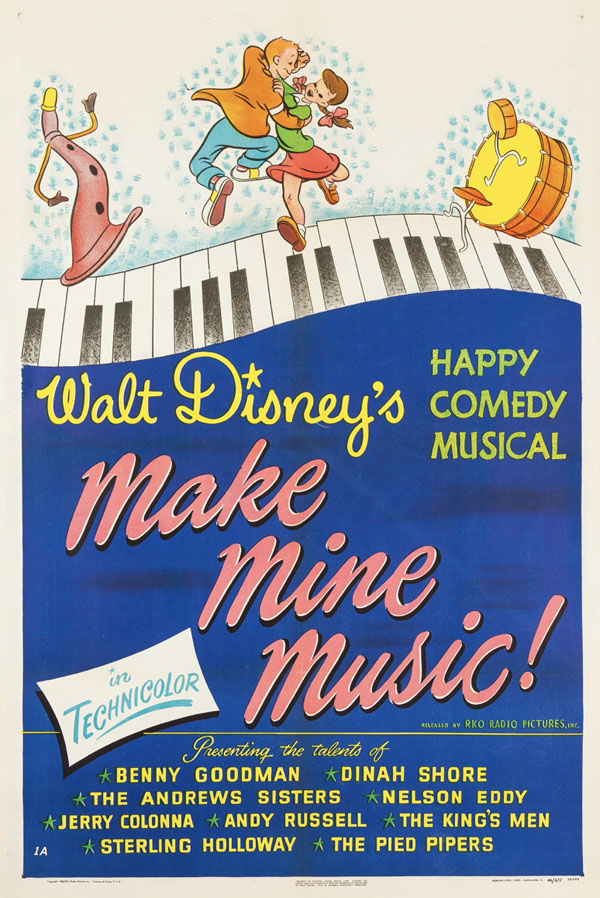
When Make Mine Music opened in 1946, The New York Post called it “…a veritable vaudeville show, a three-ring circus, and grand opera thrown together into one technical masterpiece.”

It may be the best description for this film made during a difficult time for Walt Disney and his Studio. Between an animators’ strike, and America’s involvement in World War II, production at the Studio had been a challenge during most of the 1940s.

Walt kept animation production going during this period by producing lower-budgeted, easy-to-execute films, known as “package films,” which didn’t have a traditional plot but instead were a series of short subjects strung together during a feature-length running time.

One of these was Make Mine Music, with a common theme among the segments being that each was set to a particular piece of music. As each is so vastly different, the Post’s description of the film is appropriate.

The film plays with the Fantasia formula, opening like a concert complete with a program that reads: “Make Mine Music: A Musical Fantasy.”

From here, the film segues to the first section of the film, “The Martins and the Coys” (billed on the program as “A Rustic Ballad”), narrated by the singing group The King’s Men, as it tells the musical tale of two feuding mountain families.

After this, the Ken Darby Chorus performs the title song, “Blue Bayou.” The slow-paced music features accompanying visuals of a nighttime bayou as a bird takes flight, in a sequence that reuses animation intended for a sequel to 1940’s Fantasia, originally intended to accompany the musical composition “Clair de lune.”

Next up is Benny Goodman and his Orchestra with “All the Cats Join in.” Two “hepcat bobbysoxer” teens of the decade dance to the upbeat music as they get ready for a date, with animation introduced by a pencil that draws images that come to life.

Singer Andy Russell performs the next segment, “Without You,” a ballad, with sad, surreal images that transition into views of lonely woods and nighttime stars.

The following segment is one of the film’s most famous, “Casey at the Bat,” narrated as a “Musical Recital” by comedian Jerry Colonna, in his over-the-top style, as a re-telling of the “baseball poem” by author Ernest Thayer about the Mudville team and their star player. This segment was released later in 1946 as a stand-alone short subject and even spawned a sequel with Casey Bats Again, in 1954.

Singer Dinah Shore sings “Two Silhouettes,” the next segment, a “Ballade Ballet” featuring two ballet dancers in rotoscoped silhouette animation, performing in front of a stylized backdrop and assisted by two cherubic figures.

Next is arguably the most popular segment, “Peter and the Wolf,” narrated by the familiar, comforting voice of Disney stalwart Sterling Holloway, from the famous musical composition by conductor Sergei Prokofiev. This segment (sans narration) was also created to be an additional component to Disney’s Fantasia.

Set in Russia, the segment tells the tale of young Peter and his friends Sascha, a bird, Sonia the duck, and Ivan the cat, who venture off into the woods to hunt a wolf. A different musical instrument represents each character, with a distinct theme.

“Peter and the Wolf” was such a substantial segment that it has been shown on its own several times and even released as a record album (paired with “The Sorcerer’s Apprentice” on the flip side).

“Peter and the Wolf” is followed by another Benny Goodman number, “Since You’ve Been Gone,” which provides the backdrop for a march of anthropomorphized musical instruments.

The Andrews Sisters then perform the musical narration for “Johnny Fedora and Alice Blue Bonnet,” a sweet story of two hats who fall in love after meeting in a department store window.

The concluding segment is baritone singer Nelson Eddy and the story of “The Whale Who Wanted to Sing at the Met,” about a whale named Willie with incredible operatic talents and dreams. He is hunted by a music conductor who believes that the whale has swallowed an opera singer.

Although it contains a sad ending, this segment includes beautiful, lush animation, particularly where Willie sings as Pagliacci the Clown, and full opportunity is taken for sight gags involving the size and scale of Willie.

Directed by Jack Kinney, Clyde Geronimi, Hamilton Luske, Joshua Meador, and Robert Cormack, Make Mine Music features animation by Disney Legends Ward Kimball, Ollie Johnston, and Eric Larson, among others.

The artists balance the different styles. There’s the entertaining, overly caricatured design of “Casey,” with the main character’s jut-jaw, and a player who touches the base with his giant handlebar mustache. This is offset by scenes with such images in “Without You,” which play out like rain cascading down a window.

Make Mine Music has been shown on The Disney Channel and released on home video in 2000 (with “The Martins and the Coys” removed due to violence and gunplay concerns), and on Blu-ray in 2021, but as of this writing, the film is still not available on Disney+ (although it is available on Amazon Prime).

Make Mine Music had its premiere in New York City on April 20, 1946, and went into general release on August 15. As the film now celebrates 80 years, it’s the perfect time to revisit this “vaudeville show, three-ring circus, and grand opera” from a unique era in Disney history.

For more about the music of Make Mine Music, check out Greg Ehrbar’s 2016 article.
  • ✇Cartoon Research
  • The 25th Anniversary of “Atlantis: The Lost Empire” Michael Lyons
    In the forward to the book Atlantis, the Lost Empire: The Illustrated Script, the filmmakers write, “There was a kind of film that we all loved when we were growing up: the action-adventure movie. It was a genre that Walt Disney popularized in the 1950s with movies such as 20,000 Leagues Under the Sea, Swiss Family Robinson, and In Search Of The Castaways. Later, Steven Spielberg and George Lucas invigorated the genre with Raiders of the Lost Ark. We loved these movies. We loved far-off places
     

The 25th Anniversary of “Atlantis: The Lost Empire”

29 May 2026 at 07:01

In the forward to the book Atlantis, the Lost Empire: The Illustrated Script, the filmmakers write, “There was a kind of film that we all loved when we were growing up: the action-adventure movie. It was a genre that Walt Disney popularized in the 1950s with movies such as 20,000 Leagues Under the Sea, Swiss Family Robinson, and In Search Of The Castaways. Later, Steven Spielberg and George Lucas invigorated the genre with Raiders of the Lost Ark. We loved these movies. We loved far-off places, expert explorers, perilous navigation, and romantic ruins. We loved Adventureland at Disneyland, and we wanted to go there again… this time on the movie screen.”

Inspired by the wonder in these films and Disney attractions, producer Don Hahn and co-directors Kirk Wise and Gary Trousdale set out to make Atlantis: The Lost Empire.

Atlantis, which celebrates its twenty-fifth anniversary this summer, marked a distinct shift for Disney, moving from musical fairy tales and fables to an action-adventure format. The film’s intention was to explore new creative ground while honoring the spirit of classic adventure stories.

The filmmakers initially considered adapting Jules Verne’s Journey to the Center of the Earth. However, a quote from Plato emerged during early production: “…in a single day and night of misfortune, the island of Atlantis disappeared into the depths of the sea.”

This quote appears on a title card at the opening of Atlantis: The Lost Empire. Set in 1914, the story centers on Milo Thatch (voiced by Michael J. Fox), a linguist at the Smithsonian Institution who is obsessed with the lost city of Atlantis.

Eccentric millionaire Preston Whitmore (John Mahoney of TV’s Frasier) assembles a team to search for Atlantis, inviting Milo to join the expedition. Led by Commander Rourke (James Garner), the crew includes lieutenant Helga Sinclair (Claudia Christian), demolition expert Vinny Santorini (comedian Don Novello, SNL’s “Father Guido Sarducci”), Dr. Sweet (Phil Morris), mechanic Audrey Ramirez (Jacqueline Obradors), radio operator Mrs. Packard (Florence Stanley), geologist Gaetan “Mole” Molière (Corey Burton), and their cook “Cookie” (Jim Varney in his last screen role).

On their journey, the crew discovers Atlantis, ruled by the King (Leonard Nimoy) and Princess Kida (Cree Summer). When an expedition member double-crosses the crew, they unite to save Atlantis.

To bring Atlantis: The Lost Empire to the screen, Disney artists adapted the style of comic book artist Mike Mignola, creator of the popular Hellboy, and the artist was brought in as one of the film’s production designers.

The filmmakers also hired linguist Mark Okrand (who had created Star Trek’s Klingon language) to craft an Atlantean language for the denizens of the lost city.

Co-directors Wise and Trousdale stage several impressive, dizzying action sequences in Atlantis. The crew’s submarine Leviathan, attacked by Atlantean vessels, is a striking underwater set-piece, and the film’s finale, where Milo and the others commandeer Atlantean flying ships, is a compelling dogfight.

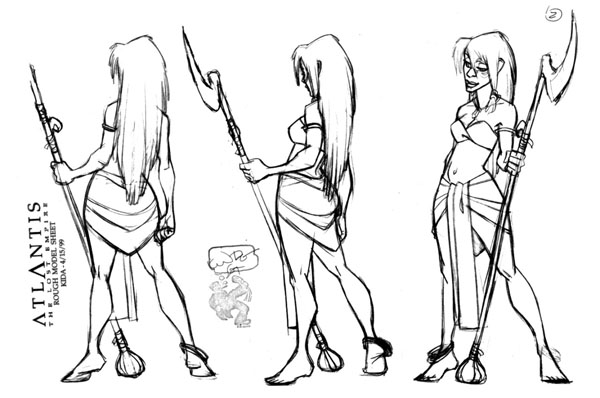
There is also noteworthy character animation throughout, as the animators craft a distinct crew. John Pomeroy, who supervised Milo and Randy Haycock animating Kida, brought impressive acting and heart to their work as the two characters discover each other and their worlds throughout the film. There is subtle comic timing to Vinny from Russ Edmonds, and Mike Surrey crafts Rourke as a captivating, enigmatic figure.

Atlantis: The Lost Empire opened on June 15, 2001, receiving a lukewarm welcome from critics and audiences. Since its release, Atlantis has cultivated a following among Disney, animation, and science fiction fans who feel it has been unfairly overlooked, in the twenty-five years since its release.

These fans share sentiments similar to film critic Roger Ebert’s rave review upon the film’s premiere. He wrote: “The story of Atlantis is rousing in an old pulp science fiction sort of way, but the climactic scene transcends the rest and stands by itself as one of the great animated action sequences. Will the movie signal a new direction from Disney animation? I doubt it. The synergy of animated musical comedies is too attractive, not only for entertainment value but also for the way they spin off hit songs and stage shows. What Atlantis does show is a willingness to experiment with the anime tradition–maybe to appeal to teenage action fans who might otherwise avoid an animated film. It’s like 20,000 Leagues Under the Sea set free by animation to look the way it dreamed of looking.”

  • ✇Cartoon Research
  • The 30th Anniversary of “James and the Giant Peach” Michael Lyons
    One sheet poster designed by Lane SmithWhen James and the Giant Peach came out, Henry Selick was already an animation veteran. Not only had he directed Tim Burton’s The Nightmare Before Christmas, which was released just three years prior, but he had been working in the industry since the late 70s. Selick had been part of Disney’s staff, animating on films such as The Fox and the Hound, but it was stop-motion animation that he eventually fell in love with. Selick’s dedication to stop-motion ext
     

The 30th Anniversary of “James and the Giant Peach”

10 April 2026 at 07:01

One sheet poster designed by Lane Smith

When James and the Giant Peach came out, Henry Selick was already an animation veteran. Not only had he directed Tim Burton’s The Nightmare Before Christmas, which was released just three years prior, but he had been working in the industry since the late 70s. Selick had been part of Disney’s staff, animating on films such as The Fox and the Hound, but it was stop-motion animation that he eventually fell in love with.

Selick’s dedication to stop-motion extended well beyond James and the Giant Peach. After the film, he went on to direct the live-action/animated Monkeybone in 2001, the Oscar-nominated Coraline in 2006, and 2022’s Wendell and Wild, continuing his journey in this unique animation style.

“It’s something I grew into. I always enjoyed the stop motion [Ray] Harryhausen films,” said Selick in a 1996 interview, reflecting on his career. “When I was a kid, I saw a lot of European puppet films, cut-out films. When I got into animation, I was going to art school already. So, I was experimenting with cut-out photos, and I even did these sorts of life-size figures that were hinged before I got into animation. I made new ones, animated them, and had them moving and talking. I went from 2D animation into 3D, and it’s sort of hard to go back.”

This dedication is evident in James and the Giant Peach, a film celebrating its 30th anniversary this spring, where Selick’s passion for the arduous and beautiful art of stop-motion truly shines.

When it was released on April 12, 1996, filmmakers were looking toward the ever-emerging technology of computer-generated imagery—Toy Story had just been released five months earlier. Despite this industry’s focus on computer graphics, Selick remained very comfortable in his stop-motion lane.

“Even in this day of super-impressive computer effects, which are only going to get more impressive over time, stop-motion still has this hold on my imagination,” said Selick in ‘96, adding, “I feel like I’m further and further out on a limb in the land of stop-motion, but the last thing I’m going to do is throw in the towel and try to compete, head-to-head, with everyone else in computers.”

Based on a book by author Roald Dahl, most famous for Charlie and the Chocolate Factory, the tale features the author’s trademark macabre story elements. “I come from this really strong visual background, so I was in love with the visual possibilities,” said Selick in 1996. “I really like the sort of flavor of Roald Dahl‘s books. There’s some pretty twisted, dark things set off against imaginative, heroic children.”

The film James and the Giant Peach opens in live-action, telling the story of young James Henry Trotter (Paul Terry), a lonely orphan living with his wicked aunts, Spiker and Sponge (Joanna Lumley and Miriam Margolyes, respectively).

A mysterious man (Pete Postlethwaite) gives James a bag of glowing green seeds, which he drops near an old peach tree outside his aunts’ house. The next day, a peach appears on the tree and keeps growing. The aunts begin charging the public admission to see it while forbidding James from going near the peach.

James sneaks away one night and enters a tunnel in the giant peach (the film then transitions to stop-motion animation). Once inside, James meets a group of large insects, who soon set the peach rolling out to sea, and he joins them on a magical journey to New York City, a place he has always dreamed of seeing.

The insect characters feature an impressive all-star voice cast. Susan Sarandon is Miss Spider, Richard Dreyfuss is the gruff Centipede, Simon Callow (Four Weddings and a Funeral) is Grasshopper, Jane Leeves (Daphne on TV’s Frasier) is Lady Bug, Margolyes as Mrs. Glowworm, and David Thewlis, is the voice of the Earthworm. “He did a remarkable job of this basic coward who’s blind and always imagines things being worse than they really are,” said the director of Thewlis, adding, “He did this amped-up performance, a quivering voice that really fueled the animation.”

There’s another character in James and the Giant Peach that audiences will immediately recognize. In one sequence, James and the insects run across an army of skeletal pirates. Look closely at the pirates, and you’ll notice a cameo that Lane Smith, the film’s character designer, snuck into the movie. “Lane kept putting in this tall, skinny guy against these other shapes,” remembered Selick in ‘96. “I finally said, ‘Well, he keeps looking like Jack Skellington, let’s just put him in the movie.”

Jack Skellington’s tale of The Nightmare Before Christmas is a film that, although not a success during its initial run, has generated a following that few films have. Sadly, this was originally not the case with James and the Giant Peach.

Despite not achieving box-office success initially, the film has since gained a following, helped by home video and its availability on Disney+.

Thirty years later, what audiences appreciate about James and the Giant Peach is reflected in the original review of The New York Times’ film critic Janet Maslin, who wrote: “Together, this prodigiously clever group has come up with expert animated effects and some boldly beautiful sights unlike anything else on screen…”

❌
Subscriptions