Normal view

  • ✇Cartoon Research
  • The 80th Anniversary of Make Mine Music Michael Lyons
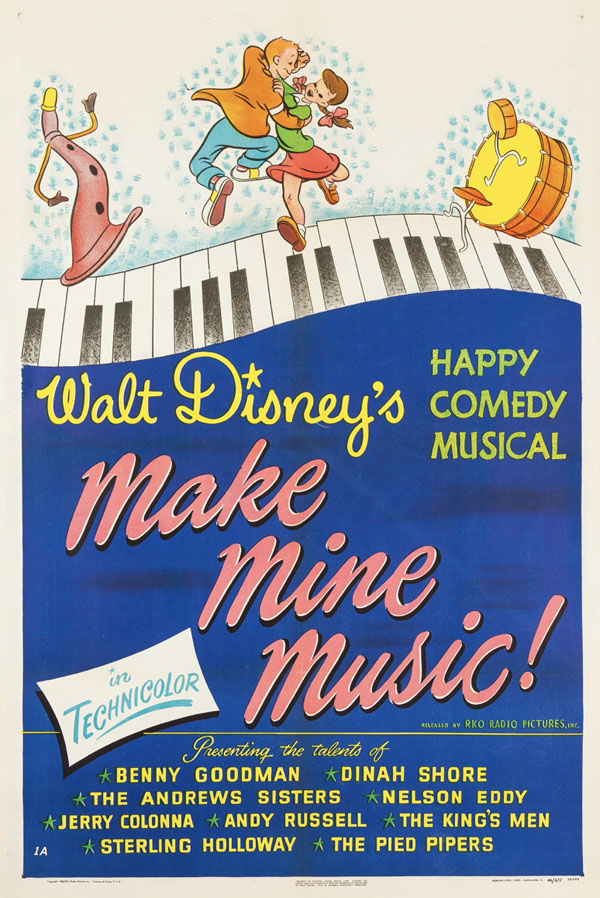
    When Make Mine Music opened in 1946, The New York Post called it “…a veritable vaudeville show, a three-ring circus, and grand opera thrown together into one technical masterpiece.” It may be the best description for this film made during a difficult time for Walt Disney and his Studio. Between an animators’ strike, and America’s involvement in World War II, production at the Studio had been a challenge during most of the 1940s. Walt kept animation production going during this period by producin
     

The 80th Anniversary of Make Mine Music
24 April 2026 at 07:01

When Make Mine Music opened in 1946, The New York Post called it “…a veritable vaudeville show, a three-ring circus, and grand opera thrown together into one technical masterpiece.”

It may be the best description for this film made during a difficult time for Walt Disney and his Studio. Between an animators’ strike, and America’s involvement in World War II, production at the Studio had been a challenge during most of the 1940s.

Walt kept animation production going during this period by producing lower-budgeted, easy-to-execute films, known as “package films,” which didn’t have a traditional plot but instead were a series of short subjects strung together during a feature-length running time.

One of these was Make Mine Music, with a common theme among the segments being that each was set to a particular piece of music. As each is so vastly different, the Post’s description of the film is appropriate.

The film plays with the Fantasia formula, opening like a concert complete with a program that reads: “Make Mine Music: A Musical Fantasy.”

From here, the film segues to the first section of the film, “The Martins and the Coys” (billed on the program as “A Rustic Ballad”), narrated by the singing group The King’s Men, as it tells the musical tale of two feuding mountain families.

After this, the Ken Darby Chorus performs the title song, “Blue Bayou.” The slow-paced music features accompanying visuals of a nighttime bayou as a bird takes flight, in a sequence that reuses animation intended for a sequel to 1940’s Fantasia, originally intended to accompany the musical composition “Clair de lune.”

Next up is Benny Goodman and his Orchestra with “All the Cats Join in.” Two “hepcat bobbysoxer” teens of the decade dance to the upbeat music as they get ready for a date, with animation introduced by a pencil that draws images that come to life.

Singer Andy Russell performs the next segment, “Without You,” a ballad, with sad, surreal images that transition into views of lonely woods and nighttime stars.

The following segment is one of the film’s most famous, “Casey at the Bat,” narrated as a “Musical Recital” by comedian Jerry Colonna, in his over-the-top style, as a re-telling of the “baseball poem” by author Ernest Thayer about the Mudville team and their star player. This segment was released later in 1946 as a stand-alone short subject and even spawned a sequel with Casey Bats Again, in 1954.

Singer Dinah Shore sings “Two Silhouettes,” the next segment, a “Ballade Ballet” featuring two ballet dancers in rotoscoped silhouette animation, performing in front of a stylized backdrop and assisted by two cherubic figures.

Next is arguably the most popular segment, “Peter and the Wolf,” narrated by the familiar, comforting voice of Disney stalwart Sterling Holloway, from the famous musical composition by conductor Sergei Prokofiev. This segment (sans narration) was also created to be an additional component to Disney’s Fantasia.

Set in Russia, the segment tells the tale of young Peter and his friends Sascha, a bird, Sonia the duck, and Ivan the cat, who venture off into the woods to hunt a wolf. A different musical instrument represents each character, with a distinct theme.

“Peter and the Wolf” was such a substantial segment that it has been shown on its own several times and even released as a record album (paired with “The Sorcerer’s Apprentice” on the flip side).

“Peter and the Wolf” is followed by another Benny Goodman number, “Since You’ve Been Gone,” which provides the backdrop for a march of anthropomorphized musical instruments.

The Andrews Sisters then perform the musical narration for “Johnny Fedora and Alice Blue Bonnet,” a sweet story of two hats who fall in love after meeting in a department store window.

The concluding segment is baritone singer Nelson Eddy and the story of “The Whale Who Wanted to Sing at the Met,” about a whale named Willie with incredible operatic talents and dreams. He is hunted by a music conductor who believes that the whale has swallowed an opera singer.

Although it contains a sad ending, this segment includes beautiful, lush animation, particularly where Willie sings as Pagliacci the Clown, and full opportunity is taken for sight gags involving the size and scale of Willie.

Directed by Jack Kinney, Clyde Geronimi, Hamilton Luske, Joshua Meador, and Robert Cormack, Make Mine Music features animation by Disney Legends Ward Kimball, Ollie Johnston, and Eric Larson, among others.

The artists balance the different styles. There’s the entertaining, overly caricatured design of “Casey,” with the main character’s jut-jaw, and a player who touches the base with his giant handlebar mustache. This is offset by scenes with such images in “Without You,” which play out like rain cascading down a window.

Make Mine Music has been shown on The Disney Channel and released on home video in 2000 (with “The Martins and the Coys” removed due to violence and gunplay concerns), and on Blu-ray in 2021, but as of this writing, the film is still not available on Disney+ (although it is available on Amazon Prime).

Make Mine Music had its premiere in New York City on April 20, 1946, and went into general release on August 15. As the film now celebrates 80 years, it’s the perfect time to revisit this “vaudeville show, three-ring circus, and grand opera” from a unique era in Disney history.

For more about the music of Make Mine Music, check out Greg Ehrbar’s 2016 article.

  • ✇Cartoon Research
  • The 85th Anniversary of Fleischer’s “Raggedy Ann and Raggedy Andy” Michael Lyons
    In 1918, writer and artist Johnny Gruelle wrote a children’s book about a little doll that would become a big deal. It was called Raggedy Ann Stories. A doll was produced and marketed alongside the book. By late 1938, the year Gruelle sadly passed away, 3 million copies of his book had been sold. The popularity of Raggedy Ann and her brother, Raggedy Andy, who was introduced in later books, became a phenomenon. The charm and whimsy of their stories made the characters a natural fit for animation
     

The 85th Anniversary of Fleischer’s “Raggedy Ann and Raggedy Andy”

17 April 2026 at 07:01

In 1918, writer and artist Johnny Gruelle wrote a children’s book about a little doll that would become a big deal. It was called Raggedy Ann Stories. A doll was produced and marketed alongside the book. By late 1938, the year Gruelle sadly passed away, 3 million copies of his book had been sold.

The popularity of Raggedy Ann and her brother, Raggedy Andy, who was introduced in later books, became a phenomenon. The charm and whimsy of their stories made the characters a natural fit for animation.

In 1941, the Fleischer Studio, riding high on the popularity of Betty Boop and Popeye, partnered with Johnny’s son, Worth Gruelle, to bring the characters to life on the screen in the 18-minute, two-reel animated short, Raggedy Ann and Andy, which celebrates its 85th anniversary this spring.

Written by Worth and William Turner, the short opens in a small toy shop with Raggedy Ann and Andy in the window. They are on sale for a dollar for the pair. A little girl runs up to the toy shop with her purse in her hand. She asks the shop owner to buy the girl doll in the window, but he explains they must be sold as a pair and shows their hands stitched together.

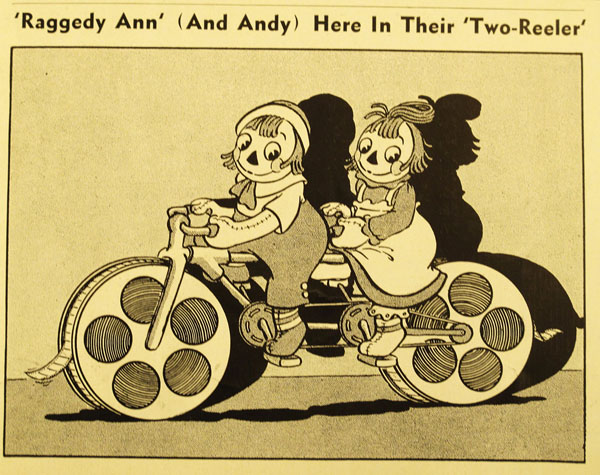
Publicity art promoting the “two-reeler” from the April 11th 1941 issue of Paramount News.

The girl only has fifty cents and asks why they can’t be separated. To answer her, the toy maker then transitions to telling her a story that happened in Ragland a long time ago, moving the narrative from the shop to a fantasy tale.

The audience is then taken to Ragland, where stitched quilts cover the landscape. From there, the story moves on to the Glad Rags Doll Factory. Here the dolls are made. All workers are objects—material, needles, scissors, spools— that are anthropomorphized. They assemble two dolls, a boy and a girl, who will become Raggedy Ann and Andy. The Paintbrush feeds them both candy hearts, and they both come to life.

However, they need their names, and for this, they are sent off to the Castle of Names, where they must arrive before sunset. On the way, they run into the Camel with the Wrinkled Knees, who agrees to give them a lift. They just have to stop off at a filling station where the Camel is filled up with sawdust.

As they continue their journey, Raggedy Andy falls under the spell of a beautiful doll who is singing. He goes off with this beautiful doll, leaving Raggedy Ann heartbroken, and riding off on the Camel with the Wrinkled Knees.

Raggedy Andy and the girl go off to “Glovers Lane,” while Raggedy Ann and the Camel continue to the Castle. Once there, she gets sick and is placed into the King’s infirmary.

Back in Glover’s Lane, Raggedy Andy is asked by the other doll what his name is. He says he doesn’t have one. She notes that he’s a nobody without a name, and he realizes he needs to get to the Castle.

Meanwhile, at the Castle, the hospital’s doctors use a fluoroscope and find that Raggedy Ann’s candy heart is broken. There’s nothing that they can do. Andy arrives at Raggedy Ann’s bedside, with certificates that reveal their names. He sings to her, and she wakes up. To make sure they can never be separated again, the two dolls have their cloth hands stitched together.

Back at the toy shop, the owner explains to the young girl that is why he cannot sell just one doll. However, he agrees to give her both, as the short ends with a happy ending.

Directed by Dave Fleischer and animated by luminaries such as Myron Waldman, Joseph Oriolo, William Henning, and Arnold Gillespie, Raggedy Ann and Andy is brimming with beautiful visuals. Ragland teems with creativity. The quilted hills seem to go on forever, and the street signs look like needles, as giant gloves surround “Glover’s Lane.”

There are also nice, themed, comedic touches, such as a street named “Linen Lane” and a bakery that sells “rag muffins.”

The Fleischer Studio also made great use of their team of talented voice actors. Pinto Colvig is very “Goofy”-esque as the Camel and also brings great charm. Joy Terry voices Raggedy Ann, Bernie Fleischer plays Raggedy Andy, and Jack Mercer, the voice of Popeye at the time, handles several characters, including the Paintbrush who brings the dolls to life.

Additionally, the musical arrangements by Sammy Timberg, with lyrics by Al Neiburg and Dave Fleischer, provide entertaining songs. These include “You’re Nobody Without a Name,” sung to the dolls in the factory, and “Raggedy Ann, I Love You,” which Andy sings to her toward the end.

The whole short comes together so well, in fact, that it makes one wish that the Studio had done more with Gruelle’s now iconic characters. (Paramount’s Famous Studios did create two more Raggedy Ann shorts as part of their Noveltoons series in the later 1940s)

Leonard Maltin noted this in his seminal book, Of Mice and Magic: A History of American Animated Cartoons. He wrote, “It’s a shame that the Fleischers didn’t select this property for feature-length treatment. The ingredients are all there, including the imaginative setting of Ragland, with its echoes of Oz, and more possibilities than either Lilliput or Bugtown (in the studio’s subsequent feature Mr. Bug Goes to Town) ever offered.”

Wanting more than its eighteen minutes is just one reason why, looking back eighty-five years later at Raggedy Ann and Andy, it stands as a very well-crafted, entertaining entry in the Fleischer filmography.

  • ✇Cartoon Research
  • The 30th Anniversary of “James and the Giant Peach” Michael Lyons
    One sheet poster designed by Lane SmithWhen James and the Giant Peach came out, Henry Selick was already an animation veteran. Not only had he directed Tim Burton’s The Nightmare Before Christmas, which was released just three years prior, but he had been working in the industry since the late 70s. Selick had been part of Disney’s staff, animating on films such as The Fox and the Hound, but it was stop-motion animation that he eventually fell in love with. Selick’s dedication to stop-motion ext
     

The 30th Anniversary of “James and the Giant Peach”

10 April 2026 at 07:01

One sheet poster designed by Lane Smith

When James and the Giant Peach came out, Henry Selick was already an animation veteran. Not only had he directed Tim Burton’s The Nightmare Before Christmas, which was released just three years prior, but he had been working in the industry since the late 70s. Selick had been part of Disney’s staff, animating on films such as The Fox and the Hound, but it was stop-motion animation that he eventually fell in love with.

Selick’s dedication to stop-motion extended well beyond James and the Giant Peach. After the film, he went on to direct the live-action/animated Monkeybone in 2001, the Oscar-nominated Coraline in 2006, and 2022’s Wendell and Wild, continuing his journey in this unique animation style.

“It’s something I grew into. I always enjoyed the stop motion [Ray] Harryhausen films,” said Selick in a 1996 interview, reflecting on his career. “When I was a kid, I saw a lot of European puppet films, cut-out films. When I got into animation, I was going to art school already. So, I was experimenting with cut-out photos, and I even did these sorts of life-size figures that were hinged before I got into animation. I made new ones, animated them, and had them moving and talking. I went from 2D animation into 3D, and it’s sort of hard to go back.”

This dedication is evident in James and the Giant Peach, a film celebrating its 30th anniversary this spring, where Selick’s passion for the arduous and beautiful art of stop-motion truly shines.

When it was released on April 12, 1996, filmmakers were looking toward the ever-emerging technology of computer-generated imagery—Toy Story had just been released five months earlier. Despite this industry’s focus on computer graphics, Selick remained very comfortable in his stop-motion lane.

“Even in this day of super-impressive computer effects, which are only going to get more impressive over time, stop-motion still has this hold on my imagination,” said Selick in ‘96, adding, “I feel like I’m further and further out on a limb in the land of stop-motion, but the last thing I’m going to do is throw in the towel and try to compete, head-to-head, with everyone else in computers.”

Based on a book by author Roald Dahl, most famous for Charlie and the Chocolate Factory, the tale features the author’s trademark macabre story elements. “I come from this really strong visual background, so I was in love with the visual possibilities,” said Selick in 1996. “I really like the sort of flavor of Roald Dahl‘s books. There’s some pretty twisted, dark things set off against imaginative, heroic children.”

The film James and the Giant Peach opens in live-action, telling the story of young James Henry Trotter (Paul Terry), a lonely orphan living with his wicked aunts, Spiker and Sponge (Joanna Lumley and Miriam Margolyes, respectively).

A mysterious man (Pete Postlethwaite) gives James a bag of glowing green seeds, which he drops near an old peach tree outside his aunts’ house. The next day, a peach appears on the tree and keeps growing. The aunts begin charging the public admission to see it while forbidding James from going near the peach.

James sneaks away one night and enters a tunnel in the giant peach (the film then transitions to stop-motion animation). Once inside, James meets a group of large insects, who soon set the peach rolling out to sea, and he joins them on a magical journey to New York City, a place he has always dreamed of seeing.

The insect characters feature an impressive all-star voice cast. Susan Sarandon is Miss Spider, Richard Dreyfuss is the gruff Centipede, Simon Callow (Four Weddings and a Funeral) is Grasshopper, Jane Leeves (Daphne on TV’s Frasier) is Lady Bug, Margolyes as Mrs. Glowworm, and David Thewlis, is the voice of the Earthworm. “He did a remarkable job of this basic coward who’s blind and always imagines things being worse than they really are,” said the director of Thewlis, adding, “He did this amped-up performance, a quivering voice that really fueled the animation.”

There’s another character in James and the Giant Peach that audiences will immediately recognize. In one sequence, James and the insects run across an army of skeletal pirates. Look closely at the pirates, and you’ll notice a cameo that Lane Smith, the film’s character designer, snuck into the movie. “Lane kept putting in this tall, skinny guy against these other shapes,” remembered Selick in ‘96. “I finally said, ‘Well, he keeps looking like Jack Skellington, let’s just put him in the movie.”

Jack Skellington’s tale of The Nightmare Before Christmas is a film that, although not a success during its initial run, has generated a following that few films have. Sadly, this was originally not the case with James and the Giant Peach.

Despite not achieving box-office success initially, the film has since gained a following, helped by home video and its availability on Disney+.

Thirty years later, what audiences appreciate about James and the Giant Peach is reflected in the original review of The New York Times’ film critic Janet Maslin, who wrote: “Together, this prodigiously clever group has come up with expert animated effects and some boldly beautiful sights unlike anything else on screen…”

Received — 3 April 2026 Comics Cartoons
  • ✇Cartoon Research
  • The 55th Anniversary of Rankin/Bass “Here Comes Peter Cottontail” Michael Lyons
    Turning holiday songs into origin stories is something that Rankin/Bass did best. The Studio translated such popular Christmas songs, such as Rudolph the Red-Nosed Reindeer, Frosty the Snowman, and Santa Claus is Comin’ to Town, into equally popular TV specials. With this in mind, Here Comes Peter Cottontail was a natural fit for adaptation. The 1949 song reached Billboard’s Top 10 and became an Easter standard, making it an obvious choice for Rankin/Bass to adapt as a holiday special. While
     

The 55th Anniversary of Rankin/Bass “Here Comes Peter Cottontail”

3 April 2026 at 07:01

Turning holiday songs into origin stories is something that Rankin/Bass did best. The Studio translated such popular Christmas songs, such as Rudolph the Red-Nosed Reindeer, Frosty the Snowman, and Santa Claus is Comin’ to Town, into equally popular TV specials.

With this in mind, Here Comes Peter Cottontail was a natural fit for adaptation.

The 1949 song reached Billboard’s Top 10 and became an Easter standard, making it an obvious choice for Rankin/Bass to adapt as a holiday special.

While it may not have had the stamina of Rankin/Bass’ Christmas specials like Rudolph and Frosty, Here Comes Peter Cottontail, celebrating its 55th anniversary this Easter Season, has developed its own following.

The song “Here Comes Peter Cottontail” was written by Steve Nelson and Jack Rollins (who also gave us “Frosty the Snowman), and released on Decca Records in 1950.

Beyond the popular song, another inspiration for Rankin/Bass’ Here Comes Peter Cottontail was the 1957 children’s book, The Easter Bunny That Overslept by Priscilla and Otto Friedrich. Building on these sources, Rankin/Bass stalwart and writing collaborator Romeo Muller penned the script.

The special, directed by Arthur Rankin, Jr. and Jules Bass, and told in their stop-motion “Animagic” style, is narrated by Seymour S. Sassafrass, voiced by Danny Kaye, a traveling salesman who tells the story of Peter Cottontail. Peter (Casey Kasem) lives in Easter Valley with all the other bunnies. It’s here that all the Easter candy, bonnets, and colored eggs are made.

Colonel Wellington (also voiced by Kaye) is retiring as Easter Bunny and chooses Peter as his successor. Villain January Q. Irontail (Vincent Price)—a black-and-grey rabbit with an iron tail—has other ideas.

He proposes a contest between himself and Peter: whoever can deliver the most Easter eggs will become the Easter Bunny. Irontail cheats by allowing Peter to oversleep, and the villainous rabbit delivers all the eggs himself, and becomes the Easter bunny, making chocolate spiders instead of bunnies, and galoshes instead of bonnets.

A dejected Peter leaves April Valley and meets Sassafrass, who gives him his time-traveling “Yestermorrowbile,” piloted by Antoine the caterpillar (Kaye again). This allows Peter to potentially “win back” Easter by travelling to other holidays and attempting to deliver eggs there.

Peter travels to Mother’s Day, July Fourth, Halloween, Thanksgiving, Christmas, Valentine’s Day, and St. Patrick’s Day. He attempts to deliver eggs on each holiday and regain the title of Easter Bunny.

As narrator for the story, Danny Kaye does excellent work, not just as Sassafrass but also as the Easter Bunny and Antoine. It’s clear from songs like “When You Can’t Get It All Together, Improvise” (one of six written for the special by Jules Bass and Maury Laws) that he was having fun.

This collaboration marked the beginning of a friendship between Kaye and Arthur Rankin.

“Arthur and Danny were kindred spirits. Both liked to travel, eat great food, loved music and art,” said Rick Goldschmidt, official Rankin/Bass historian/biographer and author of such books as The Enchanted World of Rankin/Bass. “They did some traveling together, and Danny even went to the Animagic Studios in Japan to see the animation produced; maybe the only star to do that.”

Building on this partnership, Kaye would go on to work with the Rankin/Bass Studio for what was intended to be a series of specials entitled The Enchanted World of Danny Kaye.

“The first episode was The Emperor’s New Clothes, but the ratings may not have been their best,” noted Rick. “The series may have also been very expensive to produce. Arthur got the author of Mary Poppins, P.L. Travers, to write a script for the series about Jack Frost. Animagic puppets of Punch and Judy were made with a stage set. Jerry Lewis was going to be Punch, with Carol Burnett being Judy. The plan was to re-air previous specials in the series as well.”

Unfortunately, no other specials in the series, beyond 1972’s The Emperor’s New Clothes, ever aired.

The other casting coup in Peter Cottontail was Vincent Price as Irontail. He emerged as one of Rankin/Bass’ more memorable villains. “Arthur and Jules were so happy with his appearance that they were planning to edit the feature film of Mad Monster Party to an hour TV special and have Vincent host it in Animagic form,” said Rick. He added, “This special would have been part of The Enchanted World of Danny Kaye. Ultimately, they opted to do a new special called Mad, Mad, Mad Monsters for the ABC Saturday Superstar Movie.”

Thanks to Animagic, the artists bring to life all that’s colorful about the holiday and the season in Here Comes Peter Cottontail. The special features bunnies carving chocolate rabbits like great sculptors. It also includes vibrant backdrops, such as the scene where Peter meets Seymour Sassafrass. These beautiful environments were a hallmark of Rankin/Bass.

Originally airing on ABC on April 4, 1971, Here Comes Peter Cottontail may not have had the repeat, seasonal airings of other Rankin/Bass specials, but for many, it’s still required viewing each and every spring.

“I think Rankin/Bass hit their peak in 1970 to ‘71 with Santa Claus is Comin’ to Town and Here Comes Peter Cottontail back-to-back,” said Rick. “Both Laws and Bass soundtracks are of Broadway musical quality. The Animagic never looked better, and Romeo Muller hit his story peak as well.” He added, “It showcases what Rankin/Bass will be forever known for! I think it is an amazing example of their work, and there is nothing better to watch for Easter!”

For more on Here Comes Peter Cottontail, check out Greg Ehrbar’s 2021 article.

  • ✇Cartoon Research
  • The 50th Anniversary of Rankin/Bass “The First Easter Rabbit” Michael Lyons
    If you celebrate the 50th anniversary of The First Easter Rabbit this spring, prepare for an “earworm.” The song “There’s That Rabbit” (written by Jules Bass and Maury Laws) will play in your head on repeat. It opens the special from Rankin/Bass, the Studio synonymous with beloved TV Christmas specials. Following in the footsteps of favorites like Rudolph, the Red-Nosed Reindeer and Frosty the Snowman, The First Easter Rabbit, directed by Arthur Rankin, Jr. and Jules Bass, shares many familia
     

The 50th Anniversary of Rankin/Bass “The First Easter Rabbit”

27 March 2026 at 07:01

If you celebrate the 50th anniversary of The First Easter Rabbit this spring, prepare for an “earworm.” The song “There’s That Rabbit” (written by Jules Bass and Maury Laws) will play in your head on repeat. It opens the special from Rankin/Bass, the Studio synonymous with beloved TV Christmas specials.

Following in the footsteps of favorites like Rudolph, the Red-Nosed Reindeer and Frosty the Snowman, The First Easter Rabbit, directed by Arthur Rankin, Jr. and Jules Bass, shares many familiar plot elements. Just as those specials tell the story of how a holiday legend came to be, so too does this one, highlighting the Easter Rabbit. The special features an appropriately themed song, a narrator, and even an appearance by Santa Claus, making it instantly recognizable as a Rankin/Bass production.

Instead of their usual stop-motion “Animagic,” Rankin/Bass uses traditional 2D animation here.

Though telling an Easter story, the special opens at Christmas. The narrator, G.B., a well-dressed rabbit, introduces Stuffy, a stuffed rabbit gifted to a young girl named Glinda. When Glinda contracts Scarlet Fever, her family must destroy her toys to stop the disease’s spread.

Happiness returns as Calliope, a sprite, saves Stuffy, bringing him to life and assigning him a mission: to become the First Easter Rabbit. Stuffy travels to Easter Valley—a North Pole section warmed by the magical Golden Easter Lily—where he meets Santa Claus, who assists him.

Actor Robert Morse

Three other rabbits—Spats, Flops, and Whiskers—help Stuffy reach Easter Valley and assist him there.

Zero, the evil ice wizard, and his sidekick Bruce, a snowball, aim to stop Easter. Zero wants to create a blizzard in Easter Valley and steal the Golden Easter Lily. With his friends and Santa, Stuffy sets out to save Easter.

The main character of Stuffy is voiced by Tony Award-winning Broadway musical veteran Robert Morse. “Robert appeared in three Rankin/Bass TV specials,” said Rick Goldschmidt, official Rankin/Bass historian/biographer and author of such books as The Enchanted World of Rankin/Bass. “Jack Frost is probably his best-known appearance. He was ecstatic to get my 15th-anniversary edition of The Enchanted World of Rankin/Bass, so much so that he called me on Christmas morning. He said the memories of working with Arthur and Jules were great. I think he understood the magic in the specials; that extra something that really can’t be described.”

Don Messick voices Whiskers and Bruce; Stan Freberg plays Flops; Joan Gardner is Calliope; and Paul Frees gives voice to Zero, Spats, and Santa Claus.

The cover of the rare sheet music.

Continuing the tradition of memorable narrators, none other than Burl Ives returns to a Rankin/Bass special to provide the voice of G.B., who guides the audience through the story of The First Easter Rabbit. “I became great friends with Burl’s widow, and she was proud of his work in this as G.B.,” noted Rick. “I also thought it was cool that he returned in the vest, watch, et cetera. – a nod to his appearance as Sam in Rudolph.”

The animation showcases Paul Coker, Jr.’s distinctive design, familiar from the Studio’s other specials like Frosty the Snowman (1969). Coker, a Mad magazine and Hallmark contributor, gave the special a style reminiscent of vintage greeting cards.

In addition to “There’s That Rabbit,” the special also includes “Easter Parade,” the familiar holiday standard by Irving Berlin, which features in the finale and is complemented nicely by springtime color.

The First Easter Rabbit aired on NBC on April 9, 1976. It was written by Julian P. Gardner (a pseudonym for Jules Bass) and based loosely on the popular book, The Velveteen Rabbit by Margery Williams. With their take on the story, Rankin/Bass continues the tradition established by their other holiday specials. Here, they not only provide an “origin story” for another iconic holiday figure, but with “There’s That Rabbit,” they offer an earworm of a song that may linger with you through Mother’s Day.

For more about the music in this special – check Greg Ehrbar’s post about that by Clicking Here! Another Rankin/Bass Easter special celebrates a milestone this year and will be featured next week.

  • ✇Cartoon Research
  • Spring Into Classic Cartoons Michael Lyons
    Spring arrives today. Well, at least according to calendars and meteorologists, it arrives today, March 20, at 10:46 a.m. eastern time. The weather itself may feel different. As temperatures still chill and snow still falls in some areas. A few weeks ago, there was a celebration of winter-themed cartoons as we looked forward to spring. Now that it’s arrived, it’s only fitting that we welcome this very welcome season with some spring-theme classic cartoons: Springtime (1929), Disney This Disney S
     

Spring Into Classic Cartoons

20 March 2026 at 07:01

Spring arrives today. Well, at least according to calendars and meteorologists, it arrives today, March 20, at 10:46 a.m. eastern time.

The weather itself may feel different. As temperatures still chill and snow still falls in some areas. A few weeks ago, there was a celebration of winter-themed cartoons as we looked forward to spring.

Now that it’s arrived, it’s only fitting that we welcome this very welcome season with some spring-theme classic cartoons:

Springtime (1929), Disney

This Disney Silly Symphony, “Drawn by Ub Iwerks,” as the titles inform us, celebrates the colorful season of change in glorious black-and-white.

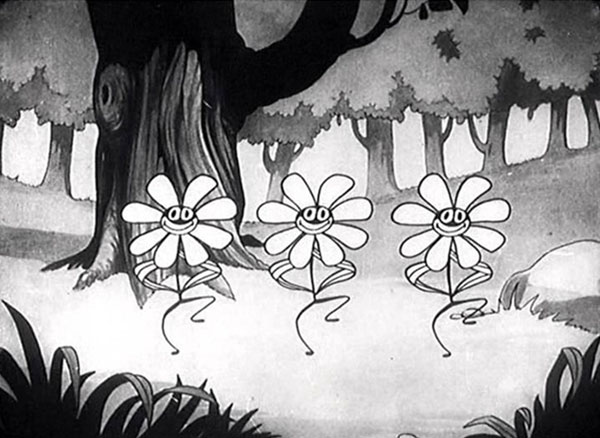
The short opens with the lovely music “Morning Mood” from Edvard Grieg’s Peer Gynt, as three flowers dance, with one flower then coming toward the screen as two ladybugs dance atop its pedals.

We then see a caterpillar dancing through the glen, and it splits into sections, all dancing independently. A crow then comes up behind it and eats each one of the sections.

The crow, wearing his top hat, then dances back to the nest where Mamma is sitting on eggs. The eggs hatch and the little hatchlings get out and immediately start dancing themselves.

A thunderstorm then arrives as lightning threatens a cloud, which tries to duck out of the way of the strikes, but the lightning finally pierces the cloud, and rain comes out of the cloud like a waterfall.

A somewhat bare tree treats the rainfall like a shower, scrubbing its branches like hair, and is then zapped in the rear end by lightning. As the rain stops, two grasshoppers, who have been using mushrooms as umbrellas, come out from underneath and begin dancing around to “Dance of the Hours” by Amilcare Ponchielli.

The two grasshoppers wind up unknowingly jumping into a frog’s mouth, and because they continue to dance, so does the frog. A spider then swings in does its own dance and uses its spider web as a harp.

A group of frogs then continues to dance, but they are tracked by a large water bird. For safety, all the frogs jump inside of each other like nesting eggs and take off, being chased by the bird, who manages to eat all of the frogs, after tossing them in the air. The bird skips through puddles, but the last puddle is deeper, and the bird sinks into the puddle as the cartoon ends.

While it’s typical of this era, with repetitive animation and a series of gags in place of its story, there is very creative animation here, including nice use of perspective and effects (when the frog dances we see its reflection rippling in the water below, which builds to a nice gag where the frog’s reflection seems to do its own dance steps).

Springtime has a vibe that’s as comforting as the season it celebrates.


Porky’s Spring Planting (1938), Warner Bros.

Another black and white entry, this one a sequel to the short, Porky’s Garden (1936), with Porky (Mel Blanc) looking to plant his vegetable garden, with assistance from his laconic dog, Streamline.

Streamline (also Blanc) digs the holes with his tail, and Porky rolls the seeds down the dog’s back to plant the garden. However, the chickens next door are hungry and see the garden as a diner (even hanging out a menu sign that reads: “Corn Beet and Cabbage”).

Porky’s efforts to rid his garden of the chickens are useless. He tries swinging a broom, but each time he does, an additional chicken appears. He eventually sends Streamline after the chickens, but they pummel the poor dog.

It all eventually leads Porky to try to come to some sort of agreement with the chickens and to try to get them to agree to creating one garden for himself and one for them. When he asks them what types of vegetables they want, and he mentions corn, the chickens break into an imitation of comedienne Martha Raye, as they declare, “Ohhh yeaaah!”

Directed by Frank Tashlin, this has his ingenious comedic touches throughout. Streamline’s thoughts come through the soundtrack in voice-over, and when Porky asks for the dog’s help, he mutters, “I’ll be able to sleep all day when I get my Social Security!”

Here, the humor is partnered with full animation and, much like Springtime, plays with perspective in the sequences where Porky plows the garden and nicely timed gags with the chickens, making Porky’s Spring Planting an entertaining entry from the title star’s early days.


Springtime for Thomas (1946), MGM

As this short opens, Jerry emerges from his mousehole (in the mailbox), ready for the day, and attempts to bother Tom by kicking the cat and pulling his hair out, but Tom simply shushes Jerry away.

Jerry looks out the window and sees what has Tom’s attention – Toodles, the female cat next door, lying out on a lounge chair, reading “Har-Puss Bazaar” magazine. Tom is in love, which is evident by the hearts that appear in his eyes and the fact that he kisses Jerry.

Toodles drops her handkerchief, and Tom buzzes over quickly to get it. She then blows a kiss, which flutters through the air and lands on Tom’s lips.

In a classic cartoon trope, a devil version of Jerry appears to the mouse and tells him that he needs to break up that relationship to save his friendship with Tom.

Jerry forges a letter from Toodles and gives it to an Alley Cat, voiced by Frank Graham (who reads it and notes that Toodles has always admired his physique, which he pronounces “fizzy-queue.”

The Alley Cat immediately goes over and breaks in between Tom and Toodles, throws Tom in the pool and immediately starts serenading Toodles with the song, “Quiéreme mucho.”

What follows is back and forth between Tom and the Alley Cat. Tom is thrown into a BBQ pit on a rotisserie, and the Alley Cat crashes into a pool that’s been drained of its water. It ends with Tom being ejected from the premises and meeting up with Jerry again.

The two gleefully start chasing each other, until Jerry encounters a female mouse and begins falling in love, as Tom did, as the cartoon ends.

Directed by William Hanna and Joseph Barbera, Springtime for Thomas is well-crafted, with beautiful visuals and lovely backgrounds by Robert Gentle, especially in the opening scene.

With a team of animators that includes Ed Barge and Kenneth Muse, the gags throughout play out perfectly (after Tom is kissed, his heart goes off like a fire alarm, he jumps in the air and is whacked in the head by a mallet from cupid, as the words “Love” appear in his eyes like a slot machine).

Additionally, the cigar-chomping, gruff Alley Cat is a great, additional rival for Tom. In all, Springtime for Thomas is a classic entry from the Golden Age of this legendary cartoon duo.

Just three of the many Springtime-themed cartoons (mention some of yours in the comments below). Once you’ve watched them, summer can’t be far behind.

❌